

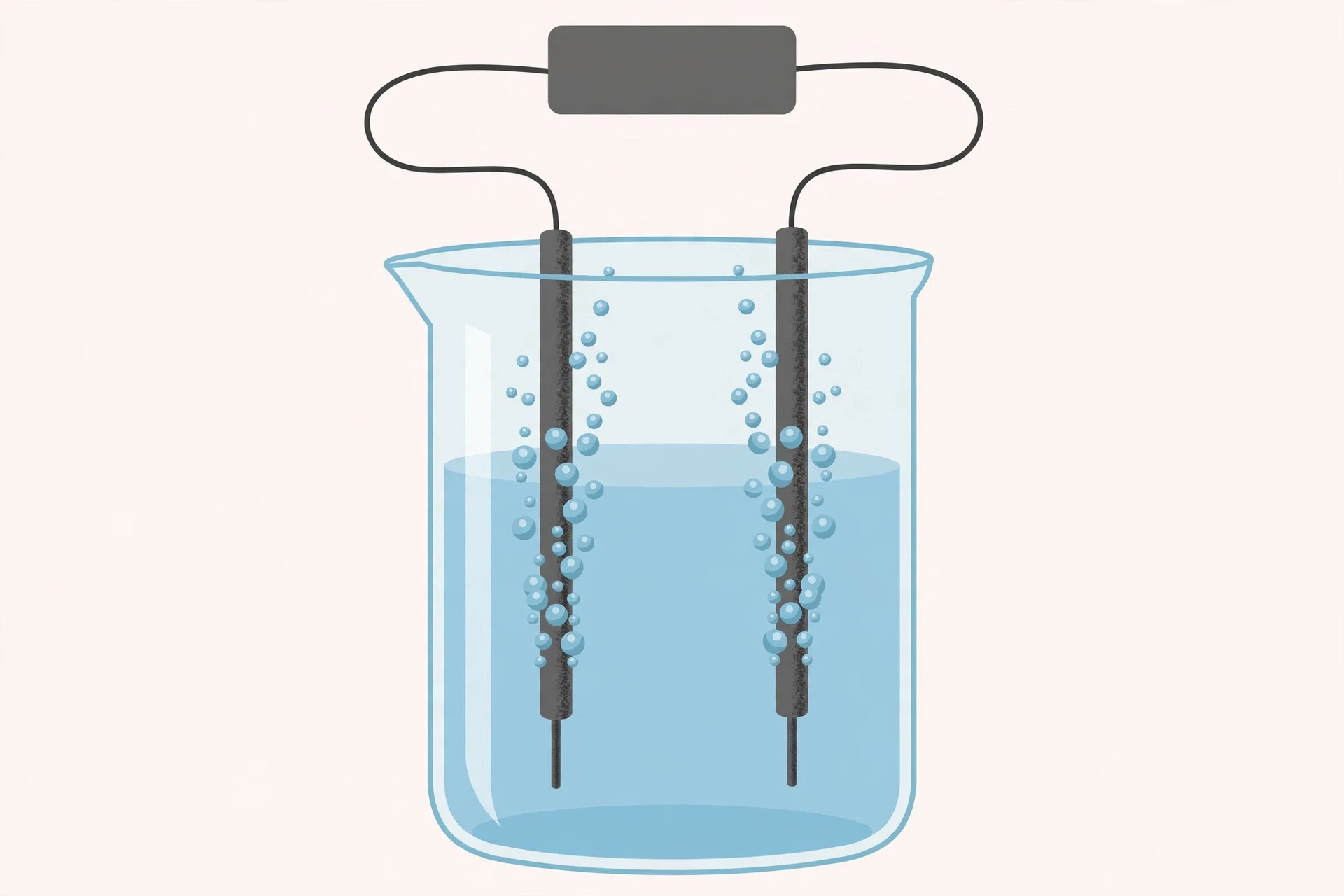
The first time I saw water split apart by electrolysis, I was standing at the back of a school chemistry lab, watching two thin streams of bubbles rise through glass tubes while the rest of the class leaned in closer. The teacher had connected a battery to two metal rods dipped in a beaker of water, and nothing about the setup looked dramatic. There was no flame, no smoke, no bang. Just a quiet fizzing, and two columns of gas collecting above the rods, one of them growing exactly twice as fast as the other. I remember thinking that something had to be wrong with the equipment, because water is famously stable stuff. It puts out fires. It does not fall apart on its own. Yet there it was, coming apart in front of us, driven by nothing more than a current from a battery.
That small, fizzing beaker is the whole subject of this article. Electrolysis is the process of using an electric current to force a chemical change that would not happen on its own. It splits water into hydrogen and oxygen, pulls aluminium out of rock, coats cheap metal with a thin skin of gold, purifies copper, and makes the chlorine that keeps swimming pools clean. It is also one of the most misunderstood ideas in school chemistry, because it looks like the opposite of a battery, and in a sense it is. A battery turns a chemical reaction into electricity. Electrolysis turns electricity into a chemical reaction. Keep that reversal in mind and almost everything else in this article falls into place.
This guide explains electrolysis from the ground up: what it is, what happens inside an electrolytic cell, why pure water refuses to split, how the rules for predicting the products work, how aluminium is extracted from its ore, how electrolysis differs from a galvanic cell, and how Faraday's laws let chemists count the electrons and predict exactly how much product they will get. It also covers the everyday uses, the common mistakes students make, and the environmental cost of running such an energy-hungry process. No prior knowledge is assumed beyond a basic idea of atoms, ions and electric current, and every equation is explained in plain language as it appears.
1. What Is Electrolysis?
Electrolysis is a chemical change driven by passing an electric current through a substance that conducts electricity because it contains free-moving ions. OpenStax Chemistry defines the process the same way: "An external circuit does work on a redox system by imposing a voltage sufficient to drive an otherwise nonspontaneous reaction, a process known as electrolysis."
That substance is called an electrolyte. It can be a molten salt, such as melted sodium chloride, or a solution of an ionic compound in water, such as copper sulfate dissolved in water. The current is supplied by a direct-current power source, usually a battery or a mains-powered supply, and it enters and leaves the electrolyte through two electrodes. The electrode connected to the negative terminal of the power supply is the cathode, and the electrode connected to the positive terminal is the anode.
The definition matters because of one word: driven. In electrolysis, electricity is the input and the chemical change is the output. The reaction that takes place would not happen on its own, or would happen so slowly that it might as well not happen at all. Splitting water into hydrogen and oxygen is a good example. Left alone, water sits there. It does not spontaneously fall apart into its elements, and for good reason: the bonds holding water molecules together are strong, and breaking them takes energy. Electrolysis supplies that energy in the form of moving electrons, and the water molecules give way.
1.1 The electrolytic cell
The apparatus for electrolysis is called an electrolytic cell, and it is deliberately simple. It has four parts, and each one has a job that is easy to remember once you see how they fit together.
The power supply is the engine. It pushes electrons out of its negative terminal and pulls electrons into its positive terminal, creating a flow of charge around the external circuit. Without it, nothing happens. The ions in the electrolyte would drift aimlessly, and no reaction would take place.
The electrolyte is the liquid or molten substance being split. It must contain ions that are free to move. Solid ionic compounds do not conduct electricity, because their ions are locked in a crystal lattice and cannot travel to the electrodes. Melt the solid, or dissolve it in water, and the ions are freed. This is why the first step in any electrolysis is always the same: get the ions moving.
The electrodes are the two conductors, usually metal rods or graphite rods, that dip into the electrolyte and carry the current in and out. They are the surfaces where the chemistry actually happens. Electrons are delivered to the electrolyte at the cathode and collected from it at the anode, and it is at those two surfaces that ions gain or lose electrons and become new substances.
The external circuit is the wiring that connects the power supply to the electrodes. Electrons flow through it from the power supply to the cathode, and from the anode back to the power supply. The circuit is completed through the electrolyte itself, where the charge is carried not by electrons but by moving ions.
I still remember the first time I tried to build an electrolytic cell on my own, away from the teacher's careful setup. I used two nails, a glass of tap water and a small battery, and I waited for bubbles. Almost nothing happened. The problem was that I had used plain water, and plain water is a terrible conductor, for reasons we will come to in Section 3. It was a useful failure, because it taught me that electrolysis is not magic. It is a machine with parts, and if one part is missing or wrong, the machine simply does not run.
1.2 Why electrolysis needs energy
Every chemical reaction has an energy balance. Some reactions release energy and run on their own once started, like burning wood or the reaction inside a battery. Others absorb energy, and they will not run at all unless energy is supplied from outside. The reactions of electrolysis belong to the second group. They are non-spontaneous, which is the chemist's way of saying that the products contain more energy than the starting materials, and that the extra energy has to come from somewhere.
Think of it like pushing a rock uphill. Left alone, the rock rolls downhill, releasing energy as it goes. Pushing it uphill takes work, and the rock stores that work as potential energy. A battery is the rock rolling downhill: a spontaneous chemical reaction releases energy as electricity. Electrolysis is the push uphill: electricity is spent to force a reaction the other way, storing energy in the chemical products. Hydrogen made by splitting water is, in this picture, a rock pushed to the top of the hill. Burn it later, or run it through a fuel cell, and it rolls back down, releasing the energy again.
This is also why electrolysis is expensive in energy terms, and why the question of where the electricity comes from matters so much. Splitting water with electricity from a coal-fired power station is a roundabout way of burning coal. Splitting it with electricity from wind or solar power is a way of bottling sunshine and wind in a gas that can be stored and shipped. The chemistry is identical in both cases. The difference is the energy source, and that difference decides whether electrolysis is a clean technology or just a detour.
Electrolysis is the reverse of a battery. A battery turns a chemical reaction into electricity; electrolysis turns electricity into a chemical reaction. Once you hold that reversal in mind, the rest of the subject follows.
1.3 A short history: Davy and the new metals
Electrolysis is not a new idea. It dates to the early 1800s, when the Italian physicist Alessandro Volta invented the first true battery, the voltaic pile, and suddenly chemists had a steady source of electric current for the first time. The English chemist Humphry Davy saw the opportunity immediately. If electricity could be pushed through a substance, he reasoned, perhaps it could tear compounds apart and reveal elements nobody had ever seen in pure form.
Davy was right, and the results were spectacular. In 1807 he used electrolysis to isolate potassium from molten potash, and then sodium from molten soda. These were metals no one had ever held in their hands before, because they react so violently with water and air that they cannot be won by ordinary chemical means. The next year he isolated calcium, magnesium, strontium and barium the same way. It was one of the great runs of discovery in the history of chemistry, and it was driven entirely by a new tool: the electric current. Davy's work opened a whole family of elements that had been hidden inside their compounds.
The lesson of Davy's work is still the lesson of electrolysis today. Some substances are too stable, too stubborn, to be broken apart by heat or by other chemicals. Electricity can do what chemistry alone cannot, because it delivers electrons directly to the place where they are needed, in exactly the quantity required.
2. The Cast: Electrodes, Electrolyte, and Ions
Every electrolysis has the same cast of characters, and the whole subject becomes much easier once you know who they are and what each one does.
There are two electrodes, an electrolyte full of ions, and a power supply driving the action. The ions are the raw material. The electrodes are the stage. The power supply is the director, telling each ion where to go and what to do when it gets there.
2.1 Anode and cathode: which is which
The two electrodes have names that cause endless confusion, because their signs flip between electrolysis and batteries. In an electrolytic cell, the anode is positive and the cathode is negative. The anode is connected to the positive terminal of the power supply, and the cathode is connected to the negative terminal. That much is simple. The confusion starts when people try to remember which electrode does what, and the answer is best remembered by what happens there, not by the sign.
At the cathode, reduction takes place. Reduction is the gain of electrons, and the cathode is where electrons arrive from the power supply and are handed to positive ions. A positive ion that gains electrons becomes a neutral atom, or a neutral molecule. In the electrolysis of molten sodium chloride, sodium ions gain electrons at the cathode and become sodium metal. The cathode is where metals are usually won, and where hydrogen gas is usually made.
At the anode, oxidation takes place. Oxidation is the loss of electrons, and the anode is where electrons are pulled away from negative ions and sent back to the power supply. A negative ion that loses electrons becomes a neutral atom or molecule. In molten sodium chloride, chloride ions lose electrons at the anode and become chlorine gas. The anode is where gases like chlorine and oxygen are usually made, and where metal electrodes themselves can dissolve if they are made of a reactive metal.
A memory aid used in classrooms around the world is OIL RIG: Oxidation Is Loss, Reduction Is Gain. Another is that the cathode is where cations go, because cations are positive and the cathode is negative, and opposites attract. Use whichever of these sticks in your head. The important thing is the pairing: anode with oxidation, cathode with reduction, in every electrolytic cell, every time. LibreTexts puts it the same way: "The site of oxidation is still the anode and the site of reduction is still the cathode, but the charge on these two electrodes are reversed."
OIL RIG — Oxidation Is Loss, Reduction Is Gain. At the anode, ions lose electrons. At the cathode, ions gain electrons. That single sentence predicts what happens at each electrode in every electrolysis you will ever meet.
2.2 Why ions move
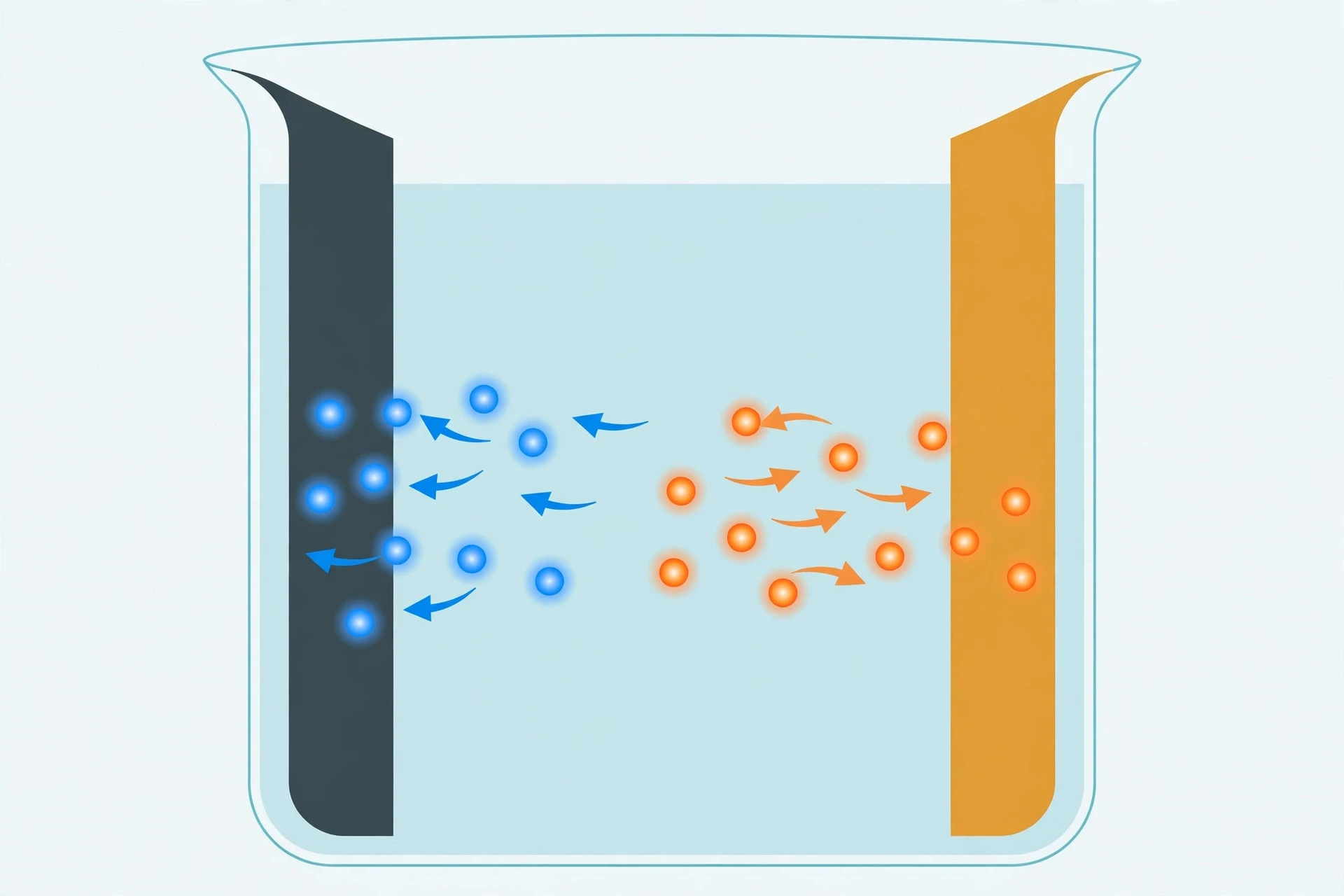
When the power supply is switched on, the electrodes become charged, and the ions in the electrolyte respond the way charged particles always respond to an electric field: they move toward the opposite charge. Positive ions, called cations, drift toward the negatively charged cathode. Negative ions, called anions, drift toward the positively charged anode. This migration is slow and stately compared with the rush of electrons through the wires, but it is the movement that matters, because it delivers each ion to the electrode where it will react.
This is also why the electrolyte must be liquid or molten. In a solid ionic compound, the ions sit in a fixed lattice, each one held in place by the attractions of its neighbours. They can vibrate, but they cannot travel. Melt the compound, and the lattice collapses into a sea of mobile ions. Dissolve it in water, and the water molecules pull the ions apart and surround them, freeing them to move. Either way, the ions gain the freedom they need to reach the electrodes.
There is a common misunderstanding here worth correcting early. People sometimes imagine that the current flows through the electrolyte as a stream of electrons, the way it flows through a wire. It does not. There are no free electrons swimming through a salt solution. The charge is carried through the liquid by the ions themselves, moving in opposite directions: cations toward the cathode, anions toward the anode. Electrons only exist in the external circuit, in the wires and the power supply. At the electrode surfaces, the two worlds meet: an electron jumps from the electrode to an ion, or from an ion to the electrode, and the chemical change happens at that boundary.
2.3 Molten or dissolved: two kinds of electrolyte
Electrolysis can be carried out on two kinds of electrolyte, and the choice changes the products completely. A molten electrolyte is a pure ionic compound that has been heated until it melts. There is nothing in it except the ions of the compound itself, so the products are simple and predictable: the metal forms at the cathode, and the non-metal forms at the anode. Molten sodium chloride gives sodium and chlorine. Molten lead bromide gives lead and bromine. The chemistry is clean, but the conditions are harsh: sodium chloride melts at over 800 degrees Celsius, so molten electrolysis needs furnaces, insulation, and materials that can survive the heat.
An aqueous electrolyte is an ionic compound dissolved in water. This is far more convenient, because it works at room temperature, but it is also more complicated, because the water itself can take part in the reaction. Water contains hydrogen ions and hydroxide ions, and those ions compete with the ions of the dissolved compound for the attention of the electrodes. Sometimes the dissolved compound wins, and sometimes the water wins, and the outcome depends on the concentrations and on how easily each ion gains or loses electrons. Section 4 works through the rules for predicting which ion wins, because those rules are the heart of practical electrolysis.
The trade-off is a familiar one in chemistry: convenience against control. Molten electrolysis gives pure, predictable products at a high cost in heat. Aqueous electrolysis works at room temperature but brings water into the reaction, and water is an active participant, not a passive spectator. Industry uses both, choosing the method that fits the product: molten electrolysis for aluminium, aqueous electrolysis for chlorine, hydrogen and copper refining.

3. How Electrolysis Splits Water
Water splitting is the most famous electrolysis of all, and the one most students meet first. It is also the one that produces the most confusion, because the experiment looks simple and the explanation has a twist.
The twist is that pure water barely electrolyses at all. What splits in the school experiment is not pure water. It is water with something added to it, and understanding why that addition is needed is the key to understanding the whole process.
3.1 Why pure water will not split
Pure water is an extremely poor conductor of electricity. The reason is that water molecules are almost entirely uncharged. Only a tiny fraction of them, about one in 500 million at room temperature, split into hydrogen ions and hydroxide ions on their own. That means a beaker of pure water contains almost no free ions to carry a current, and almost no ions to react at the electrodes. Connect a battery to two electrodes in pure water and the current is so small that the bubbling is barely visible, if it happens at all.
This is exactly what happened in my own failed experiment with two nails and a glass of tap water. Tap water does contain some dissolved salts, so it conducts a little, but not much, and the few bubbles I saw were the result of those trace ions, not of the water itself splitting in any useful quantity. Distilled water, which has had those salts removed, conducts even less. The lesson is that water needs help before it can be electrolysed, and the help comes in the form of an electrolyte added to the water.
In practice, a small amount of a soluble ionic compound, or a dilute acid or alkali, is added to the water. Sulfuric acid is a common choice in school laboratories, and sodium hydroxide is another. These dissolve to give plenty of free ions, the solution conducts well, and the current flows. The added substance is sometimes called the electrolyte, and it is not consumed in the reaction in the ideal case: it simply carries the current and lets the water do the reacting. In reality, the choice of additive matters, because some additives can take part in the reaction themselves, as Section 4 explains.
3.2 The half-equations
Once the current is flowing, the water molecules react at the two electrodes in two half-equations, one for each electrode. A half-equation shows what happens at a single electrode, and the two half-equations add up to the overall reaction.
At the cathode, the negative electrode, water molecules gain electrons and are reduced to hydrogen gas and hydroxide ions:
2H2O + 2e- → H2 + 2OH-
At the anode, the positive electrode, water molecules lose electrons and are oxidised to oxygen gas and hydrogen ions:
2H2O → O2 + 4H+ + 4e-
To balance the electrons, the cathode reaction must happen twice for every anode reaction, so that four electrons are gained at the cathode for every four lost at the anode. Adding the two half-equations together and cancelling the ions that appear on both sides gives the overall equation:
2H2O → 2H2 + O2
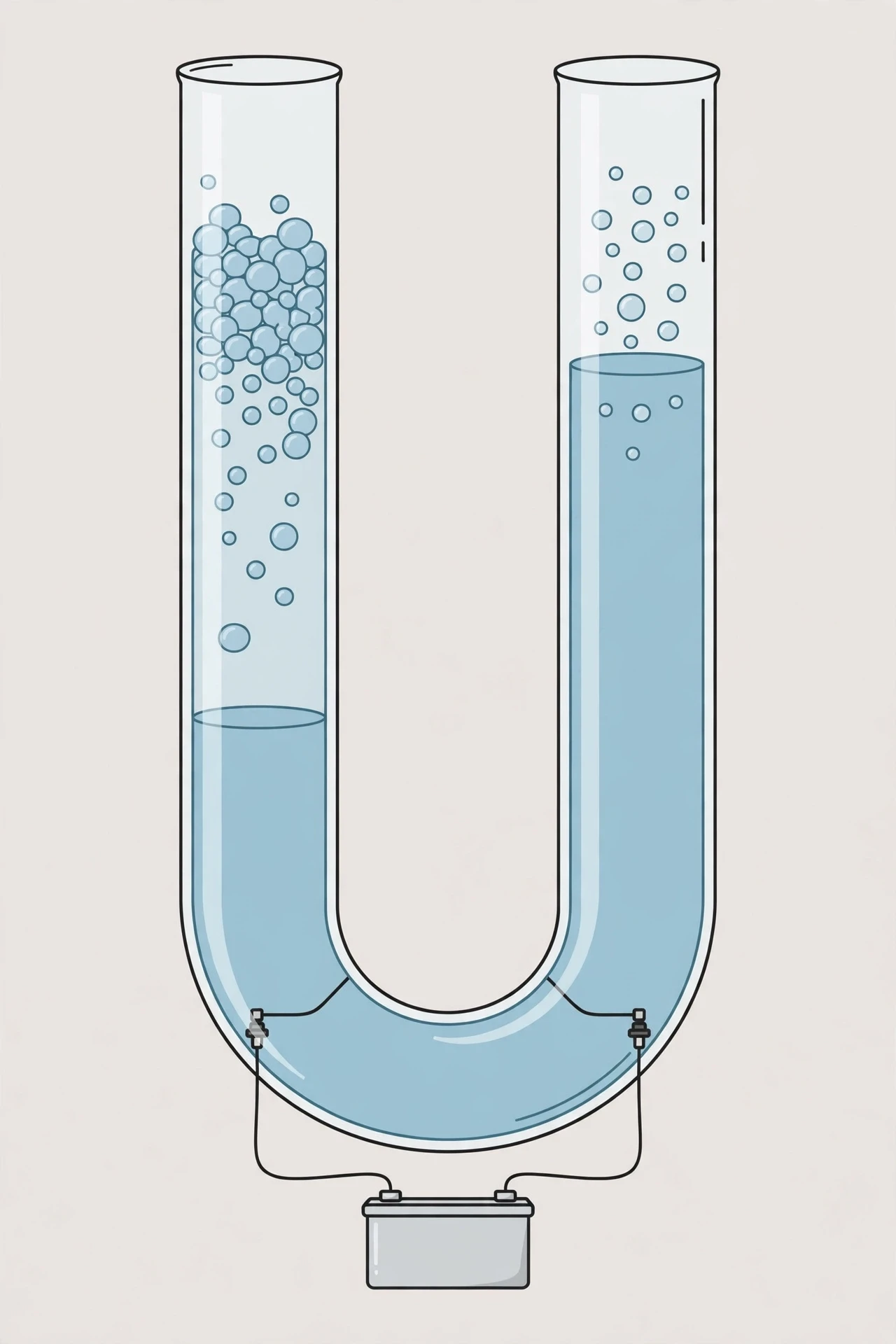
That overall equation is the whole story in one line: two molecules of water split into two molecules of hydrogen and one molecule of oxygen. It also explains the observation from my school lab that started this article. Hydrogen is produced at twice the rate of oxygen, so the column of gas above the cathode grows twice as fast as the column above the anode. The 2:1 ratio is not a coincidence. LibreTexts states it plainly: "The volume of hydrogen gas produced is twice the volume of oxygen gas produced." It is written into the chemistry, and it is one of the most satisfying things in school science to watch it appear, bubble by bubble, exactly as the equation predicts. The OpenStax chemistry textbook covers this electrolysis in its chapter on electrochemistry, with the half-equations and the cell setup laid out clearly.
3.3 The Hofmann voltameter
The classic apparatus for demonstrating water electrolysis is the Hofmann voltameter, named after the German chemist August Wilhelm von Hofmann, who devised it in the 19th century. It consists of a U-shaped glass tube with two upright arms, each topped by a tap, and a reservoir in the middle. Electrodes sit at the bottom of each arm, and the whole apparatus is filled with water containing a little acid or alkali. When the current is switched on, hydrogen collects in the arm above the cathode and oxygen in the arm above the anode, pushing the water level down in each arm. Because the arms are graduated, the volumes can be read directly, and the 2:1 ratio is visible at a glance.
The Hofmann voltameter is a beautiful piece of apparatus because it makes an invisible process visible and measurable. You can watch the two gases accumulate, compare their volumes, test the hydrogen with a lighted splint and hear the small pop that confirms it, and relight a glowing splint in the oxygen to show that it supports combustion. It turns an abstract equation into something you can see, measure and test, which is exactly what good laboratory apparatus should do.
Modern versions of the experiment use simpler equipment: a beaker, two test tubes inverted over the electrodes, and a low-voltage power supply. The principle is identical. The key safety point is that the gases must never be allowed to mix in a confined space and then meet a flame, because a mixture of hydrogen and oxygen is explosive. In a proper setup the gases are collected separately, and the quantities are small. The mixture of the two gases is sometimes called oxyhydrogen, and it is the reason water electrolysis apparatus is always designed to keep the products apart.
3.4 How much energy does it take?
Splitting water takes a minimum voltage of 1.23 volts in theory, which is the voltage that corresponds to the energy needed to break the water molecules apart. In practice, real electrolysers need more, typically around 1.8 to 2 volts per cell, because of resistances in the system and the extra push needed to make the reactions happen at a useful speed. That extra voltage is called overpotential, and it is wasted as heat.
The energy cost is the reason water electrolysis was, for most of its history, a niche technology. It was cheaper to make hydrogen from natural gas, a process called steam reforming, than to split water with electricity. That calculation is changing as renewable electricity gets cheaper and as the demand for hydrogen without carbon emissions grows. The US Department of Energy describes electrolysis as a way to produce hydrogen with low or zero emissions when the electricity comes from renewable sources. The Department defines it simply: "Electrolysis is the process of using electricity to split water into hydrogen and oxygen, and the reaction takes place in an electrolyzer." The chemistry has not changed since Hofmann's day. The economics have.
4. What Forms at Each Electrode
The hardest part of electrolysis, and the part that exam papers love to test, is predicting the products when an aqueous solution is electrolysed. The difficulty is the competition.
In an aqueous solution there are always at least four kinds of ion present: the cation and anion of the dissolved compound, plus hydrogen ions and hydroxide ions from the water itself. At the cathode, the dissolved cation competes with hydrogen ions. At the anode, the dissolved anion competes with hydroxide ions. Only one ion wins at each electrode, and the winner is decided by two factors: how easily the ion gains or loses electrons, and how concentrated it is.
4.1 The rules at the cathode
At the cathode, positive ions compete to gain electrons. The ion that gains electrons most easily wins. In practice, the rule is simple to apply. If the dissolved cation comes from a very reactive metal, such as sodium, potassium, calcium or magnesium, then hydrogen ions from the water win instead, and hydrogen gas is produced. These metals hold on to their electrons so weakly, or rather their ions accept electrons so reluctantly, that it is easier to reduce hydrogen ions than to reduce the metal ions. The metal stays dissolved, and hydrogen bubbles off.
If the dissolved cation comes from a less reactive metal, such as copper, silver or lead, then the metal ion wins, and the metal is deposited on the cathode as a solid coating. Copper sulfate solution gives copper metal at the cathode. Silver nitrate solution gives silver metal. This is the basis of electroplating, which we will return to in Section 8.
Hydrogen sits in the middle of this ranking. Metals more reactive than hydrogen lose the competition to it; metals less reactive than hydrogen win against it. That ranking is the electrochemical series, a list of metals ordered by how easily their ions gain electrons, and it is the single most useful tool for predicting cathode products. Students who learn to read it can predict the outcome of any aqueous electrolysis at the cathode in seconds.
4.2 The rules at the anode
At the anode, negative ions compete to lose electrons. The rules here have a twist, because concentration matters as much as ease of oxidation. In a dilute solution, hydroxide ions from the water usually win, and oxygen gas is produced. In a concentrated solution of a halide, such as concentrated sodium chloride, the halide ions can win instead, and the halogen gas is produced. This is why concentrated brine gives chlorine gas at the anode, while dilute brine gives oxygen.
The reason is that oxidation is a numbers game as well as an energy game. When halide ions are present in large numbers, they crowd the anode surface, and even though hydroxide ions are slightly easier to oxidise, the sheer number of halide ions tips the balance. In a dilute solution, the halide ions are too few to compete, and hydroxide wins. Exam questions test this distinction constantly, and it is worth learning as a pair: dilute halide gives oxygen, concentrated halide gives the halogen.
There is one more case to know. If the anode is made of a reactive metal, such as copper, the anode itself can be oxidised instead of any ion in the solution. The copper atoms of the anode lose electrons and dissolve into the solution as copper ions. This is not a failure of the rules. It is the same rule applied to a new competitor: the copper metal is easier to oxidise than the hydroxide ions, so it wins. This dissolving anode is the key to copper purification, described in Section 8.
4.3 Worked example: the electrolysis of brine
Brine is concentrated sodium chloride solution, and its electrolysis is one of the most important industrial processes in the world. It is worth working through carefully, because it uses every rule in this section at once.
At the cathode, sodium ions compete with hydrogen ions. Sodium is far more reactive than hydrogen, so hydrogen ions win, and hydrogen gas is produced. The sodium ions stay in solution, and the hydroxide ions left behind make the solution alkaline. The liquid that remains is sodium hydroxide solution, one of the most useful chemicals in industry.
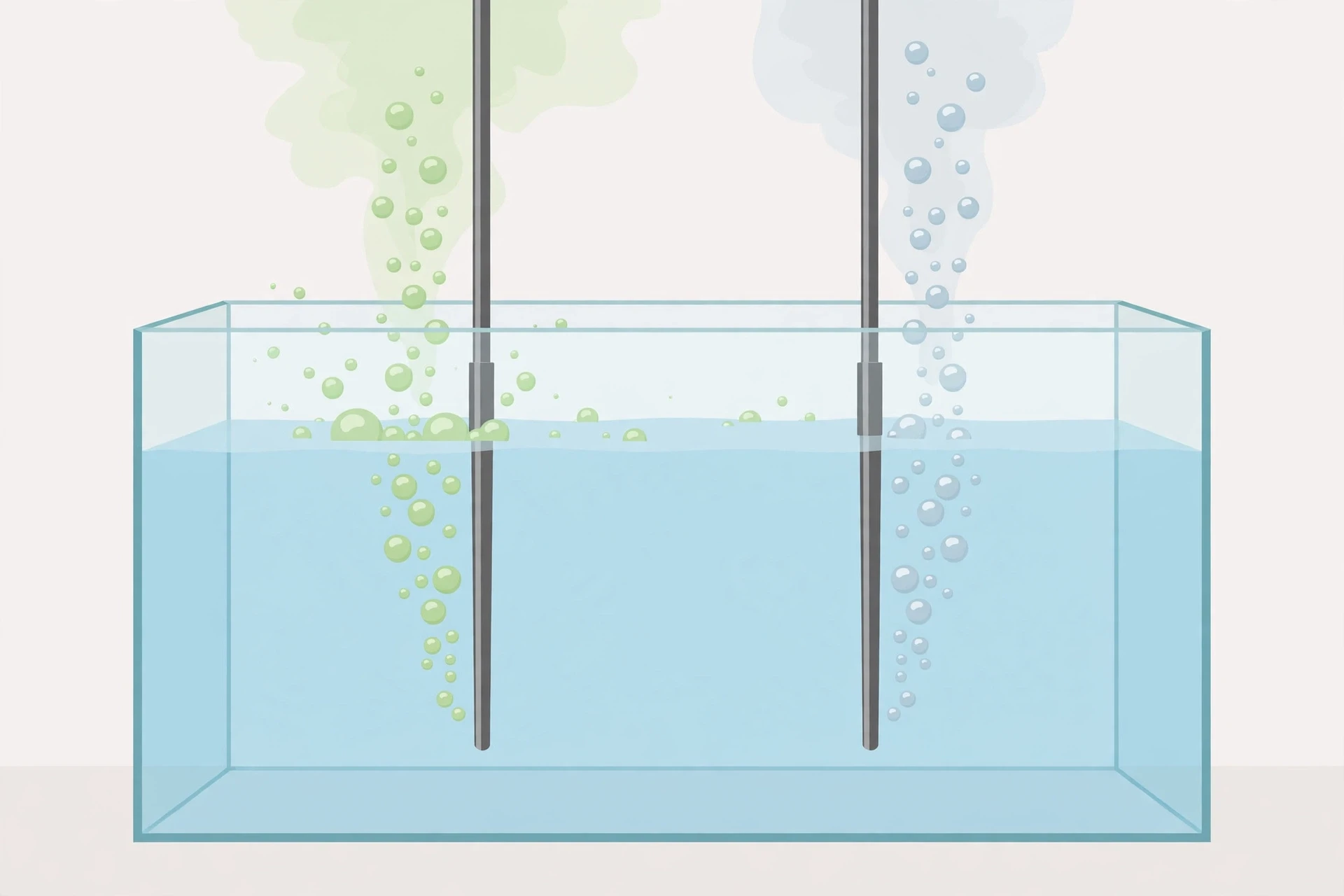
At the anode, chloride ions compete with hydroxide ions. The solution is concentrated, so chloride ions win, and chlorine gas is produced. The overall result is that brine is converted into three products: hydrogen gas, chlorine gas, and sodium hydroxide solution. This is the chlor-alkali process, named for the chlorine and the alkali it produces, and it supplies the raw materials for plastics, paper, soaps, detergents and water treatment. A single electrolysis, run on an enormous scale, feeds a whole branch of the chemical industry.
4.4 Worked example: molten sodium chloride
Molten sodium chloride is the simplest electrolysis of all, because there is no water to compete. The electrolyte contains only sodium ions and chloride ions. At the cathode, sodium ions gain electrons and become sodium metal, which is liquid at the temperature of the molten salt and floats on top of it. At the anode, chloride ions lose electrons and become chlorine gas. The overall equation is 2NaCl → 2Na + Cl2.
This simplicity comes at a price. Sodium chloride melts at over 800 degrees Celsius, so the cell must be heated continuously, and the sodium metal produced is dangerously reactive, bursting into flame on contact with water or air. The industrial version of this process, the Downs cell, mixes the sodium chloride with calcium chloride to lower the melting point, and it collects the sodium under an inert atmosphere.
The products of electrolysis are decided by competition. At the cathode, the ion that gains electrons most easily wins. At the anode, the ion that loses electrons most easily wins — unless concentration tips the balance the other way.
4.5 A table of common products
The table below collects the most common aqueous electrolysis results in one place. It is worth reading across each row and asking, for each solution, which ion won at each electrode and why. The pattern becomes clear quickly: hydrogen appears at the cathode whenever the metal is more reactive than hydrogen, and oxygen appears at the anode whenever the anion is not a concentrated halide.
Solution electrolysed | Product at the cathode | Product at the anode | Why |
|---|---|---|---|
Water with dilute acid | Hydrogen gas | Oxygen gas | Only water ions compete |
Concentrated sodium chloride (brine) | Hydrogen gas | Chlorine gas | Concentrated chloride beats hydroxide |
Dilute sodium chloride | Hydrogen gas | Oxygen gas | Dilute chloride loses to hydroxide |
Copper sulfate solution | Copper metal | Oxygen gas | Copper is less reactive than hydrogen |
Silver nitrate solution | Silver metal | Oxygen gas | Silver is less reactive than hydrogen |
Molten sodium chloride | Sodium metal | Chlorine gas | No water present to compete |
Molten lead bromide | Lead metal | Bromine gas | No water present to compete |
The Royal Society of Chemistry provides a practical classroom guide to the electrolysis of solutions that walks through several of these examples with experimental detail, and it is a useful companion to this table for anyone who wants to see the experiments done properly.
5. How Aluminium Is Extracted
Aluminium is the most abundant metal in the Earth's crust, and it is also one of the hardest to extract. That contradiction is the story of this section.
Aluminium makes up roughly eight percent of the crust by mass, locked inside minerals such as bauxite, yet for most of human history nobody had ever seen the pure metal. The reason is chemical. Aluminium holds on to oxygen with extraordinary strength, and the usual method for extracting metals from their ores, heating them with carbon, does not work on aluminium oxide. Carbon cannot steal the oxygen away. Only electrolysis can.
5.1 Why carbon reduction fails
Most metals are extracted by heating their ore with carbon. Iron ore, for example, is heated with coke in a blast furnace, and the carbon pulls the oxygen away from the iron, leaving the metal behind. This works because iron's grip on oxygen is weaker than carbon's grip on oxygen at high temperature. Aluminium's grip is stronger. No matter how hot the furnace gets, carbon cannot win the tug of war. Aluminium oxide simply sits there, unreduced, mocking the furnace.
This is not a minor technical detail. It is the reason aluminium was once more precious than gold. In the 19th century, before electrolysis was applied to aluminium, the metal was a curiosity for kings: Napoleon III of France is said to have served his most honoured guests on aluminium plates while lesser guests ate off gold. The metal was not rare in the ground. It was rare in usable form, because nobody had found a way to free it from its oxygen.
5.2 The Hall-Héroult process
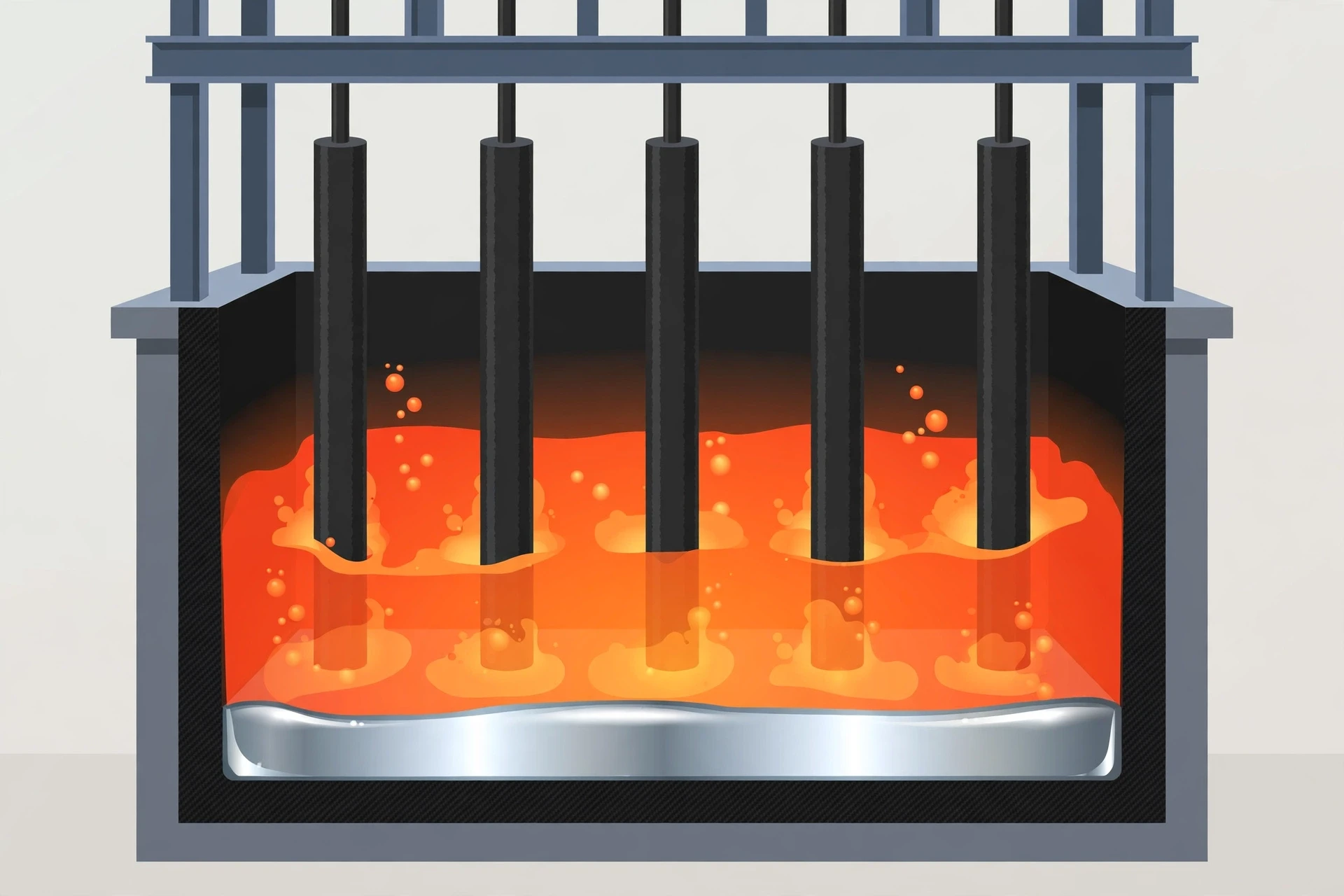
The solution was found in 1886, independently and almost simultaneously, by two young men: Charles Martin Hall in the United States and Paul Héroult in France. Both were in their early twenties. Both discovered that aluminium oxide could be electrolysed if it was first dissolved in molten cryolite, a rare mineral with the formula Na3AlF6. Cryolite melts at a much lower temperature than aluminium oxide, and it dissolves the oxide the way water dissolves salt, giving a liquid full of mobile ions that can be electrolysed at around 950 degrees Celsius instead of over 2,000.
The Hall-Héroult cell is a large steel container lined with carbon, which acts as the cathode. The anode is a block of carbon that hangs down into the molten mixture from above. When the current flows, aluminium ions gain electrons at the cathode and form liquid aluminium metal, which sinks to the bottom of the cell and is tapped off periodically. At the anode, oxide ions lose electrons and form oxygen gas, which immediately reacts with the carbon anode to form carbon dioxide. The anode is consumed in the process and must be replaced regularly, which is one of the ongoing costs of the method.
The overall chemistry can be written simply, even though the real process involves complex ions in the molten mixture. At the cathode: Al3+ + 3e- → Al. At the anode, the oxygen released reacts with carbon: C + 2O2- → CO2 + 4e-. The net result is that aluminium oxide is split into aluminium metal and carbon dioxide, with the carbon anode acting as a sacrificial partner.
5.3 The energy bill
Aluminium extraction is one of the most energy-hungry industrial processes on Earth. Producing a single tonne of aluminium takes roughly 13 to 15 megawatt-hours of electricity, which is about as much electricity as an average household uses in more than a year. That is why aluminium smelters are built next to cheap, abundant power: hydroelectric dams in Canada, Iceland and Norway, and geothermal plants in Iceland. The location of an aluminium smelter is decided less by where the bauxite is and more by where the electricity is cheap.
The energy bill is also the reason aluminium recycling matters so much. Melting down a used aluminium can and recasting it takes only about five percent of the energy needed to extract new aluminium from bauxite. I keep a mental picture of this whenever I drop a can into a recycling bin: the can I am holding is not just metal. It is bottled electricity, saved from the smelter, and every can recycled is a small refund on the energy that went into making it. Aluminium is one of the few materials where recycling is not just slightly better than making new material. It is twenty times better.
5.4 From bauxite to metal: the steps
The full journey from rock to metal has three stages, and electrolysis is only the last of them. The first stage is mining bauxite, the ore, a reddish rock rich in aluminium hydroxide minerals. The second stage is the Bayer process, in which the bauxite is digested in hot sodium hydroxide solution to dissolve the aluminium compounds and leave the iron-rich waste, known as red mud, behind. The solution is cooled and seeded so that pure aluminium hydroxide precipitates out, and that hydroxide is heated to drive off the water, leaving pure aluminium oxide, called alumina.
Only then does electrolysis begin. The alumina is dissolved in molten cryolite and electrolysed in the Hall-Héroult cell, as described above. The liquid aluminium is tapped off, cast into ingots, and sent to rolling mills and foundries to become the cans, aircraft parts, window frames and power cables of everyday life.
6. Electrolysis and Galvanic Cells: The Mirror Image
The confusion is understandable, and I have watched it happen in classrooms more times than I can count. A student learns that the anode is where oxidation happens, and then learns that the anode is negative in a battery and positive in electrolysis, and the two facts collide.
The way out is to remember that the process defines the electrode, not the sign. The anode is always where oxidation happens, in both kinds of cell. The cathode is always where reduction happens, in both kinds of cell. What changes is the sign, and the sign changes because the direction of the energy flow changes.
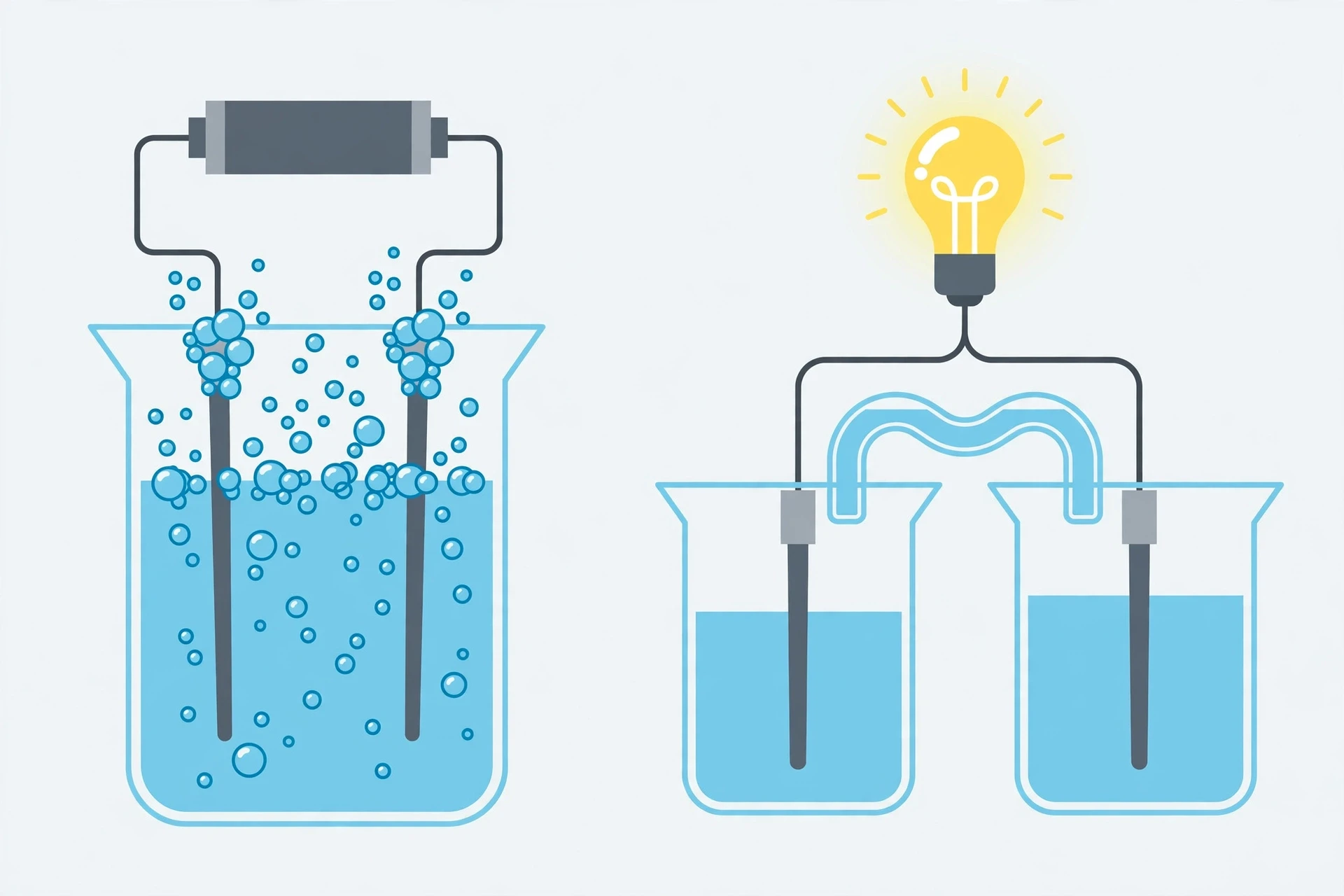
In a galvanic cell, the chemical reaction runs on its own and pushes electrons through the external circuit. The anode is negative because it is the source of the electrons: oxidation there releases electrons, which flow out of the anode, through the circuit, and into the cathode, where they are consumed by reduction. In an electrolytic cell, the power supply pushes electrons through the circuit in the opposite direction. The anode is positive because the power supply is pulling electrons away from it, and the cathode is negative because the power supply is pushing electrons into it. Same processes, opposite energy flow, opposite signs.
The practical difference is just as important. A galvanic cell is a source of power. You connect a device to it and the device runs. An electrolytic cell is a consumer of power. You connect a power supply to it and the cell runs, making chemicals. Rechargeable batteries switch between the two roles: they act as galvanic cells when they power a device, and as electrolytic cells when they are plugged in to recharge. That is why a rechargeable battery is, in a real sense, an electrolysis cell in reverse, and why understanding electrolysis is the key to understanding how the battery in a phone or an electric car is recharged. Sciory's Electrochemistry Explained covers galvanic cells, the other half of the story, in depth. The Sciory guide to how electric cars work explains the battery side of that story, including the lithium-ion cells that are charged and discharged thousands of times over a vehicle's life.
Feature | Electrolytic cell | Galvanic cell (battery) |
|---|---|---|
Energy flow | Electricity in, chemical change out | Chemical change in, electricity out |
Reaction | Non-spontaneous, needs energy | Spontaneous, releases energy |
Anode sign | Positive | Negative |
Cathode sign | Negative | Positive |
Anode process | Oxidation | Oxidation |
Cathode process | Reduction | Reduction |
Power supply | Required, external | Not required, the cell is the supply |
Example | Water splitting, aluminium extraction | Phone battery, car battery |
The table above is worth memorising in full, because it answers the question keyword for this article directly: what is the difference between electrolysis and a galvanic cell? The short answer is the direction of the energy. Everything else in the table follows from it.
7. Faraday's Laws: Counting the Electrons
Electrolysis is not just qualitative. It is one of the most precisely quantitative processes in chemistry, because the amount of product formed is directly proportional to the amount of electric charge passed through the cell.
This was discovered by Michael Faraday in the 1830s, and his two laws of electrolysis are still the basis for every industrial calculation in the field.
The first law says that the mass of substance produced at an electrode is directly proportional to the quantity of electricity passed through the cell. Double the charge, and you double the product. The second law says that when the same quantity of electricity is passed through different cells, the masses of the substances produced are proportional to their chemical equivalent masses, which depend on the charge of the ion and its molar mass. Together, the laws mean that electrolysis can be predicted exactly, in grams, from a reading on an ammeter and a stopwatch.
7.1 Charge, moles and the Faraday constant
The link between charge and chemistry is the mole of electrons. One mole of electrons carries a charge of about 96,485 coulombs, a quantity known as the Faraday constant, named after Faraday himself. The charge passed through a cell is the current multiplied by the time: Q = I × t, where Q is the charge in coulombs, I is the current in amps, and t is the time in seconds. Divide the charge by the Faraday constant and you get the number of moles of electrons. From there, the half-equation tells you how many moles of product those electrons make.
The logic is mechanical once you see it. Suppose the cathode reaction is Cu2+ + 2e- → Cu. Each copper ion needs two electrons, so one mole of electrons makes half a mole of copper. If a current of 2 amps flows for 30 minutes, the charge is 2 × 1,800 = 3,600 coulombs, which is 3,600 / 96,485 = 0.0373 moles of electrons, which makes 0.0187 moles of copper, which is about 1.19 grams. Every step is arithmetic, and every step is exact. This is why electrolysis is used to measure the Faraday constant itself, and why it is used to deposit precise, uniform coatings of metal in electroplating.
7.2 Worked example: copper plating
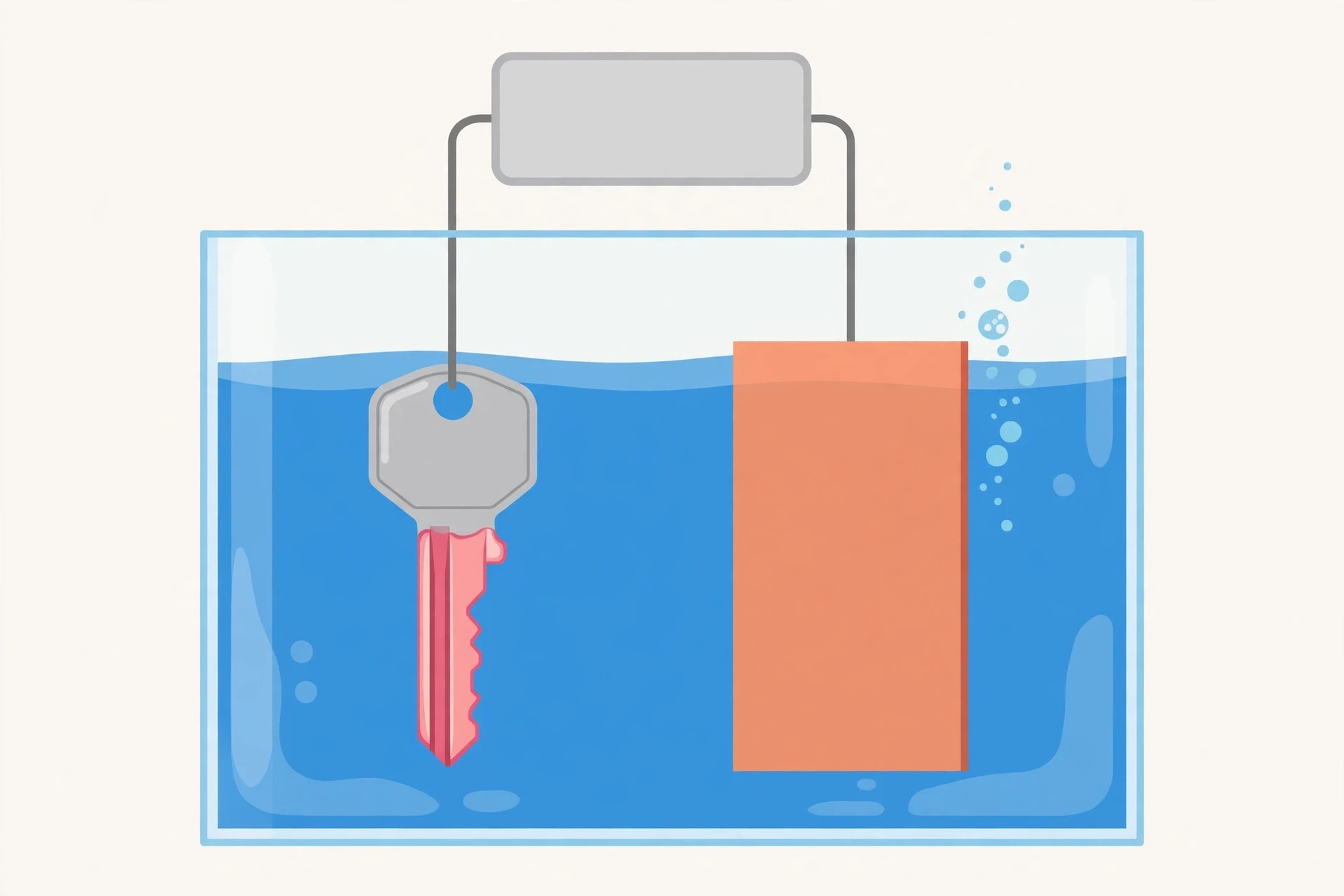
The most satisfying way to see Faraday's laws in action is to electroplate something. I once electroplated a steel key with copper, using copper sulfate solution, a copper anode and the key as the cathode, and a small power supply. The key went into the bath grey and came out, half an hour later, coated in a smooth, pink layer of copper that would not rub off. It was not magic. It was arithmetic made visible.
The copper anode dissolves, releasing copper ions into the solution, and those ions travel to the cathode, where they gain electrons and deposit as copper metal on the key. The concentration of the solution stays roughly constant, because copper leaves the anode at the same rate it arrives at the cathode. The mass of copper deposited depends only on the current and the time, exactly as Faraday's first law says. Run the current for twice as long and the coating is twice as thick. Double the current and the coating is twice as thick again, though if the current is too high the coating becomes rough and powdery instead of smooth, because the ions cannot arrange themselves neatly on the surface fast enough.
This control is why electroplating is used for everything from chrome car parts to gold jewellery to the copper tracks on circuit boards. The thickness of the coating can be set to the micron, simply by setting the current and the timer. It is also why the same calculation appears on exam papers year after year: it is one of the few places in chemistry where a real-world process can be predicted from first principles with a pocket calculator.
8. Electrolysis in Everyday Life
Electrolysis is easy to think of as a school experiment, but it is running right now, on an industrial scale, in plants all over the world.
It makes the materials of modern life: the aluminium in aircraft and drinks cans, the chlorine that disinfects water, the copper in every wire in your home, the hydrogen that may fuel the next generation of vehicles. This section follows the current from the laboratory into the factory.
8.1 Copper purification
The copper in electrical wiring must be extremely pure, because even small amounts of impurity increase its electrical resistance and waste energy as heat. The copper that comes out of a smelter is about 99 percent pure, which sounds good until you realise that the remaining one percent is enough to matter. Electrolysis finishes the job.
In copper refining, a slab of impure copper is made the anode, and a thin sheet of pure copper is made the cathode. Both sit in copper sulfate solution. When the current flows, copper atoms at the anode lose electrons and dissolve as copper ions, while copper ions at the cathode gain electrons and deposit as pure copper metal. The impurities behave differently. Some, like silver and gold, do not dissolve at all, and they fall to the bottom of the cell as a slime that is collected and processed for its precious metals. Others, like iron and zinc, dissolve but do not deposit at the cathode, because they are more reactive than copper and lose the competition for electrons. The result is copper that is 99.99 percent pure, deposited atom by atom on the cathode. It is one of the most elegant purification methods in all of chemistry, because the impurities separate themselves.
8.2 The chlor-alkali industry
The electrolysis of brine, described in Section 4, is the basis of the chlor-alkali industry, one of the largest chemical industries in the world. Its three products, chlorine, hydrogen and sodium hydroxide, feed into an enormous range of other products. Chlorine disinfects drinking water and swimming pools, and it is a raw material for PVC plastic, solvents and pharmaceuticals. Sodium hydroxide, also called caustic soda, is used to make paper, soap, detergents and aluminium. Hydrogen is used in refining, in making ammonia for fertiliser, and increasingly as a fuel.
The industry has changed its technology over time, and the change is a story about environmental responsibility. Early chlor-alkali plants used mercury cells, in which a flowing layer of mercury acted as the cathode. Mercury is toxic, and leaks caused serious pollution. Modern plants use membrane cells, in which a special membrane separates the anode and cathode compartments and allows only sodium ions to pass through. The membrane cell uses less energy, produces a purer product, and eliminates the mercury entirely.
8.3 Green hydrogen
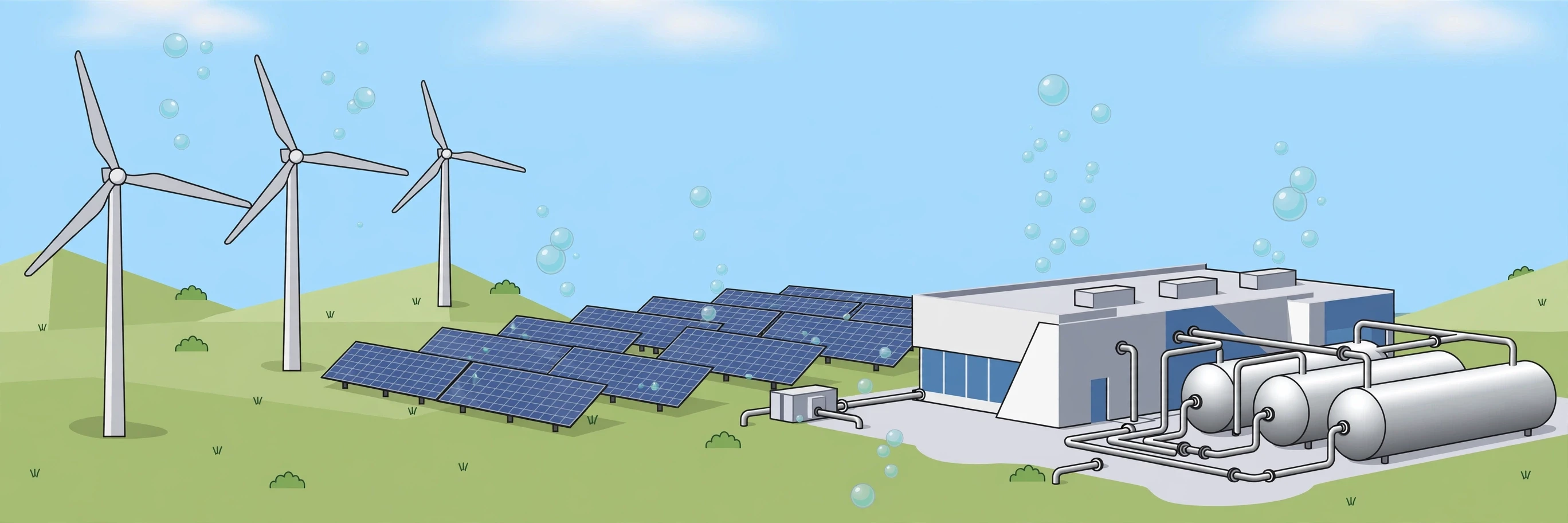
The most talked-about use of electrolysis today is green hydrogen: hydrogen made by splitting water with electricity from renewable sources. The idea is simple. Wind turbines and solar panels produce electricity, but only when the wind blows and the sun shines. Electrolysis turns that intermittent electricity into hydrogen gas, which can be stored in tanks, shipped in pipelines, and used whenever it is needed, in fuel cells, in industry, or in vehicles. Hydrogen becomes a way of storing renewable energy in chemical form.
The scale of the ambition is large. Governments and companies around the world are building electrolysers the size of factories, and the cost of the equipment is falling as production scales up. The US Department of Energy's pages on hydrogen production by electrolysis describe the technology in detail, and they make clear that the goal is hydrogen produced without carbon emissions. Whether that goal is reached depends on the price of renewable electricity and on the cost of the electrolysers, but the chemistry is already proven. It has been proven since Hofmann's voltameter.
8.4 Electroplating and the objects around you
Look around the room you are sitting in and you will find electroplating everywhere. The chrome on a tap, the gold on a piece of jewellery, the silver on a cutlery set, the zinc coating that stops a steel nail from rusting (most galvanising is hot-dip dipping in molten zinc, though thin zinc coatings can also be electroplated), the copper tracks on the circuit board inside your phone: all of these are thin layers of metal deposited by electrolysis. The process is the same in every case. OpenStax Chemistry sums up electroplating in one line: "The net result is the transfer of silver metal from the anode to the cathode." The object is the cathode, the coating metal is the anode or is supplied as ions in the solution, and the current deposits a layer whose thickness is controlled by Faraday's laws.
Electroplating is not only decorative. A thin layer of chromium on steel is harder than the steel itself, so it resists wear. A layer of zinc on steel, called galvanising, protects the steel from rust, because the zinc corrodes first, sacrificing itself to protect the iron beneath. A layer of gold on an electrical contact prevents corrosion and keeps the connection reliable for years.
9. Common Mistakes and Misconceptions
Electrolysis is one of the topics where students lose marks not because they do not know the facts, but because they hold a wrong idea that feels right. This section collects the most common of those ideas and corrects them, because recognising a misconception is the fastest way to stop making it.
The first misconception is that the anode is always negative. It is negative in a galvanic cell and positive in an electrolytic cell, because the sign follows the direction of the energy flow, not the process at the electrode. The process is the constant: oxidation always happens at the anode, reduction always at the cathode. If you remember the process and forget the sign, you will be right. If you remember the sign and forget the process, you will be wrong half the time.
The second misconception is that electrolysis and a battery are the same thing in reverse, and therefore that an electrolytic cell will produce electricity if you disconnect the power supply. It will not, or at least not in any useful way. The products of electrolysis are not, in general, arranged to run the reverse reaction spontaneously and deliver a current. A rechargeable battery is the exception, because it is designed to be reversible. An ordinary electrolysis cell is not. Once the power is off, the reaction stops, and the products sit there.
The third misconception is that water splits easily. It does not. Pure water is a poor conductor, and splitting it takes a minimum of 1.23 volts plus overpotential, and a great deal of energy per kilogram of hydrogen. The school demonstration makes it look easy because the apparatus is small and the quantities are tiny. Scaling it up to industrial hydrogen production is an engineering challenge that occupies thousands of engineers, and the energy bill is the central problem.
The fourth misconception is that the electrodes are consumed in every electrolysis. They are not. Inert electrodes, such as graphite or platinum, do not take part in the reaction at all. They simply provide a surface for the ions to react on. Reactive electrodes, such as copper in copper refining, do dissolve, but that is a deliberate choice, not a general rule. Which kind of electrode is used is a design decision, and it changes the products.
The fifth misconception is that electrolysis is only about splitting water. Electrolysis is the general process. Water splitting, aluminium extraction, copper refining, electroplating and chlorine production are all examples of it, and they all run on the same principles. Learning the principles once, properly, is worth more than memorising the products of a dozen separate experiments, because the principles predict the products.
Most people assume that electricity and chemistry are separate subjects, one belonging to physics and the other to the laboratory bench. What the evidence actually shows is that they are the same subject seen from two sides. Electricity is the movement of electrons, and chemistry is the rearrangement of electrons. Electrolysis is the place where the two meet, and once you have seen that meeting, it is hard to unsee it.
10. Safety and the Environment
Electrolysis is a powerful tool, and like every powerful tool it carries risks that have to be managed. The products are often hazardous: chlorine gas is toxic, hydrogen gas is flammable and explosive when mixed with air, sodium metal bursts into flame on contact with water, and molten salts can cause severe burns.
Industrial electrolysis plants are designed with these hazards in mind, with gas collection systems, ventilation, protective equipment and strict procedures. School demonstrations use small quantities, low voltages and dilute solutions for the same reason, and they should never be scaled up casually at home.
The environmental picture is mixed, and it is worth stating honestly. On the negative side, aluminium extraction consumes enormous amounts of electricity, and where that electricity comes from coal, the carbon footprint is large. The Hall-Héroult process also produces carbon dioxide directly, because the carbon anodes are consumed, and it can release perfluorocarbons, which are potent greenhouse gases, when the cell is disturbed. Bauxite mining scars landscapes and produces red mud waste that must be stored safely.
On the positive side, electrolysis is also one of the key technologies for a low-carbon future. The design principles behind cleaner chemical processes are the subject of Sciory's Green Chemistry Explained: The 12 Principles. Green hydrogen, made with renewable electricity, can replace fossil fuels in steelmaking, shipping, aviation and fertiliser production, where batteries alone are not practical. Aluminium recycling saves 95 percent of the energy of primary production, and the metal itself is infinitely recyclable without losing its properties. The technology is not good or bad on its own. Its impact depends on where the electricity comes from and how carefully the plants are run.
For the reader who wants to explore the subject further, the sources at the end of this article include the LibreTexts and OpenStax treatments of electrolysis, which are free, peer-reviewed in the textbook sense, and written for students. They are the right next step for anyone who wants to work through the calculations and the cell diagrams in more depth.
11. What Electrolysis Leaves Behind
Electrolysis began with a simple observation: push electricity through a substance and the substance changes. Two centuries later, that observation has become an industry that makes the aluminium in aircraft, the chlorine in drinking water, the copper in every wire, and the hydrogen that may carry clean energy into the future. The principle has not changed. Electricity drives a reaction that would not happen on its own, electrons are gained at the cathode and lost at the anode, and the products can be predicted, counted and controlled with Faraday's laws.
The school beaker with its two streams of bubbles is still the best introduction to the subject, because it contains everything: the power supply, the electrodes, the electrolyte, the 2:1 ratio, and the quiet surprise of watching water come apart. If you have never seen it, find a demonstration and watch it. The bubbles rise slowly, the ratio appears, and the equation on the page becomes something you have seen with your own eyes.
The ideas in this article connect directly to the wider story of chemistry and electricity. The Sciory guide to the fundamentals of electricity explains the current, voltage and circuits that drive an electrolytic cell, and the Sciory guide to chemical reactions places electrolysis among the other ways chemists classify and predict reactions. Electrolysis sits at the crossing of those two subjects, and it rewards anyone who follows it there.
Frequently Asked Questions
What is electrolysis?
Electrolysis is the process of using an electric current to drive a chemical change that would not happen on its own. A direct current is passed through an electrolyte, a molten salt or an ionic solution, using two electrodes. At the cathode, positive ions gain electrons and are reduced. At the anode, negative ions lose electrons and are oxidised. The result is new substances: metals, gases, or both, depending on the electrolyte.
How does electrolysis split water?
Electrolysis splits water by passing a direct current through water containing a small amount of electrolyte, such as dilute sulfuric acid, which makes the water conduct. At the cathode, water molecules gain electrons and form hydrogen gas. At the anode, water molecules lose electrons and form oxygen gas. The overall equation is 2H2O → 2H2 + O2, so hydrogen is produced at twice the volume of oxygen. Pure water alone barely conducts and will not split in any useful quantity.
How is aluminium extracted?
Aluminium is extracted by electrolysis in the Hall-Héroult process. Aluminium oxide from bauxite ore is dissolved in molten cryolite, which lowers the melting point to around 950 °C. The mixture is electrolysed in a large cell with a carbon-lined cathode and carbon anodes. Aluminium ions gain electrons at the cathode and form liquid aluminium metal, which is tapped off, while oxygen released at the anode reacts with the carbon anodes to form carbon dioxide. Carbon reduction does not work for aluminium because aluminium holds on to oxygen more strongly than carbon does.
What is the difference between electrolysis and a galvanic cell?
The difference is the direction of the energy flow. A galvanic cell, or battery, is a spontaneous chemical reaction that produces electricity. An electrolytic cell uses electricity from an external power supply to drive a non-spontaneous chemical reaction. In both cells, oxidation happens at the anode and reduction at the cathode, but the electrode signs are reversed: in electrolysis the anode is positive and the cathode is negative, while in a galvanic cell the anode is negative and the cathode is positive.
Why does pure water not conduct electricity well?
Pure water contains almost no free ions. Only about one water molecule in 500 million splits into hydrogen and hydroxide ions on its own, so there are too few charged particles to carry a current or to react at the electrodes in any useful quantity. Adding a soluble ionic compound or a dilute acid or alkali provides plenty of free ions, the solution conducts, and electrolysis can proceed.
What is formed at the anode and cathode during electrolysis?
At the cathode, reduction takes place: positive ions gain electrons and become atoms or molecules, so metals are deposited and hydrogen gas is formed. At the anode, oxidation takes place: negative ions lose electrons and become atoms or molecules, so gases such as chlorine, bromine or oxygen are formed, or a reactive metal anode dissolves. Which ion wins at each electrode depends on how easily it gains or loses electrons and, at the anode, on its concentration.
Is electrolysis used in everyday life?
Yes, widely. Electrolysis extracts aluminium from its ore, purifies copper for electrical wiring, produces chlorine, hydrogen and sodium hydroxide in the chlor-alkali industry, coats objects with metal in electroplating, and makes green hydrogen by splitting water with renewable electricity. The chrome on taps, the gold on jewellery, the zinc coating on steel nails and the copper tracks on circuit boards are all products of electrolysis.
Sources
LibreTexts — Electrolytic Cells: https://chem.libretexts.org/Bookshelves/Analytical_Chemistry/Supplemental_Modules_(Analytical_Chemistry)/Electrochemistry/Electrolytic_Cells
OpenStax Chemistry 2e — Electrolysis: https://openstax.org/books/chemistry-2e/pages/17-7-electrolysis
LibreTexts — Electrolysis (General Chemistry): https://chem.libretexts.org/Bookshelves/General_Chemistry/Chemistry_1e_(OpenSTAX)/17%3A_Electrochemistry/17.07%3A_Electrolysis
US Department of Energy — Hydrogen Production: Electrolysis: https://www.energy.gov/eere/fuelcells/hydrogen-production-electrolysis
Royal Society of Chemistry — Electrolysis of Solutions: https://edu.rsc.org/experiments/the-electrolysis-of-solutions/466.article
Fundamentals of Electricity — Sciory: https://www.sciory.com/blog/fundamentals-of-electricity
How Electric Cars Work — Sciory: https://www.sciory.com/blog/how-electric-cars-work
Chemical Reactions Explained — Sciory: https://www.sciory.com/blog/chemical-reactions-types-kinetics-examples
Electrochemistry Explained — Sciory: https://www.sciory.com/blog/electrochemistry-explained
Green Chemistry Explained: The 12 Principles — Sciory: https://www.sciory.com/blog/green-chemistry-explained