

The first time I opened a bottle of solvent in a school chemistry lab, the smell hit the back of my throat before I had even poured anything. It was sharp, sweet in a wrong way, and it made my eyes water — the smell of a solvent that green chemistry would one day teach me to replace. My teacher, calm as ever, told us to work with the fume cupboard sash pulled down, to keep the bottle capped when we were not using it, and to pour any leftover liquid into a labelled waste jar instead of down the sink. I remember staring at that waste jar — a heavy glass bottle half full of murky liquid, its label covered in hazard symbols — and wondering a simple question, the very question green chemistry exists to answer: why do we have to make things this way? Why start with something dangerous, use it once, and then pay someone to take the leftovers away?
That question is the starting point of green chemistry. It is the branch of chemistry that asks whether we can design products and processes so that the danger, the waste and the pollution never appear in the first place, instead of cleaning them up afterwards. It does not ask chemists to stop making things. It asks them to make things differently: with safer starting materials, with less waste, with less energy, and with products that break down harmlessly when their job is done. This guide explains what green chemistry is, how it differs from environmental chemistry, where the idea came from, and what its twelve principles mean in practice — with real examples from factories, labs and everyday products.
Green chemistry matters because chemistry is everywhere. The paint on your walls, the medicine in your cabinet, the plastic in your phone, the detergent under your sink — all of them were made by chemical processes, and every one of those processes made choices. Some of those choices were made a century ago, when nobody asked what happened to the waste, or what the solvent did to the workers who breathed it, or where the product went when it was thrown away. Green chemistry revisits those choices with the knowledge we have now.
1. What Is Green Chemistry?
Green chemistry is the design of chemical products and processes that reduce or eliminate the use and generation of hazardous substances. That definition, used by the United States Environmental Protection Agency, is worth reading slowly, because every word in it does work. "Design" comes first: green chemistry is something you do at the drawing board, before a single reaction is run. "Products and processes" come together: a safe product made by a dirty process is only half the job, and a clean process that makes a toxic product is the other half. And "reduce or eliminate" sets the direction — less hazard, less waste, less harm — without pretending that every hazard can be removed overnight.
The most common misunderstanding about green chemistry is that it is chemistry done in a garden, or chemistry without chemicals. It is neither. Green chemistry uses the same atoms, the same reactions and the same laboratories as any other chemistry. What changes is the set of questions asked before the work begins. A traditional chemist asks: does this reaction work, how fast is it, and how much product does it give? A chemist working in the spirit of green chemistry asks those questions too — and then asks three more. What is in the waste, and how much of it is there? What happens to the workers, the neighbours and the river if something goes wrong? And what happens to this product at the end of its life? If the answers are ugly, the design goes back to the drawing board.
Another misunderstanding is that green chemistry is only about the environment. It is also about people and money. Hazardous solvents and reagents cost money to buy, money to store safely, money to handle, and money to dispose of as hazardous waste. A process that uses water instead of a toxic solvent, or that runs at room temperature instead of under high heat and pressure, is often cheaper as well as safer. That is one reason green chemistry has spread from university labs into real factories: it is not a luxury added on top of good chemistry, but a way of doing chemistry that is often better chemistry.
Green chemistry is not a single technique. It is a way of thinking that shows up in many different places: a drug company redesigning a synthesis so it produces a tenth of the waste, a paint company replacing a solvent with water, a plastics company building a polymer from corn starch instead of oil, a cleaning-product maker choosing ingredients that break down in a river instead of lingering in it. The twelve principles in this article are the shared language that ties those very different projects together. They were written to give chemists a checklist, a way of judging whether a new process is genuinely greener than the one it replaces — and, just as importantly, a way of spotting when a claim of "green" is only a coat of paint.
1.1 The difference between "green" and "less bad"
It helps to be honest about what "green" means here. Almost no chemical process is perfectly harmless. Even water-based processes use energy, and even plant-based starting materials need land and water to grow. Green chemistry does not promise perfection. It promises direction: each new design should be safer, less wasteful and less energy-hungry than the design before it. That is why the principles talk about reducing, preventing and minimising, not about reaching zero in one step.
I learned this the hard way in a university lab, or rather, I learned it from a classmate who did. We were running a routine synthesis that used a chlorinated solvent — the kind of solvent that works beautifully and is terrible for the liver. My classmate, who was more careful than the rest of us, asked our supervisor whether we could run the same reaction in ethanol instead. The supervisor said no, not for this one, the yield would drop. But the question stayed with me, because it was the right question even though the answer that day was no. Sometimes the greener solvent does not work yet. Sometimes it works but costs more, or needs a different catalyst, or a longer reaction time. Green chemistry lives in those trade-offs, and the principles are a guide for weighing them honestly rather than pretending they do not exist.
1.2 Why chemists needed a new name for an old instinct
Good chemists have always tried to avoid waste and danger. What was new, in the 1990s, was turning that instinct into a named field with shared principles, textbooks, journals and awards — so that a chemist in one country and a chemist in another could mean the same thing by "greener", and so that students could be taught it as a discipline rather than picking it up by accident. The American Chemical Society's Green Chemistry Institute now carries much of that work, publishing the twelve principles and supporting education and research in the field. The EPA's pages on the basics of green chemistry give the same definition in plain language, and are a good first stop for any reader who wants the official wording.
The name itself can mislead. "Green" suggests the environment, and the environment is a large part of it, but the principles reach further: into worker safety, into product safety for the people who use the product, and into the design of molecules that do their job and then disappear gracefully. Keep that breadth in mind as you read the principles. They are not twelve ways to be nice to trees. They are twelve ways to make chemistry safer for everyone who touches it, from the factory worker to the child drinking from a river downstream.
2. How Is Green Chemistry Different from Environmental Chemistry?
This is one of the most asked questions about the field, and it is worth answering carefully, because the two sound almost identical and are not. Environmental chemistry studies what chemicals do once they are already in the environment: how pollutants move through air, water and soil, how they break down, and how they affect living things. It is, in large part, a science of measuring and understanding problems that already exist. Green chemistry tries to stop those problems from being created. One studies the mess; the other redesigns the process so there is less mess to study.
Think of it this way. If a factory discharges a solvent into a river, an environmental chemist is the person who samples the river, measures how much solvent is in the water, works out how far it travels, and studies what it does to the fish. A green chemist is the person who asks, a year earlier, whether the factory could use a different solvent — or no solvent at all — so that nothing reaches the river in the first place. Both jobs matter. The river needs the person measuring the pollution, and it also needs the person preventing it. But they are different jobs, with different tools and different questions.
Environmental chemistry asks what happens to a chemical after it escapes. Green chemistry asks how to design the chemical so that it never needs to escape at all.
The two fields overlap in practice, and many scientists work in both. A chemist who studies how a pesticide breaks down in soil might use that knowledge to design a pesticide that breaks down faster — and at that point the work is both environmental chemistry and green chemistry. The boundary is about intent and timing. Environmental chemistry looks backwards at consequences. Green chemistry looks forwards at design. That forward look is what makes the twelve principles useful: they are design rules, not measurement rules.
There is a related confusion with sustainability, a bigger word that covers energy, economics, social justice and the long-term health of whole systems. Green chemistry is one piece of sustainability — the chemistry piece. A process can be green in the chemical sense and still be unsustainable if it needs enormous amounts of land, or if it depends on a resource that will run out. For the bigger picture, see Sciory's guide to ecosystems, where energy flow and nutrient cycles show how one change ripples through a living system, and the guide to climate change, where the energy choices behind chemical manufacturing meet the warming of the planet.
3. A Short History: How Twelve Principles Were Born
Green chemistry did not arrive in a single eureka moment. It grew out of decades of accidents, clean-ups and hard lessons. By the 1970s and 1980s, industrialised countries were discovering the price of a century of careless chemistry: rivers that caught fire, neighbourhoods built on buried chemical waste, workers falling ill from solvents they had breathed for years. Laws were passed to control pollution, and they helped. But they mostly worked at the end of the pipe — filters, scrubbers, treatment plants — catching the waste after it had been made. A few chemists began to ask whether the waste had to be made at all.
The person most often named in that story is Paul Anastas, an American chemist who, while working at the EPA in the early 1990s, began to put the idea into words. Working with John Warner, a chemist with a gift for designing molecules, Anastas wrote the twelve principles down in their book Green Chemistry: Theory and Practice, published in 1998. The book gave the field its founding document, and the principles have been quoted, taught and argued over ever since. The American Chemical Society now publishes the twelve principles of green chemistry in full, and that page is the reference most teachers and students use today.
The principles were not handed down as laws of nature. They were a proposal — design guidelines drawn from what the authors had seen work in real labs and factories. They are practical, not philosophical: each one answers a question a working chemist actually faces, from what to do with the waste to which solvent to choose. The principles have lasted because they are useful at the bench, not just in a lecture hall.
Since 1998 the field has grown far beyond one book: there are now journals devoted to green chemistry, university courses built around the principles, and awards for companies that redesign processes along green lines. The EPA runs a programme recognising green chemistry innovations, and the Green Chemistry Institute at the ACS supports teaching and research. Most of the world's chemical production still runs on processes designed long before anyone had heard of the twelve principles. The principles are a map, not a finished journey.
4. The 12 Principles at a Glance
Before diving into each principle, it helps to see all twelve together. They fall naturally into four groups, and that grouping is a useful way to remember them. The first group is about what goes in and what comes out: prevent waste, maximise atom economy, and design less hazardous syntheses. The second is about the materials themselves: design safer chemicals, use safer solvents, and use less energy. The third is about where materials come from and how reactions are run: renewable feedstocks, fewer derivatives, and catalysis. The fourth is about the end of the story: design for degradation, monitor in real time, and make accidents unlikely in the first place.
The table below gives the short version of each principle, in the order Anastas and Warner published them. The sections that follow give the long version — what each principle means, why it matters, and where you can see it working.
Principle | Short name | One-line meaning |
|---|---|---|
1 | Prevent waste | Design the process so waste is never created, rather than treating it afterwards. |
2 | Maximise atom economy | Get as many of the starting atoms as possible into the final product. |
3 | Less hazardous syntheses | Use and generate substances with little or no toxicity to people or the environment. |
4 | Design safer chemicals | Make products that do their job while being as non-toxic as possible. |
5 | Safer solvents and auxiliaries | Avoid solvents and helpers where possible; where needed, choose the safest option. |
6 | Design for energy efficiency | Run reactions at room temperature and pressure whenever possible. |
7 | Use renewable feedstocks | Start from materials that can be regrown or replenished, not from depleting resources. |
8 | Reduce derivatives | Avoid extra steps such as protecting groups that add waste and time. |
9 | Use catalysis | Prefer small amounts of a reusable catalyst over large amounts of a one-use reagent. |
10 | Design for degradation | Make products that break down into harmless pieces after use. |
11 | Real-time analysis | Monitor reactions as they run, so problems are caught before waste is made. |
12 | Inherently safer chemistry | Choose substances and forms that minimise the chance of accidents. |
5. Principle 1: Prevent Waste
The first principle is the simplest to state and the most radical in its consequences: it is better to prevent waste than to treat or clean up waste after it has been created. Every chemist knows the end-of-reaction ritual — the leftover solvents, the washings, the by-products, the filter papers, all collected in labelled containers and sent away for disposal. Principle 1 asks why that ritual has to exist at all. If the reaction were designed differently, would there be anything to throw away?
The economics of waste are easy to underestimate. A factory does not just pay for the raw materials that end up in its product. It pays for the materials that end up in the bin, it pays to store them safely, it pays to transport them, and it pays a specialist company to treat or bury them. In many processes the waste costs more to get rid of than the product is worth. I once watched a lab technician spend an entire afternoon sorting waste jars — acids in one tray, solvents in another, heavy metals in a third — and I realised that the waste stream had its own little industry attached to it, with its own rules, its own paperwork and its own bills. None of that work makes any product. It only manages the consequences of a design decision made months earlier, when someone chose a route that made waste.
Preventing waste starts with the choice of reaction itself. Some reactions are inherently wasteful: they use a reagent that is consumed in large amounts and leaves a bulky by-product behind, or they need several steps where each step loses material. Others are inherently clean: two molecules join together and nearly every atom ends up in the product, with nothing left over. A chemist who compares two routes to the same product and picks the one that makes less waste has already applied Principle 1, even if they never use the words "green chemistry". The principle simply makes that choice explicit, and asks for it to be made every time, not just when it is convenient.
There is a famous example that textbooks love, and it deserves its place here because it shows the principle working at industrial scale. The painkiller ibuprofen was originally made by a process with six steps, and for every kilogram of ibuprofen it produced several kilograms of waste. A redesigned process, developed by the BHC company, cut the synthesis to three steps and used a catalyst to recycle one of the key reagents. The result was far less waste per kilogram of product, and a process that was cheaper to run. It is the kind of story that makes the point better than any slogan: preventing waste is not charity. It is good process design, and it often pays for itself.
6. Principle 2: Maximise Atom Economy
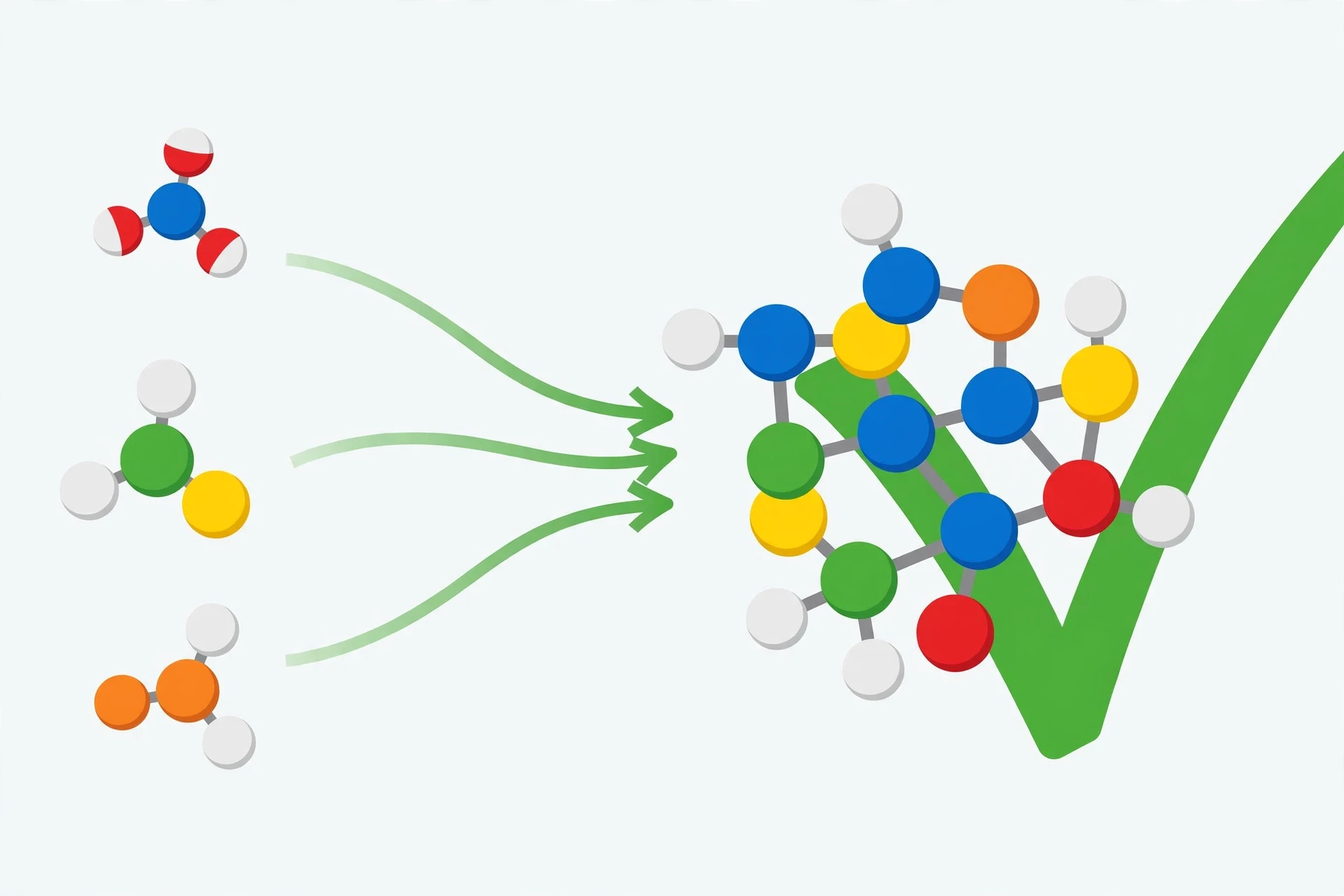
If Principle 1 is about waste in general, Principle 2 gives chemists a way to measure it precisely. Atom economy asks a blunt question: of all the atoms you put into a reaction, what fraction actually ends up in the product you want? The rest — the atoms that end up in by-products, in side products, in things you throw away — are wasted atoms, even if the reaction itself ran perfectly.
The idea is easy to see with a simple comparison. Imagine two ways of making the same molecule. In the first, two small molecules join together like two halves of a puzzle, and every atom from both halves appears in the final product. The atom economy is 100 percent: nothing is wasted. In the second, a large reagent is used to attach a small group to a molecule, and most of the reagent ends up as a by-product that is thrown away. The product is the same, but the atom economy might be 40 percent or less. A chemist who only looks at yield — how much product was made — would call both reactions a success. A chemist who looks at atom economy sees that the second reaction threw away more than half of what it started with.
This matters because yield can be misleading. Yield tells you what fraction of your starting material became product, assuming the reaction went as planned. It says nothing about the atoms that were never meant to become product — the leaving groups, the protecting groups, the stoichiometric reagents consumed and discarded. Atom economy counts all of it, which is why it became one of the most used tools in green chemistry: a single number that tells you, at a glance, whether a reaction is elegant or wasteful.
The classic teaching example is the difference between addition reactions and substitution reactions. In an addition reaction, two molecules combine and everything ends up in the product — the atom economy is high, often close to 100 percent. In a substitution reaction, one group replaces another, and the displaced group leaves as waste — the atom economy is lower, sometimes much lower. This does not mean substitution reactions are bad; many important products are made that way, and there is no addition route to them. It means that when a chemist has a choice, the addition route is usually the greener one, and when there is no choice, the chemist should at least know what the waste costs.
Atom economy also explains why the ibuprofen redesign mentioned above was such a breakthrough. The old process used stoichiometric reagents — large amounts of chemicals that were consumed and discarded — while the new one used catalysts that were not consumed at all. The atom economy rose sharply, and the waste per kilogram of product fell with it. The lesson generalises: whenever a process uses a reagent in a one-to-one amount that ends up in the bin, a chemist should ask whether a catalyst could do the same job in a tiny amount instead. That question leads directly to Principle 9, and it shows how the twelve principles support each other. They are not twelve separate rules. They are twelve views of the same problem, and a good redesign usually satisfies several of them at once.
7. Principle 3: Design Less Hazardous Chemical Syntheses
Principle 3 moves the focus from waste to danger. It says that synthetic methods should be designed to use and generate substances that possess little or no toxicity to human health and the environment. In plain language: if you can make the same product using starting materials that will not poison anyone, do that. And if the reaction itself produces a toxic by-product, find a route that does not.
This principle is easy to agree with and hard to follow, because the most hazardous reagents are often hazardous for a reason: they are reactive, and reactivity is what makes chemistry work. Chlorine, for example, is a powerful tool for adding atoms to molecules, and it is also a gas that can kill. Phosgene, once widely used to make plastics and medicines, is a chemical weapon as well as an industrial reagent. The history of chemistry is full of reagents that work brilliantly and harm the people who use them. Principle 3 does not pretend that reactivity and safety are the same thing. It asks chemists to search for safer alternatives with the same determination they once spent searching for higher yields.
One of the great successes of this principle is the replacement of phosgene in the manufacture of polycarbonates, the tough transparent plastics used in everything from safety glasses to water bottles. The old route used phosgene directly. Newer routes use safer starting materials and catalysts, and avoid phosgene altogether. Nobody who has worked with phosgene needs to be told why that matters. The product is the same. The danger in the factory is not.
A second success is the move away from heavy-metal reagents. Mercury, lead, cadmium and chromium compounds have all been workhorses of organic synthesis, and all are toxic, persistent, and hard to clean up once they escape. Wherever a safer reagent or a catalyst can replace them, Principle 3 says to make the switch — slower or more expensive though the replacement may be.
There is a personal side to this principle that is easy to forget when reading about it in a textbook. Hazard is not an abstract idea. It is the technician who breathes a solvent every day for twenty years. It is the worker who handles a corrosive liquid with gloves that are one tear away from failing. It is the community living beside a plant that stores a toxic gas. When a chemist chooses a less hazardous synthesis, they are not just ticking a box on a green checklist. They are making someone's working day safer. That human fact is the real reason Principle 3 sits so high on the list, right after waste and atom economy. Waste and danger are the two things a process creates that nobody wanted, and the principles attack them first.
8. Principle 4: Designing Safer Chemicals
Principles 3 and 4 look similar, and readers often mix them up. The difference is worth getting right. Principle 3 is about the process — the synthesis, the reagents, the route. Principle 4 is about the product — the chemical itself, once it leaves the factory and goes out into the world. It says that chemical products should be designed to achieve their function while being as non-toxic as possible.
That distinction matters because a product can be made by a clean process and still be dangerous. A pesticide made with perfect atom economy is still a pesticide, and if it kills bees as well as pests, or lingers in soil for decades, its clean synthesis does not make it safe. Principle 4 asks the chemist to think about the product's whole life: who will touch it, who will breathe it, what will eat it, where will it go when it is washed away or thrown out?
Designing a safer chemical means understanding how its structure relates to its toxicity. Chemists have learned, over decades, that certain structural features tend to make a molecule more toxic: the ability to dissolve in fat and build up in living tissue, for example, or a shape that lets it interfere with hormones. By avoiding those features where possible, and by testing new molecules early, chemists can design products that do their job without the unwanted side effects. This is not guesswork. It is a growing science, and it is one of the most active areas of green chemistry research.
A concrete example is the redesign of flame retardants. Older flame retardants worked well, but some built up in the environment and in human bodies and were linked to health concerns. Newer designs aim for the same fire protection with molecules that break down more readily and do not accumulate. Not every replacement has been perfect, which is a reminder that "safer" is a claim that has to be tested, not just asserted.
The same thinking applies to everyday products. A cleaning spray that uses a harsh, corrosive chemical could often work just as well with a milder one, and a paint that needs a toxic solvent to flow smoothly could be reformulated as a water-based paint. In each case the chemist's job is to keep the function — the cleaning, the covering, the protecting — and remove the hazard, which is harder than it sounds, because function and hazard are often tangled together in the same molecule.
A safe process that makes a dangerous product is only half the job. Green chemistry asks for both: a safe way to make it, and a safe thing to have made.
9. Principle 5: Safer Solvents and Auxiliaries
If you have ever watched a chemist work, you will have noticed that most of the liquid in the lab is not the reaction itself. It is the solvent — the liquid that the reaction happens in. Solvents dissolve the starting materials, carry heat away, and make it possible to stir, pour and filter. They are the stage on which chemistry happens. They are also, by mass, the largest part of most chemical processes, and the largest source of waste. A typical pharmaceutical process might use tens of kilograms of solvent for every kilogram of product. That is why Principle 5, which deals with solvents and other auxiliary substances, matters so much in practice.
The principle says that the use of auxiliary substances — solvents, separation agents and the like — should be made unnecessary wherever possible, and innocuous when used. The first half of that sentence is the bold part: do not use a solvent at all if you can avoid it. Some reactions can be run neat, with the reactants mixed directly, or in the solid state, ground together without any liquid. Others can be run in water, which is cheap, safe and abundant. The second half is the fallback: if a solvent is needed, choose the safest one that works.
The solvents that green chemistry most wants to replace are the volatile organic compounds — liquids that evaporate easily, catch fire easily, and damage health. Chlorinated solvents such as dichloromethane and chloroform were once the default choice in many labs because they dissolve a wide range of substances and evaporate cleanly. They are also toxic, and some are linked to cancer. Their replacements are not always as convenient, which is why the change has taken decades, but the direction is steady: water, ethanol, and a newer class of solvents such as supercritical carbon dioxide, which behaves like a liquid and a gas at once and leaves no residue behind.
Supercritical carbon dioxide deserves a closer look, because it shows how strange and clever a green solvent can be. Carbon dioxide, compressed and heated past a certain point, becomes a fluid that can dissolve substances like a liquid but flow like a gas. When the pressure is released, it turns back into a gas and floats away, leaving the product behind with no solvent residue to remove. It is already used to decaffeinate coffee and to dry-clean clothes without the toxic solvents that dry cleaning once relied on. It is not a perfect solvent — it does not dissolve everything, and the equipment to compress it is expensive — but where it works, it works beautifully, and it leaves nothing behind to throw away.
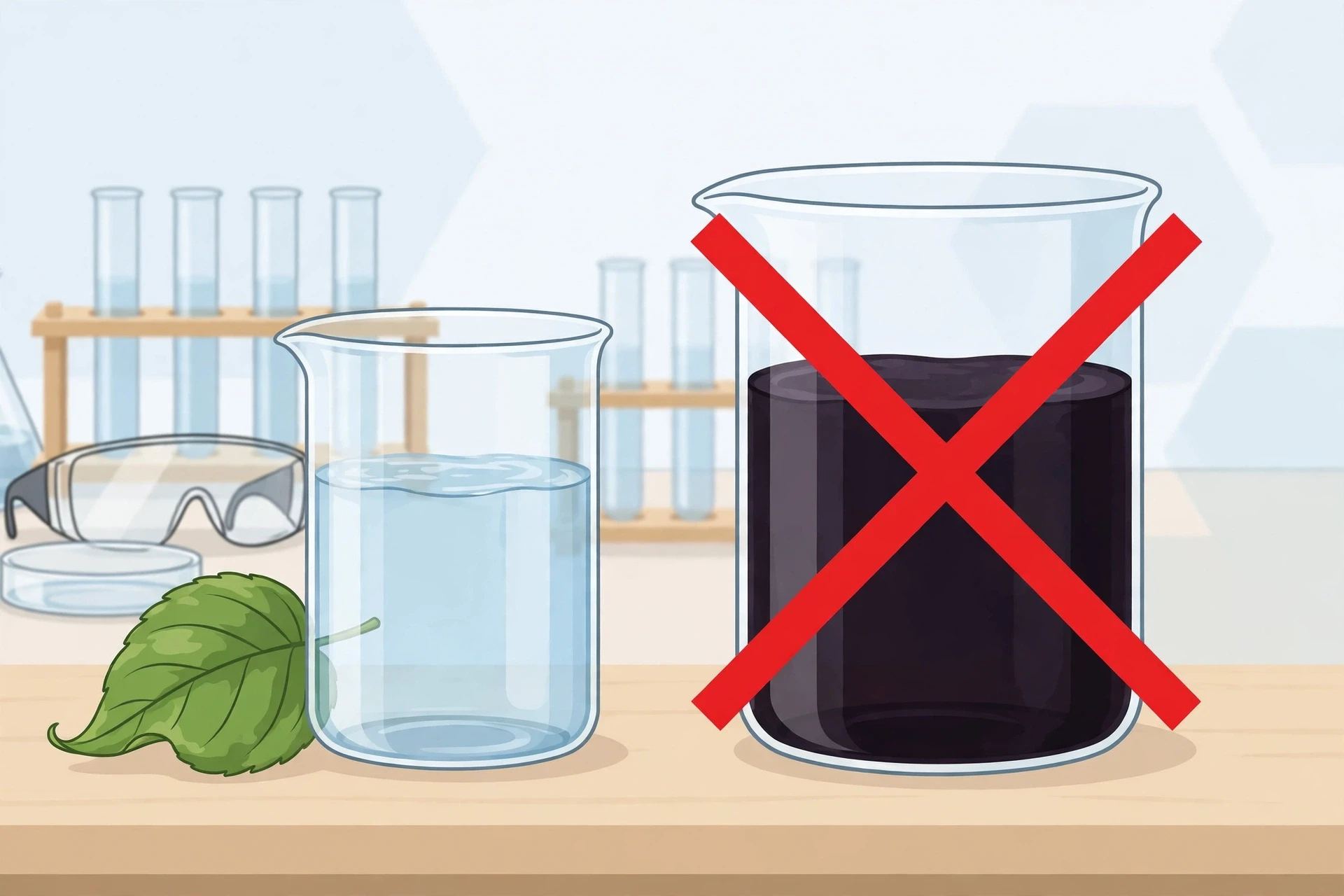
I still remember the smell of that school lab solvent from the introduction to this article. Years later, I read a cleaning-product label in a supermarket and found myself doing the same thing my teacher had taught me: reading the hazard symbols first, and the promises second. The product that advertised itself as "powerful" carried a warning about ventilation and gloves. The one next to it, water-based and far less dramatic in its claims, carried no warning at all. I bought the second one. It cleaned the sink just as well. That small, unglamorous choice is Principle 5 at work in a kitchen: the safest solvent that does the job is usually the right one, even when the label is less exciting.
10. Principle 6: Design for Energy Efficiency
Chemistry runs on energy. Reactions are heated, cooled, pressurised, stirred and distilled, and every one of those steps costs energy — and, in most of the world, that energy still comes largely from burning fossil fuels. Principle 6 says that the energy requirements of chemical processes should be recognised for their environmental and economic impacts and should be minimised, and that synthetic methods should be conducted at ambient temperature and pressure whenever possible. In short: do not heat what you can run cold, and do not pressurise what you can run at normal pressure.
The reason this matters for the climate is direct. Chemical manufacturing is one of the largest industrial users of energy, and much of that energy goes into heating reaction vessels and distilling solvents. A process that runs at room temperature instead of at high heat uses less fuel, produces fewer emissions, and is cheaper to run. It is also safer: a vessel at room temperature and normal pressure is far less likely to fail catastrophically than one running hot and under pressure. Energy efficiency and accident prevention, Principle 12, are close cousins.
Running reactions at room temperature is not always possible. Some reactions are simply too slow when cold, and need heat to proceed at a useful rate. That is where catalysis comes in — Principle 9 — because a good catalyst can make a reaction run fast at low temperature, replacing brute-force heat with clever chemistry. The two principles work together: the catalyst lowers the energy barrier, and the lower temperature lowers the energy bill. It is a neat example of how the twelve principles reinforce each other, and why a redesign that looks at all of them at once usually beats a redesign that looks at only one.
For readers who want to see where chemical manufacturing's energy use fits into the bigger picture, Sciory's guide to climate change explains how industrial energy use connects to greenhouse gas emissions, and why every industry that cuts its energy demand helps. Green chemistry is not a climate policy on its own, but it is one of the tools that makes climate policy possible — because an industry that needs less heat and less pressure is an industry that is easier to run on clean energy.
11. Principle 7: Use Renewable Feedstocks
A feedstock is the raw material a chemical process starts from. For most of modern chemistry, that raw material has been oil and natural gas: the hydrocarbons pulled from deep underground, refined, and turned into plastics, solvents, medicines and fertilisers. Oil is a remarkable feedstock — cheap, versatile, and available in enormous quantities — but it has two problems. It will run out, on a timescale that matters, and using it releases carbon that was locked underground for millions of years. Principle 7 says that a raw material or feedstock should be renewable rather than depleting whenever technically and economically practicable.
Renewable feedstocks are materials that can be regrown or replenished on a human timescale: plants, agricultural waste, algae, and the sugars and oils they produce. Corn starch can be turned into polylactic acid, a biodegradable plastic used for packaging and cups. Sugar cane can be fermented into ethanol, which can be turned into ethylene, the building block of many plastics. Waste cooking oil can be turned into biodiesel. Wood waste can be turned into chemicals that once came only from oil. None of these are perfect replacements — they need land, water and energy to grow, and they compete with food production if they are grown on farmland — but they point in the right direction: towards a chemical industry that grows its starting materials instead of mining them.
The most interesting renewable feedstocks are often the ones nobody wants. Agricultural waste — straw, husks, bagasse from sugar cane, sawdust — is produced in enormous quantities and is often burned or left to rot. Turning that waste into chemicals avoids the emissions of burning and replaces a feedstock that had to be drilled for. Carbon dioxide captured from a factory chimney can, in some processes, be used as a starting material rather than released into the air. These ideas are still young, but they show what Principle 7 looks like when it is taken seriously — rethinking what counts as a raw material at all.
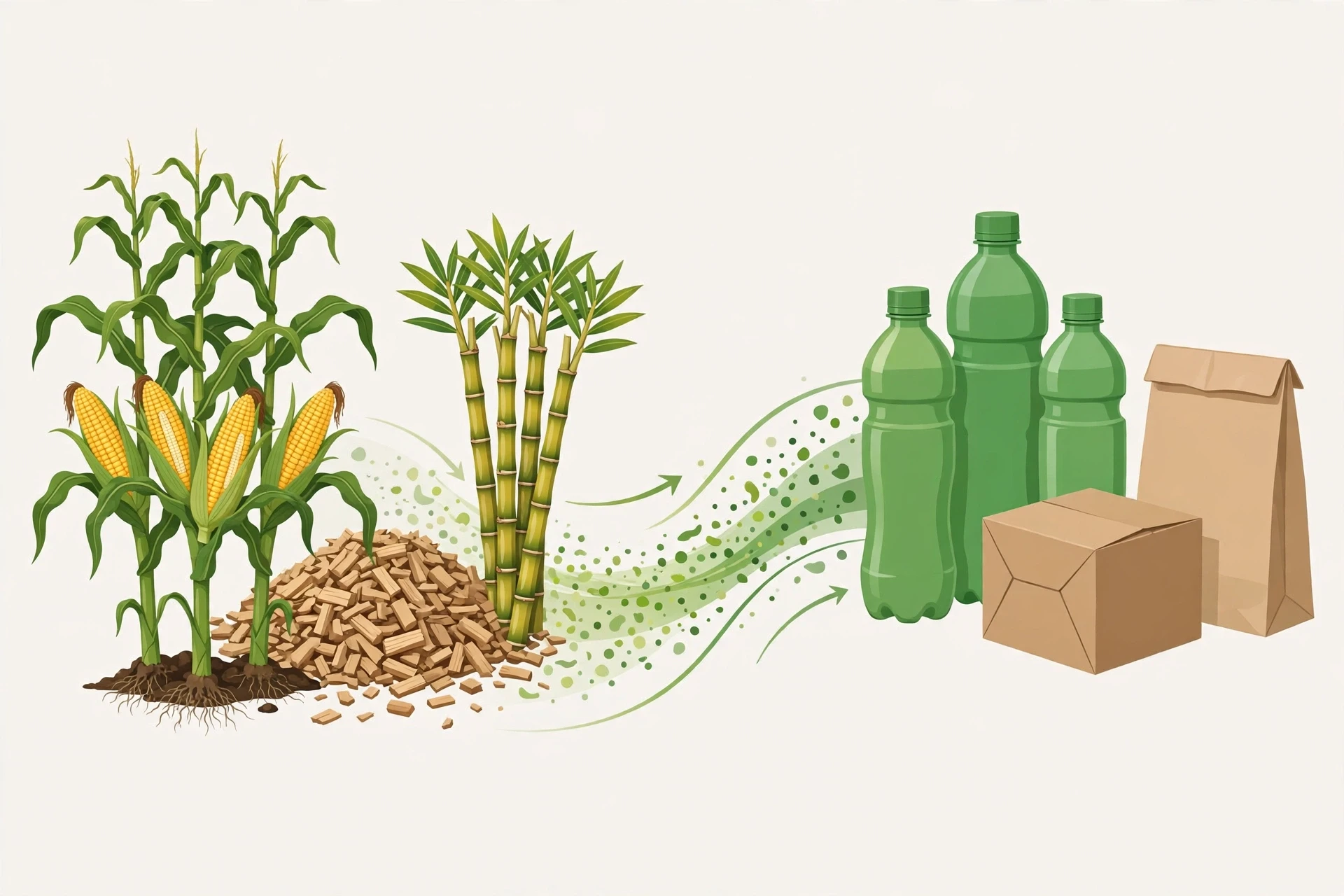
There is an honest complication here that a good article should not hide. Growing feedstocks takes land, and land used for chemicals is land not used for food or for forest. A plastic made from corn grown on land cleared from rainforest is not obviously greener than a plastic made from oil. That is why Principle 7 says "whenever technically and economically practicable", and why the best renewable feedstocks are often wastes and residues rather than crops grown for the purpose. Green chemistry does not promise that every renewable choice is good. It promises a framework for asking the question — and for noticing when the answer is no.
12. Principle 8: Reduce Derivatives
Principle 8 is the most technical of the twelve, and the one that students often find hardest to love. It says that unnecessary derivatisation — the use of blocking groups, protection and deprotection, and temporary modification of physical or chemical processes — should be minimised or avoided if possible, because such steps require additional reagents and can generate waste. In plain language: do not add extra steps to a synthesis unless you really have to.
To see why this matters, imagine building a house and painting every wall before the roof goes on, then covering the paint with plastic sheeting so it does not get damaged, then removing the sheeting at the end. The sheeting was necessary only because of the order you chose. In chemistry, a "protecting group" is that plastic sheeting: a temporary chemical group attached to one part of a molecule to stop it reacting while another part is changed, and then removed afterwards. The protecting group is not part of the final product. It is bought, attached, and thrown away — and the steps to attach and remove it use reagents, solvents, energy and time, and generate waste at every stage.
Skilled chemists have always tried to avoid protecting groups where they can, by choosing reactions that are selective enough to change only the part of the molecule they want to change. Green chemistry makes that instinct a principle, and asks for it to be applied systematically. The fewer steps a synthesis has, the less waste it makes, the less energy it uses, and the fewer chances there are for something to go wrong. That is also why the ibuprofen redesign was so effective: cutting six steps to three did not just save time. It removed whole stages of waste, solvent and energy use.
13. Principle 9: Use Catalysis
If there is one principle that chemists love most, it is probably this one. Principle 9 says that catalytic reagents — as selective as possible — are superior to stoichiometric reagents. A catalyst is a substance that speeds up a reaction without being consumed by it. A stoichiometric reagent is consumed: you need a full amount of it, molecule for molecule, and it ends up in the waste. The difference is the difference between hiring a guide who walks the path with you and returns home, and hiring a porter who carries your bag and is left behind at the end.
Catalysts work by lowering the energy barrier of a reaction, so that it runs faster at lower temperatures, or runs at all where it would otherwise barely proceed. Enzymes are the most spectacular catalysts in nature: the proteins in your body that break down food, copy DNA and build new molecules, each one performing its reaction thousands of times a second, at body temperature, in water, with exquisite selectivity. Industrial catalysts are cruder, but the idea is the same — a small amount of the right material, used again and again, replacing a large amount of a reagent that would be thrown away after one use.
The ibuprofen story is a catalysis story, and so are many of the great successes of green chemistry. The production of many medicines, plastics and fine chemicals has been transformed by replacing stoichiometric reagents with catalysts: hydrogenation with a metal catalyst instead of a metal reagent that ends up as waste, oxidation with air and a catalyst instead of a chromium reagent that ends up as toxic sludge, and polymerisation with a catalyst that builds long chains from small molecules with almost no waste. Each switch cuts waste, cuts cost, and often improves the product.
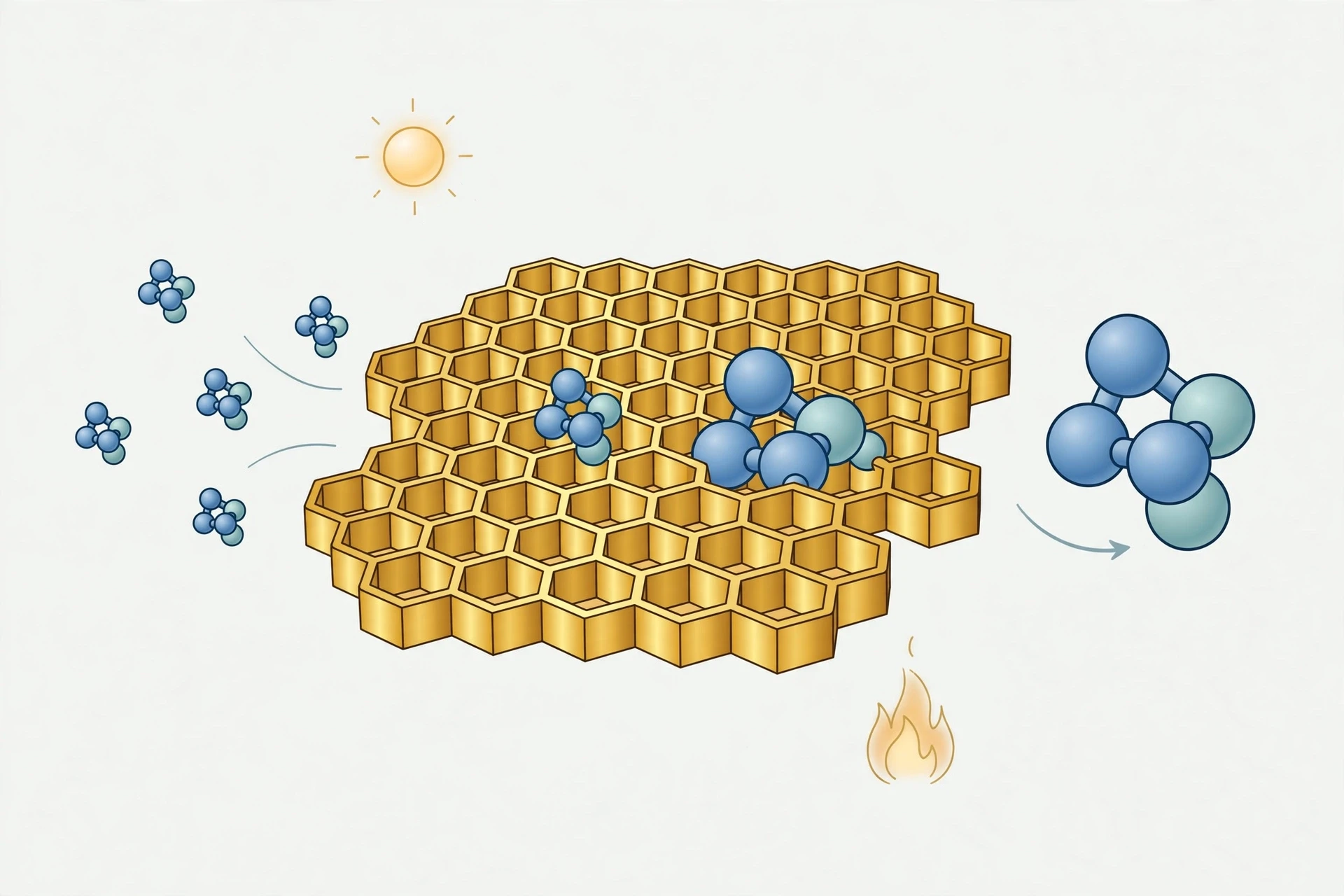
Catalysis also connects directly to energy efficiency, Principle 6: a reaction that needs high heat without a catalyst may run at room temperature with one — no small saving when the reaction runs in a vessel the size of a house, day after day. Lower temperatures and pressures also mean lower risks, which connects catalysis to Principle 12. One good catalyst can satisfy three principles at once, which is why catalyst research is one of the busiest areas of green chemistry.
There is a catch, and it is worth stating plainly. Some catalysts are made from rare and expensive metals, such as platinum, palladium and rhodium, and mining those metals has its own environmental cost. A catalyst that is used once and thrown away is not much better than a stoichiometric reagent. The greenest catalysts are the ones that are recovered and reused many times, or that are made from abundant materials such as iron, or that are enzymes grown by microbes rather than mined from the earth. The principle does not say "use any catalyst". It says use catalysts, selectively, and use them well. The selectivity matters: a catalyst that makes only the product you want, and none of the side products you do not want, is worth far more than a fast catalyst that makes a mess.
For anyone who wants to understand why reactions run at the speeds they do, and what controls those speeds, Sciory's guide to chemical reactions explains reaction types and kinetics in detail. Catalysis is, at its heart, a story about kinetics — about lowering the hill a reaction has to climb, rather than pushing it harder up the same hill.
14. Principle 10: Design for Degradation
Principle 10 looks at the end of a product's life, which is the part of the story that chemistry has historically ignored. It says that chemical products should be designed so that at the end of their function they break down into innocuous degradation products and do not persist in the environment. A product that works perfectly for a week and then lingers in a river for a century is not a well-designed product. It is a product whose designer stopped thinking too soon.
The classic example is plastic. Conventional plastics are designed to last: they resist heat, water, sunlight and microbes, which is exactly what makes them useful — and exactly what makes them a problem when they are thrown away. A plastic bag that survives for decades in the ocean is doing its job too well. Principle 10 asks for the opposite: a material that is tough while you need it and harmless when you do not. Biodegradable plastics made from plant starch, for example, can break down in composting conditions into water and carbon dioxide. They are not a solution for every use — a biodegradable plastic would be a terrible material for a water pipe — but for short-lived packaging, they match the product's lifetime to its useful life.
The same thinking applies to pesticides, detergents and medicines. A pesticide that kills pests and then breaks down in sunlight within days is far better than one that lingers in soil for years, building up in food chains. A detergent that breaks down in a sewage treatment plant is far better than one that survives into a river and foams on the surface. A medicine that is broken down by the body and by microbes in wastewater is far better than one that passes unchanged into rivers, where it can affect fish and other wildlife. In each case the designer is asked to think about the afterlife of the molecule, not just its working life.
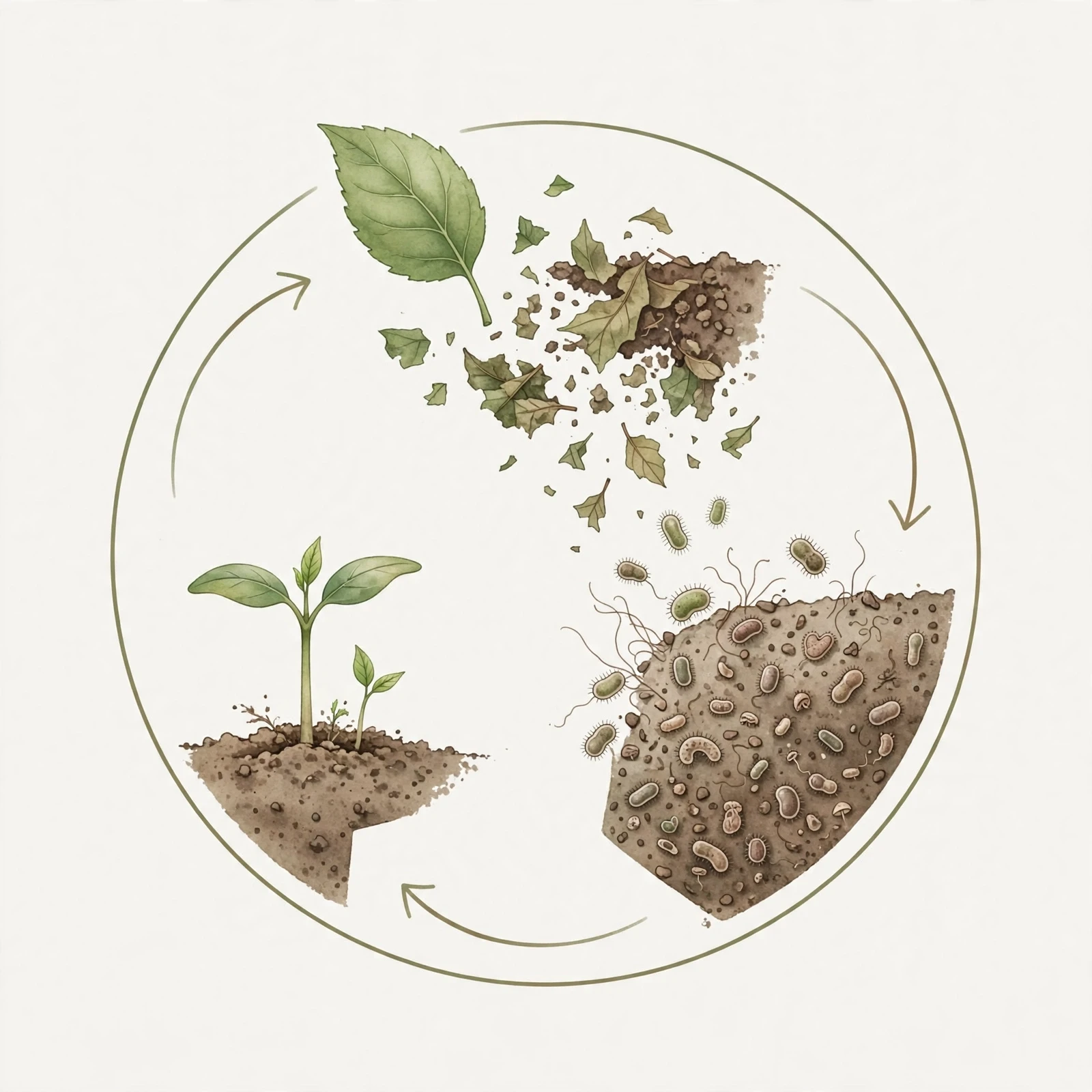
Designing for degradation is harder than it sounds, because the features that make a molecule break down easily are often the same features that make it less stable while it is being used. A plastic that degrades in sunlight will also degrade on a sunny shelf. A pesticide that breaks down in rain will also wash away in the first shower. The chemist's job is to find the balance: stable enough to work, fragile enough to disappear. That balance is different for every product, and finding it is one of the most creative challenges in green chemistry.
15. Principle 11: Real-Time Analysis for Pollution Prevention
Principle 11 is the one that sounds most like engineering, and it is the one that modern technology has made most powerful. It says that analytical methodologies need to be further developed to allow for real-time, in-process monitoring and control prior to the formation of hazardous substances. In plain language: do not wait until the end of a reaction to find out what went wrong. Watch the reaction while it is running, and stop or adjust it before the waste is made.
The traditional way of doing chemistry is to run a reaction, wait, take a sample, analyse it, and then discover that something went wrong hours ago. By that time the batch may be ruined, the waste already made, and the only option is to throw it away and start again. Real-time monitoring changes that. Sensors inside a reaction vessel can track temperature, pressure, acidity and the concentration of key chemicals as they change, second by second. If the reaction starts to go off course — if a by-product begins to form, or the temperature climbs too high — the system can sound an alarm, add a reagent, cool the vessel, or stop the reaction before the problem becomes waste.
This is the same idea as a smoke alarm, applied to chemistry. A smoke alarm does not put out a fire. It tells you about the fire early enough that you can. Real-time analysis does the same for a chemical process: it gives the chemist information early, when it is still useful, instead of late, when it is only a record of what went wrong. The Yale Center for Green Chemistry and Engineering, which works on exactly these kinds of problems, describes green chemistry as chemistry that is designed to be sustainable from the start — and monitoring is one of the tools that makes that design possible in practice.
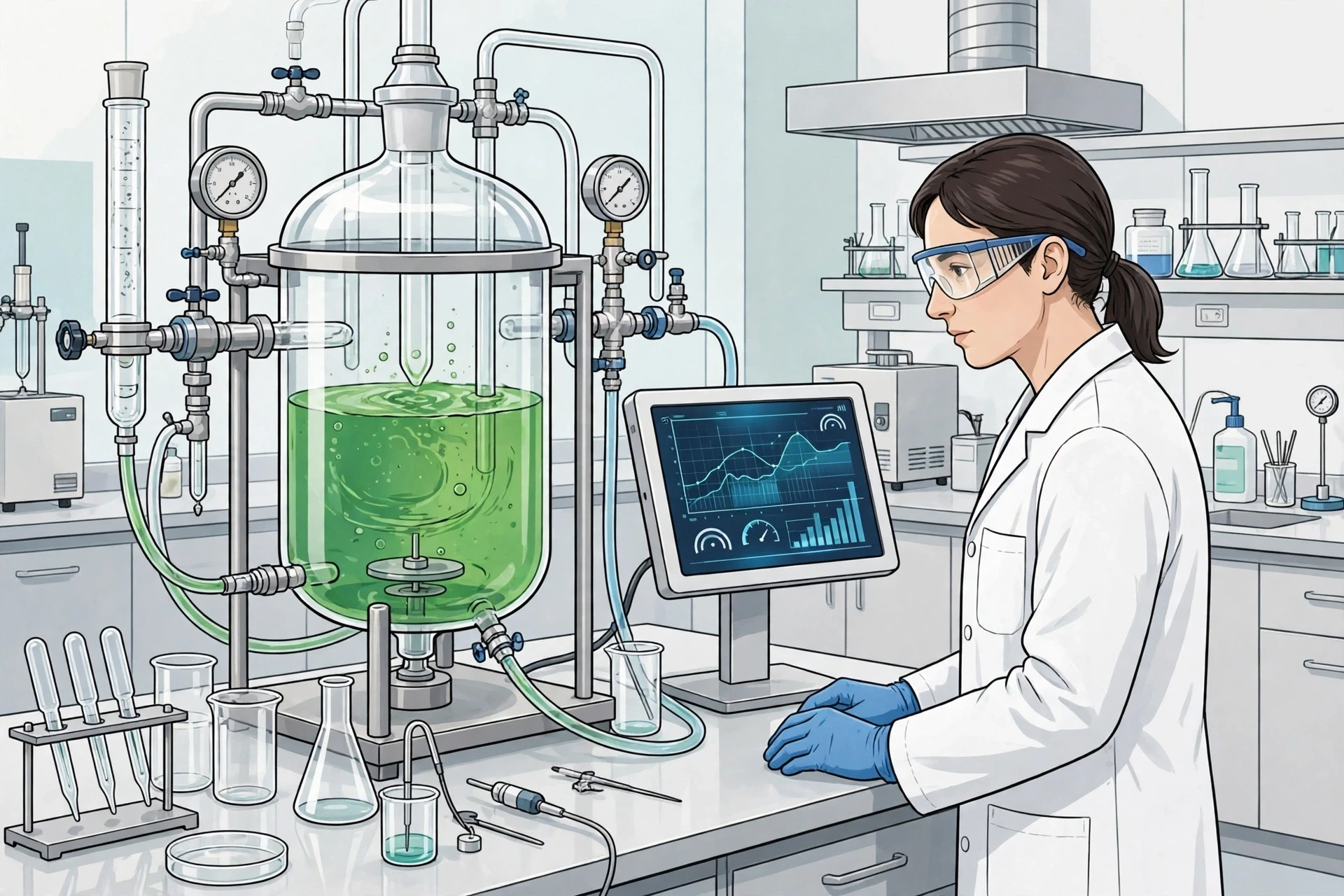
There is a human side to this principle too. A plant that is monitored in real time is a safer plant to work in: a runaway reaction caught in its first minute is a scare, while the same reaction caught an hour later is a disaster. Principle 11 is not only about pollution. It is about the people standing next to the vessel, and giving them the information they need to stay safe.
16. Principle 12: Inherently Safer Chemistry for Accident Prevention
The twelfth principle is the one that was written in the shadow of disasters. It says that substances and the form of a substance used in a chemical process should be chosen to minimise the potential for chemical accidents, including releases, explosions and fires. The key word is "inherently". It is not about adding more safety equipment, more alarms, more protective gear — though all of those matter. It is about choosing chemistry that is safe by its nature, so that even when something goes wrong, the consequences are small.
The difference between inherent safety and added safety is the difference between a candle and a gas stove with a safety valve. The valve is good engineering, and it should be there. But the candle is inherently safer, because even if it falls over, it cannot release a roomful of gas. In chemistry, the equivalent choices are everywhere: using a liquid instead of a gas, so that a leak spreads slowly rather than filling a room; using a dilute solution instead of a concentrated one, so that a spill is a mess rather than a disaster; using a solid instead of a liquid, so that it cannot spill at all; running a reaction at low pressure instead of high, so that a vessel failure is a leak rather than an explosion.
History gives this principle its urgency. The chemical industry has seen accidents that killed thousands, and in every case the investigation found the same pattern: a hazardous substance, stored in large amounts, under conditions where a single failure could release it all at once. Inherently safer chemistry asks whether the hazardous substance needed to be there at all, in that amount, in that form. Could the process use a smaller inventory, so that a leak releases litres instead of tonnes? Could it use a safer substitute? Could it generate the hazardous substance only when needed, in small amounts, instead of storing it in a giant tank? These are design questions, and they are the questions Principle 12 exists to force.
The safest accident is the one that cannot happen. Inherently safer chemistry does not add more guards around a danger — it removes the danger, or shrinks it until the worst case is a small one.
Inherent safety also connects back to almost every other principle. A process that uses less hazardous syntheses (Principle 3) is inherently safer. A process that runs at room temperature and pressure (Principle 6) is inherently safer. A process that uses water instead of a flammable solvent (Principle 5) is inherently safer. A process that is monitored in real time (Principle 11) catches problems before they become accidents. The twelfth principle is, in that sense, the summary of the other eleven: a process that follows them all is a process in which accidents are hard to have and small when they happen. That is the goal the whole list is working towards.
17. Green Chemistry in the Real World
The principles are not abstract. They are already at work in products and factories, often without any label telling you so. The redesigned ibuprofen synthesis is one example. Supercritical carbon dioxide is another: it decaffeinates coffee and dry-cleans clothes without the toxic solvents those jobs once required. Water-based paints have replaced solvent-based paints in much of the market, cutting the fumes that once filled a freshly painted room. Enzymes, the catalysts nature invented, are now used in laundry detergents that work in cold water, saving the energy of heating every wash.
The EPA's Safer Choice programme recognises products whose ingredients meet strict safety criteria, and its Safer Choice pages explain what the label means and how products qualify — one of the few supermarket labels backed by a real standard rather than a marketing department. Bioplastics made from plant starch are used for cups, cutlery and packaging that can break down in composting conditions. In pharmaceutical factories, solvent recovery and catalytic processes have cut waste per kilogram of medicine dramatically over the past two decades, driven as much by cost as by principle: when the greener way is also the cheaper way, it does not need persuading.
None of these examples is perfect, and a good scientist should say so. Water-based paints took years to match the durability of solvent-based ones. Bioplastics need the right composting conditions to break down. Supercritical carbon dioxide needs expensive equipment. But each one shows the principles working in the real world, at real scale, for real customers. Green chemistry is not a promise about the future. It is a description of things that are already happening, and a challenge to do more of them.
18. What Green Chemistry Cannot Do
Honesty requires a section on limits. Green chemistry is powerful, but it is not magic, and the people who practise it are the first to say so. The first limit is that not every reaction has a green route yet. Some molecules can only be made with hazardous reagents, or at high temperatures, or with solvents that are hard to replace. In those cases the principles guide chemists towards the least bad option, not towards a perfect one — and towards research that might find a better route tomorrow.
The second limit is trade-offs. A renewable feedstock that needs farmland competes with food. A biodegradable plastic that breaks down in a composter may not break down in the sea. A catalyst made from a rare metal carries the cost of mining that metal. A process that runs at room temperature may take ten times longer, and time is energy and money too. Green chemistry does not remove trade-offs. It makes them visible, so that they can be weighed honestly instead of ignored.
The third limit is that "green" is easy to claim and hard to verify. A product can be labelled natural, eco-friendly or green without meeting any standard at all. That is why the principles matter as a test: a genuine claim should be able to say which principles it follows and how. Does it prevent waste, or just recycle it? Does it use a safer solvent, or just a different toxic one? Does the product break down, and under what conditions? If a claim cannot answer those questions, it is marketing, not green chemistry. Most people assume that a product labelled "green" has been checked by someone. What the evidence actually shows is that, in many countries, nobody has checked at all — and the label is only as honest as the company that printed it.
19. How to Spot Real Green Chemistry
You do not need a chemistry degree to use the principles. When you buy a cleaning product, a paint or a plastic item, a few questions will take you a long way. What is the solvent — water, or something with a hazard warning? Does the product carry a recognised label, such as the EPA's Safer Choice mark, rather than a vague green leaf drawn by the manufacturer? Does the company say what the product breaks down into, and where? And does the packaging tell you anything at all, or does it only tell you how wonderful the product is?

The best sign of all is specificity. A company that says "made with 80 percent less solvent waste, using water as the solvent" is making a checkable claim. A company that says "eco-friendly formula" is saying nothing. The twelve principles give you the vocabulary to tell the difference, and that vocabulary is useful far beyond the chemistry lab. It is a way of reading the world: not asking whether something is perfectly green, but asking in which direction it is moving, and whether the movement is real.
20. Frequently Asked Questions
What is green chemistry?
Green chemistry is the design of chemical products and processes that reduce or eliminate the use and generation of hazardous substances. It works at the design stage, before a reaction is run: choosing safer starting materials, preventing waste, using less energy, and designing products that break down harmlessly when their job is done. It is guided by twelve principles published by Paul Anastas and John Warner in 1998.
What are the 12 principles of green chemistry?
The twelve principles are: prevent waste; maximise atom economy; design less hazardous syntheses; design safer chemicals; use safer solvents and auxiliaries; design for energy efficiency; use renewable feedstocks; reduce derivatives; use catalysis; design for degradation; use real-time analysis for pollution prevention; and design inherently safer chemistry for accident prevention. Together they form a checklist for judging whether a chemical process is genuinely greener than the one it replaces.
What is atom economy?
Atom economy is the fraction of the atoms in the starting materials that end up in the desired product, expressed as a percentage. It is calculated from the balanced chemical equation: divide the mass of the atoms in the product by the total mass of all the reactants, and multiply by one hundred. A reaction in which two molecules join together with nothing left over has an atom economy near 100 percent. A reaction that throws away a large leaving group has a much lower atom economy, even if its yield is high.
How is green chemistry different from environmental chemistry?
Environmental chemistry studies what chemicals do once they are already in the environment — how pollutants move, break down and affect living things. Green chemistry tries to prevent those problems at the design stage, by making products and processes that use and generate fewer hazardous substances in the first place. One measures and understands existing problems; the other redesigns chemistry so fewer problems are created.
Is green chemistry the same as sustainable chemistry?
The two terms overlap and are often used interchangeably, but sustainable chemistry is the broader idea. It covers the whole system — energy, economics, resources and social effects — while green chemistry is the chemistry piece of that system: the design of safer products and processes. A process can follow the twelve principles and still be unsustainable if, for example, it needs vast amounts of farmland. Green chemistry is necessary for sustainable chemistry, but not sufficient on its own.
Can green chemistry make products more expensive?
Sometimes, at first. A greener solvent or a new catalyst can cost more than the established alternative, and redesigning a factory is expensive. But greener processes often become cheaper over time, because they use less raw material, produce less waste to dispose of, need less energy, and carry lower safety and insurance costs. Many of the most successful green redesigns — including the ibuprofen process — were adopted because they saved money, not only because they were greener.
How can I learn more about green chemistry?
A good starting point is the American Chemical Society's page on the twelve principles of green chemistry, which gives the principles in full. The EPA's basics of green chemistry explains the field in plain language, and the LibreTexts page on the basics of green chemistry works through the principles with examples. The Yale Center for Green Chemistry and Engineering also publishes research and teaching material on the subject.