

I was nine years old when a metal spoon taught me chemistry. My grandmother was stirring a pot of soup on the stove, and I grabbed the spoon she had left leaning against the side of the pot. The handle was hot enough to make me drop it with a yelp. A minute later I picked up the wooden spoon sitting beside it, in the same pot, in the same soup, and it was barely warm. Same soup, same heat, two completely different results. I did not know the words for it then, but I had just met the two great families of the elements: metals and nonmetals. The metal spoon had carried the heat straight up its handle to my hand. The wooden spoon, made mostly of non-metal elements, had refused to pass it along.
That small kitchen accident holds the whole subject in miniature. Everything around you — the chair you sit on, the phone in your pocket, the air you breathe, the water you drink — is built from about ninety naturally occurring elements, and nearly all of them fall into one of two camps. Metals and nonmetals behave so differently that you can usually tell them apart by touch, by sight, and by what happens when you heat them, hit them, or drop them in water. Yet the line between them is not a wall. It is a sloping borderland, with a handful of in-between elements that borrow habits from both sides, and with trends that shift smoothly as you move across the periodic table. This article is a deep dive into the properties of metals and nonmetals and the periodic trends behind them — the companion piece to Sciory's guide to the Periodic Table of Elements: Structure and Trends, which maps the table itself. Here we look at what the elements actually do.
1. Two Families Under One Roof
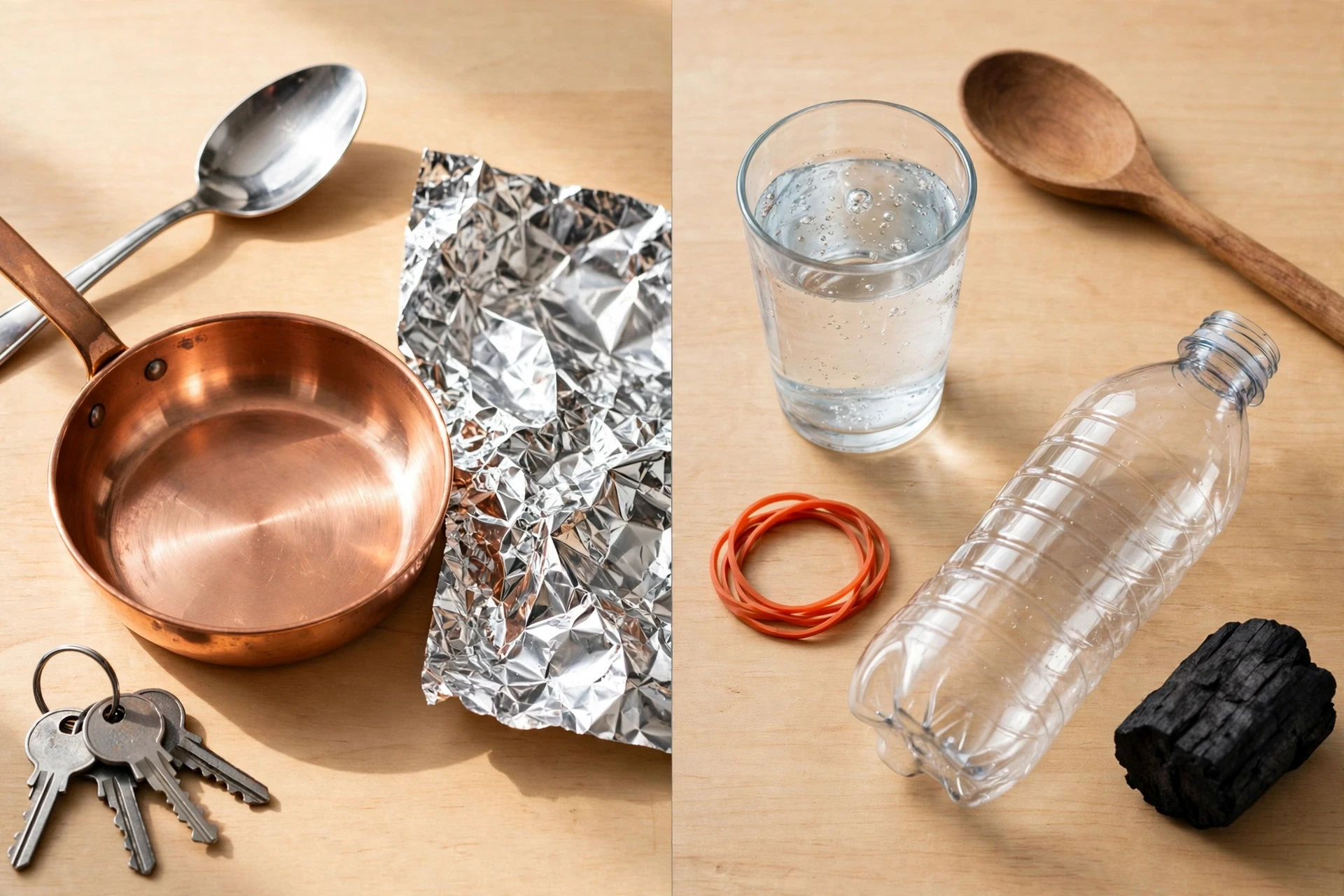
Look around the room you are sitting in and sort what you see into two piles. In the first pile go the things that shine when light hits them: the steel legs of a chair, the copper wiring hidden in the walls, the aluminium frame of a window, the gold ring on someone's finger, the iron nails holding the floorboards down. In the second pile go the things that do not shine: the wooden table, the glass window, the plastic keyboard, the rubber soles of your shoes, the cotton of your shirt, the air itself. The first pile is the world of metals. The second is the world of nonmetals, with a few mixtures and compounds thrown in for good measure.
Chemists count roughly ninety-two elements that occur in nature, and about three quarters of them are metals. That surprises most people, because the nonmetals are the ones we meet most intimately: oxygen and nitrogen make up almost all the air we breathe, carbon is the backbone of every living thing, hydrogen and oxygen together make water, and sulphur, phosphorus and chlorine turn up in our bodies, our food and our cleaning products. Metals dominate the table by number, but nonmetals dominate daily life by weight of experience. We live inside nonmetals and build with metals.
The split is not just a sorting exercise. It runs through the whole of chemistry, because metals and nonmetals behave in opposite ways at the level of electrons. Metals tend to lose electrons when they react. Nonmetals tend to gain or share them. That single difference explains why a copper wire carries electricity and a rubber cord insulates it, why iron rusts and gold does not, why salt dissolves into charged particles in water and why diamond, pure carbon, is the hardest natural material known. Once you see the electron story, the properties stop looking like a random list and start looking like consequences.
There is a catch, and it is worth stating early: the border between the two families is fuzzy. A small group of elements sits on the fence, and even the clearest members of each family break the rules now and then. Mercury is a metal, yet it is a liquid at room temperature. Graphite, a form of carbon and therefore a nonmetal, conducts electricity well enough to be used in electrodes. Hydrogen, the lightest element, sits at the top of the table looking like it belongs with the metals, but it behaves like a nonmetal in almost every reaction. These exceptions are not flaws in the classification. They are the interesting parts, and they are where the deepest understanding lives.
2. What Is the Difference Between Metals and Nonmetals?
The shortest honest answer is that metals and nonmetals differ in how their atoms hold on to electrons, and everything else follows from that. A metal atom holds its outermost electrons loosely, like a person holding a handful of marbles with an open palm. Those electrons can slip away, drift through the material, and carry energy with them. A nonmetal atom holds its outermost electrons tightly, or actively pulls in extra ones, like a person clutching marbles in a closed fist. That grip shapes every property you can measure: shine, hardness, conductivity, melting point, and chemical behaviour.
Start with the properties you can see and feel. Metals are lustrous, which is the scientific word for shiny: a freshly cut piece of metal reflects light in a way that wood, plastic and stone do not. Metals are malleable, meaning they can be hammered into thin sheets without breaking — gold can be beaten so thin that a single gram covers a square metre. Metals are ductile, meaning they can be pulled into wires; a copper wire in your wall began life as a solid block of copper. Metals are usually hard and dense, and most of them melt only at high temperatures. Nonmetals are the opposite on almost every count: dull rather than shiny, brittle rather than malleable, poor conductors of heat and electricity, and often gases or soft solids at room temperature.
The chemical differences run deeper. When metals react, they usually lose electrons and form positive ions. When nonmetals react, they usually gain electrons and form negative ions, or share electrons with another atom in a covalent bond. Put a metal and a nonmetal together and you often get an ionic compound — a salt — in which the metal has handed electrons to the nonmetal. Sodium, a soft metal that bursts into flame in water, hands an electron to chlorine, a poisonous green gas, and the result is ordinary table salt. That transformation, from two dangerous elements to something you sprinkle on food, is one of the most dramatic stories in chemistry, and it is entirely a story about metals and nonmetals trading electrons.
The table below gathers the classic contrasts in one place. Treat it as a guide to typical behaviour, not a law without exceptions — the exceptions are real, and later sections deal with them head on.
Property | Metals (typical) | Nonmetals (typical) |
|---|---|---|
Appearance | Lustrous, shiny when freshly cut | Dull, no metallic shine |
Electrons in reactions | Lose electrons, form positive ions | Gain or share electrons, form negative ions or covalent bonds |
Electrical conductivity | Good conductors | Poor conductors (insulators), graphite excepted |
Heat conductivity | Good conductors of heat | Poor conductors of heat |
Malleability and ductility | Malleable and ductile | Brittle when solid, cannot be drawn into wire |
Density and hardness | Usually dense and hard | Usually low density, soft or gaseous |
Melting and boiling points | Usually high | Usually low |
State at room temperature | Solid, except mercury | Solid, liquid or gas |
Oxides | Usually basic oxides | Usually acidic oxides |
Examples | Iron, copper, aluminium, gold, sodium | Oxygen, carbon, nitrogen, sulphur, chlorine |
Notice what the table leaves out: any mention of colour, or of how common an element is, or of whether it is useful. Colour does not sort metals from nonmetals — sulphur is bright yellow and copper is reddish, while lead is dull grey and carbon can be black or, as diamond, colourless. Usefulness does not sort them either — both families are essential. The sorting works because of electrons, and the rest of this article follows that thread wherever it leads.
3. The Periodic Table's Great Divide
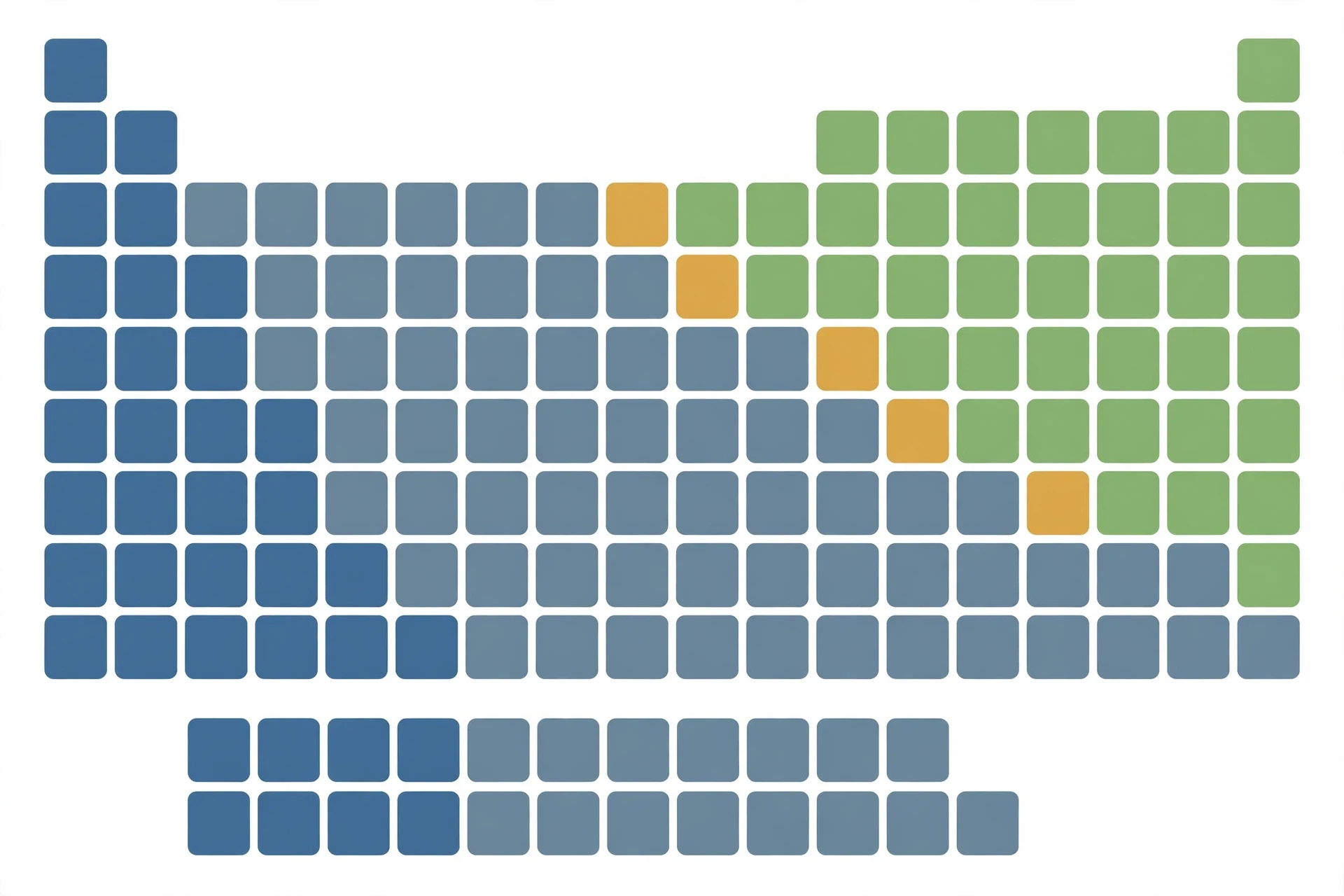
If you want to see the split between metals and nonmetals at a glance, look at a periodic table. Metals occupy the left side and the centre — a great block that covers most of the table. Nonmetals huddle in the upper right corner. Between them runs a jagged staircase, a diagonal line stepping down from boron to astatine, and along that staircase sit the metalloids, the in-between elements. The LibreTexts guide to metals, nonmetals and metalloids describes this arrangement clearly, and once you have seen it, you can read a surprising amount of chemistry straight off the map.
The geography is not an accident. It reflects atomic structure. As you move from left to right across a row of the table, each atom gains one more proton in its nucleus and one more electron in its outer shell, and the nucleus pulls those electrons in more tightly. Atoms on the left have only one or two outer electrons and hold them loosely, so they give them up easily — the behaviour of metals. Atoms on the right have nearly full outer shells and a strong pull on electrons, so they grab extras — the behaviour of nonmetals. The staircase is simply the place where the balance tips.
Hydrogen is the famous misfit on this map. It sits alone at the top left, above the metals, because it has one electron like the alkali metals below it. But hydrogen is a colourless gas that forms covalent bonds and gains electrons to become a hydride ion, so in practice it behaves as a nonmetal. Some tables park it at the top left out of tradition; others float it above the whole table, or place it in two positions at once. The honest answer is that hydrogen belongs to neither family comfortably, and that is fine — the table is a tool for seeing patterns, not a set of prison cells.
The noble gases deserve a note here too. Helium, neon, argon and their relatives sit in the far right column, and they are nonmetals, but they are nonmetals that barely react with anything at all. Their outer shells are full, so they have no reason to gain, lose or share electrons. They are the exception that proves the rule in reverse: their non-reactivity comes from the same electron logic that makes other nonmetals reactive. A full shell is content, and a content atom does nothing.
3.1 Reading the map: groups that matter
A few groups on the table are worth knowing by name, because they show the two families at their most extreme. Group 1, the alkali metals — lithium, sodium, potassium, rubidium, caesium — are the softest, most reactive metals. They are so eager to lose their single outer electron that they must be stored under oil, away from air and water. Group 2, the alkaline earth metals — magnesium, calcium, strontium — are a little less frantic, but still unmistakably metallic. On the other side, Group 17, the halogens — fluorine, chlorine, bromine, iodine — are the most reactive nonmetals, hungry for exactly one more electron to complete their shells. Group 18, the noble gases, are the unreactive ones. The middle of the table holds the transition metals — iron, copper, nickel, gold, silver — the workhorses of industry, less reactive than the alkali metals but far more useful for building things that last.
Notice the pattern: reactivity is highest at the edges and lowest in the middle and the far right. That pattern is the periodic table doing its job. The table was built to reveal exactly these rhythms, and the metals and nonmetals split is the broadest rhythm of all. For the full story of how the table is organised, Sciory's Periodic Table of Elements: Structure and Trends walks through each block and trend in detail.
4. Why Are Metals Good Conductors?
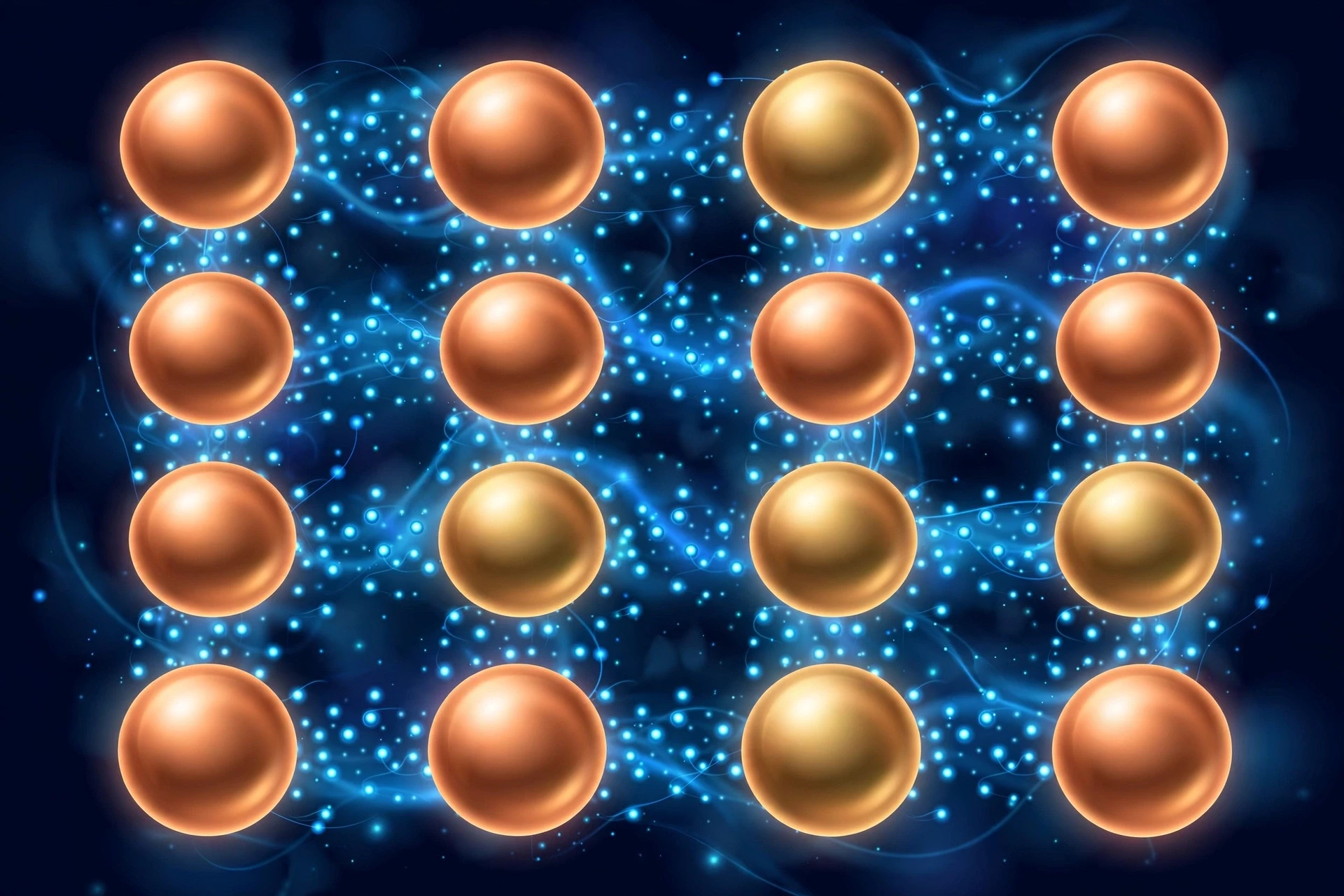
Ask a physicist why a copper wire carries electricity and a rubber cord does not, and the answer comes back to a picture called the sea of electrons. In a metal, the outermost electrons of each atom are not tied to any single atom. They detach and wander freely through the whole piece of metal, like a crowd milling around in a hall rather than people sitting in assigned seats. Chemists call this delocalised electrons, and the metal is held together by the attraction between the positively charged metal ions left behind and this shared sea of negative charge. The model is called metallic bonding, and it explains almost everything metals do.
Electricity is the flow of charge, and a metal is full of charge that is already free to move. Apply a voltage across a copper wire and the sea of electrons drifts in one direction, carrying current with almost no resistance. Heat works the same way: the free electrons pick up kinetic energy at the hot end and carry it to the cold end, which is why a metal spoon left in a hot pan burns your hand while a wooden spoon stays cool. That is the whole story of my grandmother's soup, told in the language of electrons. The OpenStax introduction to ionic bonding sets out how different bonding is when electrons are transferred rather than shared in a sea, and the contrast is the key to this article.
Nonmetals conduct poorly because their electrons are locked in place. In a diamond, every carbon atom shares its electrons in strong covalent bonds with four neighbours, and none of them are free to wander. In a piece of wood, the electrons are tied up in the molecules of cellulose and lignin. In rubber, long tangled polymer chains hold their electrons tightly. With no mobile charge, there is nothing to carry a current, so the material insulates. That is why electricians wear rubber gloves, why power lines hang from ceramic insulators, and why the plastic coating on a wire is as important as the copper inside it.
A metal is a crowd of positive ions swimming in a sea of electrons that belong to no single atom. Give that sea a push and you have electricity. Give it heat and you have conduction. Take the sea away and you have an insulator.
There are two wrinkles worth knowing. First, metals conduct less well when they get hot, because the vibrating ions jostle the flowing electrons and slow them down — the opposite of what happens in semiconductors, which conduct better as they warm. Second, not all metals conduct equally. Silver is the best conductor of all, followed by copper, then gold, then aluminium. Power grids use aluminium despite copper being better, because aluminium is lighter and cheaper, and the choice is an engineering trade-off rather than a physics contest. Silver would be better still, but nobody wires a city in silver.
4.1 What about graphite, the nonmetal that conducts?
Graphite is the exception every textbook mentions, and it is worth understanding rather than memorising. Graphite is pure carbon, a nonmetal, yet it conducts electricity well enough to be used in electrodes, in batteries, and in the brushes of electric motors. The reason is structure. In graphite, each carbon atom bonds strongly to three neighbours in flat sheets, and the fourth outer electron of each atom is left free to drift across the sheet, much like the sea of electrons in a metal. The sheets conduct within their planes but not between them, so graphite is a conductor in two directions and an insulator in the third. Diamond, the other famous form of carbon, bonds each atom to four neighbours with no free electrons at all, and it is one of the best electrical insulators known. Same element, same atoms, utterly different behaviour — the difference is entirely in how the electrons are arranged. For a closer look at how atoms and their bonds are put together, see Sciory's Atoms and Molecules Explained: Structure, Bonding, and States of Matter.
5. Shiny, Bendable, Stretchable: The Physical Personality of Metals
Metals feel different in the hand, and the reasons are all the same sea of electrons at work. Take lustre first. When light strikes a metal, the free electrons absorb the light's energy and immediately re-emit it, which is why a polished metal surface shines and reflects like a mirror. Nonmetals absorb light into their fixed electron arrangements and re-emit little of it, so they look dull. Cut a piece of sodium and the fresh surface flashes silver for a few seconds before the air tarnishes it. That flash is the metal's electrons talking to light.
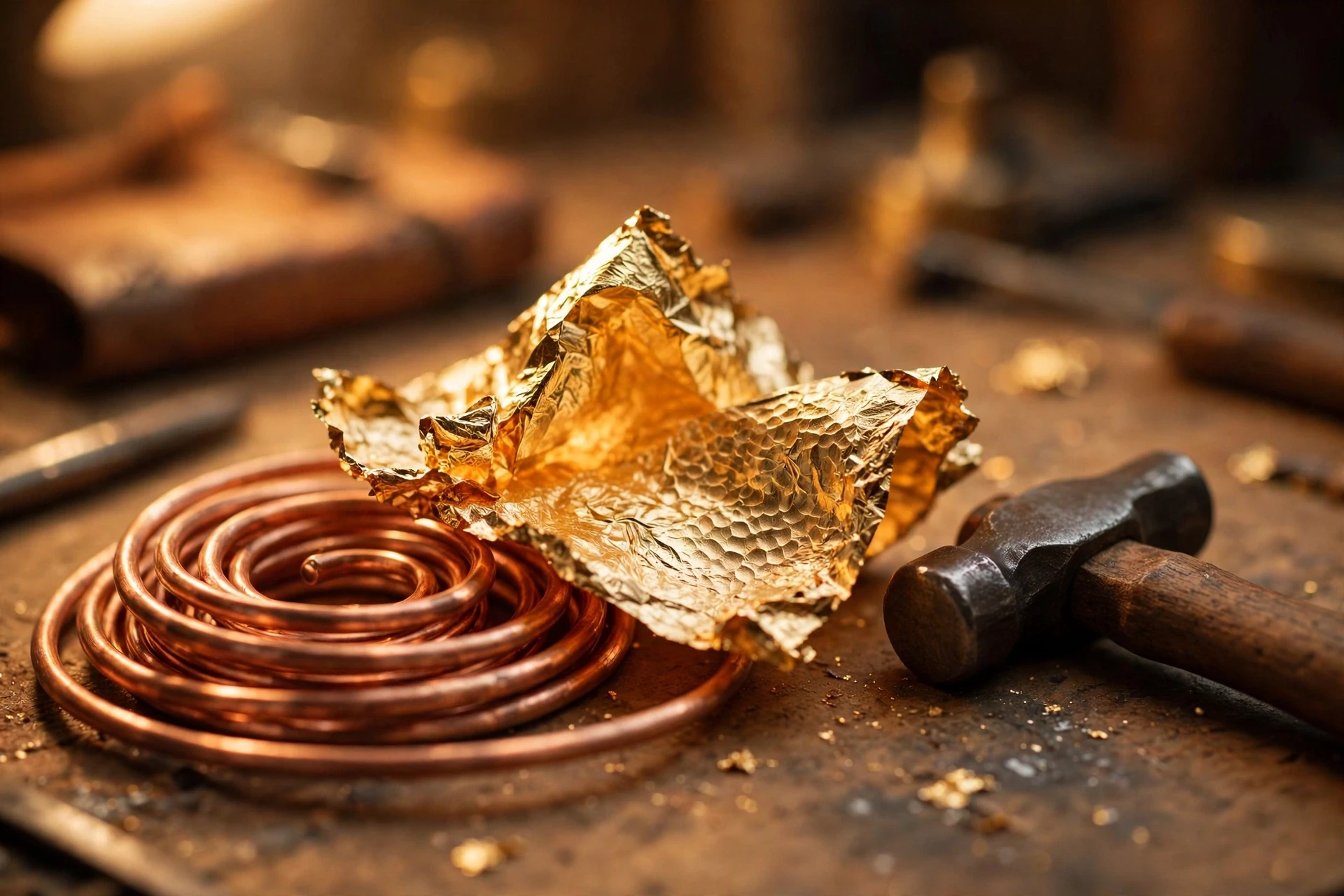
Malleability and ductility are the sea of electrons at work in a different way. Hammer a metal and the layers of ions slide past each other, but the electron sea flows with them and keeps the whole piece bonded — the metal changes shape instead of shattering. Hammer a nonmetal solid like sulphur and there is no electron sea to absorb the movement; the rigid covalent bonds snap, and the piece cracks. Pull a metal and the same sliding lets it stretch into a wire. Gold is the champion here: it is so malleable that it can be hammered into sheets thinner than a human hair, and so ductile that a single gram can be drawn into a wire kilometres long. The gold leaf on temple domes and picture frames is real gold, beaten to a thickness you can see through, and it exists because metallic bonding forgives being reshaped.
Density and hardness vary more than the textbooks suggest. Most metals are dense — iron, copper and lead feel heavy for their size — but lithium, sodium and potassium are light enough to float on water, and they are soft enough to cut with a kitchen knife. At the other extreme, osmium is one of the densest substances known, and tungsten is so hard and heat-resistant that it is used for the filaments of old light bulbs. Nonmetals are usually light: sulphur crumbles between your fingers, phosphorus is waxy and soft, and the gaseous nonmetals have almost no density at all. The pattern is real but ragged, and the ragged edges are where students get tripped up in exams.
Melting points tell a similar story of broad pattern plus sharp exceptions. Most metals melt at high temperatures — iron at around 1,538 degrees Celsius, copper at around 1,085, tungsten at a remarkable 3,422 — because metallic bonds are strong and take a lot of energy to break. Nonmetals usually melt low: sulphur melts at around 115 degrees, and oxygen and nitrogen are gases at room temperature. The exceptions are famous. Mercury melts at about minus 39 degrees and is liquid on an ordinary winter day. Gallium melts in the palm of your hand, at about 30 degrees. On the nonmetal side, carbon in the form of diamond does not melt at all under normal pressure — it simply burns or turns to graphite at extreme heat — and silicon, a metalloid, melts at over 1,400 degrees. The trend is useful, but any rule that says "all metals melt high and all nonmetals melt low" is wrong, and knowing the exceptions is part of knowing the subject.
6. What Metals and Nonmetals Do in Chemical Reactions
If physical properties are the personalities of metals and nonmetals, chemical reactions are their biographies. The central plot is always the same: metals lose electrons, nonmetals gain or share them, and the compounds that result carry the fingerprints of that exchange.
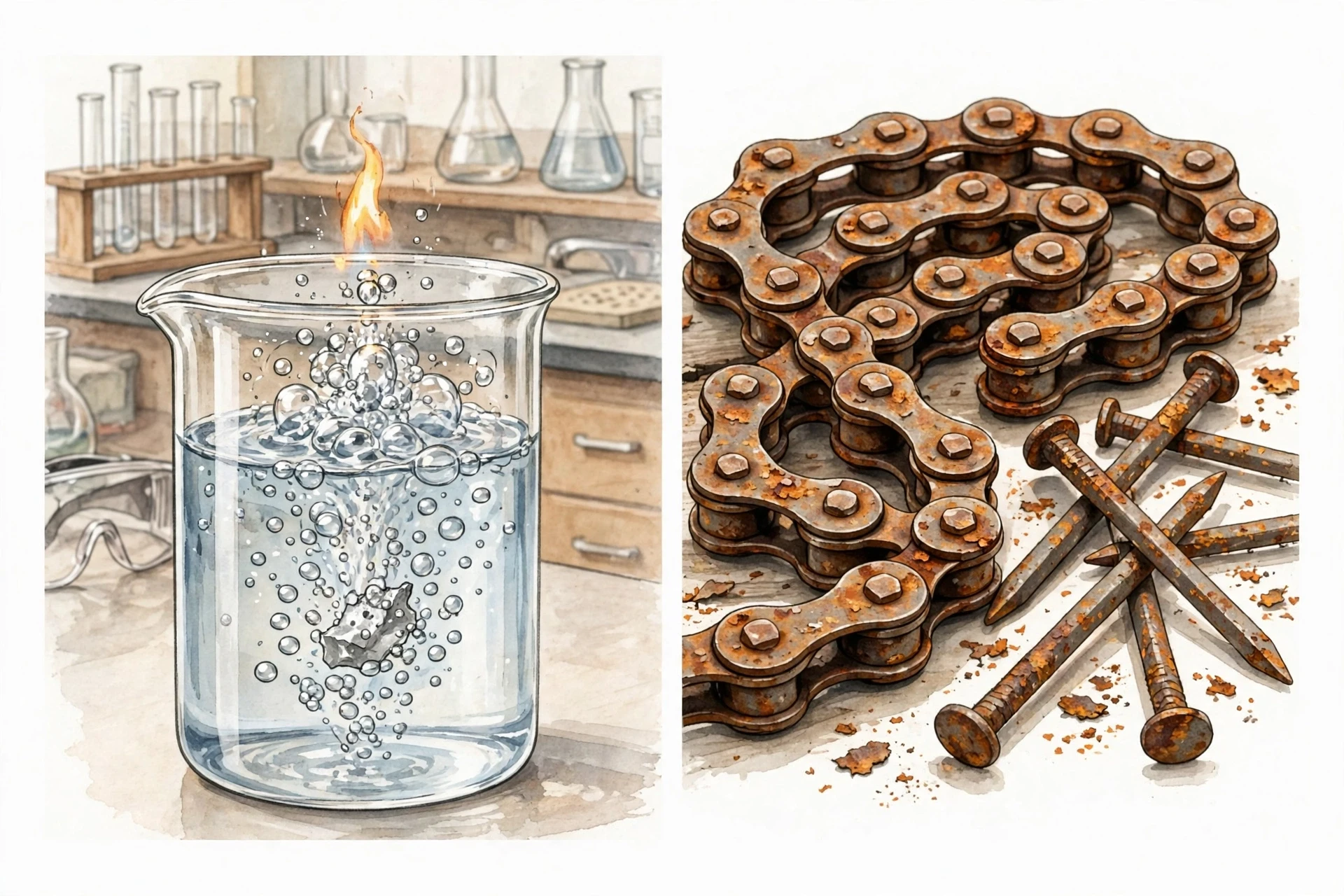
The most vivid demonstration I ever saw was in a school chemistry lesson. The teacher took a piece of sodium the size of a pea, dropped it into a trough of water, and stepped back. The sodium skittered across the surface like a frantic insect, fizzing, spitting sparks, and bursting into a yellow flame before vanishing with a pop. The class gasped, and I remember thinking that something so small had no right to be so violent. The violence had a simple explanation. Sodium has one loosely held outer electron, and water offers it a place to go. The sodium gives up its electron, hydrogen gas is released, the reaction gives off so much heat that the hydrogen catches fire, and sodium hydroxide dissolves into the water. One electron, handed over, and a quiet lump of metal turns into flame and fizz. That is metallic reactivity in its purest form, and it is why alkali metals are stored under oil and handled with tongs.
Not all metals are so eager. Iron reacts with oxygen and water slowly, over weeks and months, and the result is rust — a flaky, reddish-brown hydrated iron oxide that does not protect the metal underneath, so the corrosion eats deeper and deeper. Aluminium also reacts with oxygen, but it forms a thin, hard, transparent layer of aluminium oxide that seals the surface and stops further attack, which is why aluminium window frames and aircraft skins survive decades outdoors without rusting. Copper goes green with age as a layer of copper carbonate forms on its surface, a patina that protects the metal below and gives old statues and rooftops their distinctive colour. Gold and platinum barely react at all, which is why they are found in nature as pure nuggets and why they have been treasured as money and ornament for thousands of years. Reactivity is a spectrum, not a switch, and where a metal sits on that spectrum decides what it is good for.
Nonmetals have their own reactivity story. Oxygen is the great partner of the nonmetals: it reacts with most elements, and the oxides it forms with nonmetals are usually acidic. Burn sulphur in air and you get sulphur dioxide, which dissolves in water to make sulphurous acid. Burn carbon and you get carbon dioxide, which makes rainwater slightly acidic. The oxides of metals, by contrast, are usually basic: dissolve sodium oxide or calcium oxide in water and you get an alkaline solution. This neat split — metal oxides basic, nonmetal oxides acidic — is one of the oldest classification tests in chemistry, and it works because it reflects the same electron logic: metals give electrons to oxygen, nonmetals share them.
When metals and nonmetals meet each other directly, the result is often an ionic compound. Sodium plus chlorine gives sodium chloride. Magnesium plus oxygen gives magnesium oxide. Calcium plus fluorine gives calcium fluoride, the mineral that protects teeth. The metal loses electrons, the nonmetal gains them, and the opposite charges pull the ions into a crystal lattice. When two nonmetals meet, the result is usually a covalent compound: hydrogen and oxygen share electrons to make water, carbon and oxygen share to make carbon dioxide, nitrogen and hydrogen share to make ammonia. The LibreTexts page on chemical bonds and the octet rule explains how atoms reach stable electron arrangements by transferring or sharing, and that single idea — stability through a full outer shell — drives nearly all of it.
6.1 The reactivity series: a practical ranking
Chemists rank metals by how readily they give up electrons, producing the reactivity series: potassium, sodium, calcium, magnesium, aluminium, zinc, iron, lead, copper, silver, gold, from most reactive to least. This list is genuinely useful. A more reactive metal will push a less reactive one out of its compound — drop an iron nail into copper sulphate solution and copper metal plates out onto the nail while the iron dissolves, because iron is more reactive than copper. Drop a copper strip into iron sulphate solution and nothing happens, because copper cannot displace iron. Miners and engineers use this logic every day: aluminium is extracted from its ore by electrolysis because it is too reactive to be won by simple heating with carbon, while copper and iron can be smelted in a furnace. The series is a shortcut to predicting what will happen before you mix anything, and it is worth learning as a tool rather than memorising as a chant.
6.2 Acids, water, and the hydrogen test
A classic laboratory test sorts metals by their reaction with acids and water. Potassium, sodium and calcium react violently with cold water, releasing hydrogen. Magnesium reacts slowly with cold water but vigorously with steam. Zinc, iron and lead react with dilute acids, releasing hydrogen gas and forming a salt. Copper, silver and gold do not react with dilute acids at all — you cannot dissolve a gold ring in hydrochloric acid, which is one reason gold survives burial for thousands of years. Nonmetals, meanwhile, do not release hydrogen from acids, because they have no electrons to give in that way. The fizz of hydrogen is a metal's signature, and the absence of fizz is the nonmetal's.
7. What Are Metalloids?
Between the two great families sits a small group of elements that refuse to pick a side. Boron, silicon, germanium, arsenic, antimony and tellurium — six elements, depending on how strictly you draw the line — are the metalloids, and they borrow properties from both neighbours. They look like metals: silicon is grey and shiny, germanium has a metallic gleam. But they behave like nonmetals in important ways: they are brittle rather than malleable, and they are poor conductors compared with true metals.
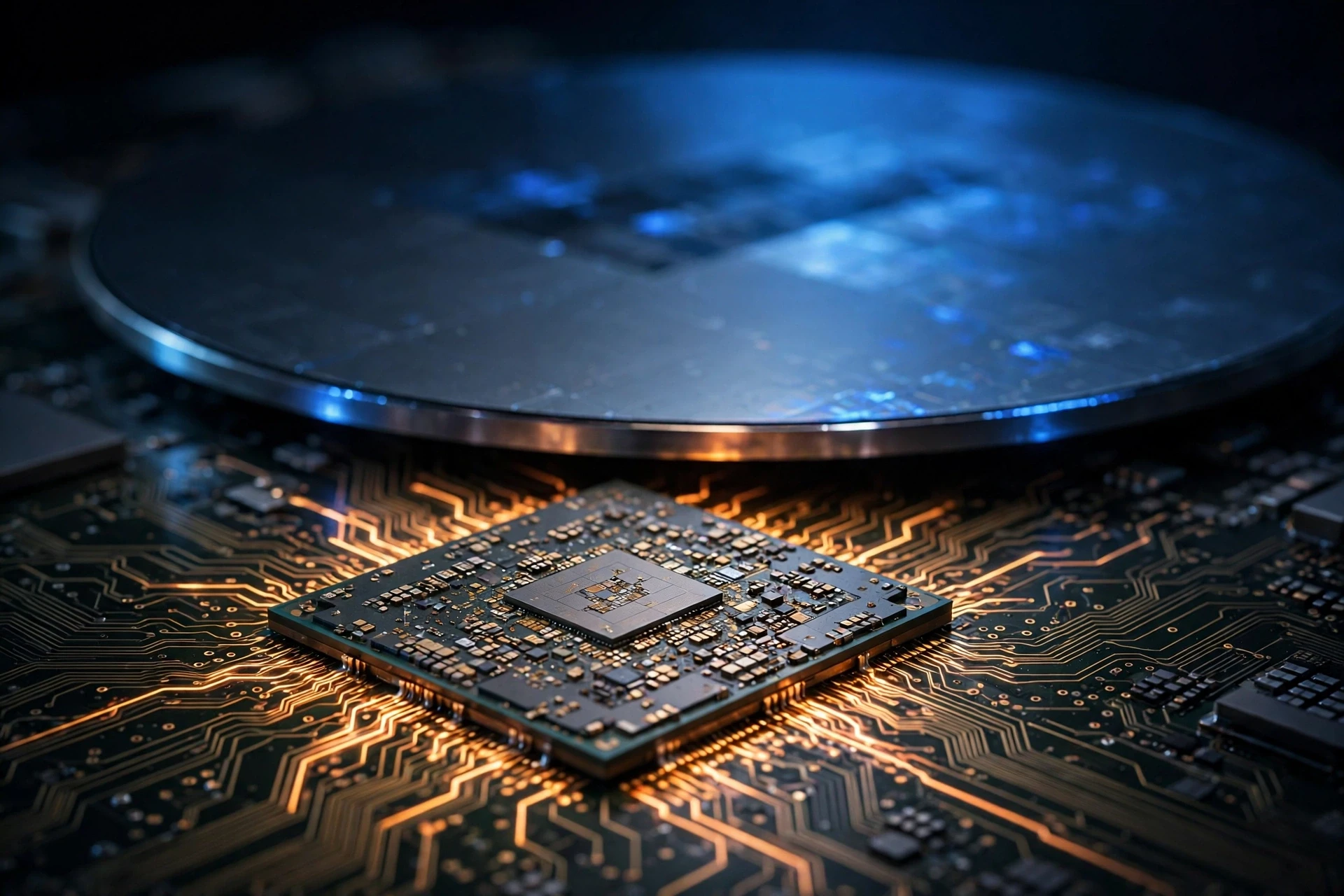
Their most important property is that they are semiconductors. A semiconductor conducts electricity, but only a little, and only under the right conditions. Pure silicon barely conducts at all, but add a tiny, controlled amount of another element — a process called doping — and its conductivity jumps by orders of magnitude. Warm it up and it conducts better, the opposite of a metal. Shine light on it and it generates current, which is how a solar cell works. The entire digital world runs on this in-between behaviour. Every computer chip, every phone, every solar panel depends on silicon, a metalloid that is neither a good metal nor a good nonmetal, but exactly the right mixture of both. There is a pleasing irony in that: the most transformative material of the modern age is an element that could not decide what it was.
The metalloid border is genuinely fuzzy, and chemists argue about where it starts and ends. Some lists include polonium and astatine; others drop arsenic or antimony. The staircase on the periodic table is a guide, not a fence with a gate. What matters is the idea: metallic character fades gradually as you cross the table, and the metalloids are the place where the fading is visible element by element. Boron, at the top of the staircase, is the least metallic of the group. Tellurium, near the bottom, is the most. The trend is smooth, and the categories are our way of talking about a smooth change.
7.1 Why silicon runs the world
Silicon is the second most abundant element in the Earth's crust, after oxygen, and most of it sits quietly in sand and rock as silicon dioxide. It took a century of patient work to turn that common material into the foundation of computing. The breakthrough was purity: chip-grade silicon must be so pure that only one atom in a billion is an impurity, a level of cleanliness that has been compared to finding one wrong grain of sand on a beach. Once that purity was achieved, doping gave engineers a dial they could turn to control conductivity precisely, and transistors — tiny switches made of doped silicon — could be printed by the billions onto a single chip. The phone in your pocket contains more transistors than there are people on Earth, and every one of them is a sliver of metalloid doing a job that neither a metal nor a nonmetal could do alone.
8. How Does Metallic Character Change Across the Periodic Table?
Metallic character is the name chemists give to how strongly an element behaves like a metal — how easily it loses electrons, how well it conducts, how shiny and malleable it is. It is not a property you can measure with a single instrument. It is a summary of several trends that all move together, and those trends are among the most useful patterns in the whole periodic table.
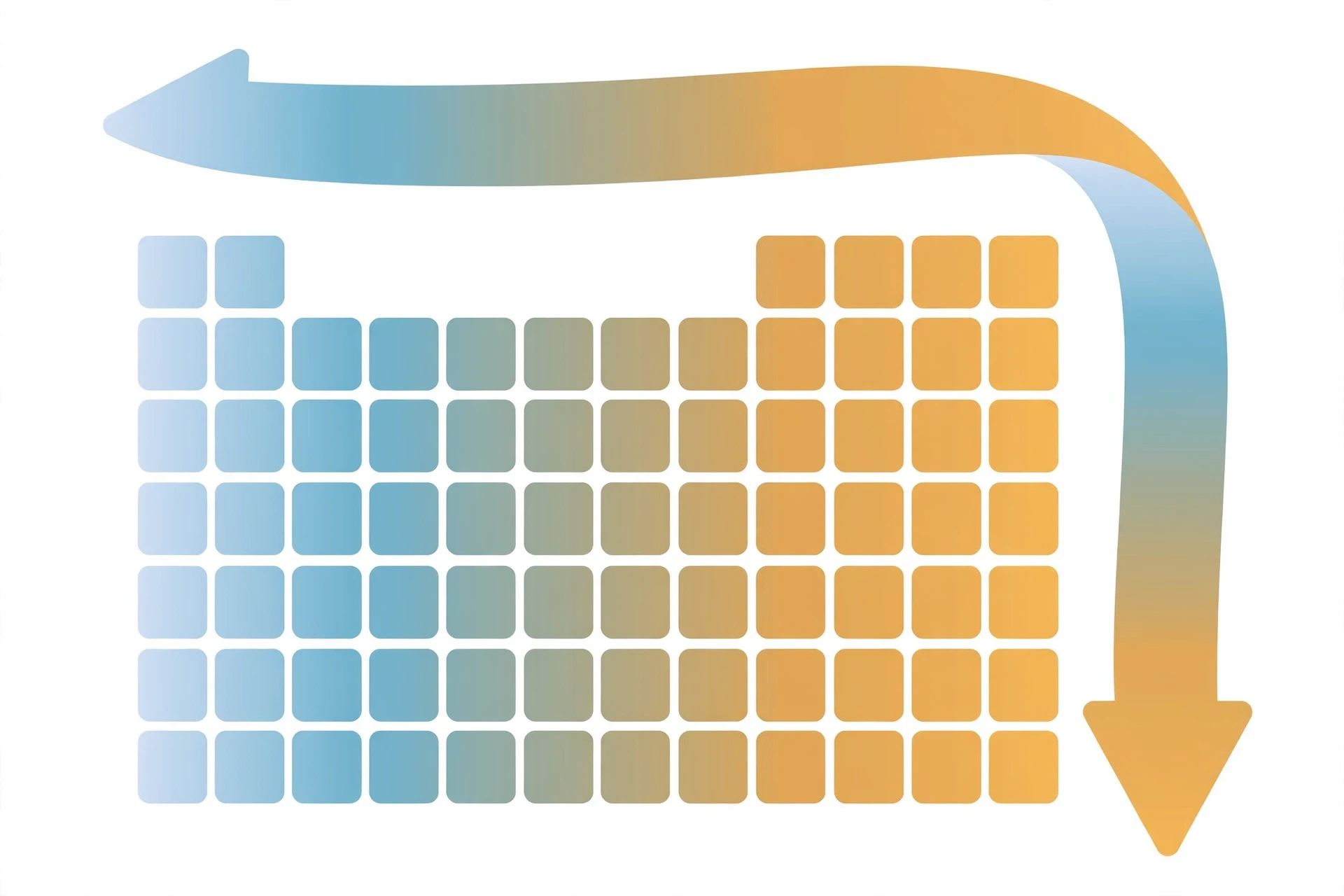
Across a period, from left to right, metallic character decreases. Sodium, at the start of period 3, is a soft, reactive metal. Magnesium is a harder, less reactive metal. Aluminium is a metal but a reluctant one, with a protective oxide skin and a touch of nonmetal behaviour in some of its compounds. Silicon, next door, is a metalloid. Phosphorus, sulphur and chlorine are clear nonmetals, and argon at the end of the row reacts with nothing. The change is steady, element by element, and it mirrors what happens inside the atoms: each step to the right adds a proton to the nucleus, the pull on the outer electrons grows stronger, and giving up an electron gets harder.
Down a group, from top to bottom, metallic character increases. The outer electrons sit in shells that are further from the nucleus, the nucleus's pull is shielded by the inner shells, and the electrons come off more easily. Lithium is a reactive metal; sodium is more reactive; potassium more still; rubidium and caesium are so reactive they ignite in air. On the nonmetal side the trend runs the other way: fluorine, at the top of the halogens, is the most reactive nonmetal, and reactivity falls as you go down to chlorine, bromine and iodine. The same shielding logic explains both directions. Distance from the nucleus is destiny in the periodic table.
Metallic character fades as you move right across the table and grows as you move down it. The most metallic elements sit at the bottom left, and the least metallic sit at the top right, and every element in between is a step on that slope.
8.1 The trends underneath: ionisation energy, atomic radius, electronegativity
Three measurable trends drive metallic character, and they are worth knowing by name. Ionisation energy is the energy needed to remove an electron from an atom. It increases across a period, because the nucleus pulls harder, and decreases down a group, because the outer electron is further away and shielded. Low ionisation energy means an atom gives up electrons easily — the signature of a metal. Atomic radius, the size of the atom, decreases across a period as the stronger nuclear pull draws the shells in, and increases down a group as new shells are added. Larger atoms lose electrons more easily, so size and metallic character travel together. Electronegativity is an atom's hunger for electrons in a chemical bond. It increases across a period and decreases down a group — the mirror image of metallic character. Fluorine has the highest electronegativity of any element, which is another way of saying it is the least metallic. The OpenStax guide to periodic variations in element properties works through all three trends with data, and the NIST periodic table of the elements is the authoritative place to check the numbers behind them.
Students often ask which of these trends matters most, and the honest answer is that they are three views of one thing: how tightly the nucleus holds the outer electrons. Learn that single idea and the three trends stop being separate facts to memorise and become one pattern you can reason through. If the nucleus holds electrons tightly, ionisation energy is high, the atom is small, electronegativity is high, and metallic character is low. If the hold is loose, everything reverses. That is the whole periodic table in one sentence, and it is the reason the table is arranged the way it is.
8.2 Where the trends break down
No trend in chemistry is perfectly smooth, and the exceptions are instructive. Ionisation energy usually rises across a period, but it dips slightly between beryllium and boron, and between nitrogen and oxygen, because of the way electrons fill their subshells — a half-filled or fully filled subshell is unusually stable, and the next electron goes into a new, higher-energy subshell where it is held less tightly. Atomic radius usually shrinks across a period, but the transition metals shrink much more slowly than the main-group elements, because the extra electrons go into inner shells that shield the nuclear charge. These wobbles do not break the pattern. They refine it, and they are the reason chemistry is a science of trends with explanations, not of rules with exceptions swept under the rug.
9. The Metals That Built Our World
Metals are the materials of civilisation in a very literal sense. Historians divide the early human past into the Stone Age, the Bronze Age and the Iron Age, and the last two are named for metals because each new metal changed what people could do. Bronze, an alloy of copper and tin, was harder than either metal alone and held a sharp edge; it made better tools, better weapons and better ornaments, and the trade networks that carried tin across continents were among the first long-distance supply chains. Iron was harder still and far more abundant, and once people learned to smelt it at high enough temperatures, it replaced bronze for tools and weapons and never gave the job back.
Iron remains the most used metal on Earth, and almost all of it is used as steel — iron with a small amount of carbon, usually less than two percent, and often with other elements added for strength, rust resistance or flexibility. Steel holds up bridges, frames skyscrapers, builds ships, rails and cars, and makes the tools that make everything else. The reason is a combination of properties no other cheap material matches: steel is strong, it can be shaped hot or cold, it can be welded, and it is abundant. Its weakness is rust, and a large part of modern materials science is the fight against rust — through stainless steel, which adds chromium to form a protective skin, through galvanising, which coats steel in zinc, and through paint and design that keep water away from the surface.
Aluminium tells a different story: a metal that was once more precious than gold. In the nineteenth century, aluminium was so hard to extract from its ore that it was a luxury — the Washington Monument was capped with aluminium in 1884 because it was the most exotic metal available. Then the electrolytic process made extraction cheap, and aluminium went from precious to everyday within a generation. Today it is the metal of aircraft, of window frames, of food packaging and of power lines, valued because it is light, strong for its weight, and protected by its own oxide skin. My first bicycle as a teenager had a steel frame that rusted at the joints no matter how I oiled it; the aluminium frame that replaced it is still in a shed somewhere, unrusted, decades later. The difference was not care. It was chemistry.
Copper is the metal of electricity. Its conductivity is second only to silver, it is easy to draw into wire, and it resists corrosion well enough to last for decades inside walls. Every home contains kilograms of it, hidden in cables and pipes. Copper also has a quiet second career in plumbing and in medicine, where its antimicrobial surface kills bacteria on contact — a property hospitals have begun to exploit on door handles and bed rails. Gold and silver, the precious metals, are valued for the opposite reason to iron: they do not react. Gold does not tarnish, does not rust, and does not dissolve in ordinary acids, so it survives burial, shipwreck and centuries in a vault unchanged. That permanence is why it became money, and why it still sits in central bank vaults as a store of value.

9.1 Alloys: metals made better by mixing
Pure metals are often too soft or too reactive for the job, so humans mix them. An alloy is a mixture of a metal with one or more other elements, and the result is often better than any of its ingredients. Steel is iron plus carbon. Brass is copper plus zinc, and it is harder than copper and easier to work. Bronze is copper plus tin. Stainless steel is iron plus chromium and nickel. Solder, the metal that joins electronic circuits, is tin plus lead, or tin plus silver in lead-free versions. Even gold jewellery is an alloy: pure gold is too soft to wear, so it is mixed with copper and silver to make it hard enough for a ring. Alloys work because the different-sized atoms disrupt the neat layers of the metal lattice, making it harder for the layers to slide — the same sliding that makes metals malleable, restrained just enough to add strength. It is a reminder that the categories of metals and nonmetals are starting points, not finished products: the materials we actually use are mostly mixtures, tuned for the job.
10. The Nonmetals That Keep Us Alive
If metals built the world, nonmetals run it. Oxygen makes up about a fifth of the air and drives nearly every energy-releasing reaction in living things, from the slow burn of respiration in your cells to the fast burn of a fire. Without oxygen, there is no breathing, no burning, and no rust — and the same reactivity that keeps you alive also slowly oxidises everything it touches, which is why iron rusts, apples brown, and fires spread. Oxygen's reactivity is a bargain life has struck: enough energy to live on, at the price of constant, slow corrosion.
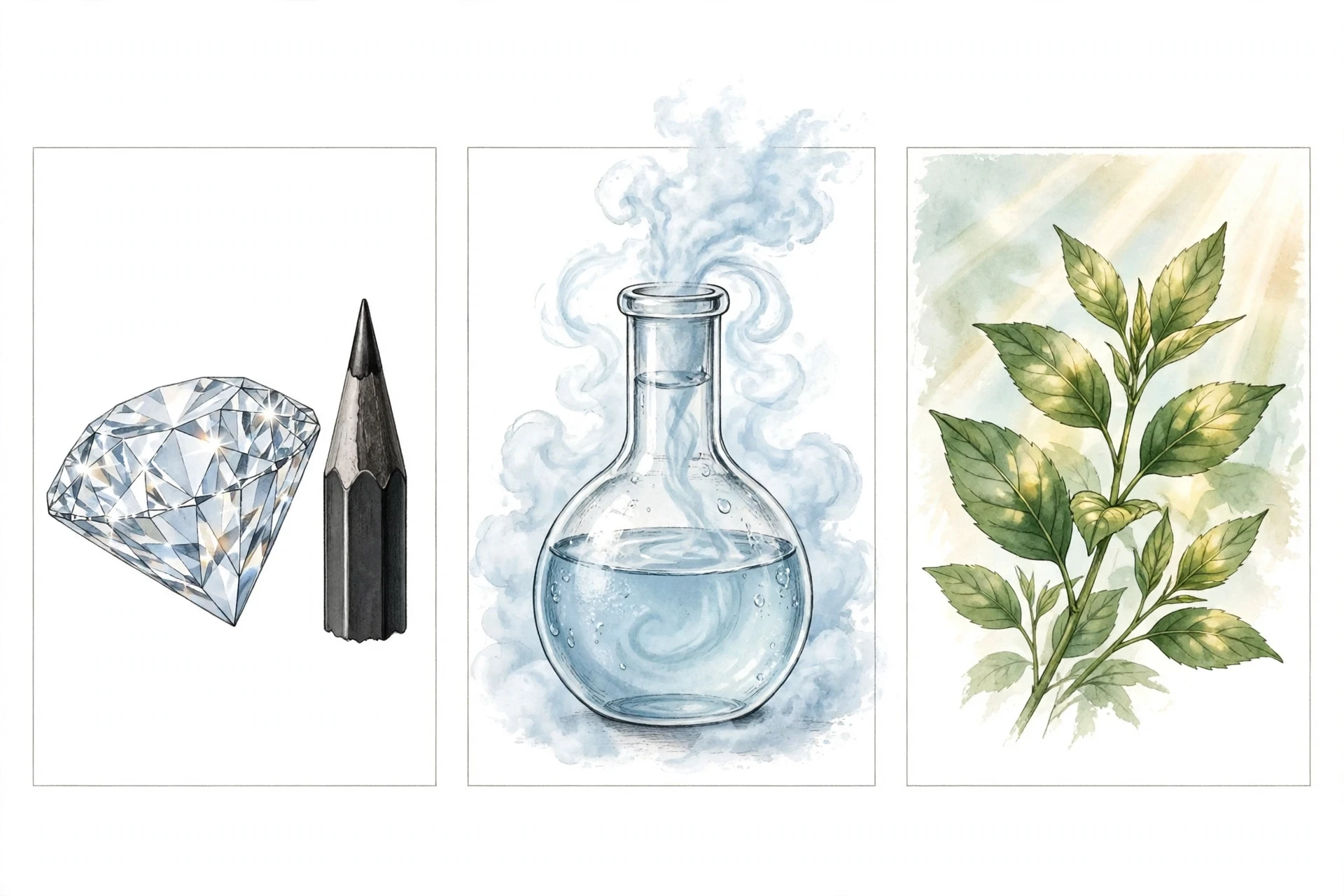
Carbon is the element of life itself. It sits in the middle of the nonmetal corner with four outer electrons, which lets it form four strong covalent bonds in every direction, chaining to itself and to hydrogen, oxygen and nitrogen in an almost endless variety of molecules. Every protein, every strand of DNA, every sugar and fat in your body is built on a carbon skeleton. Carbon also shows the most dramatic range of any single element: as diamond it is the hardest natural material and a perfect insulator; as graphite it is soft, slippery and conductive; as graphene, a single sheet of graphite, it is stronger than steel by weight and a superb conductor. One element, three materials that could hardly be more different, and the difference is structure alone.
Nitrogen makes up about four fifths of the air, and it is famously unreactive — the triple bond between its two atoms in a nitrogen molecule is one of the strongest bonds in chemistry, and it takes enormous energy to break. That inertness is useful: nitrogen fills crisp packets and light bulbs because it will not react with what it protects. But life needs nitrogen in reactive form, in proteins and DNA, and the only natural routes to it are lightning strikes and the work of nitrogen-fixing bacteria. The Haber process, which uses high temperature and pressure and an iron catalyst to force nitrogen and hydrogen together into ammonia, feeds about half the people on Earth through fertiliser — a fact that makes a nonmetal gas and a metal catalyst joint authors of the modern food supply.
The halogens — fluorine, chlorine, bromine, iodine — are the most reactive nonmetals, and they are a study in useful danger. Chlorine disinfects drinking water and swimming pools, but it is a poisonous gas. Fluorine protects teeth in tiny amounts and etches glass in larger ones. Iodine is essential for the thyroid gland in trace amounts, and a deficiency causes goitre. Bromine is a dense, corrosive liquid used in flame retardants. The pattern is consistent: the halogens' hunger for one more electron makes them powerful, and powerful means both helpful and hazardous depending on the dose. The noble gases close the family with the opposite message: helium lifts balloons and cools superconducting magnets, neon lights signs, argon fills light bulbs and welding shields, and none of them reacts with anything, because their outer shells are already full.
Hydrogen deserves a final word. It is the lightest element, the most abundant in the universe, the fuel of the stars, and the element that makes water with oxygen and acids with chlorine. It is a nonmetal that behaves a little like a metal in some compounds and a little like a halogen in others, and it sits alone at the top of the table because no group quite fits it. If there is a single element that proves the families of metals and nonmetals are a map rather than a prison, it is hydrogen.
10.1 Sulphur, phosphorus, and the quiet nonmetals
Two more nonmetals deserve a mention because they show up everywhere once you start looking. Sulphur is the yellow, brittle element of volcanoes, hot springs and rotten eggs, and it is essential to life in small amounts — it holds protein molecules in shape and gives garlic and onions their smell. Industrially, sulphur is the feedstock for sulphuric acid, the most produced chemical in the world, used in fertilisers, batteries and refining. Phosphorus is the element of matches, of fertiliser, and of the phosphate backbone of DNA; it glows in the dark in its white form and is dangerously reactive, so it is stored under water. Both are reminders that the nonmetals are not a supporting cast. They are half the periodic table's story, and the half that life is written in.
11. Mistakes People Make About Metals and Nonmetals
Most people assume that all metals are hard, heavy and magnetic. None of those three is true. Sodium is soft enough to cut with a knife. Lithium floats on water. Aluminium is light enough for aircraft. And magnetism belongs to only a few metals — iron, nickel and cobalt are the magnetic ones at room temperature, while copper, aluminium, gold and silver are not magnetic at all. The fridge magnet test sorts magnetic metals from non-magnetic ones, not metals from nonmetals. A stainless steel fridge door may not even hold a magnet, depending on its alloy.
A second common mistake is thinking that shiny means metallic and dull means non-metallic. Freshly cut lead is dull grey, and old silver tarnishes black. Graphite is a nonmetal with a distinct metallic sheen. Mercury is a liquid metal with a mirror surface. Lustre is a useful clue, not a verdict, and a good chemist checks conductivity, malleability and chemical behaviour before deciding.
A third mistake is the idea that metals and nonmetals never mix in a single material. They mix constantly. Salt is a metal and a nonmetal in one crystal. Steel is iron plus carbon, a nonmetal. Glass is made from sand — silicon and oxygen, a metalloid and a nonmetal — plus sodium and calcium, both metals. Your body is mostly nonmetals by mass, but it runs on metal ions: iron carries oxygen in your blood, calcium builds your bones, sodium and potassium fire your nerves, zinc and magnesium run your enzymes. The families are distinct, but the world is built from their collaborations.
A fourth mistake is subtler: assuming the periodic table's staircase is a sharp border. It is not. Aluminium, officially a metal, forms compounds that behave like those of nonmetals. Silicon, officially a metalloid, is used as a metal in some alloys. Astatine, at the bottom of the staircase, is so rare and radioactive that its properties are mostly inferred rather than measured. The staircase marks a gradient, and the labels are conveniences. The chemistry underneath is continuous, and it rewards people who look at the gradient rather than the label.
The periodic table is a map, not a fence. Metals and nonmetals are real families with real differences, but the border between them is a slope, and the most interesting elements live on that slope.
12. Choosing the Right Material: What This Means in Real Life
Knowing the difference between metals and nonmetals is not just exam knowledge. It is the knowledge behind almost every material choice you make. When you choose a cooking pan, you are choosing between metals and their properties: cast iron holds heat and lasts for generations but rusts if you neglect it; aluminium heats quickly and evenly but can warp; copper responds to temperature changes instantly but costs more and needs lining. When you choose a phone, you are holding a sandwich of materials: a glass front made of nonmetals, an aluminium or steel frame, a silicon chip at its heart, copper wiring inside, and a lithium battery that shuttles metal ions back and forth to store energy. When you choose a roof, a fence or a bicycle, the same trade-offs appear: strength against weight, cost against corrosion, conductivity against insulation.
The electrical world runs on the pairing of the two families. Every wire is a metal core wrapped in a nonmetal sheath, and the pairing is not a coincidence — it is the physics of metals and nonmetals made into a product. Copper carries the current because its electrons are free; plastic or rubber contains it because its electrons are locked. The same pairing appears in cookware, where a metal pan carries heat and a plastic or wooden handle insulates your hand, and in buildings, where steel frames carry loads and glass, wood and plastic fill the spaces between them. The built world is a negotiation between the two families, and the negotiation is written in their properties.
There is also an environmental side to the story. Metals are among the most recyclable materials we have: aluminium can be melted down and reused indefinitely with a fraction of the energy needed to extract it from ore, and steel is the most recycled material on Earth by weight. Nonmetals are harder: plastics, which are built from nonmetal elements, are difficult to recycle because they are mixtures of many polymers and additives, and they degrade each time they are reprocessed. Glass recycles well, paper recycles a few times, and the gases of the air are not materials at all but a shared commons. Understanding which family a material belongs to is a first step toward understanding what happens to it when you throw it away, and that is knowledge worth having.
13. Putting It All Together
The story of metals and nonmetals is the story of electrons. Metals hold their outer electrons loosely, share them in a sea, and lose them easily in reactions — and from that one fact come shine, conductivity, malleability, high melting points and basic oxides. Nonmetals hold their electrons tightly or grab extras — and from that come dullness, insulation, brittleness, low melting points and acidic oxides. The periodic table arranges these tendencies into a map, with metals on the left, nonmetals on the upper right, metalloids on the staircase between them, and smooth trends running in both directions. Metallic character fades across a period and grows down a group, because the nucleus's grip on the outer electrons tightens one way and loosens the other.
The exceptions matter as much as the rules. Mercury the liquid metal, graphite the conducting nonmetal, hydrogen the misfit, silicon the in-between element that runs the digital world — each one teaches something the simple version leaves out. Chemistry is not a list of categories to memorise. It is a set of patterns with explanations, and the explanations are what let you predict what an element will do before you ever meet it.
The next time you pick up a spoon, look at it for a second longer. It is shiny because of a sea of electrons. It carries heat because those electrons are free to move. It can be hammered into a sheet or drawn into a wire because the electron sea forgives reshaping. And the wooden spoon beside it does none of those things, because its electrons are locked in place. Two spoons, two families, one elegant explanation — and it is the same explanation that builds bridges, runs computers, rusts bicycles and keeps you breathing.
Frequently Asked Questions
What is the difference between metals and nonmetals?
Metals and nonmetals differ mainly in how their atoms handle electrons. Metals lose electrons easily in reactions and form positive ions, while nonmetals gain or share electrons and form negative ions or covalent bonds. That difference produces the familiar contrasts: metals are shiny, malleable, ductile and good conductors of heat and electricity, while nonmetals are usually dull, brittle and poor conductors. Metals typically form basic oxides and nonmetals typically form acidic oxides. The split is a strong pattern with real exceptions — mercury is a liquid metal, graphite is a conducting nonmetal — and a small group of metalloids sits in between.
Why are metals good conductors?
Metals conduct electricity and heat because of metallic bonding. Their outer electrons are not attached to any single atom; they form a delocalised sea of electrons that drifts freely through the whole piece of metal. Apply a voltage and the sea flows as electric current. Heat one end and the electrons carry energy to the other end. Nonmetals are insulators because their electrons are locked into fixed covalent bonds or molecules, with no mobile charge to carry current or heat. For a fuller picture of electric current and circuits, see Sciory's Fundamentals of Electricity: From Circuits to Electromagnetism.
What are metalloids?
Metalloids are the handful of elements on the staircase between metals and nonmetals on the periodic table — boron, silicon, germanium, arsenic, antimony and tellurium. They look like metals but are brittle like nonmetals, and they are semiconductors: they conduct electricity only modestly, and their conductivity can be controlled by doping, heating or light. Silicon is the most important metalloid, because doped silicon is the material of computer chips and solar cells. The metalloid border is fuzzy, and different lists include slightly different elements.
How does metallic character change across the periodic table?
Metallic character decreases from left to right across a period and increases from top to bottom down a group. Across a period, each atom gains a proton, the nucleus pulls the outer electrons more tightly, and losing an electron gets harder. Down a group, outer electrons sit in shells further from the nucleus and are shielded by inner shells, so they come off more easily. The most metallic elements are at the bottom left of the table, such as caesium, and the least metallic are at the top right, such as fluorine. Ionisation energy, atomic radius and electronegativity all move in step with this trend.
Is mercury a metal even though it is a liquid?
Yes, mercury is a genuine metal. It is shiny, it conducts electricity and heat, it forms positive ions, and it alloys with other metals — the mixture is called an amalgam, and dentists once used silver amalgam for fillings. Mercury is liquid at room temperature because its atoms hold on to their electrons in an unusual way that makes metallic bonding weak between mercury atoms, so very little heat is needed to break the solid apart. It is the exception that shows the rule is about electrons and bonding, not about being solid.
Why does iron rust but aluminium does not?
Both metals react with oxygen, but the products behave differently. Iron forms rust, a flaky hydrated iron oxide that does not stick to the surface, so oxygen and water keep reaching fresh metal and the corrosion eats deeper. Aluminium forms a thin, hard, transparent layer of aluminium oxide that seals the surface and stops further attack. The difference is in the oxide layer, not in the willingness to react — aluminium is actually more reactive than iron, but its oxide protects it. Stainless steel borrows the same trick by adding chromium, which forms a similar protective skin.
Can a nonmetal conduct electricity?
Yes, but only in special cases. Graphite, a form of carbon, conducts electricity because each carbon atom leaves one electron free to drift across its flat sheets, much like the electron sea in a metal. That is why graphite is used for electrodes and in batteries. Most nonmetals are insulators: diamond, the other form of carbon, is an excellent insulator because every electron is locked into a covalent bond. Semiconductors such as silicon, a metalloid rather than a true nonmetal, also conduct under the right conditions, which is how computer chips and solar cells work.
Sources
LibreTexts — Metals, Nonmetals, and Metalloids: https://chem.libretexts.org/Bookshelves/General_Chemistry/Map%3A_Chemistry_-_The_Central_Science_(Brown_et_al.)/07._Periodic_Properties_of_the_Elements/7.06%3A_Metals_Nonmetals_and_Metalloids
OpenStax Chemistry 2e — Periodic Variations in Element Properties: https://openstax.org/books/chemistry-2e/pages/6-5-periodic-variations-in-element-properties
OpenStax Chemistry 2e — Ionic Bonding: https://openstax.org/books/chemistry-2e/pages/7-1-ionic-bonding
LibreTexts — Chemical Bonds, Lewis Symbols, and the Octet Rule: https://chem.libretexts.org/Bookshelves/General_Chemistry/Map%3A_Chemistry_-_The_Central_Science_(Brown_et_al.)/08._Basic_Concepts_of_Chemical_Bonding/8.01%3A_Chemical_Bonds_Lewis_Symbols_and_the_Octet_Rule
NIST — Periodic Table of the Elements: https://www.nist.gov/pml/periodic-table-elements
American Chemical Society — ChemMatters: https://www.acs.org/education/resources/highschool/chemmatters.html
Periodic Table of Elements: Structure and Trends — Sciory: https://www.sciory.com/blog/periodic-table-elements-structure-trends
Fundamentals of Electricity: From Circuits to Electromagnetism — Sciory: https://www.sciory.com/blog/fundamentals-of-electricity
Atoms and Molecules Explained: Structure, Bonding, and States of Matter — Sciory: https://www.sciory.com/blog/atoms-molecules-explained