

In the winter of 1896, a French physicist named Henri Becquerel put a lump of uranium salt on top of a photographic plate, wrapped the whole thing in black paper, and left it in a drawer, in an experiment that would lead to the discovery of radioactivity. He expected nothing to happen. The plate was meant to record light from a mineral that glowed after sitting in the sun, and the sky that week was grey, so the experiment looked like a failure before it began. When Becquerel developed the plate anyway, he found a dark, blurred image of the uranium crystals burned straight through the paper. Something invisible had come out of the rock itself, with no sunlight, no heat, and no chemical reaction to explain it. That quiet accident opened the door to radioactivity, and nothing in physics has been quite the same since.
Radioactivity is the spontaneous breaking apart of an unstable atomic nucleus. The nucleus throws off energy, or a particle, or both, and in doing so it changes into something else. It does not need a push. It does not need fuel, air, or light. It happens on its own clock, atom by atom, and it keeps happening whether anyone is watching or not. That simple fact explains a long list of things that otherwise look unrelated: why a rock can warm your hand from the inside, why doctors can see inside a living body without cutting it open, why archaeologists can date a wooden tool that is thousands of years old, and why the Sun keeps shining.
Most people first meet the word radioactivity through fear. They picture accidents, warning signs, and invisible danger. That fear is not baseless, and this article will not pretend otherwise. Radiation at high doses can harm living tissue, and the accidents at Chernobyl and Fukushima were real disasters with real consequences. Yet radioactivity is also ordinary. It is in the ground under your feet, in the air you breathe, in the food you eat, and inside your own body. It has been there for the whole history of the Earth. The question is not whether radioactivity exists around us, because it does. The question is how much, of what kind, and for how long — and those are questions with clear, measurable answers.
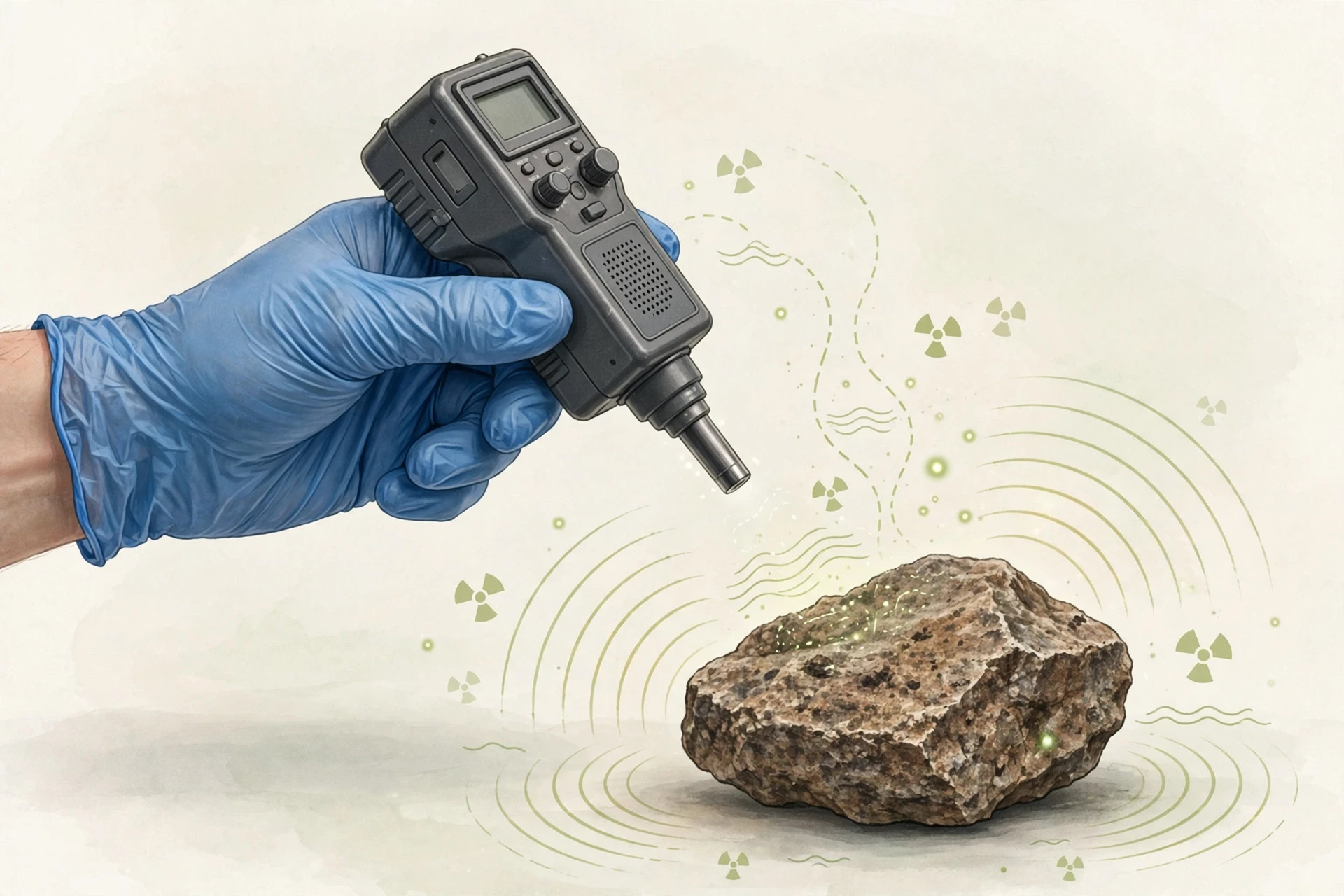
I first felt that strangeness as a student, holding a Geiger counter near a chunk of granite on a field trip. The counter clicked slowly, steadily, like a clock ticking in a quiet room. My teacher told us the rock was not broken or contaminated. It was simply old, and a tiny fraction of its atoms had been unstable since the Earth formed. I remember thinking that the stone in my hand was, in a very literal sense, still changing. That idea stayed with me: matter is not always still. Some of it is slowly, patiently becoming something else.
This article explains radioactivity from the nucleus outward. It covers what makes a nucleus unstable, the three main kinds of decay, the idea of half-life and why it is so useful, how carbon-14 dating works, how radioactivity is detected and measured, where it helps in medicine and industry, and how to think clearly about risk. Along the way it corrects a few stubborn myths, including the idea that all radioactivity is artificial, and the idea that anything radioactive stays dangerous forever.
1. What Is Radioactivity?
Radioactivity is the process by which an unstable nucleus releases energy in order to become more stable. The word itself was coined by Marie Curie, who with her husband Pierre Curie spent years separating tiny amounts of new elements from tons of ore, working in a cold shed with little more than patience and careful chemistry. The Curies showed that the effect Becquerel had seen was a property of the atom itself, not of the chemical compound it happened to sit in. A uranium atom is radioactive whether it is in a rock, in a salt, or in a laboratory flask.
An atom is mostly empty space. At its centre sits the nucleus, a dense cluster of protons and neutrons. Protons carry a positive electric charge, and like charges repel each other, so the protons inside a nucleus are constantly pushing each other apart. Neutrons carry no charge. They act as a kind of glue, holding the nucleus together through the strong nuclear force, which works only over very short distances. When the balance between the pushing apart and the holding together is wrong, the nucleus is unstable. It will, sooner or later, rearrange itself. That rearrangement is radioactive decay.
Not every atom is radioactive. Most of the atoms in your body, in the air, and in the objects around you are stable. Their nuclei sit in a comfortable balance and will stay that way for as long as anyone can measure. A smaller set of atoms, called radionuclides or radioisotopes, have nuclei that cannot hold their balance forever. Carbon-14, uranium-238, potassium-40, and iodine-131 are all examples. Each one decays in its own characteristic way, at its own characteristic rate, and turns into a different atom — often a stable one, sometimes another radioactive one that will decay again later.
Radioactivity is a nuclear process, not a chemical one. Heating a radioactive sample does not speed up its decay in any meaningful way. Cooling it does not slow it down. Dissolving it in acid, crushing it, or putting it under pressure changes the chemistry around the nucleus, but the nucleus itself barely notices. That independence from ordinary conditions is part of what surprised the early researchers so much. Chemistry is about electrons, the outer part of the atom. Radioactivity is about the nucleus, deep inside, and it follows its own rules.
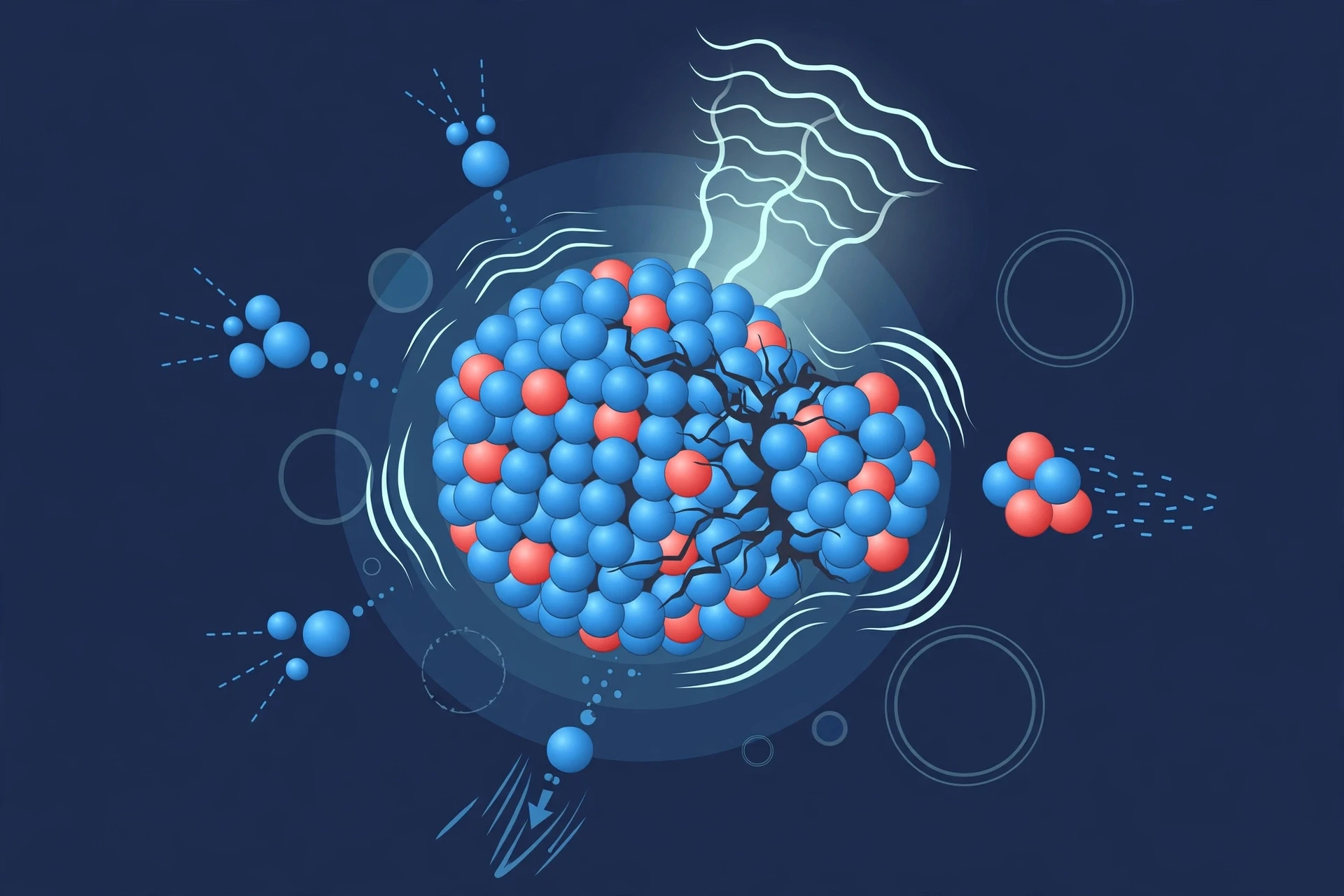
1.1 Radiation and radioactive material are not the same thing
People often use the words radiation and radioactivity as if they meant the same thing, and the confusion causes real trouble. Radioactivity is the process — the decay happening inside the nucleus. Radiation is what comes out: the energy or particles released by that decay. A radioactive material is a substance that contains unstable nuclei. Radiation is the stream of particles or energy leaving it.
The distinction matters in practice. A sealed source of a radioactive material can be handled safely if its radiation is blocked. A patient who has received a radioactive tracer for a scan is briefly radioactive themselves, because the tracer atoms are inside their body, decaying as they circulate. The radiation they give off fades as the tracer decays and is cleared from the body. An X-ray machine, by contrast, produces radiation only while it is switched on. It contains no radioactive material, so when it is off, it gives off nothing at all.
There is also a difference between being exposed to radiation and being contaminated with radioactive material. Exposure is like standing near a lamp: you receive light, but you do not take the lamp home with you. Contamination means radioactive material itself has got onto skin, clothing, or into the body, where it keeps decaying until it is removed or decays away. Emergency responders treat those two situations differently, and the difference explains why some safety advice sounds contradictory until you see it clearly.
1.2 Why some nuclei are unstable
That is why every element heavier than lead has no stable form at all. Bismuth-209 was long thought to be stable, and it is so close to stable that its half-life is vastly longer than the age of the universe, but careful measurements showed that it too decays, extremely slowly. Lead, with 82 protons, is the heaviest element with stable isotopes. Beyond it, every nucleus is on a slow road toward something smaller and more stable.
Light nuclei have their own problem. If a light nucleus has far too many neutrons for its protons, or far too few, it sits off balance in the other direction. Carbon-14 has six protons and eight neutrons. That is two neutrons too many for comfort, and so it decays. Carbon-12, with six protons and six neutrons, is perfectly balanced and stable. The ratio matters, not just the size. Nuclear physicists draw this as a valley of stability, a curved band across a chart of protons against neutrons, with stable nuclei sitting in the valley floor and unstable ones perched on the slopes, ready to roll down toward stability.
I once watched a lecturer draw that valley on a blackboard, freehand, and then dot in the isotopes one by one. The pattern was obvious once you saw it: the stable ones clustered along the bottom, and everything else was trying to get there. It was the first time the periodic table, which I had memorised as a flat list of elements, felt like a landscape with hills and valleys. That picture has stayed with me as the clearest way to think about radioactivity. Unstable nuclei are not broken. They are simply out of place, and decay is how they move toward a place where they can rest.
2. The Nucleus: A Crowded, Tense Place
To understand radioactivity, it helps to picture the nucleus properly. It is astonishingly small — about a hundred thousand times smaller than the atom as a whole — yet it holds almost all of the atom's mass. If an atom were the size of a football stadium, the nucleus would be a marble sitting at the centre of the pitch. The electrons would be like a few gnats drifting around the stands. That marble, though, is where almost all the action in this article takes place.
Inside that marble, protons and neutrons — collectively called nucleons — are packed together at extraordinary density. The strong nuclear force pulls them toward each other, but only over distances about the size of a nucleon itself. The electric force pushes the protons apart, and unlike the strong force, it reaches across the whole nucleus. In a small nucleus, the strong force wins easily, because every nucleon is close to every other nucleon. In a large nucleus, a proton on one side is too far from a proton on the other side for the strong force to help much, but the electric repulsion still reaches across. The balance tips. That is the deep reason heavy nuclei are unstable, and it is also why splitting a heavy nucleus releases energy: the pieces are more tightly bound, per nucleon, than the original was.
2.1 Isotopes: same element, different nucleus
Every atom of carbon has six protons. That is what makes it carbon. But carbon atoms can have six, seven, or eight neutrons, and each version is a different isotope of carbon. Carbon-12 has six neutrons and is stable. Carbon-13 has seven neutrons and is also stable. Carbon-14 has eight neutrons and is radioactive. Chemically, the three behave almost identically, because chemistry is governed by electrons, and all three have six electrons. Nuclear behaviour is completely different. One sits still forever, and another is a clock that ticks away over thousands of years.
The notation for isotopes is simple once you see it. The mass number — protons plus neutrons — is written as a superscript before the element symbol, and the atomic number — the proton count — is sometimes written as a subscript. So carbon-14 is written as ¹⁴C, uranium-238 as ²³⁸U, and iodine-131 as ¹³¹I. In plain text you will often see them written as carbon-14, uranium-238, and iodine-131, which is the style used in this article.
Most elements have a mix of stable isotopes in nature. Some have only one stable isotope. A few have none at all. The mix matters for dating, for medicine, and for nuclear power, because each isotope has its own half-life and its own decay mode. When scientists talk about a particular radioisotope, they are talking about a specific nucleus with a specific behaviour, not about the element in general. Saying "uranium is radioactive" is a useful shorthand, but the precise statement is that uranium-238 and uranium-235 are radioactive, with very different half-lives, while the details of their decay chains matter for everything from geology to reactor design.
The Periodic Table is the map of these elements, and Atoms and Molecules explains how atoms join into the substances around us. Radioactivity adds a third dimension to that map: time. Elements are not only arranged by their chemistry. They are also arranged by how long their nuclei last.
2.2 How decay changes one element into another
When a nucleus decays, it does not simply lose energy and stay the same element. It changes its proton count, its neutron count, or both, and so it becomes a different element. This was one of the most startling discoveries of early radioactivity research. Chemists had believed for centuries that elements could not be turned into one another by any ordinary means. The alchemists had tried for a thousand years to turn lead into gold and failed. Radioactivity does something like it every day, quietly, without any human help. Uranium-238 decays through a long chain of steps and eventually becomes lead-206, which is stable. Radium decays into radon, a gas. Carbon-14 decays into nitrogen-14.
I remember the small shock of learning that in school. We had been taught that elements were permanent, the fixed building blocks of matter. Then a teacher wrote a decay chain on the board, uranium to lead, and said, quite casually, that the lead in an old rock had once been uranium. It felt like being told that a mountain had once been a river. The permanence I had assumed was only a matter of timescale. On a long enough clock, even elements change.
3. What Are Alpha, Beta, and Gamma Decay?
Most radioactive decay falls into three main types, named with the first three letters of the Greek alphabet: alpha, beta, and gamma. They were named in the order they were discovered, before anyone knew what they were. The names stuck, and they are still the right way to organise the subject, because the three kinds of radiation behave very differently. One is heavy and slow and easily stopped. One is light and fast and more penetrating. One is not a particle at all, but a wave of pure energy.
Alpha decay happens mostly in heavy nuclei. The nucleus throws out an alpha particle, which is a tight cluster of two protons and two neutrons — in other words, the nucleus of a helium atom. Because the alpha particle carries away two protons, the original atom becomes a different element, two places lower on the periodic table, and four units lighter in mass. Uranium-238, for example, decays by alpha emission into thorium-234. Radium-226 decays by alpha emission into radon-222, a gas that can seep out of soil and into buildings, which is why radon testing matters for homes built on certain kinds of rock.
Alpha particles are heavy and carry a double positive charge, so they interact strongly with matter. They lose their energy quickly, over a distance of only a few centimetres in air, and they are stopped by a sheet of paper or by the outer layer of dead skin on your hand. That sounds reassuring, and outside the body it mostly is. Inside the body, the story changes. An alpha particle that is swallowed or breathed in deposits all of its energy into a tiny volume of living tissue, and that concentrated damage is why alpha emitters are dangerous when they get inside. The hazard of radioactivity depends on where the radiation is, not only on how strong it is.
Beta decay happens when a nucleus has too many neutrons. One of those neutrons turns into a proton, and in the process it throws out a beta particle — a fast-moving electron — along with a nearly massless particle called an antineutrino. The mass number stays the same, because a neutron has simply changed into a proton, but the atomic number goes up by one, so the atom becomes the next element along. Carbon-14 decays by beta emission into nitrogen-14. That single change is the whole basis of carbon dating, which is covered in section 5.
Beta particles are much lighter than alpha particles and carry a single charge, so they travel further — up to a few metres in air, and a few millimetres into skin or plastic. A sheet of aluminium a few millimetres thick stops most of them. They are more penetrating than alpha particles, but they deposit their energy over a larger volume, so the damage per unit of distance is lower.
Gamma decay is different again. It is not a change of particle at all, but a release of excess energy. After an alpha or beta decay, the new nucleus is often left in an excited state, like a bell still ringing after it has been struck. It settles down by giving off a gamma ray, a high-energy form of light, far more energetic than visible light or X-rays. The nucleus does not change its proton or neutron count when it emits a gamma ray. It simply drops to a lower energy state, the way a hot object cools by giving off heat.
Gamma rays are the most penetrating of the three. They can pass through paper, plastic, and skin easily, and they need dense material — thick lead, or several centimetres of steel, or a good thickness of concrete — to be stopped. That penetrating power is what makes gamma rays useful for seeing through things: for imaging inside the body, for checking welds inside a pipeline, and for sterilising medical equipment. It is also what makes them the hardest kind of radiation to shield against, and the kind that matters most for external exposure.
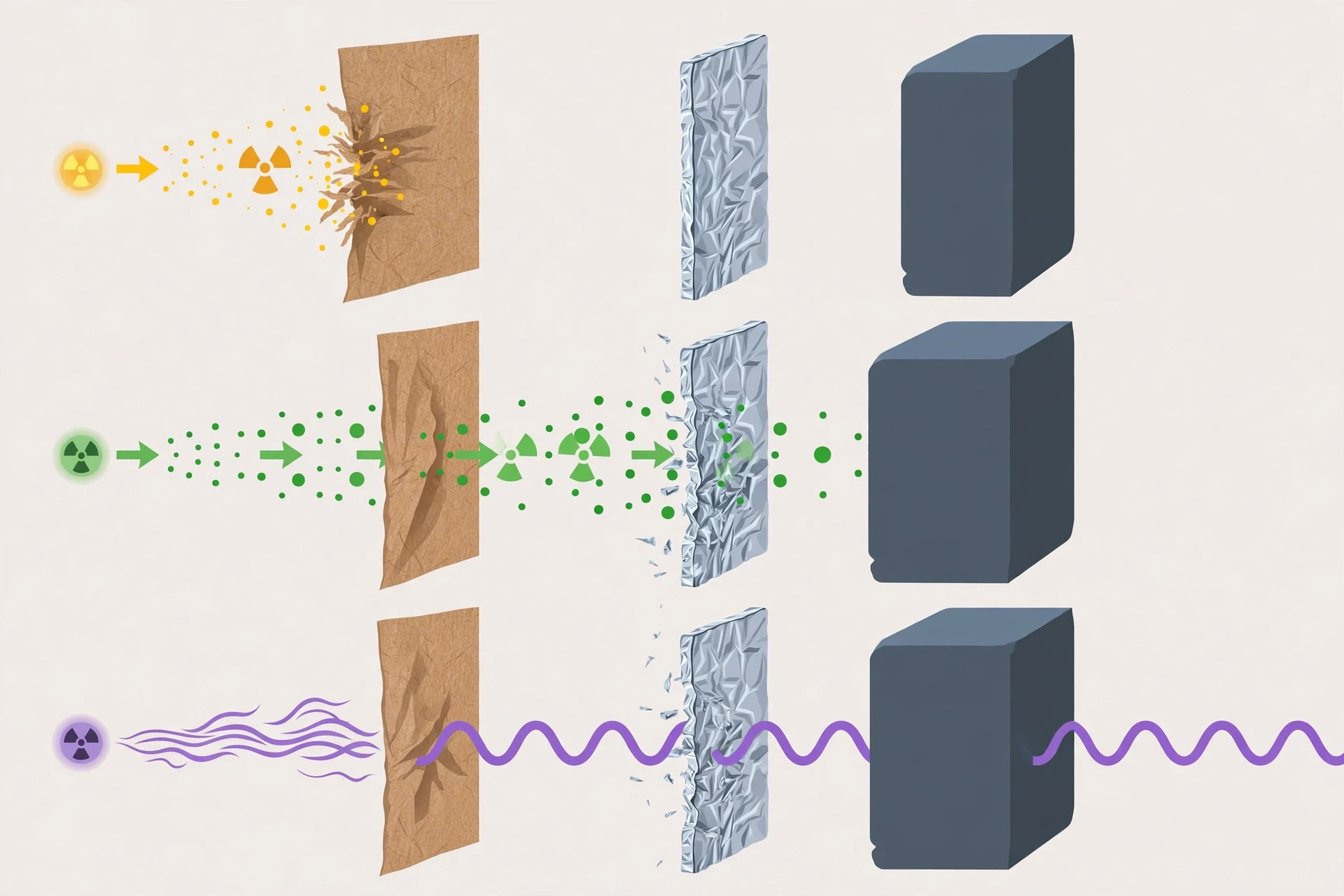
3.1 Comparing the three kinds of decay
The table below brings the three kinds together. It is worth studying, because almost every later section in this article — shielding, detection, medicine, and safety — follows from these differences.
Property | Alpha decay | Beta decay | Gamma decay |
|---|---|---|---|
What is emitted | Alpha particle: 2 protons + 2 neutrons | Beta particle: a fast electron (or positron) | Gamma ray: high-energy light, no mass |
Change to the nucleus | Atomic number down by 2; mass number down by 4 | Atomic number up by 1 (or down by 1 for positron emission); mass number unchanged | No change to proton or neutron count; energy drops |
Speed | Slow, about 5 to 7 percent of the speed of light | Fast, up to about 90 percent of the speed of light | Travels at the speed of light |
Penetrating power | Very low; stopped by paper or skin | Moderate; stopped by a few millimetres of aluminium | High; needs thick lead or concrete |
Typical examples | Uranium-238, radium-226, radon-222 | Carbon-14, tritium, iodine-131 | Cobalt-60, technetium-99m, caesium-137 |
4. What Is Half-Life?
Half-life is the time it takes for half of the atoms in a sample of a radioisotope to decay. It is the single most useful number in the whole subject of radioactivity, because it turns a random process into a clock. If you know the half-life of an isotope and you know how much of it you started with, you can work out how much will be left after any length of time. If you know how much is left now and how much there was at the start, you can work backward and find out how long it has been decaying.
The idea is easier with a concrete picture. Imagine you have 1,000 atoms of iodine-131, which has a half-life of about 8 days. After 8 days, about 500 atoms remain, and about 500 have decayed. After another 8 days, half of the remaining 500 have decayed, leaving about 250. After another 8 days, about 125 remain. The amount halves each time, and it keeps halving, never quite reaching zero in a mathematical sense, but getting smaller and smaller until the remainder is negligible. After ten half-lives, only about one atom in a thousand of the original sample remains. After twenty half-lives, only about one in a million.
Notice what does not happen. The sample does not decay at a steady rate, like a candle burning down. It decays quickly at first, when there are many atoms to decay, and more slowly later, when fewer remain. The rate of decay is proportional to the number of atoms still present. That is why the curve of amount against time is a smooth exponential curve, falling steeply at first and then flattening out. It is also why a sample with a short half-life is intensely radioactive for a short time and then fades fast, while a sample with a long half-life is only mildly radioactive at any given moment but stays that way for a very long time.
Half-lives vary across an astonishing range. Some isotopes have half-lives measured in fractions of a second. Others have half-lives measured in billions of years. Polonium-212 has a half-life of about 300 nanoseconds — it is gone almost as soon as it is made. Carbon-14 has a half-life of about 5,730 years, which makes it useful for dating things that are thousands of years old. Uranium-238 has a half-life of about 4.5 billion years, roughly the age of the Earth itself, which is why about half of the uranium-238 that was present when the Earth formed is still here. That range, from billionths of a second to billions of years, is one of the widest spans of any quantity in science, and it is why different isotopes are useful for completely different jobs.
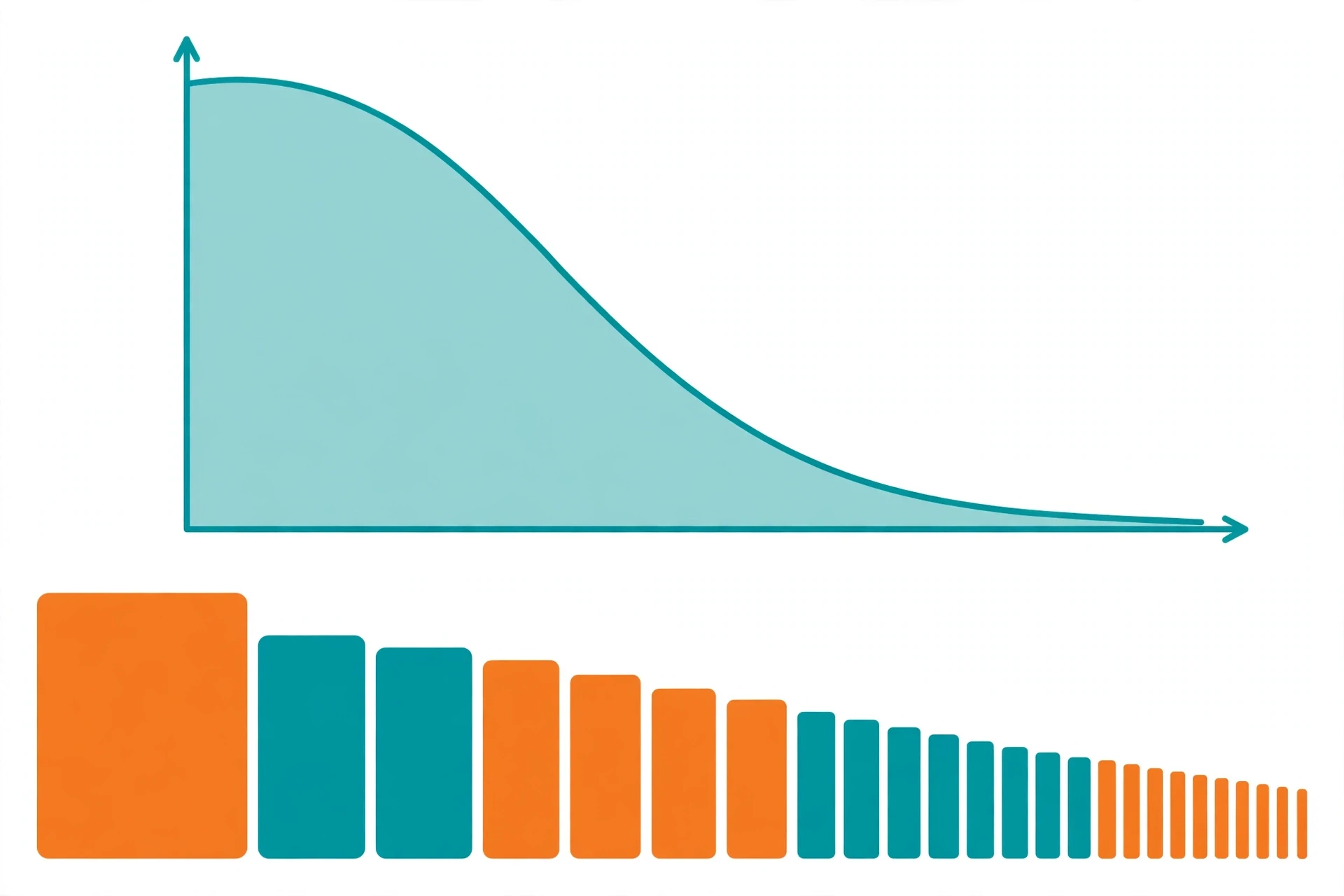
4.1 Doing the half-life maths
The maths of half-life is simple, and it is worth doing once by hand, because it makes the idea concrete. The amount remaining after a given time is the starting amount multiplied by one half, raised to the power of the number of half-lives that have passed. If three half-lives have passed, the remaining fraction is one half times one half times one half, which is one eighth. If ten half-lives have passed, the remaining fraction is about one thousandth.
A worked example helps. Suppose a hospital receives a sample of iodine-131 for thyroid treatment, with a half-life of 8 days. After 8 days, half remains. After 16 days, a quarter remains. After 24 days, an eighth remains. After 40 days, which is five half-lives, about one thirty-second remains — roughly 3 percent of the original. That is why iodine-131 is useful in medicine and not a long-term waste problem: it is active enough to do its job, and it fades away in a matter of weeks.
Now take the opposite case. Caesium-137, a product of nuclear fission, has a half-life of about 30 years. After 30 years, half remains. After 60 years, a quarter remains. After 300 years, ten half-lives, about a thousandth remains. That is a very different kind of problem. It is not intensely radioactive at any one moment, but it stays radioactive for centuries, and any plan for dealing with it has to think on that timescale. The same maths, applied to different half-lives, gives completely different answers, and that is why half-life is the first number anyone asks for when they meet a new radioisotope.
"Half-life is the closest thing nuclear physics has to a promise: not that a particular atom will decay at a particular moment, but that half of a large group will, and that the promise will hold every time, for every isotope, in every laboratory on Earth."
5. How Does Carbon-14 Dating Work?
Carbon-14 dating is the most famous practical use of radioactivity, and it is a beautiful example of a natural clock. It works because carbon-14 is being made all the time in the upper atmosphere, because living things take it up while they are alive, and because they stop taking it up when they die. From that moment on, the carbon-14 in their remains decays away with a half-life of about 5,730 years, while the stable carbon-12 stays put. By measuring the ratio of carbon-14 to carbon-12 in a sample today, scientists can work out how long it has been since the organism died.
The story starts high above the Earth. Cosmic rays, mostly fast protons from space, strike atoms in the upper atmosphere and produce neutrons. Those neutrons collide with nitrogen-14, the most common gas in the air, and turn it into carbon-14, plus a proton. The new carbon-14 atom quickly joins with oxygen to form carbon dioxide, and that carbon dioxide mixes through the atmosphere. Plants take it in during photosynthesis. Animals eat the plants, or eat other animals that ate the plants, and so carbon-14 spreads through the whole living world. While an organism is alive, it keeps exchanging carbon with its surroundings, so the ratio of carbon-14 to carbon-12 in its body stays roughly the same as the ratio in the atmosphere.
When the organism dies, the exchange stops. No new carbon-14 comes in. The carbon-14 already present keeps decaying into nitrogen-14, with a half-life of 5,730 years. The carbon-12 does not decay at all. So the ratio of carbon-14 to carbon-12 falls, halving every 5,730 years. A sample that has half the modern ratio is about 5,730 years old. A sample with a quarter of the modern ratio is about 11,460 years old. A sample with an eighth is about 17,190 years old. By measuring the ratio precisely, scientists can date organic material — wood, bone, charcoal, cloth, seeds, and parchment — that is up to about 50,000 years old. Beyond that, so little carbon-14 remains that it becomes hard to measure reliably, and other dating methods take over.
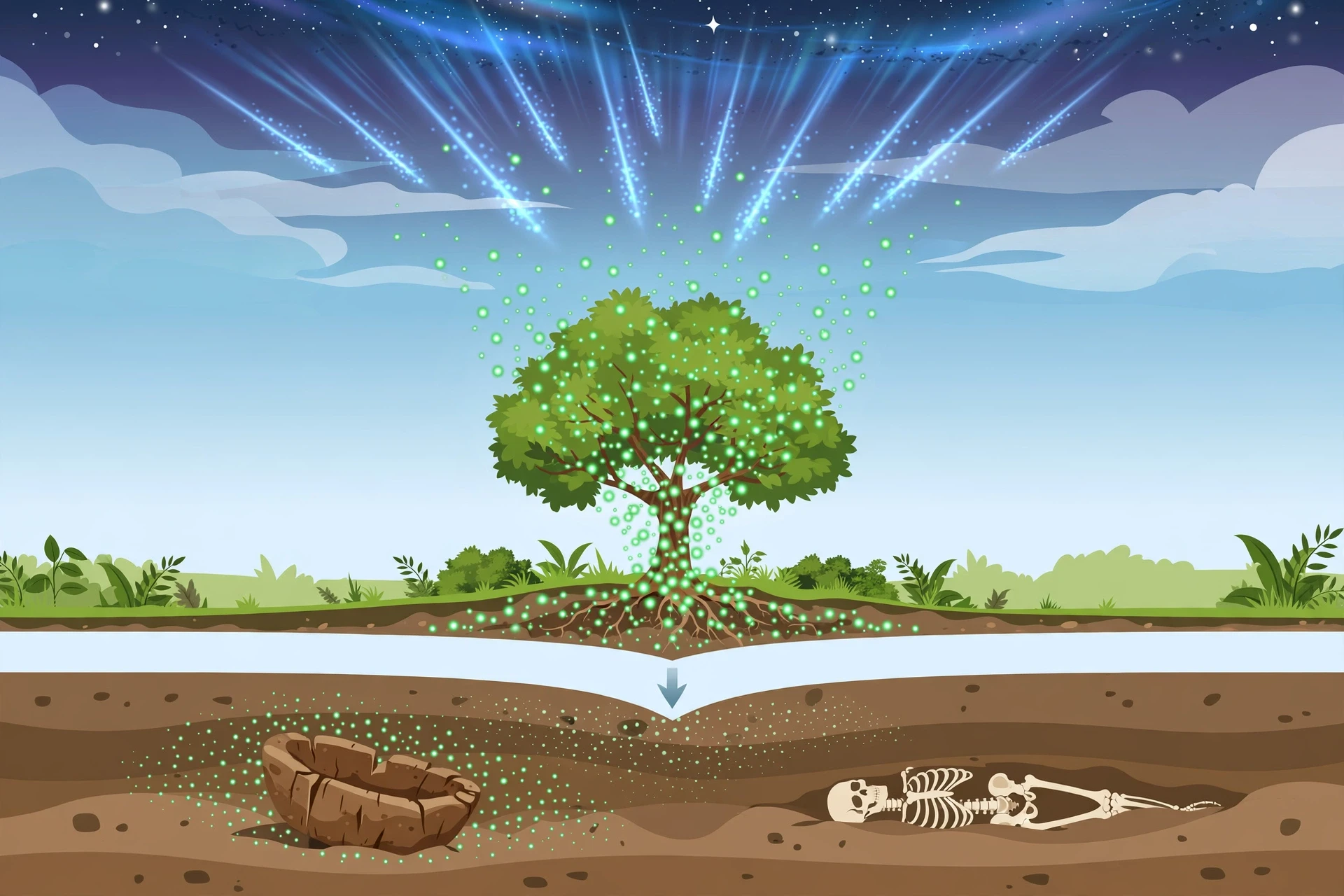
5.1 What carbon dating can and cannot do
Carbon dating is powerful, but it has clear limits, and honest science means stating them. It only works on material that was once alive, or made from something that was once alive. It cannot date a rock, a pot, or a metal tool directly, because those things never took up carbon from the atmosphere in the way a living organism does. Archaeologists sometimes date a metal tool by dating the charcoal found beside it in the same layer, but that is dating the charcoal, not the tool, and the association has to be argued carefully.
It also only works back to about 50,000 years. After about nine half-lives, the remaining carbon-14 is so small that it is hard to distinguish from background contamination. Older samples need other methods, such as potassium-argon dating or uranium-series dating, which use isotopes with much longer half-lives. And the method assumes that the ratio of carbon-14 in the atmosphere has stayed roughly constant over time. It has not stayed exactly constant — it varies with solar activity, with changes in the Earth's magnetic field, and, in the modern era, with the burning of fossil fuels, which adds old carbon with no carbon-14 left in it, and with nuclear testing, which added extra carbon-14 in the 1950s and 1960s. Scientists correct for these variations using calibration curves built from tree rings, whose ages can be counted year by year, and from other independently dated samples. The calibration is part of the method, not an afterthought.
My own first encounter with carbon dating was not in a laboratory but in a museum, standing in front of a wooden boat that was older than the building it sat in. The label said it had been dated by radiocarbon, and I remember wondering how anyone could know that from a piece of wood. The answer, I later learned, was not a single measurement but a chain of reasoning: cosmic rays, photosynthesis, decay, and a calibration curve built from thousands of tree rings. It was a reminder that a scientific date is not a guess. It is the end of a long argument, and every link in that argument can be checked.
6. The Discovery of Radioactivity: A Short History
Radioactivity was not predicted. It was found by accident, and then pursued by people who were willing to follow an unexpected result instead of dismissing it. Becquerel's fogged plate in 1896 was the first clue. Marie and Pierre Curie, working in Paris, showed that the effect came from the atom itself, and they discovered two new elements, polonium and radium, by patient chemical separation. Marie Curie named the phenomenon radioactivity, and she and Pierre shared the Nobel Prize in Physics in 1903 with Becquerel. Marie Curie later won a second Nobel Prize, in Chemistry, in 1911, for her work on radium and polonium. She remains the only person to have won Nobel Prizes in two different sciences.
The decades that followed brought both promise and danger. Radium was painted onto watch dials so they would glow in the dark, and the young women who painted them — the "radium girls" — suffered terrible harm from ingesting radium, because they were told to lick their brushes to a fine point. That tragedy, and others like it, taught the world that radioactivity needed to be handled with respect and with rules. The same decades brought medical uses, industrial uses, and, in the 1940s, the atomic bomb. Radioactivity has been a double-edged subject ever since: a powerful tool and a serious hazard, and the difference between the two is usually a matter of dose, distance, shielding, and time.
7. Fission, Fusion, and Chain Reactions
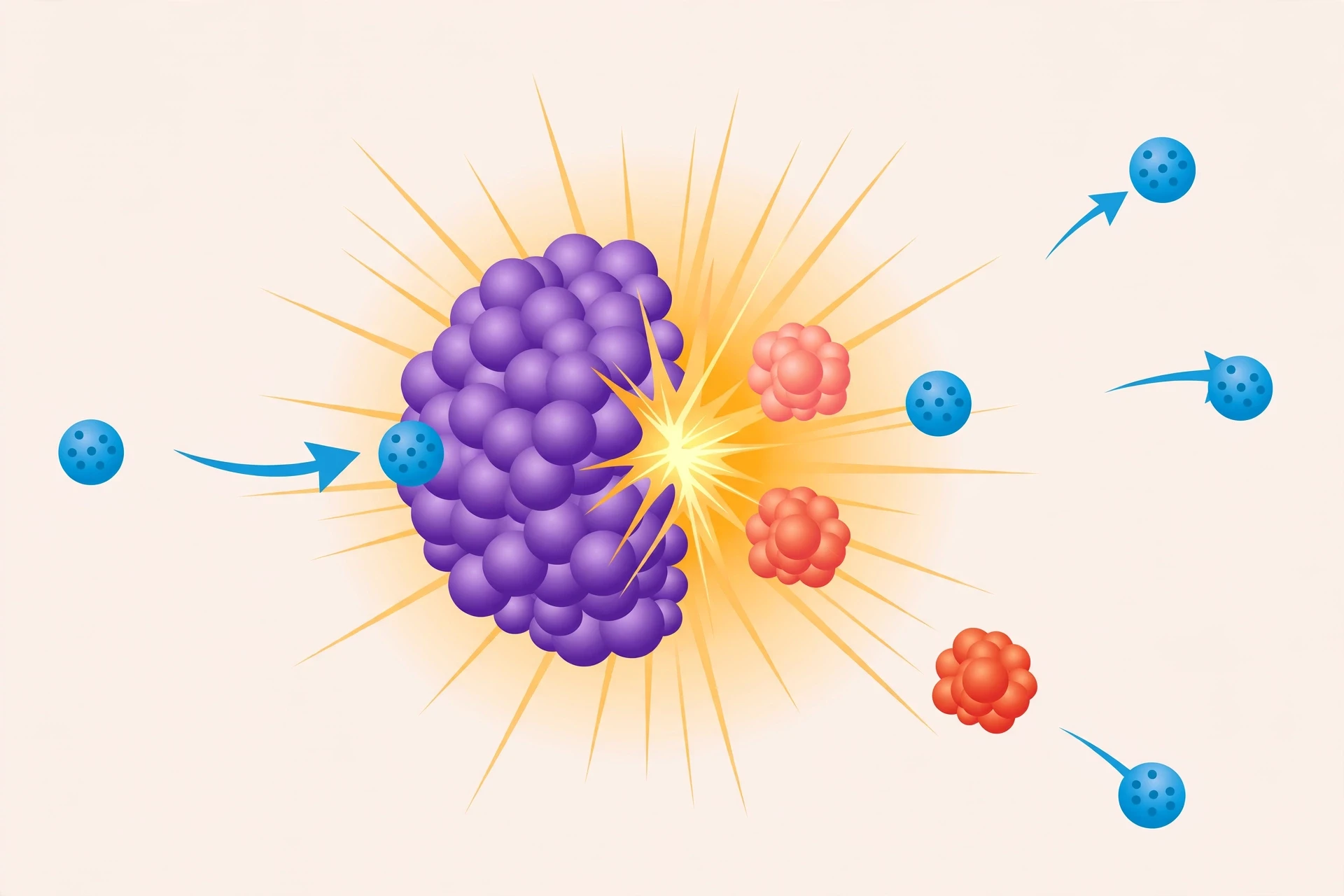
Radioactive decay, on its own, releases a small amount of energy per atom. Fission releases far more, because it splits a heavy nucleus into two lighter ones, and the total binding energy of the pieces is greater than that of the original. The difference is released as heat, as the motion of the fragments, and as radiation. A single fission of uranium-235 releases about 200 million electron volts of energy. That sounds like a small number, but a gram of uranium-235 contains an enormous number of atoms, and the total energy is large enough to matter for power generation — and, in a bomb, for destruction.
Fission is usually started by a neutron striking a nucleus of uranium-235 or plutonium-239. The nucleus becomes unstable, splits, and releases two or three more neutrons, along with the two fragments and a large amount of energy. Those new neutrons can strike other nuclei and cause more fissions. If, on average, each fission causes exactly one more fission, the reaction is steady, and that is how a nuclear reactor works. If each fission causes more than one more, the reaction grows, and that is how a bomb works. If each fission causes less than one more, the reaction dies away. Controlling that balance — keeping the chain reaction exactly at the steady point — is the central engineering problem of a nuclear reactor, and it is done with control rods made of materials that absorb neutrons.
Fusion is the opposite process. Light nuclei join together to form a heavier one, and the product is more tightly bound than the starting nuclei, so energy is released. Fusion powers the Sun, where hydrogen nuclei fuse into helium at temperatures of millions of degrees. It is also the process that makes the heavier elements in stars. On Earth, fusion is hard to control, because the nuclei repel each other electrically and need extreme temperatures and pressures to get close enough for the strong force to take over. Research reactors have achieved fusion for short periods, and the goal of a practical fusion power plant remains one of the great engineering challenges of our time. Fusion does not produce long-lived radioactive waste in the way fission does, which is one reason it attracts so much interest, but it is not yet a practical source of electricity.
8. How Do We Detect and Measure Radioactivity?
Radiation is invisible, silent, and odourless. You cannot see it, hear it, or feel it at the levels that matter for everyday safety. That is part of why it frightens people, and it is also why detection matters so much. Scientists and safety workers rely on instruments, and those instruments are remarkably sensitive. A good detector can count individual decays, one atom at a time, and it can do so for hours, days, or years without tiring.
The best-known detector is the Geiger counter, named after Hans Geiger, who developed it with Walther Müller in the 1920s. A Geiger counter contains a tube filled with gas and a wire held at high voltage. When radiation enters the tube, it knocks electrons off gas atoms, and those electrons are pulled toward the wire, creating a brief pulse of electric current. Each pulse is one count, and the counter clicks or displays a number for each one. The faster the clicking, the higher the radiation level. Geiger counters are simple, rugged, and widely used, but they do not tell you what kind of radiation you are detecting, or how much energy it carries. For that, you need a spectrometer.
A scintillation detector works differently. Radiation strikes a special crystal or liquid, which gives off a tiny flash of light. A sensitive light detector counts the flashes and measures their brightness, which is related to the energy of the radiation. That lets scientists identify which radioisotope is present, because each isotope gives off radiation at characteristic energies. Scintillation detectors are used in hospitals, in environmental monitoring, and in research laboratories, and they are the basis of the gamma cameras used in medical imaging.
Other detectors include film badges and dosimeters, which workers wear to record their total exposure over days or weeks, and cloud chambers, which make the paths of individual particles visible as trails of droplets. The cloud chamber is an old instrument, but it is still one of the most beautiful ways to see radioactivity at work. I remember watching one in a university demonstration, a small glass box with a cold base and a layer of alcohol vapour, and seeing thin white lines appear and vanish as particles passed through. Each line was a single alpha or beta particle, made visible for a second. It was the first time radiation stopped being an abstract idea for me and became something I could watch with my own eyes.
8.1 Units: becquerels, grays, and sieverts
Measuring radioactivity needs three different kinds of unit, because there are three different things to measure: how many decays are happening, how much energy is being deposited, and how much harm that energy is likely to do.
The becquerel, abbreviated Bq, measures activity: one becquerel is one decay per second. A sample with an activity of 1,000 Bq is undergoing 1,000 decays every second. An older unit, the curie, is still used in some contexts, especially in the United States. One curie is 37 billion becquerels, which is the approximate activity of one gram of radium-226. The becquerel is the standard unit in science, and it is the one used in this article.
The gray, abbreviated Gy, measures absorbed dose: the amount of energy deposited per kilogram of tissue. One gray is one joule of energy per kilogram. The gray tells you how much energy was absorbed, but it does not tell you how harmful that energy was, because different kinds of radiation do different amounts of damage for the same energy deposited.
The sievert, abbreviated Sv, measures equivalent dose: the absorbed dose multiplied by a factor that accounts for the type of radiation and the sensitivity of the tissue. Alpha particles, for example, do more damage per unit of energy than gamma rays, so they carry a higher weighting factor. The sievert is the unit used for radiation protection, and it is the unit in which dose limits are set. A dose of one sievert is large. Most everyday exposures are measured in millisieverts, thousandths of a sievert, or microsieverts, millionths of a sievert. Keeping those three units straight — activity, absorbed dose, and equivalent dose — is the key to reading any report about radiation without confusion.
9. Radioactivity in Medicine: Seeing and Treating Disease
Medicine is the place where most people will meet radioactivity directly, and it is also the place where its benefits are clearest. Radioactive tracers let doctors see inside the body without surgery. Radiotherapy lets them treat cancer by aiming radiation at a tumour while sparing as much healthy tissue as possible. Both uses depend on choosing the right isotope, with the right half-life, the right kind of radiation, and the right chemistry to go where it is needed.
A tracer is a small amount of a radioactive substance that is attached to a molecule the body uses, or that behaves in a known way in the body. The patient receives a tiny dose, the tracer travels to the organ or tissue of interest, and a detector outside the body picks up the radiation it gives off. The result is an image that shows not just the shape of an organ, but how it is working. A bone scan, for example, uses technetium-99m, which has a half-life of about 6 hours and gives off gamma rays that are easy to detect. Areas of bone that are growing, healing, or affected by disease take up more of the tracer, and they show up as bright spots on the image.
Positron emission tomography, known as a PET scan, uses a tracer that emits positrons. The positrons annihilate with electrons in the body, producing pairs of gamma rays that fly off in opposite directions. Detectors around the patient catch those pairs and work out where they came from, building a three-dimensional image. PET scans are used to study the brain, to find cancers, and to check how well a treatment is working. The most common PET tracer is fluorodeoxyglucose, a form of sugar labelled with fluorine-18, which has a half-life of about 110 minutes. Cancer cells, which use more sugar than normal cells, take up more of the tracer and show up clearly.
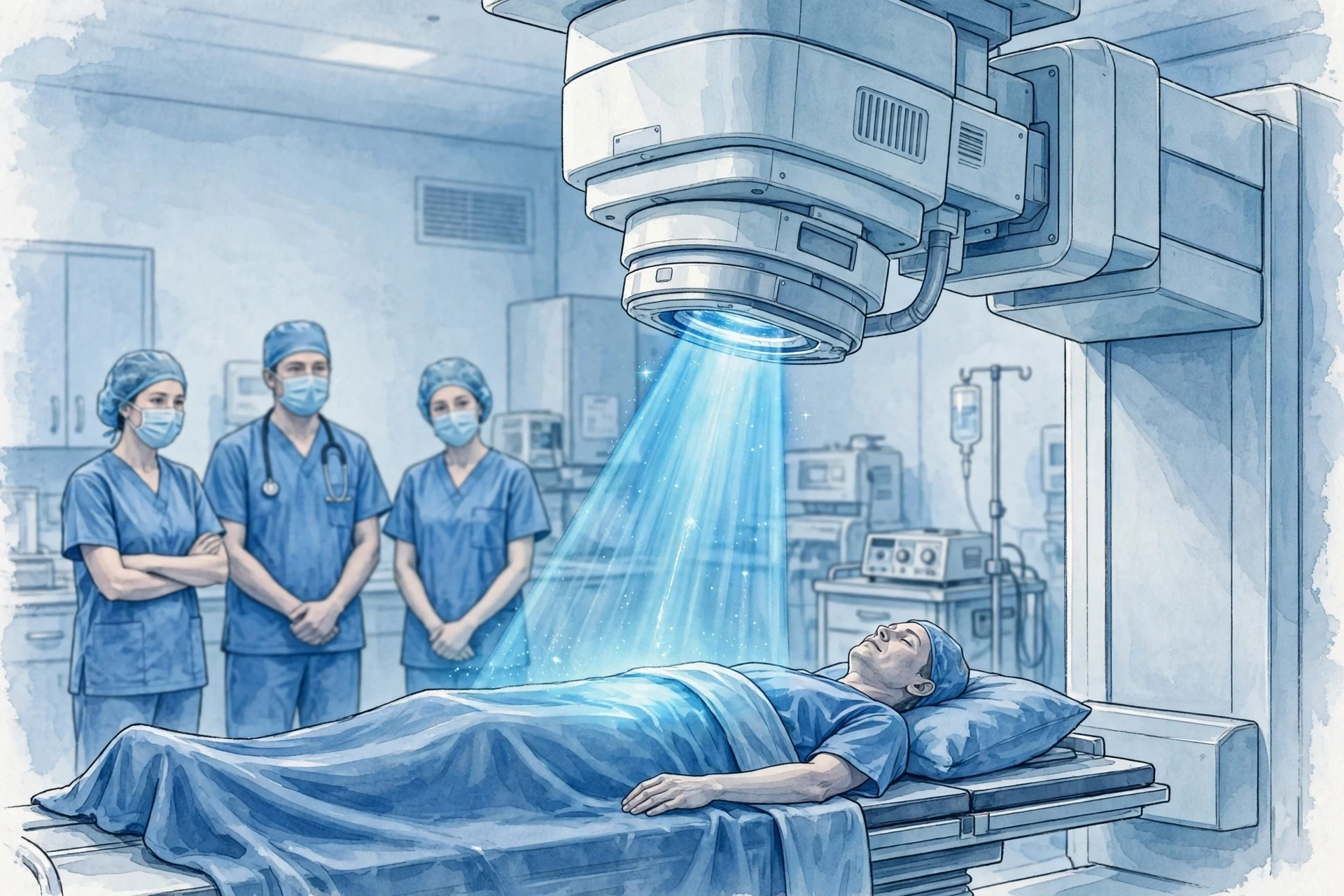
Radiotherapy uses higher doses, aimed at killing cancer cells. The radiation damages the DNA of the cells it hits, and cancer cells, which divide quickly and repair damage less well than normal cells, are more vulnerable. The treatment is usually given in many small doses over several weeks, rather than one large dose, so that healthy tissue has time to recover between sessions. Modern radiotherapy is highly targeted: the beam can be shaped to match the shape of the tumour, and it can be aimed from several directions so that the dose is concentrated where it is needed and spread out elsewhere.
Iodine-131 is a classic example of a therapeutic isotope. The thyroid gland takes up iodine from the blood, and it cannot tell the difference between stable iodine and radioactive iodine-131. A patient with an overactive thyroid, or with thyroid cancer, can be given iodine-131, which concentrates in the thyroid and delivers its radiation there, from the inside. The half-life of about 8 days means the treatment is active for a few weeks and then fades away. That combination — a chemical that goes to the right place, and a half-life that is long enough to work and short enough to fade — is what makes a good medical isotope.
"A tracer is a lantern, not a floodlight. It is bright enough to see by, small enough to carry, and it goes out on its own when its work is done."
10. Background Radiation: It Is Everywhere
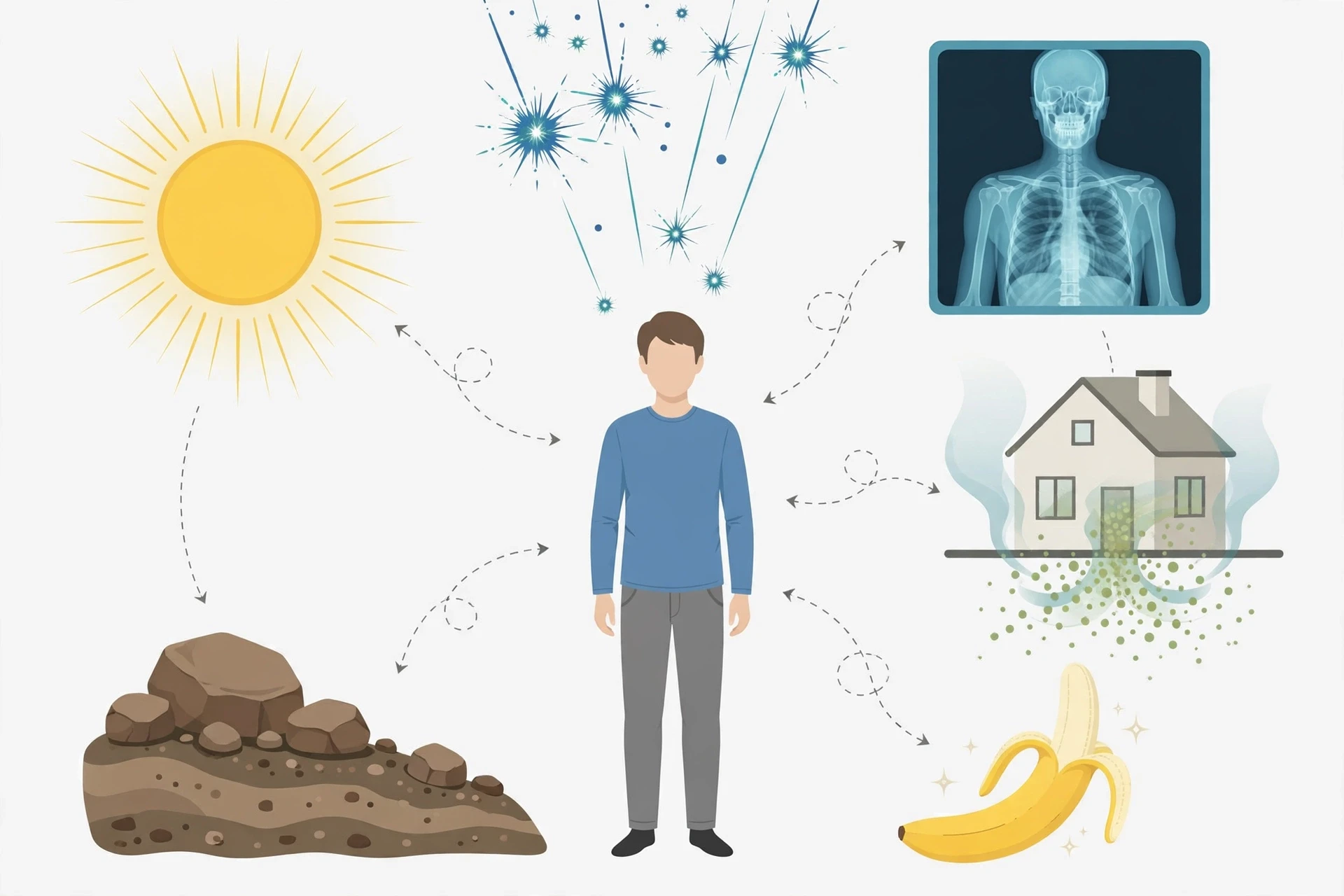
One of the most surprising facts about radioactivity is how much of it is natural. The average person receives a dose of about 3 millisieverts per year from natural background radiation, and the exact number varies with where they live, what their house is built from, how high above sea level they are, and what they eat. That dose comes from several sources, and it has been there for the whole of human history.
Cosmic radiation comes from space. Fast particles from the Sun and from distant stars strike the upper atmosphere, producing showers of secondary particles, some of which reach the ground. The dose from cosmic radiation is higher at altitude, because there is less air above to absorb it, and higher near the poles, because the Earth's magnetic field funnels charged particles toward them. A person living in a high-altitude city receives more cosmic radiation than a person living at sea level, and a long-haul flight crew receives more still, because they spend hours at altitudes where the shielding of the atmosphere is thinner.
Terrestrial radiation comes from the ground. Rocks and soil contain uranium, thorium, and potassium-40, all of which are radioactive, and they have been there since the Earth formed. Granite, in particular, contains more uranium and thorium than most other rocks, so houses built from granite, or built on granite ground, tend to have higher background levels. The dose from terrestrial radiation varies by a factor of several across different regions, and in a few places in the world — parts of Brazil, India, and Iran — natural background levels are ten times the global average or more, and people have lived there for generations without any clear increase in cancer rates that can be attributed to the radiation.
10.1 How big is a millisievert? A sense of scale
Numbers without a scale are hard to judge, so it helps to put doses in context. The table below gives approximate doses for a range of everyday exposures and medical procedures. These are average values, rounded for clarity, and individual doses vary, but the order of magnitude is what matters.
Source | Approximate dose |
|---|---|
Eating one banana | About 0.0001 millisieverts |
Dental X-ray | About 0.005 millisieverts |
Chest X-ray | About 0.1 millisieverts |
Return flight from New York to London | About 0.05 to 0.1 millisieverts |
Average natural background, one year | About 3 millisieverts |
CT scan of the abdomen | About 8 millisieverts |
Annual dose limit for a radiation worker | 20 millisieverts per year, averaged over five years |
Dose at which radiation sickness begins to appear | About 1,000 millisieverts in a short time |
11. Is Radioactivity Dangerous?
The honest answer is yes, and no, and it depends. Radioactivity is dangerous in the same way that fire is dangerous: it is a real hazard that can cause real harm, and it is also a tool that humans have learned to use safely, most of the time, by understanding it and respecting it. The danger is not a matter of belief. It is a matter of dose.
At high doses, delivered in a short time, radiation can cause acute radiation sickness: nausea, vomiting, hair loss, damage to the bone marrow, and, at very high doses, death. The threshold for these effects is around 1,000 millisieverts delivered in a short period, and the severity increases with dose. These effects are deterministic, which means they get worse as the dose increases, and they appear predictably above a threshold. They are the effects seen in the survivors of the atomic bombings, in the firefighters at Chernobyl, and in a small number of industrial accidents.
At lower doses, delivered over a long time, the main concern is an increased risk of cancer. Radiation can damage DNA, and if that damage is not repaired correctly, it can lead to a cancer years or decades later. This risk is stochastic, which means it is a matter of probability, not certainty. A higher dose means a higher probability, but there is no dose below which the risk is proven to be exactly zero, and there is no dose above which cancer is certain. The risk from a single CT scan, for example, is small — a fraction of a percent added to a lifetime cancer risk that is already about 40 percent from all causes — but it is not zero, and that is why scans are only done when they are needed.
That uncertainty at low doses is a genuine scientific debate. Some researchers argue that the risk is proportional to dose all the way down to zero, a model known as the linear no-threshold model, which is the basis of most radiation protection rules. Others argue that very low doses may be harmless, or even beneficial, a claim known as hormesis, for which the evidence is weak and contested. Still others argue that the body repairs low-level damage so well that the risk is lower than the linear model predicts. The protection rules take the cautious view, and they are deliberately conservative. That is a reasonable approach for a hazard that is invisible and cumulative, but it is worth knowing that the low-dose debate exists, and that the science at very low doses is less certain than the science at high doses.
11.1 Common myths about radioactivity
Most people assume that anything radioactive is artificial, and that the natural world is free of radiation. What the data actually shows is the opposite. Most of the radiation the average person receives comes from natural sources: cosmic rays, rocks, radon, and the potassium and carbon inside their own body. Artificial sources — medical scans, nuclear power, and fallout from past testing — add a smaller share for most people. That does not make artificial radiation safe by definition, and it does not make natural radiation safe by definition. It means that "natural" and "safe" are not the same word, and neither are "artificial" and "dangerous". The dose is what matters, not the origin.
Another common myth is that radioactivity makes things glow green. It does not. The green glow is a Hollywood invention. Some radioactive materials do glow, but the glow is usually a faint blue, caused by a phenomenon called Cherenkov radiation, in which a fast particle moves through water faster than light moves through water, producing a blue light. The glow of a radium watch dial came from a phosphor, a chemical that glows when struck by radiation, not from the radium itself. A radioactive source in a laboratory looks like an ordinary piece of metal or a sealed container. It gives no visual warning at all, which is why instruments and labels matter.
12. Nuclear Power, Waste, and the Future
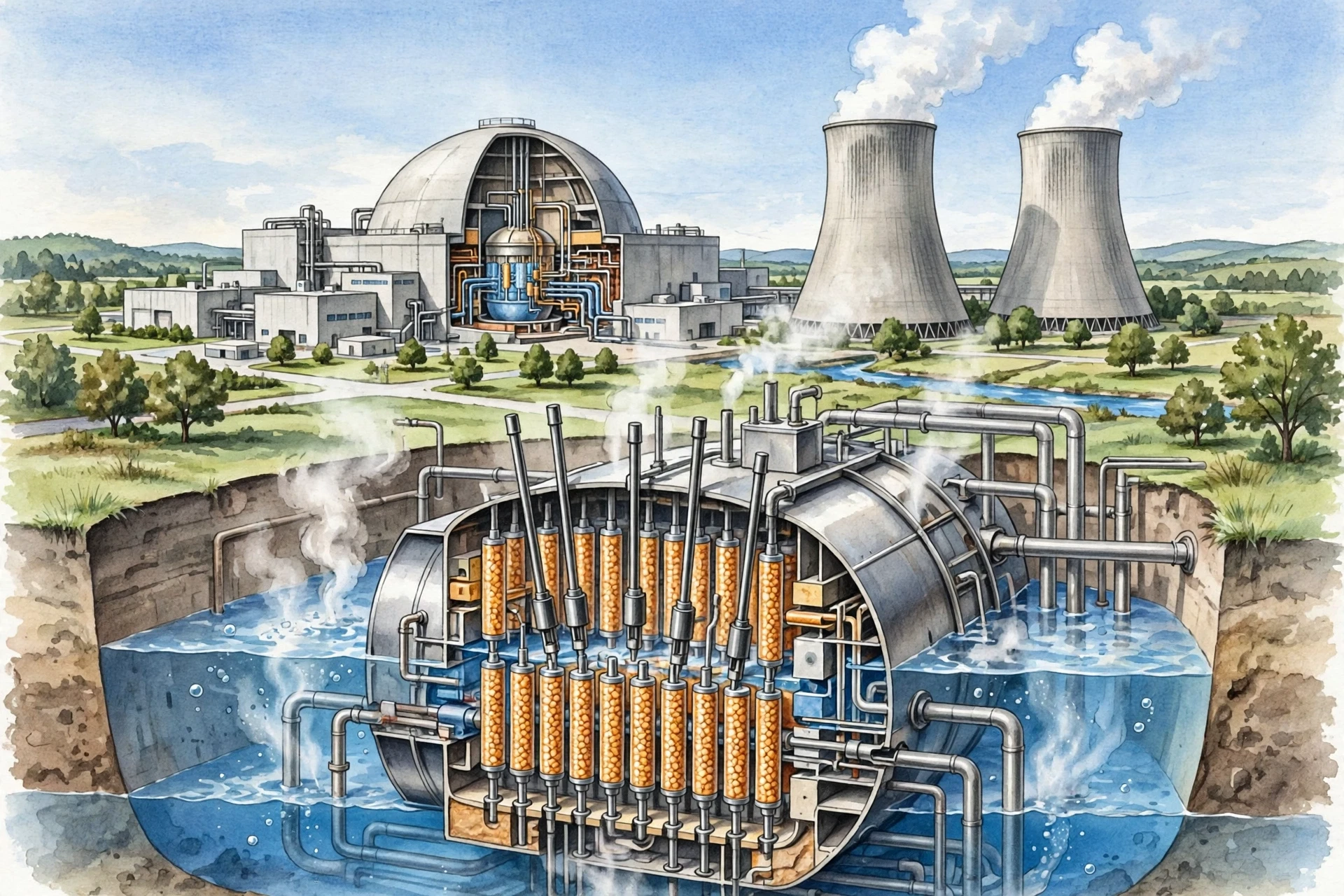
Nuclear power is the largest-scale use of radioactivity, and it is also the most contested. A nuclear power plant is, at heart, a steam engine. Fission in the reactor core produces heat. The heat makes steam. The steam turns a turbine. The turbine turns a generator, and the generator makes electricity. The difference from a coal or gas plant is the source of the heat, and the fact that the heat comes from splitting atoms rather than burning fuel. That difference brings advantages and problems that are both real.
The advantage is energy density. A small amount of uranium fuel produces a large amount of electricity, and it does so without producing carbon dioxide during operation. A single uranium fuel pellet, about the size of a fingertip, contains roughly as much energy as a tonne of coal. That is why nuclear power is attractive to countries that want large amounts of low-carbon electricity, and why it is often discussed alongside wind and solar as part of a low-carbon energy mix.
The problems are waste, cost, and risk. The waste problem is discussed in section 7 and below. The cost problem is that nuclear plants are expensive to build, and they take a long time to build, which makes them hard to finance. The risk problem is that a severe accident, while rare, can have large consequences, as Chernobyl in 1986 and Fukushima in 2011 showed. Those accidents were different in cause and in scale, and they are often confused with each other, but both released radioactive material into the environment, displaced large numbers of people, and left a lasting mark on public trust. Any honest account of nuclear power has to acknowledge them, and has to acknowledge that the fear they caused is understandable.
12.1 What happens to nuclear waste
Spent nuclear fuel is first stored in pools of water at the reactor site, where the water cools it and shields the radiation. After several years, it can be moved to dry casks — massive steel and concrete containers — for longer-term storage. The long-term plan, in several countries, is deep geological disposal: burying the waste in stable rock formations, hundreds of metres underground, where it will be isolated from the environment for thousands of years. Finland has built the first such facility, and it is expected to begin operation in the coming years. Other countries are at different stages of planning or construction.
Deep geological disposal is a sound idea in principle, and it is the option favoured by most experts, but it is hard to do in practice. It requires finding a suitable site, gaining the consent of the local community, building an engineered facility that will last far longer than any human structure has yet lasted, and doing all of that in a political environment where the benefits are national and the burdens are local. That tension has delayed progress in many countries, and it is one of the reasons the waste question is still open. It is not a technical impossibility. It is a social and political difficulty, and it deserves to be described as such.
13. Living with Radioactivity: A Clear-Eyed View
Radioactivity will not go away. It is a property of matter, and radioactivity has been part of the Earth since the beginning. Humans did not invent it. We discovered it, learned to measure it, learned to use it, and learned, sometimes painfully, to respect it. The task now is not to pretend radioactivity is harmless, and not to pretend it is unmanageable. It is to understand it well enough to make good decisions about it.
Those decisions are personal as well as political. A patient deciding whether to have a scan needs to know the dose and the benefit. A homeowner in a radon area needs to know whether to test and how to fix a high reading. A voter deciding about nuclear power needs to know the waste problem, the accident record, and the carbon savings, and to weigh them against the alternatives. None of those decisions can be made well without a basic understanding of half-life, of dose, and of the difference between a small risk and a large one.
The science in this article points to a few simple conclusions. Radioactivity is the decay of unstable nuclei, and it follows rules that are simple, predictable, and independent of ordinary conditions. The three main kinds of decay — alpha, beta, and gamma — differ in what they are, how far they travel, and how they are stopped. Half-life turns that decay into a clock, and that clock lets us date the past, treat disease, and generate power. Background radiation is everywhere, at levels far below those that cause acute harm, and the doses from everyday life and from most medical procedures are small compared with the doses that cause sickness. High doses are genuinely dangerous, and the protection principles — time, distance, and shielding — are simple and effective.
Frequently Asked Questions
What is half-life?
Half-life is the time it takes for half of the atoms in a sample of a radioisotope to decay. After one half-life, half of the original atoms remain. After two half-lives, a quarter remains. After three, an eighth remains. The half-life is a fixed property of the isotope: it does not change with temperature, pressure, chemistry, or the amount of material present. Carbon-14 has a half-life of about 5,730 years, iodine-131 has a half-life of about 8 days, and uranium-238 has a half-life of about 4.5 billion years. Half-life is what makes radioactivity useful as a clock for dating, for medicine, and for planning how long radioactive waste must be stored.
How does carbon-14 dating work?
Carbon-14 is made in the upper atmosphere when cosmic rays strike nitrogen, and living things take it up while they are alive, so the ratio of carbon-14 to stable carbon-12 in a living organism matches the ratio in the atmosphere. When the organism dies, it stops taking up new carbon-14, and the carbon-14 it already contains decays into nitrogen-14 with a half-life of about 5,730 years, while the carbon-12 stays unchanged. By measuring the ratio of carbon-14 to carbon-12 in a sample today, scientists can work out how long it has been since the organism died. The method works for organic material up to about 50,000 years old, and it is calibrated against tree rings and other independently dated samples to correct for past changes in atmospheric carbon-14.
What are alpha, beta, and gamma decay?
Alpha, beta, and gamma are the three main kinds of radioactive decay. In alpha decay, the nucleus throws out an alpha particle — two protons and two neutrons — and becomes a different element, two places lower on the periodic table. In beta decay, a neutron turns into a proton and throws out a fast electron, so the atomic number goes up by one while the mass number stays the same. In gamma decay, the nucleus gives off a gamma ray, a high-energy form of light, and drops to a lower energy state without changing its proton or neutron count. Alpha particles are heavy and easily stopped by paper, beta particles travel further and are stopped by a few millimetres of aluminium, and gamma rays are the most penetrating and need thick lead or concrete to be absorbed.
Is radioactivity dangerous?
Radioactivity can be dangerous, and the danger depends on dose. At high doses delivered in a short time — around 1,000 millisieverts and above — radiation can cause acute sickness and, at very high doses, death. At lower doses, the main concern is a small increase in the lifetime risk of cancer, and that risk rises with dose. Most everyday exposures are far below those levels: the average person receives about 3 millisieverts per year from natural background radiation, and a chest X-ray gives about 0.1 millisieverts. Radioactivity is also natural — it is in rocks, in the air, in food, and inside the body — and it is used safely in medicine and industry when the principles of time, distance, and shielding are followed. The risk is real, but it is measurable and manageable.
What is the difference between radiation and radioactivity?
Radioactivity is the process: the spontaneous decay of an unstable nucleus. Radiation is what comes out of that process: the particles or energy released by the decay. A radioactive material contains unstable nuclei that are decaying. Radiation is the stream of alpha particles, beta particles, or gamma rays leaving it. An X-ray machine produces radiation while it is switched on, but it contains no radioactive material, so it gives off nothing when it is off. Being exposed to radiation is different from being contaminated with radioactive material, which means the material itself has got onto or into the body and keeps decaying there.
Can radioactivity be used to treat cancer?
Yes. Radiotherapy uses radiation to damage the DNA of cancer cells, which divide quickly and repair damage less well than normal cells. The treatment is usually given in many small doses over several weeks, aimed carefully so that the tumour receives a high dose and the healthy tissue around it receives a much lower dose. Some treatments use a radioactive isotope that concentrates in a particular organ, such as iodine-131 for the thyroid, which delivers its radiation from inside the body. Medical uses of radioactivity involve a trade-off between a small radiation risk and a clear benefit, and doctors use the smallest dose that will do the job.
How long does radioactive waste stay dangerous?
It depends on the half-life of the isotopes in the waste. Short-lived isotopes fade in days, weeks, or months. Caesium-137 and strontium-90, with half-lives of about 30 years, stay radioactive for centuries. Plutonium-239, with a half-life of about 24,000 years, stays radioactive for far longer, though at a lower level of activity per gram. After ten half-lives, about one thousandth of the original amount remains. That is why waste is sorted by half-life, why short-lived waste is stored until it decays to safe levels, and why long-lived waste is planned for deep geological disposal, buried in stable rock hundreds of metres underground.