

Hold a piece of gold in your hand and it looks the way gold has always looked: heavy, yellow, warm in the light, impossible to mistake for anything else. Now imagine that same gold ground so fine that a single speck of it is smaller than the wavelength of light itself — and watch it turn ruby red. Not painted red. Not dyed. The gold itself becomes red, because at that size gold stops behaving like gold. That single, startling fact is where nanochemistry begins, and it is the thread this article follows from an ancient Roman drinking cup to the medicines, sunscreens, batteries and water filters of today.
Nanochemistry is the branch of chemistry that studies matter at the scale of one to one hundred nanometres, and asks a question that sounds almost like a riddle: how can the same atoms, arranged from the same elements, behave like a completely different substance simply because they are smaller? The answer touches surface area, quantum physics, the way light interacts with matter, and the way living cells handle tiny intruders. If you have ever rubbed sunscreen into your skin, worn a stain-resistant shirt, or taken a medicine that worked better than the version before it, there is a good chance nanochemistry was quietly involved.
I first met this strangeness not in a lecture hall but at a museum display case, staring at a glass cup that changed colour as I walked around it. The label said the glass contained gold. Gold, in glass, making it red in one light and green in another — it felt like a trick. Years later, in a teaching laboratory, I watched a student add a few drops of a gold salt solution to a flask, heat it, and produce a liquid the colour of good red wine. She held the flask up to the window and laughed, because nothing about the pale yellow starting solution had suggested that ruby liquid was coming. That flask contained gold nanoparticles, and the red colour was not a dye or an impurity. It was the gold itself, behaving at the nanoscale the way bulk gold never does. That moment is the best doorway into nanochemistry I know, so this article starts there, with the cup, the flask, and the question they both ask.
1. The Red Glass That Should Not Exist
In a museum in London sits a glass cage-cup made in Rome in the fourth century, known as the Lycurgus Cup. It is a beautiful object on its own: scenes from a Greek myth carved into greenish glass. But it holds a secret that no Roman glassmaker could have explained. Shine a light on it from the front and the glass looks jade green. Put the light behind it and the same glass glows a deep, blood red. One object, two colours, changed by nothing but the direction of the light.
For centuries nobody knew why. The answer arrived only when modern microscopes let scientists look inside the glass itself. Scattered through it are particles of gold and silver, each only a few tens of nanometres across — far too small to see, far too small even to scatter light the way a grain of sand does. These particles interact with light in a way that depends on their size, their shape, and the metal they are made from. Green light is scattered one way, red light another, and the cup changes colour as the light changes direction. The Romans did not know they were doing nanochemistry. They were adding tiny amounts of gold to glass because the results were beautiful, and the results were beautiful because of nanoscale chemistry they could not see.
Medieval glassmakers stumbled onto the same effect: the deep reds in stained-glass windows come in many cases from gold particles dispersed in the glass, worked by recipe and feel.
That history matters, because it corrects a common idea about nanochemistry: that it is a brand-new science invented in a modern laboratory. The science is new. The phenomenon is ancient. What changed in the last few decades is that we learned to see it, to measure it, and to control it on purpose. Once you can make particles of a chosen size and shape, reliably, you can design materials with properties that do not exist in nature at bulk scale. That is the promise that has drawn chemists, doctors, engineers and environmental scientists into nanochemistry, and it is also the reason the field needs careful explanation rather than hype.
1.1 Why a cup matters to a chemist
A chemist looking at the Lycurgus Cup does not see a magic trick. She sees a demonstration of three ideas that run through all of nanochemistry. First, size changes properties: the same gold that is yellow and metallic in a ring is red and glassy in a nanoparticle. Second, surfaces matter more than interiors: when a particle is only a few dozen atoms across, most of its atoms sit on the surface, exposed and ready to react. Third, light and matter interact differently at the nanoscale, which is why nanoparticles show up in everything from medical tests to television screens.
Keep those three ideas in mind as you read. Almost every application in this article — the medicine, the sunscreen, the catalyst, the sensor — is one of those three ideas, put to work.
2. What Is Nanochemistry?
Nanochemistry is the study of chemical systems at the nanoscale — the scale of structures between about one and one hundred nanometres in at least one dimension — and of how chemistry at that scale creates new properties and new uses. A nanometre is one billionth of a metre. Written out, that is 0.000000001 metres, a number so small that it is easier to think in comparisons: a sheet of paper is about one hundred thousand nanometres thick, a human hair is roughly eighty thousand nanometres wide, and a single strand of DNA is about two and a half nanometres across. Nanochemistry lives in the world between individual atoms and the visible specks of dust you can see floating in sunlight.
The word itself is a compound of "nano", from the Greek word for dwarf, and "chemistry", the science of matter and its changes. Nanochemistry sits at the meeting point of chemistry, physics, biology and materials science. A chemist working in nanochemistry might spend the morning synthesising particles, the afternoon measuring them with an electron microscope, and the evening discussing with a biologist whether those particles can carry a drug to a tumour. The field is collaborative by nature, because no single discipline owns the nanoscale.
It helps to separate nanochemistry from its close neighbours. Nanotechnology is the broader engineering field: the design and use of nanoscale devices and systems. Nanochemistry is the chemistry inside that field — the synthesis, the bonding, the reactions, the surface behaviour that make nanoscale devices possible. Nanoscience is the wider study of phenomena at the nanoscale across all sciences. Think of it this way: nanoscience asks what happens at the nanoscale, nanochemistry explains why it happens in chemical terms and how to make it happen, and nanotechnology builds things from it. The three overlap constantly, and you will see all three words used in the sources for this article, but the chemical questions — how do you make the particles, why do they react the way they do, what happens at their surfaces — are the heart of nanochemistry.
The National Nanotechnology Initiative, the United States federal programme that coordinates nanoscale research, defines nanotechnology in terms of working at dimensions of roughly one to one hundred nanometres, where unique phenomena enable novel applications. That one-to-one-hundred range is not a law of nature. It is a working definition, a boundary drawn where the interesting changes tend to begin and end. Some particles slightly larger than one hundred nanometres still show nanoscale behaviour. Some structures smaller than one nanometre are really just molecules. The boundary is fuzzy, and honest scientists will tell you so. What matters is not the exact number but the principle: below a certain size, matter starts to play by different rules, and nanochemistry is the study of those rules.
2.1 The building blocks: nanoparticles, nanocrystals, and nanostructures
The vocabulary of nanochemistry can feel like a wall of similar-sounding words, so here is the short version. A nanoparticle is any particle between one and one hundred nanometres in size. A nanocrystal is a nanoparticle with an ordered, crystal-like internal structure — a tiny, well-organised solid. A nanostructure is any object with nanoscale features: a tube, a wire, a sheet, a cage, a shell. A quantum dot is a semiconductor nanocrystal whose optical and electronic properties change with its size. A nanotube is a hollow cylinder at the nanoscale, most famously made from carbon. A nanocomposite is a material that gains its properties from nanoparticles embedded inside it.
Two more terms deserve attention because they appear in nearly every discussion of safety and medicine. Functionalisation is the deliberate attachment of molecules to a nanoparticle's surface to give it a job: a targeting molecule that seeks out a cancer cell, a coating that keeps the particle stable in blood, a chemical group that binds to a pollutant. Much of practical nanochemistry is functionalisation — not making the particle, but teaching it what to do once it exists.
2.2 Where nanochemistry came from
The modern story of the nanoscale usually starts with a talk given by the physicist Richard Feynman in 1959, titled "There's Plenty of Room at the Bottom". Feynman asked his audience to imagine writing the entire Encyclopaedia Britannica on the head of a pin, and building machines atom by atom. At the time it sounded like science fiction, but the talk planted an idea that stayed alive for decades.
The instruments arrived in the 1980s. The scanning tunnelling microscope, invented in 1981, let scientists see individual atoms for the first time. The atomic force microscope followed, and then ever more powerful electron microscopes. Suddenly the nanoscale was not a thought experiment but a place you could visit, image, and measure. Chemists began to ask the question that defines nanochemistry: if we can see atoms and build with them, what new chemistry becomes possible?
Discoveries such as buckminsterfullerene in 1985 and carbon nanotubes in 1991 showed that the nanoscale held entirely new structures, with properties no bulk material could match, and nanochemistry grew out of that excitement.
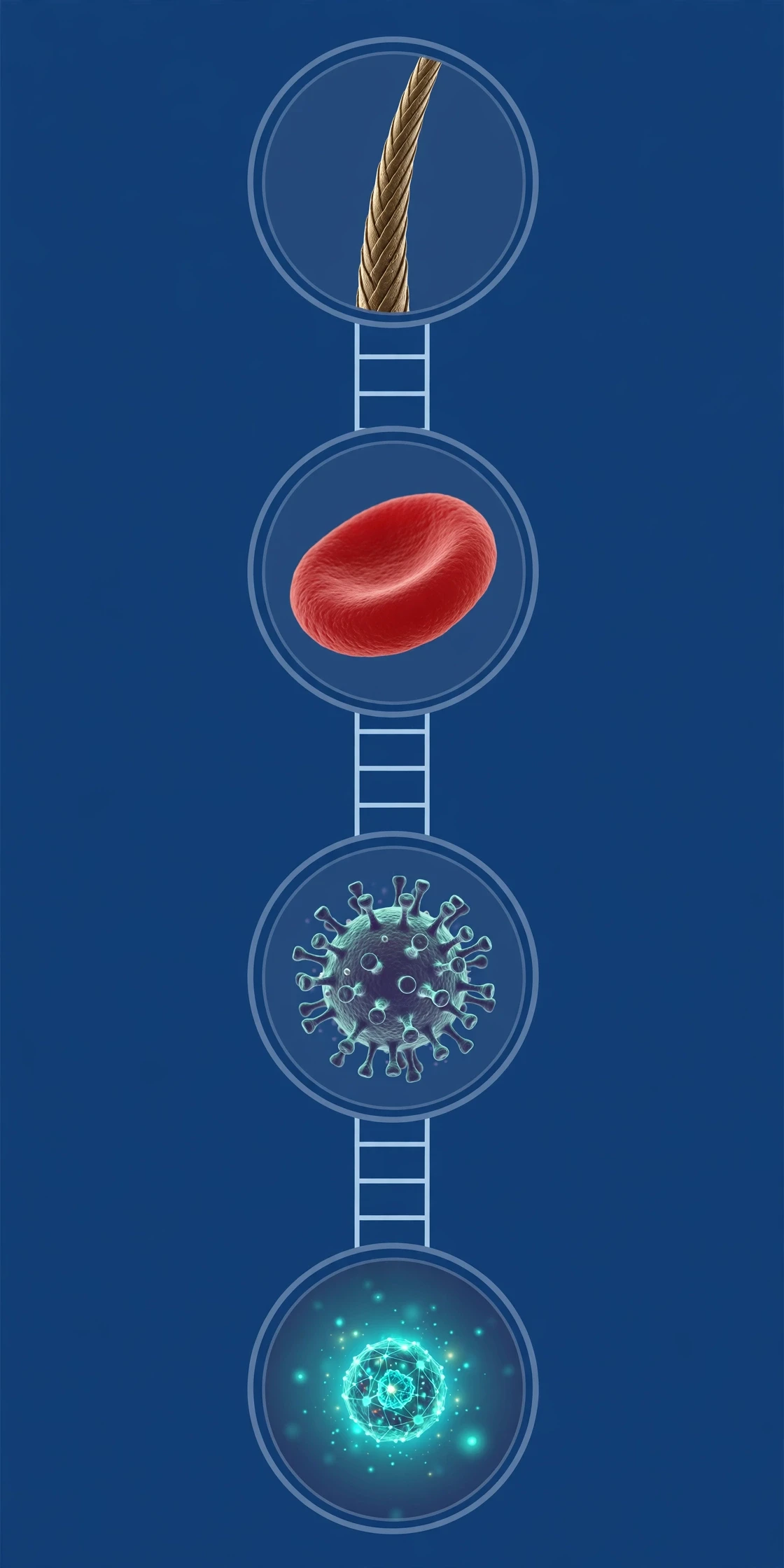
3. How Small Is a Nanometre, Really?
Numbers like "one billionth of a metre" are hard to feel. The human brain did not evolve to picture billionths, so it helps to build a ladder of comparisons and climb down it slowly. Start with something you can hold: a metre stick. Cut it into a thousand pieces and you have millimetres, the thickness of a credit card edge. Cut one millimetre into a thousand pieces and you have micrometres: a red blood cell is about seven micrometres across, and a bacterium is about one or two. Cut one micrometre into a thousand pieces and you have nanometres. A nanoparticle ten nanometres across is one hundred times smaller than a bacterium, and about ten thousand times smaller than the width of your hair.
That smallness is not just a curiosity. It is the reason nanochemistry exists as a separate field. At the scale of everyday objects, the properties of a material depend mostly on what it is made of. A kilogram of iron is iron, whether it is a single block or a bucket of nails. At the nanoscale, that rule breaks down. The properties depend on how big the pieces are, how they are shaped, and how much of the material is surface rather than interior. A ten-nanometre particle of gold and a hundred-nanometre particle of gold are the same element, yet they can differ in colour, melting point, chemical reactivity and electrical behaviour. The size is part of the chemistry.
The nanoscale is not just a smaller version of our world. It is a different world, where surfaces rule, quantum effects appear, and the familiar properties of materials quietly change their minds.
3.1 The surface takes over
The single most important idea in nanochemistry is the surface-area-to-volume ratio, and it is worth understanding properly because it explains so much of what follows. Imagine a cube of sugar. It has a certain surface area — the outside faces you can see — and a certain volume — the sugar inside. Now cut that cube into eight smaller cubes. The total volume is unchanged, but the total surface area has doubled, because cutting exposes new faces that used to be hidden inside. Cut again, and again, and again. Each time, the volume stays the same and the surface area grows. By the time your sugar is divided into nanoparticles, the surface area is enormous compared with the volume, and most of the atoms in the material are sitting on a surface rather than buried inside.
Why does that matter? Because chemistry happens at surfaces. A reaction between a solid and a liquid, or a solid and a gas, can only happen where the two meet — at the surface. Atoms buried inside a solid are locked in place, bonded to their neighbours on all sides, with no room to react. Atoms on the surface have unsatisfied bonds, dangling connections reaching outward, looking for something to grab. They are restless, reactive, ready. In a nanoparticle, a large fraction of all the atoms are surface atoms, so a large fraction of the material is ready to react. That is why nanoparticles make such powerful catalysts, why they can be so chemically lively, and why a small amount of nanoparticle material can do the work of a much larger amount of the bulk substance.
In a particle one micrometre across, far less than one atom in a hundred sits on the surface. In a ten-nanometre particle, roughly one in five does. In a two-nanometre particle, about half do — at that point the particle is almost all surface, and the material has become, in a real sense, a different substance from the bulk version of itself.
3.2 A sugar-cube demonstration you can picture
I once watched a teacher demonstrate this with a block of ice and a tray of crushed ice, and the image has stayed with me because it makes the abstract idea physical. The block sat in a warm room and melted slowly, dripping at its edges. The crushed ice, the same mass of water, melted in minutes. Nothing about the water had changed. Only the surface area had changed, and the surface area decided how fast heat could get in. Nanoparticles work the same way, except the stakes are higher: the "heat getting in" is a chemical reaction, and the difference in speed can be thousands of times, not just minutes versus hours.
That demonstration also explains why nanochemistry is so useful for catalysts: spread a catalyst out as nanoparticles and you get vastly more working surface from the same amount of expensive metal. A car exhaust catalyst uses tiny particles of platinum, palladium and rhodium spread over a ceramic support.

3.3 When quantum rules appear
Surface area explains much of nanochemistry, but not everything. Below a certain size — roughly ten nanometres for many materials — a second effect appears, and it is stranger. Electrons inside a tiny particle become confined, squeezed into a space so small that they can only occupy certain energy levels, like notes on a guitar string that can only vibrate at particular pitches. Physicists call this quantum confinement, and it changes the colour of light a particle absorbs and emits, its electrical conductivity, and its magnetic behaviour.
This is why quantum dots glow in different colours depending on their size. A larger quantum dot emits red light; a smaller one made of exactly the same material emits blue. Nothing about the chemical composition has changed. Only the size has changed, and the size decides which wavelengths of light the confined electrons can produce. Television manufacturers use this effect to make displays with richer, more precise colours. Medical researchers use it to make fluorescent labels that glow in distinct colours, so several different targets inside a cell can be tracked at once.
Quantum effects matter most for semiconductors and for particles below about ten nanometres. Knowing which effect is doing the work in a given application is part of what separates careful nanochemistry from hand-waving.
4. Why Do Nanoparticles Behave Differently from Bulk Materials?
Most people assume that a material is a material — that gold is gold and silver is silver, whatever the size of the piece. That assumption is reasonable for everything you can see, and it is wrong at the nanoscale. What we actually see in the data is a set of properties that shift smoothly as particles shrink, then shift sharply below about ten nanometres, until the material behaves like something new. Nanochemistry exists to map those shifts and to use them.
There are four main reasons nanoparticles behave differently from bulk materials. The first is the surface-area-to-volume ratio, described above: more surface atoms means more reactivity, faster reactions, and lower melting points. The second is quantum confinement: electrons squeezed into a tiny space behave differently, changing colour and conductivity. The third is that the arrangement of atoms can change at small sizes — a crystal structure that is stable in a large chunk may not be the stable form in a nanoparticle, so the nanoparticle adopts a different arrangement with different properties. The fourth is that light interacts differently with objects smaller than its own wavelength, producing the colour effects seen in the Lycurgus Cup and in gold nanoparticle solutions.
4.1 Melting points that fall off a cliff
One of the most dramatic demonstrations is the melting point. Bulk gold melts at 1,064 degrees Celsius. A gold nanoparticle a few nanometres across can melt at several hundred degrees lower. Bulk silver melts at 962 degrees Celsius, yet a silver nanocrystal two nanometres across has been measured melting near 127 degrees Celsius — a drop of roughly eight hundred degrees. The surface-energy reasoning behind that drop is worked through in the LibreTexts nanomaterials section. The reason is surface energy. Atoms on the surface of a particle are less tightly bound than atoms in the interior, because they have fewer neighbours holding them in place. When most of the atoms are surface atoms, the whole particle is held together more loosely, and less heat is needed to break it apart into a liquid.
That matters for manufacturing: metal nanoparticle inks can be printed onto flexible plastic and heated gently to form conducting lines, because the nanoparticles fuse at temperatures the plastic can survive.
4.2 Colour, conductivity, and magnetism
Gold is the classic example of colour change, but it is far from the only one. Silver nanoparticles are yellow. Copper nanoparticles can look red or black depending on size. Semiconductor nanoparticles change colour with size across the whole rainbow, as quantum dots show. These colour changes are not dyes. They are the material's own interaction with light, tuned by size.
Electrical behaviour changes too. A metal that conducts well in bulk may conduct poorly as a tiny particle, because electrons scatter off the particle's surfaces. A material that is an insulator in bulk can become a semiconductor at the nanoscale. Magnetic behaviour changes as well: tiny magnetic particles can lose their permanent magnetism and become superparamagnetic, meaning they respond strongly to a magnetic field but keep no magnetism of their own once the field is removed. Doctors use that property in magnetic resonance imaging contrast agents and in experimental treatments where magnetic nanoparticles are guided to a tumour and then heated with an alternating magnetic field.
The table below gathers the main differences in one place. It is a summary, not a law — the exact numbers depend on the material, the shape, and the surroundings — but it shows the pattern that nanochemistry works with every day.
Property | Bulk material | Nanoparticle (1–100 nm) | Main reason |
|---|---|---|---|
Colour | Fixed for the material (gold is yellow) | Changes with size and shape (gold can be red, purple or blue) | Light interacts with particles smaller than its wavelength |
Melting point | Fixed, high for metals | Drops sharply as size falls | Surface atoms are less tightly bound |
Chemical reactivity | Moderate; only the outer surface reacts | Much higher; most atoms are surface atoms | Surface-area-to-volume ratio |
Electrical conductivity | Steady for the material | Can fall, or change character entirely | Electron scattering and quantum confinement |
Magnetism | Permanent in magnetic materials | Can become superparamagnetic | Thermal energy overwhelms the tiny magnetic moment |
Solubility | Low for many solids | Often higher | High surface energy favours dissolving |
Crystal structure | The stable bulk form | A different form can become stable | Surface energy changes which arrangement wins |
4.3 Shape matters as much as size
A nanoparticle is not just a small sphere. Chemists can make rods, plates, cubes, stars, cages and wires, and the shape changes the behaviour as surely as the size does. A gold nanorod absorbs light at a different wavelength from a gold sphere of the same volume. A star-shaped particle concentrates electric fields at its points, which makes it useful for sensing tiny amounts of a chemical. A hollow nanoshell can carry a drug inside it and release it when triggered.
Shape control is one of the hardest parts of nanochemistry: temperature, concentration, the molecules present, and the speed of the reaction all decide whether spheres, rods or plates grow. At the nanoscale, the recipe is the product.
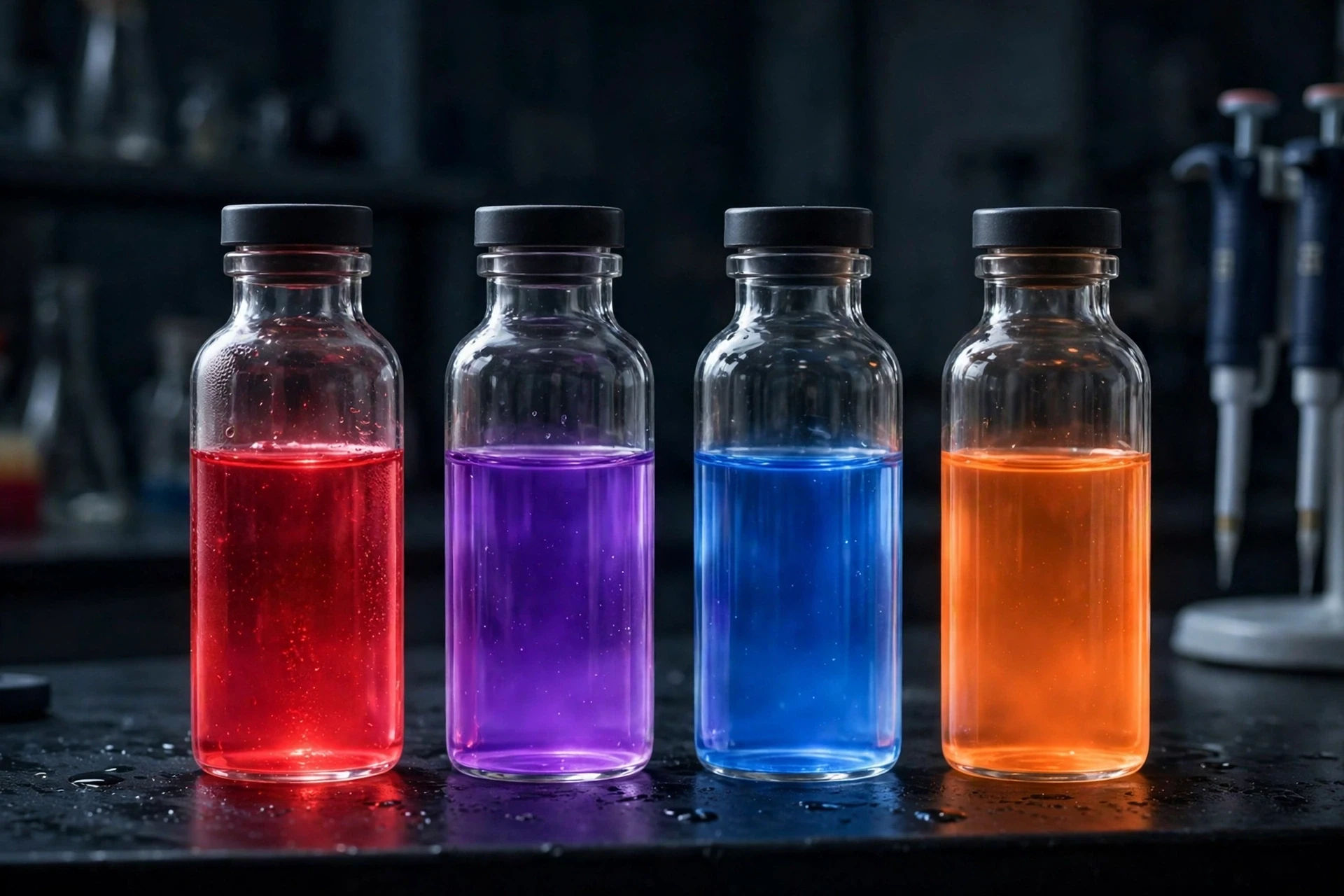
5. What Are Nanoparticles Made Of?
Nanoparticles are not one kind of thing. They are a size class, and almost any material can be made into nanoparticles: metals, metal oxides, carbon, silicon, polymers, lipids, proteins, and combinations of several of these at once. The choice of material decides what the particle can do, and nanochemistry is largely the art of matching material to purpose.
5.1 Metal and metal oxide nanoparticles
Gold nanoparticles are the most famous, partly because of their colour and partly because gold is chemically stable — it does not rust or dissolve easily in the body, which makes it useful for medical tests and treatments. Silver nanoparticles are valued for a different reason: silver kills bacteria, and silver nanoparticles release silver ions slowly from their large surface area, making them effective in wound dressings, socks, and coatings for medical devices. Titanium dioxide and zinc oxide nanoparticles are the workhorses of sunscreen, where they block ultraviolet light while remaining transparent on the skin. Iron oxide nanoparticles are magnetic, which makes them useful for imaging and for experimental cancer treatments. Silica nanoparticles — tiny grains of glass-like silicon dioxide — are used as carriers, fillers and polishing agents.
5.2 Carbon nanoparticles: tubes, balls, and sheets
Carbon is the great shape-shifter of nanochemistry. Rolled into a tube one nanometre across, it becomes a carbon nanotube: stronger than steel by weight, able to conduct electricity, and stiff enough to reinforce plastics and composites. Arranged as a hollow sphere of sixty atoms, it becomes a buckyball, a molecule with a cage that can trap other atoms inside it. Spread as a single sheet of atoms, it becomes graphene, a material one atom thick that conducts electricity and heat remarkably well and is stronger than steel at the same weight.
Carbon nanoparticles appear in bicycle frames, batteries, water filters and experimental electronics — and they show a recurring theme: the same element, carbon, can be a soft lubricant, a hard gemstone, a hollow cage, a tube, or a sheet, and the difference is entirely in how the atoms are arranged.
5.3 Quantum dots
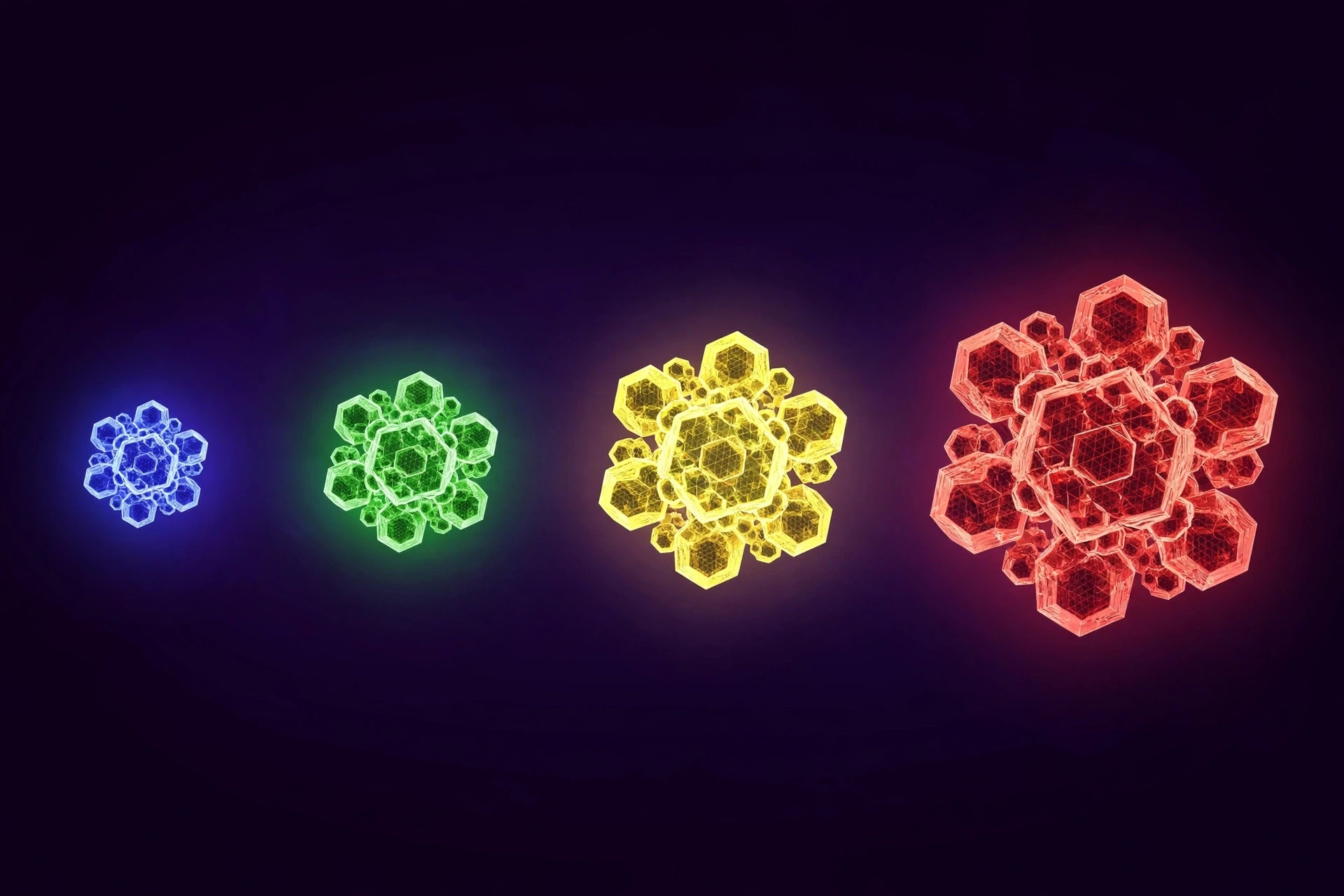
Quantum dots deserve a section of their own because they show quantum confinement more clearly than any other material. A quantum dot is a semiconductor nanocrystal, typically two to ten nanometres across, made from materials such as cadmium selenide or indium phosphide. Because the electrons inside it are confined to such a small space, the colour of light it emits depends on its size: small dots glow blue, larger dots glow red, with green, yellow and orange in between. Change the size by a nanometre and the colour shifts.
That precision has made quantum dots valuable in television and computer displays, where they produce bright, pure colours that ordinary phosphors cannot match. In medicine, quantum dots are used as fluorescent labels: attach a quantum dot to an antibody, let the antibody find its target inside a cell, and the dot lights up under a microscope, showing exactly where the target is. Several different sizes of dot can be used at once, each glowing a different colour, so several targets can be tracked in the same cell at the same time. The catch is that many quantum dots contain cadmium, a toxic metal, so researchers are working hard on cadmium-free versions — a reminder that in nanochemistry, the best-performing material is not always the one you can safely use.
5.4 Soft nanoparticles: polymers, lipids, and proteins
Not all nanoparticles are hard, inorganic solids. Some of the most important are soft: made from polymers (long chain molecules), lipids (fats), or proteins. Lipid nanoparticles are the delivery vehicles behind some modern vaccines, including the messenger RNA vaccines that became familiar worldwide in recent years. A fragile strand of messenger RNA would be destroyed quickly if injected on its own. Wrapped inside a lipid nanoparticle — a tiny droplet of fat-like molecules — it survives the journey into a cell, where it can do its work. The nanoparticle is not the medicine. It is the envelope that carries the letter.
Polymer nanoparticles work the same way for other drugs: a biodegradable shell that protects its cargo, releases it slowly, and then breaks down into harmless fragments. Protein nanoparticles use the body's own building blocks, which can make them easier for the body to accept.
5.5 Nanocomposites: small particles, big materials
A nanocomposite is an ordinary material — a plastic, a ceramic, a metal — with nanoparticles mixed into it. The particles change the properties of the whole. A small amount of clay nanoparticles can make a plastic stronger and less permeable to gases, which is useful for food packaging that keeps food fresh longer. Carbon nanotubes mixed into epoxy make composites used in aircraft parts and sports equipment. Nanoparticles of silica strengthen car tyres and reduce rolling resistance.
A few percent of nanoparticles by weight can transform a material, which is why nanocomposites are among the most commercially successful products of nanochemistry, even though they rarely get the attention that medical applications do.
6. How Nanoparticles Are Made
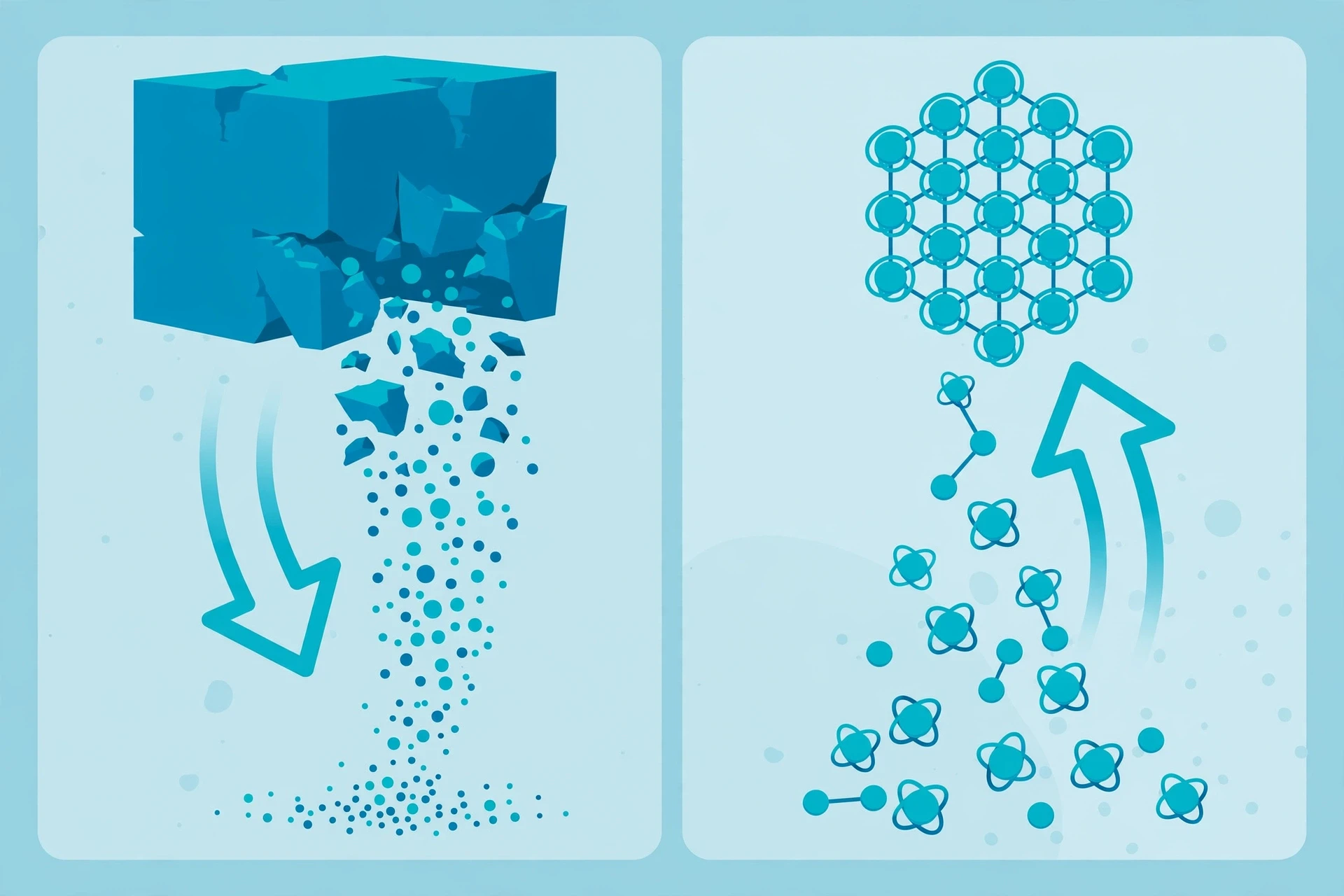
Making nanoparticles is the central craft of nanochemistry, and there are two broad approaches, often described as top-down and bottom-up. Top-down starts with a large piece of material and breaks it into smaller pieces: grinding, milling, etching, cutting with a beam of light or electrons. Bottom-up starts with atoms or molecules and builds them into particles: growing crystals in solution, letting molecules assemble themselves, depositing atoms layer by layer. Both approaches are used, and each has strengths and weaknesses.
6.1 Top-down: breaking big things into small ones
Top-down methods are familiar from ordinary manufacturing: ball milling grinds a powder until the grains are nanoscale, and lithography uses light to etch patterns into silicon. They are good at precise patterns and large quantities, but grinding creates particles of many different sizes and can damage their surfaces, and each step down in size costs more than the last.
6.2 Bottom-up: building from atoms and molecules
Bottom-up methods are closer to how nature builds things. In a typical chemical synthesis, a metal salt is dissolved in a liquid, a reducing agent is added, and metal atoms come together to form tiny particles. The chemist controls the size by controlling the conditions: the concentration of the starting materials, the temperature, the speed of mixing, and the molecules added to stop the particles growing once they reach the right size. Those stopping molecules, called capping agents or stabilisers, coat the particle surface and prevent it from growing further or clumping together with its neighbours.
6.3 Self-assembly: letting molecules build themselves
One of the most elegant bottom-up methods is self-assembly, where molecules are designed so that they spontaneously arrange themselves into the desired structure. Lipid molecules in water, for example, naturally form spheres called liposomes, with their water-loving heads facing outward and their water-fearing tails tucked inside. DNA can be folded into precise shapes — a technique called DNA origami — by designing strands that stick to each other in exactly the right places. Proteins self-assemble into virus-like shells that can carry drugs.
Self-assembly is attractive because it is cheap, it works at room temperature, and it can produce structures too complex to build by hand. It is also humbling, because it borrows from biology rather than inventing from scratch. The cell has been doing nanoscale self-assembly for billions of years. Nanochemistry, in this mode, is less an inventor and more a student, learning from the way living things build at the molecular scale.
Making a nanoparticle is easy. Making a billion identical nanoparticles, every time, is the hard part — and that gap between a good flask and a reliable factory is where much of nanochemistry research lives.
6.4 Green synthesis: gentler ways to make nanoparticles
Traditional nanoparticle synthesis often uses strong chemical reducing agents and organic solvents, which are effective but generate waste and can leave toxic residues on the particles. Green synthesis tries to do the same job with gentler tools: plant extracts, bacteria, fungi, and other biological agents that can reduce metal ions into nanoparticles. Tea leaves, for example, contain molecules that can turn gold and silver ions into nanoparticles. Certain bacteria produce nanoparticles as part of their normal metabolism.
Green synthesis is still young — biological extracts vary in composition, which makes precise size control harder — but as nanochemistry scales up, how particles are made matters as much as what they do.
7. Nanochemistry in Medicine: What Are Nanoparticles Used For?
If you ask a room of people what nanoparticles are used for, medicine is usually the first answer, and with good reason. Medicine is where nanochemistry has produced some of its most visible successes and where its promise is greatest. The central problem of medicine is delivery: getting the right molecule to the right place in the body, at the right time, in the right amount, without harming everything else along the way. Nanoparticles are delivery vehicles small enough to travel through the bloodstream, slip into tissues, and enter cells — and chemistry can programme them to do it.
7.1 Carrying drugs to their target
Most drugs are small molecules that spread through the whole body. A chemotherapy drug meant to kill a tumour also reaches healthy tissue, which is why the side effects can be so severe. A nanoparticle carrier changes that arithmetic. The drug is loaded into or onto the particle, the particle is coated with molecules that help it find its target — an antibody that recognises a protein on a cancer cell, for example — and the drug is released mainly where it is needed. Less drug reaches healthy tissue, so side effects fall, and more drug reaches the tumour, so the treatment works better.
Nanoparticle drug formulations are already in clinical use: liposomal doxorubicin, a chemotherapy drug wrapped in a lipid nanoparticle, treats certain cancers with fewer heart side effects than the unprotected drug, and albumin-bound paclitaxel is used for breast, lung and pancreatic cancers.
The same idea applies beyond cancer. Nanoparticles can carry drugs across the blood-brain barrier, the tight seal that protects the brain but also blocks most medicines from reaching it. They can carry antibiotics into cells where bacteria hide. They can release their cargo slowly over days or weeks, so a patient needs fewer doses. Each of these is a chemistry problem — how to load the drug, how to keep it stable, how to trigger its release — and nanochemistry provides the tools.
7.2 Vaccines and the lipid nanoparticle
The most famous nanoparticles in the world today are the lipid nanoparticles in messenger RNA vaccines. The idea is simple to describe and hard to execute. Messenger RNA is a fragile instruction molecule: it tells a cell to make a particular protein, in this case a piece of a virus that trains the immune system. Left unprotected, messenger RNA is destroyed quickly by enzymes in the body. Wrapped in a lipid nanoparticle — a droplet made of fat-like molecules, tens of nanometres across — it survives the journey into the cell, where it is released and read.
The lipid nanoparticle is a triumph of nanochemistry: its four lipid components each have a job, and the particle must be the right size, carry the right surface charge, and break apart at the right moment. It was the result of decades of quiet work on lipid chemistry, long before the vaccines made it famous.
7.3 Diagnosis: finding disease earlier
Nanoparticles are also changing diagnosis. Gold nanoparticles are used in rapid tests — including the familiar lateral-flow tests used for pregnancy and for infectious disease — because they produce a strong, visible colour when they cluster together. A single drop of sample, a strip of paper, and a line that turns red: that red line is gold nanoparticles, doing chemistry you can see with your eyes.
Quantum dots and magnetic nanoparticles can detect tiny amounts of a disease marker in blood, sometimes before symptoms appear, and iron oxide nanoparticles improve magnetic resonance imaging by making tumours stand out more clearly.
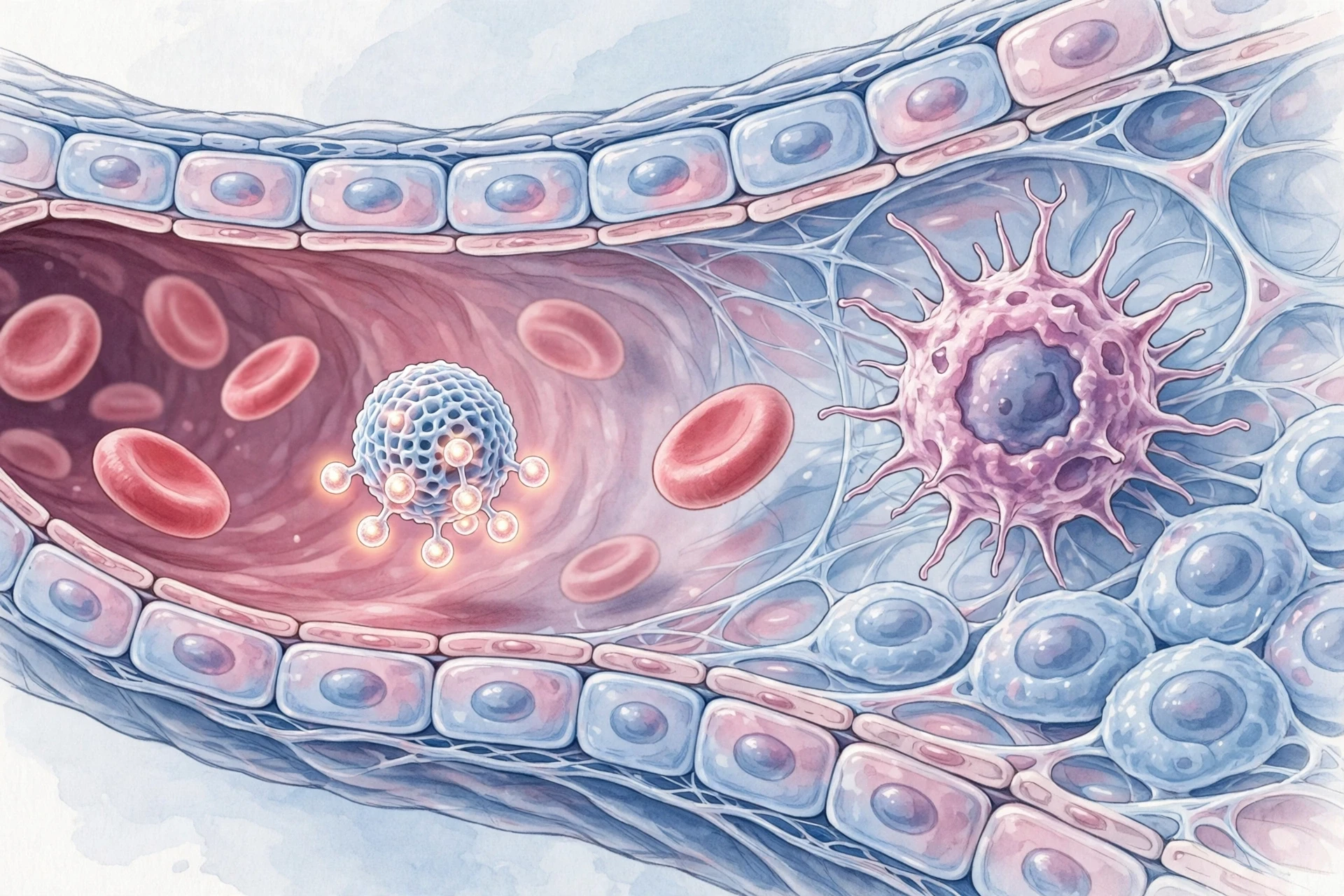
7.4 How cells handle nanoparticles
To design medical nanoparticles, you have to understand how cells treat them. A nanoparticle that enters the body is quickly coated with proteins from the blood, forming what scientists call a protein corona — a layer of the body's own molecules stuck to the particle's surface. The cell does not see the particle as the chemist made it. It sees the particle plus its corona, and it responds to that combination. A particle designed to target a tumour may end up coated in proteins that send it to the liver instead.
This is one of the hardest problems in nanomedicine, and it is a chemistry problem through and through: the surface chemistry of the particle decides which proteins stick, how tightly, and what the cell does next. Coating particles with a polymer called polyethylene glycol can reduce protein binding and help particles circulate longer, but it can also reduce their ability to enter target cells. Every design choice is a trade-off, and understanding the trade-offs requires studying the interface between the particle and the living world — which is exactly what nanochemistry does. For readers who want the biological background, our article on cell biology explains how cells take in and process materials, and our article on microbiology covers the microbes that nanoparticles are sometimes designed to fight.
8. Nanoparticles in Everyday Life
Medicine gets the headlines, but nanoparticles are already woven into ordinary life in ways most people never notice. They are in the sunscreen on your skin, the clothes you wear, the phone in your pocket, and the packaging around your food. Nanochemistry is not a future technology waiting to arrive. It is a present technology, quietly at work.
8.1 Sunscreen: invisible protection
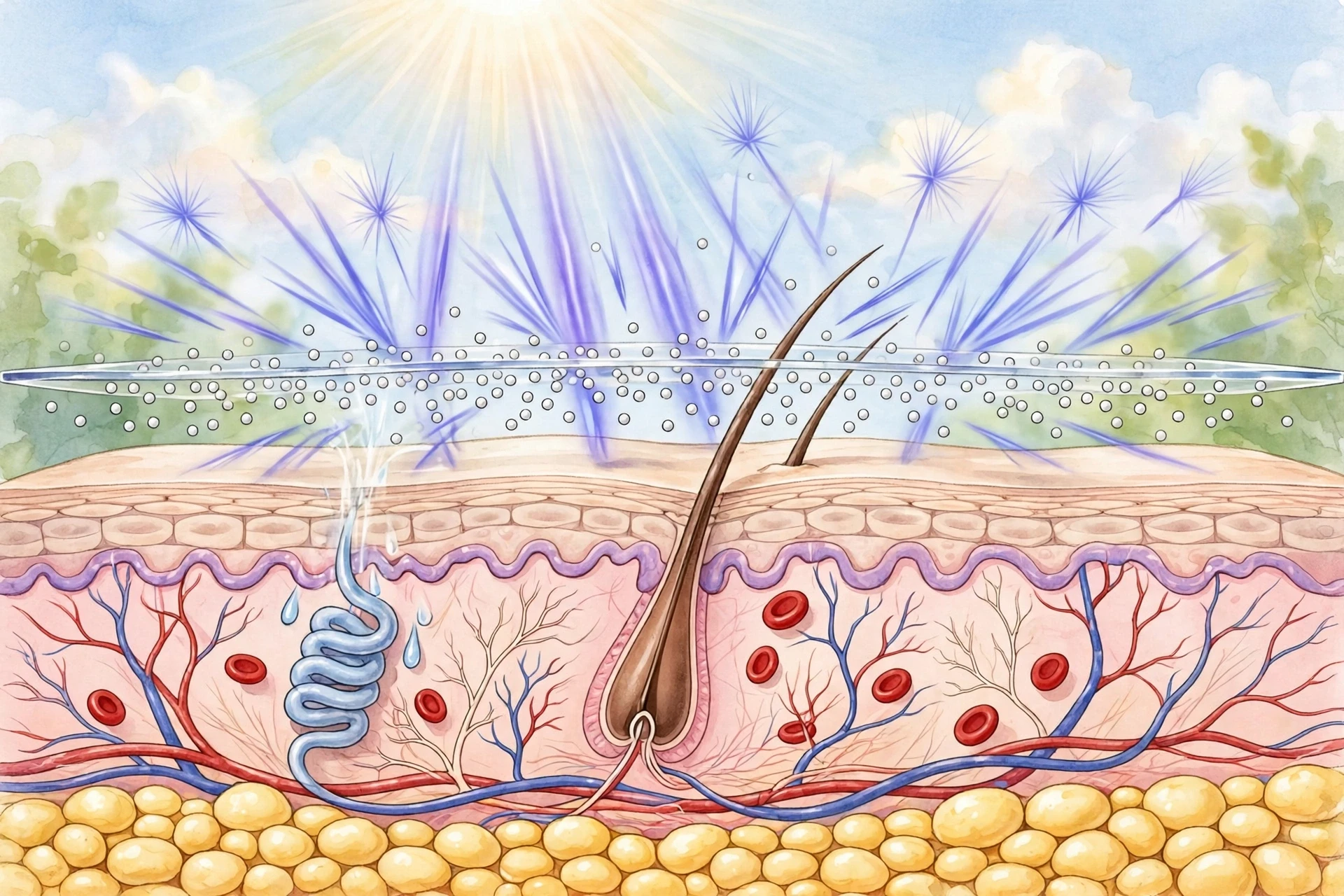
Sunscreen is the most familiar nanoparticle product in daily life, and it is a good example of how the nanoscale solves a practical problem. The active ingredients in mineral sunscreens, titanium dioxide and zinc oxide, block ultraviolet light. In bulk form, they are white powders — the thick white paste lifeguards used to wear on their noses. Ground into nanoparticles, the same materials still block ultraviolet light, but they scatter visible light far less, so the sunscreen goes on transparent instead of white. The chemistry is unchanged. The size changes how the material interacts with light, and that change makes the product one people will actually use.
That transparency is also why sunscreen raises the questions it does. A particle small enough to be invisible on the skin is small enough to raise questions about where it goes: does it stay on the surface, or does it sink into the skin? Research so far indicates that titanium dioxide and zinc oxide nanoparticles in sunscreen largely stay on the outer layer of the skin, but the question is taken seriously, and regulators continue to review the evidence. It is a good example of the pattern this article returns to in the safety section: the same property that makes a nanoparticle useful can be the property that needs checking.
8.2 Clothes, coatings, and surfaces
Silver nanoparticles are woven into socks, sportswear and bedding for their antibacterial effect, reducing the odour caused by bacteria. Silica nanoparticles make coatings that repel water and dirt, so a treated surface stays cleaner longer. Titanium dioxide nanoparticles in paints and glass can break down dirt and pollutants when exposed to sunlight, a process called photocatalysis — self-cleaning windows and air-purifying building surfaces both use it.
8.3 Electronics: smaller, faster, brighter
Electronics is the field where the nanoscale was already a fact of life before nanochemistry had a name. The transistors on a computer chip are measured in nanometres, and the industry has spent decades shrinking them. Nanochemistry contributes the materials: quantum dots in television displays, silver nanoparticle inks in printed circuits, carbon nanotubes in experimental transistors, and nanoparticle coatings that protect screens and lenses.
9. Nanochemistry for Clean Energy and a Cleaner Environment
Beyond medicine and consumer products, nanochemistry is at work on two of the largest problems of our time: how to produce clean energy, and how to clean up the pollution we have already made. Both problems are chemistry problems at their core, and both benefit from the nanoscale.
9.1 Catalysts that do more with less
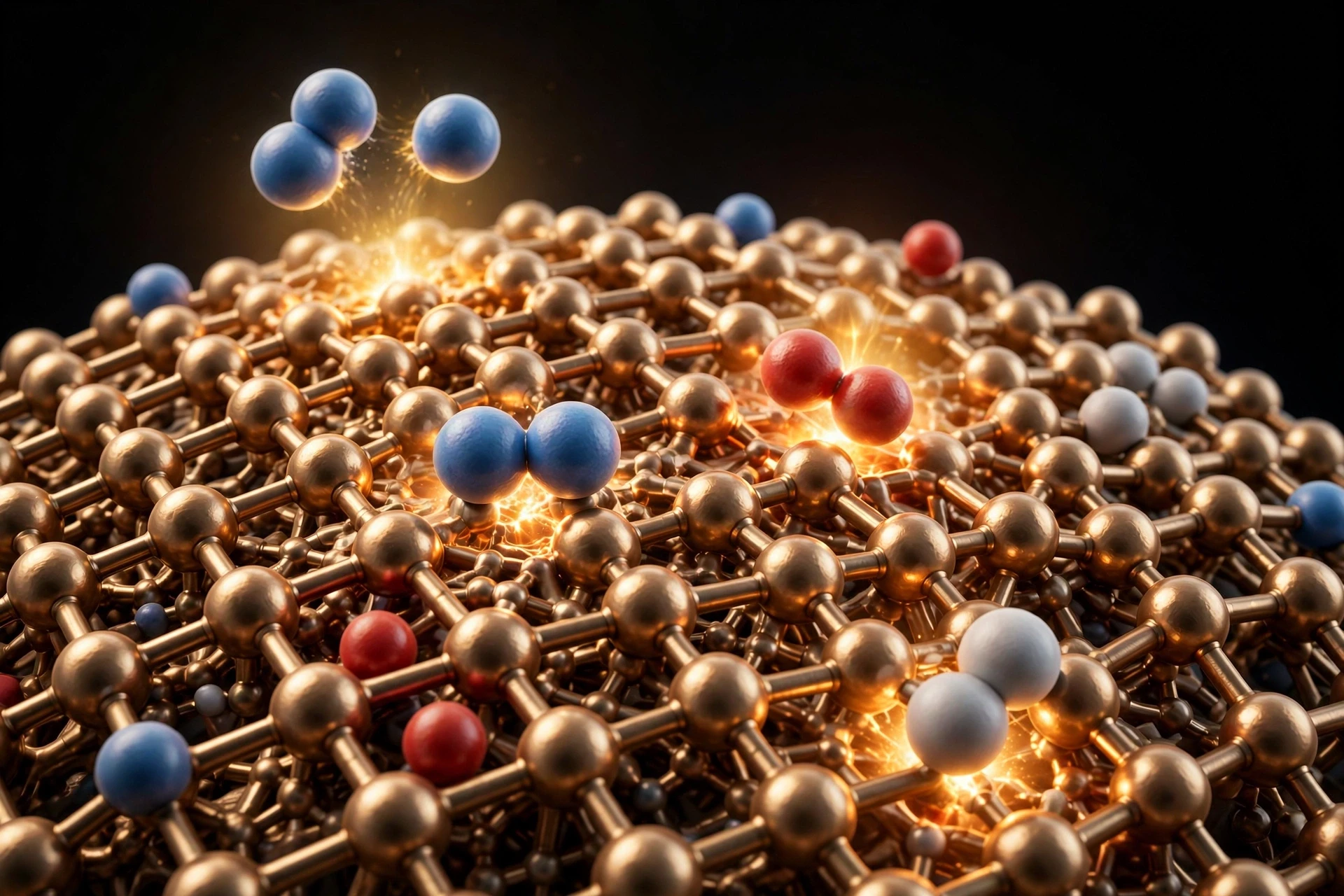
A catalyst is a substance that speeds up a chemical reaction without being consumed by it, and most industrial catalysts work at surfaces. Nanochemistry's gift to catalysis is surface area: a nanoparticle catalyst exposes far more working surface per gram than a bulk catalyst, so less precious metal is needed and reactions run faster at lower temperatures. Platinum nanoparticles in fuel cells help turn hydrogen and oxygen into electricity and water. Nanoparticle catalysts in car exhausts convert harmful gases into less harmful ones. Catalysts based on nanoparticles of iron, cobalt and nickel help make fuels and chemicals from simpler starting materials.
The most exciting catalytic work today is aimed at the energy transition: splitting water into hydrogen and oxygen, turning carbon dioxide into useful chemicals, and making ammonia without the high temperatures and pressures of current methods. The challenge is durability — a nanoparticle catalyst that works beautifully on day one can lose activity as particles clump together — and keeping nanoparticles small, separate and active over months of use is a central problem in nanochemistry.
9.2 Batteries and solar cells
Batteries are chemistry in a box, and nanochemistry is changing what goes inside the box. Silicon nanoparticles in lithium-ion battery anodes can store far more lithium than the graphite used today, which could mean longer-lasting batteries for phones and electric cars — though silicon swells as it absorbs lithium, and stopping the nanoparticles from breaking apart as they swell is an active research problem. Nanoparticle coatings protect battery electrodes and extend their life. In solar cells, nanoparticles of titanium dioxide and perovskite materials help capture light and carry charge, and quantum dots are being explored for solar cells that could be printed cheaply onto flexible surfaces.
Nanochemistry has produced real improvements in batteries and solar cells, but the path from a promising laboratory result to a battery in a car is long, and many promising materials fail on cost, durability, or safety.
9.3 Cleaning water and air
Nanoparticles can also help clean up pollution. Iron nanoparticles can break down chlorinated pollutants in groundwater. Titanium dioxide nanoparticles, activated by sunlight, can degrade organic pollutants in water and air. Nanoparticle membranes with pores of a precise size can filter out salts, heavy metals and microbes, offering a route to cleaner drinking water in places where it is scarce. Carbon nanotubes and other nanomaterials can absorb oil spills and capture heavy metals from wastewater.
Using nanoparticles to clean the environment means putting nanoparticles into the environment, so the best designs plan the whole lifecycle: make the particle, use it, then recover it or let it break down harmlessly.
10. How Scientists See and Measure the Nanoworld
You cannot see a nanoparticle with your eyes, and you cannot see it with an ordinary microscope either. Visible light has a wavelength of roughly four hundred to seven hundred nanometres, and anything much smaller than that is blurred beyond recognition by the very light you are using to look at it. Nanochemistry depends on instruments that get around that limit, and understanding them helps you understand how scientists know what they claim to know.
10.1 Electron microscopes: seeing with electrons
The workhorse instruments are electron microscopes. Instead of light, they use beams of electrons, whose wavelength is far smaller than that of visible light. A transmission electron microscope fires electrons through a thin sample and builds an image from the electrons that pass through, revealing the shape, size and internal structure of individual nanoparticles. A scanning electron microscope sweeps a beam across a surface and builds an image from the electrons that bounce back, showing the surface in remarkable detail. Modern electron microscopes can resolve individual atoms.
I remember the first time I saw a transmission electron microscope image of gold nanoparticles I had made myself: dark, almost perfectly round discs against a pale background, each one a tiny shadow of the red liquid in my flask. In one image I could see whether they were the size I wanted, whether they were round or ragged, whether they had clumped together. It was the moment the invisible became visible.
10.2 Feeling the surface: atomic force microscopy
The atomic force microscope drags an extremely sharp tip — a needle whose point is only a few atoms wide — across a surface, measuring the tiny forces between tip and surface to build a three-dimensional map accurate enough to show individual molecules. Unlike electron microscopy, it can work in air or liquid, so it can study nanoparticles in conditions closer to those in the body.
10.3 Measuring size, charge, and composition
Seeing a particle is only part of the job. Chemists also need to know the distribution of sizes in a sample (are the particles all ten nanometres, or a mix of five and fifty?), the surface charge (which affects how particles behave in liquids and in the body), and the chemical composition (is the particle really what you think it is, or has its surface oxidised?). Techniques with names like dynamic light scattering, X-ray diffraction, and X-ray photoelectron spectroscopy answer these questions. Each technique gives one piece of the puzzle, and a careful nanochemist uses several together, because any single measurement can mislead. The National Institute of Standards and Technology develops reference materials and measurement methods for nanoparticles, so laboratories can compare results. A sample that looks uniform in one instrument can turn out to be a mixture in another, and the difference matters — for a medicine, the difference between ten and fifty nanometres can be the difference between reaching a tumour and being filtered out by the liver.
Good nanochemistry reports the size, the shape, the surface coating, and the method used to measure them, because without those details the result cannot be repeated or trusted. The background science of atoms and molecules is covered in our article on atoms and molecules.
11. Are Nanoparticles Safe?
This is the question most readers ask, and it is the right question. Nanoparticles are powerful precisely because they are small, reactive, and able to go places larger particles cannot. Those same properties are the reason their safety needs careful study. The honest answer is not a simple yes or no. It is: it depends on the material, the size, the shape, the dose, the route of exposure, and what happens to the particle once it is inside the body or the environment. Nanochemistry takes that answer seriously, and so should anyone writing about the field.
11.1 What makes a nanoparticle risky
A nanoparticle can be risky for the same reasons it is useful. Its small size lets it enter cells and cross barriers that block larger particles. Its large surface area makes it chemically reactive, which can mean it generates reactive molecules inside a cell that damage proteins and DNA. Its shape matters: long, thin fibres such as some carbon nanotubes have raised concerns because their shape resembles asbestos fibres, which cause disease when inhaled. Its persistence matters: a particle that the body cannot break down or clear may accumulate over time.
None of this means all nanoparticles are dangerous. It means that safety cannot be assumed from the safety of the bulk material. Titanium dioxide is safe to eat as a bulk food additive in the quantities used, but titanium dioxide nanoparticles inhaled as dust are treated differently by regulators, because the route of exposure and the size change the risk. Silver is used safely in cutlery and jewellery, but silver nanoparticles released into water can harm aquatic microbes. The rule is simple to state and hard to apply: judge the nanoparticle, not just the element it is made from.
11.2 How safety is studied
Safety research in nanochemistry follows the particles. Scientists study how nanoparticles enter the body — through the lungs, the skin, the gut — where they go, how long they stay, and how the body clears them. They study what happens at the cellular level: does the particle damage the cell, does it trigger inflammation, does it interfere with normal processes? They study what happens in the environment: do nanoparticles released from products accumulate in soil and water, do they affect microbes, plants and animals, do they break down?
Regulators have responded with frameworks that treat nanoparticles as a distinct case. In the United States, the Environmental Protection Agency studies nanomaterials under its chemical safety programmes, and the Food and Drug Administration has issued guidance on nanotechnology in products it regulates. These frameworks are still evolving, because the science is still evolving — study first, regulate on the evidence, and update as the evidence grows. The Environmental Protection Agency's research on nanomaterials is a useful starting point for readers who want to see how that work is done.
The question is never "are nanoparticles safe?" in the abstract. It is always "is this nanoparticle, in this product, used this way, at this dose, safe?" — and that question has a different answer for every particle.
11.3 The dose and the route
Two ideas from toxicology matter more than any other in this discussion. The first is dose: the amount matters. A small amount of a substance can be harmless while a large amount is harmful, and nanoparticles are no exception. The second is route: how the particle enters the body matters. Swallowing a nanoparticle, breathing it in, and putting it on the skin are three different exposures with three different risks. A sunscreen nanoparticle that stays on the skin is a different case from the same particle inhaled as a spray. A nanoparticle drug injected in a controlled dose is a different case from the same particle breathed in as workplace dust.
Blanket statements — whether "nanoparticles are dangerous" or "nanoparticles are safe" — are both wrong. Always ask: which nanoparticle, how much, how did it get in, and what is the evidence?
11.4 What you can do as a reader and consumer
Look for products that say what they contain, prefer lotions over sprays for products containing nanoparticles, because sprays are easier to inhale, and be sceptical of both extremes — marketing that promises miracles from "nano" and alarm that treats every nanoparticle as a threat.
12. Common Mistakes and Misconceptions
Nanochemistry attracts misunderstandings, partly because it is new and partly because the word "nano" sounds like magic. Clearing up the most common ones helps you read news stories about the field with a steadier eye.
"Nano means artificial and unnatural." Not so. Nature has been doing nanochemistry for billions of years. The lotus leaf repels water because of nanoscale structures on its surface. Gecko feet stick to walls because of nanoscale hairs. The iridescent colours of butterfly wings and peacock feathers come from nanoscale structures, not pigments. The magnetite crystals that some bacteria use to navigate are nanoparticles. Nanochemistry often copies nature rather than inventing from nothing.
"All nanoparticles are the same." This is the most damaging misconception, because it makes sensible discussion impossible. A gold nanoparticle, a carbon nanotube, a lipid nanoparticle and a titanium dioxide nanoparticle have almost nothing in common except their size range. They differ in chemistry, in behaviour, in uses and in risks. Talking about "nanoparticles" as if they were one thing is like talking about "chemicals" as if they were one thing: technically true, practically useless.
"Nanochemistry will solve everything." It will not. Nanoparticles are tools, and like all tools they solve some problems and not others. They can deliver drugs more precisely, but they cannot cure a disease whose biology is not understood. They can make catalysts more efficient, but they cannot repeal the laws of thermodynamics. They can clean water, but they cannot replace the need to stop polluting it in the first place. The field's real achievements are impressive enough without exaggeration.
13. The Future of Nanochemistry
Where does nanochemistry go from here? The field is moving in several directions at once, and the most interesting ones share a theme: from making particles to making systems — particles that sense, decide, and respond, rather than particles that simply exist.
One direction is smarter medicine: nanoparticles that release their drug only when they detect a signal, such as the acidity of a tumour or the presence of a particular enzyme, and particles that combine diagnosis and treatment in one — find the disease and treat it at the same time.
Another direction is sustainability. Nanochemistry is working on catalysts that turn waste carbon dioxide into fuels and chemicals, on membranes that desalinate seawater with less energy, on fertilisers that feed crops without polluting rivers, and on materials that can be recycled more easily because their nanoparticles can be recovered and reused. The goal is a nanochemistry that does not just make better products but makes them in a way the planet can afford.
A third direction is computing and sensing. Quantum dots and other nanomaterials are being developed for quantum computers, for sensors that can detect a single molecule of a pollutant or a disease marker, and for devices that harvest energy from heat or movement. Nanoscale sensors could one day monitor the air in a city street by street, or track a patient's health continuously from inside the body.
There are also hard problems that the field has not solved. Making nanoparticles identically, batch after batch, at industrial scale, remains difficult. Predicting the long-term behaviour of nanoparticles in the body and the environment remains incomplete. Regulating a technology that changes with every new material remains a challenge for governments. These are not reasons to dismiss nanochemistry. They are the work ahead, and they are the reason the field needs careful, honest explanation — the kind this article has tried to give.
The nanoscale is not a distant frontier. It is already in your sunscreen, your phone, and the water you drink. Nanochemistry explains why it works, how to make it better, and how to use it safely. That is a science worth understanding, because it is already shaping the world you live in, one billionth of a metre at a time.
Frequently Asked Questions
What is nanochemistry?
Nanochemistry is the branch of chemistry that studies matter at the scale of one to one hundred nanometres — the size range the National Nanotechnology Initiative uses to define nanotechnology — and asks how chemistry at that scale creates new properties and uses. A nanometre is one billionth of a metre. At that size, materials can change colour, melt at lower temperatures, react faster, and behave in ways their bulk forms never do. Nanochemistry covers how nanoparticles are made, why they behave the way they do, and how they can be used in medicine, electronics, energy, and environmental cleanup.
What are nanoparticles used for?
Nanoparticles are used in medicine, where they carry drugs to tumours and deliver vaccines; in sunscreen, where titanium dioxide and zinc oxide nanoparticles block ultraviolet light while staying transparent; in electronics, where quantum dots improve television displays; in catalysis, where nanoparticle catalysts speed up chemical reactions in fuel cells and car exhausts; in food packaging, where nanocomposites keep food fresh longer; and in water treatment, where nanoparticles help remove pollutants. Their uses keep growing as researchers find new ways to control their size, shape, and surface chemistry.
Are nanoparticles safe?
It depends on the material, the size, the shape, the dose, and how the particle enters the body. Some nanoparticles are well studied and widely used, such as the titanium dioxide in sunscreen and the lipid nanoparticles in vaccines. Others raise concerns, especially when inhaled as dust or released into the environment in large amounts. Safety cannot be judged from the bulk material alone — the nanoparticle form must be tested on its own. Regulators in the United States and Europe assess nanomaterials specifically, and the evidence is updated as new research appears.
Why do nanoparticles behave differently from bulk materials?
Nanoparticles behave differently for four main reasons. First, their surface-area-to-volume ratio is enormous, so most of their atoms sit on the surface and are ready to react. Second, quantum confinement changes how electrons behave in very small particles, altering colour and conductivity. Third, the crystal structure that is stable in a large chunk may not be stable in a nanoparticle, so the particle adopts a different arrangement. Fourth, light interacts differently with objects smaller than its wavelength, which is why gold nanoparticles can look red while bulk gold looks yellow.
How are nanoparticles made?
There are two broad approaches. Top-down methods start with a large piece of material and break it down by grinding, milling, or etching. Bottom-up methods start with atoms or molecules and build them up, usually by growing particles in a solution under carefully controlled conditions. A third approach, self-assembly, lets specially designed molecules arrange themselves into the desired structure. Bottom-up methods, including green synthesis using plant extracts or microbes, are the most widely used in nanochemistry today.
What is the difference between nanochemistry and nanotechnology?
Nanotechnology is the broad engineering field of designing and using nanoscale devices and systems. Nanochemistry is the chemistry inside that field: the synthesis of nanoparticles, the reactions at their surfaces, and the reasons they behave the way they do. Nanoscience is the wider study of phenomena at the nanoscale across all sciences. In practice the three overlap constantly, but the chemical questions — how to make the particles and why they react as they do — belong to nanochemistry.
What is a quantum dot?
A quantum dot is a semiconductor nanocrystal, typically two to ten nanometres across, whose optical and electronic properties change with its size. Because the electrons inside it are confined to such a small space, the colour of light it emits depends on its size: small dots glow blue, larger dots glow red. Quantum dots are used in television displays for bright, precise colours and in medical research as fluorescent labels that can track several targets inside a cell at once.
Sources
National Nanotechnology Initiative: About Nanotechnology — https://www.nano.gov/about-nanotechnology/
National Nanotechnology Initiative: What Is Nanotechnology? — https://www.nano.gov/nanotech-101/what/definition
National Institute of Standards and Technology: Nanotechnology — https://www.nist.gov/topics/nanotechnology
Chemistry LibreTexts: Nanomaterials — http://chem.libretexts.org/Courses/Centre_College/CHE_332%3A_Inorganic_Chemistry/09%3A_Structure_and_Energetics_of_Solids/9.06%3A_Nanomaterials
U.S. Environmental Protection Agency: Research on Nanomaterials — https://www.epa.gov/chemical-research/research-nanomaterials
OpenStax: Chemistry 2e — https://openstax.org/books/chemistry-2e/pages/1-introduction
Nature: Nanoscience and Technology — https://www.nature.com/subjects/nanoscience-and-technology
National Institutes of Health: NIH Research Matters — https://www.nih.gov/news-events/nih-research-matters
Atoms and Molecules Explained — Sciory — https://www.sciory.com/blog/atoms-molecules-explained
Cell Biology Explained: How Cells Work, Organelles and Functions — Sciory — https://www.sciory.com/blog/cell-biology-explained-organelles-functions
Microbiology Explained: Bacteria, Viruses, and How Microbes Shape Life — Sciory — https://www.sciory.com/blog/microbiology-bacteria-viruses-explained