

1. The Kettle That Gave the Game Away
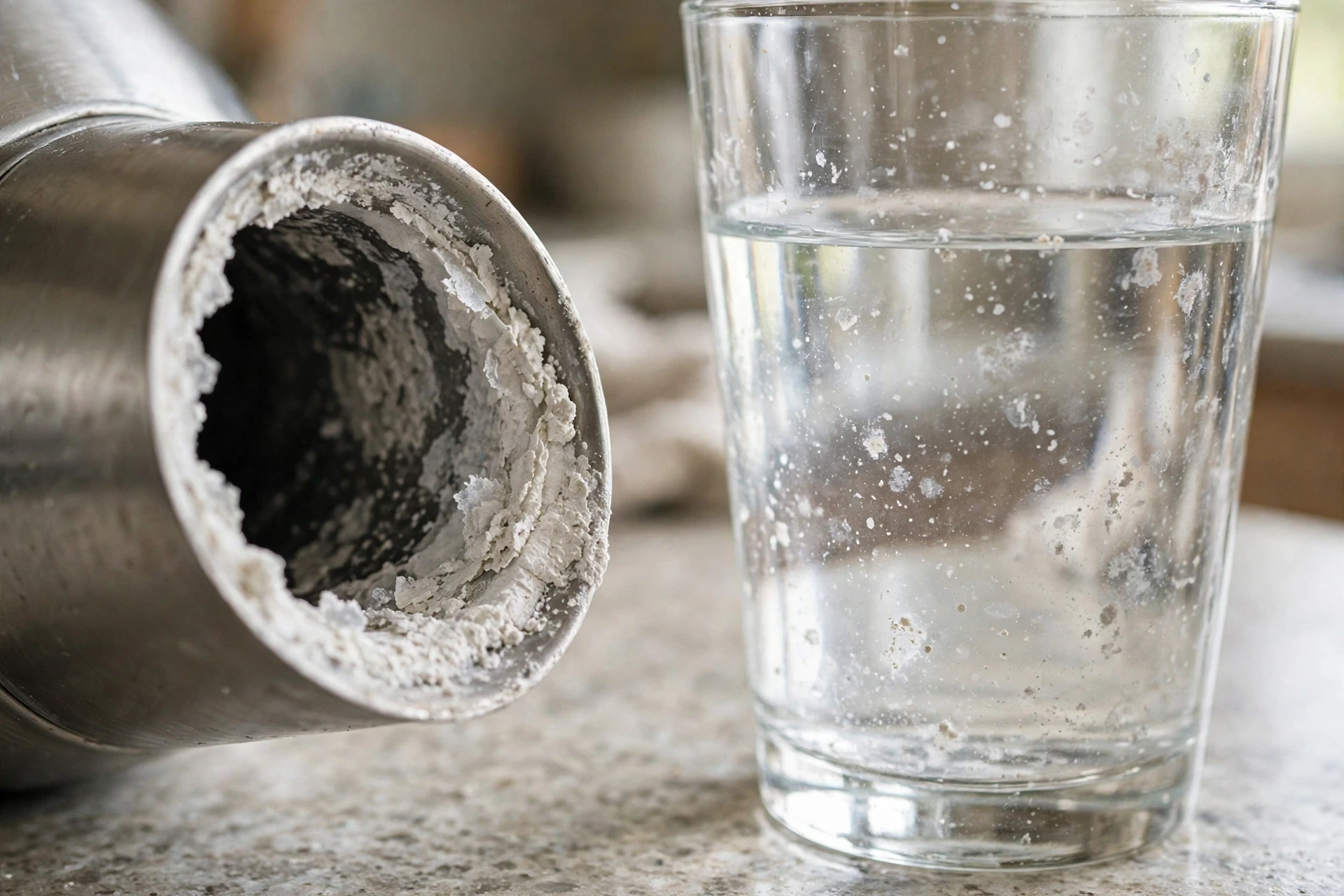
My first real lesson in hard water did not come from a textbook. It came from a kettle in a rented flat, a cheap white electric kettle that started out gleaming and, within a few months, sounded like it was boiling gravel. I opened the lid one morning and found the inside coated in a rough, off-white crust, as if someone had painted the metal with chalk. I scraped at it with a fingernail. It did not budge. A splash of vinegar made it fizz, and the fizz told me more than the crust itself: something in the water was leaving solid rock behind every time it boiled.
That crust has a name, limescale, and the water that leaves it behind has a name too: hard water. Hard water is ordinary water carrying an unusually large load of dissolved minerals, chiefly calcium and magnesium. You cannot see those minerals while they are dissolved. The water looks clear, tastes much like any other tap water, and pours exactly the same way. The trouble only shows up later, as spots on glass, a film on soap, stiff laundry, or a heating element slowly burying itself in stone.
This article follows that invisible load from start to finish. We will trace how rainwater picks up minerals underground, what calcium and magnesium actually do in a glass, a kettle, and a washing machine, how hardness is measured, why some hard water can be fixed by boiling and some cannot, whether hard water is bad for you, and how softening really works — from a pot on the stove to the ion-exchange tank in a basement. Along the way, the chemistry stays close to everyday life, because hard water is one of those subjects where the everyday evidence is the chemistry.
2. What Is Hard Water?
Hard water is water with a high concentration of dissolved calcium (Ca2+) and magnesium (Mg2+) ions. That is the whole definition, and it is worth holding on to, because almost every hard-water puzzle reduces to those two ions. When water contains only small amounts of them, it is soft water. When it contains a lot, it is hard water. The boundary between the two is a matter of degree, not a sudden switch, which is why water reports give hardness as a number rather than a simple yes or no.
The minerals arrive as ions, not as grains of sand. An ion is an atom or group of atoms carrying an electric charge, and dissolved ions are spread evenly through the water, far too small to see. Calcium ions carry a double positive charge, written Ca2+, and magnesium ions do the same, written Mg2+. They stay dissolved because water molecules surround them and keep them apart, a talent water has in abundance. If you want the background on why water is such a good solvent, the story starts with the shape of the water molecule itself, which is why Sciory's guide to why water is the weirdest molecule is a useful companion to this one. The rules of what dissolves in water, and what stays dissolved, are covered in Sciory's guide to solutions and solubility.
Most people meet hard water through its effects before they ever meet the word for it. Soap refuses to lather properly. A glass left to dry wears a constellation of white spots. The showerhead slowly loses pressure as its holes narrow. A kettle grows a crust. None of these is a defect in the soap, the glass, or the kettle. Each is the same dissolved load making itself visible at a different moment: when water evaporates, when it is heated, or when it meets soap.
I learned that the hard way in that rented flat. I blamed the kettle first, then the tap, then the detergent, and only then did I test the water itself. A cheap test strip turned a colour that meant the water was very hard, and suddenly a dozen small annoyances — the spots, the scum, the kettle's rattle — lined up behind one cause. That is the usual pattern with hard water: a scatter of minor irritations that turn out to share a single chemical explanation.
Hard water is also a regional story. Water that falls as rain and runs quickly over granite or sandstone stays soft, because those rocks give up little calcium or magnesium. Water that seeps slowly through limestone, chalk, or gypsum picks up a heavy mineral load and arrives at the tap hard. Two towns a short drive apart can have very different water for exactly this reason: the difference is not the rain, it is the rock underneath.
2.1 Hard water, soft water, and everything in between
Soft water is not pure water. Even the softest tap water contains some dissolved minerals, and rainwater picks up gases and traces of minerals on its way down. Soft simply means the calcium and magnesium load is low enough that scale and soap problems stay minor. Hard means the load is high enough that they become a regular part of household life.
Between the two sits a wide middle ground. Water described as moderately hard may leave faint spots and use a little extra soap without causing serious trouble. Water described as very hard can choke a showerhead within a year and coat a water heater's element in a thick jacket of scale. The labels matter because they guide decisions: a household with moderately hard water may need nothing more than a descaling routine, while a household with very hard water may find a softener pays for itself in appliance life and detergent saved.
One common misunderstanding deserves clearing up early. Hard water is not dirty water. The minerals that make water hard are the same calcium and magnesium found in milk, leafy greens, and mineral supplements. Hardness is a measure of dissolved mineral content, not of contamination, and water can be perfectly clear, properly treated, and safe to drink while still being very hard. The distinction matters, because it shapes what a softener can and cannot do: softening changes the mineral load, it does not disinfect water or remove other contaminants.
2.2 Why the word "hard"?
The word hard in hard water is old, and it comes from the feel of the water rather than from any laboratory test. In hard water, soap is hard to work into a lather, and washed cloth comes out feeling stiff and hard to the touch. In soft water, soap lathers easily and cloth feels softer. The name stuck because it described what people could feel with their hands long before anyone could measure calcium in milligrams per litre.
That everyday origin is a useful reminder. Hardness was a household observation before it was a chemical measurement, and the measurement was invented to put a number on something people already knew from their kettles and their laundry lines. When we measure hardness today, we are still answering the same question a washerwoman asked centuries ago: how much of this mineral load is in my water, and what will it do?
3. How Rainwater Becomes Hard Water
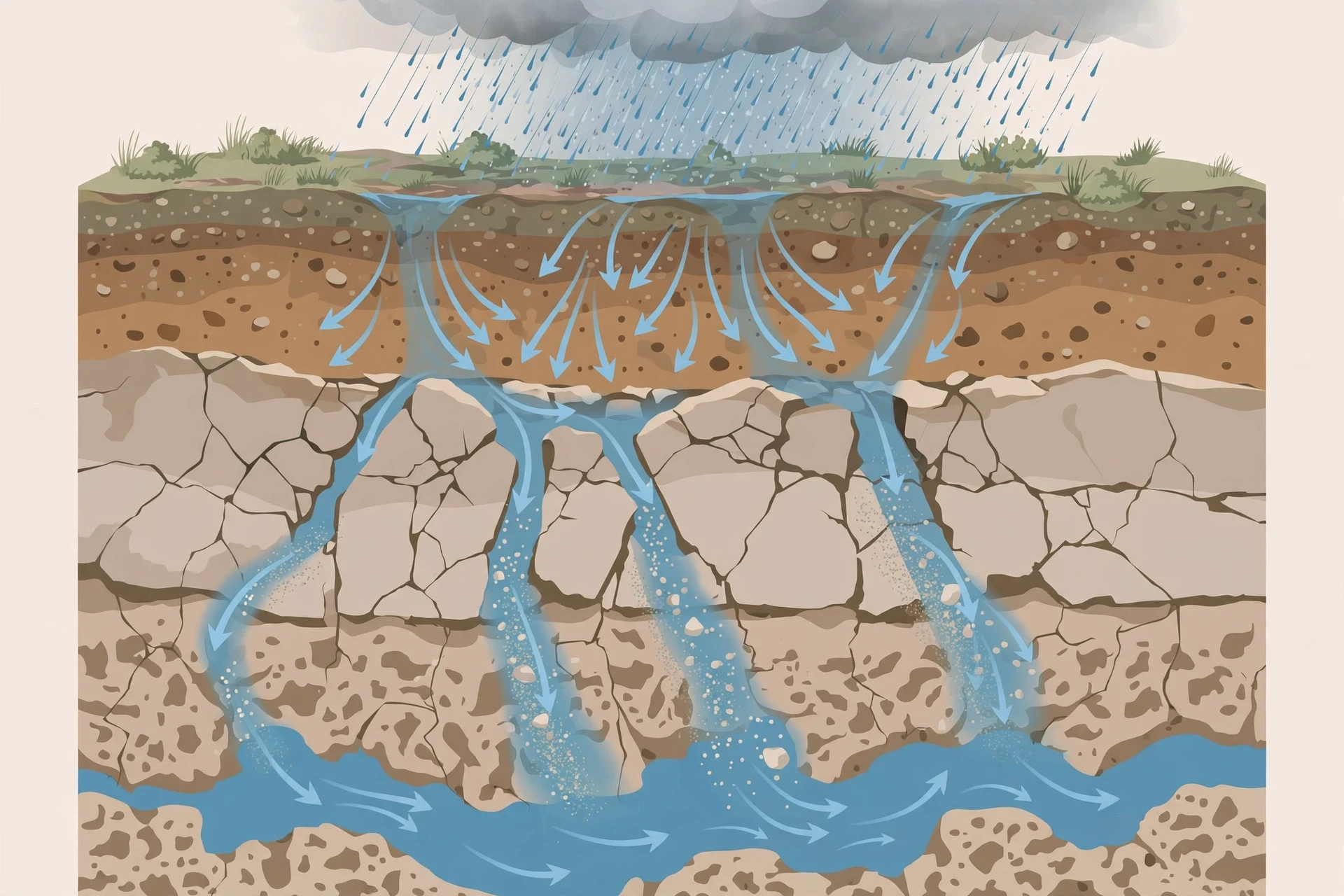
Rainwater starts its life soft. As it falls through the air it picks up carbon dioxide and becomes very slightly acidic, forming a weak solution of carbonic acid, H2CO3. That faint acidity is the key to the whole story, because slightly acidic water can dissolve rock that pure water would leave alone.
When that rain soaks into the ground, it meets soil and rock. In limestone country, the rock is mostly calcium carbonate, CaCO3, and the acidic water attacks it in a reaction that can be written in shorthand as:
CaCO3 + H2CO3 → Ca2+ + 2HCO3−
In plain language: solid calcium carbonate plus carbonic acid gives dissolved calcium ions plus bicarbonate ions. The rock does not vanish in a dramatic way. It dissolves grain by grain, invisibly, over years and centuries, and the water carries the dissolved calcium away with it. Magnesium enters the same way, from dolomite and other magnesium-bearing rocks, giving dissolved Mg2+ ions alongside the calcium.
The longer water stays underground, and the more limestone it passes through, the harder it becomes. Groundwater that has spent years winding through cracks in chalk or limestone can arrive at a well carrying a heavy mineral load. Surface water that runs quickly off hard, insoluble rock stays soft. This is why the hardness map of any country follows its geology: limestone belts and chalk downs produce hard water, granite highlands and sandy lowlands produce soft water.
I once walked a chalk stream in southern England on a bright spring day, and the water was so clear I could count the pebbles on the bed. A local angler told me the stream never ran dry, even in summer, because it was fed by groundwater stored in the chalk. That same chalk, I later realised, was the reason the water in the nearby village was famously hard. The clarity of the water and its hardness came from the same source: slow passage through a vast, pale, soluble rock that filtered the water and mineralised it at the same time.
3.1 The water cycle's hidden detour
The journey of hard water is a detour inside the wider water cycle. Rain falls, some runs off into rivers, some evaporates, and some infiltrates the ground. The infiltrating fraction is the one that matters here. Underground, water moves slowly, sometimes only a few metres a year, in long contact with rock. That slow contact is what loads it with minerals. Sciory's guide to the water cycle follows the big loop — evaporation, condensation, precipitation, and flow back to the sea — and hard water is what happens when one part of that loop takes the slow road through soluble rock.
Time underground also explains why hardness can vary with the seasons and with pumping. In dry periods, a greater share of a river's flow may come from groundwater, and the river water becomes harder. When a well is pumped hard, it may draw older, deeper water that has spent longer in contact with rock and carries a heavier load. None of this changes the chemistry; it changes the contact time, and contact time is what sets the concentration.
3.2 Which rocks make hard water?
Not all rock contributes equally. Limestone and chalk are calcium carbonate, and they dissolve readily in slightly acidic water. Dolomite adds magnesium as well as calcium. Gypsum, calcium sulfate, dissolves even more easily and contributes calcium paired with sulfate ions. Sandstone and granite, by contrast, are built from minerals that resist weak acid, so water passing through them stays soft.
This is why a map of hard water looks like a geological map in disguise. It also explains a puzzle many people notice on holiday: the water in one region leaves the kettle spotless while the water in another furs it up within weeks. The rain is the same. The rock is different. And because the rock changes slowly, hardness is a stable, long-term property of a place — a household's water does not swing from soft to hard overnight, though it can drift with the seasons and with changes in the water supply.
4. The Ions Behind It: Calcium and Magnesium
If hard water has a cast of characters, it is a small one. Calcium and magnesium do almost all the work. Other ions can contribute — iron, manganese, and aluminium appear in some waters — but they are supporting players, and in most supplies their contribution is minor. When a water report talks about hardness, it is talking, in practice, about calcium plus magnesium.
Calcium is usually the larger share. It comes from limestone, chalk, gypsum, and dolomite, and it is the ion most responsible for the hard, crystalline scale in kettles and boilers. Magnesium is usually the smaller share, and it tends to form softer, more powdery deposits. The ratio between the two varies with the local rock: water from pure limestone is calcium-dominated, while water from dolomite carries a more even mix.
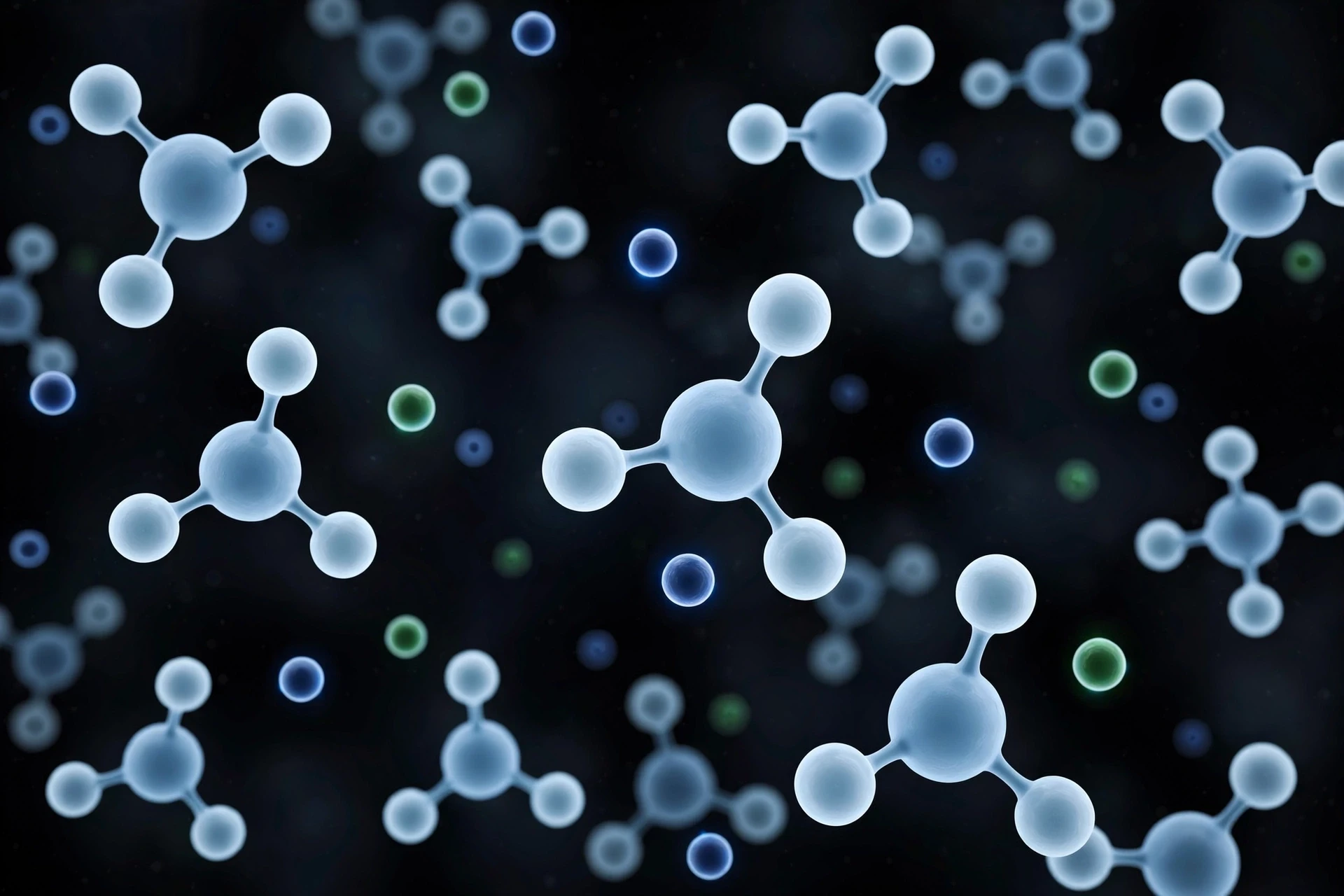
Why do these two ions behave this way? Both carry a double positive charge, and both form compounds with carbonate that are poorly soluble in water. That combination is the heart of the matter. While the ions stay dissolved, nothing seems wrong. But when conditions change — when water is heated, when it evaporates, or when carbonate ions become more plentiful — calcium carbonate and magnesium carbonate drop out of solution as solids. The water was carrying dissolved rock all along; heating and evaporation simply force it to give the rock back.
My first encounter with this in a laboratory was a titration I nearly ruined as a student. I was measuring hardness by adding a soap-like reagent drop by drop, waiting for a colour change that refused to arrive. My sample was so hard that I used twice the reagent I had expected, and I assumed I had made an error. I had not. The water really did contain that much calcium, and the slow colour change was the measurement telling me so. It was a small humiliation and a useful one: the numbers in a water report are not abstractions, they are a count of real ions, and a hard sample will make itself known to anyone who measures it carefully.
4.1 Why hardness is reported as calcium carbonate
Water reports rarely list calcium and magnesium separately when they talk about hardness. Instead, they combine them into a single number expressed as milligrams per litre as calcium carbonate, written mg/L as CaCO3. This is a convention, not a claim that the water actually contains that much calcium carbonate. It is a way of adding calcium and magnesium together on a common scale, so that one number can describe the total load.
The convention works because calcium and magnesium behave similarly in the reactions that matter — scale formation and soap curd — and because expressing both as an equivalent amount of calcium carbonate lets water suppliers, laboratories, and householders compare numbers from different places without confusion. A reading of 150 mg/L as CaCO3 means the combined calcium and magnesium in the water would form the same amount of scale as 150 milligrams of calcium carbonate per litre. It is a bookkeeping device, and a good one, but it is worth knowing what it is, because it explains why the same water can be described in two different units without contradiction.
4.2 Carbonate, bicarbonate, and sulfate: the partners
Calcium and magnesium never travel alone. Every positive ion in water is balanced by negative ions, and the identity of those partners decides what kind of hard water you have. The most important partners are bicarbonate (HCO3−), carbonate (CO32−), sulfate (SO42−), and chloride (Cl−).
Bicarbonate is the partner in temporary hard water, the kind that boiling can remove. Sulfate and chloride are the partners in permanent hard water, the kind that boiling cannot remove. This distinction is not a detail for chemists only; it decides which softening methods will work in a given home, and it is the subject of a whole section later in this article. For now, the point to carry forward is simple: hardness is a team effort between the metal ions and their anionic partners, and the partners matter as much as the metals.
5. Measuring Hardness: Numbers, Units, and Tests
Hard water announces itself through spots and scale, but the only way to know how hard your water really is, is to measure it. The measurement is straightforward, and the numbers are worth learning, because they turn a vague complaint — "our water is hard" — into a decision: descale occasionally, or soften properly.
The standard scale used by the United States Geological Survey (USGS) classifies water by its hardness in milligrams per litre as calcium carbonate. Soft water is 0 to 60 mg/L. Moderately hard water is 61 to 120 mg/L. Hard water is 121 to 180 mg/L. Very hard water is more than 180 mg/L. Those bands are descriptive, not safety limits, and they are the ones most water reports and guides use. Other organisations use slightly different bands, which is why two guides can disagree at the edges, but the USGS bands are the common reference point.
Classification | Hardness (mg/L as CaCO3) | Grains per gallon (gpg) | What you are likely to notice |
|---|---|---|---|
Soft | 0–60 | 0–3.5 | Soap lathers easily; little or no scale |
Moderately hard | 61–120 | 3.5–7.0 | Faint spots on glass; slightly more soap needed |
Hard | 121–180 | 7.0–10.5 | Visible limescale; soap scum; stiff laundry |
Very hard | More than 180 | More than 10.5 | Rapid scaling; clogged showerheads; heavy soap use |
The second unit in that table, grains per gallon (gpg), is the one most American water softeners are sized in. One grain per gallon equals 17.1 mg/L as calcium carbonate. To convert, multiply grains per gallon by 17.1 to get mg/L, or divide mg/L by 17.1 to get gpg. A water at 10 gpg is about 171 mg/L, firmly hard; at 3 gpg it is about 51 mg/L, soft. It is the one conversion worth memorising if you ever shop for a softener.
5.1 How to test your water
There are three practical ways to find your number, and each has its place.
Your water supplier's report. Public water suppliers publish an annual water quality report, often called a consumer confidence report, and many list total hardness in mg/L as CaCO3. This is the easiest starting point, and it costs nothing. The number is an average for the supply area, so it may not match a single house exactly, but it tells you which band you are in.
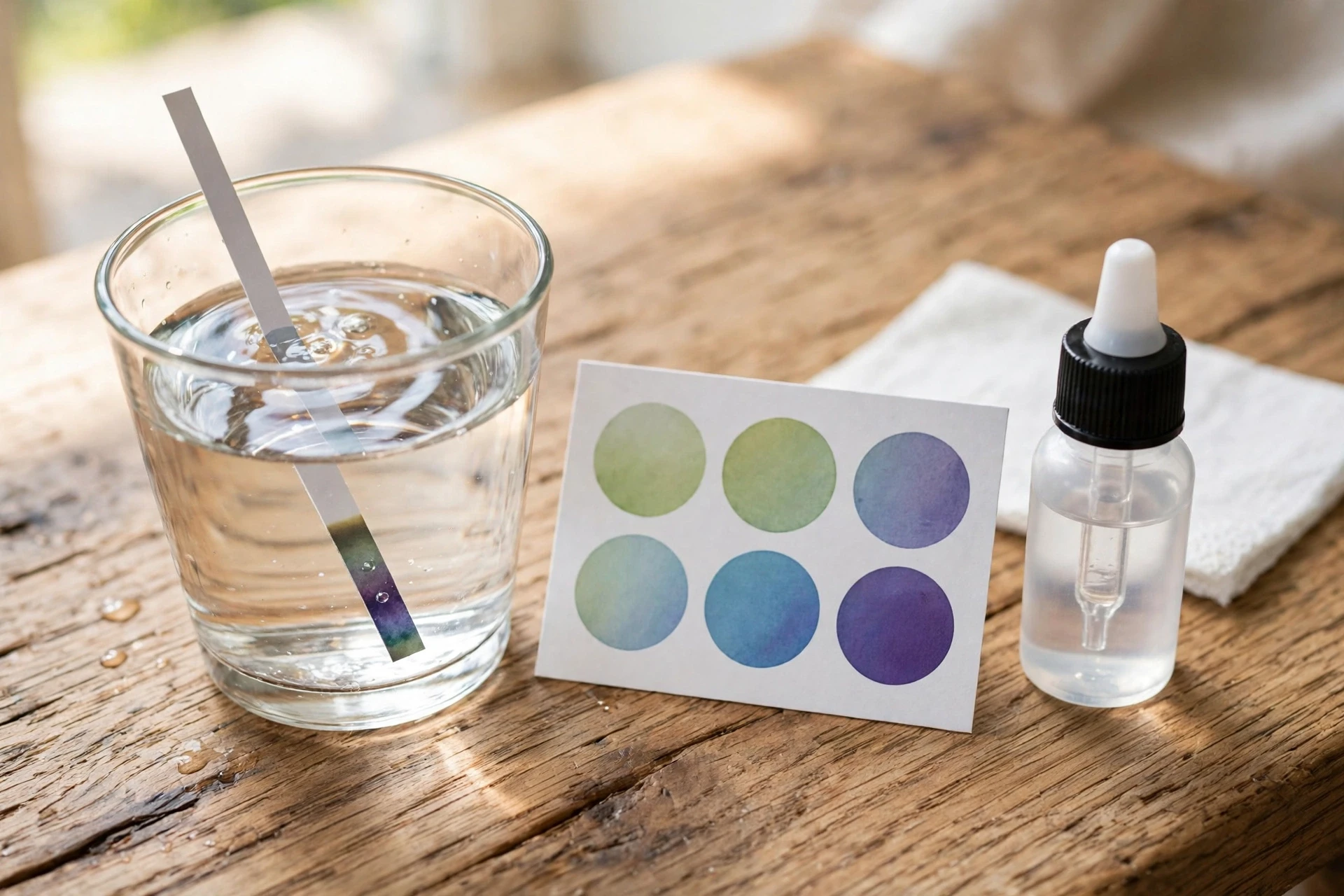
A home test strip or drop kit. Test strips are dipped in a glass of tap water and matched against a colour chart. Drop kits add a reagent one drop at a time until the colour changes, and the number of drops gives the hardness. Both are cheap and quick, and both are accurate enough to decide whether softening is worth considering.
A laboratory test. A certified laboratory measures calcium and magnesium directly and reports hardness precisely, along with other things a strip cannot see, such as iron and pH. This is the right choice if you are sizing a softener, investigating a private well, or troubleshooting a persistent problem.
I keep a strip kit in a kitchen drawer and use it whenever I stay somewhere new. In one holiday cottage, the shower ran weak and the kettle furred within days; the strip read very hard, and the landlord simply nodded and said the whole village was the same. The test did not fix the water, but it stopped me wasting a morning descaling a showerhead that would clog again within weeks.
5.2 Reading a water report without a chemistry degree
A water report can look intimidating, but for hardness you need only a few lines. Look for "total hardness" or "hardness as CaCO3", and check the units. If the number is in mg/L or parts per million (ppm), it is directly comparable to the USGS bands, because 1 mg/L as CaCO3 is numerically the same as 1 ppm as CaCO3. If the number is in grains per gallon, multiply by 17.1. Most reports give the total directly, so you rarely need to work it out from separate calcium and magnesium figures.
Watch for one trap: some reports list "total dissolved solids" (TDS), which is not the same as hardness. TDS counts everything dissolved in the water, while hardness counts only calcium and magnesium. A TDS meter measures conductivity and estimates TDS; it does not measure hardness, and it cannot tell you whether a softener is working. For hardness, use a hardness test, not a TDS reading.
Hardness is a number, not a feeling. Two households can argue for an hour about whether their water is "really hard" and both be right about their own experience — the test strip settles it in a minute, and the number decides what to do next.
6. Temporary and Permanent Hard Water
Not all hard water behaves the same way when you heat it, and the difference gives us the two great families of hardness: temporary and permanent. The names are old and slightly misleading — permanent hard water is not permanent in the sense of being impossible to soften, only in the sense that boiling will not soften it. Temporary hard water is temporary in the sense that boiling removes it.
Temporary hardness comes from calcium and magnesium paired with bicarbonate ions. When temporary hard water is heated, the bicarbonate decomposes. Carbon dioxide escapes, and carbonate ions are left behind, which promptly join with calcium and magnesium to form solid calcium carbonate and magnesium carbonate. The solids settle out or stick to the hot surface, and the water that remains is softer. In shorthand, for calcium:
Ca2+ + 2HCO3− → CaCO3 (solid) + CO2 + H2O
That reaction is the kettle's crust, written as chemistry. The heat drives off carbon dioxide, the equilibrium shifts, and the dissolved rock becomes solid rock again. It is also the reason a kettle furred with scale is, in a strange way, a water softener: every gram of scale stuck to the element is a gram of hardness removed from the water that passed through it.
Permanent hardness comes from calcium and magnesium paired with sulfate, chloride, or nitrate ions. Those partners do not decompose on heating, so no carbonate is produced, and no precipitate forms. Boil permanent hard water all day and it stays hard; the water simply gets more concentrated as it evaporates. The only way to remove permanent hardness is to remove the ions themselves, by ion exchange, reverse osmosis, or chemical treatment.
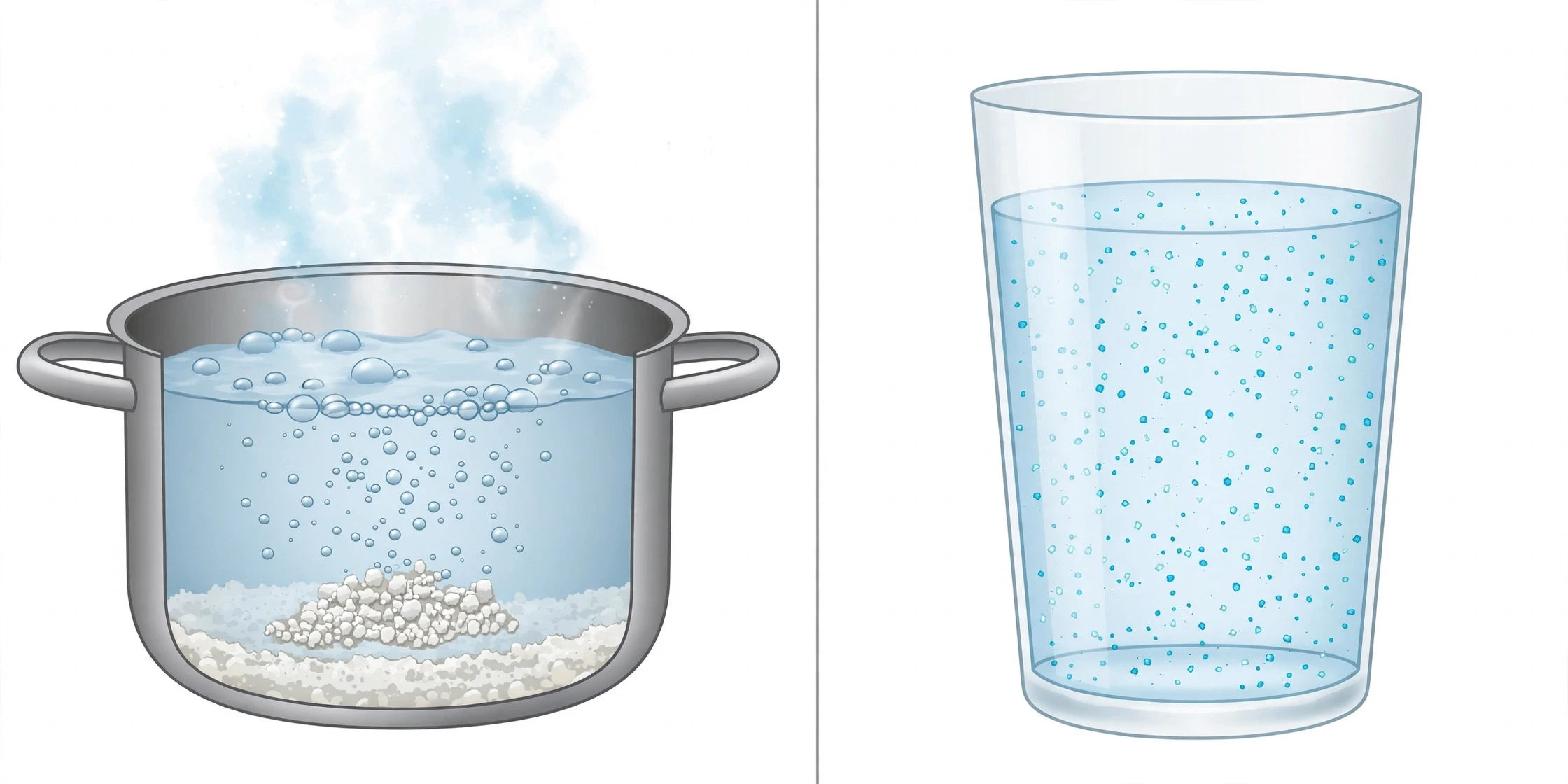
Most real tap water is a mixture of the two. The temporary fraction can be boiled away, the permanent fraction cannot, and the sum of the two is the total hardness. A laboratory can measure each fraction separately, but a householder rarely needs to. The practical test is simpler: if boiling a kettleful leaves a crust and the water tastes softer afterwards, a good share of the hardness was temporary. If the water stays stubbornly hard after boiling, the permanent fraction dominates, and only a proper softener will help.
6.1 Why the distinction matters in practice
The distinction matters because it decides which cheap fixes are worth trying. Boiling is a legitimate way to soften a small amount of temporary hard water for cooking or for a kettle, and it is the reason some older cookbooks advise boiling water before making tea in hard-water areas. But boiling a whole household's supply is impractical, and it does nothing at all for permanent hardness. Knowing which kind you have prevents wasted effort.
It also matters for boilers and industrial equipment. Engineers must soften water before it enters a boiler, because scale inside a boiler insulates the heating surface, wastes fuel, and can cause overheating. Temporary hardness is the main culprit in boilers, precisely because heat precipitates it exactly where it does the most harm: on the hottest surface. That is a neat, cruel piece of chemistry — the scale forms fastest where the water is hottest, which is where heat transfer matters most.
7. What Causes Limescale?
Limescale is calcium carbonate, CaCO3, with some magnesium carbonate mixed in, laid down as a hard, off-white crust. It is the solid form of the dissolved minerals in hard water, and it appears whenever the water is pushed out of the conditions that keep those minerals dissolved. Three pushes do most of the work: heating, evaporation, and a rise in pH.
Heating is the most important. Calcium carbonate becomes less soluble as water gets hotter, which is the opposite of how most solids behave. Sugar dissolves more easily in hot tea; calcium carbonate dissolves less easily in hot water. As water in a kettle, a water heater, or a boiler warms up, the dissolved calcium carbonate has nowhere to go but out of solution, and it deposits on the hottest surface available — the heating element, the inside of the tank, the pipe wall. The hotter the surface, the faster the scale grows.
Evaporation does the same thing by a different route. When water evaporates from a glass, a tap, or a shower screen, the minerals it carried are left behind. Each drying leaves a faint deposit, and the deposits accumulate into visible spots and crusts. This is why limescale appears around the base of taps and on shower glass even where the water is never boiled: the water dries, the minerals stay.
The third push, a rise in pH, matters most in pipes and in natural settings. When carbon dioxide escapes from water, the water becomes less acidic, carbonate ions become more plentiful, and calcium carbonate precipitates. This is the same chemistry that builds stalactites in limestone caves: water dripping from a cave roof loses carbon dioxide to the cave air, deposits a thin ring of calcium carbonate, and over centuries builds a stone icicle drop by drop. Your kettle is a fast, domestic version of a cave.
7.1 Where limescale does its damage
Limescale is rarely a single dramatic failure. It is a slow tax on everything water touches when heated. In a kettle, it lengthens boiling time and eventually kills the element. In a water heater, it coats the element or the tank wall, insulates it, and forces the heater to work harder for the same hot water. In pipes, it narrows the bore, reduces flow, and roughens the surface so that more scale sticks. In washing machines and dishwashers, it coats heating elements and spray arms. In coffee machines, it clogs narrow passages until the machine sputters and dies.
The U.S. Geological Survey's page on the hardness of water describes this plainly: heating hard water can leave calcium carbonate on a heater and in a pipe, and the scale can shorten the life of equipment, raise the cost of heating water, and clog pipes. That is the official picture, and it matches what any plumber will tell you. The scale is not poisonous; it is expensive. It costs energy, it costs appliances, and it costs time spent descaling.
Scale also provides a rough surface where other deposits can anchor, and in hot-water systems it can shelter bacteria from disinfectants — one more reason to keep hot-water systems clean and descaled on a sensible schedule.
7.2 Limescale, chalk, and limestone: the same material
It helps to see limescale for what it is: limestone, made in your kitchen. The white cliffs of Dover, the stalactites in a cave, the chalk on a blackboard, and the crust in a kettle are all calcium carbonate, differing in form and purity rather than in substance. The water that built a limestone hill over millions of years and the water that furs a kettle in a month are running the same reaction at different speeds.
That connection reframes the problem. Limescale is not a foreign contaminant invading clean water. It is the rock the water came from, returning to solid form. Once you see it that way, the remedies make sense: either keep the minerals dissolved, prevent them from depositing, or remove them from the water before it is heated. Every softening and scale-prevention method in this article is one of those three strategies.
8. Hard Water and Soap: Why Lather Fails
The most immediate way most people meet hard water is not scale but soap. In soft water, a small amount of soap produces a rich lather. In hard water, the same soap produces a thin, reluctant foam and a grey, sticky film. The difference is chemistry, and it is the reason soap was the original hardness test, centuries before test strips existed.
Soap molecules have two ends: one end loves water, the other loves grease. In soft water, soap molecules gather around grease and dirt, lift them away, and rinse clean. In hard water, calcium and magnesium ions get there first. Each calcium ion grabs two soap molecules and ties them together into an insoluble compound — soap scum, also called soap curd or lime soap. The soap is spent before it ever reaches the dirt. You need more soap to get the same cleaning, and the curd that forms sticks to skin, hair, cloth, and bath surfaces as a dull film.
The reaction is easy to picture, even without a formula: soap plus calcium gives solid soap scum plus dissolved sodium. The sodium end of the soap stays in the water; the fatty end, now bound to calcium, becomes a sticky solid. That solid is what you feel as a film on your skin after a shower in hard water, and what you see as a ring around the bath.
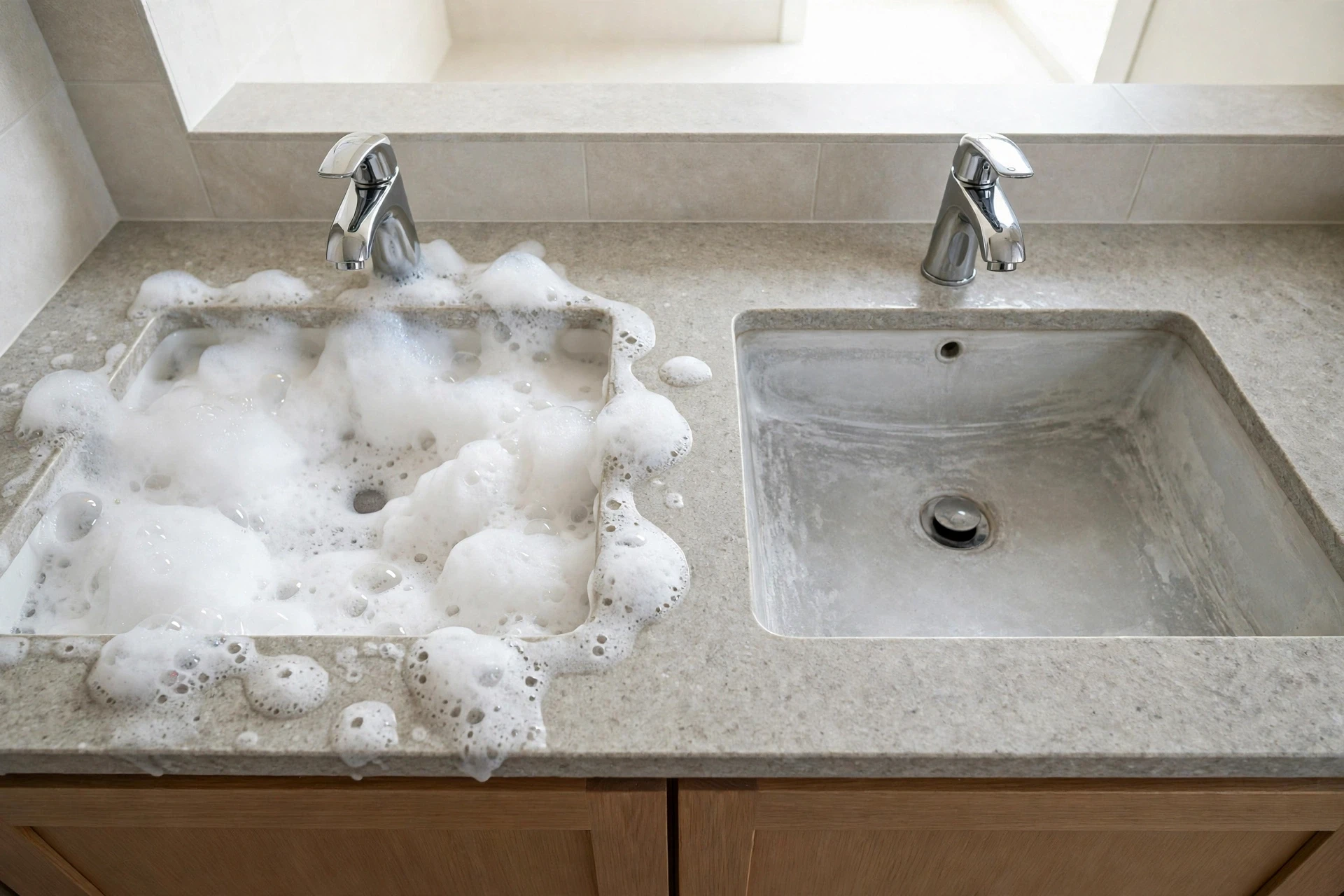
I noticed this most clearly not at home but in a laundry room, watching two identical loads washed in different towns. The load washed in soft water came out smelling clean and feeling loose. The load washed in hard water needed extra detergent, came out stiffer, and left a faint grey tinge on white cloth. The detergent had not failed; a share of it had been consumed by the water itself before it could touch the dirt. That is the hidden tax of hard water on every wash: you pay for detergent that cleans the water instead of the clothes.
8.1 Detergents and the hard-water workaround
Modern laundry detergents are built with hard water in mind. They contain builders — phosphates in older formulas, zeolites and citrates in newer ones — whose job is to grab calcium and magnesium ions and hold them harmlessly in solution, freeing the cleaning agents to do their work. How dissolved ions stay dissolved — and what makes them drop out — is the subject of Sciory's guide to solutions and solubility. This is why a modern detergent can cope with moderately hard water far better than a plain bar of soap can. It is also why detergent packaging in hard-water regions recommends a larger dose: the extra dose is not marketing, it is the amount needed to satisfy the water's appetite for builders before cleaning begins.
Even so, builders have limits. In very hard water, no reasonable dose fully compensates, and the familiar symptoms return: dingy whites, stiff towels, and a washing machine that slowly accumulates scale on its heater. Fabric softener can mask the stiffness, but it does not remove the cause. The cause is the mineral load, and only softening the water removes it.
8.2 Skin, hair, and the feeling of clean
Ask people in a hard-water area what they notice first, and many will mention their skin and hair before their kettle. Skin can feel dry or tight after washing, and hair can feel dull, heavy, or harder to rinse. The mechanism is the same soap scum: a thin film of calcium soap left on skin and hair, which can feel like residue even after thorough rinsing.
It is worth being careful here. Skin and hair are individual, and many things affect them — weather, diet, shampoo, and skin conditions among them. Hard water is one factor among several, not a diagnosis, and softening the water may help some people notice a difference while others notice little. What is certain is the chemistry: hard water leaves more residue, and residue changes how skin and hair feel. If you live in a hard-water area and your skin feels coated after a shower, the water is a reasonable suspect, and it is a cheap one to test.
9. Hard Water in the Home: Pipes, Heaters, and Laundry
Step back from the single kettle, and hard water becomes a whole-house story. Every pipe, every hot-water appliance, and every wash is a small experiment in the same chemistry, and the results accumulate over years. A home with very hard water does not usually suffer one catastrophic failure. It suffers a hundred small ones, and the bill arrives as higher energy use, shorter appliance life, and more cleaning products.
Start with the pipes. Cold-water pipes scale slowly, because the water is cool and the carbonate stays dissolved. Hot-water pipes scale faster, because heat drives precipitation. Over years, the bore narrows, flow falls, and the rough scale surface catches more scale. A shower that once ran strong may run weak not because the supply has fallen but because the pipe has narrowed from the inside. Descaling a showerhead helps the symptom; the narrowing further back in the pipe is harder to reach.
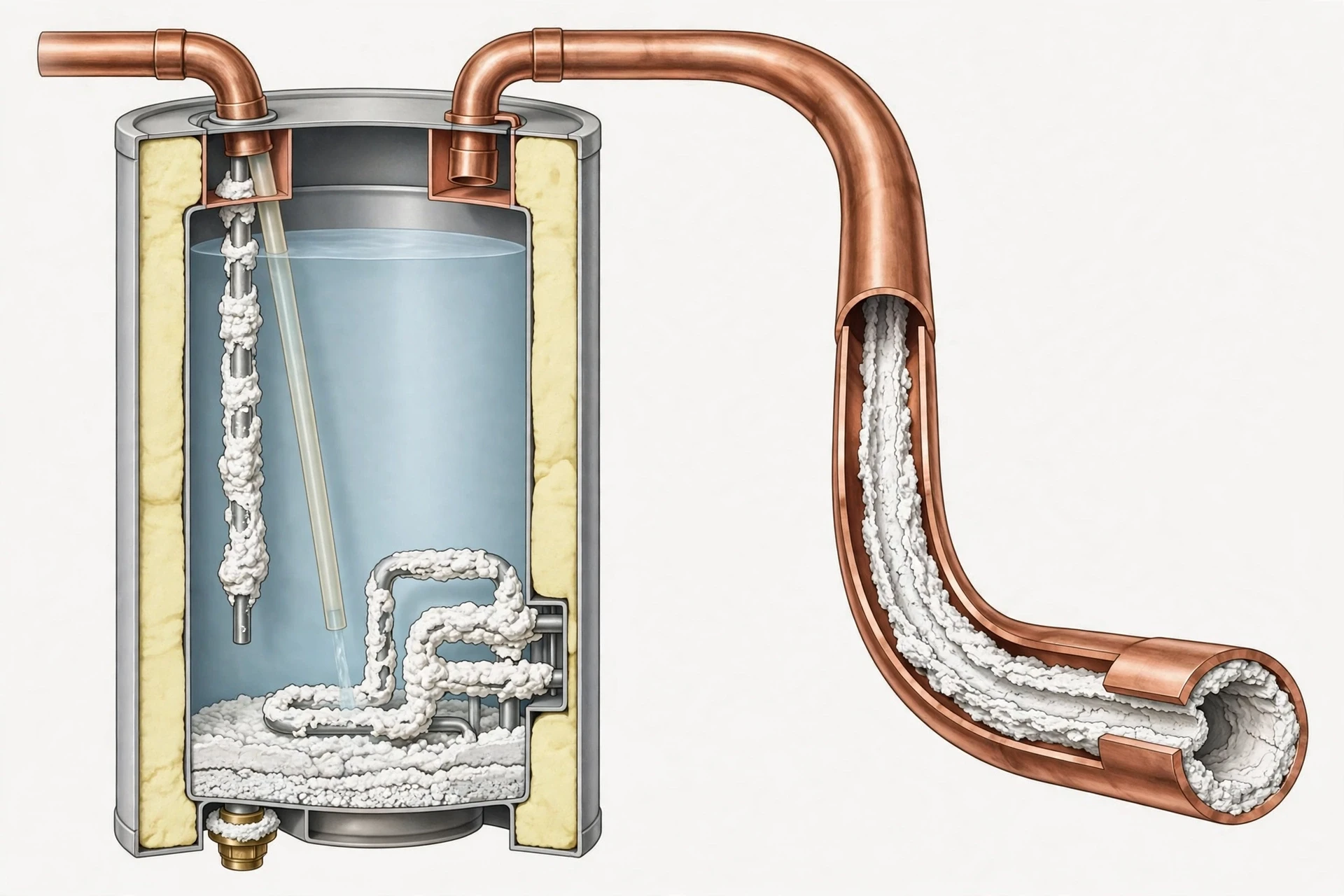
Water heaters bear the heaviest cost. Scale on a heating element acts as insulation between the element and the water. The element must run hotter to deliver the same heat, which wastes energy and shortens the element's life. In a tank, scale settles as sediment on the bottom, where it can cause rumbling noises as water trapped beneath it boils, and where it can hide corrosion. Regular flushing and descaling help, but they treat the symptom. Softening treats the cause.
Laundry and dishwashing carry the same story in miniature. More detergent is needed, whites grey faster, and glassware emerges from the dishwasher spotted unless a rinse aid is used. The spots on glass are not dirt; they are the minerals left when rinse water evaporates. A dishwasher can mask them with rinse aid, which helps water sheet off the glass instead of beading and drying in place, but the minerals are still in the water.
9.1 How much does it cost?
It is tempting to put a single number on the cost of hard water, and many commercial guides do. Resist that temptation, because the cost depends on the hardness, the size of the home, the age of the appliances, the price of energy, and how much detergent is used. A home at 70 mg/L will notice little. A home at 300 mg/L will notice a lot. What can be said safely is that the costs are real and they are cumulative: more detergent per wash, more descaler, more frequent replacement of kettles, showerheads, and heating elements, and more energy to heat water through a layer of scale.
The honest way to weigh a softener is to test your water, list the symptoms you actually have, and compare the cost of living with them against the cost of the softener, its salt, and its maintenance. A household with moderately hard water and no symptoms may reasonably decide to do nothing. A household with very hard water, a furred boiler, and a dead kettle every year may find the arithmetic easy. The number on the test strip is the start of that calculation, not the end of it.
9.2 Hard water outside the house
Hard water is not only a household matter. In industry, boilers, cooling towers, and heat exchangers all suffer when scale insulates heat-transfer surfaces, and industrial water treatment is a large field built around preventing exactly that.
In nature, the same chemistry builds landscapes. Limestone pavements, tufa terraces, and stalactites are all calcium carbonate deposited from hard water, and the ecosystems that live in hard-water streams are adapted to it. Sciory's guide to ecosystems shows how energy and nutrients flow through a living system, and in a chalk stream the dissolved minerals are part of that flow. Hard water, seen this way, is not a defect in nature. It is a property of a landscape, and the problems begin only when that landscape's water is piped into a house full of hot metal.
Limescale is limestone made in your kitchen. The same reaction that built a limestone hill over millions of years furs a kettle in a month — the only difference is speed.
10. Is Hard Water Bad for You?
This is the question most people actually want answered, and it deserves a straight answer first: hard water is not considered a health hazard at the levels found in drinking water. The United States Geological Survey puts it plainly — hardness is not a health concern, but it can be a nuisance — and the World Health Organization has not set a health-based guideline value for hardness in drinking water. The United States Environmental Protection Agency has set no primary (health-based) or secondary (aesthetic) drinking-water standard for hardness itself. That is a notable fact: a substance that causes so much household trouble is, by the judgement of the agencies that regulate drinking water, not a health risk at ordinary concentrations.
The reason is straightforward. Calcium and magnesium are essential minerals, and the human body needs both. Drinking water contributes only a small share of most people's daily intake — food provides the bulk — but the contribution is in the right direction. Hard water adds calcium and magnesium to the diet rather than adding a toxin. There is no dose of hardness in ordinary tap water that poisons a healthy adult, and no credible evidence that drinking hard water causes kidney stones, heart disease, or any of the other ills sometimes blamed on it. Kidney stones are a real and painful condition, but their causes are dietary and metabolic, and blaming the tap is a misunderstanding of how the body handles calcium.
That does not mean hard water is harmless in every sense. It is harmless to drink, and harmful to plumbing. The two statements can both be true, and keeping them apart is the key to thinking clearly about hard water. A softener is a plumbing decision, not a health intervention, and it should be judged as one.
10.1 What about skin, hair, and eczema?
The honest picture here is mixed, and it is worth saying so rather than picking a side. Some people find that hard water leaves their skin feeling dry and their hair feeling coated, and some studies have found associations between hard water and skin irritation in people who already have eczema. The mechanism is plausible: soap scum residue, and the extra soap and rinsing that hard water demands, can irritate skin that is already sensitive.
At the same time, the evidence is not settled, and hard water is not established as a cause of eczema. Skin is affected by many things at once, and a household that softens its water and notices an improvement cannot be sure the water was the only change. If you have a skin condition, the right person to ask is a clinician who knows your history, not a water-softener salesperson. What can be said with confidence is that hard water is a nuisance factor for skin and hair, and that softening may help some people feel more comfortable, without being a treatment for any condition.
10.2 The sodium question
There is one health-related caveat to softening, and it belongs here rather than in the sales brochure. A conventional ion-exchange softener swaps calcium and magnesium for sodium, and the softened water therefore contains more sodium than the hard water it replaced. For most people, the amount is small compared with the sodium in food, and it is not a concern. For people on a strictly sodium-restricted diet, it can matter, and the Environmental Protection Agency sets a guidance level of 20 mg/L of sodium in drinking water for people on a very low sodium diet of 500 mg per day.
The practical answers are simple. A household with a sodium concern can soften only the hot-water supply, leaving the cold kitchen tap unsoftened for drinking and cooking, or it can use potassium chloride instead of sodium chloride in the softener, or it can add a small reverse-osmosis unit at the kitchen tap, which removes sodium along with other dissolved substances. None of these is complicated, but each needs to be chosen deliberately. A softener installed without thinking about the kitchen tap is a softener installed half-blind.
10.3 Hard water and taste
Taste is personal, and hard water divides opinion. Some people prefer moderately hard water, finding soft water flat or slightly salty after ion exchange; others prefer soft water and find hard water chalky. Neither preference is a health judgement. Taste is also affected by chlorine, temperature, and the pipes, so a change after softening may have more than one cause. If taste is your main concern, a small filter at the kitchen tap may be a cheaper answer than a whole-house softener.
11. How Do You Soften Hard Water?
Softening means removing calcium and magnesium ions from water, or preventing them from causing trouble. There are several ways to do it, and they are not interchangeable. Each works on a different principle, each has a different cost, and each suits a different situation. The table below compares them, and the sections that follow explain how each one works.
Method | How it works | Removes hardness? | Best for |
|---|---|---|---|
Boiling | Precipitates temporary hardness as scale | Partly — temporary only | Small amounts for cooking or a kettle |
Lime–soda treatment | Adds lime and soda ash to precipitate calcium and magnesium | Yes | Municipal water treatment plants |
Ion exchange | Swaps Ca2+ and Mg2+ for Na+ or K+ on resin beads | Yes | Whole-house softening |
Reverse osmosis | Forces water through a membrane that blocks dissolved ions | Yes, plus most other dissolved substances | Drinking water at one tap |
Salt-free conditioning | Changes crystal form so scale sticks less readily | No — minerals stay in the water | Scale reduction where true softening is not needed |
Chelation / sequestration | Binds Ca2+ and Mg2+ into soluble complexes | No — minerals stay dissolved | Detergents, small appliances, short-term use |
11.1 Boiling: the oldest method
Boiling is the oldest way to soften water, and it still works — within its limits. Heat temporary hard water, and the bicarbonate decomposes, calcium carbonate precipitates, and the water left behind is softer. Let the water cool, pour it off the sediment, and you have softened water for tea or cooking.
The limits are the point. Boiling removes only temporary hardness, it removes it only from the water you actually boil, and it costs energy. Nobody boils a household's whole supply. Boiling is a kettle-scale answer, not a house-scale one, and it is best thought of as a demonstration of the chemistry rather than a treatment system. It is, however, a useful test: if boiling softens your water noticeably, a good share of your hardness is temporary.
11.2 Lime–soda softening: the municipal method
Water treatment plants soften water on a large scale by adding measured amounts of slaked lime, calcium hydroxide, and soda ash, sodium carbonate. The lime precipitates magnesium as magnesium hydroxide and, with bicarbonate, precipitates calcium as calcium carbonate. The soda ash precipitates the remaining calcium from permanent hardness. The solids are settled out and filtered away, and the water that leaves the plant is softer.
This is the method described in the LibreTexts treatment of hard water, and it is the workhorse of municipal softening. It is not a household method — dosing lime and soda ash accurately, and removing the sludge, needs a treatment plant — but it explains why some cities deliver moderately soft water even though their source is hard. If your supplier softens centrally, your tap water may already be softer than the raw source, and your water report will show the treated number.
11.3 Ion exchange: the household softener
The standard whole-house softener is an ion-exchange unit, and its chemistry is elegant. Hard water flows through a tank of resin beads, tiny polymer spheres covered in negatively charged sites. The beads start loaded with sodium ions. As hard water passes, calcium and magnesium ions, with their double charge, bind to the resin more strongly than sodium does, and they displace the sodium into the water. Two sodium ions are released for each calcium or magnesium ion captured. The water that leaves the tank is soft: its hardness ions are sitting on the resin, and sodium has taken their place.
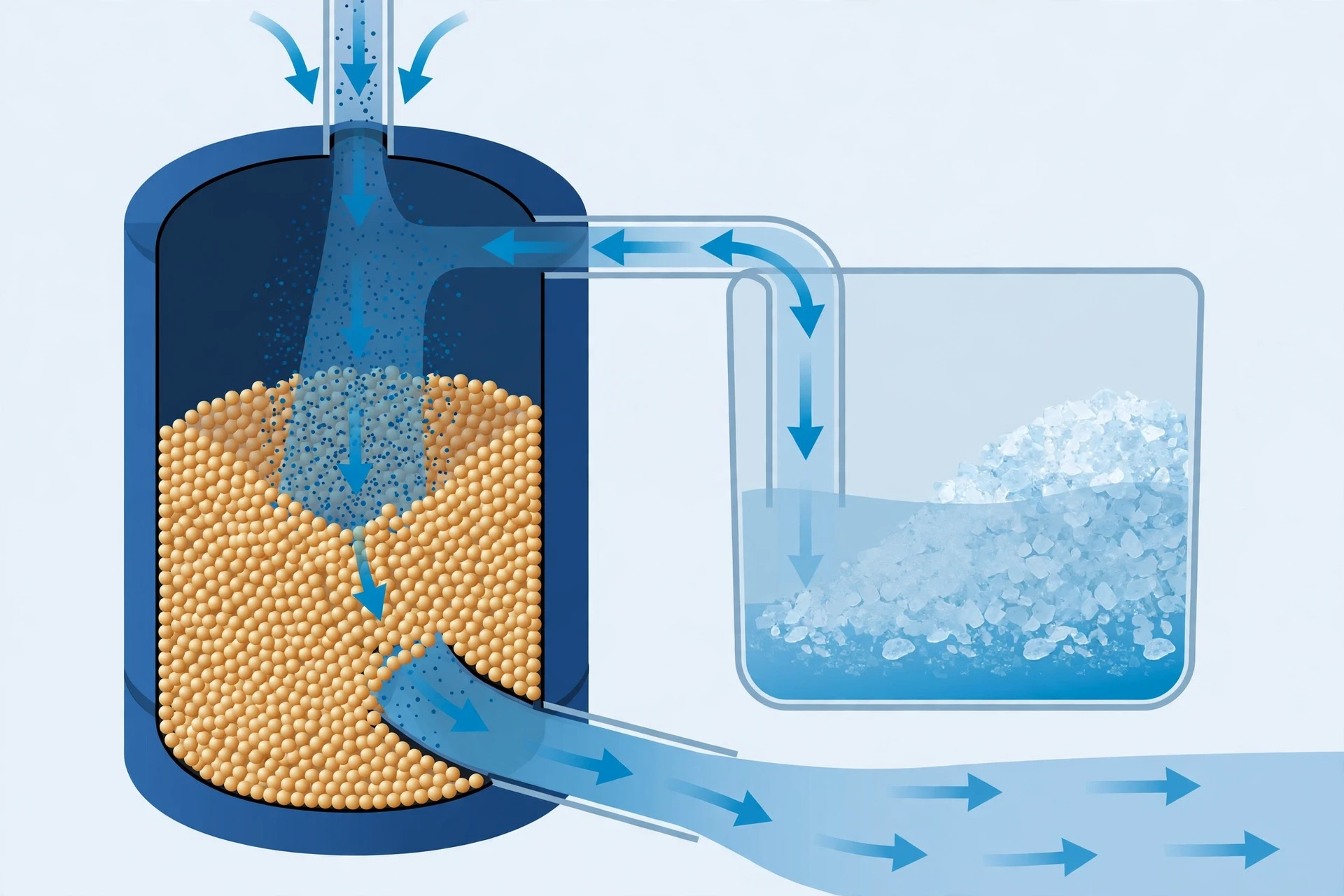
Sooner or later the resin fills up. At that point the softener regenerates: it flushes the resin with a concentrated brine of sodium chloride, which floods the beads with sodium and drives the captured calcium and magnesium off into the drain. The resin is reloaded with sodium, and the cycle begins again. A modern softener regenerates automatically, on a timer or when a meter shows that a set volume has passed, and the only regular job for the householder is keeping the brine tank topped up with salt.
Ion exchange is the only household method that truly softens a whole house's water, and it is the right answer for very hard water with real symptoms. Its drawbacks are honest ones: it adds sodium to the water, it uses salt and water for regeneration, and it needs space, a drain, and occasional maintenance. It also does not remove other contaminants — lead, nitrate, bacteria, and chlorine pass through a softener largely untouched, and a softener is not a filter or a purifier. Anyone who buys a softener expecting it to purify water has bought the wrong machine.
11.4 Reverse osmosis: softening at one tap
Reverse osmosis, often shortened to RO, forces water through a semi-permeable membrane with pores so fine that dissolved ions cannot pass. The water that emerges is very low in dissolved substances of all kinds, including hardness. RO is excellent for drinking water at a single tap, and it is the method behind many under-sink units and much bottled water.
RO is not a whole-house answer. It is slow, it wastes a share of the feed water as concentrate, and it strips out minerals indiscriminately, which is why some RO units add a remineralising stage for taste. For a household that wants soft water for drinking and cooking but does not want to soften the whole house, an RO unit at the kitchen tap, combined with a conventional softener or with no softener at all, is a sensible pairing.
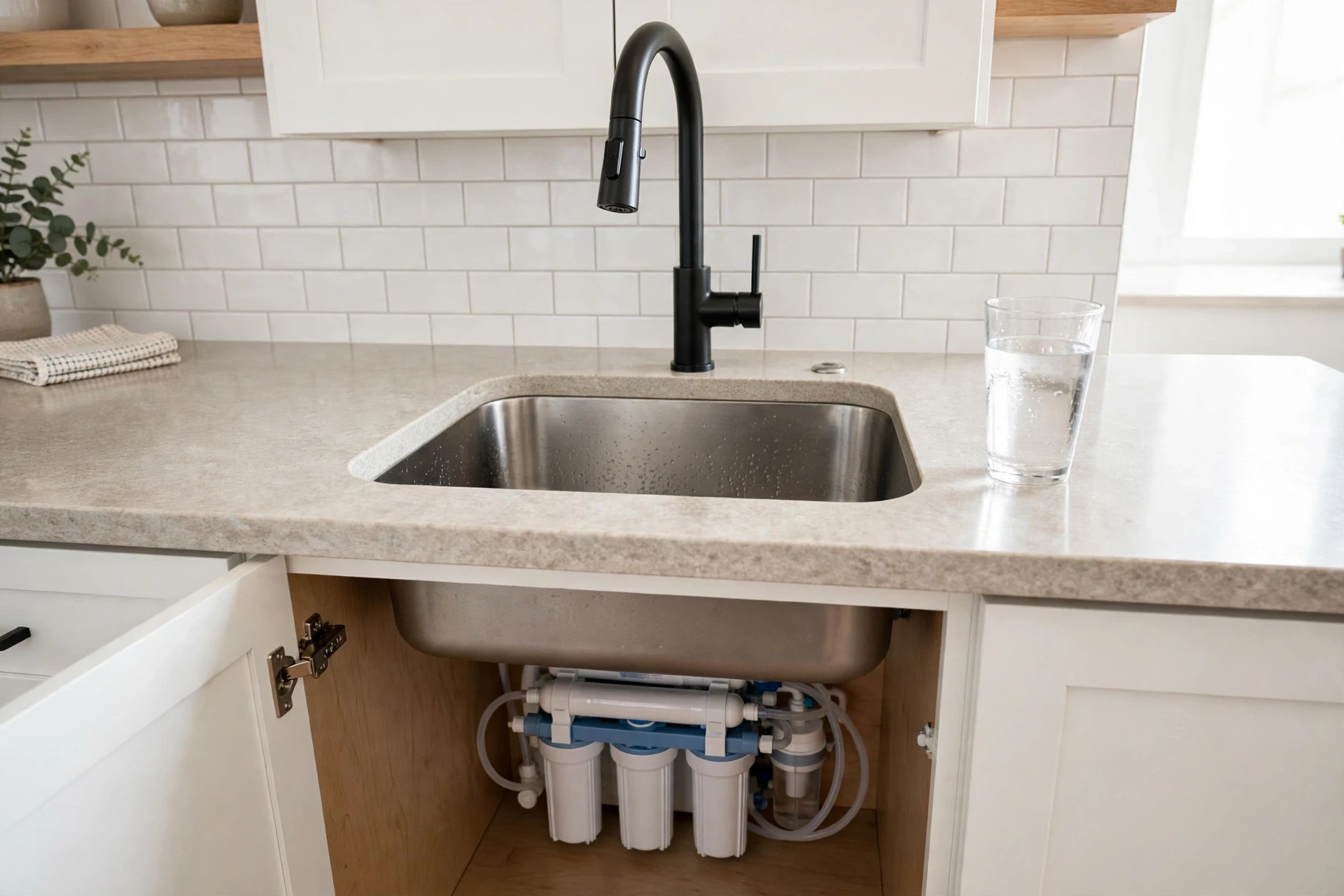
11.5 Salt-free conditioners and magnetic devices: what they do and do not do
Walk through any home show and you will meet salt-free water conditioners, often sold as salt-free softeners, and magnetic or electronic devices that claim to treat hard water without salt, without a drain, and without maintenance. Their claims deserve a careful hearing, because the language around them is often slippery.
Salt-free conditioners, usually based on template-assisted crystallisation, do not remove calcium or magnesium. They encourage the minerals to form tiny crystals in the water rather than scale on surfaces, so that the crystals wash through instead of sticking. Used well, they can reduce scale formation. They do not soften water in the chemical sense: a test strip will still read hard, soap will still struggle to lather, and the water will still leave spots when it evaporates. Calling them softeners is misleading. They are scale-reduction devices, and they should be judged as such.
Magnetic and electronic devices have a thinner record. The idea is that a magnetic field changes how calcium carbonate crystallises, favouring a form that sticks less readily. Some users report less scale; controlled studies have been inconsistent, and the effect, where it exists, is modest and dependent on water chemistry and flow. A careful buyer treats such devices as experimental, not as a proven replacement for ion exchange, and insists on evidence that applies to their own water rather than to a demonstration in a showroom.
The honest rule is simple: if a device does not remove calcium and magnesium, it has not softened your water, whatever the brochure says. It may still be useful, but it is useful for a different job, and the price should match that job.
11.6 Choosing a method: a practical guide
Start with the number. Test your water, or read your supplier's report, and place yourself on the hardness scale. Below about 120 mg/L, most households need nothing more than descaling and a little extra detergent. Between 120 and 180 mg/L, the decision is a judgement call: weigh the symptoms against the cost and bother of a softener. Above 180 mg/L, with visible scale, stiff laundry, and ailing appliances, a softener is usually the sensible choice.
Then match the method to the problem. If the problem is the kettle and the showerhead, descaling and a shower filter may be enough. If the problem is the whole house — the boiler, the washing machine, the pipes — only a whole-house ion-exchange softener addresses it. If the problem is drinking water, an RO unit at the kitchen tap is the targeted answer. If the problem is sodium, soften the hot water only, use potassium chloride, or add RO at the kitchen tap.
Finally, size the system honestly. A softener is sized by hardness, water use, and the capacity of its resin, and an undersized unit will regenerate constantly and waste salt, while an oversized one costs more than it needs to. A reputable installer will ask for a water test and a household size before quoting, and will explain the regeneration schedule and the salt use. An installer who quotes without testing has not done the job properly.
A softener is a plumbing decision, not a health intervention. Judge it the way you would judge a new boiler: by the symptoms it fixes, the cost of running it, and the number on the test strip.
12. Common Mistakes and Misconceptions
Hard water attracts confident wrong ideas, and most of them survive because they sound plausible. Here are the ones worth retiring.
"Hard water is dirty water." It is not. Hardness measures dissolved calcium and magnesium, not contamination. A hard supply can be properly treated and perfectly clear, and a soft supply can be contaminated. Softening changes the mineral load; it does not disinfect or purify.
"Boiling fixes hard water." It fixes temporary hardness, in the pot you boil, and nothing else. Permanent hardness survives boiling untouched. Boiling a kettle is a demonstration, not a treatment system.
"A filter softens water." A standard carbon filter does not. Dissolved calcium and magnesium pass straight through carbon, ceramic, and mesh filters, because they are dissolved, not suspended. Only ion exchange, reverse osmosis, and chemical precipitation remove them. A filter that claims to soften water should be asked which of those it does.
"A TDS meter measures hardness." It does not. It estimates total dissolved solids from conductivity. A softener can be working perfectly while a TDS meter shows almost no change, because the softener swaps one dissolved ion for another. Test hardness with a hardness test.
"Soft water is pure water." It is not. Softened water still contains dissolved substances, including the sodium or potassium added by ion exchange. Truly pure water — distilled or deionised — is a laboratory product, not what comes out of a softener.
"Hard water causes kidney stones." There is no established link between drinking hard water and kidney stones. Kidney stones have dietary and metabolic causes, and the calcium in drinking water is a small share of total calcium intake. This is one of those ideas that feels like it should be true, because calcium is involved in both, and it is not.
"If the water is hard, the softener must be broken." Not necessarily. A softener can be working and the water can still test hard at a tap that bypasses it, such as an outside tap or a kitchen cold tap left unsoftened by design. Check which taps the softener serves before blaming the machine. And check the salt: an empty brine tank is the most common cause of a softener that has quietly stopped softening.
Most people get one of these wrong at least once — I certainly did, when I assumed a carbon filter jug would soften my kettle water and wondered why the scale kept coming back. The jug improved the taste, which is what it was built to do. It did nothing to the hardness, because nothing in it could. Match the tool to the chemistry, and the chemistry will cooperate.
13. Putting It All Together
Hard water is a simple idea with long consequences. Rain falls soft, seeps through limestone and chalk, and arrives at the tap carrying dissolved calcium and magnesium. Those ions are invisible while they stay dissolved, and they make themselves known when water is heated, when it evaporates, or when it meets soap: as limescale, as spots, as scum, as stiff laundry, as a heater working harder than it should.
The response follows the same logic. Measure first, because the number decides everything else. Below the hard band, live with it and descale occasionally. In the hard and very hard bands, weigh the symptoms against the cost of a softener. If you soften, use ion exchange for the whole house and reverse osmosis at the kitchen tap where drinking water matters, and remember that a softener is a plumbing appliance with a salt bill and a maintenance schedule, not a purifier.
And keep the perspective that the geology gives you. The water in your kettle was rain not long ago, and the rock it passed through is older than any house it enters. The crust in the kettle is a small, fast piece of the same chemistry that built limestone hills and stalactites. Once you can see that, hard water stops being a mysterious household curse and becomes what it is: a soluble landscape, arriving one glass at a time, asking only to be understood before it is managed.
Frequently Asked Questions
What is hard water?
Hard water is water with a high concentration of dissolved calcium (Ca2+) and magnesium (Mg2+) ions. It is usually reported in milligrams per litre as calcium carbonate (mg/L as CaCO3). The U.S. Geological Survey classifies water as soft at 0–60 mg/L, moderately hard at 61–120 mg/L, hard at 121–180 mg/L, and very hard above 180 mg/L. Hard water looks and tastes much like soft water; its effects — limescale, soap scum, and poor lather — appear when the water is heated, evaporated, or mixed with soap.
How do you soften hard water?
The reliable household method is ion exchange: hard water passes through resin beads that capture calcium and magnesium and release sodium (or potassium) in their place, and the resin is regenerated with brine. Reverse osmosis also removes hardness, and is best for drinking water at a single tap. Boiling removes temporary hardness only, and only from the water you boil. Lime–soda treatment softens water at municipal plants. Standard filters do not soften water, because dissolved ions pass through them.
What causes limescale?
Limescale is calcium carbonate left behind when hard water is heated or evaporates. Heating makes calcium carbonate less soluble, so it precipitates onto the hottest surface — a kettle element, a water-heater tank, or a pipe wall. Evaporation leaves the dissolved minerals behind as water dries on glass, taps, and shower screens. Loss of carbon dioxide also raises the pH and encourages precipitation, which is the same chemistry that builds stalactites in limestone caves.
Is hard water bad for you?
At the levels found in drinking water, hard water is not considered a health hazard. The U.S. Geological Survey describes hardness as not a health concern but a nuisance, the World Health Organization has set no health-based guideline value for hardness, and the U.S. Environmental Protection Agency has set no primary or secondary drinking-water standard for hardness. Calcium and magnesium are essential minerals, and drinking water contributes only a small share of daily intake. The main costs of hard water are to plumbing, appliances, and cleaning, not to health. People on a strictly sodium-restricted diet should note that ion-exchange softening adds sodium to the water, and should discuss options with a clinician.
How can I test my water hardness at home?
Use a home test strip or drop kit, which gives a reading in mg/L or grains per gallon (1 grain per gallon equals 17.1 mg/L), or read your water supplier's annual water quality report, which usually lists total hardness. A certified laboratory test gives the most precise result and is the right choice when sizing a softener or testing a private well. A TDS meter does not measure hardness.
Does boiling remove permanent hardness?
No. Boiling removes temporary hardness, which is calcium and magnesium paired with bicarbonate, because heat drives off carbon dioxide and precipitates calcium carbonate. Permanent hardness, paired with sulfate, chloride, or nitrate, does not decompose on heating, so boiled permanent hard water stays hard. Most tap water is a mixture of the two, so boiling softens it only partly.
Do water filters remove hard water?
No, not in the usual sense. Carbon, ceramic, and mesh filters remove particles and improve taste, but dissolved calcium and magnesium pass straight through them. To remove hardness you need ion exchange, reverse osmosis, or chemical precipitation. Salt-free conditioners do not remove hardness either; they aim to reduce scale formation while the minerals stay in the water, so a hardness test will still read hard after treatment.
Sources
Chemistry LibreTexts — Hard Water: Hard Water — Chemistry LibreTexts
U.S. Environmental Protection Agency — Secondary Drinking Water Standards: Secondary Drinking Water Standards: Guidance for Nuisance Chemicals — EPA
U.S. Environmental Protection Agency — Drinking Water Advisory on Sodium: Drinking Water Advisory: Consumer Acceptability Advice and Health Effects Analysis on Sodium — EPA
Penn State Extension — Common Drinking Water Problems and Solutions: Common Drinking Water Problems and Solutions — Penn State Extension
Water Quality Association — Hardness: Hardness — Water Quality Association
OpenStax Chemistry 2e — The Dissolution Process: The Dissolution Process — OpenStax Chemistry 2e
World Health Organization — Guidelines for Drinking-water Quality: Guidelines for Drinking-water Quality — WHO
U.S. Geological Survey — Hardness of Water: Hardness of Water — USGS
Why Water Is the Weirdest Molecule — Sciory: Why Water Is the Weirdest Molecule
The Water Cycle — Sciory: The Water Cycle
Ecosystems Explained — Sciory: Ecosystems Explained: How Energy Flows, Nutrients Cycle, and Life Connects
Solutions and Solubility Explained — Sciory: Solutions and Solubility Explained: Molarity and Concentration