

The first time I watched a clock reaction in a chemical kinetics demonstration, I thought someone had played a trick on me. Two clear liquids went into a flask, I swirled them, and nothing happened. Ten seconds passed. Twenty. I was about to complain that the demonstration had failed when the whole solution turned ink-black in a single heartbeat, as if a switch had been flipped. The students around the bench laughed, and so did I, but the question stuck with me for years: what was the liquid doing during those quiet twenty seconds? It was not doing nothing. It was reacting, silently and steadily, building toward a threshold nobody could see. That hidden countdown is the subject of chemical kinetics — the study of how fast reactions run, what sets their pace, and how we can measure, predict, and change it.
Chemical kinetics is the part of chemistry that asks not whether a reaction can happen, but how quickly it happens and why some reactions take microseconds while others take centuries. A spark can turn a mixture of hydrogen and oxygen into water in a flash. A steel bridge rusts over decades. Bread dough rises in an hour. Milk left on a warm counter sours by evening, while the same milk in a fridge stays fresh for days. All of these are chemical changes, and the difference between them is speed. Once you learn to see reactions as races with measurable speeds, ordinary life starts to look different: every kitchen, every factory, every living cell is full of reactions whose rates are being tuned, deliberately or by accident, all the time.
This article stays strictly on that question of speed. The companion article on Chemical Reactions covers the types of reactions, what they are, and where they show up in everyday life; here we go deeper into the clockwork underneath — how rates are measured, what collision theory says about why reactions happen at all, what activation energy really is, how rate equations work, and how temperature, concentration, and catalysts pull the levers. If you have ever wondered why food cooks faster in a pressure cooker, why a catalyst is not used up, or why doubling a concentration sometimes does nothing at all, this is the article that answers those questions with the numbers to back them up.
1. Chemical Kinetics: Measuring How Fast Reactions Run
Chemical kinetics begins with a simple idea: a reaction rate is how quickly a reactant disappears or a product appears. Chemists usually measure it in moles per litre per second, written mol L⁻¹ s⁻¹, which tells you how much the concentration changes in one second.
If a reactant starts at 1.0 mol/L and falls to 0.6 mol/L over 10 seconds, the average rate over that stretch is 0.04 mol/L per second. That single number already tells a story — but only part of it, because most reactions do not run at a steady speed. They start fast, when reactants are plentiful, and slow down as the reactants are used up. A rate measured at the very start, the initial rate, is often the most useful number of all, because it is measured before the changing concentrations muddy the picture.
There is a subtlety here that trips up many students. The rate of a reaction is not the same as how far the reaction goes. A reaction can be very fast and still stop halfway, or very slow and eventually go almost to completion. Speed and extent are different questions, governed by different ideas: kinetics governs speed, while equilibrium governs how far a reaction goes. A catalyst, as we will see later, can make a reaction much faster without changing where it ends up. Keeping those two ideas apart is the first step toward thinking clearly about chemical kinetics.
Another point worth settling early: when chemists say a reaction is "fast" or "slow", they mean it relative to a human timescale and a purpose. The neutralisation of an acid by a base in water is essentially instant — mix them and the pH jumps before you can blink. The conversion of diamond to graphite, on the other hand, is so slow at room temperature that a diamond ring will outlast its owner by an unimaginable margin, even though graphite is the more stable form of carbon. Both reactions are allowed by the laws of thermodynamics. Only kinetics decides whether they matter in a lifetime.
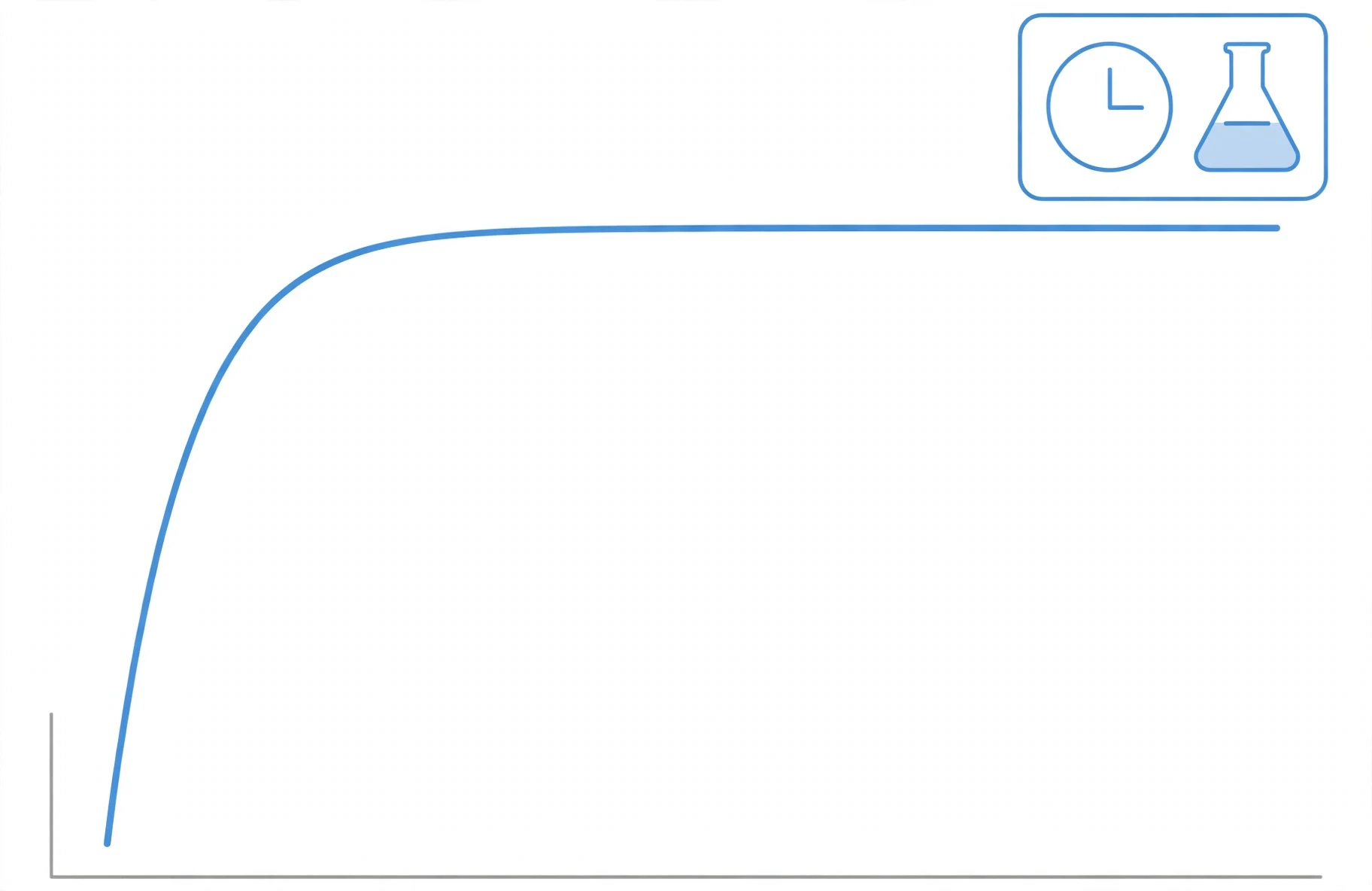
So how do chemists actually watch a reaction run? It depends on what changes. If a gas is produced, they can measure the volume over time. If the colour changes, they can track the light absorbed. If the pressure changes, a sensor records it. If the acidity changes, a pH meter follows it. The trick is always the same: find something measurable that changes as the reaction proceeds, record it against time, and plot the result. The shape of that curve — steep at first, flattening later — is the fingerprint of the reaction's rate, and from it chemists can work backward to the mechanism, the step-by-step sequence of molecular events that actually happened.
2. Collision Theory: Why Reactions Need the Right Bump
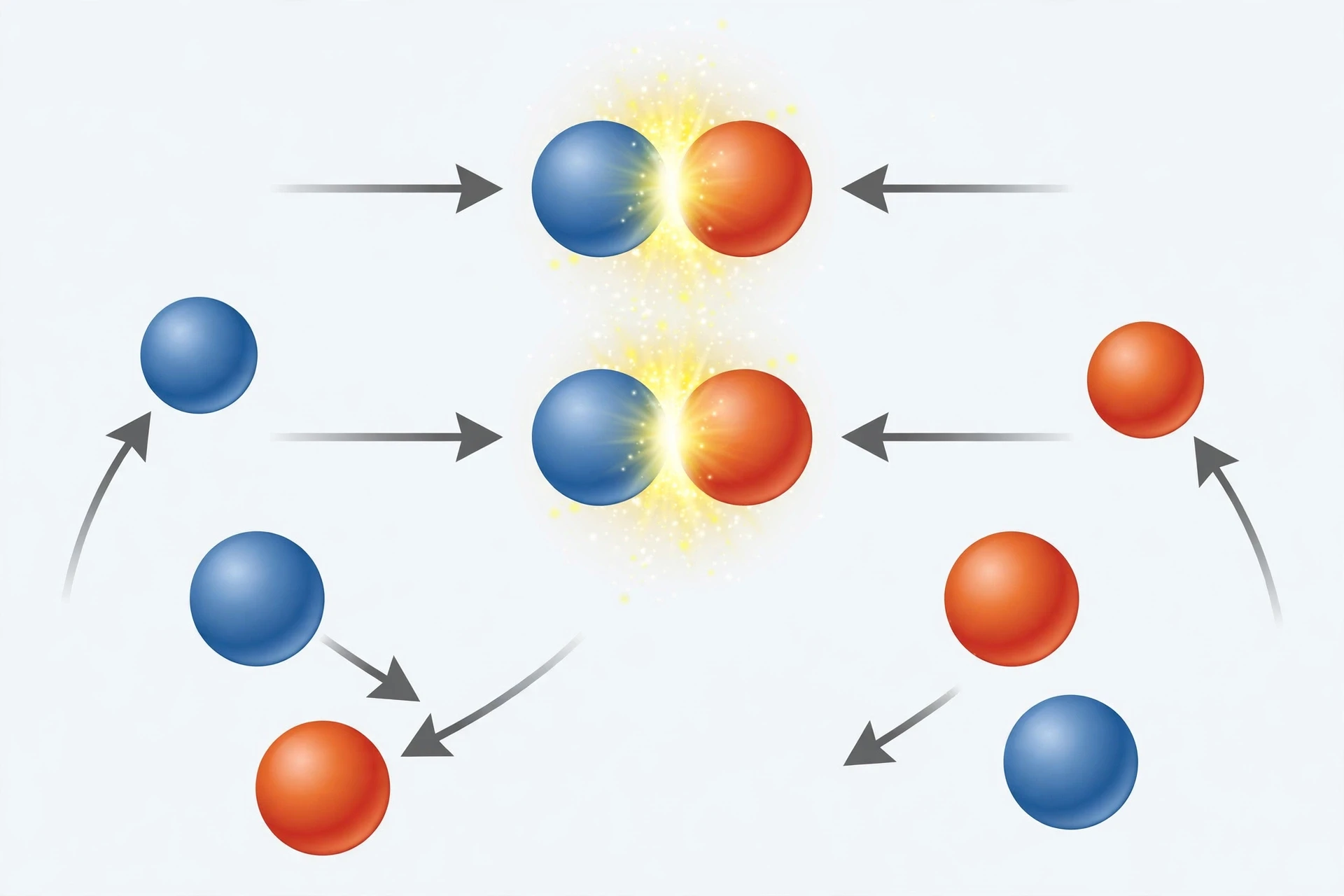
Collision theory says a reaction happens only when molecules collide with enough energy and in the right orientation. Most collisions have neither, so most do nothing — and that rarity is what sets the pace of a reaction.
If you want to understand why reactions run at the speeds they do, start with a picture of what molecules are actually doing. In a gas or a liquid, molecules are in constant, frantic motion, colliding with each other billions of times every second. Most of those collisions do nothing at all — the molecules simply bounce apart, unchanged. A tiny fraction of them lead to a reaction. Collision theory, the foundation of chemical kinetics, explains why: for a collision to cause a reaction, the molecules must hit each other with enough energy, and they must hit each other in the right orientation.
Think of two people trying to assemble a piece of flat-pack furniture. They have all the parts, and they keep bumping into each other in a crowded room, but nothing gets built unless they meet with the right pieces facing each other and with enough force to push the parts together. Molecules are the same. A collision between two hydrogen molecules and one oxygen molecule will not make water unless the atoms arrive in an arrangement that lets old bonds break and new bonds form. Hit them the wrong way round, and they simply rebound. This is why the orientation factor matters, and it is one reason reactions between large, complicated molecules tend to be slower than reactions between small, simple ones: there are fewer ways for a big molecule to hit its partner correctly.
The energy requirement is just as strict. Bonds do not break for free. Before new bonds can form, old ones must be stretched and broken, and that costs energy. A gentle collision cannot pay that cost, so the molecules bounce apart. Only collisions above a certain energy threshold — the activation energy — can get the job done. At room temperature, in an ordinary mixture, only a small fraction of molecules carry that much energy at any moment. That fraction is the bottleneck that sets the pace of most reactions, and it is why temperature has such a dramatic effect, as we will see in section 6.
Collision theory also explains a puzzle that confuses many beginners: why do some reactions that look simple on paper run so slowly? Consider the reaction between hydrogen and oxygen. The equation is short, the products are simple, and the reaction releases a great deal of energy. Yet a mixture of hydrogen and oxygen can sit peacefully in a balloon for years. The reason is that the first step — breaking the strong bonds in hydrogen and oxygen molecules — demands a large activation energy, and at room temperature almost no collisions clear that bar. Add a spark, which gives a few molecules the energy they need, and the heat released by those first reactions energises their neighbours, and the whole mixture goes up in a chain. The reaction was always possible. It was waiting for the energy to start.
There is a limit to what collision theory can do on its own. It works well for simple gas-phase reactions, where molecules fly freely and collide cleanly. In liquids, molecules are hemmed in by their neighbours and collide far more often but with less freedom, and in solids, molecules barely move at all — which is why solid-state reactions are usually slow unless the solid is heated or ground fine. Later theories, such as transition-state theory, refined the picture by describing the fleeting, high-energy arrangement of atoms at the top of the energy barrier. OpenStax Chemistry defines that fleeting arrangement in one sentence: "When reactant species collide with both proper orientation and adequate energy, they combine to form an unstable species called an activated complex or a transition state." But collision theory remains the best first picture, and it correctly predicts the three great levers of chemical kinetics: more collisions, harder collisions, and a lower barrier all make reactions faster.
3. What Is Activation Energy?
Activation energy is the minimum energy that colliding molecules need before they can react. It is usually written Ea, and it is measured in kilojoules per mole. Picture a boulder sitting in a shallow dip on a hillside, with a ridge between it and the valley below.
The boulder cannot roll into the valley on its own, even though the valley is lower — it has to be pushed up and over the ridge first. The height of that ridge is the activation energy. The valley is the product, lower in energy than the starting point for an energy-releasing reaction, but the ridge stands in the way regardless.
Chemists draw this idea as an energy profile diagram: a curve that rises from the energy of the reactants, peaks at the top of the barrier, and falls to the energy of the products. The peak is the transition state, sometimes called the activated complex — a brief, unstable arrangement of atoms, partway between reactants and products, that exists for less than a trillionth of a second. OpenStax Chemistry defines the threshold itself plainly: "The minimum energy necessary to form a product during a collision between reactants is called the activation energy (Ea)." No one can bottle a transition state. It is a mountain pass, not a place to live. But its height controls everything: a high barrier means few molecules get over it, and the reaction is slow; a low barrier means many molecules get over it, and the reaction is fast.
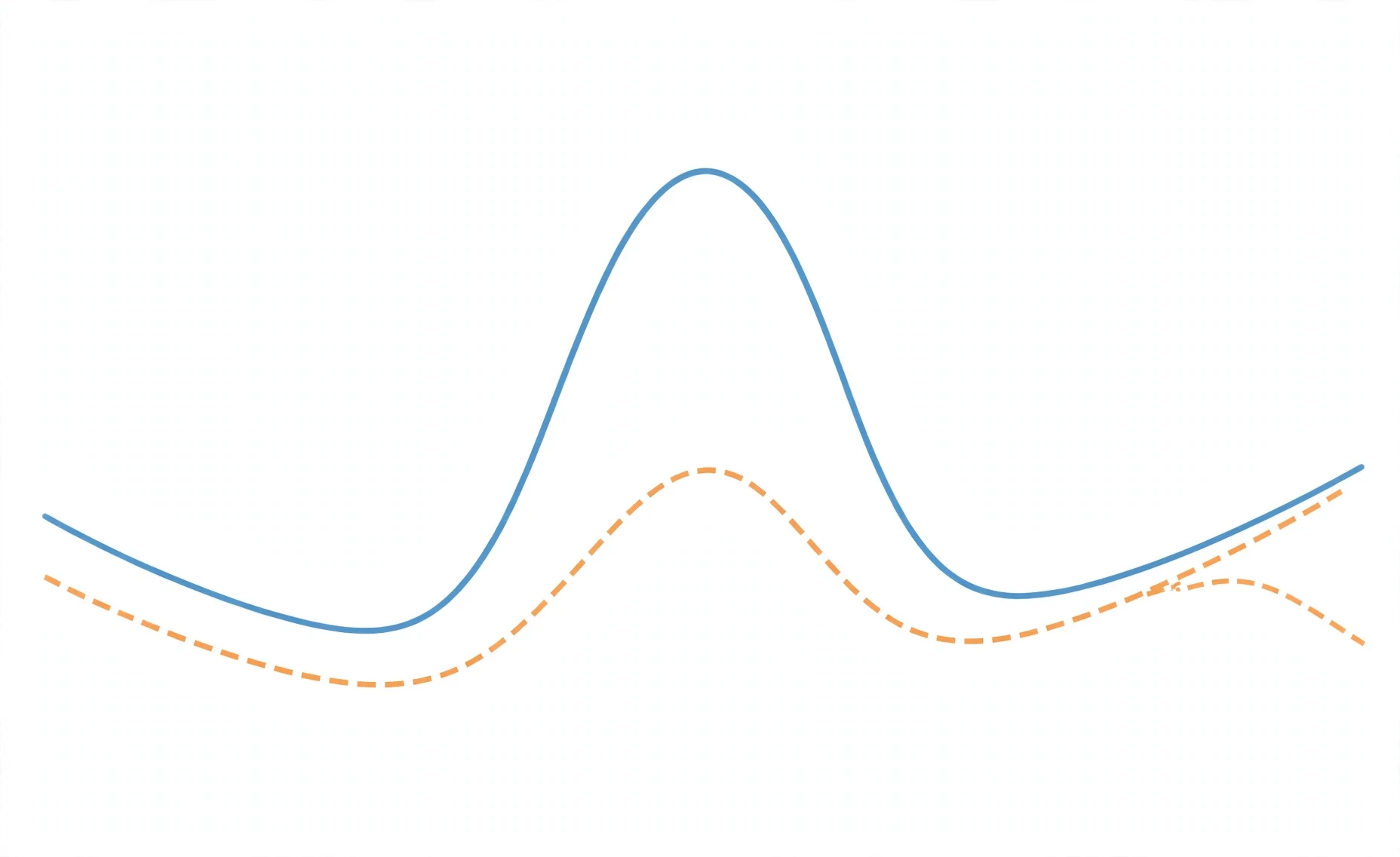
A common mistake is to think of activation energy as energy the reaction "uses up" — as if it were a toll paid and gone. It is not. The energy borrowed to climb the barrier is returned as the new bonds form on the way down. In an exothermic reaction, the products sit lower than the reactants, so the reaction releases net energy once it gets going. In an endothermic reaction, the products sit higher, so the reaction absorbs net energy overall. In both cases, the barrier has to be crossed, and the height of the barrier has nothing to do with whether the reaction releases or absorbs energy overall. A strongly exothermic reaction can still be very slow if its barrier is high — the hydrogen-oxygen mixture is the classic example — and a mildly endothermic reaction can be fast if its barrier is low. The energy accounts behind exothermic and endothermic reactions — enthalpy, entropy, and Gibbs free energy — are covered in Sciory's guide to thermochemistry.
I learned this the hard way in a teaching lab, years ago, when a student asked why a reaction that "gave out heat" still needed heating to start. I had the energy diagram on the board, and I pointed at the hill between the reactants and the products, and I watched the idea land: the heat released comes after the barrier, not before it. You have to invest energy to get energy back. That is why a match is needed to light a candle, even though the burning candle gives out far more heat than the match ever contained. The match pays the activation energy. The flame pays for itself after that.
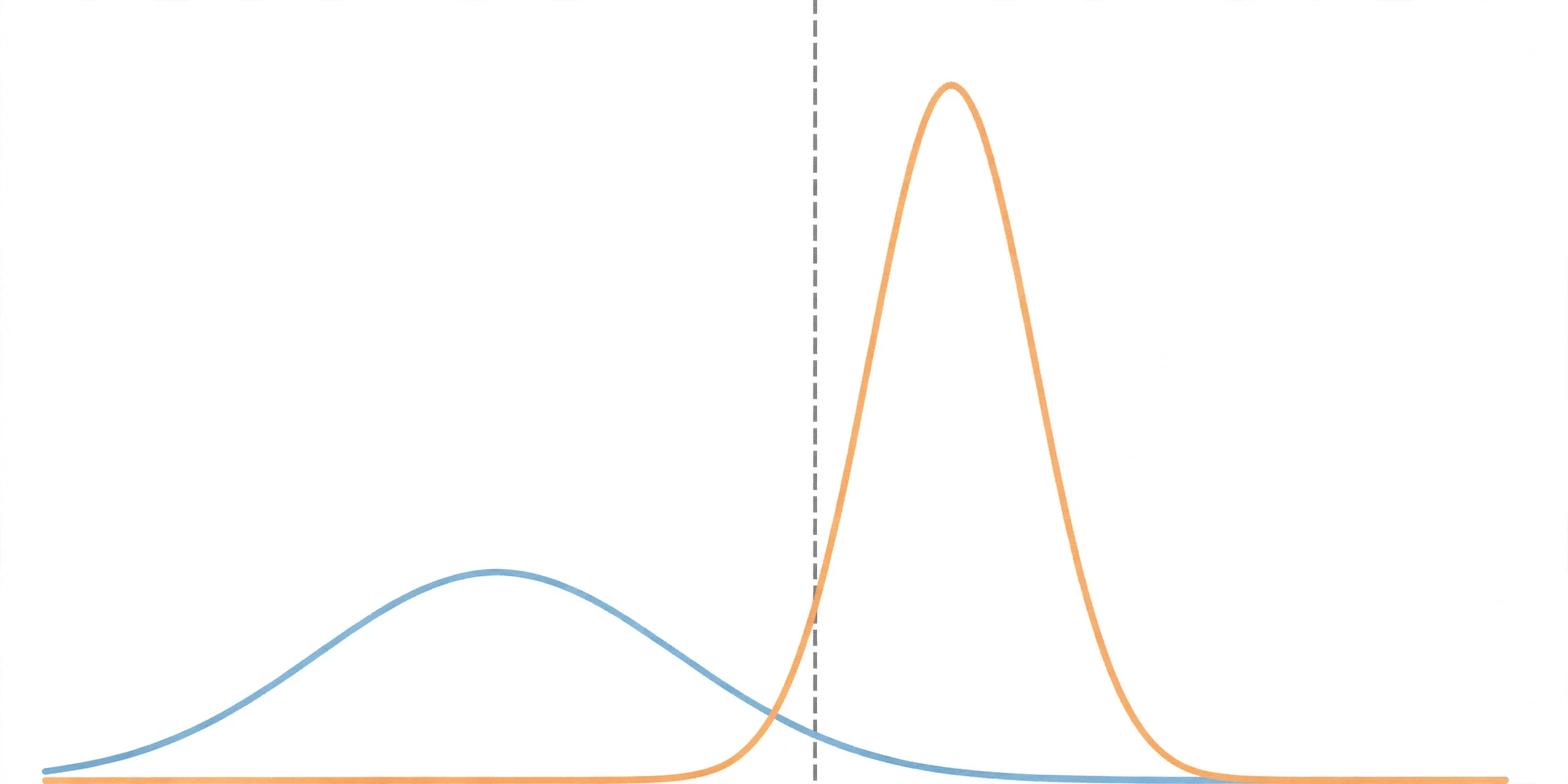
Activation energy also explains why the fraction of successful collisions is so small. Molecular energies at a given temperature are spread out — some molecules move slowly, some quickly, most somewhere in between. The shape of that spread is described by the Maxwell–Boltzmann distribution, which we will meet properly in section 6. Only the molecules in the fast tail of the distribution carry enough energy to clear the barrier. For a reaction with a large activation energy, that tail is vanishingly thin at room temperature, and the reaction crawls. Raise the temperature, and the whole distribution shifts and spreads, and the fast tail fattens dramatically — which is why a modest temperature rise can double or triple a rate.
The barrier is the whole story of chemical kinetics in miniature. Everything that changes a reaction rate — heat, concentration, a catalyst, a bigger surface — works by changing how many molecules get over the barrier, or by lowering the barrier itself.
4. What Affects the Rate of a Reaction?
Six factors set the pace: concentration, temperature, surface area, a catalyst, the nature of the reactants, and light. Each works through collision theory — by changing how often molecules meet, how hard they hit, or how high the barrier is.
Ask a chemist what affects the rate of a reaction, and the answer comes back as a short list that has been confirmed thousands of times in laboratories, kitchens, and factories: the concentration of the reactants, the temperature, the surface area of any solids, the presence of a catalyst, the nature of the reactants themselves, and, for some reactions, light. Each of these works through collision theory. Concentration changes how often molecules meet. Temperature changes how hard they hit and how many clear the barrier. Surface area changes how many molecules are exposed and able to collide. A catalyst changes the barrier itself. Light, for photochemical reactions, supplies energy directly. That is the whole list, and the rest of this article is an exploration of each lever in turn.
The table below summarises the six factors and the mechanism behind each. Keep it in mind as you read the detailed sections that follow — every example in this article traces back to one of these rows.
Factor | What changes | Why the rate changes |
|---|---|---|
Concentration (or pressure for gases) | More reactant particles in the same volume | More frequent collisions, so more successful collisions per second |
Temperature | Particles move faster; energy spread widens | More collisions, and a much larger fraction above the activation energy |
Surface area | More of a solid exposed to the other reactants | More collision sites available at the surface |
Catalyst | A new reaction pathway opens | Lower activation energy, so more collisions succeed |
Nature of reactants | Bond strengths, size, and structure differ | Strong bonds and awkward shapes raise the barrier or cut successful orientations |
Light | Photons supply energy directly | Light can break bonds and start reactions that heat alone cannot |
Notice what is not on the list: the amount of product already made does not speed a reaction up, stirring does not change the rate of a reaction that is already well mixed, and adding more of a reactant that is not involved in the slow step may do nothing at all. That last point surprises people, and it is the key to understanding rate equations in section 7. The factors above are the levers — but which lever matters, and how much, depends on the mechanism of the particular reaction.
Before moving on, it is worth saying plainly what chemical kinetics cannot tell you. It cannot tell you whether a reaction will happen at all — that is the job of thermodynamics, which compares the energies of reactants and products. It cannot tell you the mechanism on its own — the mechanism is inferred from rate data, not read off it. And it cannot be guessed from the balanced equation. The balanced equation tells you the overall change, not the route. Two reactions with similar-looking equations can have wildly different rates and completely different mechanisms. That is why chemists measure rates instead of guessing them.
5. Concentration and Pressure: Crowding the Room
Concentration is the most intuitive lever in chemical kinetics. Put more reactant particles into the same volume, and they collide more often. More collisions per second means more successful collisions per second, and the reaction runs faster.
Dilute the mixture, and the particles meet rarely, and the reaction crawls. The analogy writes itself: a crowded dance floor produces more encounters than an empty one. What the analogy misses is how precise the relationship can be — and how often it is not the simple doubling you might expect.
For gases, pressure plays the same role as concentration. Squeeze a gas into a smaller volume and its particles are forced closer together; the concentration rises, collisions multiply, and the rate climbs. This is one reason industrial reactors often run at high pressure, and why a reaction in a sealed vessel can behave differently from the same reaction in an open flask. It is also why the lungs work as they do: oxygen moves from air into blood partly because the concentration of oxygen in the air is higher than in the blood, driving the flow down the gradient.
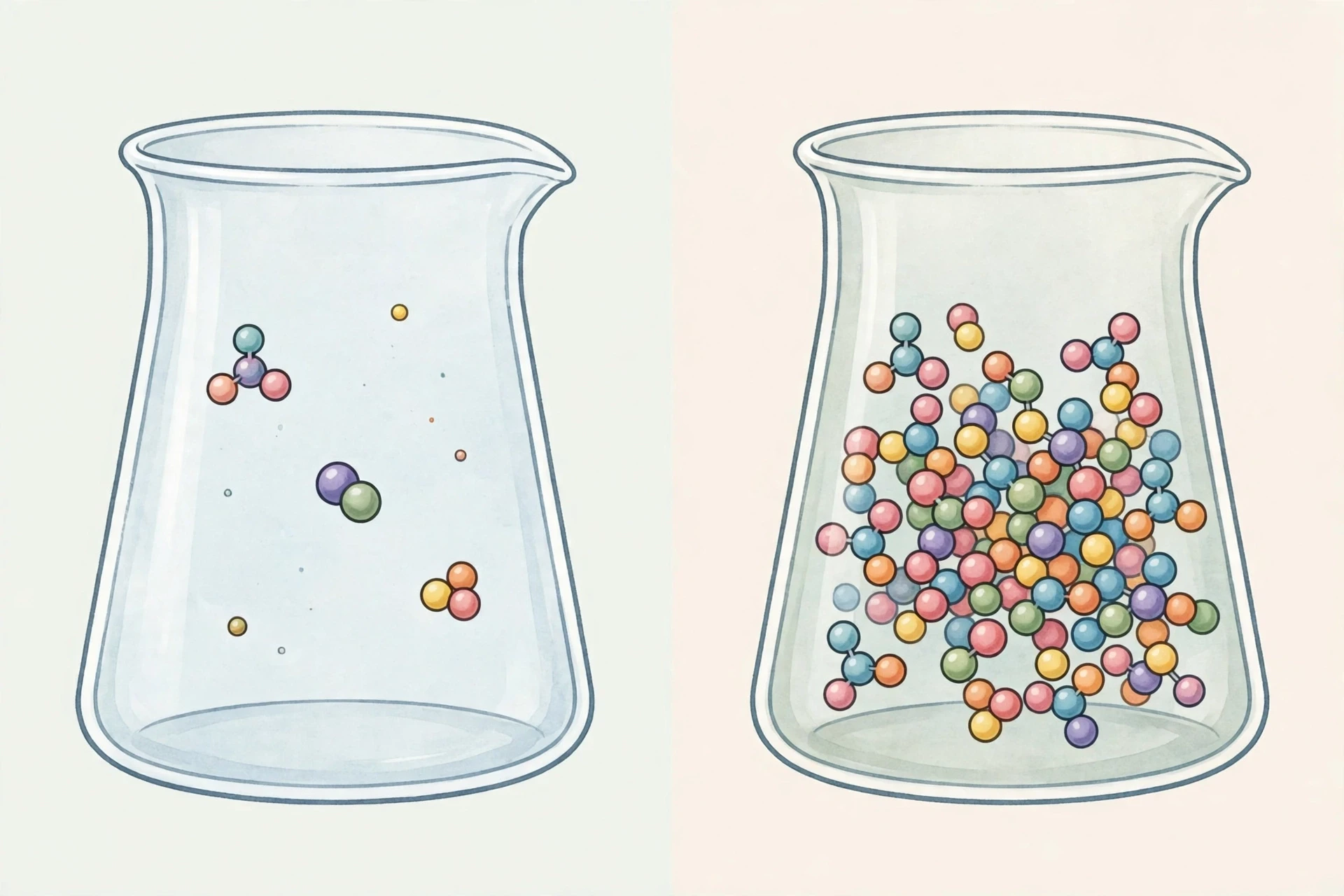
But here is where beginners get caught out. Doubling the concentration does not always double the rate. Sometimes it quadruples it. Sometimes it does nothing at all. The reason is that the effect of concentration depends on the reaction's mechanism — specifically, on whether the molecule you added takes part in the slowest step of the reaction. If the slow step involves two molecules of a reactant, doubling its concentration makes that step happen four times as often, because the chance of two of them meeting rises with the square of the concentration. If the slow step does not involve that reactant at all, changing its concentration changes nothing. This is not a flaw in the theory. It is a clue. Chemists use exactly this behaviour to work out what the slow step must be, as section 7 explains.
I once watched a student dilute a reaction mixture to "slow it down a bit" for easier timing, and then look baffled when the rate barely changed. The reactant they diluted was not in the slow step at all — it was consumed in a fast step afterward. Diluting it changed the colour of the solution and nothing else. It was a frustrating afternoon for them, and a perfect lesson for everyone watching: concentration matters, but only where the mechanism says it matters.
There is a second subtlety. At very high concentrations, the simple picture can break down. Molecules get in each other's way, the solution becomes viscous, and the rate may stop rising in proportion to concentration. In gases at high pressure, molecules spend so much time close together that the idea of separate, clean collisions starts to blur. These are edge cases for an introductory article, but they are worth knowing about, because they are a reminder that the rules of chemical kinetics are summaries of molecular behaviour, not laws carved in stone. They hold beautifully across the range chemists usually work in, and they bend at the extremes.
For reactions involving a solid and a liquid or gas, the related lever is surface area. Only the atoms on the surface of a solid can collide with the other reactant; the atoms buried inside are unreachable. Grind a solid into a fine powder, and you expose far more surface, and the reaction speeds up dramatically. This is why coal dust can explode while a lump of coal burns slowly, why powdered metals react violently with acids while a solid bar barely fizzes, and why pharmaceutical tablets are designed to dissolve at a controlled rate — the surface area of the particles sets the pace at which the drug enters the body. A sugar cube and a spoonful of granulated sugar are the same chemical in the same cup of tea, and the granulated sugar wins the race every time.
6. Temperature: The Lever That Changes Everything
If concentration changes how often molecules meet, temperature changes how hard they hit — and that turns out to matter far more. Raise the temperature of a reaction by 10 degrees Celsius, and the rate roughly doubles for many reactions near room temperature.
Raise it by 50 degrees, and the rate can climb by a factor of thirty or more. No other lever is so powerful, and the reason lies in the shape of the energy distribution of the molecules.
At any temperature, molecular energies are not all the same. They are spread out in a lopsided curve called the Maxwell–Boltzmann distribution: most molecules have middling energy, a few are slow, and a thin tail stretches out toward high energy. Only the molecules in that fast tail carry enough energy to clear the activation energy barrier. When you heat a mixture, two things happen. The molecules move faster on average, so they collide more often — but that effect is modest, worth perhaps a few percent for a 10-degree rise. The big effect is on the tail: the whole distribution shifts to higher energies and spreads out, and the fraction of molecules above the barrier grows enormously. A small shift in the curve can double or triple the area beyond the barrier. That is the secret behind the rule of thumb that a 10-degree rise doubles the rate.
The kitchen is full of this effect, and I learned it there before I learned it in a laboratory. Bread dough rises in an hour on a warm countertop and takes all night in the fridge. The yeast is doing the same chemistry in both places; the cold simply starves it of energetic collisions. Milk sours faster on a summer afternoon than in a cold refrigerator for the same reason. A pressure cooker works by raising the boiling point of water, letting food cook at a higher temperature — and therefore at a much faster reaction rate — than an open pot ever could. Every recipe that says "simmer gently" or "chill overnight" is an instruction in chemical kinetics, written by cooks who never used the term.
Industry leans on the same lever, with higher stakes. Chemical plants run reactors hot because heat is the cheapest way to make reactions fast, but heat is also dangerous: a reaction that releases heat can warm itself, which speeds it up, which releases more heat, which speeds it up further. This runaway feedback is called thermal runaway, and preventing it is one of the central jobs of chemical engineering. Cooling jackets, slow addition of reactants, and careful temperature monitoring exist precisely because temperature is such a powerful lever. A reaction that is calm at 40 degrees can be violent at 80.
There is a quantitative way to describe temperature's effect, and it is one of the most famous equations in chemistry: the Arrhenius equation. It relates the rate constant k to the temperature T, the activation energy Ea, and a pre-exponential factor A. OpenStax Chemistry describes A as "a constant called the frequency factor, which is related to the frequency of collisions and the orientation of the reacting molecules." Written out, it is k = A × e^(−Ea/RT), where R is the gas constant. The important part is the exponent: because the activation energy sits inside an exponential, small changes in temperature or activation energy produce large changes in the rate. Plot the logarithm of k against 1/T, and you get a straight line whose slope is −Ea/R, from which the activation energy is calculated — a trick that lets chemists measure activation energies with nothing more than a thermometer, a stopwatch, and a series of rate measurements at different temperatures. Svante Arrhenius proposed this relationship in the late nineteenth century, working from the data available to him, and it has held up across more than a century of experiments. When a modern chemist measures an activation energy, they are still, in essence, doing what Arrhenius did.
Heat does not push molecules over the barrier. It gives more of them the energy to climb it themselves. That distinction is the difference between forcing a reaction and letting it happen faster.
One more temperature effect deserves a mention, because it confuses students: heating a reaction usually speeds it up, but it can also change where the reaction ends up. For a reversible reaction, temperature shifts the equilibrium as well as the rate, and the two effects can pull in opposite directions. A reaction that goes faster when hot may also go less far when hot, if it is exothermic. Chemists who design industrial processes have to balance the two — hot enough to be fast, cool enough to get a good yield — and the compromise temperature they choose is one of the quiet triumphs of applied chemical kinetics.
7. What Is a Rate Equation?
A rate equation states how the rate depends on reactant concentrations: rate = k[A]^m[B]^n, where k is the rate constant and m and n are the measured orders. The orders cannot be guessed from the balanced equation — they must be measured.
A rate equation, also called a rate law, is a mathematical statement of how the rate of a reaction depends on the concentrations of the reactants. For a reaction involving reactants A and B, it often takes the form rate = k[A]^m[B]^n, where square brackets mean concentration, k is the rate constant, and m and n are the orders of the reaction with respect to A and B. The rate constant k is a number that captures everything about the reaction at a given temperature — the activation energy, the collision frequency, the orientation requirements — folded into a single value. Change the temperature, and k changes. Change the catalyst, and k changes. But at fixed temperature and catalyst, k is constant, and the rate equation tells you exactly how the rate will respond to concentration changes.
The orders m and n are the interesting part, because they cannot be guessed from the balanced equation. They have to be measured. A reaction might be first order in A, meaning the rate doubles when [A] doubles; second order in A, meaning the rate quadruples; or zero order in A, meaning the rate does not change at all when [A] changes. The overall order is the sum of the individual orders. This is where chemical kinetics turns from description into detective work, because the orders are fingerprints of the mechanism.
Consider a simple example that appears in textbooks around the world: the decomposition of hydrogen peroxide into water and oxygen, a reaction that runs slowly on its own and much faster with a catalyst. Experimentally, the rate is first order in hydrogen peroxide: rate = k[H₂O₂]. Double the peroxide concentration, and the rate doubles. That tells chemists that one peroxide molecule is involved in the slow step. Now consider a different case: the reaction between nitrogen dioxide and carbon monoxide, studied in detail by generations of physical chemists. The measured rate law is rate = k[NO₂]² — second order in nitrogen dioxide, zero order in carbon monoxide. Doubling the carbon monoxide does nothing, even though the balanced equation shows it as a reactant. The conclusion is unavoidable: carbon monoxide is not involved in the slow step. The mechanism must involve two nitrogen dioxide molecules colliding first, with carbon monoxide joining in a later, faster step. The balanced equation never could have told you that. Only the rate law could.
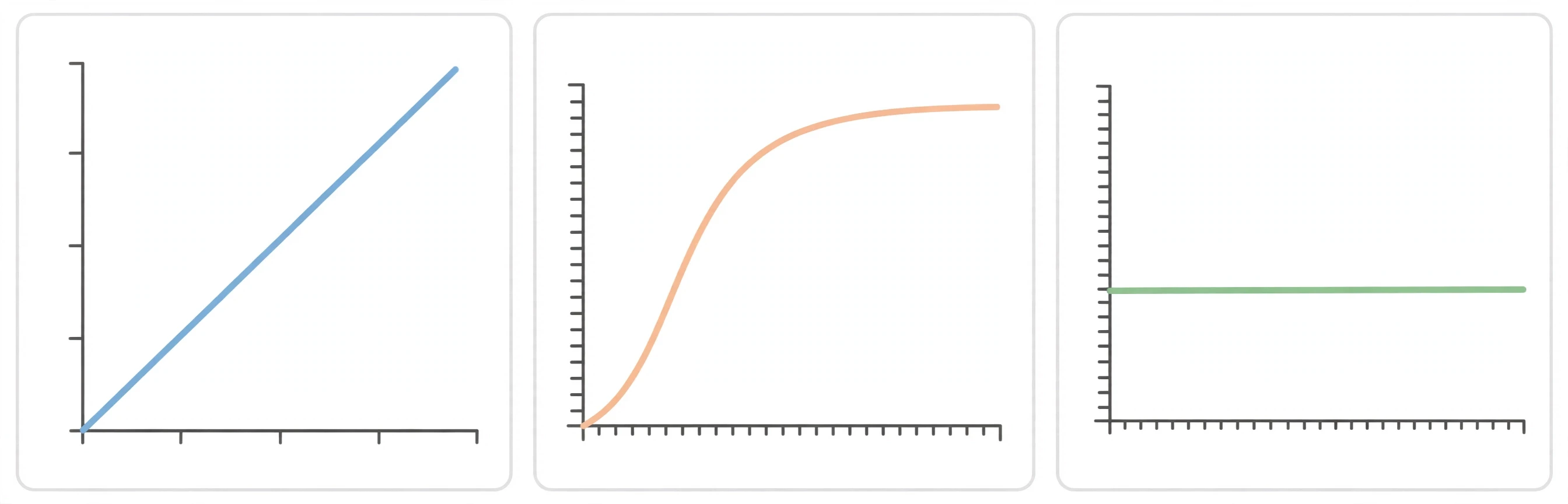
How do chemists measure orders in practice? The standard method is the method of initial rates: run the reaction several times, changing one concentration at a time while holding the others fixed, and measure the initial rate each time. If doubling [A] doubles the rate, the reaction is first order in A. If doubling [A] quadruples it, second order. If nothing changes, zero order. It is simple in principle and fiddly in practice, because initial rates have to be measured before concentrations change much, and that means working fast and carefully. I remember a lab session where my own initial-rate measurements were so noisy that the order came out as 1.4 — a number that means nothing, since orders are usually whole numbers or simple fractions. The fault was not in the chemistry. It was in my timing, my pipetting, and my impatience. The second run, done slowly and carefully, gave a clean first order. The chemistry had been right all along; the chemist needed practice.
Orders also connect to a deeper idea: the rate-determining step. Most reactions do not happen in a single collision. They happen in a sequence of elementary steps, and the slowest step sets the pace for the whole reaction, like the slowest walker setting the pace of a group hike. The other steps can be as fast as they like — the group cannot go faster than its slowest member. The rate law reflects the slow step and only the slow step, which is why reactants that appear only in fast steps do not show up in the rate law at all. When chemists propose a mechanism, the test is whether the mechanism predicts the measured rate law. If it does not, the mechanism is wrong, no matter how elegant it looks on paper.
There is one more quantity tied to rate equations that deserves attention: half-life. For a first-order reaction, the half-life — the time for the concentration to fall to half its value — is constant, no matter what the starting concentration is. It depends only on k. This is why first-order decay is so useful: radioactive decay, the breakdown of many drugs in the body, and the decomposition of some pollutants all follow first-order kinetics, and their half-lives are fixed properties you can look up and rely on. For other orders, the half-life changes as the reaction proceeds. The constancy of the first-order half-life is a direct consequence of the rate law, and it is one of the most practical results in all of chemical kinetics.
8. How Does a Catalyst Speed Up a Reaction?
A catalyst is a substance that speeds up a reaction without being consumed by it. It does this by providing an alternative pathway with a lower activation energy — a different route over the mountain, with a lower pass.
The reactants still start at the same energy and the products still end at the same energy, so the overall energy change is untouched. Only the barrier is lower, and because the rate depends exponentially on the barrier height, even a modest reduction can speed a reaction by orders of magnitude. The catalyst itself comes out of the reaction unchanged, ready to help the next set of molecules. That is the definition, and it is worth memorising, because almost every misunderstanding about catalysts comes from forgetting one of its parts.
There are two broad kinds. A homogeneous catalyst is in the same phase as the reactants — dissolved in the same solution, for instance. An acid catalysing a reaction in water is a homogeneous catalyst. A heterogeneous catalyst is in a different phase, usually a solid whose surface the reactants meet. The catalytic converter in a car's exhaust is a heterogeneous catalyst: exhaust gases flow over a solid surface coated with metals such as platinum and palladium, and harmful gases are converted to less harmful ones on that surface. The Haber process, which makes ammonia for fertiliser by combining nitrogen and hydrogen, uses an iron-based heterogeneous catalyst at high temperature and pressure; without it, the reaction would be far too slow to be useful, and modern agriculture would look very different. Sciory's guide to how catalysts work follows the catalyst story in full, from the catalytic converter to the enzymes in your cells.
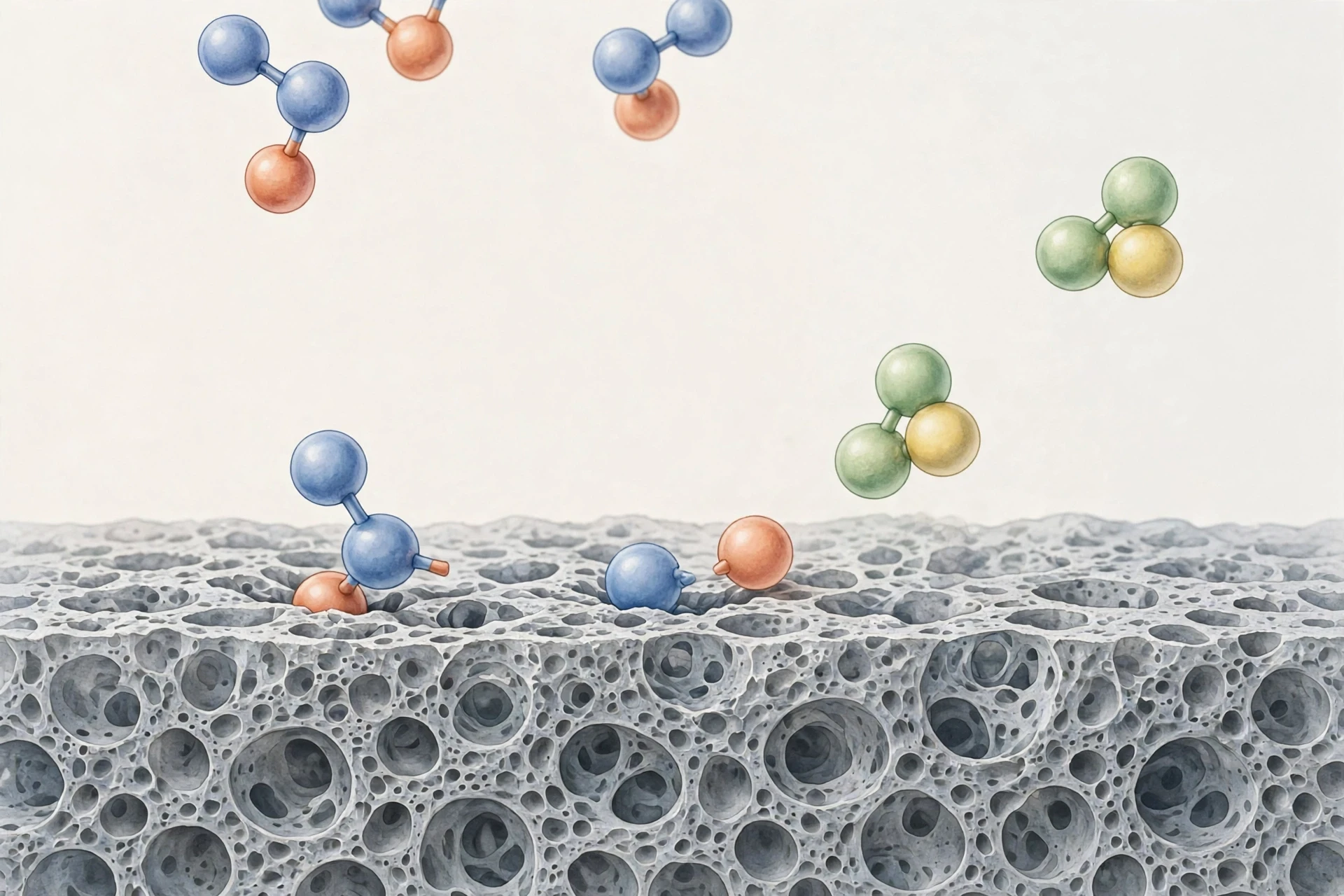
The mechanism is different in each case, but the principle is the same. On a solid catalyst surface, reactant molecules adsorb — they stick to the surface — and the surface weakens their bonds, holding the molecules in the right orientation for reaction. The molecules react, the products desorb, and the surface is free again. In a homogeneous catalyst, the catalyst typically forms a temporary intermediate with a reactant, a compound that reacts more easily than the original, and the catalyst is released at the end. Either way, the catalyst participates and is regenerated. It is not a magic ingredient sprinkled on top. It is a participant that takes a round trip and comes home unchanged.
This leads to the most persistent misconception about catalysts, and it is worth correcting firmly: a catalyst does not make a reaction go further, and it cannot make an impossible reaction happen. Because it lowers the barrier for the forward reaction and the reverse reaction by the same amount, it speeds up both directions equally. A catalysed reaction reaches equilibrium faster, but it reaches the same equilibrium. A catalyst cannot change the thermodynamics — the energy difference between reactants and products — any more than a shortcut can change the distance between two towns as the crow flies. It changes the route, not the destination. Anyone who tells you a catalyst "pushes a reaction to completion" is describing something a catalyst cannot do.
Catalysts can also be poisoned. Certain substances stick to a catalyst surface so strongly that they block the active sites, and the catalyst stops working. Lead once poisoned car catalytic converters, which is one reason leaded petrol was phased out. Sulphur compounds can poison industrial catalysts. This is not a minor detail — catalyst poisoning is a major industrial problem, and protecting catalysts from poisons is a large part of chemical engineering. It is also a reminder that a catalyst's power comes from its surface, and anything that occupies that surface takes the power away.
The scale of catalysis in the modern world is hard to overstate. The great majority of industrial chemical processes use catalysts, from making plastics and fuels to producing medicines and fertilisers. Without catalysts, many of these processes would need temperatures and pressures so extreme that they would be uneconomic or dangerous. The development of better catalysts — more selective, more durable, working at lower temperatures — is one of the most active areas of chemistry research, and it matters for the climate as well as for the economy: a catalyst that lets a process run cooler saves energy, and a catalyst that avoids a wasteful side reaction saves raw materials.
9. Enzymes: Nature's Catalysts
Living things run on catalysts too, and theirs are called enzymes. An enzyme is a protein — a large, folded molecule — with a pocket called the active site, shaped to fit a particular reactant, called the substrate.
The substrate slots into the active site, the enzyme strains its bonds and holds it in exactly the right orientation, the reaction happens, and the products are released. The enzyme is unchanged, ready for the next substrate molecule. A single enzyme molecule can catalyse thousands of reactions per second, and it does so at body temperature, in water, without the heat and pressure that industrial catalysts often need.
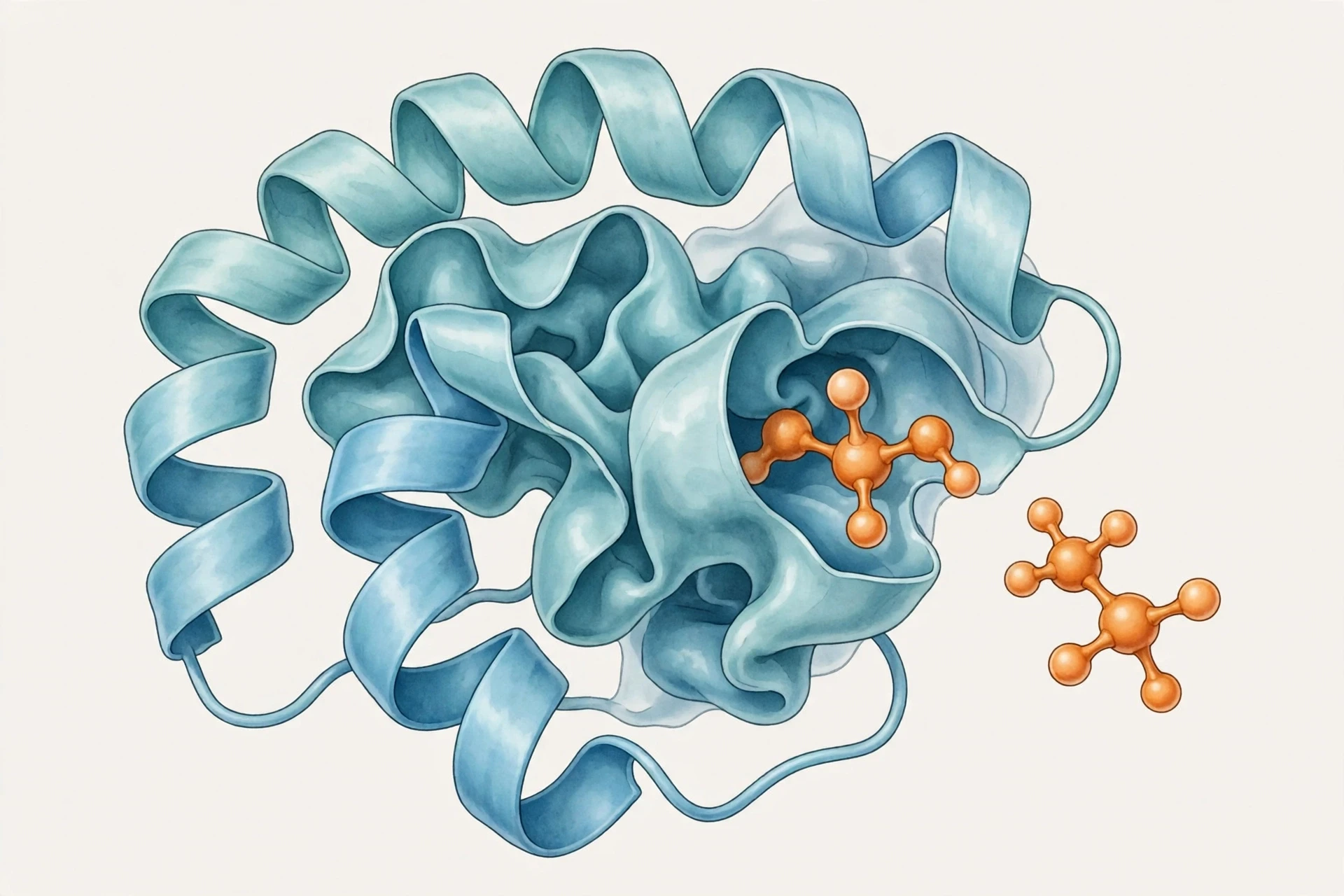
Enzymes are astonishingly selective. Most enzymes catalyse one reaction, or a small family of closely related reactions, and ignore everything else in the crowded cell. This selectivity comes from the shape of the active site: only a substrate with the right shape and chemistry fits. The classic image is a lock and key, and while modern biochemistry has refined it — the enzyme flexes and moulds itself around the substrate, a process called induced fit — the basic idea holds. Shape matters. A molecule that is almost right but not quite will not fit, and the reaction will not happen.
Enzymes are also sensitive, and that sensitivity is a matter of life and death. Most enzymes work best near body temperature and near neutral pH. Heat them too much, and the protein unfolds — it denatures — and the active site loses its shape. The enzyme stops working, and it usually cannot be repaired. This is why a high fever is dangerous, why cooking changes food irreversibly, and why an egg white turns from clear liquid to solid white when heated: the proteins are denaturing. Strong acids and bases do the same. The cell keeps its enzymes in a narrow, comfortable range because outside that range, the chemistry of life falls apart.
Enzymes are also the targets of many medicines. A drug that blocks an enzyme can slow a harmful process: some blood pressure medicines block the enzyme that makes a vessel-tightening hormone, some antibiotics block enzymes that bacteria need to build their cell walls, and some cancer drugs block enzymes that drive uncontrolled growth. Understanding the rate at which an enzyme works — enzyme kinetics, a branch of chemical kinetics in its own right — is therefore not just academic. It is how doses are set, how drug interactions are predicted, and how new medicines are designed. The Michaelis–Menten equation, which describes how enzyme rate depends on substrate concentration, is one of the most used equations in biochemistry, and it is a rate equation of exactly the kind described in section 7, adapted to the special case of a catalyst that can be saturated.
10. Measuring Rates in the Laboratory
Rates are measured by tracking something that changes — colour, gas volume, pressure, pH — against time. The slope of the resulting curve is the rate, and the slope at the very start is the initial rate.
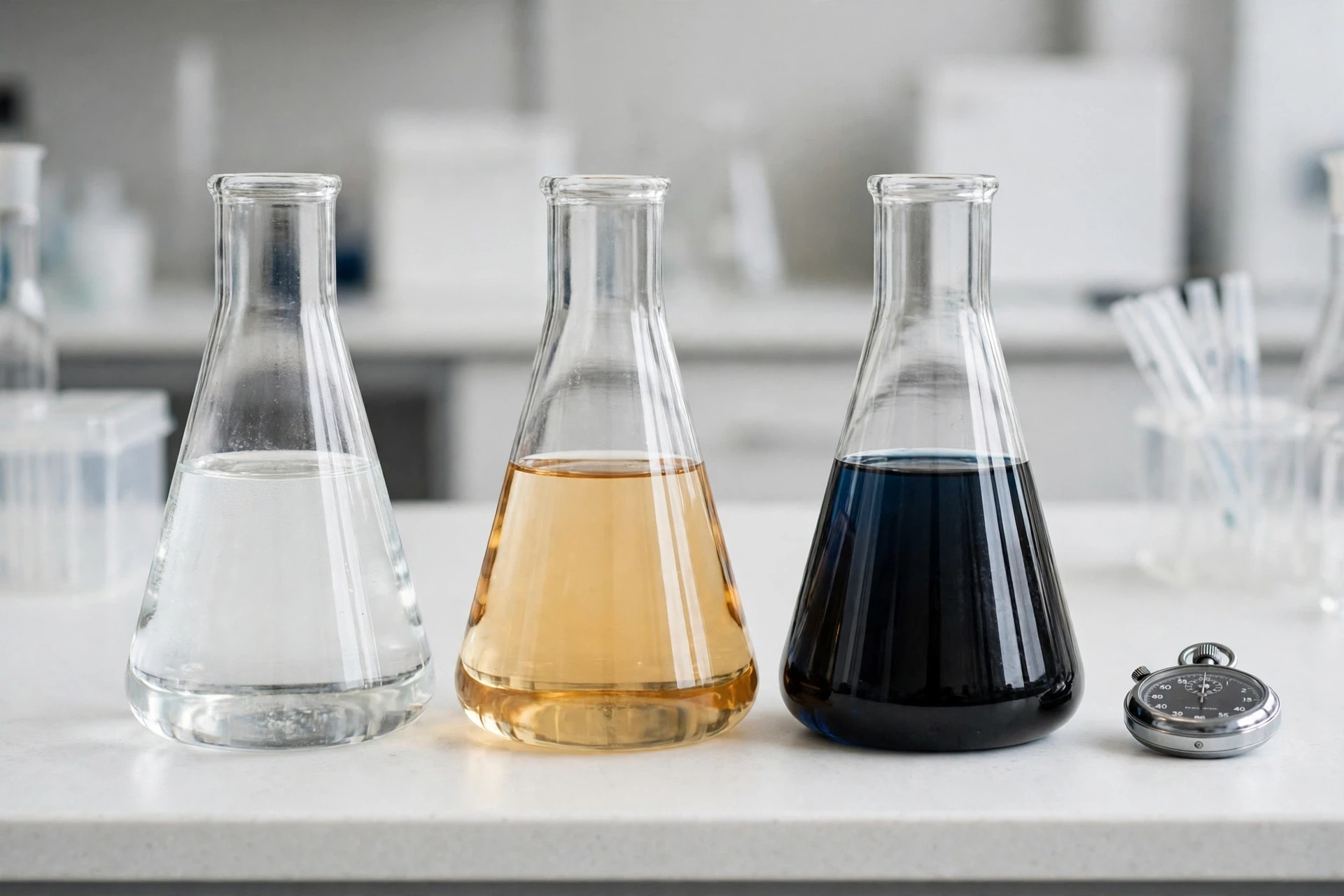
All of this theory rests on measurement, and measuring a reaction rate is a practical craft with its own pleasures and pitfalls. The classic school experiment is the iodine clock reaction, and it is worth describing, because it is how many chemists first meet chemical kinetics in person. Two colourless solutions are mixed, and nothing seems to happen — and then, after a delay that can be timed with a stopwatch, the mixture suddenly turns deep blue-black. The delay is the reaction time, and by changing the concentration of one reactant and timing the delay again, students can work out the order of the reaction. It is the same hidden countdown I watched in my first encounter with the reaction, and it never quite loses its drama: a solution that looks idle is busy the whole time.
Real laboratories use more precise tools. A spectrophotometer shines light through a reacting solution and measures how much is absorbed, tracking a colour change continuously. A gas syringe or pressure sensor follows a gas being produced. A conductivity meter follows ions appearing or disappearing. A pH meter follows acidity. In each case the raw data is the same shape: a measurement plotted against time, giving a curve that starts steep and flattens as the reactants run out. The slope of that curve at any point is the rate at that moment, and the slope at the very start is the initial rate. Draw a tangent to the curve, measure its gradient, and you have the rate. Do it at several starting concentrations, and you have the data for a rate law.
There are traps, and every chemist learns them by falling into them at least once. Temperature must be held constant, because a drift of a few degrees changes the rate enough to ruin the data — which is why rate experiments are often done in a water bath. Mixing must be quick and complete, because the clock starts when the reactants meet, not when you finish pouring. The measurement itself must not disturb the reaction: shining a bright light on a light-sensitive reaction to watch it is a good way to change it. And the reaction must be timed from a defined zero, not from "about when I started". I once spent an afternoon chasing a rate constant that drifted from run to run, and the cause turned out to be the draught from a window cooling one side of the water bath. The chemistry was fine. The laboratory was not.
A rate measurement is only as good as the control of the conditions. The reaction does not care about your stopwatch; it cares about temperature, concentration, and mixing — and it will answer exactly the conditions you gave it, not the ones you meant to give it.
Modern kinetics goes further still. With lasers and fast detectors, chemists can follow reactions that finish in billionths of a second, watching bonds break and form in real time. Flash photolysis — firing a laser pulse to start a reaction and watching it with a second pulse — lets researchers study species that exist for microseconds. At the other extreme, geochemists study reactions that take thousands of years, using the record left in rocks and ice. The tools differ by a factor of a trillion in timescale, but the logic is the same: measure something that changes, plot it against time, and read the rate from the curve.
11. Common Misconceptions About Reaction Rates
Most people assume that a reaction's speed can be read off its balanced equation. It cannot. The balanced equation is a bookkeeping summary of the overall change; the rate law is a report from the slow step. They answer different questions, and confusing them is the single most common error in chemical kinetics.
The balanced equation for the reaction between hydrogen and bromine looks simple, yet the measured rate law is complicated, involving the concentrations of several species in a fraction.
A second misconception is that catalysts are used up, or that you need to keep adding them. You do not. A catalyst is regenerated in every cycle. What does get used up is a reactant — and in some industrial processes, the catalyst slowly degrades or gets poisoned, so it eventually needs replacing. But that is damage, not consumption by the reaction. A healthy catalyst does the same job, cycle after cycle, for as long as its surface stays clean.
A third misconception is that increasing the temperature always helps. It speeds the reaction up, yes — but for a reversible exothermic reaction, it also shifts the equilibrium toward the reactants, so you can end up making less product, faster. Industrial chemists live with this trade-off every day, and the temperatures they choose are compromises, not maxima. Hotter is faster, but faster is not always better.
A fourth misconception is that all collisions lead to reactions, or that a reaction happens the moment two reactant molecules touch. As section 2 showed, most collisions do nothing. Energy and orientation both matter, and the fraction of successful collisions is often tiny. A reaction mixture is not a crowd of molecules all reacting at once. It is a crowd in which, at any instant, only a rare few are doing anything at all — and that rarity is exactly what the rate measures.
A fifth misconception is subtler: that the rate of a reaction stays constant until the reactants run out. It does not, except in the special case of zero-order reactions. For most reactions, the rate falls continuously as reactants are consumed, and the progress curve bends over and flattens. Anyone who has watched bread rise knows this intuitively: the dough surges at first and then slows, because the yeast is running out of sugars to ferment. The curve flattens for the same reason in a flask and in a kitchen.
Finally, there is the idea that chemical kinetics is only about fast reactions — explosions and flashes. Some of the most important kinetics in the world is slow: the rusting of bridges, the weathering of stone, the breakdown of plastics in the sea, the decay of medicines on a shelf. Shelf life is a kinetics question. Corrosion is a kinetics question. The carbon cycle is, in part, a kinetics question. Slow reactions shape the world just as surely as fast ones do, and often more so, because they have time to act.
12. Why Reaction Rates Matter
Reaction rates decide drug doses, food shelf life, how long pollutants persist, how fast factories run, and whether a cell stays alive. This section follows the rate through five places it matters: medicine, food, the environment, industry, and the living cell.
The practical reach of chemical kinetics is enormous, because almost every process that makes, breaks, or preserves things is a race against time. In medicine, the rate at which a drug is broken down in the body — its pharmacokinetics — decides the dose and the interval between doses. A drug that is cleared too quickly never reaches an effective level; one cleared too slowly accumulates to toxic levels. Drug designers tune molecular structures to adjust these rates, and the half-life of a drug in the bloodstream is a number doctors rely on every day.
In food science, kinetics decides shelf life. The browning of an apple slice, the souring of milk, the staling of bread, the loss of vitamins in stored vegetables — all are reactions with measurable rates, and all slow down in the cold. Refrigeration is applied chemical kinetics. So is canning, which uses heat to destroy the micro-organisms that would otherwise spoil food, and so is the use of preservatives, which slow the reactions that cause spoilage. When a label says "best before", it is reporting a kinetics prediction.
In the environment, kinetics governs how long pollutants last. A chemical spilled into a river does not vanish when it is diluted; it decays at a rate set by its chemistry, sunlight, and the microbes present. Some pollutants break down in days. Others persist for decades, because their reactions are slow. Climate models depend on the rates of reactions in the atmosphere — the breakdown of methane, the formation of ozone, the uptake of carbon dioxide by the oceans — and small errors in those rates compound into large errors in prediction. The atmosphere is a giant, sunlit reaction vessel, and chemical kinetics is one of the tools that lets us understand it.
In industry, the stakes are money and safety. A process that runs twice as fast can halve the size of the reactor needed, or double the output of the plant. A process that runs away can destroy the plant. Chemical engineers spend their careers balancing rate against yield, temperature against safety, and catalyst cost against lifetime. The Haber process for ammonia, the Contact process for sulphuric acid, the cracking of crude oil into petrol — these are all exercises in applied chemical kinetics, and they underpin the modern world in ways that are easy to overlook precisely because they work so reliably.
And in the living world, kinetics is the difference between life and non-life. The reactions of metabolism run at useful speeds only because enzymes catalyse them. Without enzymes, the reactions that keep a cell alive would take years instead of milliseconds, and life as we know it would be impossible. The cell is a masterclass in rate control: enzymes switched on and off, pathways sped up or slowed down by feedback, all tuned so that the right reactions happen at the right speed at the right time. When that control fails, disease follows — which is why so many medicines are, at heart, tools for adjusting a reaction rate.
13. Putting It All Together
Chemical kinetics is the study of a simple question with deep answers: how fast, and why. A reaction's rate is set by how often molecules collide, how hard they hit, how many carry enough energy to clear the activation barrier, and whether a catalyst offers a lower path over it. Concentration crowds the room. Temperature fattens the energetic tail. Surface area opens more doors. A catalyst lowers the pass. And the rate equation, measured carefully from initial rates, turns all of that into numbers — orders, rate constants, half-lives — that let chemists predict what will happen next, and how to change it.
The next time you put milk back in the fridge, watch bread rise, or see a flask change colour in a sudden flash, you are watching chemical kinetics at work. The molecules are colliding, a few are clearing the barrier, and the clock is running. The quiet seconds before the colour changes are not empty. They are the reaction, doing its work invisibly, one successful collision at a time.
Frequently Asked Questions
What affects the rate of a reaction?
Six factors affect the rate of a reaction: the concentration of the reactants (or pressure, for gases), the temperature, the surface area of any solids, the presence of a catalyst, the nature of the reactants themselves, and light for photochemical reactions. Concentration changes how often molecules collide, temperature changes how hard they collide and how many clear the activation energy barrier, surface area changes how many molecules are exposed, a catalyst lowers the barrier, and the nature of the reactants sets the barrier height and the orientation requirements. Which factor matters most depends on the reaction's mechanism.
What is activation energy?
Activation energy is the minimum energy that colliding molecules need before they can react, usually written Ea and measured in kilojoules per mole. It is the height of the energy barrier between reactants and products: molecules must climb over it before new bonds can form. Only the fraction of molecules with energy above Ea can react, which is why temperature has such a large effect on rate. A catalyst speeds up a reaction by providing a pathway with a lower activation energy, without changing the energies of the reactants or the products.
What is a rate equation?
A rate equation, or rate law, is a mathematical statement of how a reaction's rate depends on reactant concentrations, usually written as rate = k[A]^m[B]^n, where k is the rate constant and m and n are the orders with respect to A and B. The orders cannot be guessed from the balanced equation — they must be measured, usually by the method of initial rates — and they reveal which reactants take part in the slowest step of the reaction mechanism. The rate constant k captures everything about the reaction at a given temperature, and it changes with temperature according to the Arrhenius equation.
How does a catalyst speed up a reaction?
A catalyst speeds up a reaction by providing an alternative pathway with a lower activation energy, so a larger fraction of collisions succeed. It takes part in the reaction — for example by holding reactants on its surface or forming a temporary intermediate — and is regenerated unchanged at the end, ready to catalyse the next molecules. A catalyst does not change the overall energy change of the reaction, cannot make an impossible reaction happen, and does not change where equilibrium lies; it only helps the reaction reach equilibrium faster.
Why do reactions slow down as they proceed?
Most reactions slow down because the reactants are being used up: as their concentration falls, collisions become less frequent, and fewer successful collisions happen per second. The rate is steepest at the start and falls toward zero as the reaction approaches completion, which is why a reaction progress curve flattens over time. Zero-order reactions are the exception — their rate stays constant until the reactant is nearly gone. The falling rate is also why chemists measure initial rates, before concentrations have changed much, when they want clean data for a rate law.
Does a catalyst change the equilibrium of a reaction?
No. A catalyst lowers the activation energy for the forward reaction and the reverse reaction by the same amount, so it speeds up both directions equally. The reaction reaches equilibrium faster, but the equilibrium position — how much product versus reactant there is at the end — stays exactly the same. Changing the equilibrium requires changing the temperature, pressure, or concentrations, not adding a catalyst. This is one of the most commonly misunderstood points in chemical kinetics, and it follows directly from the fact that a catalyst changes the route, not the destination.
What is the difference between reaction order and molecularity?
Reaction order is an experimental quantity: it is the power to which a concentration is raised in the measured rate law, and it describes how the rate responds to that reactant. Molecularity is a theoretical quantity: it is the number of molecules that collide in a single elementary step of a proposed mechanism — one for unimolecular, two for bimolecular, three for termolecular. Order is measured; molecularity is proposed as part of a mechanism. For a single-step reaction the two can match, but for a multi-step reaction the overall order reflects only the slow step, and it may not match the molecularity of any individual step.
Sources
Chemical Reactions Explained: Types, Kinetics, and Everyday Examples — Sciory
Atoms and Molecules Explained: Structure, Bonding, and States of Matter — Sciory
Catalysts Explained: How Catalysts and Enzymes Speed Up Reactions — Sciory
Chemical Equilibrium Explained: Le Chatelier's Principle — Sciory
Thermochemistry Explained: Enthalpy, Entropy, and Gibbs Free Energy — Sciory