

I can still picture the dog. A scruffy brown terrier, I told my sister, who used to wait for us at the gate after school and bark at the postman with enormous seriousness. I could see his patch over one eye. I could hear the jingle of his collar. I was so sure of him that I argued about him for years — until my mother, laughing, showed me the family photo albums and pointed out the plain truth. We never had a dog. We had a neighbour's dog, briefly, for one summer. The rest — the gate, the barking, the patch — was a story I had built from borrowed pieces and then lived inside for decades.
That is what false memories are. They are not lies. They are not signs of a broken mind. They are memories that feel completely real — vivid, detailed, emotionally convincing — of things that never happened, or that happened very differently from the way we now remember them. And they happen to everyone, including people with excellent memories, including scientists who study memory for a living. I include myself in that list. The dog taught me that.
This article is about how those memories get made, and why they feel so trustworthy. It is not about how memories form in the first place. That story — encoding, the hippocampus, consolidation during sleep — belongs to our companion article, How the Human Brain Forms Memories. Here we pick up where that article leaves off: once a memory exists, how does it bend, blend, and sometimes invent itself entirely?
The answer matters far beyond family arguments. False memories shape courtroom verdicts, family estrangements, medical histories, and the stories whole societies tell about the past. Elizabeth Loftus, the psychologist whose work anchors this article, spent half a century showing that a single word in a question can change what a person remembers seeing. Her findings are unsettling. They are also, once you understand them, strangely reassuring: your memory is not a faulty machine. It is a creative one, doing exactly the job it evolved to do — just not the job you assumed it was doing.
1. What a False Memory Actually Is
1.1 A definition that clears away the confusion
A false memory is a recollection of an event that did not occur, or a recollection of a real event that has been substantially altered — in its details, its timing, its participants, or its meaning. The person reporting it is usually sincere. They are not pretending, exaggerating for effect, or confabulating in the clinical sense of inventing stories to fill gaps they know are there. They genuinely remember. The memory arrives with the same sensory texture and the same feeling of "I was there" as a true one.
That sincerity is the whole problem, and the whole fascination. If false memories felt flimsy, we could catch them easily. They do not. Research has repeatedly shown that people can hold false memories with high confidence, rich detail, and real emotion. A memory can be wrong and still feel like the most solid thing you own.
Psychologists draw a useful line between two kinds of error. A false memory is the wrong content — the wrong detail, or a whole event that never happened. A memory distortion is the broader process: the bending of a real memory by later information, by suggestion, by imagination, or by the simple passage of time. Most of the false memories in this article are distortions that went far enough to become new memories in their own right.
1.2 Memory is reconstruction, not playback
Most people assume memory works like a video camera. You point it at life, it records, and later you press play. The tape may degrade a little, but the footage is the footage. That model feels natural. It is also wrong in almost every important respect.
A better analogy is a storyteller retelling a tale from notes. Each time you remember something, your brain does not open a file. It rebuilds the scene from scattered fragments — a face here, a sound there, a feeling, a fact you learned later — and assembles them into something coherent enough to experience as a single memory. The rebuilding happens in the present, with present knowledge, present beliefs, and present emotions all invited to the table. That is why the same event can be remembered differently at twenty and at fifty, and why two honest witnesses can describe the same afternoon in ways that barely overlap.
I learned this the slow way, in a laboratory where I once watched a volunteer describe a film clip she had just watched, adding a red car that was never in the film. She was not guessing. She was not trying to please me. When I showed her the clip again, she stared at the screen, then at me, and said, "But I saw it." The red car had come from a poster on the laboratory wall. Her brain had borrowed it, quietly, and filed it under "what happened." That afternoon changed how I talk about memory. I stopped saying "I remember" as if it were a guarantee, and started saying it as a report from a talented but creative witness — myself.
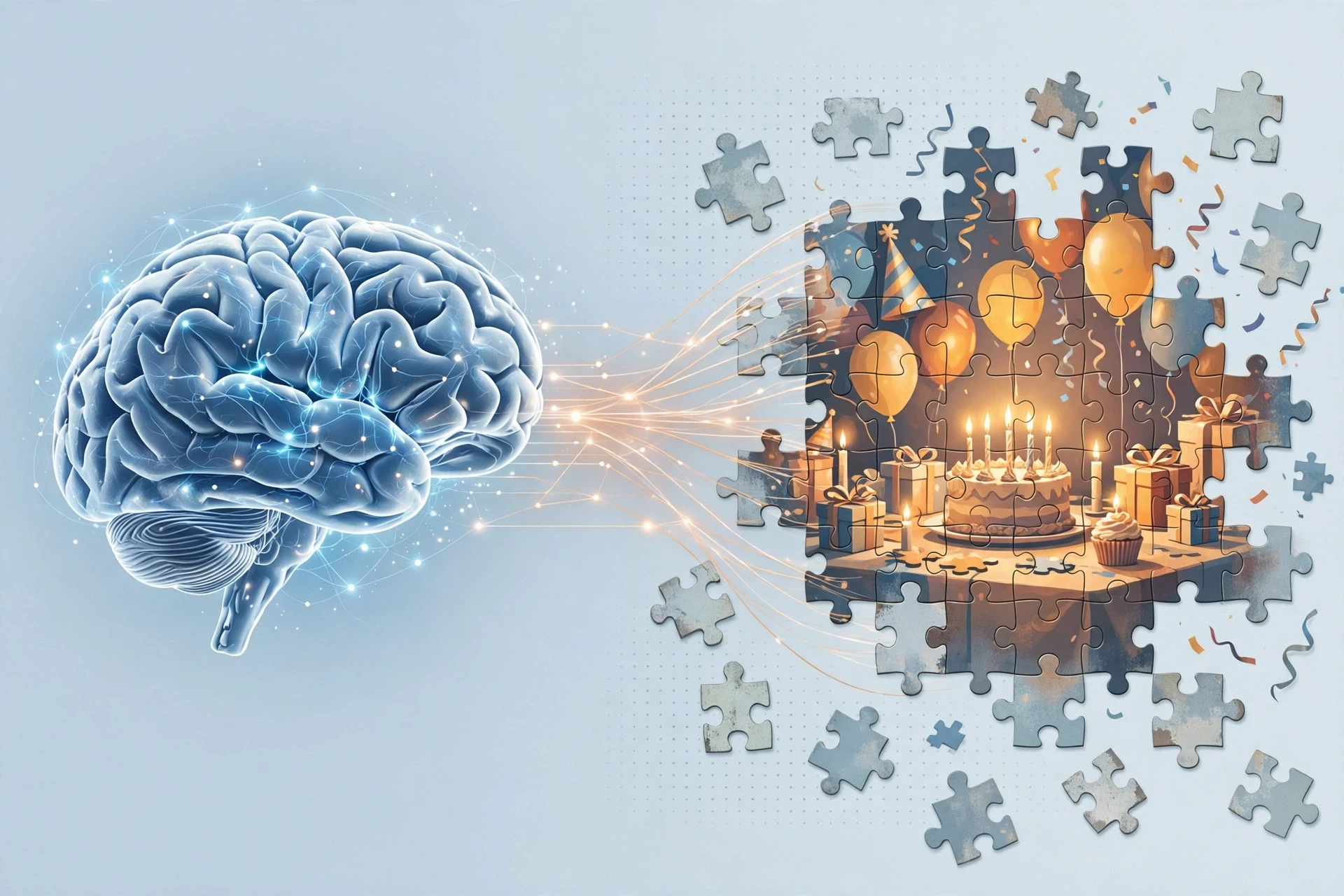
1.3 Why a creative memory is useful
Here is the part people miss when they first hear about false memories: the system that creates them is not a design flaw. It is the price of a system built for the future, not the past.
Your brain does not need a perfect archive. It needs a workable model of the world that helps you predict what will happen next. To build that model, it generalises. It fills gaps. It extracts the gist — the meaning of an event — and lets the surface details go. That is efficient. It is also why you can remember the point of a conversation from three years ago while forgetting the exact words, the room, and what you were wearing. Gist is what guides decisions. Detail is expensive to store, and most of it is never needed again.
The trouble starts when gist and detail get confused, or when a gap gets filled with the wrong material. Then the same machinery that makes memory useful makes it inventive. A brain that can imagine a plausible past is a brain that can imagine a future — and that trade-off, researchers argue, is one of the reasons our species is so good at planning and so bad at testifying with perfect accuracy.
2. The Word That Changed a Car Crash: Loftus and Palmer, 1974
2.1 One verb, two different accidents
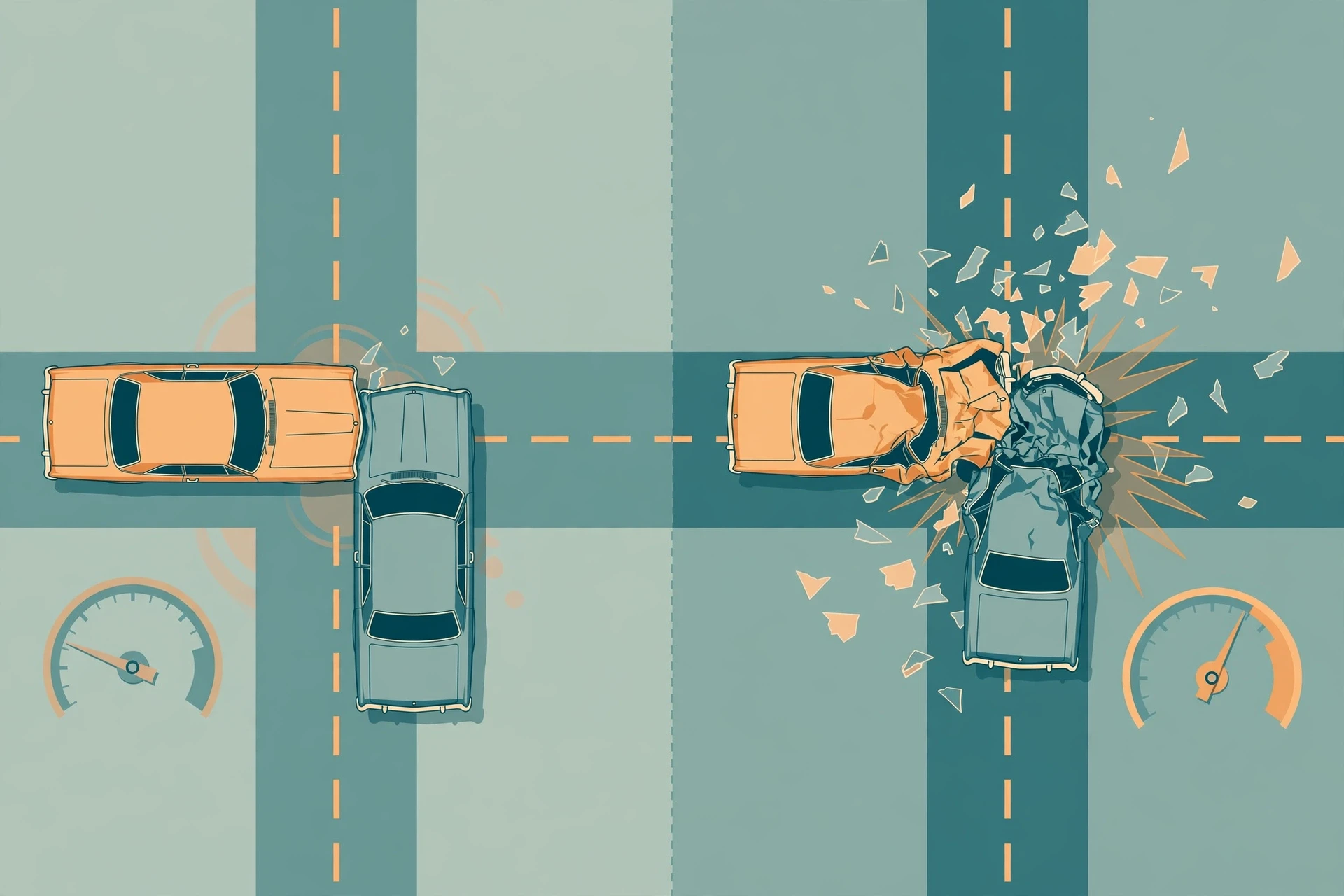
In 1974, Elizabeth Loftus and John Palmer ran an experiment so simple that it still shocks students the first time they hear it. Forty-five students watched short films of traffic accidents. Afterwards, each student was asked the same question, with one word changed: "About how fast were the cars going when they smashed into each other?" or "...when they hit each other?" or "...when they contacted each other?"
The answers moved with the verb. Students who heard "smashed" estimated the cars were travelling at about 41 miles per hour. Those who heard "hit" said about 34 miles per hour. Those who heard "contacted" said about 32 miles per hour. Same films. Same crashes. Different words, different speeds — a gap of nearly 10 miles per hour conjured by a single verb.
The verb did more than change a number. In a second experiment, students watched a film, answered a question with either "smashed" or "hit," and came back a week later. This time they were asked a new question: did you see any broken glass? There was no broken glass in the film. Yet 32 percent of the "smashed" group said yes, they had seen broken glass, compared with 14 percent of the "hit" group. The word "smashed" had not only raised the speed estimate. It had planted a detail — shattered glass — that belonged to the word, not to the film. A week later, that detail had become part of the memory itself.
Loftus's own university page at the University of Washington, where her research career is documented, remains a good starting point for anyone who wants to see the scope of this work — decades of experiments, courtroom testimony, and public debate, all circling the same question: how easily can memory be led? You can find it at Elizabeth Loftus's faculty page.
2.2 Why a question can rewrite the past
What happened in that laboratory? The leading question did two things at once. First, it supplied information disguised as a question. "How fast were the cars going when they smashed into each other?" quietly assumes a violent collision. The listener's brain absorbs that assumption while it is busy answering the speed question. Second, it gave the brain a richer, more coherent story to rebuild from. A violent crash should have broken glass. A gentle contact should not. When the brain reconstructed the film a week later, it reached for the version that made sense — and the version that made sense included glass.
This is the heart of the misinformation effect, the term Loftus gave to the change in memory that follows exposure to misleading information after an event. The American Psychological Association's overview of false memories describes the same pattern in plain terms: post-event information can alter what people remember, and the altered memory can feel entirely genuine. See the APA's page on false memories for a concise summary.
I have seen a version of this in my own teaching. I once showed a class a short video of a busy street, then asked half the class about "the man in the yellow jacket" — there was no man in a yellow jacket — and the other half a neutral question. A week later, several students in the first group described the yellow-jacketed man in confident detail. They were good students. They were paying attention. They were also, like all of us, rebuilding a scene from fragments, and I had handed them a fragment that did not belong.
2.3 The experiment that launched a field
Loftus and Palmer's study was small — 45 students in the first experiment — and it was conducted in a laboratory, not on a real road. Those limits matter, and honest science says so. But the finding has been replicated many times, in many forms, with many kinds of events: films, slides, live staged incidents, and real-world news footage. The core result holds. Language shapes memory. Questions are not neutral. They are part of the event they ask about.
That insight changed how police interview witnesses, how therapists ask about the past, and how journalists report on what people say they saw. It also changed Loftus's own life. She became one of the most cited — and most contested — psychologists alive, called as an expert witness in trials where a person's freedom depended on whether a memory could be trusted. We will come back to the courtroom in Section 9. First, try the effect on yourself.
3. Try It Yourself: The Word-List Demo That Catches Almost Everyone
3.1 The DRM test
Read the following list of words slowly, once, and try to remember them. Do not write them down yet.
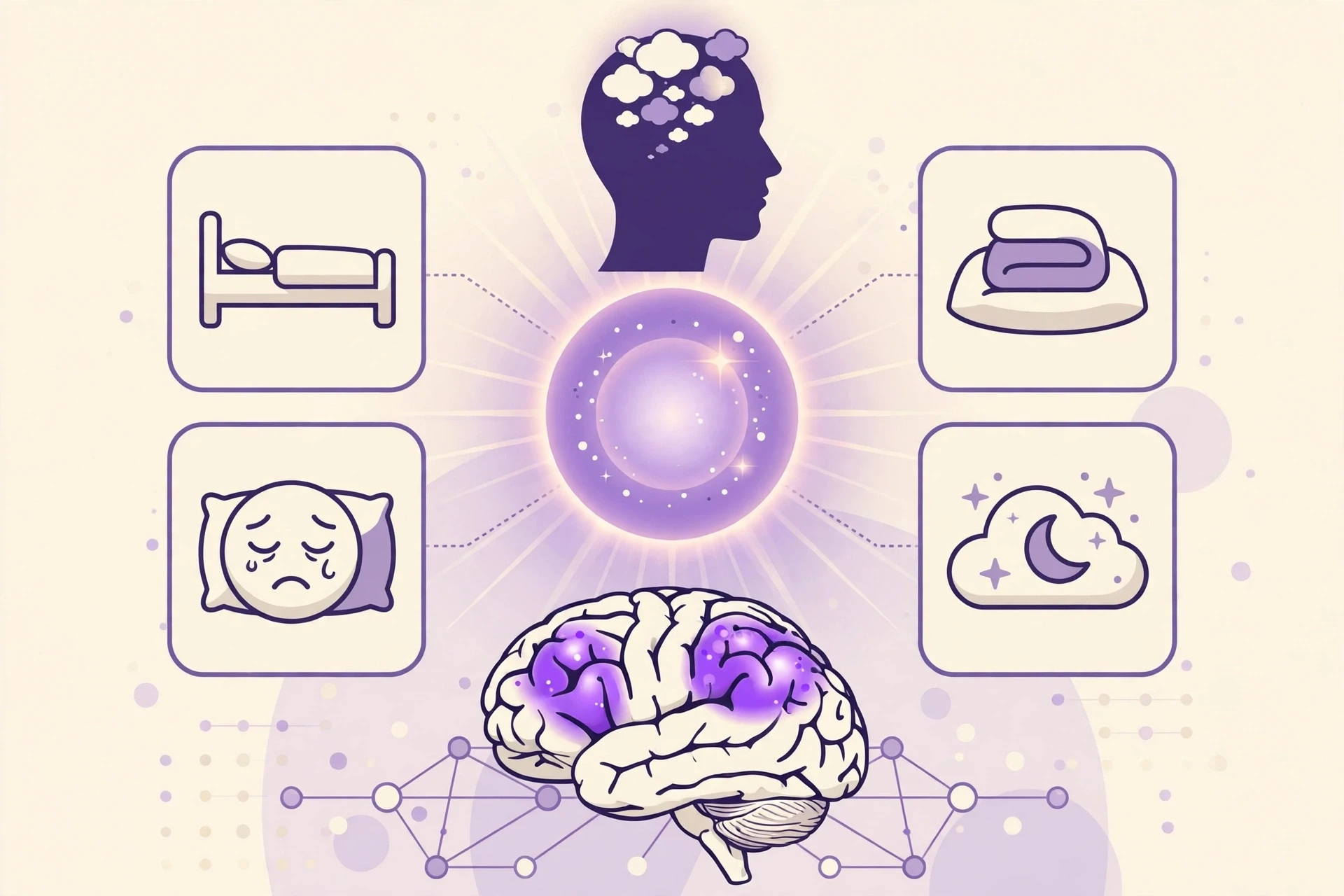
bed, rest, awake, tired, dream, wake, snooze, blanket, doze, slumber, snore, nap, peace, yawn, drowsy
Now cover the list. Take a breath. Then ask yourself: was the word sleep on the list?
If you said yes — or if you hesitated — you have just met the DRM effect. The word "sleep" was never on the list. Every word on it is related to sleep, and your brain, doing its normal job of extracting gist, supplied the missing centrepiece. In laboratory versions of this test, developed by James Deese and later refined by Henry Roediger and Kathleen McDermott, a large share of participants — often more than half — confidently "remember" the missing word. They will swear they saw it. Some will even claim they remember where it appeared in the list.
I run this demo in lectures, and it never fails to produce a small gasp. A room full of bright, careful people, caught by their own brains in under a minute. The gasp is the sound of a model breaking: the video-camera model cannot explain why you remember a word you never saw. The storyteller model can. Your brain stored the theme — sleep — and when you asked it to recall the list, it rebuilt the list around the theme and included the theme's best representative.
3.2 What the DRM test proves — and what it does not
The DRM test proves something narrow and something broad. Narrowly, it proves that associative activation can create a false memory: related concepts activate each other, and the strongest, most central concept can feel as if it was actually presented. Broadly, it proves that false memories do not require suggestion, pressure, or trickery. They can arise from the ordinary, healthy operation of a brain that organises information by meaning.
What it does not prove is that all your memories are false, or that memory is useless. The same students who falsely remember "sleep" correctly remember most of the words that were on the list. Memory is usually right about the gist and often right about the details. The DRM test is a warning light, not a demolition. It tells you where the system is vulnerable — at the edges, where meaning outruns evidence — so you can be careful there.
3.3 Gist versus detail
The DRM effect rests on a distinction that runs through this whole article: gist versus verbatim detail. Your brain stores both, but it keeps gist far longer and far more reliably. Verbatim traces — the exact words, the exact shade of a jacket, the exact speed of a car — fade fast. Gist traces — what the event was about — persist.
That is usually a good bargain. You need to remember that the meeting was about budget cuts, not the precise phrasing of the third slide. But when a test, a question, or a conversation demands verbatim detail, your brain may answer with gist dressed up as detail. It fills the gap with the most plausible candidate. In the DRM list, the most plausible candidate is "sleep." In a car crash, it is broken glass. In a childhood memory, it is the dog that fits the story of your childhood — even if the dog belonged to the neighbours.
Sleep, by the way, plays a double role here. It consolidates real memories, and it can also consolidate false ones. Our article on the science of sleep and dreams explores how sleep shapes what we keep; the point to carry forward here is that a night's sleep does not sort true memories from false ones. It strengthens both.
4. The Misinformation Effect: How Later Information Rewrites Earlier Memory
4.1 The three-stage pattern
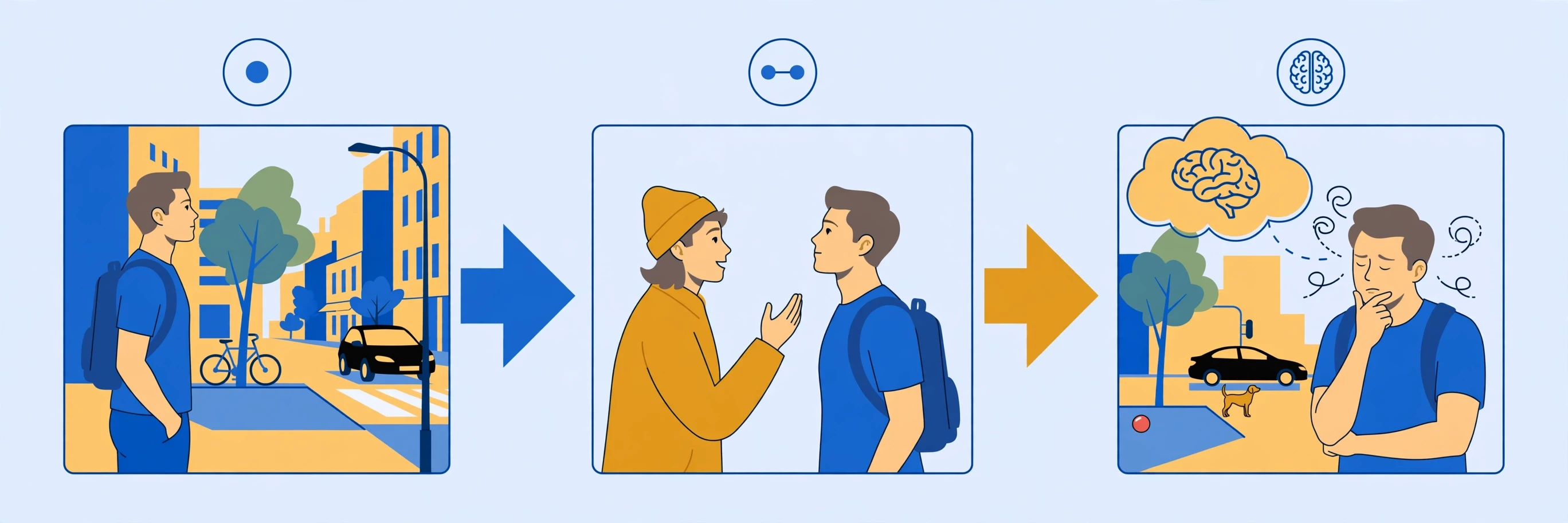
Most misinformation studies follow the same three-stage design, and once you see it, you will recognise it everywhere — in news coverage, in family conversations, in police interviews.
An event happens. You watch a film, witness an accident, or live through an afternoon.
Misleading information arrives. A question, a news report, a comment from a friend, or a doctored photograph suggests a detail that was not in the original event.
A memory test follows. You are asked what happened — and the suggested detail now appears in your answer, as if it had been there all along.
The timing matters. Loftus's 2005 review of thirty years of research on the misinformation effect found that misleading information does more damage when it arrives after the original memory has had time to fade. A fresh memory can resist suggestion. A faded one welcomes it, because the brain has gaps to fill and the suggestion arrives looking like a helpful answer. That review, "Planting misinformation in the human mind," is the single best entry point into the field, and its findings have held up across decades of follow-up work.
4.2 The stop sign that became a yield sign
The cleanest demonstration after the car-crash study involved a traffic sign. Participants watched slides of a car and pedestrian accident. In the original slides, the car approached a stop sign. Later, some participants received information that mentioned a yield sign instead. When tested, many of them remembered the yield sign — and some insisted on it with confidence.
Think about what that means. A stop sign and a yield sign are not vague impressions. They are specific, visible objects. Yet a sentence read after the event was enough to swap one for the other in memory. The original memory was not necessarily erased; researchers still debate whether misinformation overwrites the original trace, blocks access to it, or simply outcompetes it at recall. What is not debated is the outcome: at the moment of remembering, the wrong sign felt right.
4.3 Where misinformation comes from in real life
In the laboratory, misinformation is a sentence in a questionnaire. In real life, it is everywhere, and it rarely announces itself as misleading.
Leading questions. "Was the man tall?" assumes a man. "How fast was he running?" assumes running. Each question smuggles in a premise.
News coverage and social media. Watching the same clip replayed with a caption, a chyron, or a commentator's interpretation can blend the commentary into the memory of the event itself.
Other people's memories. Hearing a sibling's version of a childhood event can quietly replace your own, especially if their version is more detailed or more confidently told.
Photographs — including doctored ones. In one famous line of research, participants shown doctored photographs of themselves in events that never happened — a hot-air balloon ride, for example — later "remembered" those events in detail. A photograph feels like proof. The brain treats it that way, even when the photograph is the source of the error.
Repeated retelling. Every time you tell a story, you rebuild it. Details that make the story better — funnier, clearer, more dramatic — can creep in and stay. After enough retellings, you remember the improved version, not the original.
4.4 Warnings help — a little
Can you protect yourself by knowing about the misinformation effect? Partly. Studies show that warning people that they may have received misleading information reduces the effect, but does not remove it. The warning helps when it comes before the misleading information, and helps less when it comes after the false memory has already formed. Once a suggested detail has been woven into the reconstruction, it is hard to unweave — partly because the brain no longer tags it as "suggested." It feels like it came from the event.
That is a humbling limit. Knowledge is not immunity. I know this literature well, and I have still caught myself, more than once, defending a memory that turned out to be borrowed. The best defence is not confidence in your immunity. It is a habit: treating vivid memories, especially old ones and especially ones you have discussed with others, as hypotheses to check rather than facts to defend.
5. Source Monitoring: Forgetting Where a Memory Came From
5.1 The librarian who lost the labels
Imagine a library where every book has lost its catalogue card. You can still read the books, but you no longer know which ones came from the history section and which from fiction. That is what happens when source monitoring fails.
Source monitoring is the brain's system for tagging memories with their origin: did I see this, hear about it, dream it, imagine it, or read it? Normally the tags work well. A memory of seeing something carries visual detail; a memory of hearing about something carries the sound of the other person's voice. But the tags are not perfect, and they fade faster than the memories themselves. When the tag fades, the content remains — and the brain, faced with a vivid scene and no label, makes its best guess about where it came from. Often it guesses "I experienced it."
Marcia Johnson's source-monitoring framework, developed over decades of research, explains a wide range of false memories with this one idea. A dream can become a memory. A story told at a family dinner can become a childhood experience. A scene from a film can become something you witnessed. The content is real — the dream happened, the story was told, the film was watched — but the source is wrong, and the wrong source changes everything.
5.2 Everyday source errors
You have almost certainly made source-monitoring errors. They are the small, ordinary cousins of the dramatic false memories in this article.
You remember telling someone something, but you only thought about telling them.
You remember reading a fact in a book, but you heard it on a podcast.
You remember a joke as your own, but a friend told it to you years ago.
You are sure you locked the door — because you remember locking it yesterday, and the two days have blurred together.
None of these mean your memory is failing. They mean your brain is doing what it always does: keeping the content and letting the label go. The label is the first thing to fade, because the brain judges it less important than the content. Usually it is right. Sometimes, when the stakes are high — a courtroom, a medical history, a family rift — the label is the whole point.
5.3 Why older memories are more vulnerable
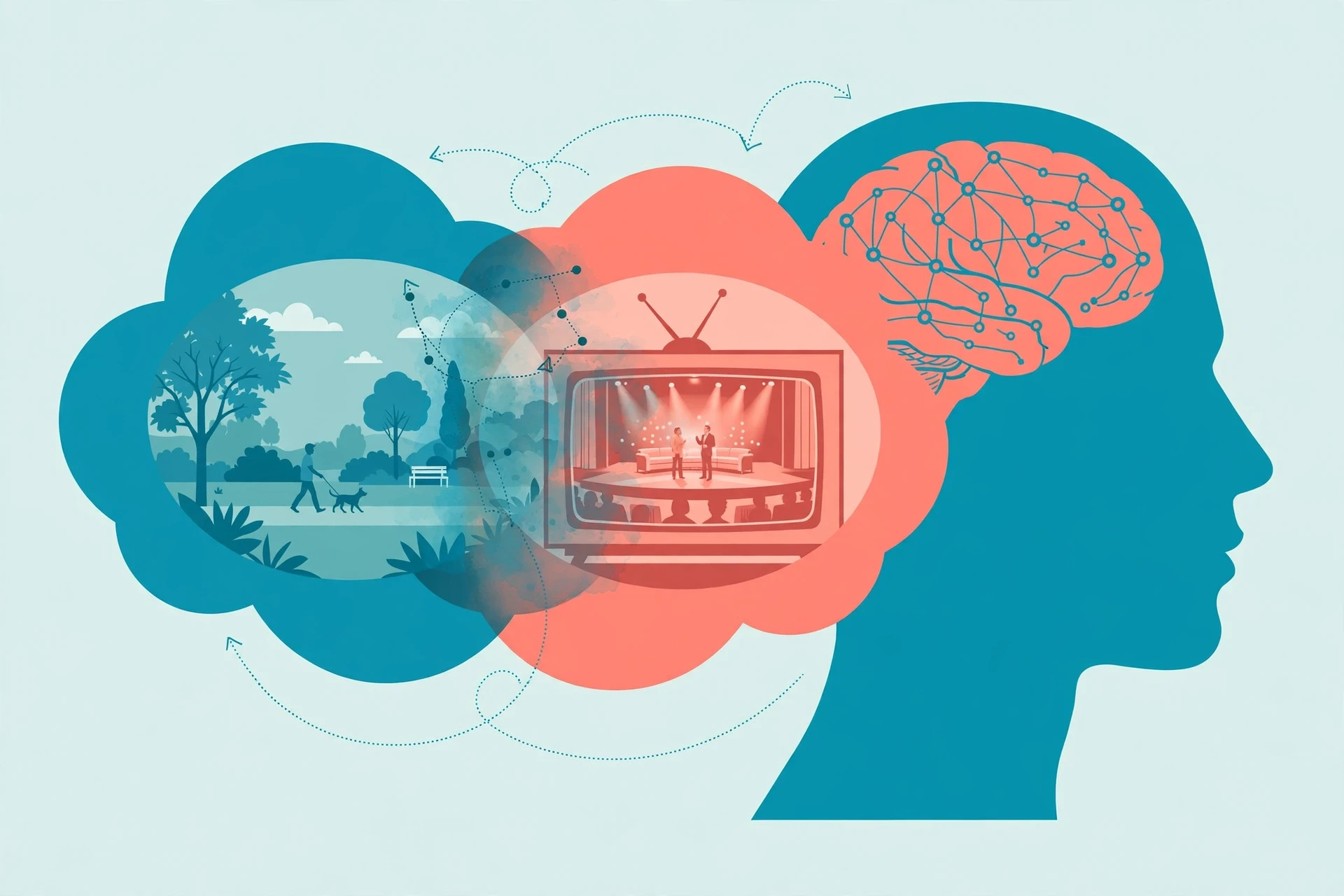
Source tags fade with time, which is why older memories are the most vulnerable to source errors. A childhood memory has had decades for its label to wear off, and decades of retellings, photographs, and family stories to supply new content. By the time you are an adult remembering yourself at seven, the memory is a collage: some original fragments, some photographs you have seen many times, some stories your parents told, some details you inferred because they must have been true.
That does not mean childhood memories are worthless. Many are broadly accurate — the gist, the emotional tone, the people who mattered. But the details are the least trustworthy part, and the details are often what arguments are about. When my sister and I argued about the dog, we were not arguing about whether our childhood was happy. We were arguing about a detail, and details are where memory is weakest. Knowing that has made me gentler in family disagreements, and I hope it does the same for you.
6. Imagination Inflation: Imagining Something Can Make You Remember It
6.1 The "lost in the mall" study
In the mid-1990s, Loftus and her colleague Jacqueline Pickrell devised a technique for planting whole events — "rich false memories" — and the most famous version involved a shopping mall. Participants were given short descriptions of childhood events, supposedly supplied by their relatives. Three were real. One was false: the participant, as a young child, had been lost in a shopping mall, frightened, crying, and eventually rescued by an elderly person.
About a quarter of participants — six out of twenty-four in the original study — came to "remember" the mall incident, some in partial form and some in rich detail. They added specifics their relatives had never supplied: what the mall looked like, what they were wearing, how scared they felt. The false event had been suggested once, in writing, by a trusted source. That was enough. The participants' own imaginations did the rest, filling in the scene until it felt like a memory.
Later studies using similar methods — doctored photographs, guided imagination, repeated interviews — have produced higher rates, sometimes around half of participants forming a false memory of a childhood event. The exact rate depends on the method, the event, and the person. The direction of the finding does not depend on any of those things. Given a plausible suggestion, a trusted source, and some imagination, a substantial minority of people will come to remember something that never happened.
6.2 How imagining makes a memory
The mechanism is called imagination inflation, and it is easy to understand once you see it. Imagining an event and remembering an event use overlapping mental machinery. Both involve constructing a vivid scene, with sensory detail and emotion. Each time you imagine the scene, it becomes more vivid, more detailed, and more familiar. And familiarity is one of the brain's main cues for "this really happened." A scene you have imagined five times feels more familiar than a scene you experienced once, years ago, and never thought about since.
That is why repeated questioning, repeated visualisation, and repeated retelling are so powerful — and so risky. Each repetition adds detail and fluency. The memory feels smoother, easier to retrieve, more confident. The brain reads fluency as truth. It is a reasonable shortcut in everyday life, where fluent memories usually are true. In a suggestive interview, it is a trap.
I felt this trap myself, years ago, when I spent an afternoon trying to remember a childhood holiday by staring at old photographs and imagining the beach, the hotel, the smell of the sea. By evening I had a vivid memory of a boat trip — and my brother, when I mentioned it, said gently that the boat trip was his, from a different holiday, a different year. I had borrowed his memory and imagined it into mine. The photographs had helped me imagine. They had also helped me misremember.
6.3 Photographs, dreams, and the stories we tell
Imagination inflation is not limited to formal experiments. Three everyday sources feed it.
Photographs. A photograph is a powerful imagination aid. Looking at a childhood photo repeatedly can create a "memory" of the moment in the photo — even if you were too young to remember it, or even if the photo shows something you never experienced. The photo supplies the detail; your imagination supplies the feeling of being there. Psychologists call this a photograph-induced false memory, and it is one of the most common kinds.
Dreams. A vivid dream, retold and thought about, can blur into waking memory, especially if the dream was about a plausible event. Source monitoring is supposed to tag dreams as dreams, but the tag fades. A dream about an argument can become a memory of an argument. This is one reason sleep researchers, including those behind our article on the science of sleep and dreams, are careful about dream recall: dreams are experiences, and experiences leave traces, even when they never happened in the waking world.
Repeated storytelling. Every retelling is a rehearsal. A story told often enough becomes smooth, detailed, and confident — the three qualities the brain reads as "true." Families have stories like this: the tale everyone tells at gatherings, polished over decades, which no one can quite verify and everyone remembers slightly differently. The story may be broadly true. Its details are a group project.

7. Why Confidence Says Nothing About Accuracy
7.1 The most dangerous misconception in this article
If you remember one sentence from this article, make it this one: a confident memory is not necessarily an accurate memory.
Most people believe the opposite. We treat confidence as evidence. A witness who says "I am absolutely certain" feels more believable than one who says "I think so, but I am not sure." A family member who remembers in rich detail feels more credible than one who remembers vaguely. Our legal system, our news media, and our everyday arguments all run on this assumption. The research says it is wrong — or at least, far weaker than we think.
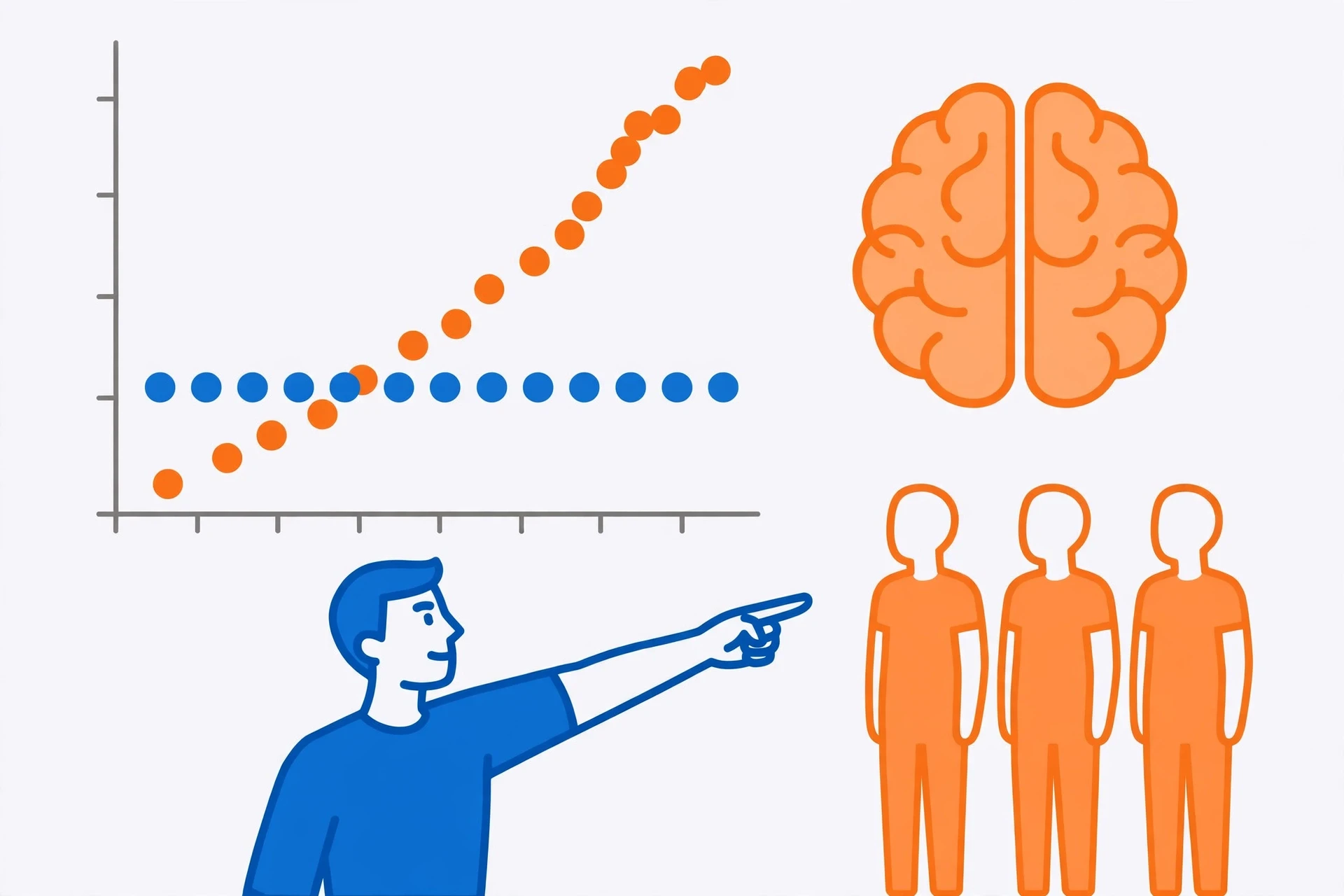
The relationship between confidence and accuracy in memory is real, but it is modest, and it collapses under exactly the conditions where it matters most: after delay, after suggestion, after repeated retelling, and after feedback. A witness who is told "good, you picked the right person" becomes more confident, even if the pick was wrong. A person who rehearses a false memory becomes more confident in it. Confidence grows with repetition and social confirmation. Accuracy does not.
"The confidence of a witness is one of the least reliable guides to the accuracy of their memory — and one of the most persuasive to a jury."
That tension — unreliable guide, persuasive signal — is why false memories are so consequential in courtrooms. Jurors, like the rest of us, read confidence as truth. Expert testimony on memory exists precisely to break that link, and to explain why a sincere, confident, detailed witness can still be wrong.
7.2 What the data actually show
Laboratory studies that measure both confidence and accuracy find a consistent pattern. When people are tested immediately, under clean conditions, with no suggestion, confidence and accuracy track each other reasonably well. Add delay, add a leading question, add a lineup where the real culprit is absent, and the link weakens sharply. In some conditions, highly confident witnesses are wrong as often as they are right.
The reason is simple once you see the machinery. Confidence is a feeling about the retrieval — how fluently, vividly, and easily the memory came to mind. Accuracy is a fact about the past — whether the memory matches what actually happened. Fluency and vividness are influenced by repetition, imagination, suggestion, and emotion. None of those guarantee a match with the past. A false memory that has been imagined, retold, and confirmed by others can be retrieved with great fluency. It will feel certain. It will be wrong.
7.3 True memories versus false memories
How, then, can you tell a true memory from a false one? Honestly: often, you cannot, from the inside. That is the uncomfortable finding at the centre of this field. True and false memories share the same subjective qualities — vividness, detail, emotion, confidence. No internal signal reliably separates them.
What can help is external evidence: photographs, documents, other witnesses, physical records. And what can help in advance is process: how the memory was formed, whether it was suggested, whether it was rehearsed, whether it changed over time. A memory that has stayed stable, was recorded close to the event, and was not shaped by leading questions is more trustworthy than one that grew more detailed with each retelling. That is a statement about process, not about feeling.
Feature | True memory | False memory |
|---|---|---|
Feels vivid and detailed | Often, yes | Often, yes |
Held with confidence | Often, yes | Often, yes |
Carries real emotion | Often, yes | Often, yes |
Matches external records | Usually | Often not — check documents, photos, other witnesses |
Grows more detailed over time | Sometimes | Common — a warning sign, not proof |
Source is clear | Usually | Often blurred: dream, story, photo, or suggestion |
Best test | Corroboration close to the event | Corroboration close to the event |
Table 1: True and false memories feel alike from the inside. The differences that matter are in the evidence and in how the memory was formed — not in how confident it feels.
8. The Mandela Effect: When False Memories Go Viral
8.1 A shared wrong memory
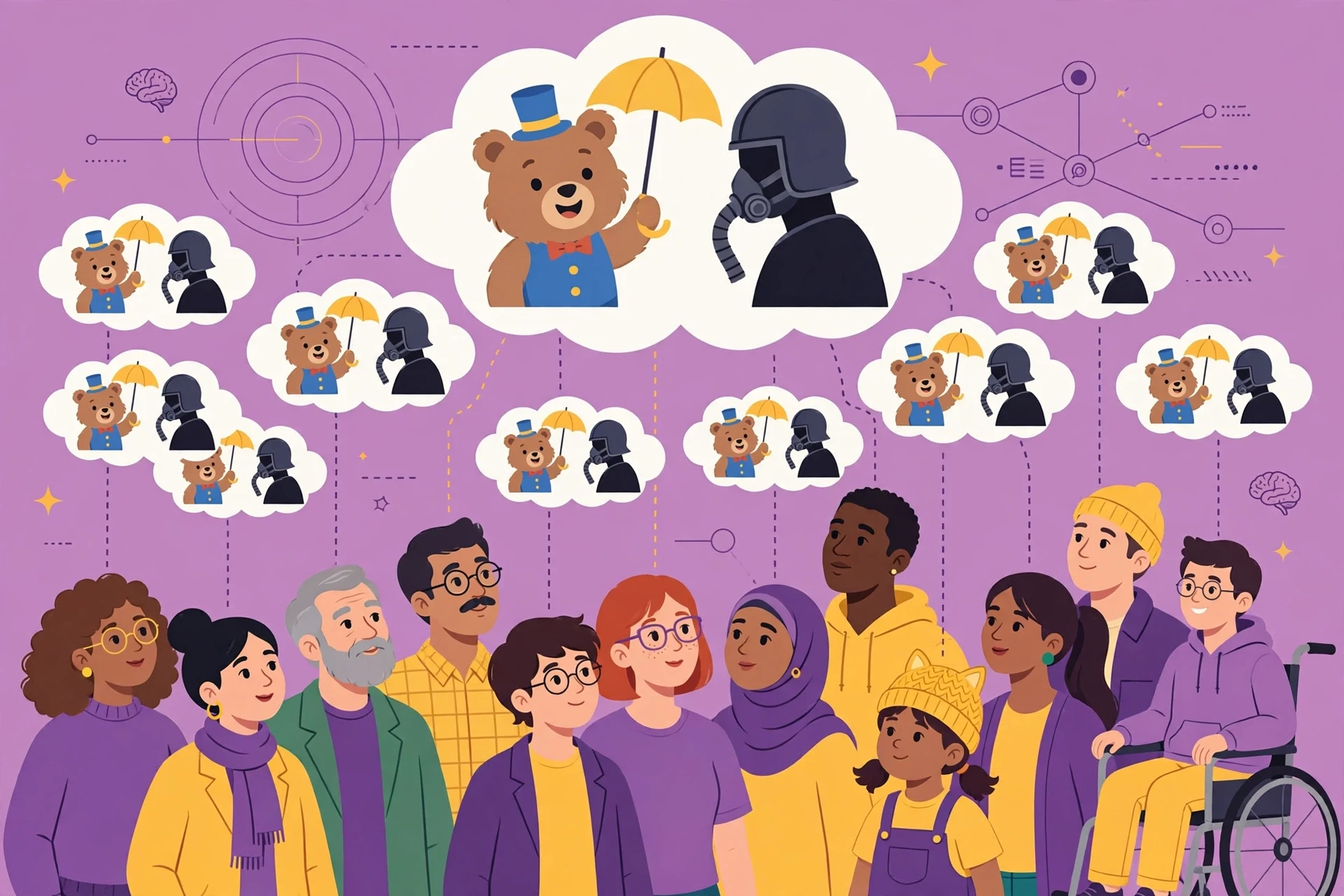
In 2009, a researcher named Fiona Broome noticed something odd. She, and many other people, vividly remembered that Nelson Mandela had died in prison in the 1980s. He had not. He was released in 1990, became president of South Africa, and died in 2013. Yet the memory of his earlier death was shared, detailed, and confident — people remembered news coverage, funeral scenes, and the reactions of those around them. Broome coined a name for the phenomenon: the Mandela Effect.
Since then, the Mandela Effect has become a catalogue of shared false memories. Many people remember the children's book series as the Berenstein Bears, with an "e," when the books are the Berenstain Bears, with an "a." Many remember a cartoon character with a tail that was never drawn, a famous movie line worded slightly differently from the actual script, and a peanut-butter brand spelled in a way it never was. Each example is small. Together, they are a striking demonstration that false memories are not only individual. They can be social.
8.2 Why whole groups remember the same wrong thing
The Mandela Effect is mostly explained by the mechanisms in this article, operating at scale. No parallel universe is needed. Three ordinary processes do the work.
First, schemas. Your brain stores the general shape of things — how a name should sound, how a familiar character should look — and fills in details to match the schema. "Berenstein" is a more common name pattern than "Berenstain," so the brain regularises it. The same logic applies to movie lines: the brain remembers the gist of a famous line and reconstructs the wording in the most natural form, which may not be the exact form.
Second, social reinforcement. When one person states a false memory confidently, others who share the same gist recognise it as familiar. Familiarity feels like confirmation. The memory spreads, each retelling adding confidence, until a community holds a memory that no single member could verify. The internet accelerates this: a post, a meme, a video essay can synchronise thousands of people's reconstructions in a single afternoon.
Third, source confusion at scale. A parody, a misquote in a popular article, a misremembered clip — any of these can become the source that many people draw on, without realising they are drawing on it. The memory feels personal, but its origin is public and wrong.
Consciousness researchers wrestle with a related puzzle: how does a private experience become a shared, reportable fact? Our article on what consciousness is explores how the brain builds a coherent picture of the world from fragmentary signals. The Mandela Effect is what happens when that picture-building goes wrong in the same way for many people at once — a reminder that the brain's picture is a construction, and constructions can converge on the same error.
8.3 What the Mandela Effect is not
It is worth saying plainly: the Mandela Effect is not evidence that reality changed, that timelines split, or that collective memory taps into another world. Those explanations are popular online because they are dramatic. The psychological explanation is less dramatic and far better supported: shared schemas, shared sources, and social reinforcement produce shared errors.
That does not make the effect boring. It makes it important. If thousands of people can share a false memory of a book title, how much easier is it for a community to share a false memory of an event that matters — a protest, a disaster, a political speech? The Mandela Effect is a laboratory for understanding collective memory, and collective memory shapes history. The same mechanisms that misspell a bear's name can misremember who said what, who was present, and what happened first. The stakes scale up fast.
9. Where False Memories Do Real Damage
9.1 The courtroom
The highest stakes for false memory research are in criminal justice. Eyewitness misidentification is the leading contributor to wrongful convictions overturned by DNA evidence in the United States. The Innocence Project, which works on such cases, states plainly that eyewitness misidentification contributes to an overwhelming majority of wrongful convictions overturned by post-conviction DNA testing — and that memory is "incredibly malleable," shaped by pressure, suggestive procedures, and time. You can read their account at the Innocence Project's page on eyewitness misidentification.
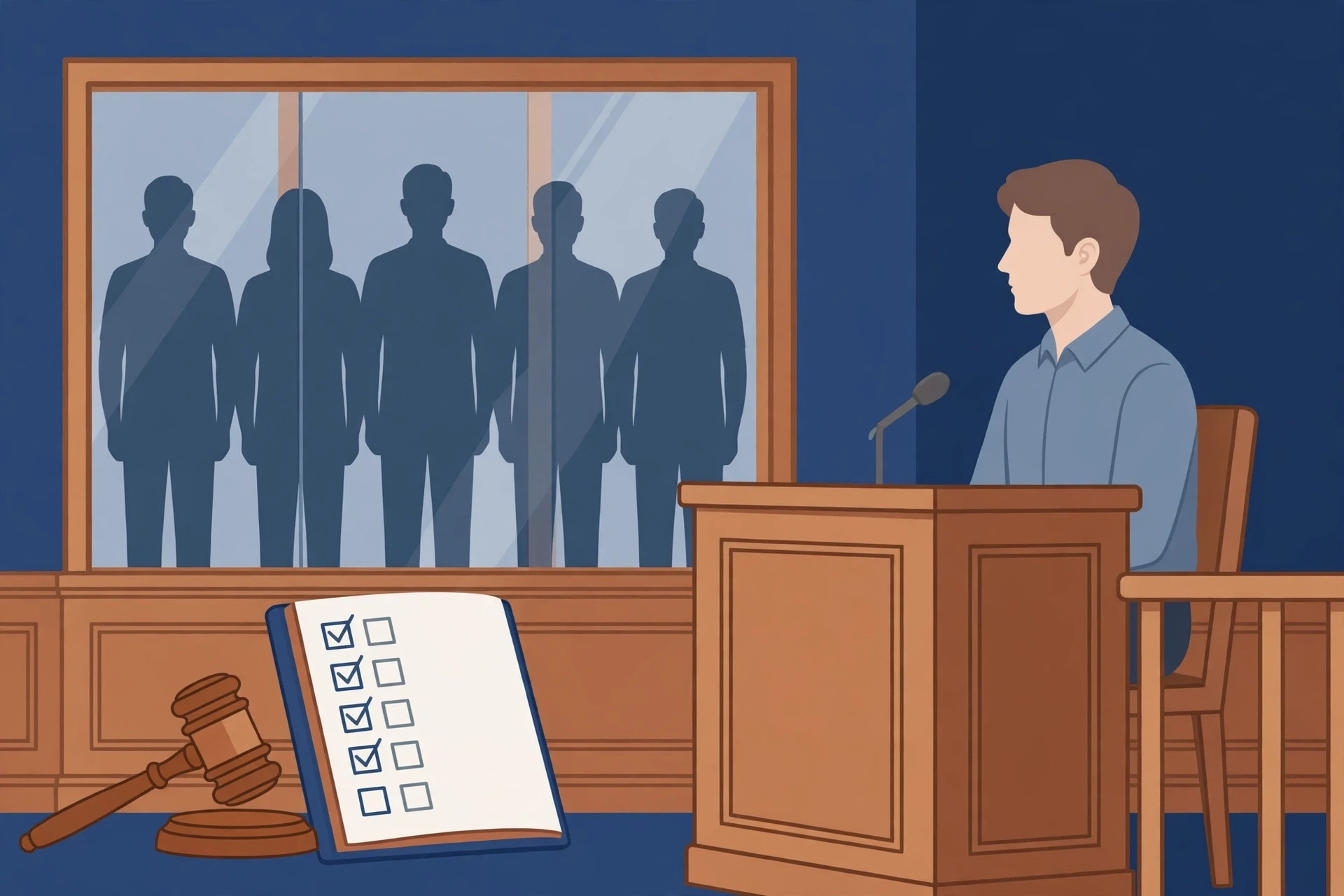
The mechanism is the misinformation effect wearing a uniform. A witness sees a crime under stress, in poor light, for a few seconds. Later, they are shown photographs, asked leading questions, or presented with a lineup that does not include the real perpetrator. Each step can add a detail, narrow a choice, or boost confidence. By the time the witness testifies, months later, the memory may be confident, detailed, and wrong — and the jury, reading confidence as accuracy, believes it.
The American Psychological Association's reporting on eyewitness testimony makes the same point from the research side: memory is reconstructive, and the procedures used to collect it matter as much as the witness's sincerity. See the APA's article on memory and eyewitness testimony. The reforms that follow from this research are practical, not abstract: blind lineups, where the officer running the lineup does not know who the suspect is; careful wording of questions; recording the witness's confidence at the time of the first identification, before feedback can inflate it; and expert testimony to explain to jurors why confidence is a weak guide.
9.2 Families, therapy, and recovered memories
False memories also do damage in private life, where there is no jury and no DNA test. A person who comes to believe, sincerely, that a parent harmed them in childhood — when no such event occurred — can shatter a family. A person who "recovers" a memory in therapy, after repeated guided imagination and suggestion, may be recovering a construction, not a buried truth. This was the painful centre of the "memory wars" of the 1990s, when Loftus's research collided with therapeutic practices that treated recovered memories as reliable historical records.
The science, as it stands, is careful and unsentimental. Traumatic events can be forgotten and later remembered. People can have genuine memories that return after years. But memories recovered through suggestion, imagination, hypnosis, or repeated leading questions are at high risk of being false, and they feel exactly like true ones. That is why responsible therapists today are cautious about memory-recovery techniques, and why courts are cautious about testimony based solely on a recovered memory with no corroboration.
If you are carrying a painful memory and wondering whether it is true, this article cannot answer that for you — and no article should try. What the research can say is this: talk to a qualified professional, look for corroboration where it exists, and be wary of any process that asks you to imagine a scene repeatedly until it feels real. Imagination is a tool for building memories, not for excavating them.
9.3 Health, news, and everyday decisions
The stakes are lower but still real in everyday life. A patient who falsely remembers a doctor's instructions — or a drug allergy, or a symptom's timing — can receive the wrong care. A voter who falsely remembers a politician saying something they never said can vote on a fiction. A manager who falsely remembers an employee's promise can damage a career. None of these require malice. They require only a normal brain, a suggestive question, and time.
The brain's vulnerability here is linked to its anatomy. The systems that build memories, monitor their sources, and weigh confidence are distributed across the brain, not housed in a single "memory centre." Our article on human brain anatomy gives the map; the point here is that a distributed system has many points where a detail can slip in unnoticed. And when stress enters the picture — as it does in accidents, crimes, and medical emergencies — the system is under even more strain. Our article on anxiety and depression explores how stress and mood shape cognition; for memory, the practical lesson is that the most stressful moments are often the ones we remember least reliably, even though they feel the most vivid.
10. Common Misconceptions About False Memories
10.1 "If I remember it vividly, it must be true"
No. Vividness is a property of the reconstruction, not a certificate of accuracy. False memories in the laboratory are routinely vivid, detailed, and emotional. Vividness tells you the memory was built well. It does not tell you it was built from true materials.
10.2 "Only suggestible or weak-minded people get false memories"
No. False memories have been planted in university students, in professionals, in people with excellent memories, and in the researchers themselves. Suggestibility varies between people — children and older adults are, on average, more vulnerable — but no one is immune. The DRM demo in Section 3 catches almost everyone, including people who know how it works.
10.3 "False memories mean my memory is broken"
No. False memories are a by-product of a healthy, creative memory system. A brain that never generalised, never filled gaps, and never extracted gist would be useless for planning and prediction. The same system that invents a dog also lets you imagine next year, learn from experience, and understand a story. The goal is not to eliminate the creativity. It is to know where it operates, so you can check it when the stakes are high.
10.4 "You can tell a false memory by how it feels"
No. From the inside, true and false memories feel alike. Researchers have searched for a reliable internal marker — a feeling of doubt, a lack of sensory detail, a different emotional tone — and none has held up. The differences that matter are external: corroboration, timing, and process. If you are relying on a feeling to sort true from false, you are relying on the wrong instrument.
10.5 "Hypnosis and recovered-memory therapy reliably uncover the truth"
No. Hypnosis increases confidence and the amount of detail a person reports, but it also increases false memories, and the person cannot tell which details are new and which are real. The same is true of any technique that relies on repeated imagination or leading questions to "recover" a memory. These methods can produce sincere, detailed, confident memories of events that never happened. That is not a reason to dismiss every recovered memory. It is a reason to require corroboration before treating one as fact.
10.6 "Once a memory is formed, it stays the same"
No. Every retrieval is a reconstruction, and every reconstruction is an opportunity for change. A memory retrieved, retold, and re-stored is not the same memory. It is a new version, built from the old version plus whatever the present added. This process, called reconsolidation, is still being studied, and researchers disagree about its exact limits. What they agree on is the practical point: memories are not frozen. They are living documents, edited each time they are opened.
11. How to Protect Your Memory — Practical Steps That Actually Help
11.1 Record close to the event
The single most effective habit is also the simplest: write things down promptly. A note taken on the day — a few lines, a date, a name — is an external anchor that later reconstructions cannot easily move. Police, journalists, doctors, and scientists all rely on contemporaneous notes for the same reason. Your memory will change. The note will not.
11.2 Ask neutral questions
When you ask someone what happened — a child, a witness, a colleague, yourself — use open, neutral wording. "What happened next?" is safer than "Did he hit you?" "What did you see?" is safer than "Was the car red?" Every premise you smuggle into a question is a candidate for the other person's memory. If you need detail, ask for it without supplying it.
11.3 Separate imagination from recall
If you are trying to remember something, resist the urge to imagine it into clarity. Visualising a scene repeatedly makes it feel more familiar, and familiarity feels like truth. Instead, report what you actually remember, even if it is vague, and label the rest as inference: "I think this happened, but I am not sure," or "I am picturing this, but I do not know if it is a memory." That label is a source tag, and it protects the memory from being overwritten by the imagination.
11.4 Check, do not rehearse
When a memory matters — a medical history, a legal statement, a family dispute — check it against external evidence before rehearsing it. Look at documents, photographs, messages, and calendars. Talk to other witnesses before you settle on a version, and note where accounts differ. Rehearsing a single version, especially a version shaped by suggestion, only makes it feel more certain. Checking first gives the truth a chance to compete.
11.5 Be humble about old memories, and kind about other people's
Old memories deserve humility. They have had years to change, and they have changed in ways you cannot detect from the inside. That does not mean discarding them. It means holding them lightly: "This is how I remember it, and I know memory can be wrong." The same humility, extended to others, changes arguments. When someone remembers differently, they are probably not lying. They are remembering — with a different brain, a different history, and a different set of borrowed fragments. The nervous system that builds those memories is the same one that lets us feel, decide, and connect; our article on how the nervous system works traces that system from neuron to behaviour, and it is worth remembering that the witness you are arguing with is using the same creative machinery you are.
"A memory is not a recording. It is a story your brain tells you about the past — and like any story, it can be beautifully told and still get the facts wrong."
12. What Researchers Are Still Learning
Research on false memories is not finished. It is, if anything, accelerating, as new tools let researchers watch the brain while it builds a false memory — and while it builds false memories in general.
Neuroimaging studies have shown that true and false memories activate overlapping brain regions — which is why they feel alike — but with subtle differences in activity, particularly in regions involved in sensory detail and in monitoring. Those differences are not yet reliable enough to use as a lie detector for memory, and researchers are careful to say so. A brain scan cannot tell a court whether a witness is right.
Newer work is also exploring who is most vulnerable, and when. Sleep deprivation increases false memories. Stress can increase them, or in some conditions sharpen true memory while leaving false memory unchanged. Age matters: children are more suggestible, and older adults, whose source monitoring weakens, can be more vulnerable to some kinds of false memory. None of these findings translate into a simple rule — "this person is reliable, that person is not" — but they do translate into better procedures: shorter delays before interviewing witnesses, fewer leading questions, and more care with vulnerable witnesses.
Another frontier is digital. Doctored photographs, deepfake video, and AI-generated images are new, powerful sources of misinformation — and they arrive looking like evidence. A doctored photograph in the 1990s required skill and time. Today it requires seconds. Researchers are now asking how these tools change the misinformation effect, and early signs suggest they make it stronger, because a realistic image bypasses the scepticism that a verbal suggestion might trigger. The lesson is not to distrust every image. It is to remember that an image is a source, and sources need checking, just like memories do.
Conclusion
I never did get my dog back. The photo albums were clear, my mother was certain, and my sister — who had argued with me about him for years — laughed and said she had been picturing the neighbour's dog too. We had shared a false memory, built from the same summer, the same street, and the same longing for a dog of our own. Losing him, a second time, was oddly freeing. If a memory I had defended for decades could be wrong, then other memories could be wrong too — and that meant I could hold them more lightly, check them more carefully, and argue about them more kindly.
That is the real lesson of false memories. Your memory is not a camera, and understanding false memories changes how you trust your own recollections. It is a storyteller, and a good one: it generalises, it fills gaps, it builds a usable past from fragments so you can plan a future. The price of that talent is invention. A word in a question can change a speed estimate. A suggested detail can become a broken window. An imagined scene can become a childhood event. A confident witness can be sincerely wrong.
None of that means you should distrust everything you remember. Most of your memories are broadly right, especially about the gist of what happened and how it felt. It means you should distrust the feeling of certainty as a guarantee, and trust the process instead: record promptly, ask neutral questions, separate imagination from recall, and check against evidence when it matters. Memory is a creative, social, living system. Treat it that way — with respect for what it does well, and with care for where it invents — and it will serve you better than any fantasy of perfect recall ever could.
Frequently Asked Questions
Can you have a false memory of something that never happened?
Yes. Research shows that people can form detailed, confident, emotional memories of entire events that never occurred — for example, being lost in a shopping mall as a child — after a single suggestion from a trusted source, combined with imagination. These are called rich false memories, and they feel indistinguishable from true memories from the inside.
Why do false memories feel so real?
Because true and false memories are built by the same brain machinery. Both involve reconstructing a scene from fragments, with sensory detail and emotion. The brain does not tag a memory as "true" or "false" when it builds it; it tags it with a source, and that tag fades. When the tag is gone, a vivid reconstruction feels like a lived experience, whatever its origin.
What is the misinformation effect?
The misinformation effect is the change in memory that follows exposure to misleading information after an event. In Loftus and Palmer's 1974 car-crash study, the word "smashed" in a question led people to estimate higher speeds and, a week later, to "remember" broken glass that was never in the film. Later information — a question, a news report, another person's account — can become part of the memory itself.
Can false memories be implanted?
Yes, under laboratory conditions, and the methods are surprisingly simple: a plausible suggestion, a trusted source, and repeated imagination. Doctored photographs, guided visualisation, and leading questions have all produced false memories in a substantial minority of participants. That does not mean anyone can implant any memory in anyone at any time — resistance, plausibility, and prior knowledge all matter — but the effect is real, replicable, and strong enough to matter in courtrooms and therapy rooms.
Is confidence a good sign that a memory is accurate?
No, not on its own. Confidence reflects how fluently and vividly a memory comes to mind, and fluency grows with repetition, imagination, and social confirmation — all of which can also grow a false memory. Confidence and accuracy track each other reasonably well under clean, immediate conditions, but the link weakens sharply after delay, suggestion, or feedback. A confident witness can be sincerely wrong.
How can I tell if a memory is false?
Often you cannot tell from the inside, because true and false memories feel alike. The reliable tests are external: check documents, photographs, messages, and other witnesses; note whether the memory was recorded close to the event or grew more detailed over time; and ask whether it was shaped by leading questions, imagination, or suggestion. A memory that is stable, contemporaneous, and corroborated is more trustworthy than one that is vivid but uncorroborated.
Does the Mandela Effect prove that reality changed?
No. The Mandela Effect — shared false memories, such as many people remembering the children's books as the "Berenstein" Bears — is explained by ordinary psychology: shared schemas, social reinforcement, and shared mistaken sources. No parallel universe is needed. The effect is important because it shows that false memories can be collective, not only individual.
Sources
American Psychological Association. "False Memories." https://www.apa.org/topics/memory/false-memories
American Psychological Association. "Memory." https://www.apa.org/topics/memory
American Psychological Association. "How reliable is eyewitness testimony?" Monitor on Psychology, 2022. https://www.apa.org/monitor/2022/05/memory-eyewitness-testimony
Loftus, Elizabeth F. Faculty page, University of Washington. https://faculty.washington.edu/eloftus/
Innocence Project. "Eyewitness Misidentification." https://innocenceproject.org/eyewitness-misidentification/
Loftus, E. F. (2005). Planting misinformation in the human mind: A 30-year investigation of the malleability of memory. Learning & Memory, 12(4), 361–366. doi:10.1101/lm.94705