

It is 2:14 in the morning. You told yourself, an hour ago, that you would put the phone down. You meant it. You even set the phone face-down on the nightstand, the way people do when they are serious about sleeping. Then your thumb found it again in the dark, the screen lit your face blue, and here you are — one more video, one more thread, one more refresh of a feed you have already read to the bottom. Nothing in it is urgent. Nothing in it is even that interesting. And still, you cannot quite stop.
If that scene feels familiar, you are not weak, and you are not alone. The question of why are phones addictive is one of the most honest questions in modern psychology, because the answer is not a single villain. It is a chain: a century-old discovery about how rewards shape behaviour, a brain chemical that has been wildly misunderstood, a design playbook borrowed from slot machines, and an entire economy that profits every time your attention stays one minute longer. None of those pieces is magic. Each one is understandable. And once you can see the chain, you can start to loosen it.
I have spent years watching people — including myself — lose small wars against their own pockets. I once tracked my own phone checks for a week, out of professional curiosity and a little embarrassment, and the number stopped me cold: I reached for the phone more than a hundred times a day, and most of those reaches had no reason at all. No buzz, no badge, no message waiting. Just a hand moving on its own, the way a hand moves toward a light switch in a dark room. That is the phenomenon this article explains. Not with panic, and not with a lecture about willpower. With the science of how behaviour is built, reward by reward, until it runs without asking permission.

1. What "Addictive" Actually Means When We Talk About Phones
1.1 A word we should use carefully
Before we go any further, we need to be honest about the word in the title. "Addictive" is a strong word, and psychologists argue about it. A phone is not a drug. It does not flood the brain with a foreign chemical, and it does not produce the physical withdrawal that substances like alcohol or nicotine can. When researchers talk about phone use, the careful term is usually problematic or compulsive use — behaviour that a person repeats even when it interferes with sleep, work, relationships, or mood, and that they struggle to cut back on despite wanting to.
That distinction matters, because it changes the fix. If phones were addictive in exactly the way drugs are, the only answer would be abstinence, and that is not a realistic answer for a device most of us need for work, maps, banking, and staying in touch with the people we love. But if phone checking is a learned behaviour — built by reward schedules, strengthened by habit, and held in place by design — then it can be unlearned, redesigned, and renegotiated. That is a far more hopeful story, and it is the one the evidence actually supports.
1.2 The scale of the habit
How common is heavy phone use? Pew Research Center's mobile fact sheet tracks American adults' mobile device use, and the picture is consistent year after year: the overwhelming majority of adults now own a smartphone, and a large share say they are online almost constantly. The Pew Research Center's mobile fact sheet is the place to check the current numbers, because they move every year. What does not move much is the pattern underneath: the phone has become the default object in the hand during every idle moment — waiting rooms, bus stops, queues, ad breaks, the gap between one task and the next.
Surveys of self-reported screen time are notoriously unreliable — people underestimate their own use by large margins — but the direction is clear. A device that did not exist in its modern form twenty years ago now occupies hours of the average day. The question is not whether that happened. The question is how it happened, so quietly, to so many of us at once.
1.3 Why the usual explanation fails
The usual explanation is willpower. You check your phone because you lack discipline; if you were stronger, you would stop. This explanation is appealing because it is simple, and it is wrong in an interesting way. Willpower is real, but it is a thin resource, and it is the wrong tool for this particular job. You cannot out-willpower a system that has been engineered, over thousands of design iterations, to exploit the exact learning machinery your brain uses to survive. That is not an excuse. It is a diagnosis. And a correct diagnosis is what makes a real fix possible.
2. Skinner and the Pigeon That Could Not Stop
2.1 The box that changed psychology
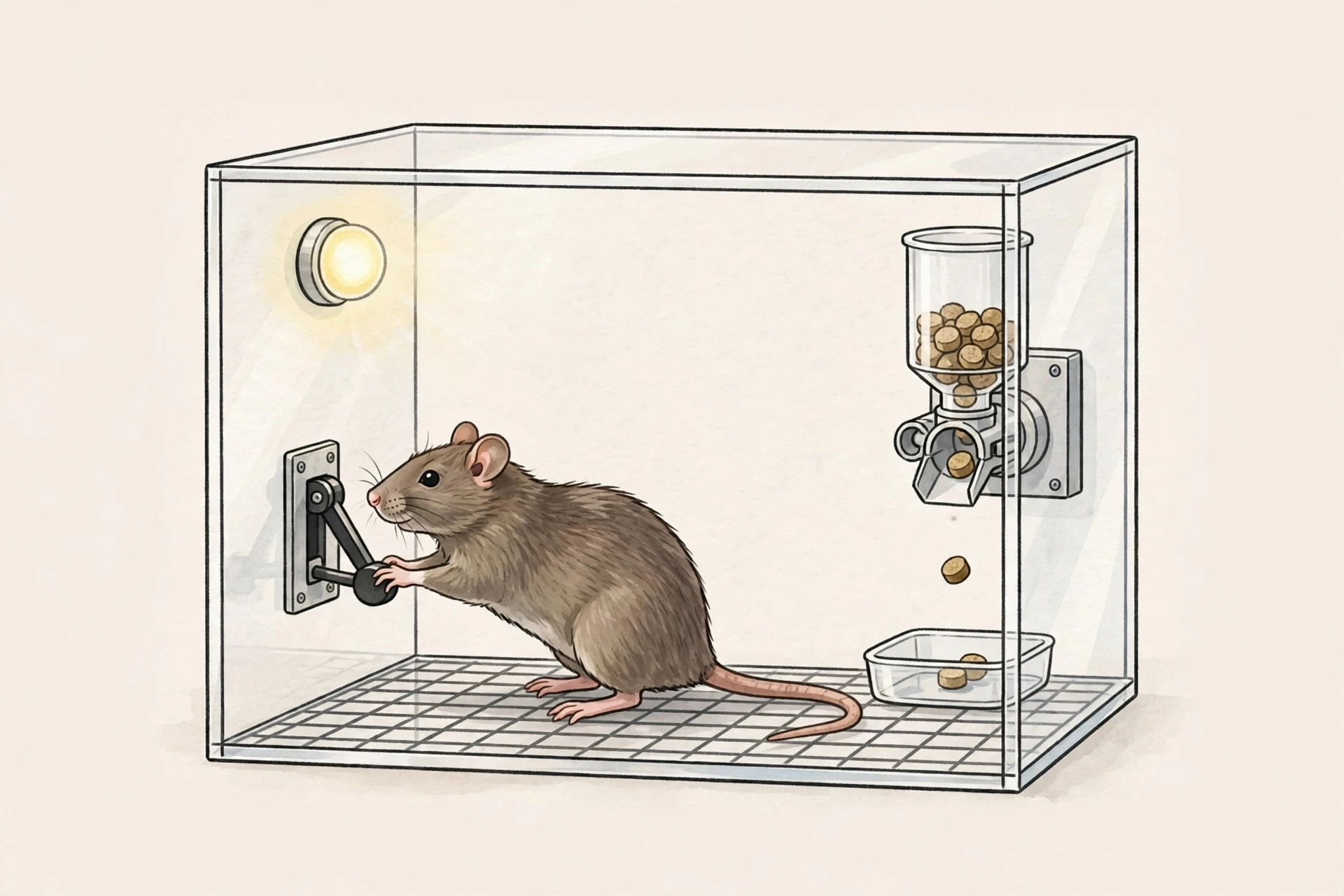
In the 1930s, the Harvard psychologist B. F. Skinner built a small chamber — later known as the Skinner box — in which a rat or a pigeon could press a lever and receive a food pellet. The setup was deliberately simple, and the results were anything but. Skinner showed that behaviour is shaped by its consequences: actions followed by a reward get repeated, and actions followed by nothing fade away. He called this operant conditioning, and the American Psychological Association's dictionary defines it as learning in which behaviour is shaped and maintained by its consequences. You can read the formal definition in the APA Dictionary of Psychology.
I remember the first time I watched a recording of one of those experiments in a lecture hall, years ago. The pigeon pecked, the pellet dropped, the pigeon pecked again. It looked almost boring — until the experimenter changed the rules. The pellet no longer came every time. It came sometimes. And the pigeon, instead of giving up, pecked faster. That small change — making the reward unpredictable — turned a calm animal into a compulsive one. I have thought about that pigeon more times than I can count, usually while watching a room full of adults refresh their feeds.
2.2 The four schedules of reinforcement
Skinner and his colleague Charles Ferster spent years mapping exactly how the timing of rewards changes behaviour. They found four main patterns, called schedules of reinforcement:
Fixed ratio: a reward after a set number of actions. Buy nine coffees, get the tenth free. Steady effort, with a short pause after each reward.
Fixed interval: a reward after a set amount of time. A weekly pay cheque. Effort ramps up as the reward approaches, then relaxes.
Variable interval: a reward after an unpredictable amount of time. Checking email for a reply. Slow, steady checking that never quite stops.
Variable ratio: a reward after an unpredictable number of actions. A slot machine. The highest, steadiest response rate of any schedule — and the hardest behaviour to extinguish once it is established.
That last one is the key to this whole article. On a variable-ratio schedule, the animal — or the person — never knows whether the next response will be the one that pays off. So it keeps responding. And keeps responding. Skinner's pigeons on variable schedules pecked until they were exhausted, long after the rewards had stopped coming entirely. The unpredictability itself is the engine.
2.3 Your phone runs on a variable-ratio schedule
Now look at your phone with Skinner's eyes. Pull down to refresh a feed: sometimes something new and delightful appears, sometimes nothing does, and you cannot predict which pull will pay off. Open a messaging app: sometimes a message from someone you care about is waiting, sometimes it is a delivery notification. Scroll through short videos: most are forgettable, one in twenty is genuinely funny, and you cannot tell in advance which one it will be. Each of these is a lever press. Each is a small gamble. And the schedule is variable-ratio, the most powerful pattern Skinner ever found.
The comparison to slot machines is not mine, and it is not poetic licence. Tristan Harris, a former Google design ethicist, has described the smartphone openly as "a slot machine in everyone's pocket." The lever is the pull-to-refresh gesture. The reels are the feed. The payout is a like, a message, a funny video — delivered on no schedule you can learn. Your brain, which evolved to keep doing whatever sometimes produces food, safety, or social connection, does what Skinner's pigeons did. It keeps pressing.
Reinforcement schedule | How the reward arrives | Response pattern | Phone equivalent |
|---|---|---|---|
Fixed ratio | After a set number of actions | High rate, brief pause after reward | Loyalty stamps; "post 5 times to unlock a badge" |
Fixed interval | After a set amount of time | Effort rises as the time approaches | Daily login bonuses; weekly streak rewards |
Variable interval | After an unpredictable time | Slow, steady checking | Checking email or messages for a reply |
Variable ratio | After an unpredictable number of actions | Very high, steady rate; hardest to stop | Pull-to-refresh, infinite scroll, slot-machine feeds |
Table 1: Skinner's four schedules of reinforcement, and where each one hides in your phone. The variable-ratio row is the one that matters most: it produces the fastest, most persistent behaviour and the greatest resistance to stopping.
2.4 Negative reinforcement: checking to escape a feeling
There is a second Skinnerian force at work, and it is quieter. Sometimes you check your phone not to gain something good, but to escape something uncomfortable — boredom, awkwardness in a lift full of strangers, the low-grade anxiety of an unanswered message, the itch of not knowing whether someone replied. When checking removes that discomfort, even briefly, the behaviour is strengthened. Psychologists call this negative reinforcement: not punishment, but the removal of something unpleasant, which makes the behaviour more likely next time.
That is why the phone comes out in waiting rooms and in the gaps between tasks. It is not only a source of rewards. It is an escape hatch from every small discomfort of being unoccupied. And a behaviour that is rewarded both ways — sometimes a treat, sometimes relief — is doubly hard to change.
3. Dopamine: The Most Misunderstood Chemical in the Story
3.1 The myth: dopamine is the pleasure chemical
Ask most people what dopamine does and they will tell you it is the brain's "pleasure chemical" — the molecule that makes you feel good when something nice happens, the chemical your phone floods you with. This story is repeated in thousands of articles, videos, and wellness posts. It is also wrong, and the correction matters more than it might seem, because the wrong story leads to the wrong fix. If dopamine were pleasure, the answer to phone overuse would be to find other pleasures, and the phone would be just one pleasure among many. The real story is stranger and more powerful.
3.2 The correction: dopamine is anticipation, not pleasure
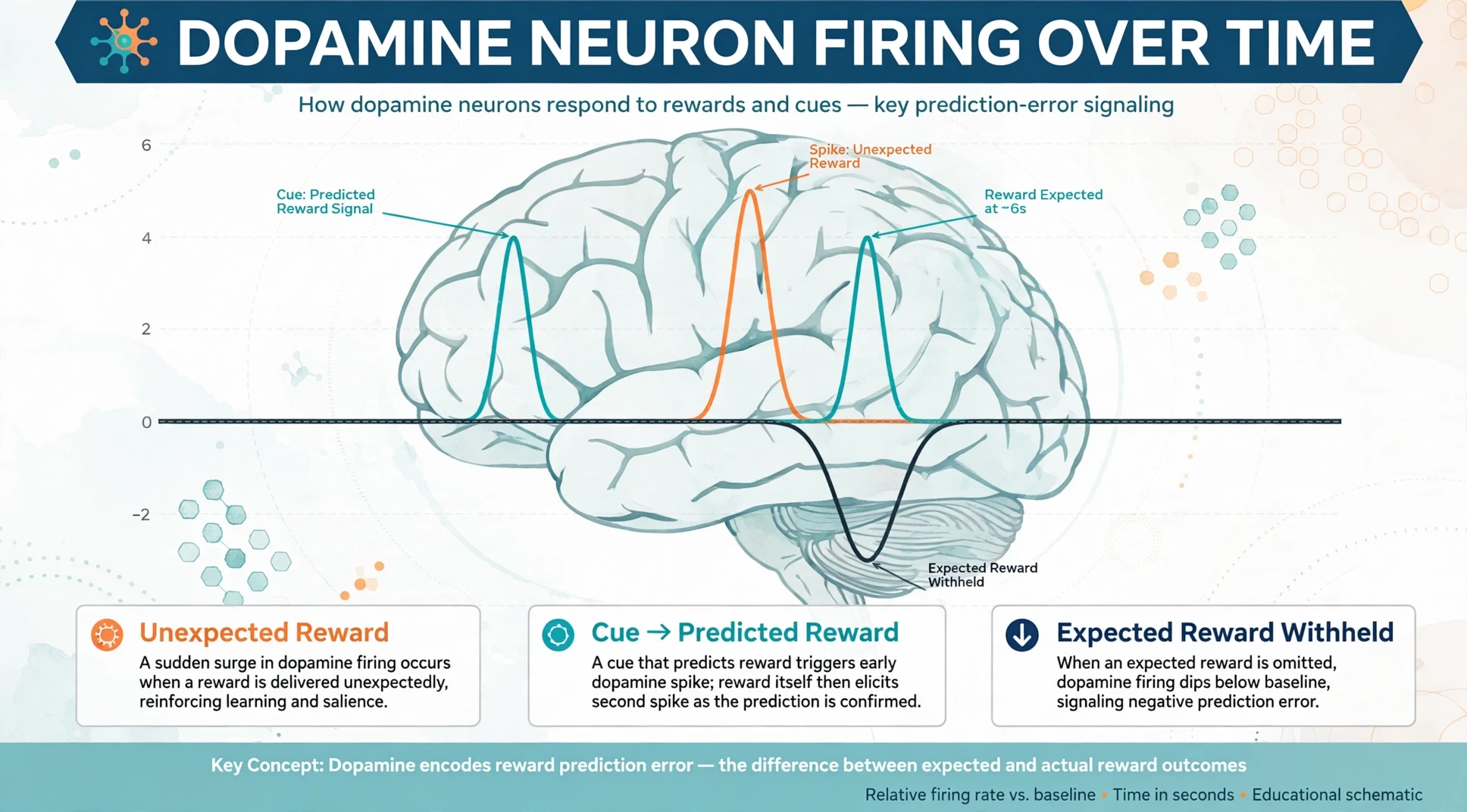
The modern understanding of dopamine comes largely from the work of neuroscientist Wolfram Schultz, who recorded the activity of single dopamine neurons in animals learning to associate a cue with a reward. The pattern he found has three parts, and each one is worth holding in mind:
Unexpected reward: early in learning, when a reward arrives by surprise, dopamine neurons fire a sharp burst at the moment of delivery.
Predicted reward: once the animal learns that a cue predicts the reward, the burst moves backwards in time. The neurons stop responding to the reward itself and fire instead to the cue — the light, the sound, the signal that a reward is coming.
Omitted reward: if a fully predicted reward is then withheld, the neurons do the opposite: they dip below their baseline firing rate at the exact moment the reward was due.
Put those three together and the conclusion is unavoidable. Dopamine does not report how good something feels. It reports the gap between what you expected and what you got — the reward prediction error. It is a learning signal and a motivation signal: it tells the brain "pay attention, something better than expected just happened" or "update your model, that did not pay off." The pleasure itself — the actual enjoyment of the food, the joke, the message — is carried largely by other systems, including the brain's own opioid chemistry. Dopamine is the wanting, not the liking. That distinction, first drawn sharply by researchers Kent Berridge and Terry Robinson, is one of the most useful ideas in all of neuroscience.
3.3 Why this makes phones so hard to put down
Now run the phone through that corrected lens. The notification badge is a cue. The red dot, the buzz, the preview line of a message — each one predicts that a reward might be coming. Dopamine fires at the cue, and what you feel is not pleasure but wanting: a pull, an itch, a sense that something might be there. You open the app. If the message is good, the prediction was right and the wanting is satisfied — briefly. If the message is dull, there is a small dip, a flicker of disappointment, and the brain updates: maybe next time. And because the rewards are variable — sometimes a message from a friend, sometimes nothing — the prediction error never settles at zero. The system stays active, alert, and hungry. Uncertainty is the fuel.
This also explains a puzzle that the pleasure story cannot. People often keep scrolling long after they have stopped enjoying it. They describe the feeling as compulsive, empty, even boring — and yet they continue. If dopamine were pleasure, that would make no sense: why keep doing something that no longer feels good? But if dopamine is wanting — a signal that says "check, there might be something" — then the behaviour can outlast the enjoyment by hours. The wanting system and the liking system are separate, and the phone is tuned to the wanting one.
I learned this distinction the slow way, by watching my own behaviour. For years I assumed my evening scrolling was something I enjoyed, because I kept doing it. Then I started paying attention to how I actually felt at 11 p.m., thumb still moving, eyes tired: not happy, not entertained — just unfinished. The feeling was not pleasure. It was the feeling of a prediction that had not yet been resolved. Naming that correctly changed how I dealt with it, because you cannot fix a wanting problem with a pleasure substitute. You fix it by changing the cues and the schedule.
"Dopamine is not the molecule of pleasure. It is the molecule of wanting — the signal that tells the brain a reward may be coming, and that it should act now to find out."
3.4 What the brain-imaging evidence can and cannot tell us
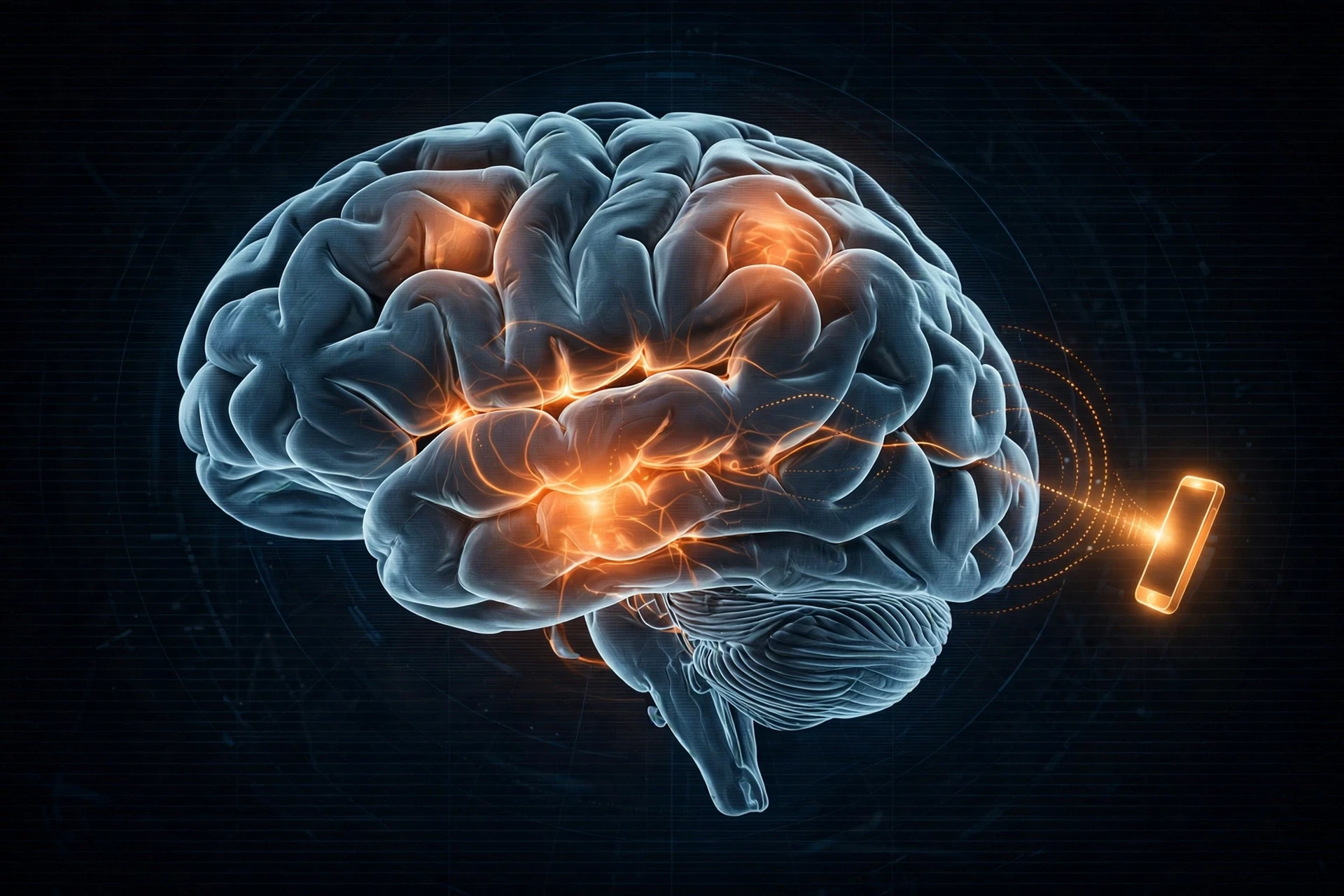
You will sometimes see headlines claiming that brain scans "prove" phones are addictive, or that a phone lights up the brain "just like cocaine." Treat those headlines with care. Brain imaging can show that phone cues activate reward-related regions, including the ventral striatum, and that people who report heavier, more compulsive phone use sometimes show different patterns of activity or connectivity in those regions. That is real, and it is interesting. But imaging studies in this area are mostly correlational, often small, and rarely able to say whether the brain differences caused the behaviour, resulted from it, or both. A scan cannot diagnose an individual, and it cannot tell you that a phone is "just like" a drug — drugs and phones act on the brain through very different routes, even when some of the same regions are involved. The honest version of the imaging story is: the reward system is engaged, the engagement looks like the engagement we see with other variable rewards, and the causal picture is still being built. That is enough to take the design seriously. It is not enough to declare a new brain disease.
4. The Slot Machine in Your Pocket
4.1 Pull to refresh: a lever you pull a hundred times a day
The pull-to-refresh gesture is a small masterpiece of behavioural design. You drag the feed downward, the little spinner turns, and new content drops in. The motion itself mimics a slot machine lever. The outcome is uncertain. The cost is tiny — a flick of a thumb — so there is almost no friction to doing it again. And because the feed is endless, there is no natural stopping point: no last page, no end of the chapter, no moment when the machine says you are done. The only stopping cue is your own decision, and decisions are exactly what a tired brain avoids.
Infinite scroll works the same way. Older designs had pages: you reached the bottom, you chose whether to continue. Infinite scroll removes the choice by removing the bottom. Each new item is a small variable reward — mostly dull, occasionally delightful — delivered on a schedule you cannot predict. The combination of a near-zero cost per pull and an unpredictable payoff is precisely the combination Skinner found hardest to extinguish.
4.2 Notifications: cues that train themselves
Notifications add a second layer. A buzz or a badge is a cue that predicts a possible reward, and cues, as we saw, are what dopamine responds to. But notifications do something cleverer still: they train you to check even when they are absent. Research on smartphone checking has found that people check their phones at high rates even when notifications are turned off — the behaviour has become a habit that no longer needs its original trigger. The cue has moved inside: boredom, a pause, a moment of uncertainty, and the hand moves on its own.
I ran a small experiment on myself one winter: notifications off for a week, all of them, including the badges. I expected the checking to fall away. It did not — not at first. For two days I checked more, reaching for a phone that had nothing to tell me, the way you might keep glancing at a door after the knock you expected never comes. By day five the checking had faded, and the quiet was startling. That two-day spike has a name in the psychology literature: an extinction burst, a temporary increase in a behaviour when its reward is removed, before it fades. Knowing the name helped me survive it. Without the name, I would probably have concluded the experiment had failed and switched everything back on.
4.3 Social rewards: the most powerful payout of all
The most potent rewards on a phone are not points or badges. They are social: a like, a reply, a comment, a message from a person whose opinion matters to you. Humans are a deeply social species, and social approval is one of the oldest rewards in our evolutionary history. A variable schedule of social rewards is therefore more powerful than a variable schedule of almost anything else. You do not know when someone will reply, what they will say, or whether the post you shared will be noticed — and that uncertainty keeps the wanting system running.
This is also why "just delete the apps" is incomplete advice for many people. The phone is not only a slot machine. It is also the place where friendships live, where family groups coordinate, where work messages arrive. The social rewards are real, and the social costs of disappearing are real too. Any honest account of phone addiction psychology has to hold both facts at once: the design exploits real learning machinery, and the connections it mediates are genuinely valuable.

5. The Hook Model: How Products Build Habits on Purpose
5.1 Four steps, repeated until automatic
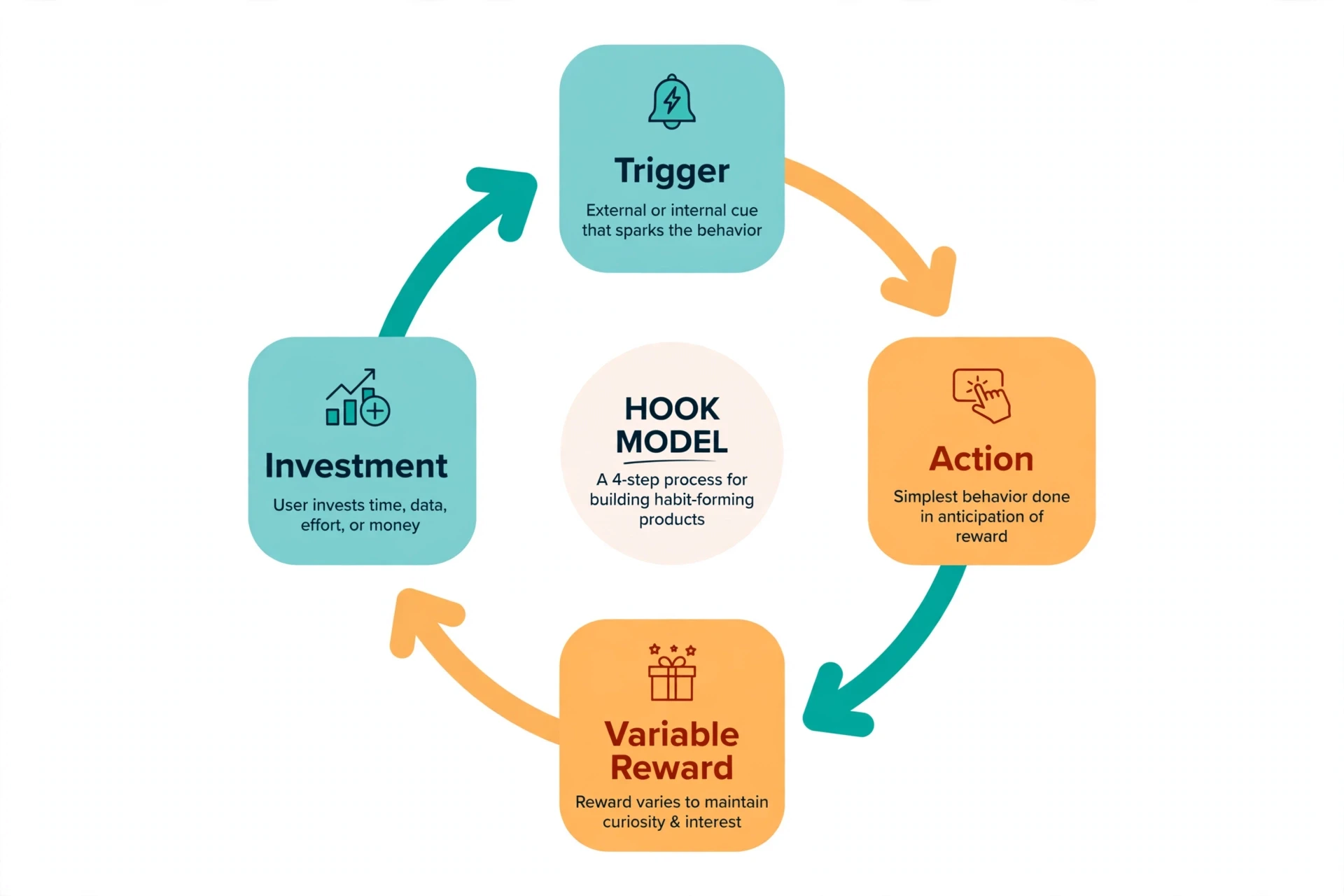
In 2014, the author and entrepreneur Nir Eyal published a model of habit-forming products that has since become standard reading in product design. He called it the Hook Model, and it has four steps: Trigger, Action, Variable Reward, Investment. The model is not a conspiracy theory. It is a design framework, taught openly, and it describes with unusual clarity what the most successful apps do.
Trigger. Something prompts the behaviour. An external trigger is a notification, an email, a badge. An internal trigger is an emotion: boredom, loneliness, anxiety, the need for a distraction. The most successful products migrate from external triggers to internal ones, so that a feeling itself becomes the prompt.
Action. The behaviour, made as easy as possible. One tap, one swipe, one flick of the thumb. Every extra step is friction, and friction kills habits, so designers remove it ruthlessly.
Variable Reward. The payoff, delivered unpredictably. A message, a like, a funny video, a piece of news. The variability is the point — it is what keeps the dopamine system engaged.
Investment. The user puts something into the product: time, data, effort, followers, a profile, a streak. Investment makes the next trigger more likely to work, because leaving now would mean abandoning what you have built. A 200-day streak is not just a number. It is a reason to open the app tomorrow.
Run that loop a few hundred times and the behaviour no longer needs a decision. The internal trigger fires, the action is automatic, the reward arrives sometimes, and the investment grows. That is a habit, in the psychological sense: a behaviour that has moved from deliberate choice to automatic routine. For a fuller account of how habits are built in the brain, see our guide to how the human brain forms memories — the same machinery of repetition and consolidation is at work.
5.2 Investment is the step people miss
Most discussions of phone overuse focus on triggers and rewards. Investment deserves more attention, because it is what makes quitting feel costly. Your photo library, your message history, your follower count, your saved posts, your carefully curated feed, your streaks — all of these are investments that raise the price of leaving. A new app has to earn your attention from nothing. An app you have invested in for three years has a head start that no amount of willpower easily overcomes.
This is also why the most effective interventions often target investment rather than willpower. Deleting an app is hard when the app holds your photos. Moving the app off the home screen, turning off its badges, or using it only on a laptop changes the loop without demanding that you abandon anything. The loop is a chain of four links; breaking any one of them weakens the whole thing.
5.3 Design is not destiny
It is worth saying plainly: the Hook Model describes design, not destiny. Millions of people use the same apps without developing compulsive patterns, and the same design that hooks one person leaves another indifferent. Individual differences — in impulsivity, in stress, in loneliness, in how much unstructured time a person has — matter enormously. The design loads the dice. It does not roll them for you. That is why the measured response is not panic about "evil tech companies" but a clear-eyed view of the incentives: products are optimised for engagement because engagement is what they are measured on, and engagement is built from the same learning machinery this article describes.
6. The Attention Economy: Why Your Focus Is the Product
6.1 If you are not paying, you are the product
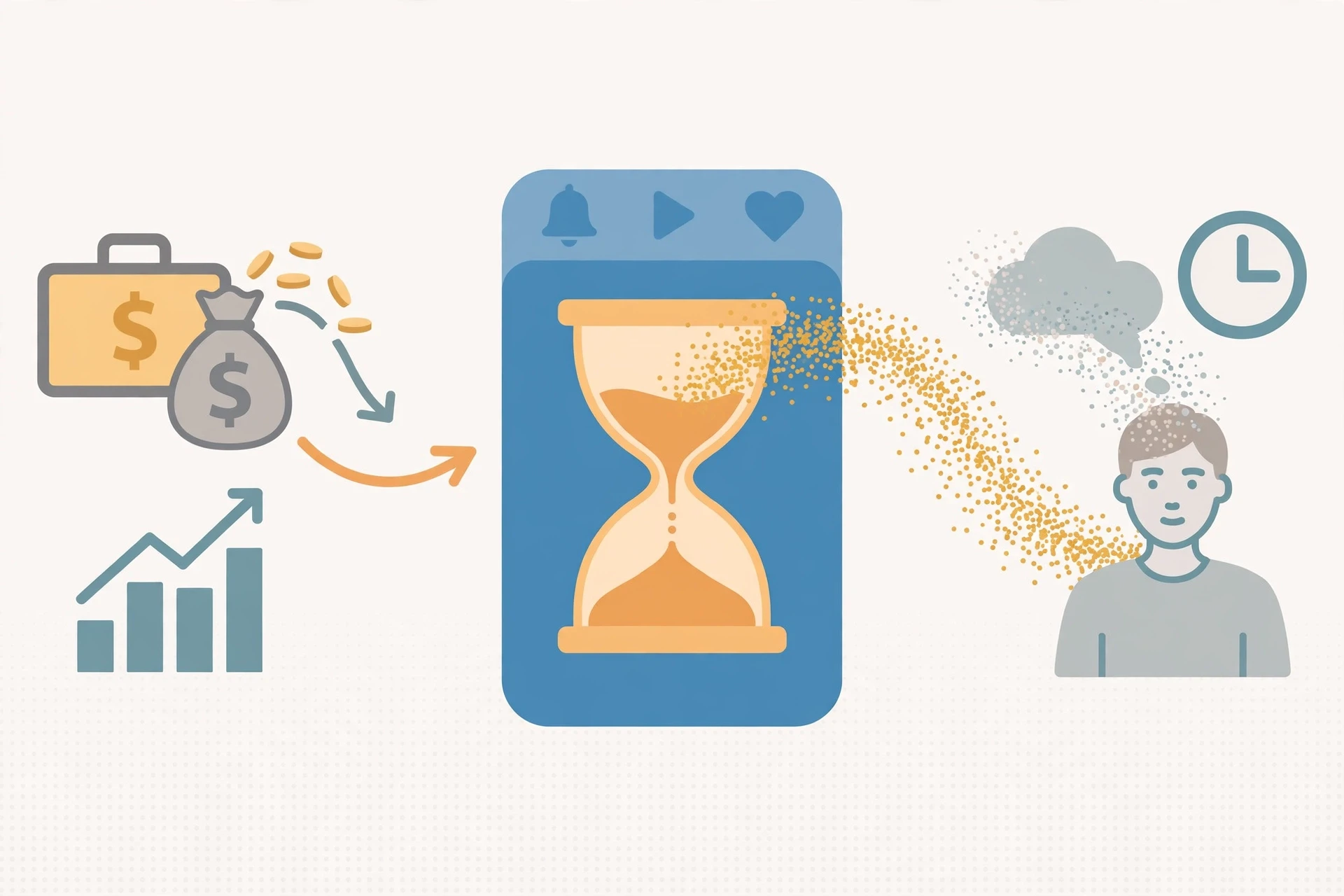
The phrase is a cliché, and like many clichés it is mostly true. Most of the apps on your phone are free to use, and they are free because their business model is advertising. Advertisers pay for attention, and attention is sold by the second. Every extra minute you spend scrolling is inventory. Every extra check is another chance to show you an ad. The economics are simple, and they explain a great deal about the design: a product that earns money from your attention has a direct financial incentive to keep your attention for as long as possible, and to bring it back as often as possible.
This is the attention economy, and it is the structural reason the variable rewards never get less variable and the feeds never get an ending. A feed with a stopping point would be a feed that stops earning. A notification system that respected your sleep would be a notification system that sold fewer impressions. None of this requires anyone to be a villain. It requires only that the metric being optimised is time spent, and that the optimisation is very, very good. That is the economic half of the answer to why phones are addictive — the other half is the psychology of the reward schedule itself.
6.2 The cost of a divided mind
The price of that attention is not only time. It is the quality of the time that remains. Research on divided attention — including the work summarised by the American Psychological Association — consistently shows that switching between tasks carries a cost: we are slower, we make more errors, and we remember less of what we were doing. The APA's overview of social media and the internet is a good starting point for the research consensus, and you can read it at the APA's social media and internet topic page.
That cost shows up in daily life in small, measurable ways. A conversation interrupted by a glance at a phone is a conversation half-heard. A page read with a phone beside it is a page half-remembered. A lecture attended with a feed one swipe away is a lecture half-learned. The memory science behind this is well established: attention is the gateway to encoding, and encoding is the gateway to memory. If you want the detail, our article on how the human brain forms memories walks through the mechanism, and our piece on brain fog covers what happens when focus stays fragmented for weeks.
6.3 Sleep: the quiet casualty
The most consequential cost is sleep. The phone is the last thing many people look at before bed and the first thing they reach for in the morning, and the research on screens and sleep is now substantial: late-night use is associated with later bedtimes, shorter sleep, and poorer sleep quality, through a mix of light exposure, arousal from content, and simple displacement — the hours spent scrolling are hours not spent sleeping. The details of sleep's architecture and why it matters for memory are covered in our guide to the science of sleep and dreams, which is worth reading alongside this article, because sleep loss and compulsive checking feed each other: a tired brain has less self-control, and a brain with less self-control checks more.
I noticed this loop in my own life before I understood it. On the nights I scrolled latest, I woke up groggy, reached for the phone before my feet hit the floor, and checked more often all day — as if the tiredness itself were a trigger. It was, in a sense: fatigue weakens the prefrontal systems that pause and deliberate, and leaves the older, faster habit systems in charge. The fix, when I finally found it, was not a better alarm or a stricter rule. It was charging the phone outside the bedroom. The habit could not run if the cue was in another room.
7. What Brain Imaging Actually Shows — and What It Does Not
7.1 The studies that exist
Over the past decade, a growing number of brain-imaging studies have looked at people who report heavy or compulsive smartphone and social media use. The typical findings are patterns rather than proof: greater reactivity in reward-related regions when people see phone cues or social feedback, differences in connectivity between reward regions and the prefrontal cortex (the area involved in planning and self-control), and sometimes smaller grey-matter volume in regions linked to attention and control. The anatomy of those regions — the reward circuitry, the prefrontal cortex, and how they connect — is covered in our guide to human brain anatomy and functions. These findings are consistent with what we would expect from a behaviour built on variable rewards. They are also consistent with many other explanations.
7.2 The three limits every honest summary must state
First, correlation is not causation. Most imaging studies compare groups at a single point in time. If heavy phone users show a different brain pattern, we cannot tell from that snapshot whether the phone use caused the pattern, whether a pre-existing pattern made heavy use more likely, or whether a third factor — stress, poor sleep, loneliness — caused both. Longitudinal studies, which follow the same people over time, are rarer and more expensive, and they are the ones that could answer the causal question.
Second, the samples are small and the definitions vary. "Problematic use" is measured differently from study to study — sometimes by hours, sometimes by questionnaire scores, sometimes by self-reported distress. Small samples and shifting definitions make results harder to replicate, and replication is the standard by which science judges itself.
Third, a brain difference is not a diagnosis. Brains change with experience: musicians, taxi drivers, and bilingual speakers all show measurable brain differences from their practice, and nobody calls those differences damage. The fact that a behaviour changes the brain is the least surprising fact in neuroscience. It is what brains do. The question that matters is whether the change is associated with harm, and how large that harm is compared with the benefits of the behaviour. For phones, that question is still open, and the honest answer is that the effect sizes in most studies are modest.
7.3 The drug comparison, handled honestly
The comparison people reach for most often is with drugs. It is understandable, and it is misleading if taken literally. Drugs of abuse act directly on the brain's chemistry: they flood reward circuits with dopamine or mimic its effects, and they can produce tolerance, physical dependence, and withdrawal. A phone acts indirectly, through learned cues and social rewards. The National Institute on Drug Abuse explains the direct route in its overview of how drugs change the brain — see Drugs and the Brain (NIDA) — and the contrast with a behavioural habit is instructive. Both involve the reward system. They do not involve it in the same way, and they do not carry the same risks. Saying a phone is "just like cocaine" is not a scientific claim. It is a metaphor that has escaped its cage.
That does not make the phone harmless. Behavioural addictions — gambling is the clearest example — are real, recognised, and capable of ruining lives, and gambling works through exactly the variable-ratio schedule this article describes. The point is one of degree and mechanism, not a verdict of harmlessness. A behaviour can be powerfully compelling, can crowd out sleep and relationships, and can deserve serious attention, without being identical to a drug. Precision here is not pedantry. It is what keeps the conversation honest — and what keeps the solutions realistic.
8. Why Willpower Alone Keeps Losing
8.1 The wrong battlefield
If you have ever set a screen-time limit, broken it by noon, and concluded that you simply lack discipline, you have fought on the wrong battlefield. Willpower is a deliberate, effortful process. It lives in the prefrontal cortex, it tires with use, and it is weakest exactly when you need it most — when you are tired, stressed, bored, or hungry. Phone checking, by contrast, is a habit: fast, automatic, and triggered by cues you barely notice. Asking willpower to beat a habit is like asking a committee to outrun a reflex. The committee is smarter. The reflex is faster.
This is not a counsel of despair. It is a change of strategy. The research on habit change is consistent on one point: changing the environment beats changing the mind. You do not need a stronger resolve. You need fewer cues, more friction, and a different default. The habit runs on triggers and ease; remove the triggers and add friction, and the habit starves. That is the practical answer to why phones are addictive in daily life: the behaviour is automatic, and automatic behaviours are beaten by design, not by debate with yourself.
8.2 The stress connection
Stress deserves its own paragraph, because it is one of the strongest drivers of compulsive checking. When stress hormones rise, the brain shifts toward habitual, automatic behaviour and away from deliberate, goal-directed behaviour. That is a sensible survival design — in a genuine emergency, you want fast routines, not slow deliberation — but it means that on the most stressful days, the phone habit is at its strongest and your ability to resist it is at its weakest. The stress hormone cortisol is part of this story, and its effects on the brain and body are covered in our article on high cortisol symptoms. If your checking spikes during stressful weeks, that is not a character flaw. It is the predicted outcome of a stressed brain running its fastest available routine.
Anxiety plays a similar role. For many people, the phone is checked not for pleasure but for reassurance: did they reply, did anyone react, is everything all right? Each check delivers a small dose of relief, and relief is a reward. The loop tightens. Our article on anxiety and depression explains the underlying science, and it is worth reading if the checking feels driven by worry rather than by boredom, because the fix for a reassurance habit is different from the fix for a boredom habit.
8.3 The loneliness trap
There is a sadder loop, too. People who feel lonely often turn to the phone for connection, and the phone offers a thin version of it: likes and comments instead of conversation, the sight of other people's social lives instead of participation in one. The thin version can take the edge off the loneliness without resolving it, which makes it easy to return to — and each return is time not spent on the thicker forms of connection that actually help. The science of loneliness is a large topic, and it is worth taking seriously rather than treating the phone as its cause or its cure. The phone is, for lonely people, often both a symptom and a poor substitute. Recognising which of those it is, in your own life, is the first step to changing it.
9. Misconceptions: What Most People Get Wrong
Much of phone addiction psychology is misunderstood in the same few ways, and each misunderstanding points to the wrong fix. Clearing them up is not a side note — it is the point, because the question of why phones are addictive has a different answer depending on which myth you believe.
9.1 "Dopamine is the pleasure chemical, and phones flood you with it"
This is the most repeated error in the whole conversation, and we have already corrected it in Section 3 — but it is worth repeating, because the correction changes the remedy. Dopamine is anticipation and learning, not pleasure. Your phone does not flood you with a pleasure chemical. It keeps your wanting system in a state of unresolved prediction, and that state is what keeps your thumb moving. If you take one idea from this article, take this one.
9.2 "Phone addiction is just like drug addiction"
No — and the difference matters for treatment. Drugs act directly on brain chemistry and can produce physical dependence and withdrawal. Phone overuse is a behavioural pattern built by reward schedules, habit loops, and social rewards. The comparison to gambling is closer than the comparison to drugs, because gambling runs on the same variable-ratio schedule. But even there, the stakes and the harms differ. Precision is not a way of minimising the problem. It is a way of matching the solution to the actual mechanism.
9.3 "It's just a lack of willpower"
Willpower is real, and it matters, but it is the wrong explanation for a behaviour that has been engineered to bypass deliberation. Blaming willpower also backfires: it makes people feel ashamed, and shame is a stressor, and stress strengthens habitual behaviour. The people who change their phone habits most successfully are rarely the ones with the strongest resolve. They are the ones who redesign their environment so that resolve is rarely needed.
9.4 "A digital detox will fix it"
A weekend without a phone can be refreshing, and it can reveal how much of your checking was automatic. But a detox is a pause, not a cure. The cues, the apps, and the schedules are all still there on Monday morning, and the habit returns within days unless something structural has changed. Detoxes are useful as a diagnostic — they show you the shape of the habit — and weak as a treatment, because they treat the behaviour as a toxin to be flushed rather than a learned pattern to be rebuilt. The durable changes are smaller and less dramatic: fewer notifications, more friction, a phone that sleeps in another room.
9.5 "Young people are the problem; adults are fine"
Heavy, compulsive phone use is not confined to teenagers. Adults check their phones during meetings, at dinner tables, in bed, and at traffic lights. The mechanisms in this article — variable rewards, dopamine prediction errors, the Hook Model — do not have an age limit. Younger users may be more exposed, and their brains are still developing, which is a genuine reason for extra care around children and adolescents. The National Institute of Mental Health's work on technology and mental health treatment is a useful starting point for the research picture — see NIMH: Technology and the Future of Mental Health Treatment. But the idea that this is someone else's problem, belonging to another generation, is a comfortable fiction. The pigeon in Skinner's box did not check its age before it started pecking.
9.6 "If I just delete social media, the problem is solved"
Deleting one app often moves the behaviour rather than ending it. The checking migrates to email, news, messages, or another app, because the underlying loop — cue, action, variable reward — is still intact and looking for an outlet. The app is the venue, not the mechanism. That is why the most effective changes target the loop itself: the triggers, the ease, the schedule, and the investment.

10. What Actually Helps: Rebuilding the Loop
10.1 Start with the triggers
The cheapest intervention is also the most effective: turn off the external triggers. Notifications are cues, and every cue is a chance for the wanting system to fire. Turn off all non-essential notifications — the badges, the banners, the sounds — and keep only the ones that genuinely require your attention, such as calls from family or messages from a small number of people. Do this for a week, not a day. Remember the extinction burst: the checking may spike for a day or two as the brain protests the missing rewards, and then it fades. That spike is evidence the intervention is working, not evidence that it failed.
10.2 Add friction to the action
Make the behaviour slightly harder, and the habit weakens. Practical ways to do this:
Move the most compelling apps off the home screen, into a folder, or off the phone entirely. A behaviour that takes three taps instead of one is a behaviour you will do less often.
Use grayscale mode in the evenings. Colour is part of the reward; a grey screen is measurably less compelling.
Set the phone to require a passcode or a deliberate unlock for specific apps, rather than face recognition. A second of friction is often enough for the deliberate mind to catch up with the automatic hand.
Charge the phone outside the bedroom. This single change addresses the two most vulnerable moments of the day — the last hour before sleep and the first hour after waking — and it protects sleep, which in turn protects self-control.
10.3 Change the schedule
Variable rewards are powerful because they are unpredictable. You can make them more predictable, and therefore less compelling, by batching: check messages and feeds at set times — say, three times a day — instead of continuously. Batching converts a variable-interval schedule into something closer to a fixed one, and fixed schedules produce far less compulsive behaviour. It also restores a natural stopping point: the check has a beginning and an end, rather than an open-ended drift.
10.4 Replace the investment, not just the app
Habits are easier to replace than to erase. The phone fills genuine needs: connection, information, entertainment, relief from boredom. A plan that removes the phone without replacing those needs will fail, because the needs do not go away. The practical question is not "how do I stop using my phone" but "what will I do instead, at 2 a.m., in a waiting room, on a train?" A book by the bed, a podcast for the commute, a walk for the lunch break, a real conversation for the lonely evening — these are not platitudes. They are replacement behaviours, and replacement is how habit change actually works.
10.5 Know when to ask for help
For most people, the steps above are enough. But if phone use is interfering seriously with sleep, work, relationships, or mood — if you have tried to cut back repeatedly and cannot, if you feel distressed when separated from the phone, or if the checking is driven by anxiety that does not lift — that is worth taking to a professional, just as you would take any other persistent behavioural problem. A clinician can help distinguish a habit from an anxiety problem, a sleep problem, or a mood problem, and can offer structured approaches such as cognitive-behavioural strategies that target the loop directly. Asking for help is not an admission of weakness. It is the recognition that some loops are easier to rebuild with a guide.
"You cannot out-willpower a system designed to bypass willpower. Change the cues, add friction, and give the habit somewhere better to go."

The Thread That Ties It Together
So why are phones addictive? Not because of one chemical, and not because of one design trick. Because a chain of mechanisms, each well understood on its own, has been assembled into a single object that lives in your pocket. Skinner showed that unpredictable rewards produce the most persistent behaviour. Schultz showed that dopamine tracks anticipation, not pleasure — so the wanting can outlast the enjoyment. Eyal's Hook Model showed how triggers, easy actions, variable rewards, and investment turn a behaviour into a habit. And the attention economy showed why the design keeps getting better at holding you: your focus is the product being sold.
None of that makes you powerless. It makes you informed, and information changes the game. A person who knows that the itch at 2 a.m. is a prediction error, not a genuine need, can meet it differently. A person who knows that the checking spikes for two days when notifications go off — and then fades — can survive the spike. A person who knows that the fix is environmental, not moral, can stop blaming themselves and start moving the charger.
The phone is not going away, and it should not. It carries your maps, your messages, your photographs, your work. The goal was never to defeat it. The goal is to use it deliberately — to decide, rather than to be decided for. That is a smaller ambition than a detox, and a more durable one. Start tonight, with the charger in another room, and see what the morning feels like.
Frequently Asked Questions
Why are phones addictive?
Phones are addictive because they combine several powerful psychological mechanisms: variable-ratio rewards (you never know when the next check will pay off), dopamine-driven anticipation (the brain's wanting system fires at cues, not at pleasure), habit loops built by triggers and easy actions, and an attention economy that profits from every extra minute. No single mechanism explains it; the combination does.
Is phone addiction a real addiction?
Phone overuse is best described as problematic or compulsive use, not an addiction in the same sense as a drug addiction. Drugs act directly on brain chemistry and can cause physical dependence; phones act through learned behaviour, reward schedules, and social rewards. The comparison to gambling is closer than the comparison to drugs, because gambling runs on the same variable-ratio schedule. The behaviour can still cause real harm to sleep, work, and relationships, and it deserves to be taken seriously.
Does dopamine make you feel pleasure when you use your phone?
No — and this is the most common misunderstanding in the whole topic. Dopamine is mainly a signal of anticipation and learning: it fires when a reward is unexpected, and when a cue predicts a reward is coming. The actual feeling of pleasure is carried largely by other brain systems. That is why people keep scrolling long after they have stopped enjoying it: the wanting system and the liking system are separate, and the phone is tuned to the wanting one.
Why do I check my phone even when there are no notifications?
Because the behaviour has become a habit that no longer needs its original trigger. Early on, notifications prompt the check. With repetition, the cue moves inward: boredom, a pause, a moment of uncertainty, or simply a free hand becomes enough. Research has found that people check their phones at high rates even with notifications turned off. The habit has been internalised, and the hand moves before the mind has decided anything.
What is the Hook Model?
The Hook Model, described by Nir Eyal, is a four-step design framework for habit-forming products: Trigger (something prompts the behaviour), Action (the behaviour, made as easy as possible), Variable Reward (an unpredictable payoff), and Investment (the user puts time, data, or effort into the product, making it harder to leave). Each loop makes the next one easier to start. The model is taught openly in product design, and it describes with unusual clarity what the most successful apps do.
Does a digital detox cure phone addiction?
A short break from the phone can be refreshing and can reveal how much of your checking is automatic, but it is a pause, not a cure. The cues, apps, and reward schedules are all still there when you return, and the habit usually comes back within days unless something structural has changed. Durable change comes from redesigning the loop: fewer notifications, more friction, batched check-ins, a phone that sleeps in another room, and a replacement for each need the phone was filling.
How can I stop checking my phone so much?
The evidence points to environmental changes rather than willpower. Turn off non-essential notifications for a week and expect a brief spike in checking (an extinction burst) before it fades. Move compelling apps off the home screen, use grayscale in the evenings, batch your check-ins to set times, and charge the phone outside the bedroom. If the use is seriously interfering with sleep, work, relationships, or mood, or you cannot cut back despite repeated attempts, consider speaking to a clinician — structured approaches such as cognitive-behavioural strategies can help rebuild the loop.
Sources
American Psychological Association, APA Dictionary of Psychology — Operant Conditioning: https://dictionary.apa.org/operant-conditioning
Pew Research Center — Americans' Use of Mobile Devices (Mobile Fact Sheet): https://www.pewresearch.org/internet/fact-sheet/mobile/
National Institute on Drug Abuse (NIDA) — Drugs and the Brain: https://nida.nih.gov/publications/drugs-brains-behavior-science-addiction/drugs-brain
American Psychological Association — Social Media and the Internet: https://www.apa.org/topics/social-media-internet
National Institute of Mental Health (NIMH) — Technology and the Future of Mental Health Treatment: https://www.nimh.nih.gov/health/topics/technology-and-the-future-of-mental-health-treatment
Schultz, W., Dayan, P., & Montague, P. R. (1997). A neural substrate of prediction and reward. Science, 275, 1593–1599. (Foundational research on dopamine as a reward-prediction signal.)
Schultz, W. (1998). Predictive reward signal of dopamine neurons. Journal of Neurophysiology, 80(1), 1–27.
Skinner, B. F., & Ferster, C. B. (1957). Schedules of Reinforcement. (The four reinforcement schedules, including variable ratio.)
Berridge, K. C., & Robinson, T. E. (1998). What is the role of dopamine in reward: hedonic impact, reward learning, or incentive salience? Brain Research Reviews, 28(3), 309–369. (The wanting-versus-liking distinction.)
Eyal, N. (2014). Hooked: How to Build Habit-Forming Products. (The Hook Model: Trigger, Action, Variable Reward, Investment.)