

I was twenty-three, sitting on a borrowed sofa in a flat I could barely afford, when my neighbour knocked on my door holding a scratch card. He had won the equivalent of a small car. We stood in the hallway and laughed, and for about a week he was the happiest person I knew. He bought a television, took his mother out for dinner, and told everyone who would listen that his life had changed. A year later, I ran into him in the same hallway. He was carrying groceries, worrying about the same rent, and the television was just a television. Nothing terrible had happened. The money had simply stopped feeling like money. That hallway moment has stayed with me longer than most of my formal training, because it asked the question that the science of happiness tries to answer with data instead of slogans: why does getting what we want so rarely change how we feel for long?
The science of happiness is not a shelf of cheerful advice. It is a research field — part psychology, part neuroscience, part economics — that measures how people actually feel, day by day, and tests which parts of life move those feelings in a lasting way. Researchers call the core subject subjective well-being: how people evaluate their own lives. And what makes us happy, it turns out, is a stranger and more hopeful story than either the self-help industry or the cynics suggest. Some of what we chase barely matters. Some of what we neglect matters enormously. And some of the most quoted numbers in the field are wrong, or at least far less certain than they sound.
This article separates what the evidence supports from what it does not. We will look at the hedonic treadmill, the famous 50-10-40 split and the debate around it, the eighty-year Harvard study that put relationships at the centre of a good life, the money question that two rival research teams finally settled together, and the small daily practices — gratitude, flow, kindness, time spent well — that have survived repeated testing. Where the science is unsettled, I will say so. Happiness deserves that honesty.
1. What Do We Mean by Happiness?
1.1 Two kinds of happiness, and why the difference matters
Ask ten people what happiness means and you will get ten answers, which is exactly the problem researchers faced in the 1960s and 1970s. A word that means everything measures nothing. So psychologists split it into two related but distinct ideas, and the split turns out to matter for almost every finding that follows.
The first is hedonic well-being: pleasure in the moment. The warmth of a good meal, the laugh at a friend's joke, the relief of a deadline met. It is real, it is measurable, and it passes. The second is eudaimonic well-being, from the Greek word for a life well lived: the sense that your life has purpose, that you are growing, that what you do matters to someone beyond yourself. A parent awake at 3 a.m. with a sick child is not enjoying the moment, yet may still describe their life as deeply meaningful. A person who spends a year training for a marathon endures months of discomfort for a satisfaction that has little to do with pleasure.
Most work in the science of happiness measures both, because they move in different ways. A pay rise can lift momentary mood and life satisfaction at different rates. A difficult but meaningful project can lower daily pleasure while raising life satisfaction. When a study says "happiness rose," always ask which kind the researchers measured. The confusion between the two is behind half the misleading headlines in this field.
1.2 How scientists measure something so personal
If happiness is subjective, how can the science of happiness be science? The answer is that researchers stopped trying to define happiness from the outside and started asking people, carefully and repeatedly. The standard tools are simple: life-satisfaction scales ("On a scale of 0 to 10, how satisfied are you with your life as a whole?"), daily mood diaries, and experience sampling — pinging people on their phones at random moments and asking, "How do you feel right now?" That last method matters, because memory is a poor witness. Ask someone how happy they were last week and they will tell you a story about their week; ask them in the moment and they tell you how they feel.
I learned this the hard way in my early research years. I once ran a small study asking volunteers to rate their mood at the end of each day for a month. The daily ratings were noisy and honest. The end-of-month summary each person gave me was a different creature entirely — smoother, tidier, and heavily coloured by whatever had happened in the final three days. My supervisor smiled when I showed her the mismatch. "People remember the ending," she said, "and they remember the peak. They do not remember the average." Daniel Kahneman later formalised this as the difference between the experiencing self, which lives through each moment, and the remembering self, which tells the story afterwards. Both are real. They simply disagree, often.
That disagreement is not a flaw in the science of happiness; it is one of its findings. A good life, by the research definition used in the science of happiness, is one that scores well on both: pleasant days and a satisfying story when you look back.
Kind of well-being | What it captures | Example | How it is measured |
|---|---|---|---|
Hedonic well-being | Pleasure and comfort in the moment | Laughing with friends over dinner | Momentary mood ratings, experience sampling |
Evaluative well-being | Judgement of your life as a whole | Feeling your life is on the right track | Life-satisfaction scales (0–10) |
Eudaimonic well-being | Purpose, growth, meaning | Raising a child, finishing a hard project | Purpose and meaning questionnaires |
Table 1: Three faces of happiness. They overlap, but they are not the same thing — and they respond to different parts of life.
2. The Thermostat Inside Us: The Happiness Set Point
2.1 Why good news fades
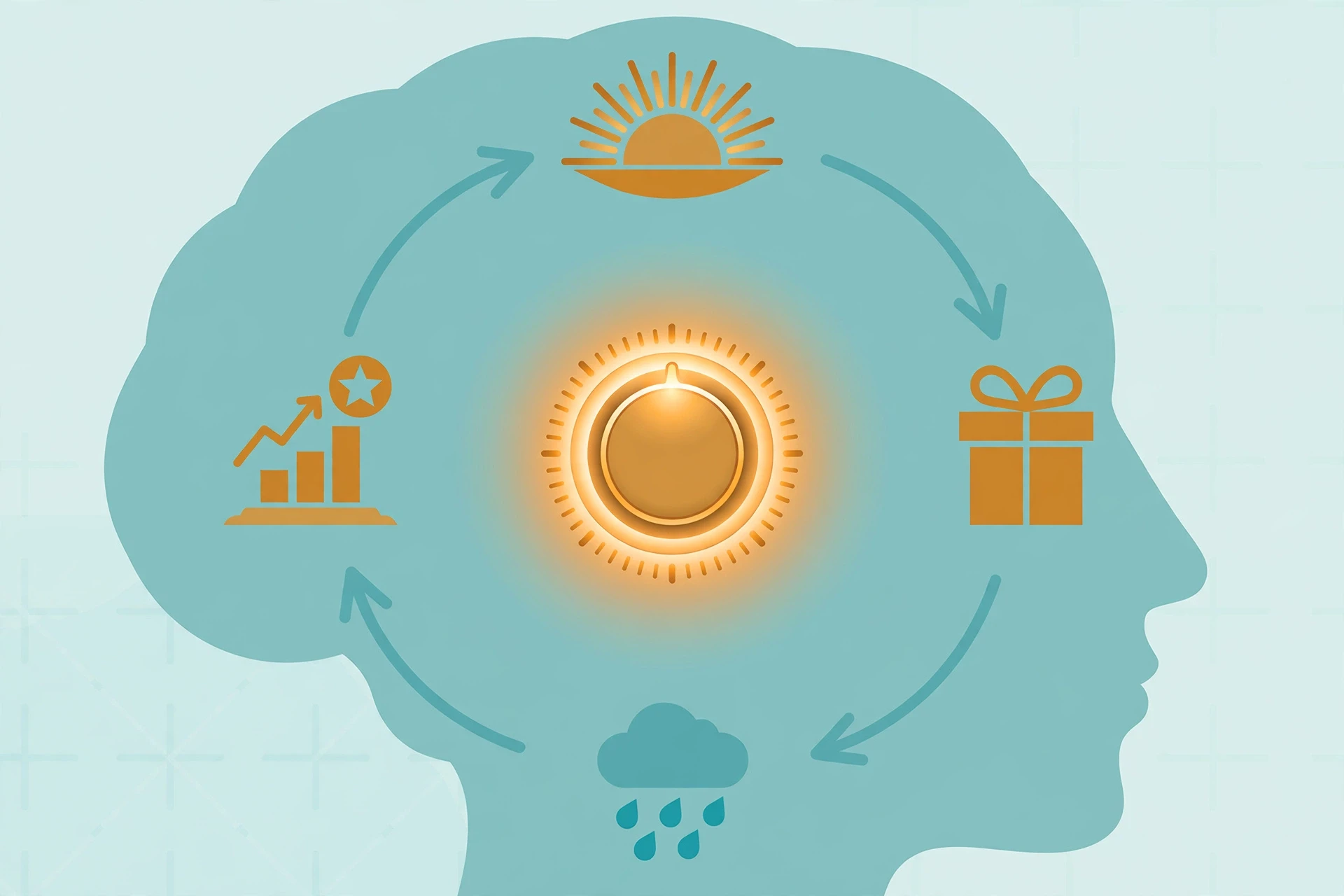
Here is a pattern every reader will recognise. You get the promotion, the flat, the exam result. For a few weeks, everything feels brighter. Then, quietly, the brightness thins out. The new salary becomes the salary. The bigger flat becomes the flat. Nothing went wrong; the feeling simply wore off. Psychologists call the baseline you return to your set point, and the return journey is called hedonic adaptation.
In the science of happiness, the idea has roots in twin studies. Identical twins, even when raised apart, tend to report similar levels of well-being — more similar than fraternal twins do. That resemblance is the main evidence that temperament, the raw material of mood, is partly inherited. Some people are simply wired to be sunnier, just as some are wired to worry more. The heritability estimates that circulate in textbooks sit near 40 to 50 percent of the variation between people. But that number describes differences across a population, not a fixed ceiling inside any one person. A heritability of 50 percent does not mean half of your happiness is locked away from you. It means that, in the population studied, about half of the differences between people tracked with genetic differences. Your own range is wider than that sentence sounds.
2.2 A set point is a range, not a prison sentence
The strongest early version of set-point theory said something bolder: that each person has a fixed happiness level and that life events, good or bad, can only push them away from it briefly. That version has not survived. Long-term studies that follow the same people for decades — the German Socio-Economic Panel, the British Household Panel Study — show that set points can shift. People who marry, divorce, lose a job, or develop a lasting disability do not all return to exactly where they started. Some settle higher. Some settle lower. The thermostat exists, but someone can turn the dial.
I think of it the way a colleague once described it to me over coffee after a conference: "It is less like a thermostat and more like a river's usual level. Rain raises it, drought lowers it, and the banks change shape over the years." That image has stuck with me because it keeps both truths in view. Adaptation is real, and change is possible.
The practical question in the science of happiness, then, is not whether a set point exists. It is which changes move it, and which ones only splash.
3. The Hedonic Treadmill: Why Getting More Rarely Feels Like More
3.1 Brickman and Campbell's uncomfortable idea
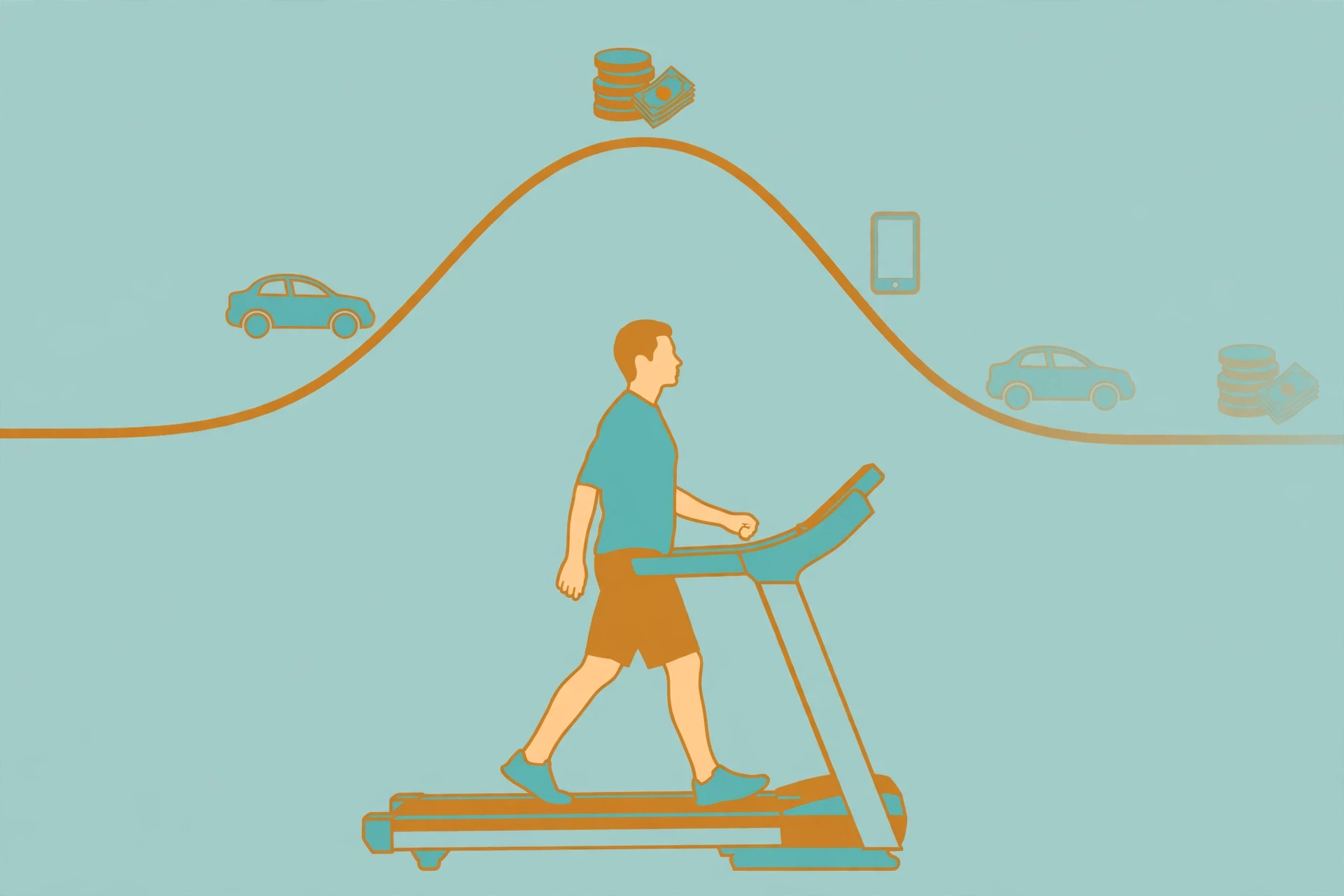
In 1971, psychologists Philip Brickman and Donald Campbell gave the adaptation pattern its most famous name: the hedonic treadmill. Their argument was simple and unsettling. As our circumstances improve, our expectations rise in step. The new normal becomes the old normal, and we have to keep running — earning more, buying more, achieving more — just to stay in the same emotional place.
Seven years later, Brickman and his colleagues published the study that made the idea famous in the science of happiness. They interviewed 22 lottery winners, people who had won between $50,000 and $1,000,000, alongside people who had become paraplegic after accidents, and a comparison group. The winners were not dramatically happier in everyday life than the comparison group. The accident victims, while clearly affected, were not as miserable as outsiders assumed. Both groups had adapted, in opposite directions, toward their baselines. The study was small, and later research has refined it considerably, but it launched the modern understanding that people adjust to fortune and misfortune to a striking degree.

3.2 Why adaptation happens
Adaptation is not a design flaw. It is the same machinery that lets your eyes adjust to a dark room and your nose stop noticing a smell after a few minutes. The brain is a change detector, not an absolute meter. It notices the new salary against the old one, the new house against the old one, and then it recalibrates. That recalibration keeps us sensitive to what has changed, which is useful for survival. It also means that steady, unchanging good fortune stops registering.
Two mechanisms drive the treadmill. The first is habituation: the emotional response to a repeated stimulus fades. The second is rising aspiration: the goalposts move. The car that once felt luxurious becomes the minimum acceptable car. The salary that once felt generous becomes the salary you need just to keep up. Daniel Gilbert's research in the science of happiness on impact bias adds a third piece: we systematically overestimate how intensely, and for how long, future events will affect us. We predict that the promotion will transform us and the break-up will destroy us. Both predictions are usually wrong in the same direction — we recover faster than we expect, from good news as well as bad.
3.3 Adaptation is real, but it is not total
The early, strong version of the treadmill said adaptation was complete and universal. That version is wrong, and the correction matters. A careful 2006 review by Ed Diener, Richard Lucas, and Christie Scollon showed that adaptation is real but incomplete and uneven. People adapt quickly and almost fully to some events, such as marriage, and far more slowly — or never fully — to others, such as long-term unemployment, chronic disability, or bereavement. The treadmill has friction. Some things keep hurting. Some things keep helping.
That unevenness is good news for anyone trying to live well — and it is one of the most useful findings in the science of happiness. It means the choice is not between chasing the next thrill and giving up. It is between the things that adapt away quickly and the things that resist adaptation. Novelty, variety, and appreciation slow the treadmill down. A good meal eaten mindfully, a walk taken on a different route, a friendship you actively notice — these resist fading precisely because they are not the same stimulus repeated. Psychologist Sonja Lyubomirsky's hedonic-adaptation-prevention model makes this point directly: the practices that keep working are the ones that stay fresh and that we keep noticing.
"People remember the ending, and they remember the peak. They do not remember the average." — my supervisor's warning about mood diaries, and a fair summary of why memory-based happiness surveys need the backup of moment-by-moment measurement.
4. The 50-10-40 Split: A Famous Pie Chart, and the Argument About It
4.1 What the pie chart claims
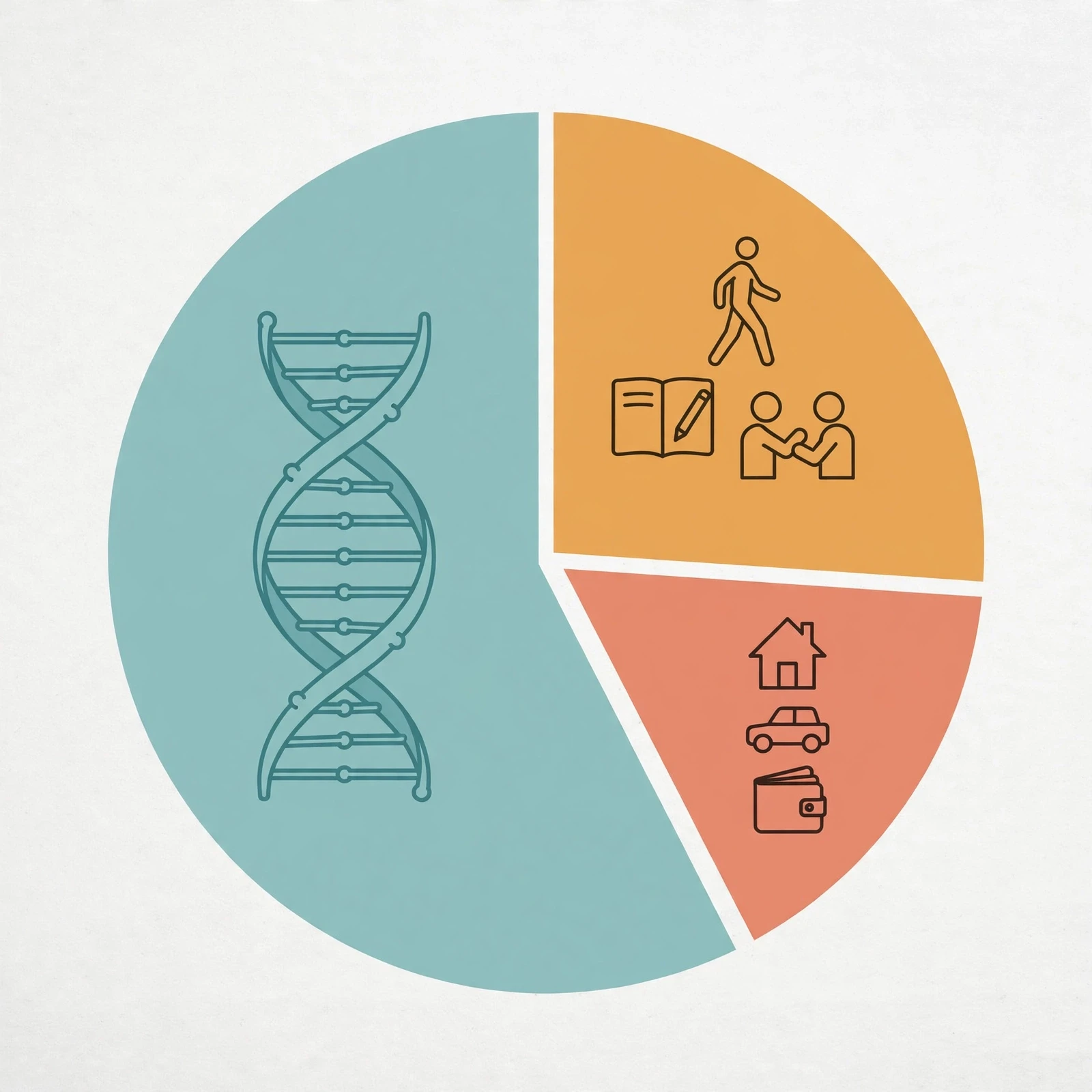
No image in the science of happiness is more shared than the pie chart from Lyubomirsky, Sheldon, and Schkade's 2005 paper, "Pursuing Happiness: The Architecture of Sustainable Change." It divides the differences in happiness between people into three slices: about 50 percent from a genetically influenced set point, about 10 percent from life circumstances (income, marital status, where you live, what you own), and about 40 percent from intentional activities — the things you choose to do, day by day. The message was hopeful: the key to happiness lies less in changing your circumstances than in your daily practices.
4.2 Why researchers pushed back
The pie chart has been argued about ever since, and the argument is worth understanding, because it shows how the science of happiness corrects itself in public. The numbers were never measurements from a single study. They were preliminary estimates assembled from earlier research: twin-study heritability for the genetic slice, correlations between circumstances and well-being for the small slice, and the remainder — the 40 percent — was what was left over. A 2020 reanalysis by Nick Brown and Julia Rohrer argued that the 40 percent figure could, with equally plausible inputs, be as low as 5 percent, and that the slices cannot be separated so neatly because genes, circumstances, and behaviour interact rather than adding up like ingredients.
Lyubomirsky herself has since said the chart has been widely misinterpreted, while standing by its central claim: that people can intentionally improve their well-being, and that intentional activity matters more than chasing circumstances. In a 2019 revisit, she and Sheldon acknowledged the 40 percent estimate may have been too high and added important nuance. That is science working as it should — a useful model, criticised, revised, and kept for the part that survives testing.
4.3 What survives the debate
Three things survive in the science of happiness. First, temperament matters; some of us start from a sunnier baseline. Second, circumstances matter less than we think for people whose basic needs are met — and far more than the pie chart suggests for people whose needs are not met, a point the original model handled poorly. Poverty, unsafe housing, and chronic illness are not 10-percent problems. Third, daily intentional activity is the largest lever most of us can actually pull, even if the exact size of that lever is uncertain. The pie chart is best read as a direction, not a recipe: invest in what you do, not only in what you have.
5. Relationships: The Strongest Predictor We Have
5.1 Eighty years of following the same lives
If the science of happiness has a single headline finding, it comes from the Harvard Study of Adult Development, the longest study of adult life ever conducted. It began in 1938 with two groups: 268 Harvard undergraduates — the Grant Study — and 456 boys from Boston's most disadvantaged neighbourhoods — the Glueck Study. Researchers have followed them, and later their children, for more than eighty-five years, with interviews, medical records, and brain scans. The study's director, psychiatrist Robert Waldinger, summarises the result in one sentence: "Good relationships keep us happier and healthier. Period." The Harvard Gazette's account of the study, and the study's own site, both carry that finding in full.
What makes the result so striking in the science of happiness is what did not predict a good old age. It was not wealth, fame, social class, or IQ. It was the quality of close relationships. People who were most satisfied in their relationships at age 50 were the healthiest at age 80 — and relationship satisfaction at 50 predicted physical health at 80 better than cholesterol levels did. People in securely attached relationships at 80 had sharper memories and slower cognitive decline. Loneliness, by contrast, behaved like a toxin: people who were more isolated than they wanted to be were less happy, their health declined earlier, and their memory faded faster.
5.2 Why relationships protect health
The mechanism, as the science of happiness explains it, is not mysterious, and it connects directly to other Sciory articles. Close relationships buffer stress. A trusted person to talk to lowers the body's stress response — the same cortisol system described in our article on high cortisol symptoms — and a calmer stress system protects the heart, the immune system, and the brain. Relationships also give life structure: someone who notices when you skip meals, who walks with you, who argues with you about seeing a doctor. And they give meaning, which is the eudaimonic half of happiness. Our article on anxiety and depression covers the other side of this coin: isolation and low mood feed each other, and breaking that loop often starts with one restored connection.
A note of honesty is needed here. The original Harvard sample was entirely male, white, and American, and the early decades of the study reflect that narrowness. Later research in the science of happiness, in other groups, has broadly confirmed the central role of social connection — a 2010 meta-analysis of 148 studies and more than 300,000 people found that strong social relationships raised the odds of survival by about 50 percent — but the Harvard finding alone should not be quoted as if it covered everyone. It is the strongest single thread in a much larger weave.
5.3 It is quality, not quantity
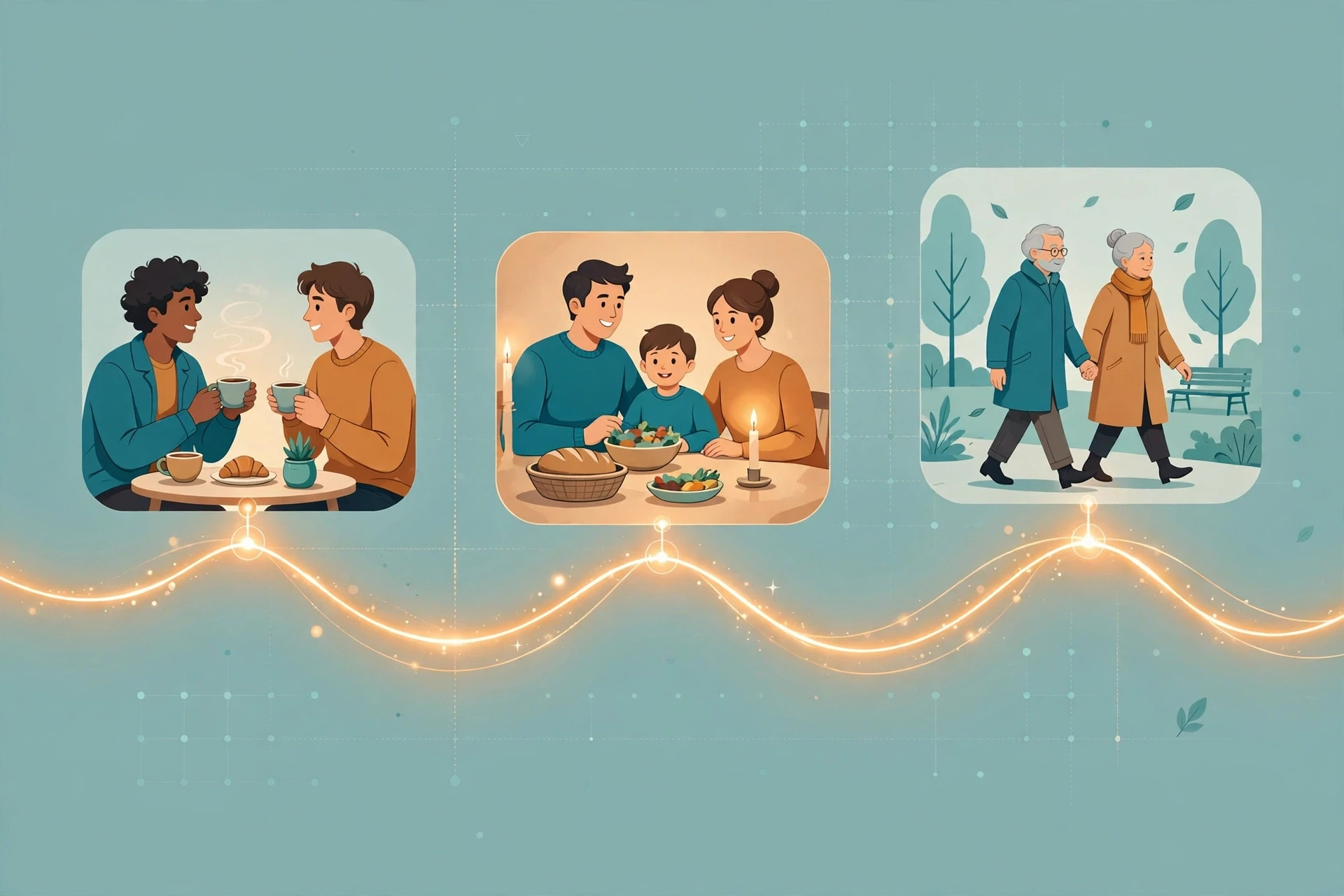
The study's most useful nuance is that the number of friends did not matter nearly as much as the warmth of the few closest bonds. A person with two deep friendships did better than a person with fifty acquaintances and no one to call at 2 a.m. Conflict matters too: high-conflict marriages were worse for health than divorce in some analyses, and a warm marriage protected mood even when the partners argued. The lesson is not "collect people." It is "tend the bonds you have." Waldinger's team found that the people who did best were not the ones with perfect relationships. They were the ones who kept repairing them.
I saw this in my own family. My grandmother, who lived to ninety-four, was not wealthy and had lost her husband young. What she had was a kitchen table that was never empty: neighbours dropping in, grandchildren doing homework, a phone that rang all evening. When I asked her once what had made her life good, she did not mention any achievement. She said, "People came back." I have thought about that sentence while reading the Harvard data. The study, in its careful academic language, says the same thing.
6. Money, Time, and the Question Everyone Asks
6.1 Does money buy happiness?
The short answer from the science of happiness is yes, a little, and in a particular way. The longer answer is one of the best stories in modern psychology, because it shows two rival teams arguing in public and then settling the argument together.
In 2010, Daniel Kahneman and Angus Deaton, working with Gallup survey data from more than 450,000 Americans, reported that day-to-day emotional well-being rose with household income and then flattened at around $75,000 a year. Life satisfaction — the evaluative judgement — kept rising with income, but daily mood did not. The $75,000 figure became a meme. It was quoted in magazines, in sermons, and in dinner-table arguments as if it were a law of nature.
In 2021, Matthew Killingsworth, using smartphone experience sampling with 33,391 working adults and more than 1.7 million real-time mood reports, found no plateau at all. Experienced well-being kept rising with income, well past $75,000. The two findings contradicted each other directly, and both teams had good data. So they did something unusual in academic life: they teamed up. In a 2023 adversarial collaboration, Killingsworth, Kahneman, and Barbara Mellers reanalysed the data together, with Mellers as facilitator. Their joint paper, published in the Proceedings of the National Academy of Sciences, resolved the conflict.
6.2 The resolution: the plateau belongs to the unhappiest fifth
The 2023 paper found that both patterns were real, in different parts of the population. For most people, happiness keeps rising with income across the whole measured range, roughly in proportion to the logarithm of income — doubling a small income matters far more than doubling a large one. The flattening pattern exists, but it is restricted to the least happy 15 to 20 percent of people, and for them it sets in at around $100,000. For the unhappiest group, the miseries that remain — bereavement, heartbreak, clinical depression — are not the kind of miseries money can fix. For everyone else, money keeps helping, just with diminishing returns: the jump from $30,000 to $60,000 matters far more than the jump from $200,000 to $400,000.
The effect, even at its largest, is modest — a humbling result in the science of happiness. The correlation between income and experienced well-being in Killingsworth's data was about 0.09, and the difference in median happiness between households earning $15,000 and $250,000 was about five points on a 100-point scale. Money matters most where it removes a source of suffering: paying rent without fear, fixing the car, seeing a doctor, feeding a family. Past that point, it buys comfort, choice, and time — all genuinely valuable — but not a proportional rise in joy.
6.3 Experiences beat things — and time beats money
One of the most repeated findings in the science of happiness is that spending on experiences — a trip, a concert, a meal with friends — brings more lasting happiness than spending the same money on material goods. Experiences resist adaptation better: they are harder to compare with what the neighbours have, they become part of your identity and your stories, and they usually involve other people. A television gets compared with newer televisions. A weekend away becomes a story you retell for years.
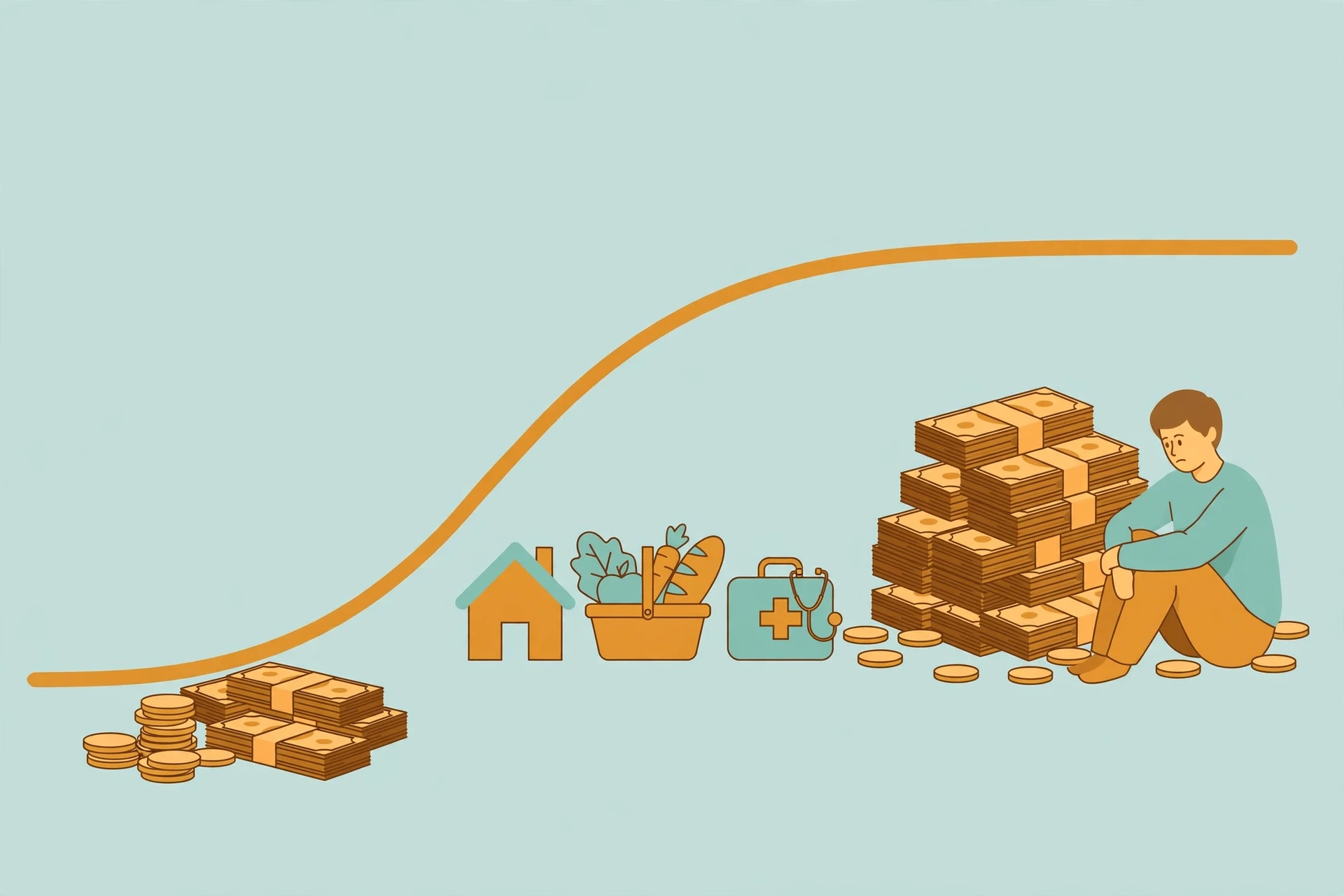
A related finding concerns time. In a series of studies in the science of happiness, people who prioritised time over money — who chose a job with shorter hours, who paid for time-saving help, who protected an evening with friends — reported greater happiness than people who prioritised money over time, even at the same income. The mechanism is straightforward: money is a means, and time is where life is actually lived. The happiest spending, in study after study, is spending that buys time, connection, or a memory.
7. Flow: The Happiness of Disappearing Into What You Do
7.1 Being "in the zone"
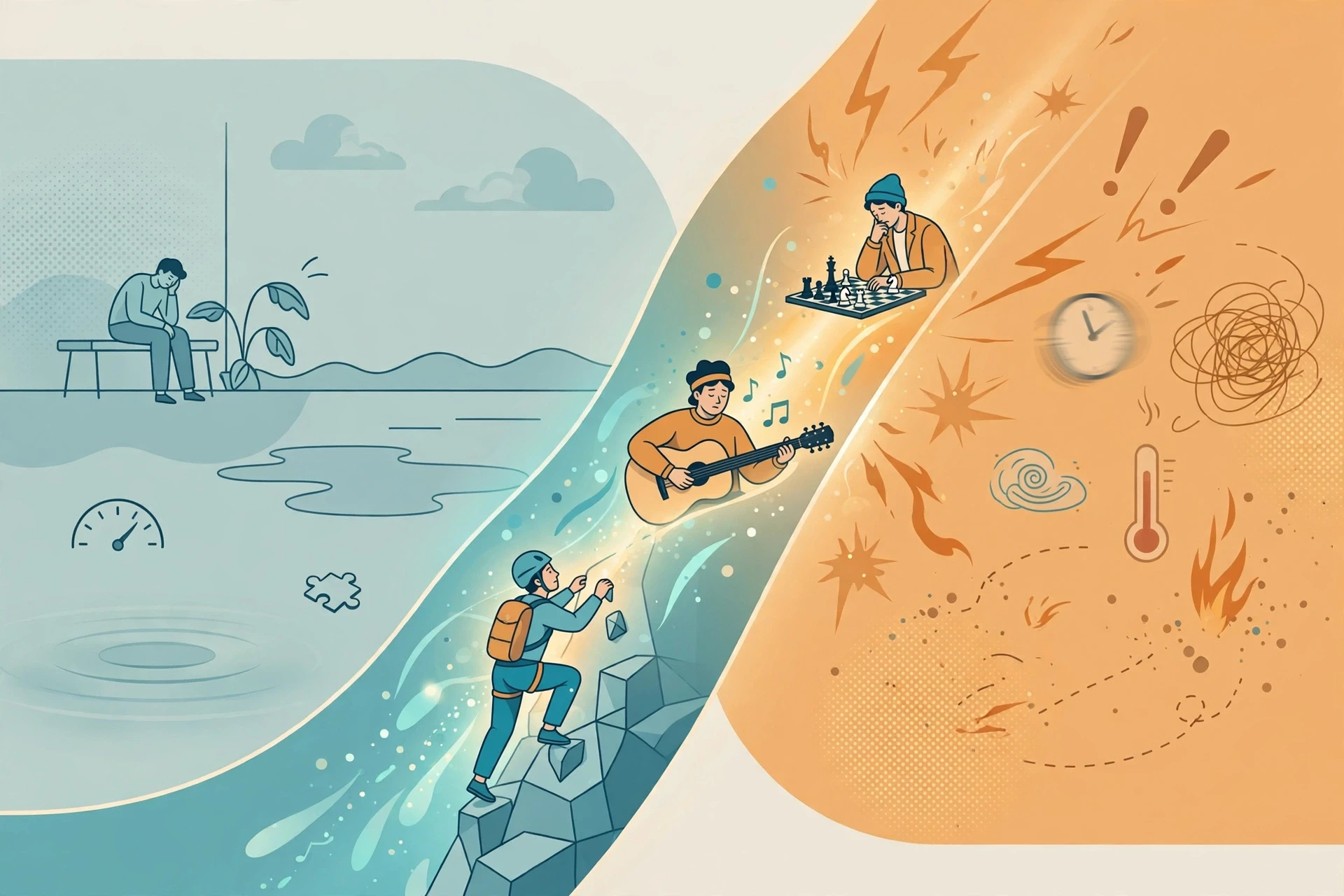
There is a kind of happiness that has nothing to do with pleasure or achievement, and everything to do with absorption. Psychologist Mihaly Csikszentmihalyi named it flow: a state of complete concentration in which action and awareness merge, self-consciousness falls away, time distorts, and the activity feels rewarding for its own sake. Rock climbers described it. Chess players described it. Surgeons, musicians, and programmers describe it. I have felt it once, properly, while debugging a stubborn piece of analysis code late at night — three hours passed in what felt like twenty minutes, and I surfaced hungry, tired, and oddly elated.
Flow happens when challenge and skill are in balance. Too easy, and you are bored. Too hard, and you are anxious. The sweet spot is a task that stretches you just past what you can already do, with clear goals and immediate feedback. Csikszentmihalyi's experience-sampling studies, in which people carried pagers and reported their state eight times a day, confirmed that the balance of perceived challenge and skill predicted the quality of experience. His work with Giovanni Moneta on talented teenagers showed the same pattern across school, friends, and solitary work.
7.2 Why flow matters for happiness
Flow matters in the science of happiness because it is one of the few pleasures that does not adapt away quickly. A new possession fades because it stops changing. A flow activity keeps changing: the climb gets harder, the piece gets faster, the problem gets deeper. It also delivers the eudaimonic side of happiness — growth, mastery, purpose — without requiring you to think about purpose at all. You do not need a grand life mission to find flow. You need a task with the right difficulty, a clear next step, and an hour without interruption.
The practical lesson from the science of happiness is to design for flow rather than waiting for it. Pick one activity that already absorbs you — cooking, gardening, drawing, running, coding, playing an instrument — and give it a slightly harder goal and a protected block of time. Remove the phone from the room. Flow is fragile; a single notification can break it, and the research on attention suggests it takes real minutes to get back in. The science of happiness, here, is also the science of attention, and attention is the scarcest resource most of us own.
8. What Actually Works: Gratitude, Kindness, and Savouring
8.1 Gratitude — small practice, real effect
Of all the interventions researchers in the science of happiness have tested, gratitude has the strongest and most repeated evidence. In the classic studies by Robert Emmons and Michael McCullough, people who wrote down three things they were grateful for each week reported better mood and life satisfaction than control groups, and the effect grew over weeks. The Greater Good Science Center at UC Berkeley, which collects this research, describes gratitude as changing both attention and the brain: practising it trains you to notice good things you would otherwise walk past, and brain-imaging work has linked gratitude practice with activity in reward-related regions.
Why does it work when a new purchase does not? Because gratitude directly interrupts the two engines of the treadmill. It fights habituation by making you notice the good thing again, and it fights rising aspiration by reminding you that what you have is already more than you expected. A gratitude journal is not magic, and it is not a treatment for depression. It is a small, cheap attention exercise with a real, modest effect — the kind of result this field produces when it is honest.
I tried it myself during a difficult winter, sceptical and slightly embarrassed, writing three lines each night in a cheap notebook. The first week felt forced. By the third week, something had shifted — not my circumstances, which were unchanged, but what I noticed on the walk home. The bus driver who waited. The light on the river. I do not tell that story as proof. I tell it because it matches what the studies report: the practice works on attention first, and mood follows.
8.2 Kindness and connection in action
Spending money on others reliably produces more happiness than spending the same money on yourself, in studies run across countries and income levels. So does spending time helping: volunteering, even a few hours a month, is associated with higher life satisfaction, and the effect is strongest when the help is freely chosen and socially connected. The mechanism is not selflessness as a virtue. It is that kindness is social, it is varied, and it is meaningful — three properties that resist adaptation.
8.3 Savouring: the skill nobody teaches
Savouring is the deliberate act of noticing and stretching a good moment: lingering over a meal, telling someone about a good day, taking a mental photograph of a view. Research in the science of happiness on savouring shows that people who do this — rather than rushing past good moments toward the next goal — report higher well-being from the same events. It is the opposite of the treadmill. The treadmill is what happens when good things become background. Savouring is the practice of keeping them in the foreground.

9. The Body You Live In: Sleep, Movement, and the Gut
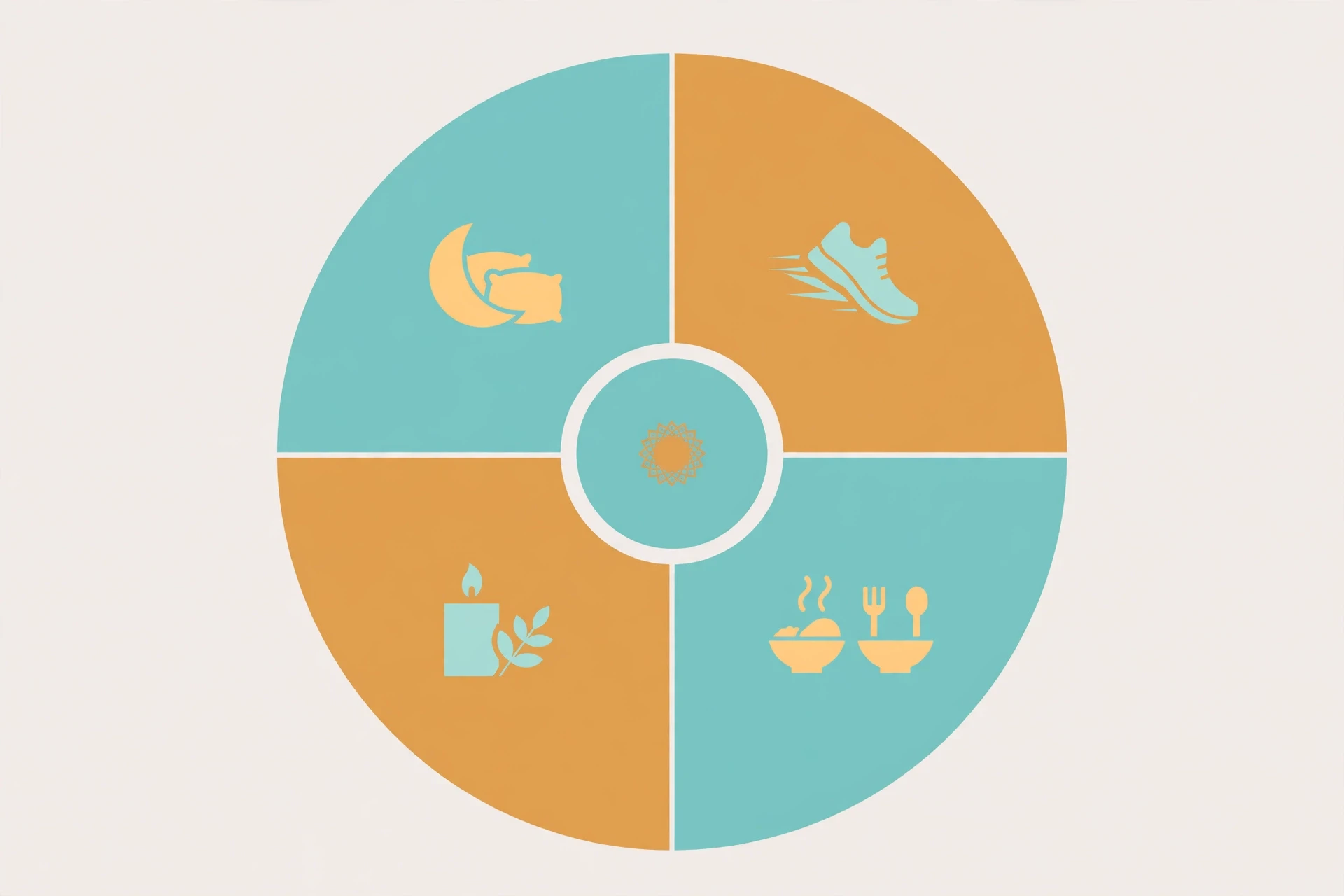
In the science of happiness, happiness is not only a matter of thoughts. The body sets the floor. Sleep is the clearest example: our article on the science of sleep and dreams explains how sleep consolidates memory and regulates emotion, and the happiness data agree — people who sleep poorly report worse mood the next day, and chronic short sleep is one of the most reliable predictors of low well-being. Exercise has a similar, well-replicated effect: regular movement, even brisk walking, lifts mood in the short term and protects against depression in the long term. The effect is modest, roughly comparable to some talking therapies for mild depression, and it does not require a gym.
The gut matters too, through the same pathways described in our article on the gut-brain connection: the vagus nerve, the microbiome, and the immune system all carry signals between gut and brain, and mood is one of the things those signals influence. None of this means happiness is "just chemistry." It means the mind and the body are one system, and tending the body is a legitimate way of tending the mind. Longevity research points the same way: our guide to longevity and healthy aging finds the same ingredients — movement, sleep, connection, purpose — at the centre of a long, good life. The overlap is not a coincidence. A life that is good for the body and a life that feels good are, to a large extent, the same life.
10. Misconceptions: What the Evidence Does Not Support
Most people assume happiness is mostly about money, success, and good luck. What the data actually show is quieter: circumstances matter, but they matter most at the bottom, where hardship is real; they matter least at the top, where comfort is already secured. Here are the claims that fail most often when they meet the evidence.
"I will be happy when I get the promotion / the house / the partner." This is impact bias. The event will matter, briefly, and then adaptation will do its work. The people who stay happy are the ones whose daily life is already good, not the ones waiting for a single event to fix it.
"Happy people are just born lucky." Temperament matters, but the set point is a range, and daily practices, relationships, and health move people within it — sometimes a long way.
"Happiness means feeling good all the time." No one does. A meaningful life includes grief, boredom, and frustration. The research measures a life that is satisfying overall, not a mood that never dips.
"More choice means more happiness." Beyond a point, more choice brings more regret and more second-guessing. People are often happier with a good-enough choice they can stop thinking about.
"Positive thinking alone will fix it." Gratitude and optimism help, but they are not treatments for clinical depression or anxiety, and they cannot replace sleep, safety, or human connection. Anyone whose low mood lasts weeks should seek professional help — our article on anxiety and depression explains what the science says about treatment, and the U.S. National Institute of Mental Health carries clear, plain-language information on depression and where to find help.
"The 50-10-40 pie chart is a personal formula." It is not. It describes variation across a population, roughly, and the 40 percent figure is contested. Use it as a direction, never as a promise about yourself.
"Good relationships keep us happier and healthier. Period." — Robert Waldinger, director of the Harvard Study of Adult Development, summarising more than eighty years of data in a single sentence.
11. Putting It Into Practice: A Week of Small Experiments
Research is only useful if it changes a Tuesday. Below is a week of small experiments, each tied to a finding in this article. Try them as tests, not as commandments, and notice what actually moves your own mood.
Monday — gratitude, three lines. Before bed, write three specific good things from the day and why they happened. Specific beats general: "Sara saved me a seat" beats "friends are great."
Tuesday — buy an experience, not a thing. Spend a small amount on something you will do with someone, or on time saved, rather than on an object.
Wednesday — one repaired bond. Call or message one person you have been meaning to contact. Keep it short. The Harvard data suggest that tending a bond matters more than making a new one.
Thursday — one hour of flow. Choose an activity that absorbs you, set a slightly harder goal, put the phone in another room, and give it a full hour.
Friday — savour one meal. Eat slowly, without a screen, and notice three things about the food. It sounds trivial. The savouring research says it is not.
Saturday — help someone, briefly. Give directions, carry a bag, donate, volunteer for an hour. Notice how you feel afterwards, not how virtuous you feel.
Sunday — protect sleep and a walk. Go to bed at the same time, walk for thirty minutes, and spend an unhurried hour with someone you like. The body's floor and the relationship's warmth, in one day.
Keep a one-line mood note each evening, from 1 to 10. After a week, look at which days scored highest. That is your own small dataset, and it is worth more than any listicle's promise.
12. Latest Research in the Science of Happiness and Open Questions
The science of happiness is moving quickly, and several questions remain open. First, the genetics of well-being: large genome-wide studies are finding many small genetic influences on well-being, none of them decisive alone, which fits the picture of temperament as a nudge rather than a destiny. Second, the income debate is not finished — the 2023 adversarial collaboration settled the plateau question for the United States, but researchers are now asking how the pattern looks in other countries, where safety nets and costs of living differ. Third, digital life: early evidence suggests that how we use phones matters more than how much we use them — active connection helps, passive scrolling hurts — but the long-term data are still thin.
There is also a deeper question the field is only beginning to ask properly: whose happiness counts? Most research in the science of happiness has been done in wealthy, Western countries, and the measures themselves — life-satisfaction scales, mood ratings — may miss forms of well-being that matter more elsewhere, such as harmony, duty, or community standing. The World Health Organization's work on mental health stresses that well-being is shaped by social and economic conditions, not only by individual choices, and that is a necessary correction to any article — including this one — that focuses on what individuals can do. A person working three jobs to pay rent does not have a gratitude problem. They have a circumstances problem, and no honest science of happiness can pretend otherwise.
Conclusion: What Actually Makes Us Happy
The science of happiness gives a clear, if unglamorous, answer to its central question. What makes us happy is not a single thing, and it is not the things we are sold most loudly. It is a life with warm, tended relationships; enough money to live without fear; time spent on experiences rather than objects; work and play that sometimes absorb us completely; a body that is slept, moved, and fed; and small daily practices — gratitude, kindness, savouring — that keep good things from fading into background. None of these is dramatic. All of them survive testing.
My neighbour with the scratch card was happy for a week, and then his life went back to being his life. That is not a sad ending. It is the treadmill doing what treadmills do. The happier ending is quieter: the same hallway, the same groceries, and a kitchen table with people around it. The research, after eighty years and thousands of studies, keeps pointing at the same table.
Frequently Asked Questions
What is the science of happiness?
The science of happiness is the research field that studies subjective well-being — how people feel day to day and how they judge their lives overall. It uses surveys, daily diaries, and experience sampling to test which parts of life, such as relationships, money, health, and daily practices, actually move well-being in a lasting way.
What makes us happy, according to research?
The strongest evidence points to warm close relationships, enough money to live without financial fear, time spent on experiences rather than things, absorbing activities that produce flow, good sleep and movement, and small daily practices such as gratitude and kindness. No single factor explains happiness on its own.
Does money buy happiness?
Yes, but with diminishing returns. Money lifts well-being steeply when it removes hardship, then ever more slowly. A 2023 adversarial collaboration by Killingsworth, Kahneman, and Mellers found that happiness keeps rising with income for most people, while the flattening pattern applies only to the least happy 15 to 20 percent, setting in at around $100,000.
What is the hedonic treadmill?
The hedonic treadmill, named by Brickman and Campbell in 1971, is the tendency to return to a personal baseline of happiness after positive or negative life events. Expectations rise with circumstances, so the emotional lift from a gain fades. Adaptation is real but incomplete — some events, such as long-term unemployment, shift well-being for much longer.
Is the 50-10-40 happiness pie chart accurate?
It is a rough, contested estimate, not a precise formula. Lyubomirsky, Sheldon, and Schkade's 2005 model suggested about 50 percent of differences in happiness track with genetics, 10 percent with circumstances, and 40 percent with intentional activities. Later critics argued the 40 percent figure could be far lower, and the original authors acknowledged the numbers were preliminary. The direction — daily activity matters more than chasing circumstances — has held up better than the exact numbers.
Can happiness be learned, or is it fixed by genetics?
Happiness is partly influenced by temperament, but it is not fixed. Long-term studies show that people's well-being can shift over years, and that relationships, health, and daily practices move it within a range. Genetics sets a starting point and a tendency, not a destiny.
Sources
Harvard Gazette. "Over nearly 80 years, Harvard study has been showing how to live a healthy and happy life." https://news.harvard.edu/gazette/story/2017/04/over-nearly-80-years-harvard-study-has-been-showing-how-to-live-a-healthy-and-happy-life/
Harvard Study of Adult Development. https://www.adultdevelopmentstudy.org/
Greater Good Science Center, UC Berkeley. "How Gratitude Changes You and Your Brain." https://greatergood.berkeley.edu/article/item/how_gratitude_changes_you_and_your_brain
Killingsworth, M. A., Kahneman, D., & Mellers, B. (2023). "Income and emotional well-being: A conflict resolved." Proceedings of the National Academy of Sciences, 120(10). https://www.pnas.org/doi/10.1073/pnas.2208661120
Kahneman, D., & Deaton, A. (2010). "High income improves evaluation of life but not emotional well-being." Proceedings of the National Academy of Sciences, 107(38). https://www.pnas.org/doi/10.1073/pnas.1011492107
Moneta, G. B., & Csikszentmihalyi, M. (1996). "The effect of perceived challenges and skills on the quality of subjective experience." Journal of Personality, 64(2). https://psycnet.apa.org/record/1996-04601-001
Lyubomirsky, S., Sheldon, K. M., & Schkade, D. (2005). "Pursuing happiness: The architecture of sustainable change." Review of General Psychology, 9(2), 111–131.
Diener, E., Lucas, R. E., & Scollon, C. N. (2006). "Beyond the hedonic treadmill: Revising the adaptation theory of well-being." American Psychologist, 61(4), 305–314.
Brickman, P., Coates, D., & Janoff-Bulman, R. (1978). "Lottery winners and accident victims: Is happiness relative?" Journal of Personality and Social Psychology, 36(8), 917–927.
National Institute of Mental Health. "Depression." https://www.nimh.nih.gov/health/topics/depression
World Health Organization. "Mental health: strengthening our response." https://www.who.int/news-room/fact-sheets/detail/mental-health-strengthening-our-response
American Psychological Association. "Stress." https://www.apa.org/topics/stress