
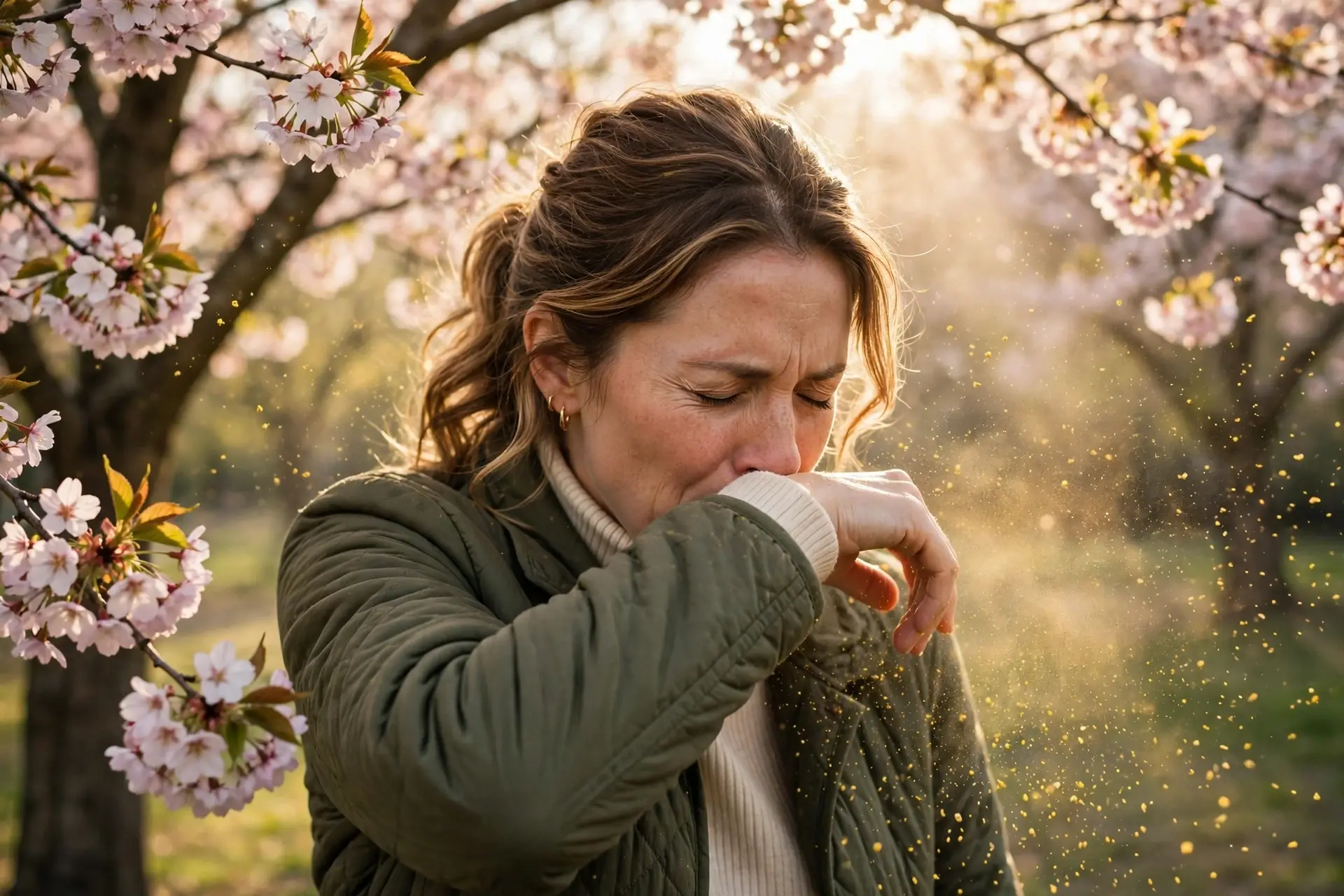
The sandwich was ordinary. White bread, a thick spread of peanut butter, a glass of milk — the kind of lunch a four-year-old eats a hundred times without incident. This time, within minutes, his lips began to swell. Hives bloomed across his cheeks like a rash drawn in fast-forward. His mother, who had packed that same lunch the day before, watched her son's face change shape in front of her and did the only thing that made sense: she called for help. By the time the ambulance arrived, his breathing was laboured and a paramedic was pressing an epinephrine auto-injector against his thigh. He survived. He also never ate peanut butter again — not because peanuts had become dangerous, but because his immune system had decided they were.
That decision is the whole subject of this article. Allergies are not a weakness of the immune system. They are the opposite: a defence system working at full power against the wrong target. The same machinery that protects you from parasites and venom — the same cells, the same antibodies, the same chemical messengers — can mistake a peanut, a grain of pollen, or a speck of dust-mite droppings for an invader, and fire everything it has. The result ranges from a sneeze to a medical emergency, and it now touches an extraordinary share of humanity: allergic disease affects an estimated 30 to 40 percent of the world's population, and in the United States more than 106 million people — about 1 in 3 — had diagnosed allergies in 2024.
This article follows that overreaction from beginning to end. It starts with what an allergy actually is, then walks through the mechanism step by step: the silent arming of the immune system, the antibody called IgE, the mast cell that bursts open like a grenade, and the chemical called histamine that does most of the damage you can feel. It maps the symptoms organ by organ, explains anaphylaxis and the drug that stops it, tours the common allergens — pollen, dust mites, pets, mould, the nine major foods, venom, drugs, latex, nickel — and asks the question everyone asks: why are allergies rising, and why do some people get them and others do not? It covers how allergies are diagnosed, what each medicine actually does, the treatments that retrain the immune system, and the myths that still do real harm. The numbers come from the latest releases: the CDC's January 2026 data briefs on 2024 figures, the Asthma and Allergy Foundation of America's April 2026 update, and the landmark trials that changed prevention and treatment. Where the evidence is uncertain, this article says so.
1. What Is an Allergy?
1.1 The bite that changed everything
The peanut butter sandwich in the opening scene is not a hypothetical. Food allergies now affect about 1 in 13 American children — two in every classroom — and roughly 1 in 10 adults. For most of those families, there was a first reaction, and the first reaction is almost always a shock, because nothing about the food looked dangerous. The child had eaten it before, or the adult had eaten shellfish for years. Then one day the same food, the same dose, produced hives, vomiting, or a throat that began to close. Nothing about the food had changed. What had changed was invisible: the immune system had quietly armed itself against it, and on that day it fired.
I have seen that shock from the other side, in a laboratory, watching a skin-prick test. A nurse placed a row of tiny drops on a volunteer's forearm — pollen, dust mite, cat, peanut — and pricked the surface of the skin through each one. Fifteen minutes later, most of the spots were flat and calm. Two had risen into red, itchy welts the size of coins. The volunteer stared at his own arm as if it belonged to someone else. He had lived with a blocked nose every spring for a decade and called it a cold that never ended. The welts told a different story: his immune system had been fighting tree pollen all along, and losing, every April, without him ever knowing the enemy's name.
1.2 What an allergy actually is
An allergy happens when the immune system treats a harmless substance as a threat and fires a full defence against it. The Asthma and Allergy Foundation of America puts the definition in one sentence, and it is the definition this article will keep coming back to, because it contains the two ideas that matter most: the substance is not actually harmful, and the reaction is an overreaction. The substance is called an allergen. The reaction is the immune system doing its job — just at the wrong target, with the wrong intensity.
An allergy occurs when the body's immune system sees a substance as harmful and overreacts to it. The reactions can range from mild to severe and can cause a medical emergency. — Asthma and Allergy Foundation of America, Allergy Facts, Figures and Stats
It helps to separate two words that are often used as if they meant the same thing. An allergy is the immune reaction itself — the machinery firing. Allergic diseases are the conditions that result: hay fever, food allergy, eczema, allergic asthma, anaphylaxis. One person can carry several of them at once, because the same underlying machinery drives them all. That shared machinery is why this article treats them together, and why treating one allergic disease sometimes helps another.
Most people assume an allergy means the immune system is weak. What the evidence shows is the opposite. The immune system of a person with allergies is not underpowered; it is over-eager. It has learned to treat a harmless protein as if it were a parasite, and it defends the body against that protein with the same ferocity it would bring to a real invasion. The symptoms of allergy — the sneezing, the itching, the swelling, the wheeze — are not caused by the allergen. They are caused by your own immune system, doing exactly what it evolved to do, to the wrong thing.
1.3 How common it is
The scale is hard to overstate. Allergic diseases affect an estimated 30 to 40 percent of the world's population, making them among the most common chronic conditions on the planet. Sensitisation rates to one or more common allergens among schoolchildren are approaching 40 to 50 percent in many regions. Some reviews put the global figure lower, around 20 to 30 percent — the difference depends on what is counted — but whichever way the counting is done, the answer is the same: roughly a third of humanity lives with some form of allergy.
In the United States, the newest figures are higher than the ones most people still quote. The CDC's data briefs published in January 2026, based on the 2024 National Health Interview Survey, found that 31.7 percent of adults and 29.5 percent of children had a diagnosed allergy — seasonal allergy, eczema, or food allergy — in 2024. That is more than 106 million Americans, about 1 in 3. The old line that "more than 50 million Americans suffer from allergies" is now far too low; it comes from pre-2020 material and should be retired. Among adults, seasonal allergy was the commonest at 25.2 percent, followed by eczema at 7.7 percent and food allergy at 6.7 percent. Among children, seasonal allergy led at 20.6 percent, eczema at 12.7 percent, and food allergy at 5.3 percent. Allergic rhinitis — hay fever — is the commonest allergic condition of all: about 400 million people worldwide live with it, and more than 82 million Americans were diagnosed with seasonal allergic rhinitis in 2024.
There is no cure for allergies. That is the honest starting point, and the Asthma and Allergy Foundation of America states it plainly. What exists instead is management — exposure control, prevention, and medical treatment — and the management has improved dramatically in the last few years. Some of those improvements, including a medicine approved in 2024 that protects against accidental exposure to multiple foods, are among the most encouraging developments in allergy medicine in decades. But to understand why they work, you first have to understand the guard that gets it wrong.
2. Your Immune System: The Guard That Gets It Wrong
2.1 The guard's normal job
Your immune system is a network, not an organ. It lives in your bone marrow, your thymus, your spleen, your lymph nodes, your gut, your skin, and your bloodstream — all at once — and its job is to sort the world into two piles: things that belong to you, and things that do not. The things that do not belong are dealt with. The things that do belong are left alone. That sorting decision, made thousands of times a day in every tissue you own, is the whole business of immunity, and How the Human Immune System Works explains the network in full.
The system has two great branches. Innate immunity is the fast, general branch you are born with: it responds within minutes or hours to any invader, without needing to learn its identity first. Adaptive immunity is the slow, specific branch: it takes days to build a response, but it targets one particular invader with extraordinary precision, and it remembers. Allergy lives almost entirely in the adaptive branch — in its memory, its specificity, and its most specialised antibody.
2.2 What "overreaction" means in practice
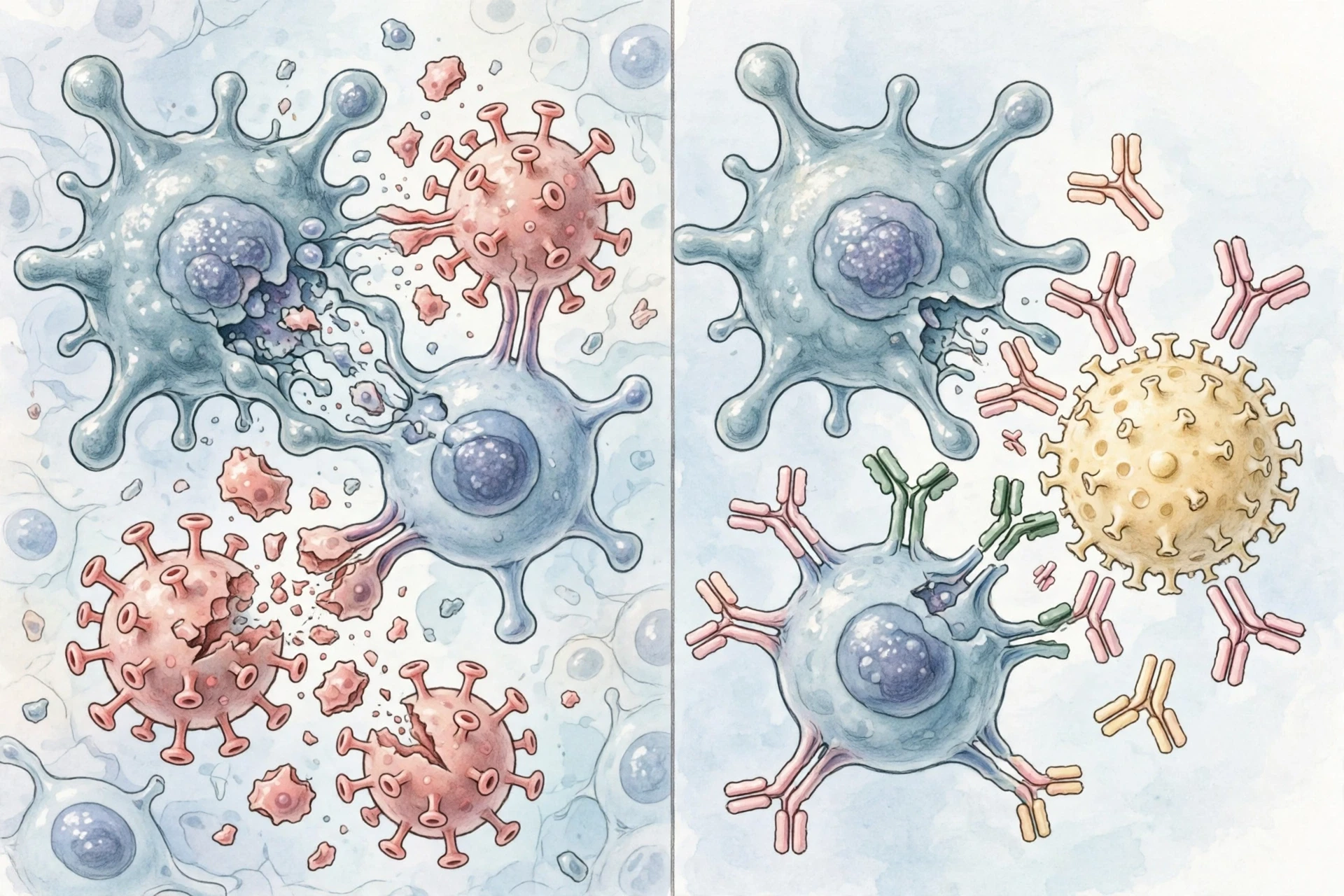
Imagine a security guard who has been trained to spot intruders. One day the guard sees a delivery driver in a uniform he has never seen before, decides the driver is a threat, and sounds the alarm, locks the building, and calls in the response team. The driver was harmless. The guard was not lazy or broken — he was thorough, vigilant, and wrong. That is an allergy. The immune system has filed a harmless protein under "threat", and when it meets that protein again, it responds with the full force of a defence that evolved for parasites and venom.
That last point matters, because it answers the question of why the allergy machinery exists at all. The antibody at the centre of allergy, immunoglobulin E — IgE — did not evolve to make you sneeze at pollen. It evolved as a defence against parasitic worms and against venoms. In a world where intestinal worms were a constant threat, a fast, violent, whole-body response to a foreign protein was a survival advantage. In the modern world, where worms are rare in wealthy countries, that same machinery has little real work to do — and it turns, in a substantial minority of people, on pollen, peanuts, and dust mites. The IgE system is not broken in a simple sense. It is a defence system firing at the wrong target.
2.3 The four types of hypersensitivity in one page
In 1963, two immunologists, Philip Gell and Robin Coombs, sorted the ways the immune system can overreact into four types, and the classification is still used today. Only two of them matter for most allergies, and the difference between them explains why some reactions arrive in minutes and others take days.
Type I is the classic allergy: IgE-mediated, immediate, arriving within minutes. Hay fever, food allergy, allergic asthma, and anaphylaxis are all Type I. This is the mechanism the next section follows in detail, and it is the mechanism behind nearly everything in this article.
Type IV is the delayed reaction: T cells, not antibodies, do the work, and the reaction takes 24 to 72 hours to develop. Allergic contact dermatitis — the itchy rash from nickel in a belt buckle or a cheap earring — is Type IV. It has no IgE, no histamine burst, and no anaphylaxis. It is a different disease wearing the same word, "allergy", and section 8.4 explains it separately.
Types II and III are antibody-mediated reactions against the body's own cells or against immune complexes deposited in tissues. They drive certain autoimmune and inflammatory diseases, but they are not what people mean by "allergy", and this article will not follow them further — except to note that they exist, so that nobody is misled into thinking all four types are allergies.
The word itself is young. Clemens von Pirquet, a Viennese paediatrician, coined "allergy" in 1906, from the Greek allos, "other", and ergon, "reaction" — a changed reactivity. He meant it broadly, covering protective as well as harmful changes; today it usually means a harmful overreaction to something harmless. The science followed slowly: French physiologists Charles Richet and Paul Portier named anaphylaxis in 1902, Richet later winning the 1913 Nobel Prize for the work. In 1921, Carl Prausnitz showed that allergy could be transferred by blood serum — injecting serum from his fish-allergic colleague Heinz Küstner into his own skin made Prausnitz's skin react to fish — proving that a blood-borne factor carried allergy. That factor was finally identified in 1966, when Kimishige and Teruko Ishizaka in Denver purified it and showed it was a new antibody isotype, and Gunnar Johansson and Hans Bennich in Sweden independently found the same isotype; in 1968 the two groups presented jointly to the World Health Organization and the antibody was officially named IgE, the fifth antibody class. Sixty years passed between the word and the molecule. The mechanism in the next section is what those sixty years uncovered.
3. Allergies, Inside the Cell: Sensitisation, IgE, and the Mast-Cell Explosion
If the immune system is the guard, this section is the security footage. The allergic reaction happens in two acts, separated by days, months, or years. The first act is silent: the system arms itself, and nothing happens. The second act is explosive: the same allergen returns, and the armed cells fire everything at once. Understanding that the first act produces no symptoms at all is the key to understanding why allergies seem to appear out of nowhere.
3.1 Sensitisation — the silent arming
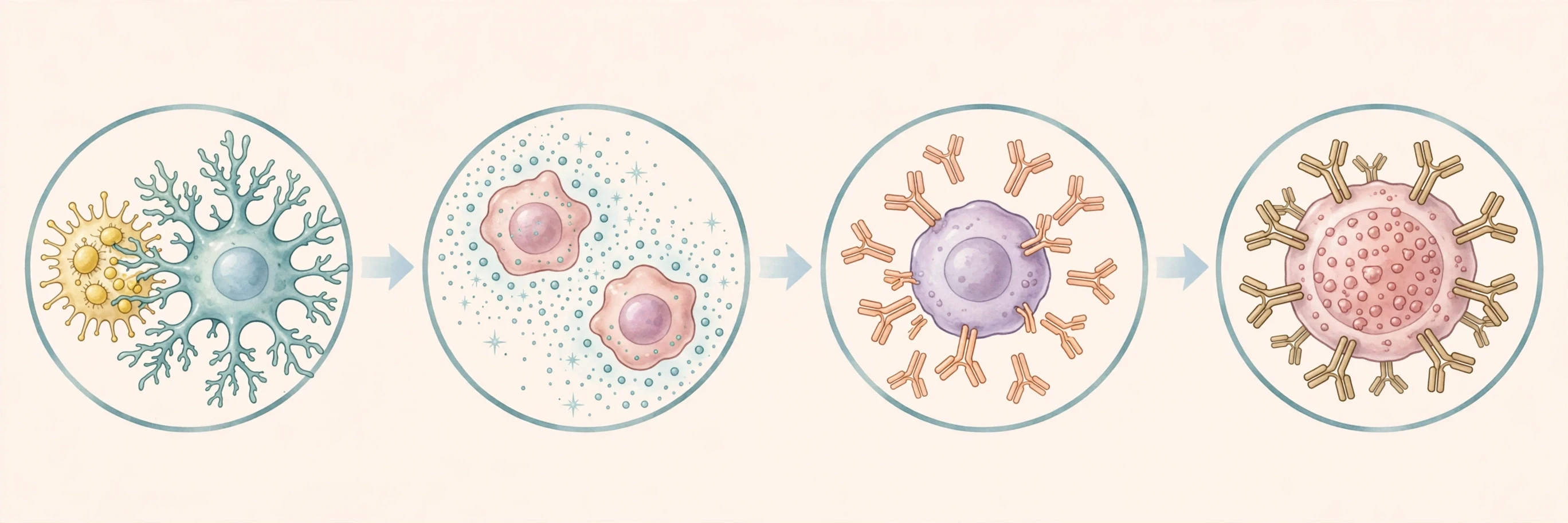
It begins with an ordinary exposure. Pollen drifts into the nose. A peanut is eaten. Dust-mite droppings are breathed in during sleep. The allergen crosses a barrier — skin, airway, or gut — and is captured by a dendritic cell, a sentinel that patrols the tissues, swallows foreign material, and carries it to the nearest lymph node. There, the dendritic cell presents fragments of the allergen to naive T cells, the blank-slate soldiers of the adaptive immune system, and asks, in effect: do you recognise this?
In a person who will go on to develop an allergy, the answer goes wrong at this step. The T cells differentiate into T helper 2 cells — Th2 cells — rather than the Th1 cells that would fight a virus or bacterium. Th2 cells are the coordinators of the allergic response, and they release a set of chemical signals: interleukin-4, interleukin-5, and interleukin-13. Interleukin-4, together with interleukin-13, instructs B cells to undergo class switching — to stop making the ordinary antibodies they were making and start making IgE instead. IgE is the antibody class specialised for allergic responses, and it is vanishingly rare in the blood of a person without allergies. In a sensitised person, the body begins to manufacture it in quantity.
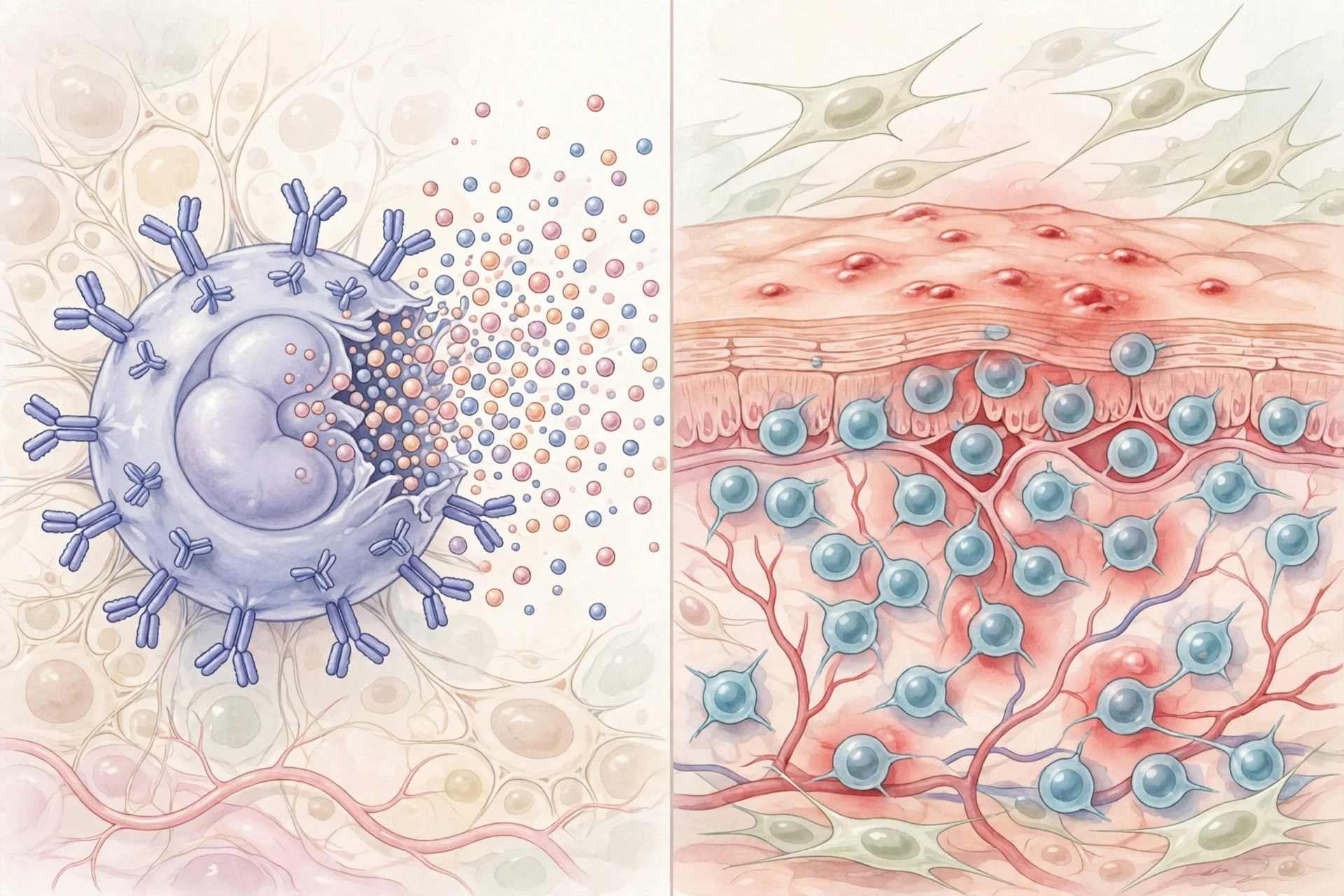
The IgE does not float free. It binds, with extraordinarily high affinity, to receptors called FcεRI on the surface of mast cells — the large, granule-packed cells that live in tissues, especially under the skin, in the airways, and in the gut — and on basophils, their cousins in the blood. A single mast cell can carry 100,000 to 500,000 IgE molecules on its surface, each one waiting for its specific allergen. And here is the crucial fact: none of this causes any symptoms. Sensitisation is silent. The weapons are loaded, the sentries are posted, and the person feels perfectly well. The first act ends without a sound.
3.2 Re-exposure — cross-linking fires the weapon
Months or years later, the allergen returns. A peanut is eaten again. Spring arrives. The cat comes back into the house. This time the allergen meets mast cells already armed with IgE against it, and the decisive event is a piece of molecular geometry: the allergen must bridge — cross-link — two or more IgE molecules on the mast-cell surface. One IgE binding allergen alone does nothing. Two or more, pulled together by the same allergen molecule, fire the signal.
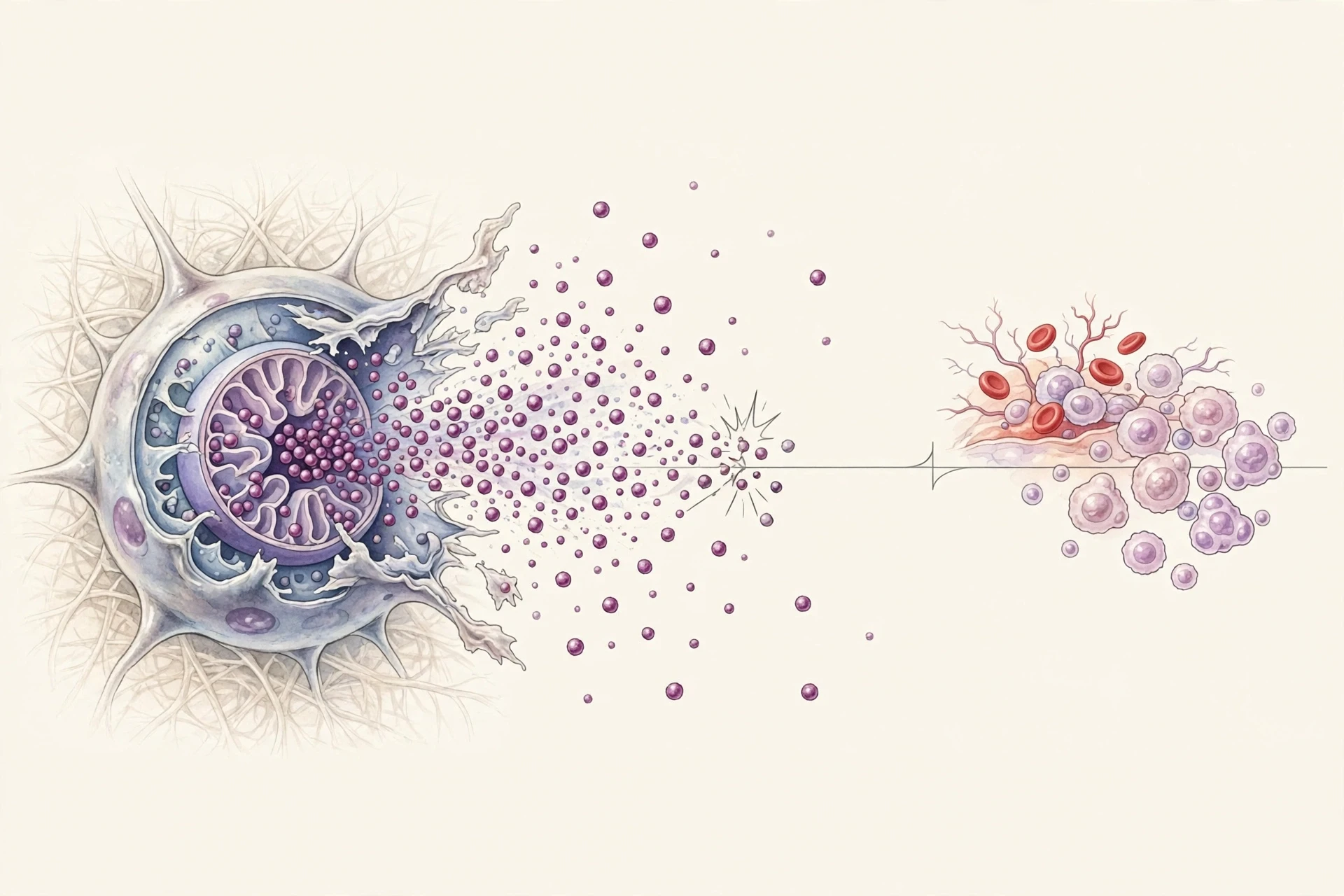
That signal triggers degranulation. The mast cell, which is essentially a bag of chemical grenades, bursts open and dumps its contents into the surrounding tissue within seconds. I once watched a film of this under a microscope, in a teaching laboratory, and the speed of it stayed with me: one moment a round, calm cell; the next, granules streaming out in every direction, as if the cell had been punctured. It is the fastest decision the immune system makes, and it is the moment allergies become visible.
3.3 Histamine and the other mediators
The granules contain histamine, and histamine is the chemical most people have heard of, because it does most of the things you can feel. Histamine dilates small blood vessels and makes them leaky, which produces redness and swelling and the raised welts of hives. It stimulates mucus glands, which produces a runny nose and watery eyes. It contracts airway smooth muscle, which produces wheeze. And it irritates nerve endings, which produces itch. One chemical, four symptoms — and it acts mainly through H1 receptors on the lining of blood vessels, which is why drugs that block H1 receptors are called antihistamines.
But histamine is only the first wave. The mast cell also releases the protease tryptase, a marker of mast-cell activation that doctors measure in the blood after a severe reaction. And over the following minutes to hours, the cell synthesises a second wave of mediators: prostaglandin D2, which dilates vessels and increases their leakiness; leukotrienes, which constrict the airways and increase mucus production; and cytokines — interleukin-4, interleukin-5, interleukin-13, and tumour necrosis factor — which recruit and sustain eosinophils and Th2 inflammation. The first wave explains the sneeze. The second wave explains why the symptoms keep going, and why they sometimes come back.
3.4 Early phase vs late phase
The reaction that follows degranulation has two phases, and the gap between them catches people by surprise. The early phase arrives within minutes and lasts about an hour: sneezing, itching, hives, wheeze. Then, often, it seems to settle. Four to eight hours later — the textbook range is 2 to 24 hours — the late phase arrives, driven by eosinophils, basophils, and Th2 cells recruited by the cytokines of the second wave. The symptoms are different in character: prolonged congestion, a cough that will not settle, wheeze that returns. In the nose, the late phase is why a hay-fever sufferer can feel worse in the evening than in the morning, hours after the pollen exposure. In the lungs, it is why an asthma attack can recur in the night after an afternoon trigger. The late phase can last for days, and it is the reason antihistamines, which block only the early histamine wave, are often not enough on their own.
3.5 Sensitisation is not allergy
There is one more distinction in this mechanism that matters more than almost any other fact in this article, because it is the source of a great deal of unnecessary fear. A positive allergy test shows sensitisation — the immune system has made IgE to a substance. It does not always mean the substance causes symptoms. In one study of children sensitised to peanut, only about 22 percent had clinical peanut allergy. The other 78 percent carried the antibody and ate peanuts without any trouble.
That is why a test result, on its own, is never a diagnosis. Diagnosis needs the history — symptoms tied to a specific trigger — plus the test, and in food allergy the final word belongs to a supervised oral food challenge, eating the food in increasing doses under medical supervision. A blood test that says "sensitised" is a clue, not a verdict. Millions of people walk around with positive allergy tests to foods they eat happily every day, and the only thing wrong is the interpretation of the result.
4. Symptoms, Organ by Organ
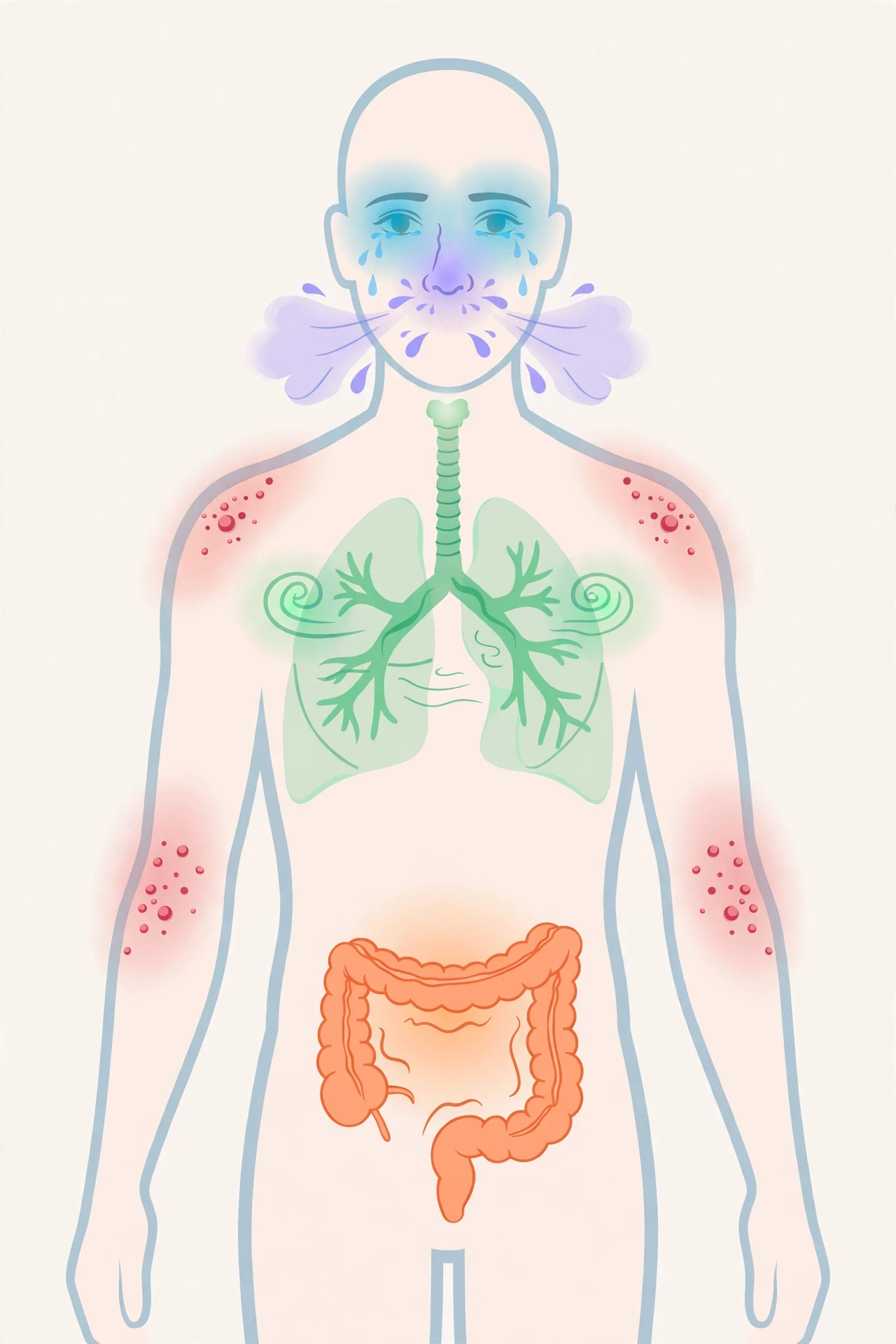
An allergy is one mechanism, but it wears many costumes, because the mast cells are stationed all over the body and the symptoms depend on where they fire. The same histamine that makes a nose run will, in the skin, make a welt, and in the gut, make a stomach cramp. The organ map below is the fastest way to recognise what you are looking at — and to recognise when the reaction has stopped being local and become systemic.
4.1 Skin
The skin is where allergy is most visible. Hives — urticaria — are itchy, raised bumps, or welts, that can appear anywhere on the body and look like bug bites. They come and go within hours, moving from place to place, which is one of the ways to tell them from an insect bite or a fixed rash. Acute hives last up to six weeks; chronic hives last longer than six weeks, and chronic hives affect up to 2 percent of people, with symptoms starting on average around age 40 and more common in women. Chronic hives are often not allergic at all in the IgE sense — many cases are driven by the immune system in other ways — which is why they need a clinician's assessment rather than an allergy test alone.
Eczema, or atopic dermatitis, is the other great skin allergy. It is itchy skin, discoloration, swelling, and a dry, flaky, scaly rash, sometimes with small blisters that ooze and crust. It affects about 30 million Americans — roughly 21 million adults and more than 9 million children in 2024 — and it is the condition that usually arrives first in the sequence called the atopic march. The skin barrier is the story here: when the barrier is broken, allergens get in through the skin and sensitise the immune system, which is why eczema in infancy raises the risk of food allergy roughly sixfold. How the Skin Works explains the barrier itself — the layers, the lipids, and the protein filaggrin that holds it together.
4.2 Nose and eyes
Allergic rhinitis is the commonest allergic disease, and its symptoms are the ones most people recognise: sneezing in bursts, a runny nose with clear mucus, nasal congestion, an itchy nose, and postnasal drip. Allergic conjunctivitis usually travels with it — itchy, watery, red eyes — because the same pollen that lands on the nasal lining lands on the eye.
The practical question is how to tell allergies from a cold, and the answer is mostly in the pattern. Allergy tends to cause itchy nose and eyes, clear runny mucus, sneezing in bursts, and symptoms that persist for weeks or follow an exposure pattern — worse outdoors on a high-pollen day, better indoors — without fever. A viral cold usually brings a sore throat, fever or a general feeling of being unwell, and resolves in 7 to 10 days. A "cold" that lasts all spring, or that returns every September like clockwork, is almost never a cold.
4.3 Airways
When allergen reaches the lower airways, the same mechanism narrows them. Allergen exposure can trigger airway narrowing in allergic asthma — wheeze, cough, chest tightness, breathlessness. About 60 percent of asthma in the United States is allergic, and the overlap runs both ways: two-thirds of children with asthma also have allergies, and allergic rhinitis and asthma commonly coexist, sharing the same Type 2 inflammation. The nose and the lungs are, in the words of the "united airways" idea, one airway — which is why treating rhinitis can help asthma control, and why uncontrolled rhinitis can make asthma harder to control. The full story of the narrowed airway is in Asthma Explained, Human Health article number 6, including the three-part mechanism of inflammation, muscle squeeze, and mucus.
4.4 Gut
Food allergy reaches the gut first, because the gut is where the food goes. The symptoms are nausea, vomiting, crampy abdominal pain, and diarrhoea, often within minutes to two hours of eating. Severe gut symptoms — repetitive vomiting, severe crampy pain — can be part of anaphylaxis, and that matters for recognition: a person who has eaten a known trigger and is vomiting repeatedly is not having a stomach bug. They are having a systemic allergic reaction, and the clock is running. Not all food allergy is IgE-mediated — food protein-induced enterocolitis syndrome, or FPIES, and eosinophilic oesophagitis run on different immune pathways, stay invisible to IgE testing, and behave differently over time — but the IgE form is the commonest, and it is the one this article's mechanism describes.
4.5 Whole body
When the reaction stops being local and becomes systemic — skin plus breathing plus circulation plus gut, together, or the airways or circulation collapsing on their own — it has a different name: anaphylaxis. It is the severe end of the same spectrum, not a different disease, and it has its own section, because it is the one allergic reaction that can kill, and the one where knowing what to do matters most.
5. Anaphylaxis: When Allergy Becomes an Emergency
5.1 What anaphylaxis is
Anaphylaxis is a serious allergic reaction that can progress rapidly and may cause death. That is the first sentence of the 2024 consensus definition from GA²LEN, the global allergy network, and its bluntness is deliberate: this is not a bad allergy. It is a medical emergency. In plain terms, it is a severe, systemic, rapid-onset reaction involving two or more body systems — skin or mucosal, respiratory, cardiovascular, gastrointestinal — or isolated low blood pressure, bronchospasm, or laryngeal swelling after exposure to a known allergen.
Two details in that definition save lives. First, the reaction must involve more than one system, or one system collapsing — hives alone, however dramatic, are not anaphylaxis, while hives plus wheeze, or vomiting plus a drop in blood pressure, are. Second, skin symptoms may be absent. Their absence does not rule out anaphylaxis, and waiting for a rash before acting is one of the commonest and most dangerous delays in allergy care.
5.2 How common it is, honestly
Here the honest answer is that nobody knows precisely, and any article that gives you a single clean number is oversimplifying. Estimates of anaphylaxis incidence in the United States range from 50 to 112 per 100,000 person-years in some studies to 210 per 100,000 — 2.1 per 1,000 person-years — in a 2020 review in American Family Physician. Lifetime prevalence estimates range from 0.05 to 2 percent, with some surveys finding up to 5.1 percent with "probable" anaphylaxis. The spread reflects different case definitions and different data sources, not disagreement about the disease. What is not in dispute is that the incidence is rising.
The numbers that are firmer are the ones about what happens after the reaction starts. Anaphylaxis results in an estimated 45,000 to 50,000 emergency department visits per year in the United States, and those visits more than doubled between 2008 and 2016. Allergy-related deaths are estimated at roughly 200 to 500 people per year in the United States. And of people who reach hospital with anaphylaxis, about 99.7 percent survive. The danger is real, but it is also, overwhelmingly, survivable — if treatment arrives in time.
5.3 The commonest triggers
In the Anaphylaxis in America survey, the most common triggers were medicines at 34 percent, foods at 31 percent, and insect stings at 20 percent. Up to one-fifth of cases have no identified trigger at all. The Asthma and Allergy Foundation of America puts it the same way: the most common triggers for serious allergic reactions are medicines, food, and insect stings — and medicines cause most allergy-related deaths. That last fact surprises people, because food allergy gets most of the public attention, but it is antibiotics, anaesthetic agents, and contrast agents, given in hospitals to people whose allergy was not known, that account for the largest share of fatal reactions. Most fatal food-related reactions progress within 30 to 60 minutes of exposure, which is why the response to a suspected reaction must be immediate, not watchful.
5.4 Epinephrine — the only first-line treatment
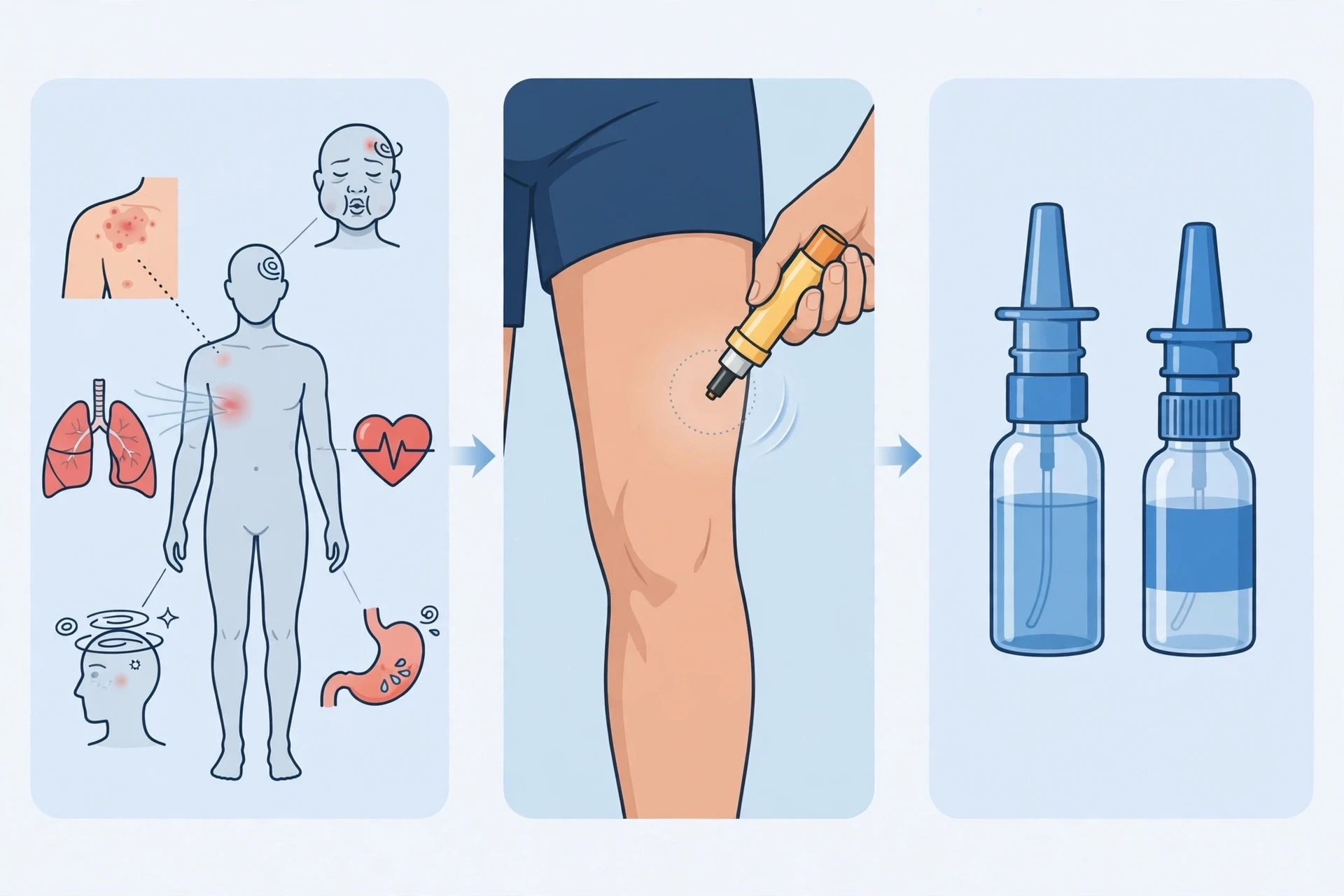
Epinephrine — adrenaline — is the primary treatment for anaphylaxis, with no absolute contraindication to its use. It is given as an intramuscular injection into the mid-outer thigh as soon as the diagnosis is suspected. It works on every part of the reaction at once: it constricts blood vessels, raising blood pressure; it relaxes airway smooth muscle, opening the breathing passages; and it stabilises mast cells, slowing further mediator release. Nothing else does all three. Antihistamines and corticosteroids are adjuncts only, never substitutes, and epinephrine must not be delayed while waiting for low blood pressure, a rash, laboratory results, or worsening symptoms.
The tragedy of anaphylaxis care is not that the treatment does not exist. It is that it is not used. In the Anaphylaxis in America survey, only 11 percent of people self-administered epinephrine, while 27 percent self-treated with antihistamines. Fifty-two percent had never received a prescription for a self-injectable epinephrine device, and 60 percent did not currently have epinephrine available. In emergency departments in the United States and Canada, only about 45 percent of anaphylaxis patients received epinephrine in the last ten years — up from about 21 percent for food-induced anaphylaxis more than ten years ago, but still less than half. The single most dangerous misconception in allergy medicine is the belief that an antihistamine will do. It will not. Antihistamines block one mediator, slowly, in the skin and nose. They do nothing for blood pressure, nothing for a closing airway, and nothing fast enough to matter.
5.5 Biphasic reactions
A biphasic reaction is a recurrence of anaphylaxis symptoms after the initial episode has completely resolved, without any additional exposure. It is the reason people are kept for observation after anaphylaxis, and it is the reason the question "how long should I stay?" has no single answer. A 2014 systematic review found a rate of 7.36 percent overall, 9.07 percent in prospective studies, with a mean second-phase onset of 8.13 hours and a range of 1 to 72 hours; a registry figure quoted by the American Academy of Allergy, Asthma and Immunology is about 4.7 percent overall and 9.6 percent for peanut. Older single-centre studies reported up to about 19 to 20 percent. The honest summary is roughly 5 to 10 percent in most large studies, up to about 20 percent in older single-centre reports, and most second reactions are milder than the first.
Current guidance leans toward risk stratification rather than a fixed observation time: the American Academy of Family Physicians in 2020 recommended monitoring for 4 to 12 hours depending on risk factors, while more recent practice-parameter guidance suggests that about one hour of asymptomatic observation may be reasonable without severe risk factors, and six or more hours for higher-risk patients. Antihistamines and glucocorticoids have not been shown to prevent biphasic reactions. The practical point is simple: a reaction that has resolved can return, and the person should not be alone, or far from help, in the hours afterwards.
5.6 Neffy — the first needle-free epinephrine
For decades, the only way to give epinephrine outside a hospital was a needle — an auto-injector pressed against the thigh. In August 2024, the FDA approved neffy, an epinephrine nasal spray, the first non-injection epinephrine product: a single spray into one nostril for adults and children weighing 30 kilograms or more, expanded in March 2025 to children weighing 15 to under 30 kilograms, at a lower dose. In March 2026 the FDA removed the age requirement from the 1 mg labelling, so the lower dose is now weight-based only — any patient weighing 33 lb (15 kg) or more. The approval rested on blood-level and pharmacodynamic equivalence to injection products, not on head-to-head trials in people actually having anaphylaxis — an important qualification, because the nasal spray has never been tested against an injection during a real reaction.
What neffy changes is the barrier to use. A significant share of the under-use of epinephrine comes from fear of needles, from the device being left at home, or from hesitation in the moment. A spray that fits in a pocket and needs no needle may reach people who would never carry an injector. What it does not change is the medicine, the dose, or the rule: it is the same drug, it is not a cure, and it is still only the first step — emergency care follows, as it always must.
6. The Atlas of Allergies: Pollen, Dust, Pets, Mould
The aeroallergens — the things you breathe in — are the commonest triggers of all, because breathing is not optional. They differ in where they live, when they peak, and what they do, and the table below is the quickest way to keep them straight.
Allergen | Where it lives | When it peaks | Main symptoms |
|---|---|---|---|
Tree pollen | Outdoors, spring | Spring | Sneezing, itchy eyes, runny nose |
Grass pollen | Outdoors, summer | Late spring to summer | Sneezing, itchy eyes, congestion |
Weed pollen (ragweed) | Outdoors, fall | Late summer to fall | Sneezing, congestion, itchy eyes |
Dust mites | Beds, carpets, upholstery | Year-round | Congestion, sneezing, asthma |
Pet dander | Homes with animals; also carried on clothing | Year-round | Sneezing, itchy eyes, asthma |
Mould spores | Damp indoor and outdoor spaces | Damp and wet seasons | Congestion, cough, wheeze |
6.1 Hay fever / allergic rhinitis
Seasonal allergic rhinitis is an allergic reaction to pollen, and the calendar is the diagnosis. Trees pollinate in spring, grasses in summer, weeds in fall — and ragweed, the dominant fall weed pollen, is the single most troublesome plant in the United States, affecting roughly 1 in 7 people. In 2024, more than 82 million Americans were diagnosed with seasonal allergic rhinitis, about 67 million adults and 14 million children. The symptoms are the classic ones: sneezing, itchy eyes, a runny nose, congestion. They arrive with the season and leave with it, which is itself a clue — a cold does not respect the pollen count.
6.2 Dust mites
Dust-mite allergy affects 20 million people in the United States. House dust mites — Dermatophagoides pteronyssinus and Dermatophagoides farinae — are microscopic arachnids that live in beds, carpets, and upholstery, feeding on shed skin cells. The allergen is not the mite itself but its droppings and body fragments, and the proteins have names worth knowing: Der p 1, Der p 2, and Der p 23. About 84 percent of American households have detectable house dust mites, and 5 to 30 percent of the general population show dust-mite sensitivity on skin testing. Clinically confirmed dust-mite allergy affects about 4 to 6 percent of the global population — roughly 500 million people. Unlike pollen, dust mites are year-round, which is why a person whose nose is blocked every morning, all year, in a house with old carpets, should think about mites before pollen. And the link to asthma is strong: 40 to 85 percent of people with asthma and allergies are allergic to house dust mites.
6.3 Pet dander
Pet allergy is one of the most misunderstood allergies, because the culprit is not what people think. It is not the fur. It is the dander — tiny skin flakes — plus saliva and urine proteins, above all Fel d 1 in cats and Can f 1 in dogs. Those proteins are sticky, light, and persistent: they stay airborne, they settle into carpets and upholstery, and they travel on clothing, so that a home without a cat can still carry cat allergen on the clothes of a visitor. Cat and dog allergens are among the commonest indoor sensitisers, and like dust mites they are year-round. The practical consequence is that "hypoallergenic" breeds, which shed less fur, do not reliably solve the problem, because the allergen is a protein in skin and saliva, not in hair.
6.4 Mould
Mould spores — Alternaria and Cladosporium are the commonest culprits — are both indoor and outdoor allergens, worse in damp conditions and wet seasons. Indoors, mould grows in bathrooms, basements, and anywhere water has leaked; outdoors, it grows on decaying leaves and vegetation. People with mould allergies may have seasonal symptoms when mould counts rise, and perennial symptoms when the source is inside the house. Mould is the allergen most often overlooked in a work-up, partly because it is invisible and partly because its season overlaps with pollen — a person who sneezes in the fall may blame ragweed when the cause is the leaf mould underfoot.
7. Food Allergies: The Big 9 and the Numbers That Confuse People
7.1 How common food allergies really are
Food allergy is the part of this article where the numbers most often confuse people, and the confusion is not the reader's fault. Two different methods produce two different answers, and both are quoted as if they were the same thing.
The higher figure comes from Gupta and colleagues, who surveyed Americans and counted a food allergy as "convincing" when the reported symptoms were consistent with an IgE-mediated reaction. By that definition, 10.8 percent of American adults — more than 26 million people — and 7.6 percent of children, about 1 in 13, have a convincing food allergy. The Food Allergy Research and Education organisation's 2026 National Indicator Report combines the two Gupta studies into a headline of 33 million Americans. Nearly twice as many adults — 19 percent — believe they have a food allergy, which is itself a finding: food allergy is both under-diagnosed and over-believed, in different people.
The lower figure comes from the CDC's 2024 National Health Interview Survey, which counted only allergies a clinician had diagnosed: 6.7 percent of adults and 5.3 percent of children, or about 22 million Americans. The gap is definitional, not a disagreement. The CDC counts diagnosed allergy; Gupta counts survey-convincing allergy. Both are correct under their own definitions, and any article that quotes one without saying which it is quoting is misleading its readers. This article quotes both, and labels them.
Food allergy in the United States rose by approximately 50 percent between 1997 and 2011. Separately, peanut or tree nut allergy in children more than tripled between 1997 and 2008, from 0.6 percent to 2.1 percent. The rise has not stopped, and it is the rise — not just the level — that drives the research into why allergies are increasing, which section 9 takes up.
7.2 The Big 9
Nine foods cause most food allergies in the United States: milk, eggs, peanuts, tree nuts, fish, shellfish, wheat, soy, and sesame. Milk is the most common food allergen for children, followed by egg and peanut; shellfish is the most common for adults, followed by peanut and tree nut. The ranking matters because it is different at different ages: a child's allergy is most often to milk or egg, an adult's to shellfish or peanut, and nearly half of food-allergic adults developed at least one of their food allergies as an adult. Shellfish allergy in particular is frequently adult-onset — a person can eat shrimp happily for thirty years and then, one evening, cannot.

7.3 Sesame, the ninth allergen
Sesame is the newest member of the list, and its arrival is a small lesson in how food labelling law works. The Food Allergen Labeling and Consumer Protection Act of 2004 named eight major allergens and required them to be declared in plain English on FDA-regulated packaged food. The eight were chosen because they accounted for roughly 90 percent of food allergies. But sesame, which affected about 500,000 American adults and can cause severe reactions including anaphylaxis, was not among them — and for seventeen years it could hide in an ingredient list under names like "natural flavouring" or "spice". The FASTER Act, signed in April 2021, added sesame as the ninth allergen, with mandatory compliance from 1 January 2023.
The labelling mechanics are worth knowing, because they are the daily tools of a food-allergic person's life. The allergen must be declared either parenthetically in the ingredient list — for example, "lecithin (soy)" — or in a "Contains:" statement immediately after or adjacent to the ingredient list. Fish, crustacean shellfish, and tree nuts must name the specific species or nut. And "may contain" precautionary statements are voluntary and unregulated: they are a manufacturer's choice, not a legal requirement, and their absence does not mean a food is safe.
7.4 Food allergies vs food intolerance
True, IgE-mediated food allergies involve the immune system and can cause anaphylaxis. Food intolerance — lactose intolerance is the classic example — involves digestion, not IgE, and is not life-threatening in the same way. The distinction is not a technicality; it is the difference between a condition that needs an epinephrine auto-injector and one that needs a dietary adjustment.
The same distinction exposes a thriving industry of tests. IgG and IgG4 "food sensitivity" panels are widely sold, but they measure ordinary exposure to foods, not allergy, and the major allergy societies advise against using them for diagnosis. An allergy test diagnoses IgE-mediated allergy only. It does not diagnose intolerance, and a panel that claims to do so is selling something the science does not support.
There is also food allergy that is not IgE-mediated at all — food protein-induced enterocolitis syndrome, and eosinophilic oesophagitis — which involve other immune mechanisms, do not show up on IgE tests, and follow different courses. The IgE mechanism in section 3 covers the commonest form of food allergy, not all of it.
7.5 Oral allergy syndrome / pollen-food syndrome
Oral allergy syndrome, also called pollen-food syndrome, is the allergy world's best illustration of mistaken identity. It is a contact allergic reaction of the mouth and throat to raw fruits and vegetables whose proteins resemble pollen proteins. The immune system, primed against birch pollen, meets an apple, recognises a protein that looks almost identical, and fires. It occurs in up to 50 to 75 percent of adults allergic to birch tree pollen, and the symptoms — itching and swelling of the mouth, face, lip, tongue, and throat — usually appear immediately after eating the raw fruit or vegetable.
This reaction occurs because the proteins found in some fruits and vegetables are very similar to those found in pollen. These proteins can confuse the immune system and cause an allergic reaction or make existing symptoms worse, which is referred to as cross-reactivity. — American Academy of Allergy, Asthma & Immunology, Oral Allergy Syndrome
The pairings are predictable once you know the pollen: birch pollen cross-reacts with apple, apricot, cherry, peach, pear, plum, kiwi, carrot, celery, almond, hazelnut, peanut, and soybean; grass pollen with peach, celery, tomato, melons, and oranges; ragweed with banana, cucumber, melon, and zucchini. Cooking — baking or microwaving — breaks the proteins down and usually prevents symptoms, and peeling helps because the protein is often concentrated in the skin. One warning matters: mouth itching with nuts should prompt a visit to an allergist, because it may signal a more serious nut allergy rather than the usually mild oral allergy syndrome.
8. Venom, Drugs, Latex, and Contact Allergy
8.1 Insect venom
Insect sting allergy affects about 3 out of 100 people in the United States — roughly 10 million. The commonest stinging insects are bees, wasps, hornets, yellow jackets, and fire ants. In the United States between 2011 and 2021 there were 788 deaths from hornet, wasp, and bee stings, an average of 72 a year, and 84 percent were male. Systemic sting reactions occur in about 1 percent of children, up to 3 percent of adults, and up to 32 percent of beekeepers — a dose-response curve written in stings. The good news is in section 12: venom immunotherapy prevents systemic reactions in the large majority of people treated, which makes venom allergy one of the most treatable allergies there is.
8.2 Drug allergy
Only 5 to 10 percent of adverse drug reactions are allergic reactions at all; most are predictable side effects, or interactions, or the drug doing what it does too strongly. But the allergic minority matters, and penicillin is the story that defines it. Approximately 10 percent of the American population reports a penicillin allergy — but evidence consistently shows that more than 90 percent of those people are not truly allergic on evaluation, and fewer than 1 in 100 of the total population is truly penicillin-allergic. A 2023 study of adults aged 65 and over found that 97 percent of reported penicillin allergies were disproved after verification testing. Most people also lose penicillin allergy over time, even after severe reactions such as anaphylaxis: about 80 percent of genuinely allergic patients lose sensitivity within ten years.
A wrong label is not harmless. Inaccurate labels lead to broader-spectrum antibiotics, higher healthcare costs, more antimicrobial resistance, more adverse events — including MRSA and Clostridioides difficile infection — and worse outcomes. Delabelling, through history plus skin testing and, where appropriate, a supervised oral challenge, is a low-cost, high-yield intervention, and the American Academy of Allergy, Asthma and Immunology pressed in June 2026 for penicillin-allergy verification to be included in Medicare Annual Wellness Visits. Other common culprits include aspirin and other non-steroidal anti-inflammatory drugs, chemotherapy agents, anticonvulsants, and monoclonal antibody therapies.
8.3 Latex
About 4.3 percent of the general population has a latex allergy — roughly 14 million Americans — and about 10 percent of healthcare workers are affected, with 8 to 12 percent sensitised by one occupational estimate. Latex is a protein in the sap of the rubber tree, and powdered latex gloves were the major workplace exposure source: the powder carried the protein into the air, where it was breathed in by everyone in the room. Latex-free and powder-free policies have reduced new cases substantially, which is a rare example of an allergy epidemic being reversed by a workplace change rather than a drug.
8.4 Contact dermatitis and nickel
Contact allergy is the delayed reaction, and nickel is its classic cause. Contact allergies affect about 20 out of 100 people; a meta-analysis of 20,107 people from the general population found 20.1 percent sensitised to at least one common contact allergen. Nickel is the commonest, at 11.4 percent of the general population, followed by fragrance mix at 3.5 percent.
The mechanism is Type IV, and it is worth seeing in full because it is so different from the IgE story. Nickel is a hapten — a small molecule that is not itself recognised by the immune system, but that binds to skin proteins and changes them into something the system does recognise. Langerhans cells in the skin present the changed protein to T cells, and on re-exposure those T cells mount an inflammatory response. The result is an itchy, eczematous rash that appears 24 to 72 hours later, peaking at 72 to 96 hours, shaped like the contact: earlobes under cheap earrings, the wrist under a watch, the skin under a belt buckle. Patch testing is the gold standard for diagnosis — allergens applied under occlusion to the back for two days, read on day 2 and day 3 to 4 — and it is not to be confused with skin-prick testing, which is for Type I, IgE allergy.
8.5 Alpha-gal syndrome
One newer allergy deserves a single line, because it shows how strange allergy can get. Alpha-gal syndrome is an IgE-mediated allergy to galactose-alpha-1,3-galactose, a sugar in non-primate mammalian meat, acquired after certain tick bites — and its reactions are delayed by hours after eating red meat, which breaks the usual rule that food allergy is fast. No drug is approved specifically for it. It is a reminder that the map of allergy is still being drawn.
9. Why Some People Get Allergies — and Why They Are Rising
9.1 Genes and atopy
Atopy is the inherited tendency to produce IgE to common environmental proteins — pollen, dust mites, food. Having one allergic disease increases the risk of others, and a family history of allergies, especially in a parent or sibling, raises risk. Twin studies put the heritability of asthma at roughly 60 to 80 percent, and allergy runs in the same families. But genes are only half the story, and they cannot explain the rise: the allergy epidemic has happened within one or two generations, far too fast for genetic change. Genes set susceptibility. Something in the environment is pulling the trigger.
One gene deserves a name. The FLG gene encodes filaggrin, an essential protein of the skin's outer layer that aggregates keratin filaments in the cornified layer — the mortar of the skin barrier. Loss-of-function mutations in FLG cause earlier-onset, more persistent atopic dermatitis, and predispose to asthma and allergic sensitisation — but only in the presence of atopic dermatitis. The barrier is the gate: when it is broken, allergens get in through the skin, and the immune system learns to fear them. That is the molecular basis of the atopic march, and of the dual-allergen hypothesis that follows.
9.2 The atopic march
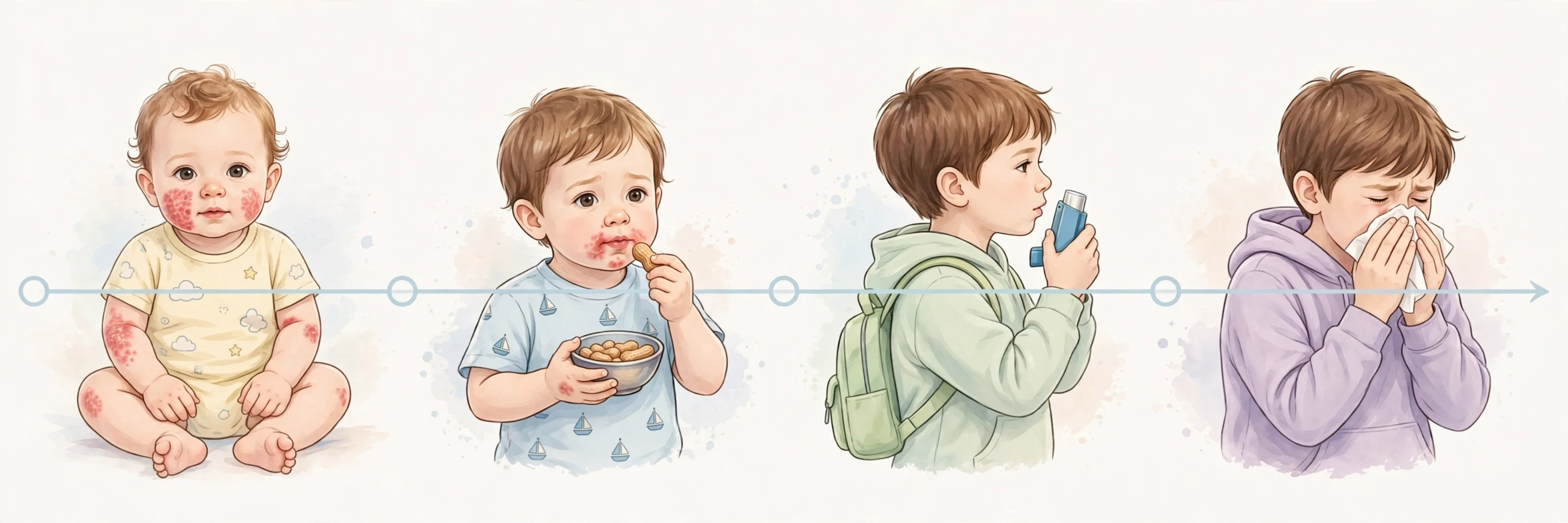
The atopic march is the sequence that many allergic children follow: atopic dermatitis in early infancy, then IgE-mediated food allergy, then allergic asthma, then allergic rhinitis in later childhood. Children with atopic dermatitis are about six times more likely to be sensitised to foods than children without it (adjusted odds ratio 6.18), and the risk of the later conditions rises with eczema severity. Allergic asthma is the commonest asthma phenotype — about 60 percent of asthma in the United States — and allergic rhinitis and asthma frequently coexist.
But the march is a tendency, not a destiny, and presenting it as a fixed staircase would be wrong. Only about 3.1 percent of children follow the classic full sequence of eczema, then wheeze, then rhinitis (the "atopic march" latent class in Belgrave et al. 2014); about 10.5 percent when eczema plus any other atopic condition is counted. Many children have one condition only, or a different order. The modern view is shifting toward coexisting clusters rather than a strict progression — a pattern of risk, not a timetable.
9.3 The dual-allergen exposure hypothesis
The dual-allergen exposure hypothesis is the idea that the route of first exposure decides the outcome. Exposure to a food allergen through an impaired skin barrier — as in eczema — induces sensitisation and food allergy. Early oral exposure to the same food induces tolerance. Skin exposure sensitises; eating tolerises. It sounds paradoxical, and it is the reason the old advice to delay peanut introduction turned out to be exactly backwards: keeping peanut away from infants' mouths while it entered through their broken skin was, in effect, sensitising them. The hypothesis is the mechanistic basis for the LEAP study, and for the early peanut introduction guidelines that followed it, which section 12.5 covers in full.
9.4 The hygiene hypothesis, corrected
The hygiene hypothesis is the most quoted and most misquoted idea in allergy. In 1989, David Strachan observed in the British Medical Journal that hay fever was less common in children with more older siblings, and proposed that reduced early-childhood infection — from smaller families, better household amenities, and higher personal cleanliness — left the immune system prone to allergy. The term "hygiene hypothesis" was not even in the 1989 paper. And the idea as it is usually stated — that being too clean causes allergy — is a caricature. Strachan was writing about infections and family size, not about hand-washing, and the evidence since has moved a long way from the original framing.
9.5 Old friends and the microbiome
Graham Rook's "old friends" hypothesis, proposed in 2003, reframed Strachan. The key loss, Rook argued, is not infections as such but exposure to co-evolved microbes — commensals, helminths, the organisms humans lived with for millennia — that train regulatory immune responses. Losing them explains something the original hygiene hypothesis could not: the parallel rise of allergy, which is driven by Th2 immunity, and autoimmunity, which is driven by Th1 immunity. If the problem were simply too little Th1 stimulation, autoimmunity should have fallen as allergy rose. It did not. Both rose together, which points to a loss of regulation — of the regulatory T cells that keep both arms of the immune system in check — rather than a tilt from one arm to the other.
The microbiome is the mechanism behind that regulation. Early-life gut and skin microbiome diversity shapes regulatory T-cell development and a tolerogenic environment; dysbiosis impairs tolerance and favours Th2 expansion. Skin microbiome diversity is inversely correlated with eczema severity. The farm effect is the most vivid demonstration: Amish children, exposed daily to barns from early age, have asthma at about 5 percent, against about 20 to 21 percent in genetically similar Hutterite children. Amish house dust carried about 6.8 times more endotoxin, and Amish dust — not Hutterite dust — protected mice from experimental allergic asthma. The difference was not in the genes. It was in the dust. The microbes in the gut, and the environment that shapes them, are part of the story, and The Gut Microbiome Explained follows that world in full.
9.6 Pollution, cities, and a warming climate
Air pollution is an important risk factor for allergic disease, causing new cases and worsening existing disease, and urbanisation is associated with increased allergy prevalence. Diesel exhaust and traffic pollution can act as adjuvants, boosting IgE responses to aeroallergens — the pollutant does not just irritate the airways, it makes the immune system more likely to react to what it breathes in.
Climate change has lengthened the allergy season, and the figures are widely misquoted, so they are worth stating precisely. A 2021 study in the Proceedings of the National Academy of Sciences, analysing 60 North American stations from 1990 to 2018, found that pollen seasons started about 20 days earlier, lasted about 8 days longer, and total pollen concentrations rose about 21 percent. Human-caused climate change explained about 50 percent of the shift in season timing and length, and about 8 percent of the pollen increase. The commonly repeated claim that pollen season is "20 days longer" conflates the earlier start with the longer duration; it is 20 days earlier and 8 days longer. Climate Central's 2026 analysis of NOAA data adds the context: the freeze-free growing season lengthened in 87 percent of 198 American cities analysed — by 21 days on average from 1970 to 2025 — and the fall frost-free stretch grew by 11 days on average in 177 of 202 cities. With continued high carbon dioxide, American pollen production could rise by up to 200 percent by the end of the century. The allergy season is not just worse. It is longer, earlier, and heavier, and the trend is driven by the same warming that is changing everything else.
Caesarean delivery, early antibiotics, and vitamin D are often listed as possible early-life influences, and they have been studied. But no verified quantitative risk estimate for any of the three is robust enough for a headline figure, and this article will not invent one. They are mentioned here as studied possibilities, nothing more.
10. How Allergies Are Diagnosed
10.1 History first
Diagnosis starts with an allergy-focused clinical history, and European guidelines describe it that way for a reason. Tests for IgE sensitisation follow the history; they do not replace it. Testing should be guided by a history of symptoms tied to a specific trigger, not used as a general screen. The history is the diagnosis; the tests are the confirmation. A person who has never had symptoms after eating peanut does not need a peanut test, however many panels a laboratory is willing to sell.
Test | What it measures | What a positive result means | What it cannot do |
|---|---|---|---|
Skin-prick test | IgE on skin mast cells | Sensitisation to that allergen | Prove clinical allergy; about half of positives are not clinical allergy |
Specific IgE blood test | Allergen-specific IgE in blood | Sensitisation; higher levels make allergy more likely | Predict how severe a reaction would be |
Oral food challenge | Actual clinical reaction | Confirms or rules out food allergies | Be done at home — it must be supervised |
Component-resolved diagnostics | IgE to single allergen molecules | More specific allergy signal than whole-extract tests | Replace the oral food challenge |
Patch test | T-cell reaction in skin | Sensitisation to a contact allergen | Diagnose IgE allergy — it is for Type IV, not Type I |
IgG / IgG4 food panel | IgG antibodies to foods | Normal food exposure | Diagnose allergy — not recommended by allergy societies |
10.2 Skin-prick testing
A drop of allergen extract is placed on the skin and the surface pricked through it. A wheal — a raised bump — within 15 to 20 minutes indicates IgE-mediated sensitisation, and a positive result is usually a wheal at least 3 millimetres larger than the negative control. The test is sensitive: about 90 percent of true food allergies are caught. But it is only about 50 percent specific, which means roughly half of positive results are "false positives" for clinical allergy — sensitisation without symptoms. A negative test, by contrast, has high negative predictive value: it is reassuring. The wheal on the forearm is the mechanism of section 3 made visible, and it is why the test works at all.
10.3 Specific IgE blood tests
Blood tests measure allergen-specific IgE in the blood. A positive result confirms sensitisation, not clinical allergy — the same distinction as the skin-prick test, in a different format. Higher levels make clinical allergy more likely, but the level does not predict how severe a reaction would be. A person with a very high IgE level to peanut may have mild symptoms, and a person with a modest level may have anaphylaxis. The number is a probability, not a severity score, and it should never be read as one.
10.4 The oral food challenge — the gold standard
The oral food challenge — eating increasing doses of the suspect food under medical supervision — is the diagnostic gold standard for food allergy. The double-blind, placebo-controlled version is the research standard; open challenges are more common in practice. It is the only test that definitively confirms or rules out clinical food allergy, and the only test that distinguishes sensitisation from true allergy. It is also the test that determines whether a child has outgrown an allergy, and it must never be attempted at home: a challenge is done in a clinic, with epinephrine on the table, because the challenge itself can cause the reaction it is testing for.
10.5 Component-resolved diagnostics and basophil activation test
Component-resolved diagnostics test IgE to single allergen molecules — components — rather than whole extracts. For peanut, the component Ara h 2; for birch, Bet v 1. A positive component test is more likely to reflect true allergy than a positive whole-extract test, because the component is the specific protein that drives the reaction, rather than a mixture that includes proteins shared with harmless pollens. The basophil activation test is an emerging alternative: the patient's basophils are exposed to allergen in a test tube and their activation measured. It is more specific than skin-prick testing or specific IgE, and it is used where available, but it has not replaced the oral food challenge.
10.6 Patch testing for contact allergy
Patch testing is the diagnostic standard for allergic contact dermatitis, and it is a different test from skin-prick testing in every respect. Allergens are applied under occlusion to the back for two days, and read on day 2 and day 3 to 4, sometimes day 7. A positive patch test indicates sensitisation; whether it is clinically relevant depends on whether exposure explains the dermatitis. The two-day wait is the Type IV mechanism in action: T cells take time to arrive and react, and a test read too early will miss them.
10.7 What NOT to use
IgG and IgG4 food sensitivity panels are widely marketed, but the major allergy societies do not recommend them. IgG reflects normal food exposure, not allergy, and a positive result is common in people with no symptoms. A European Academy task force concluded that IgG4 tests to foods should not be performed for food-related complaints. The test is not merely unhelpful; it is actively misleading, because it produces a long list of "sensitivities" that sends people into unnecessary dietary restriction. The same caution applies to routine screening: guidance from the National Institute of Allergy and Infectious Diseases states that there is not enough evidence to recommend routine food-allergy testing before introducing common allergens — milk, egg, peanut — even in high-risk children. Testing should follow a symptom history.
11. Everyday Medicines: Antihistamines, Sprays, and What Each One Actually Does
11.1 Antihistamines — H1 blockade
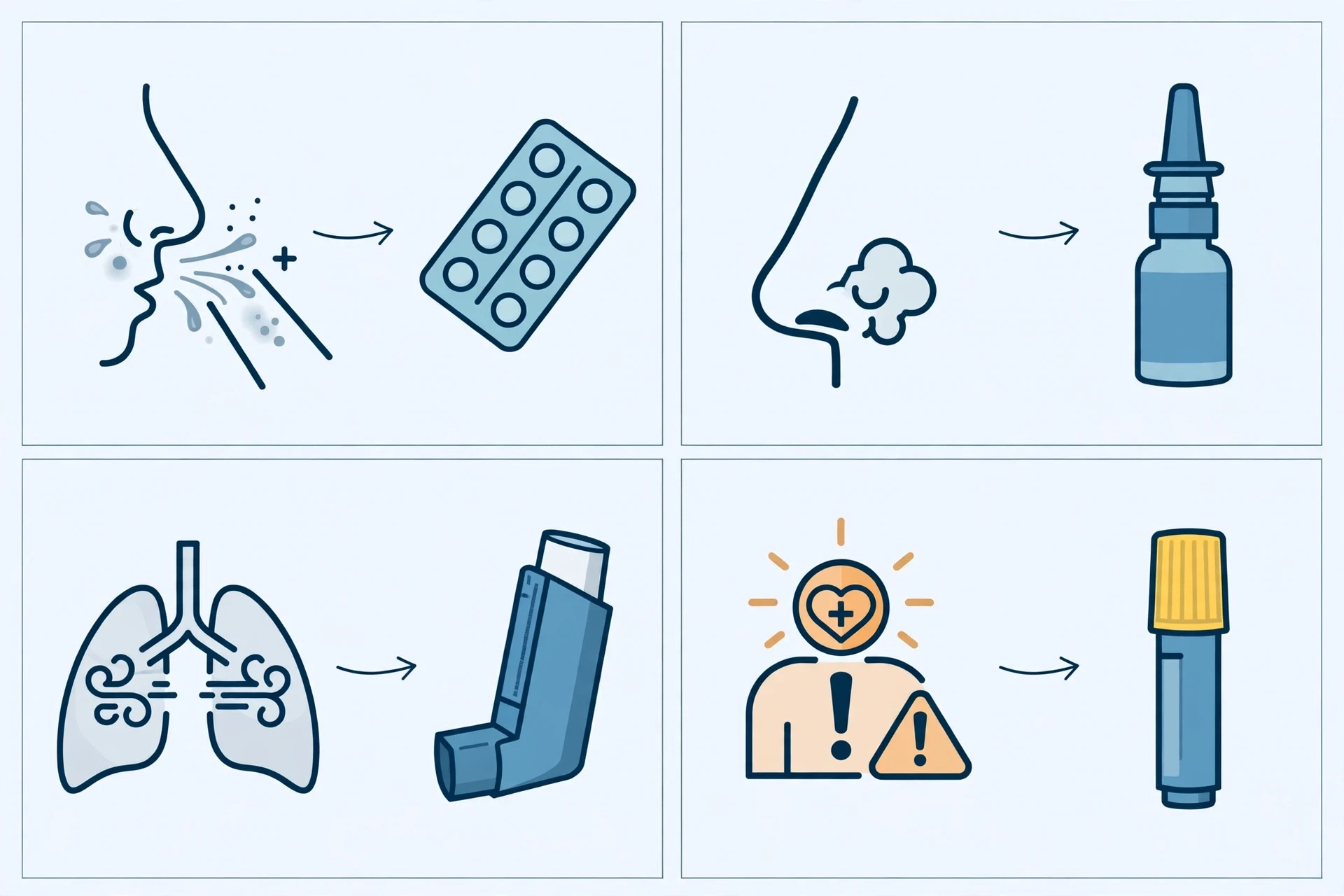
Antihistamines block H1 histamine receptors — more precisely, they act as inverse agonists, suppressing the receptor's baseline activity. They work best for sneezing, itching, a runny nose, and hives. They do not relieve nasal congestion well, and they do not treat anaphylaxis. That last point cannot be repeated too often: an antihistamine is a symptom drug for the early phase, not a rescue drug for a systemic reaction. Knowing what a medicine does not do is as important as knowing what it does.
11.2 First vs second generation
First-generation antihistamines — diphenhydramine, chlorpheniramine — are small, fat-soluble molecules that cross the blood-brain barrier, causing sedation, psychomotor impairment, dry mouth, and other anticholinergic effects, and they last only 4 to 6 hours. Diphenhydramine, the ingredient in many over-the-counter sleep aids, is still the drug most people reach for — and it is the drug that most impairs driving, work, and school performance, in a way its users often do not notice. The impairment is real even when the person feels awake.
Second-generation agents — cetirizine, loratadine, fexofenadine, desloratadine, levocetirizine — are larger and less fat-soluble, and are often pumped out of the brain by a transporter called P-glycoprotein. They last 12 to 24 hours and are much less sedating. Fexofenadine is the least sedating, with under 5 percent central H1 receptor occupancy; cetirizine is the most sedating of the second generation, with about 10 to 20 percent of users reporting drowsiness. First-generation agents are flagged as potentially inappropriate in adults over 65, under the Beers and STOPP criteria for prescribing in older people. The practical rule is simple: if the antihistamine makes you sleepy, it is doing so because it has reached your brain, and there is almost always a newer alternative that will not.
11.3 Intranasal corticosteroids — the most effective rhinitis treatment
Intranasal corticosteroids — fluticasone, mometasone, budesonide — are the most effective first-line treatment for all allergic rhinitis symptoms, including congestion, which antihistamines handle poorly. Some relief begins within 3 to 12 hours, with maximal benefit over days to weeks, and they are preferred over oral antihistamines for moderate-to-severe or persistent rhinitis. Technique matters: the spray should be aimed outward, toward the side wall of the nose, not straight up toward the septum, which is where nosebleeds come from. A steroid spray used wrongly is a steroid spray wasted, and the commonest reason it "does not work" is that it was aimed at the wrong place or stopped after two days, before it had time to work.
11.4 Decongestants and leukotriene modifiers
Decongestants — oral pseudoephedrine, topical oxymetazoline — shrink swollen nasal tissue but do not treat the allergy itself. Topical decongestants must not be used for more than a few days, because stopping them after prolonged use causes rebound congestion that is worse than the original problem. Leukotriene receptor antagonists, above all montelukast, block leukotriene action; montelukast carries an FDA boxed warning for neuropsychiatric events, including suicidal thinking and behaviour. Both are useful in the right hands and for the right duration. Neither is a substitute for treating the inflammation that causes the congestion in the first place.
12. Treatments That Change the Immune System
The medicines in section 11 suppress symptoms. The treatments in this section do something different: they retrain the immune system itself. That is the distinction that matters, and it is the reason allergen immunotherapy has been called the only disease-modifying allergy treatment. The last few years have added new options to this section faster than at any time in the history of allergy medicine — and removed one, which is also part of the story.
Treatment | Who it is for | How long | What it does — and does not do |
|---|---|---|---|
Allergen immunotherapy (shots) | Rhinitis, asthma, venom allergy | 3–5 years | Retrains the immune system; lasting benefit after stopping; does not work overnight |
Allergen immunotherapy (tablets) | Ragweed, grass, dust-mite allergy | 3+ years | Daily at home; only certain allergens have approved tablets |
Venom immunotherapy | Sting allergy | 3–5 years | 85–98% effective; some residual risk remains after stopping |
Omalizumab (anti-IgE) | Multiple food allergies, ages 1+ | Ongoing injections every 2–4 weeks | Reduces reactions from accidental exposure; not a cure, not emergency treatment |
Dupilumab (anti-IL-4Rα) | Eczema, asthma, nasal polyps | Ongoing injections | Blocks IL-4 and IL-13 signalling; first biologic for eczema |
Early peanut introduction | High-risk infants, 4–6 months | Prevention, not treatment | About 81% relative reduction in peanut allergies; changes the trajectory |
12.1 Allergen immunotherapy — the only disease-modifying treatment
Allergen immunotherapy is the only treatment that targets the underlying pathophysiology rather than just suppressing symptoms. It can produce lasting remission after stopping, and it can prevent new sensitisations and progression from rhinitis to asthma. The idea is old — allergen immunotherapy dates to 1911, when Noon and Freeman gave grass-pollen injections for hay fever — and it is still the template for the shots given today.
Subcutaneous immunotherapy, the shots, follow a schedule: build-up injections weekly for about 3 to 6 months, then maintenance injections every 2 to 4 weeks, for a total of usually 3 to 5 years, sometimes longer. A Cochrane review from 2007 found that the shots significantly reduced rhinitis symptoms against placebo (standardised mean difference −0.73). Sublingual immunotherapy, the tablets, dissolve under the tongue at home, daily to three times a week, and in the United States FDA-approved tablets exist only for ragweed, northern pasture grasses such as timothy, and dust mites; sublingual drops are not FDA-approved in the United States and are used off-label. A minimum of three years is needed for durable benefit after stopping — the GRASS trial showed that two years was not enough — and guidelines generally advise making the decision about continuation after an initial period of 3 to 5 years, individualised to the person. There have been no documented fatalities from sublingual immunotherapy worldwide. The treatment is slow, and that is its nature: it is retraining a system that took years to learn the wrong lesson, and retraining takes years too.
12.2 Venom immunotherapy
Venom immunotherapy is 85 to 98 percent effective at preventing systemic reactions to stings while it is being given, and it is recommended for at least 3 to 5 years, usually five. After stopping at five years or more, there is still about a 10 percent chance of a systemic reaction to each future sting, but most of those reactions are mild, and protection after discontinuation is 77 to 84 percent for honeybee venom and 91 to 96 percent for vespid venom. For a beekeeper, a gardener, or a parent whose child has had anaphylaxis to a wasp sting, those numbers are the difference between a life lived outdoors and a life lived indoors. It is one of the clearest successes in allergy medicine, and it is under-used.
12.3 Omalizumab for food allergy
On 16 February 2024, the FDA approved omalizumab — Xolair — for the reduction of allergic reactions, including anaphylaxis, after accidental exposure to one or more foods, in adults and children aged 1 and over with IgE-mediated food allergy. It was the first medicine approved for multiple food allergies, and the first food-allergy treatment for adults and for children aged 1 to 4. Omalizumab is an antibody that binds free IgE and gradually reduces the IgE receptors on mast cells and basophils — it disarms the weapon, rather than blocking the explosion. The dose is set by weight and total IgE, given by subcutaneous injection every 2 to 4 weeks.
The evidence is the OUtMATCH trial, published in the New England Journal of Medicine in 2024: after 16 to 20 weeks, 67 percent of people on omalizumab, against 7 percent on placebo, could tolerate at least 600 milligrams of peanut protein — roughly two peanuts — without a reaction. Three qualifications matter. It does not cure allergy. It is not an emergency treatment — it does not replace epinephrine. And protection stops when the injections stop. What it does is raise the threshold: an accidental bite that would once have caused anaphylaxis may now cause nothing, or a mild reaction. For a family that lives in fear of a trace of peanut in a restaurant meal, that change in threshold is a change in life. Omalizumab was first approved in 2003 for moderate-to-severe allergic asthma, and its food-allergy approval is the newest chapter in a drug that has been in use for more than two decades.
12.4 Dupilumab for eczema
Dupilumab — Dupixent — is a fully human monoclonal antibody that blocks the interleukin-4 receptor alpha subunit, inhibiting both interleukin-4 and interleukin-13 signalling: the two cytokines at the heart of the Th2 response. The FDA approved it in March 2017 for moderate-to-severe atopic dermatitis in adults — the first biologic for eczema — and it has since been approved for asthma, chronic rhinosinusitis with nasal polyps, eosinophilic oesophagitis, and other conditions, and now for atopic dermatitis from six months of age. Where omalizumab disarms IgE, dupilumab interrupts the signal that creates it. The two drugs attack the same pathway at different points, and together they mark a shift in allergy medicine from suppressing symptoms to interrupting the mechanism.
12.5 The LEAP study and prevention
The LEAP study is the single most consequential trial in the history of food allergy, and it began with a paradox. For years, parents of high-risk infants were told to avoid peanut until the child was three. Then researchers noticed that peanut allergy was ten times commoner in the United Kingdom, where peanut was avoided in infancy, than in Israel, where peanut-containing snacks were given to babies. The dual-allergen hypothesis predicted exactly that: skin exposure sensitises, oral exposure tolerises, and keeping peanut out of the mouth while it entered through broken skin was sensitising children.
LEAP tested the prediction. Du Toit and colleagues, in the New England Journal of Medicine in 2015, randomised 640 high-risk infants — aged 4 to 11 months, with severe eczema and/or egg allergy — to consume peanut or avoid it until age five. In the skin-prick-negative stratum, peanut allergy at 60 months was 13.7 percent in the avoidance group against 1.9 percent in the consumption group. In the skin-prick-positive stratum, 35.3 percent against 10.6 percent. Overall, in the intention-to-treat analysis, 17.2 percent against 3.2 percent — an approximately 81 percent relative reduction. LEAP-On, the follow-up, showed that the protection persisted after a year of avoidance, and the National Institute of Allergy and Infectious Diseases issued addendum guidelines in 2017 recommending peanut introduction at 4 to 6 months for high-risk infants. One trial reversed a generation of advice, and it did so by testing a hypothesis about the route of exposure rather than the dose. It is the clearest proof in allergy medicine that prevention is possible — and that the advice parents receive matters enormously.
12.6 Palforzia — approved 2020, gone 2026
Palforzia, a peanut allergen powder for oral immunotherapy, was FDA-approved in January 2020 for ages 4 to 17, later expanded to ages 1 to 3 in 2024 — the first FDA-approved food-allergy treatment. In the PALISADE trial, published in the New England Journal of Medicine in 2018, 67 percent of treated participants tolerated at least 600 milligrams of peanut protein, against 4 percent on placebo. And then, in January 2026, Stallergenes Greer — which had acquired Palforzia in September 2023 — announced it would voluntarily discontinue it. Production stopped on 31 July 2026, and no new patients were accepted after 1 April 2026. The decision was explicitly not related to product safety, quality, or efficacy; it was a business and strategic decision. As of November 2026, there is no FDA-approved peanut oral immunotherapy on the market, and omalizumab is now the only FDA-approved food-allergy therapy. Oral immunotherapy continues in specialist practice with non-branded products, and unsupervised oral immunotherapy with ordinary peanut products is not an approved substitute. The episode is a reminder that a treatment's availability is not only a scientific question. It is also a commercial one, and patients can lose a therapy that worked for reasons that have nothing to do with medicine.
13. Living With Allergies
13.1 Daily management
Daily life with a serious allergy is a discipline. Label reading, every time, because formulations change. An action plan, written down, that says what to do and when. Epinephrine carried, not left at home — and the people around you told where it is and how to use it. Schools and restaurants informed, not assumed to know. It is a burden, and it is invisible to people who do not carry it: the parent who reads every label in a supermarket, the teenager who asks about ingredients at a party, the adult who carries an injector to a work lunch. The discipline works, and the discipline is also exhausting, and both of those things are true at once.
13.2 Children, school, and food allergy
Food allergies affect school, eating out, travel, and social life. With about 1 in 13 children affected — two in every classroom — a school cannot treat it as an exception. And the rise is not evenly shared: it is greatest in Black children, who also carry a higher burden of severe reactions and a lower rate of epinephrine prescription, a disparity that mirrors the racial disparities in asthma and in much of American medicine. The families carry most of the cost, too: of the 24.8 billion dollars a year that childhood food allergies cost in the classic 2013 estimate, 20.5 billion was borne by families, including lost labour productivity and special foods. Anaphylaxis action plans, epinephrine carriage, label reading, and informing schools and restaurants are the daily management tools — and they are tools that depend on the adults around the child, not only on the child.
13.3 The cost
The cost of allergies is large, and it has been badly under-counted. A 2025 study by Warren and colleagues estimates that food allergies may cost the United States nearly 371 billion dollars per year in societal burden. The classic paediatric figure, from Gupta and colleagues in 2013, was 24.8 billion dollars a year for childhood food allergy — 4,184 dollars per child per year, of which 4.3 billion was direct medical cost and 20.5 billion was borne by families. The other conditions add their own totals: nasal allergies 3 to 4 billion dollars a year, contact allergies about 1.5 billion in direct medical costs, eczema about 5 billion a year — adults with eczema pay 4,979 dollars more a year in healthcare costs, 2,381 directly eczema-linked — chronic hives about 244 million a year, and nasal polyps 5.7 billion a year. The old figure of 18 billion dollars a year for all allergies, still widely quoted, dates to older NIAID-era estimates of annual healthcare costs and is now far too low. The real cost is measured not only in money but in the days of school and work lost, the holidays not taken, and the meals not eaten.
13.4 Allergies and asthma together
Two-thirds of children with asthma and up to half of adults with asthma also suffer from allergies, and allergic rhinitis and asthma commonly coexist and share Type 2 inflammation. Chronic rhinosinusitis affects up to 12 percent of adults — about 32 million Americans — and up to 30 percent of people with chronic rhinosinusitis have nasal polyps, about 10 million adults, of whom as many as 67 percent also have asthma. The nose, the sinuses, and the lungs are one airway, and the allergy that inflames one inflames the others. That is why the asthma article and this article keep pointing at each other: they are two views of the same inflammation, and treating the nose can help the lungs. The exercise question, which people with allergic asthma ask often, is answered in How Exercise Changes the Body — exercise can trigger narrowing, and it is also one of the best things a person with asthma can do, with a warm-up and a plan.
13.5 Can you outgrow it?
The answer depends entirely on which allergy. Approximately 80 percent of children with cow's milk, egg, wheat, or soy allergy outgrow it by their teenage years, usually by age 16 — the Mayo Clinic puts the figure at 60 to 80 percent of young children with milk or egg allergy by age 16, and population studies show faster resolution than specialist-clinic studies, because referral clinics see the stubborn cases. Peanut is different: only about 20 to 25 percent of children with peanut allergy outgrow it, mostly by age 6 to 8. Tree nut allergy is outgrown about 14 percent of the time, and fish and shellfish allergies only about 4 to 5 percent of the time — those are usually lifelong.
How outgrowing is confirmed matters as much as the numbers. An oral food challenge overseen by a board-certified allergist is the best way to see whether allergies have been outgrown; falling IgE levels or a shrinking skin-test wheal predict it but do not prove it. And it must never be tested at home: a home test is a challenge without a clinic, and a challenge can cause the reaction it is testing for. Penicillin allergy fades too — roughly four in five people who were genuinely allergic lose that sensitivity over a decade — which is one more reason a label from childhood deserves to be re-checked rather than carried for life.
14. Eight Misconceptions About Allergies
14.1 "Allergies are all in your head"
False. Allergies are measurable immune responses: IgE in the blood, mast-cell degranulation, histamine and other mediators, with objective signs — a wheal on skin-prick testing, raised specific IgE, measurable airway narrowing. Stress can worsen symptoms, and it can make an itch feel worse, but it does not cause the underlying IgE mechanism. Telling a person with allergies that it is in their head is not only wrong; it delays the diagnosis and the treatment that would have helped.
14.2 "You can outgrow all allergies"
False, and misleading in a way that causes real harm. The outgrowing figures are set out in full in section 13.5: most childhood milk, egg, wheat, and soy allergies resolve, while peanut, tree nut, fish, and shellfish usually persist. Nobody should stop carrying epinephrine, or stop avoiding a trigger, on the assumption that they have outgrown an allergy. That is a decision for a clinician, with a supervised oral food challenge to back it.
14.3 "A positive allergy test means you are allergic"
False, and the source of a great deal of unnecessary dietary restriction. A positive skin-prick or IgE test shows sensitisation only. Many sensitised people eat the food with no symptoms — as section 3.5 explains, most peanut-sensitised children eat peanuts without any trouble. Diagnosis needs history plus test, and the oral food challenge is the gold standard. A test result without a history is a clue without a case.
14.4 "Antihistamines treat anaphylaxis"
False, and dangerous. Antihistamines are adjuncts only. Epinephrine is the sole first-line treatment for anaphylaxis and must not be delayed. Only 11 percent of people in the Anaphylaxis in America survey self-administered epinephrine, while 27 percent self-treated with antihistamines. That gap — between the drug that works and the drug people reach for — is measured in lives.
14.5 "If you have a penicillin allergy label, you can never take penicillin"
False for more than 90 percent of labelled people. About 10 percent of the population carries the label, but more than 90 percent are not truly allergic on evaluation, and most lose their allergies over time. Evaluation — history, skin test, and a supervised oral challenge — can safely remove most labels, and removing them matters, because the alternative antibiotics are broader, more expensive, and more likely to cause resistance and harm.
14.6 "Allergy shots are just symptom relief like antihistamines"
False. Allergen immunotherapy is the only disease-modifying allergy treatment: it retrains the immune system, can produce lasting remission after stopping, and can prevent new sensitisations and progression from rhinitis to asthma. It takes 3 to 5 years, and it is slow, and it is the closest thing allergy medicine has to a cure — which is precisely why it is not like an antihistamine.
14.7 "Pollen season is 20 days longer than it used to be"
Misquoted. The 2021 Proceedings of the National Academy of Sciences finding is that North American pollen seasons start about 20 days earlier and last about 8 days longer, with about 21 percent more pollen. "20 days longer" conflates the earlier start with the longer duration. The season is longer, but the headline number belongs to the earlier start.
14.8 "Food allergy and food intolerance are the same thing"
False. Food allergy is immune — IgE — mediated and can cause anaphylaxis. Intolerance, such as lactose intolerance, is digestive, not IgE-mediated, and IgG "food sensitivity" panels do not diagnose allergy. The words matter because the response matters: one needs an epinephrine auto-injector, the other needs a dietary adjustment, and confusing them puts the first person at risk.
15. Frequently Asked Questions
Why do people have allergies?
Because their immune system mistakes a harmless substance for a threat. The system makes IgE antibodies to a protein in pollen, food, or dust mites, arms mast cells with that IgE, and fires a full defence response — histamine, leukotrienes, and other mediators — when it meets the protein again. Genes set the susceptibility, especially the inherited tendency called atopy, but the rise in allergies over one or two generations is driven by the environment: changes in microbial exposure, diet, pollution, and climate. The IgE system itself evolved to fight parasites and venom. In allergy, it fires at the wrong target.
What is histamine?
Histamine is a chemical stored in mast cells and released when they degranulate. It dilates small blood vessels and makes them leaky, producing redness, swelling, and hives; it stimulates mucus glands, producing a runny nose and watery eyes; it contracts airway smooth muscle, producing wheeze; and it irritates nerve endings, producing itch. It acts mainly through H1 receptors, which is why drugs that block H1 receptors are called antihistamines. Histamine is the main cause of the early phase of an allergic reaction, within minutes. The late phase, hours later, is driven by other mediators — leukotrienes, prostaglandins, and cytokines — which is why antihistamines alone are often not enough.
What is anaphylaxis?
Anaphylaxis is a severe, systemic, rapid-onset allergic reaction that can progress quickly and may cause death. It involves two or more body systems — skin, breathing, circulation, gut — or the airways or circulation collapsing on their own after exposure to a known allergen. Skin symptoms may be absent, and their absence does not rule it out. The only first-line treatment is epinephrine, given immediately into the mid-outer thigh. Antihistamines and steroids are adjuncts only. About 45,000 to 50,000 emergency department visits a year in the United States are for anaphylaxis, and about 99.7 percent of people who reach hospital survive — if treatment arrives in time.
Why do allergies happen?
They happen because the immune system learns the wrong lesson. On first exposure to an allergen, dendritic cells present it to T cells, which become Th2 cells, which instruct B cells to make IgE, which arms mast cells. On re-exposure, the allergen cross-links that IgE and the mast cells burst open. Why some people learn that lesson and others do not is a mix of genes — atopy, filaggrin mutations, family history — and environment: the microbes of early life, the route of first exposure, pollution, and a warming climate that lengthens the pollen season. The dual-allergen hypothesis explains the food-allergy part: exposure through broken skin sensitises, while early eating builds tolerance. The hygiene hypothesis, as usually stated, is a caricature; the "old friends" version — the loss of co-evolved microbes that train regulatory immunity — fits the evidence better.
Can you outgrow allergies?
It depends on the allergy. The childhood allergies to milk, egg, wheat, and soy usually resolve — roughly four in five children are free of them by the teenage years. Peanut is a different story: only about one in five children outgrow it, tree nut about one in seven, and fish and shellfish hardly ever, at about one in twenty — those are usually lifelong. Whether an allergy has been outgrown can only be confirmed by a supervised oral food challenge, never by testing at home. Hay fever and pet allergy are rarely outgrown in adulthood, though symptoms can change over time.
What is the difference between a food allergy and a food intolerance?
A food allergy involves the immune system — usually IgE — and can cause hives, vomiting, wheeze, and anaphylaxis. A food intolerance involves digestion, not IgE: lactose intolerance, for example, is a shortage of the enzyme that digests milk sugar, and it causes bloating and diarrhoea but not anaphylaxis. Allergy tests diagnose IgE-mediated allergy only. They do not diagnose intolerance, and IgG "food sensitivity" panels do not diagnose allergy either — IgG reflects normal food exposure.
Do allergy shots work?
Yes, and they are the only treatment that changes the underlying disease rather than suppressing symptoms. Subcutaneous immunotherapy — the shots — significantly reduced rhinitis symptoms against placebo in a Cochrane review, and can produce lasting remission after 3 to 5 years of treatment, as well as preventing new sensitisations and progression from rhinitis to asthma. Sublingual tablets work for ragweed, certain grasses, and dust mites. Venom immunotherapy prevents systemic reactions to stings in 85 to 98 percent of people treated. The treatment is slow, and it requires years of commitment, but it retrains the immune system rather than muting it.
Are allergies curable?
No. There is no cure for allergies, and this article will not pretend otherwise. But allergies are manageable, and the management has improved dramatically: intranasal steroids control rhinitis, immunotherapy can produce lasting remission, omalizumab now protects against accidental exposure to multiple foods, and early peanut introduction can prevent peanut allergy in high-risk infants by about 81 percent. The goal of treatment is not to erase the immune system's memory. It is to keep the reactions rare, the symptoms small, and the life lost to the condition as small as possible.
Sources
Nutricia. Allergy is on the rise (World Allergy Organization 30–40% figure).
American College of Allergy, Asthma & Immunology. Allergy Facts.
Learn How To Science. The Science Behind Allergies: How Immune Hypersensitivity Works.
Pathophysiology of IgE-mediated food allergy. Journal of Food Allergy (2020).
Food Business News. Food allergies affect more than 10% of U.S. adults (Gupta 2019 summary).
Nutrition Facts Labels. Food Allergen Labeling: FALCPA + FASTER Act + Top 9.
FedLaws. Food Allergen Labeling: The Nine Allergens and Federal Rules.
Biphasic anaphylaxis: a systematic review. Allergy, Asthma & Clinical Immunology (2014).
American Academy of Allergy, Asthma & Immunology. Oral Allergy Syndrome (OAS).
House dust mite allergy review. Frontiers in Allergy (2026). DOI: 10.3389/falgy.2026.1813656.
The Cool Down. Ragweed pollen and fall allergy (AAFA 1-in-7 figure).
American Academy of Allergy, Asthma & Immunology. Penicillin Allergy FAQ.
American Academy of Allergy, Asthma & Immunology. Penicillin Allergy Delabeling letter (June 2026).
Curex. Penicillin Allergy: Delabeling, PEN-FAST & Testing (Khan et al. 2022).
Occupational Safety and Health Administration. Latex Allergy.
Current Insights into Atopic March. Children (2021). DOI: 10.3390/children8111067.
Atlas of Science. The allergies go marching on (Aw et al. 2020).
News-Medical. The Hygiene Hypothesis (Rook 2003 old friends).
Microbial Dysbiosis Tunes the Immune Response Towards Allergic Disease Outcomes (2023).
Climate Central. Warmer Growing Season, Longer Allergy Season (2026).
Allergy Ava. Allergy Medicine Guide: Antihistamines, Nasal Sprays & Eye Drops.
Treating Food Allergy. Omalizumab (Xolair) for food allergy.
Allergic Living. Palforzia OIT to End: What It Means for Food Allergy Patients (2026).
Allergy & Asthma Network. With Palforzia Ending, What's Next for Peanut Allergy Patients? (2026).
HCPLive. Palforzia Discontinuation Ends Only FDA-Approved Peanut OIT (2026).
Mito Health. Food Allergy Testing: IgE vs IgG vs Oral Challenge (2026 Guide).
Diagnosis of Food Allergy review. Allergies (2026). DOI: 10.3390/allergies6010003.
Sciory. Asthma Explained: Why Airways Tighten and How Inhalers Open Them (Human Health #6).
Sciory. How the Human Immune System Works: Components, Responses, and Defenses.
Sciory. How the Skin Works: Your Largest Organ, Layer by Layer.
Sciory. The Gut Microbiome Explained: The Trillions of Microbes Inside You.
Sciory. How Exercise Changes the Body: Muscles, Heart, Brain, and Mood.
Noon, L. Prophylactic inoculation against hay fever. The Lancet (1911);177:1572–1573. (No DOI; pre-DOI-era paper.)
Freeman, J. Further observations on the treatment of hay fever by hypodermic inoculations of pollen vaccine. The Lancet (1911);2:814–817. (No DOI; pre-DOI-era paper.)
Strachan, D. P. Hay fever, hygiene, and household size. BMJ (1989). DOI: 10.1136/bmj.299.6710.1259.