
It is three in the morning, and the small body in the bed is burning. You press the back of your hand to a forehead that feels like a radiator, and the thermometer confirms what your hand already told you: 103 degrees Fahrenheit. In that moment, fever and inflammation stop being textbook words and become the only two things in the world. Every parent who has stood in a dark hallway holding a thermometer knows this exact feeling — the fear is older than medicine itself, and it has not changed much in two thousand years. The question that follows is always the same: is the heat helping, or is it hurting?
This article answers that question with the evidence, not with reassurance for its own sake. Fever is a decision your brain makes on purpose. Inflammation is the same defence working at a local scale, in one ankle or one lung instead of the whole body. Both can help, and both can harm, and the difference between the two usually comes down to context — how high, how long, and what else is happening in the body at the same time. By the end, you will know how fever and inflammation work together as one system: how the thermostat in your brain gets reset, why your immune cells work better when you are hot, why doctors spent forty years arguing about whether to bring fevers down, and why one doctor won a Nobel Prize for deliberately giving people malaria to make them feverish. The numbers come from the latest releases: a 2025 study that overturned a famous idea about ageing, and a 2026 heart trial whose result surprised everyone, including the company that ran it. Where the evidence is uncertain, this article says so.
1. Three in the Morning: The Thermometer Reads 103°F
1.1 The 3 AM scene
The scene repeats itself in millions of homes, every night, in every country. A child who went to bed fine wakes up flushed and restless. The parent's hand goes to the forehead — the oldest diagnostic instrument in medicine — and finds heat that was not there at bedtime. The thermometer comes out of the drawer. The numbers climb. And then comes the decision that no parent makes calmly at three in the morning: do something now, or wait?
Fear is the right word for what happens next, and it is not a modern invention. Fever has frightened people for as long as people have kept records, because it looks like the body losing control. A person who was fine at dinner is shaking under blankets at midnight, sweating through the sheets by dawn. Nothing about it looks deliberate. That is the first thing this article wants to correct: the shaking, the sweating, the heat itself — all of it is controlled. Your body is not failing to regulate its temperature. It is regulating it to a new target, on purpose, and it will defend that target as stubbornly as it defends the old one.
1.2 What this article will show
There are two defences at the centre of this story, and they are really one defence working at two scales. Fever is the whole-body version: the brain raises the body's temperature set point, and the entire body runs hotter for a while. Inflammation is the local version: blood vessels widen, fluid leaks out, white blood cells arrive, and one small patch of tissue becomes red, hot, swollen and sore. The same chemical messengers drive both — interleukin-1, interleukin-6 and tumour necrosis factor — and the same logic governs both: a short, sharp response is protective, while a response that never switches off causes disease.
The article follows that logic from the thermostat in the brain, through the messengers that reset it, into the battlefield of an inflamed ankle, and out the other side into the diseases that happen when inflammation becomes chronic — heart disease, diabetes, Alzheimer's. It covers the practical half too: when a fever is dangerous, why so many parents are afraid of fever, and what the guidelines actually say about treating it. And it ends with the strangest chapter in this story: the decades when doctors prescribed fever itself as a treatment, and the Nobel Prize that followed.
1.3 How common the fear is
Fever is the most common reason children are brought to emergency departments — more common than injuries, more common than breathing problems. And the fear that brings them there is remarkably consistent. In a 2013 survey of caregivers, 93 percent believed that a high fever can cause brain damage, and not a single caregiver surveyed could correctly define what a fever actually is. Four in five set the threshold too low. For a child who looked comfortable, most said they would give medicine anyway and book a clinic visit. The fear is not irrational — it comes from love, and from watching someone small burn with heat. But it is built on a misunderstanding of what fever is for, and that misunderstanding has consequences: it leads to medicine given for the thermometer's sake rather than the child's, to sleepless nights spent chasing a number, and to a generation of parents who treat a defence as if it were the disease.
2. Fever and Inflammation: Two Defences, One System
2.1 Fever in one sentence
Fever is a regulated rise in body temperature above the normal range, caused by the brain deliberately raising its temperature set point. That one word — regulated — is the whole story. Once a fever is established, the body balances heat production and heat loss just as carefully as it does in health, only at a higher level. The set point has moved, and the body defends the new setting. Fever is generally defined as a core temperature of 38.0 degrees Celsius (100.4 degrees Fahrenheit) or higher, and it usually begins within two hours of the trigger — a bacterial toxin, a virus, or any signal that tells the immune system an invasion is under way. Infection is the most common cause, but it is not the only one: fever also appears in allergic reactions, autoimmune disease and some cancers, wherever the same messenger molecules are released.
2.2 Inflammation in one sentence
Inflammation is the protective response of vascularised tissue to infection or injury — the local version of the same defence. Where fever raises the temperature of the whole body, inflammation raises the temperature, blood flow and immune activity of one small patch of tissue. It has five classic signs, described two thousand years ago and still taught to medical students today: redness, heat, swelling, pain and loss of function. The Latin word behind it, inflammare, means to set on fire, and the description is not poetic licence — an inflamed joint genuinely is hotter than the tissue around it, because more warm blood is flowing through it.
2.3 How the two connect
The connection between fever and inflammation is not an analogy. It is the same molecules doing the same job at two scales. When immune cells detect an invader, they release signalling proteins called cytokines — chiefly interleukin-1, interleukin-6 and tumour necrosis factor. At the site of the injury, those cytokines widen blood vessels, make them leaky, and call white blood cells to the scene. That is inflammation. When the same cytokines reach the brain, they reset the thermostat, and the whole body heats up. That is fever. One way to think of it: inflammation is a fire in one room, fever is the whole house turning up its heating. Both are the body spending energy to make itself a worse place for microbes to live — and a better place for its own immune cells to work. The network that coordinates all of this is the immune system, and How the Human Immune System Works explains that network in full.
2.4 The 98.6°F myth
Before going further, one number needs correcting, because nearly everyone carries it around as fact: 98.6 degrees Fahrenheit is not the normal human body temperature. The number comes from 1868, when the German physician Carl Wunderlich published a study based on reportedly more than one million temperature readings from about 25,000 patients. His instruments were the problem. One of Wunderlich's own thermometers, later found in Philadelphia's Mütter Museum, was calibrated about 1.5 degrees Celsius higher than modern instruments — so his average was inflated from the start.
In 1992, Mackowiak and colleagues measured 700 oral temperatures from 148 healthy adults and found a mean of 36.8 degrees Celsius — 98.2 degrees Fahrenheit, not 98.6. Only 8 percent of the 700 readings were actually 98.6. Normal temperature also moves across the day, lowest around 6 AM and highest between 4 and 6 PM, by about half a degree Celsius. And the average has been falling ever since: a 2020 study of American records found modern averages closer to 97.5 to 97.9 degrees Fahrenheit, possibly because chronic infection and inflammation are rarer now than in the nineteenth century. The honest statement is that normal is a range — roughly 36.5 to 37.5 degrees Celsius — and it varies by person, age, sex, time of day and where you measure it.
I learned that the embarrassing way, years ago, when a routine thermometer reading of 97.4 degrees Fahrenheit sent me into a brief spiral of worry about hypothermia. I was not ill. I was not cold. I was simply a person whose normal sits low, measured early in the morning, when everyone's temperature is at its daily minimum. A single number means nothing without the person attached to it — a lesson that matters even more when the number is a fever, because the number alone tells you almost nothing about how sick someone is.
3. The Thermostat in Your Brain: How the Hypothalamus Resets Itself
3.1 The preoptic hypothalamus
Deep in the brain, just above the point where the optic nerves cross, sits a cluster of neurons about the size of a pea that acts as the body's thermostat. It is called the preoptic hypothalamus, and it works the way a thermostat in a house works: it has a target temperature, it constantly measures the actual temperature, and it switches heating and cooling on and off to close the gap. Its target is normally around 37 degrees Celsius. Neurons there monitor the temperature of the blood flowing past them and integrate signals from temperature sensors in the skin and the body's core, adjusting the balance every minute of your life without you ever noticing.
The thermostat metaphor is more accurate than it first sounds, because the system has a set point that can be changed — and fever is what happens when something changes it. A broken thermostat and a reset thermostat look the same on a thermometer: the house is hotter. But they are opposite problems, and confusing them is the mistake behind most of the fear about fever. In a fever, the thermostat is working perfectly. It has simply been told to aim higher.
3.2 PGE2, the molecular trigger
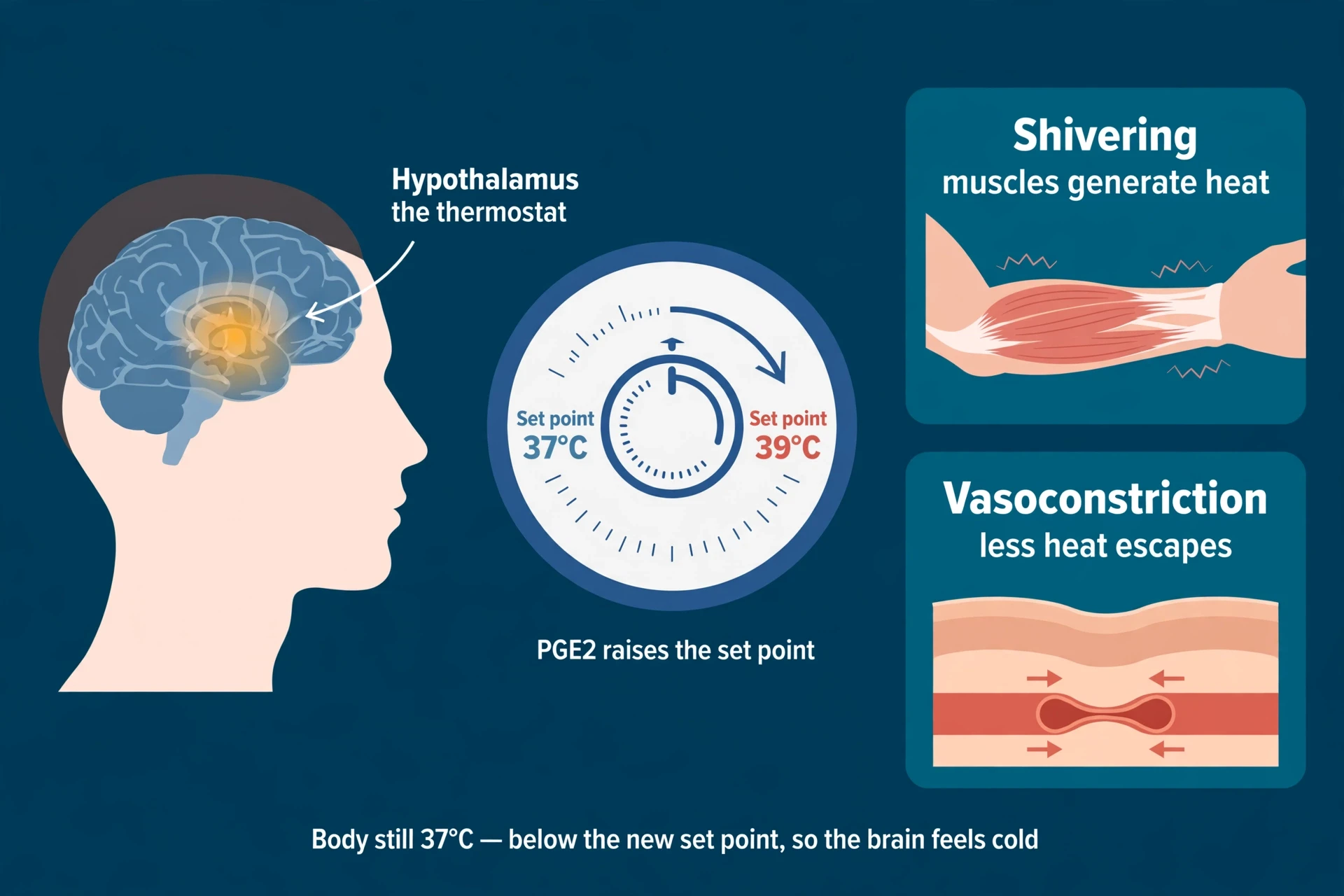
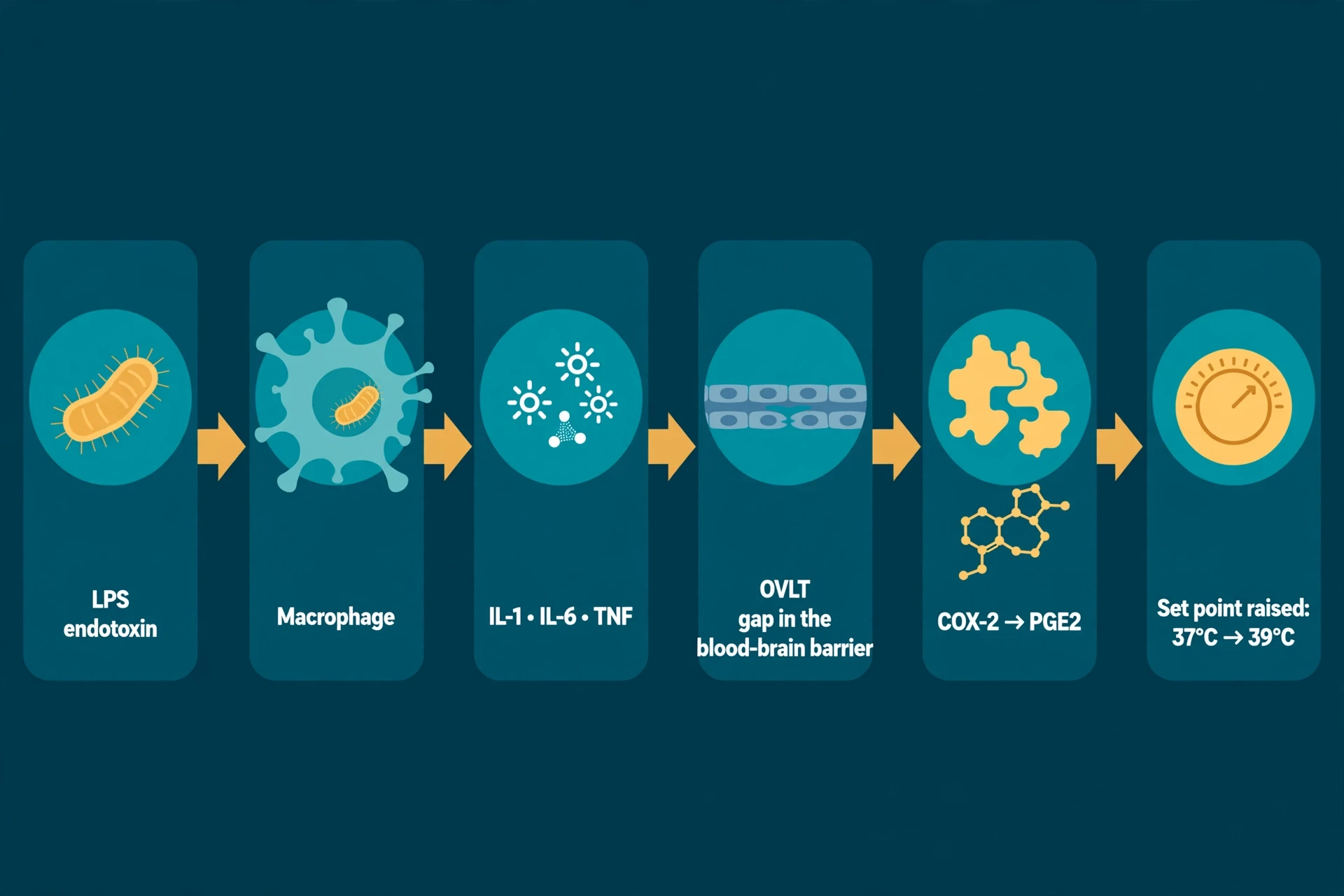
The molecule that turns the dial is prostaglandin E2, usually shortened to PGE2. When immune cells release cytokines into the blood, those cytokines stimulate an enzyme called COX-2 in the blood vessels of the hypothalamus, and COX-2 produces PGE2 right next to the thermostat neurons. PGE2 binds to receptors on those neurons and raises the set point — from 37 degrees to 39 degrees, for example. The thermostat now believes the body should be 39 degrees, and it will act accordingly.
PGE2 is made from arachidonic acid, a fatty acid in cell membranes, through a short chain of steps: phospholipase A2 frees the arachidonic acid, COX-2 converts it, and a final enzyme produces PGE2. The same pathway makes other inflammatory mediators, which is why this one molecule sits at the junction of fever and inflammation. It is also why the most common fever medicines work the way they do: paracetamol and ibuprofen block COX enzymes, cutting PGE2 production, and the set point falls back down. They do not cool the body directly. They persuade the thermostat to lower its target, and the body does the rest.
3.3 The OVLT: the gap in the blood-brain barrier
There is a problem with this chain of events, and the body solves it with a piece of anatomy that looks like a deliberate loophole. The cytokines that carry the fever signal — interleukin-1, interleukin-6 and tumour necrosis factor — are large proteins. They cannot cross the blood-brain barrier, the tight seal that protects the brain from most of what circulates in the blood. So how do they reach the thermostat?
They do not have to. At the base of the brain, next to the hypothalamus, sits a small structure called the organum vasculosum of the lamina terminalis — the OVLT — where the blood-brain barrier is naturally incomplete. Its capillaries are fenestrated, full of tiny windows, so circulating molecules can reach the cells there. Cytokines bind to receptors on OVLT cells, those cells synthesise PGE2, and the PGE2 diffuses a very short distance into the neighbouring preoptic area. The barrier stays intact everywhere else. The fever signal enters through the one door that was left open, and it is open by design — the brain needs a way to listen to the immune system, and the OVLT is the listening post.
3.4 Why you shiver while burning up
Here is the paradox every fever patient knows: you feel freezing cold while your temperature is climbing. The shivering, the chills, the goosebumps, the desperate piling on of blankets — all of it happens because of the gap between the new set point and the body's actual temperature. The moment PGE2 raises the target from 37 to 39 degrees, the body is still at 37. The thermostat reads the body as two degrees too cold, and it does what any thermostat does when the house is below target: it turns the heating on and stops the heat escaping.
Shivering is the heating. Rapid, involuntary contractions of skeletal muscle generate warmth quickly, which is why a fever often begins with teeth-chattering shakes. Vasoconstriction is the insulation: blood vessels in the skin narrow, reducing heat loss, which is why your hands and feet go cold and your skin pales. Goosebumps are the same reflex in miniature — tiny muscles pulling hairs upright to trap a layer of warm air, a leftover from ancestors who had fur. Once the body reaches the new set point, the shivering stops, and the person feels hot instead of cold, because now the thermostat is defending 39 degrees and the body is there. When the fever breaks, the process reverses: the set point falls, the body is suddenly too hot for its new target, and it sweats to shed the extra heat.
3.5 The off-switch
Fever does not climb forever, and the reason is built into the same molecule that starts it. PGE2 exerts negative feedback on the release of the pyrogenic cytokines — it damps down the very signal that produced it. As the infection is cleared and cytokine levels fall, PGE2 production drops, the set point returns to normal, and the body sheds heat through sweating and widened skin vessels. The system is regulated at every level, even at high temperatures: once a fever is established, heat production and heat loss stay balanced, even above 41 degrees Celsius. A fever is a controlled burn, not a runaway fire — which is precisely what distinguishes it from overheating, as the next sections will show.
4. Pyrogens: The Messengers That Start the Fire
4.1 Exogenous pyrogens
A pyrogen is anything that causes fever, and the ones that start the chain come from outside the body. The most potent of them is endotoxin, also called lipopolysaccharide or LPS — a heat-stable component of the outer membrane of Gram-negative bacteria such as Escherichia coli and Salmonella. A tiny amount of LPS in the bloodstream is enough to trigger a fever within about two hours. Other exogenous pyrogens include peptidoglycan, the main fever trigger of most Gram-positive bacteria, plus viral components, fungal products in the bloodstream, and some bacterial toxins, including the exotoxins behind scarlet fever and toxic shock syndrome.
What makes LPS so powerful is that the immune system is exquisitely tuned to detect it. A single Gram-negative bacterium carries millions of LPS molecules on its surface, and immune cells have dedicated receptors whose only job is to recognise them. The system is tuned this way because Gram-negative infection can kill quickly, and an early fever is worth the cost. The detection is so sensitive that even the trace amounts of endotoxin that leak from the gut during severe illness can contribute to fever — the immune system would rather overreact to a false alarm than miss a real invasion.
4.2 Endogenous pyrogens
Exogenous pyrogens do not raise the set point themselves. They act by inducing the body's own cells — mainly macrophages and monocytes — to produce and release a second set of messengers, the endogenous pyrogens: interleukin-1 (IL-1), interleukin-6 (IL-6), tumour necrosis factor (TNF) and interferons. Of these, IL-1 and IL-6 do most of the work of fever. They are the same cytokines that drive inflammation at the site of infection, which is why fever and inflammation so often arrive together: one signal, two effects.
Each cytokine does more than cause fever. IL-1 activates T lymphocytes to produce interferon and IL-2, vital steps in building an adaptive immune response — and the fact that fever arrives at the same moment as lymphocyte activation is, in the words of fever researcher A. S. El-Radhi, the clearest evidence that fever is protective rather than accidental. TNF activates neutrophils and other first responders. IL-6 is the primary driver of the acute-phase response, the liver's contribution to the defence, which the next section covers. And the system has brakes as well as accelerators: anti-inflammatory cytokines such as the IL-1 receptor antagonist, IL-4 and IL-10 oppose the pro-inflammatory ones and promote healing once the threat passes.
4.3 Non-infectious pyrogens
Fever does not need a microbe at all. Blood-transfusion reactions can cause fever when the recipient's immune cells attack the transfused blood. Antigen-antibody complexes — the immune system's own debris — can induce IL-1 and produce fever in autoimmune diseases such as lupus and in drug reactions. Some hormones, some drugs, and bleeding or clots inside the skull can raise temperature by acting directly on the hypothalamus. The common thread is always the same: anything that releases IL-1, IL-6 or TNF, or that makes PGE2 near the thermostat, will produce a fever, whether or not an infection is involved. That is why a fever is a clue, not a diagnosis — it tells you the immune system is activated, and nothing more.
4.4 The 40-year hunt
Nobody knew any of this until a chain of experiments stretching across forty years pulled the mechanism apart, and the story of that hunt is one of the best examples in medicine of a question that refused to stay answered. In 1868, the surgeon Theodor Billroth injected pus into animals and produced a fever — showing that something in infected material, not the infection itself, caused the heat. In 1943, the Russian émigré Eli Menkin injected rabbits with fluid from white blood cells and called the fever-inducing property "pyrexin". Then in 1948, Paul Beeson confirmed Menkin's observation and showed that a protein released from rabbit white blood cells — completely free of bacterial endotoxin — caused a rapid fever when injected into rabbits. That was the milestone: it proved fever could happen without any infection at all, driven by a substance the body itself made.
Beeson's paper was not even accepted for presentation at the annual meeting of the American Society for Clinical Investigation — a 1967 editorial in the New England Journal of Medicine noted the rejection, almost twenty years after the fact. The protein he found went by many names over the following decades — granulocytic pyrogen, endogenous pyrogen, leukocytic pyrogen, lymphocyte-activating factor — until it was identified as interleukin-1. The cDNA for human IL-1 beta was reported in 1984, and in 1986 recombinant IL-1 beta was shown to cause fever in rabbits and in humans, nearly forty years after Beeson's first experiment. The word "cytokine" itself is younger than the science: Stanley Cohen introduced it in 1974. At least 37 interleukins have now been identified.
4.5 From fever research to medicine
The hunt did not end with understanding. It ended with drugs. The biology that began with fever research became therapy: IL-1-blocking medicines such as anakinra and canakinumab now treat autoinflammatory diseases, and they were tested against heart disease — a story this article returns to in the section on the heart, where a 2017 trial changed how cardiologists think about inflammation. A question that started with a surgeon injecting pus into a rabbit in 1868 ended, a century and a half later, with medicines that switch off one specific cytokine in one specific disease. That is the ordinary shape of progress in medicine: slow, stubborn, and built on experiments that were ignored for years before anyone understood what they meant.
5. The Acute-Phase Response: Fever's Travelling Companions
5.1 CRP and serum amyloid A
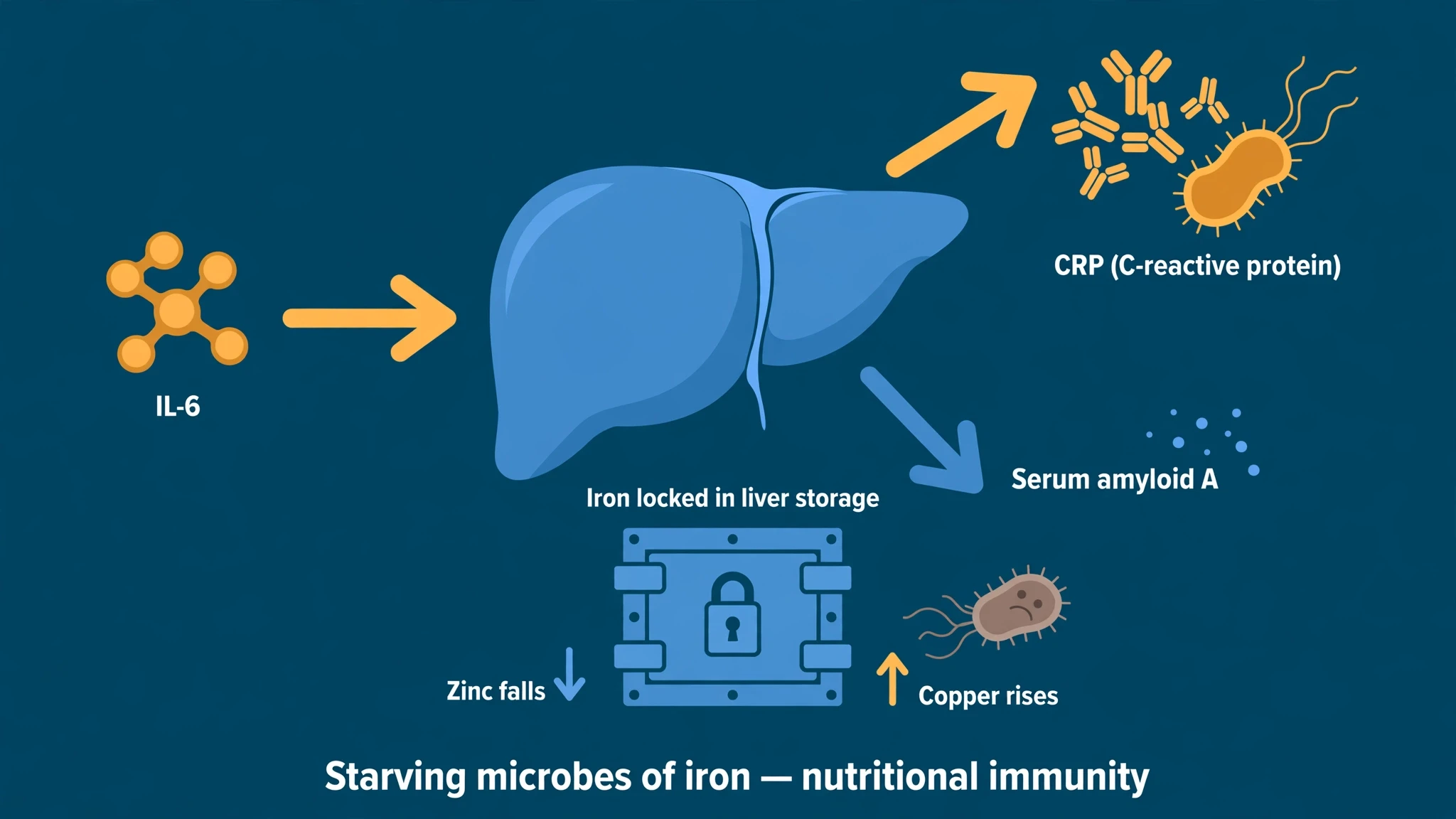
Fever and inflammation never travel alone. Within hours to days of its onset, IL-6 drives the liver to manufacture large amounts of proteins called acute-phase proteins — most notably C-reactive protein, or CRP, and serum amyloid A. CRP activates complement, a cascade of blood proteins that punches holes in bacterial membranes; it promotes opsonisation, the process of marking microbes so that white blood cells can eat them; and it increases platelet aggregation, helping to seal off damaged vessels. Doctors measure CRP in blood tests because it rises fast and falls fast, making it a useful gauge of how much inflammation is happening right now. It is worth knowing what it is not: CRP is a tool the liver makes, not a thermometer. It tracks the immune response, and the immune response usually — but not always — tracks the fever.
5.2 Nutritional immunity
One of the strangest parts of the acute-phase response is also one of the cleverest. During a fever, iron and zinc levels in the blood fall while copper rises. The iron drop happens because the gut absorbs less iron and the liver stores more of it, locking it away where invading microbes cannot reach it. Bacteria need iron to grow — it is as essential to them as it is to us — and the body responds to invasion by hiding its iron. The strategy has a name: nutritional immunity. It is the same logic as a city under siege cutting off the enemy's food supply, except the city is your bloodstream and the food is a metal. Zinc is hidden the same way, for the same reason. The fever makes the body hotter; the acute-phase response makes it poorer in the nutrients bacteria need most.
5.3 The whole-body package
The fever package includes more than heat and liver proteins. Appetite falls — the loss of appetite during illness is not a side effect but part of the defence, since eating less means less iron and fewer nutrients for microbes, and less energy spent on digestion. Sleepiness increases, conserving energy for the immune response. Neutrophils, the first-responder white blood cells, become more effective at killing bacteria. The immune system's protective processes work best at high temperature, around 39.5 degrees Celsius — which is a striking fact when you think about it. The body does not merely tolerate the heat it creates. It is tuned to work best in it, as if the whole system were designed to fight at fever temperature and merely idles at normal temperature.
5.4 CRP is not a fever meter
CRP is useful, but it is easy to misread. Its levels can be normal in viral infections and high in diseases without any fever at all, including some cancers. A high CRP does not prove a fever, and a normal CRP does not prove there is no inflammation. It is one signal among many, and doctors who treat it as a verdict on its own will be misled. The same caution applies to every number in this article: the immune system does not come with a single dashboard gauge, and the temptation to reduce it to one is the source of a great deal of bad medicine.
5.5 When the response overshoots
Fever and inflammation are defences, and like all defences they can overshoot. When cytokines are produced in overwhelming amounts, or when the balance between cytokines and their inhibitors breaks down, the response itself becomes the danger. This is what happens in septic shock, where the immune system's reaction to infection damages organs faster than the infection does, and in the cytokine storms seen in severe infections of many kinds. The same IL-1 and IL-6 that raise the set point and rally the defences can, at extreme levels, drive blood pressure down, clotting haywire, and organs into failure. The lesson is not that fever is dangerous in general — it is that the dose matters, and that the immune system, like any powerful tool, causes harm when it cannot switch itself off.
6. How Fever Helps You Fight Infection
6.1 An ancient defence
Fever and inflammation are older than warm blood. Fever is a response to infection conserved in warm-blooded and cold-blooded vertebrates for more than 600 million years of evolution, and it confers a survival benefit during infection. Cold-blooded animals cannot generate a fever internally, so they do the next best thing: a sick lizard will crawl into the sun and bask until its body temperature rises, and a sick fish will swim to warmer water. The behaviour is called behavioural fever, and it is the same strategy executed with different machinery. When a defence survives 600 million years of evolution, across animals that diverged before mammals existed, it is worth asking what it is for — because evolution does not preserve expensive responses for no reason. Running a fever costs energy, makes you feel miserable, and in the wrong circumstances can be dangerous. A trait that costly would have been discarded long ago if it did not pay for itself.
6.2 Heat makes bacteria easier to kill
The most direct benefit is also the simplest: heat makes bacteria easier to kill. At fever temperatures, Gram-negative bacteria become far more susceptible to destruction by serum, the liquid part of blood — more than 200 times more susceptible at 40 to 41 degrees Celsius in laboratory studies. The heat weakens bacterial defences and makes their membranes more vulnerable to the immune system's chemical weapons.
The cleanest demonstration comes from an experiment published in 1986, when Small and colleagues studied pneumococcal meningitis in rabbits. Rabbits whose fever was left alone had pneumococcal doubling times of about 2.76 hours in their spinal fluid — the bacteria were growing, but slowly. Rabbits whose fever was blunted with medicine had bacteria doubling every 1.10 hours, more than twice as fast. In a dish, pneumococci grew well at 37 degrees but did not grow at all at 41 degrees. The researchers' conclusion was careful and is worth quoting in spirit: body temperature appears to be a critical determinant of how fast pneumococci grow, and fever could be a host defence in this disease. A fever of 41 degrees did not merely slow the bacteria. It stopped them.
6.3 Heat moves your T cells
Heat does more than slow bacteria. It moves your own immune cells to the battlefield. In a 2019 study in the journal Immunity, Lin and colleagues showed that fever promotes T-lymphocyte trafficking through a thermal sensory pathway: a heat-shock protein called Hsp90 binds to alpha-4 integrins on the surface of T cells, activating them and driving them to stick to blood-vessel walls and migrate into lymph nodes, where infections are fought. When the researchers blocked the Hsp90-alpha-4 interaction, fever no longer drove T cells into the lymph nodes, and the mice cleared Salmonella infection worse. The heat was not a side effect of the immune response. It was part of how the immune response worked.
Fever-range heat, between 38 and 40 degrees Celsius, also increases the expression of ICAM-1 and the chemokine CCL21 on the lining of blood vessels, making it easier for lymphocytes to cross the high endothelial venules — the specialised vessel walls that act as gates into lymph nodes. The same trafficking machinery is what vaccines exploit: a vaccine trains T cells in the lymph nodes so they are ready before the real infection arrives, as How Vaccines Work explains. And heat draws more neutrophils into the lungs, reinforcing the first responders at the site of infection. The picture that emerges is of a system that uses temperature as a signal, not just as a by-product: the heat tells immune cells where to go and makes them better at getting there.
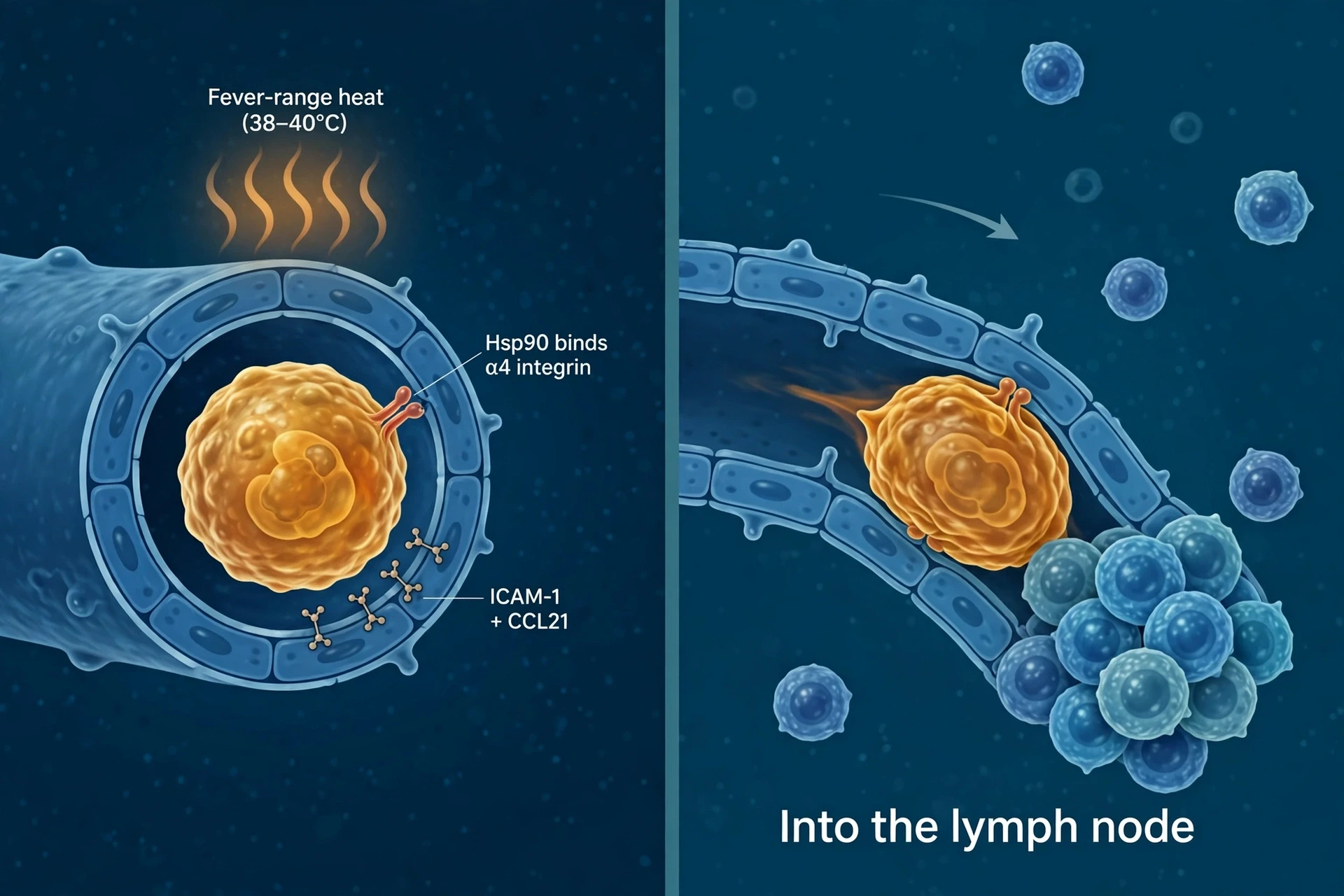
I have watched immune cells behave differently at 39 degrees than at 37, in a laboratory, on an ordinary afternoon that I still remember because the result was not what I expected. The cells at fever temperature moved faster, stuck harder to the surfaces they were meant to cross, and looked, for want of a better word, more purposeful. Nothing about the experiment was dramatic — no explosion, no sudden revelation, just a quiet difference in the numbers at the end of the day. But it changed how I thought about fever. It stopped being an abstract symptom in a textbook and became something the immune system does on purpose, with machinery built for the job. The cells were not suffering in the heat. They were using it.
6.4 Heat sharpens TH1 cells
The evidence has only grown stronger. In 2024, Heintzman and colleagues cultured CD4 T cells at 37 degrees versus 39 degrees and found that at the higher temperature, TH1 cells — the type that fights intracellular infections — produced more interferon-gamma, the signal that activates macrophages, and became fitter and more effective. At the same time, regulatory T cells, which suppress immune responses, became less suppressive. Fever heat, in other words, does not merely turn the immune system up. It tilts it: more attack, less restraint, exactly the balance you want during an infection and exactly the balance you do not want the rest of the time.
6.5 The counterweight: bacteria fight back
Honesty requires the other side of this story, because fever does not always win. Some bacteria sense the heat and fight back. In 2021, Eichner and colleagues showed that Streptococcus pneumoniae and Haemophilus influenzae detect rising temperature through RNA thermosensors — stretches of RNA that change shape as they warm — and respond by producing thicker protective capsules and more Factor H binding proteins, shielding themselves from immune killing. The same temperature cue that rallies your immune system also primes these pathogens' defences. Fever tilts the fight toward the host, but it does not guarantee the outcome, and any article that pretends otherwise is selling a simpler story than the science supports.
That is also the honest summary of the whole evidence base. Direct proof that fever improves outcomes in intact human hosts is hard to obtain, because every method of reducing fever has secondary effects of its own. The strongest arguments are evolutionary — a defence conserved for 600 million years — mechanistic, and animal-experimental. The clinical-trial evidence on suppressing fever shows no mortality benefit from bringing it down, which is consistent with fever being useful, but is not itself proof that it is. The right conclusion is not certainty. It is that the burden of proof has shifted: fever looks like a defence, and anyone who wants to suppress it routinely should have a good reason.
The production of fever simultaneously with lymphocyte activation constitutes the clearest and strongest evidence in favour of the protective role of fever. — A. S. El-Radhi, Pathogenesis of Fever, Springer 2018
7. Fever vs Hyperthermia: The Distinction That Changes Treatment
7.1 Fever: set point raised, regulation intact
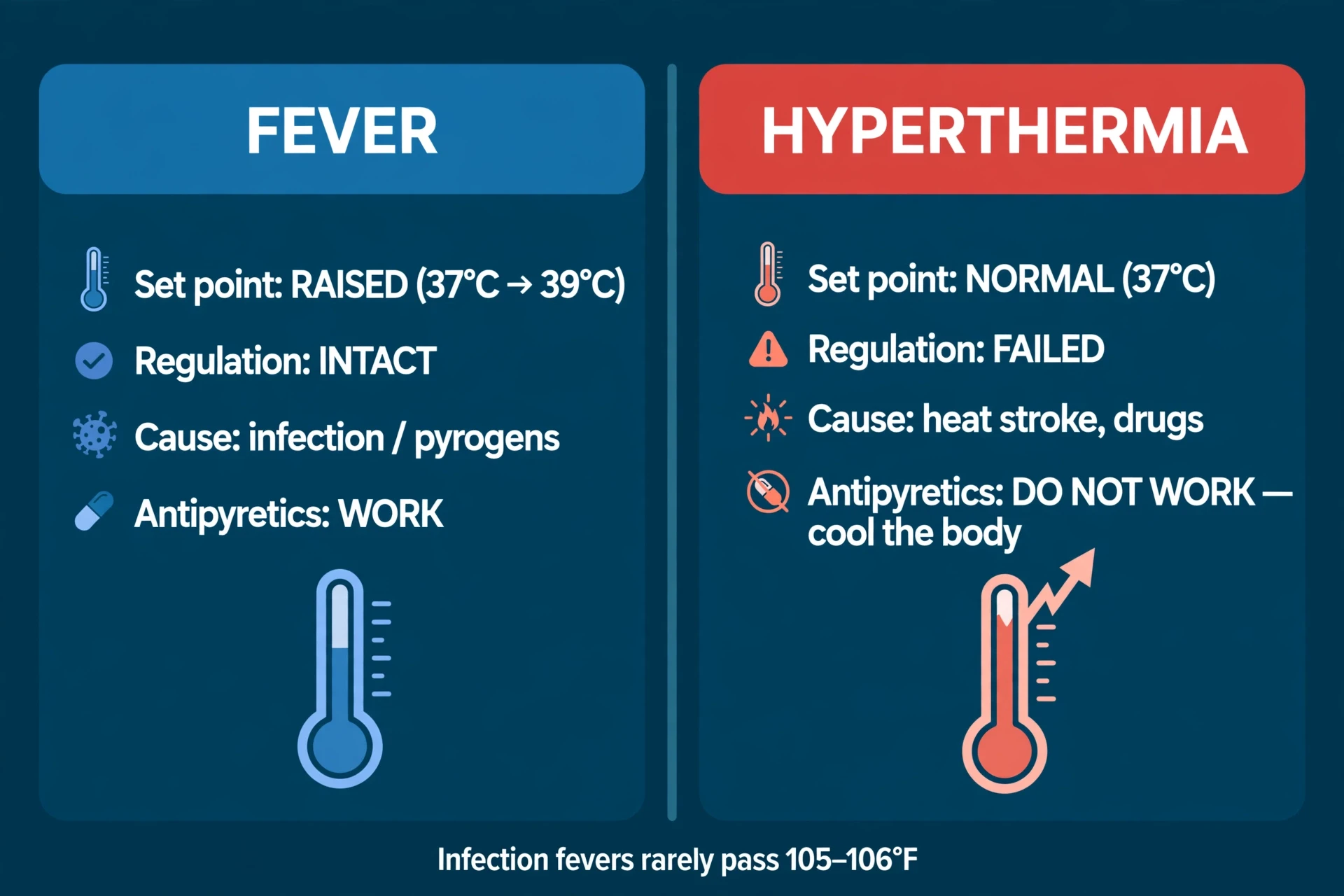
Everything in this article so far describes fever: the set point is raised, and the body defends the new temperature. Heat production rises and heat loss falls until the new set point is reached, and then production and loss balance again. The system is regulated throughout — the thermostat works, it has simply been given a new target. That is why a person with a fever shivers while heating up and sweats while cooling down: the body is actively managing its temperature, first upward and then downward, in response to the set point.
7.2 Hyperthermia: set point normal, regulation failed
Hyperthermia is the opposite problem, and confusing the two can be dangerous. In hyperthermia, the set point is normal and the regulation has failed. Heat production exceeds heat loss — because of heat stroke, malignant hyperthermia, or drugs that impair the body's ability to shed heat — and the temperature climbs without any thermostat telling it to. Interleukins are not involved. The body is not defending a higher temperature; it is losing control of temperature altogether. A person with hyperthermia does not shiver their way up to a new target. They simply get hotter, and the heat itself damages the organs.
7.3 Why it matters
The distinction changes the treatment completely. Fever medicines — paracetamol and ibuprofen — work by cutting PGE2 and lowering the set point. In a fever, that is exactly what they do, and the body cools itself. In hyperthermia, the set point is already normal, so lowering it further achieves nothing. A patient who is hot because of heat stroke will not improve on paracetamol. Hyperthermia needs physical cooling and treatment of the cause: shade, cold water, ice, and medical care that addresses why the body cannot shed heat. Giving a fever medicine to a heat-stroke patient is not merely useless — it wastes the time in which cooling could save them.
7.4 Infection fevers have a ceiling
There is one more reassuring point about fever, and it follows directly from the thermostat. Because the hypothalamus limits the rise, paediatric guidance notes that fevers caused by infection rarely exceed 105 to 106 degrees Fahrenheit. The thermostat caps them. A temperature that keeps climbing past that range is a sign that the problem may not be an ordinary fever — it may be hyperthermia, where the regulation has failed. That is one reason doctors pay attention to very high temperatures even though, as this article will show, the height of an ordinary fever says little about how sick someone is. The number matters less than what is driving it.
Fever | Hyperthermia | |
|---|---|---|
Set point | Raised (for example 37°C to 39°C) | Normal (37°C) |
Regulation | Intact — the body defends the new temperature | Failed — heat production exceeds heat loss |
Cause | Infection, pyrogens, immune activation | Heat stroke, malignant hyperthermia, drugs that impair heat loss |
Interleukins involved | Yes — IL-1, IL-6, TNF drive it | No |
Treatment | Antipyretics lower the set point; body cools itself | Physical cooling and treatment of the cause |
Do antipyretics work? | Yes | No |
8. Inflammation's Five Signs: A 2,000-Year-Old Diagnosis That Still Works
8.1 The word means "to set on fire"
The word inflammation comes from the Latin inflammare — to ignite, to set alight. It is the protective biological response of vascularised tissue to infection or injury, involving immune cells, blood vessels, proteins and chemical mediators. The name is older than the understanding, and the understanding is still catching up with the name: an inflamed tissue is genuinely hotter than its surroundings, genuinely redder, genuinely swollen. The people who named it were describing what they could see and feel, and what they could see and feel turned out to be an accurate description of the mechanism.
8.2 Celsus and the four signs
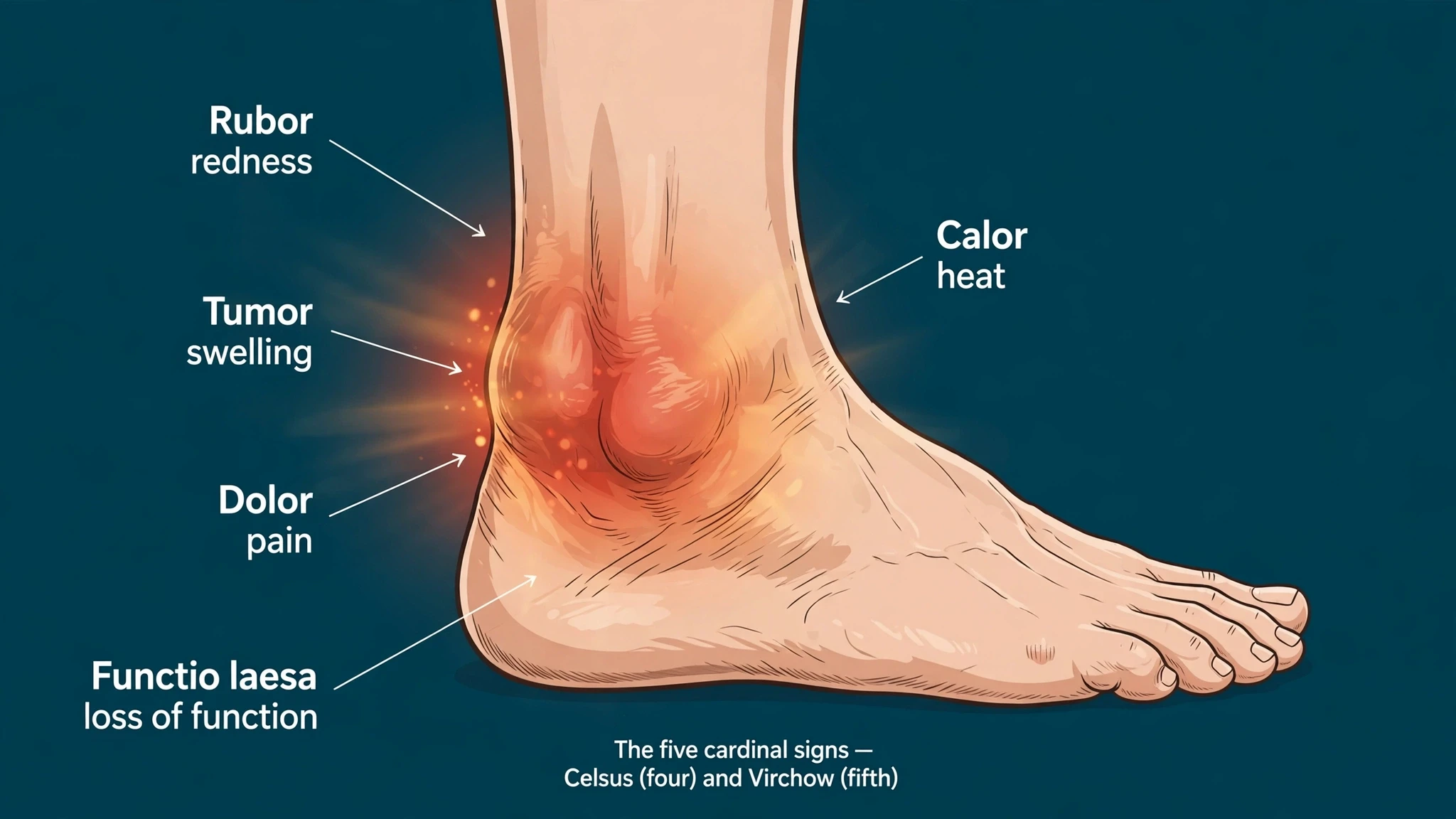
Around two thousand years ago, the Roman physician Aulus Cornelius Celsus, writing between about 30 BC and 38 AD, recorded the four cardinal signs of inflammation in a phrase that medical students still memorise today: rubor et tumor cum calore et dolore — redness and swelling with heat and pain. Nearly two thousand years later, in the nineteenth century, Rudolf Virchow added a fifth sign: functio laesa, loss of function. (One source credits the fifth sign to Galen instead of Virchow; the standard account, and the one this article uses, credits Virchow.) The five signs have survived because they work. A clinician who checks for redness, heat, swelling, pain and loss of function is checking the same five things Celsus checked, and for the same reason: they are the visible traces of the mechanism underneath.
8.3 Each sign, explained
Each sign has a mechanism behind it, and the mechanisms fit together like parts of a machine. Redness, or rubor, comes from hyperaemia — the widening of small blood vessels brings more blood, and more red blood cells, into the area. Heat, or calor, comes from the same increased blood flow; it applies mainly to the body's extremities, since deep internal inflammation has no palpable heat. Swelling, or tumor, comes from the expansion of capillaries and the leaking of protein-rich fluid into the tissue — the exudate. Pain, or dolor, comes from the pressure of that fluid on nerve endings, plus chemical mediators such as bradykinin and prostaglandins irritating the nerves directly. Loss of function, or functio laesa, follows from the rest: a swollen joint cannot move, an inflamed lung cannot exchange gas properly, and the tissue cannot do its job while the battle is under way.
8.4 Galen was right: inflammation is beneficial
The Roman physician Galen, writing in the second century AD, defined inflammation as a beneficial response to injury — a view that modern immunology has returned to after centuries of treating inflammation as purely harmful. Galen was right, in the sense that matters: inflammation exists to defend and repair, and the damage it causes is usually the price of the defence, not the purpose of it. The cellular understanding of that defence came much later, from Élie Metchnikoff, who discovered that white blood cells called macrophages — "big eaters" — could engulf and clear the debris of inflammation, founding the cellular theory of immunity. One molecule ties the whole picture together: bradykinin, a single mediator, has long been known to produce the four classic symptoms of inflammation — redness, local heat, swelling and pain — with loss of function following from the rest.
8.5 Your own five-signs laboratory
You do not need a textbook to see all five signs at work. You need a sprained ankle. I have had one — stepping off a kerb I had stepped off a hundred times before, and landing wrong — and the sequence that followed was a perfect demonstration of the mechanism. Within minutes the ankle was red and warm. Within the hour it had swollen to the point where the shoe would not fit. The pain arrived with the swelling, sharp at first and then a deep, throbbing ache that made every step a negotiation. And the loss of function was the most obvious sign of all: the ankle that had carried me without a thought for years could no longer carry anything. Five signs, one injury, and every one of them was the defence doing its job — more blood, more fluid, more immune cells, and a pain signal loud enough to keep me off the joint while it healed. The ankle recovered in a week. The lesson lasted longer.
9. Acute Inflammation, Step by Step: The Cascade
9.1 The definition and the three components
Acute inflammation is a rapid host response that delivers white blood cells and plasma proteins, such as antibodies, to sites of infection or tissue injury. It has three major components: changes in blood-vessel calibre that increase blood flow; structural changes in the microvasculature that let plasma proteins and white blood cells leave the circulation; and the emigration of white blood cells from the blood, their accumulation at the focus of injury, and their activation to eliminate the offending agent. The sequence that follows is one of the most choreographed processes in the body — a cascade in which each step creates the conditions for the next, and the timing is measured in minutes and hours. It is the local half of fever and inflammation, working on a patch of tissue instead of the whole body. The immune cells that carry it out belong to the network described in How the Human Immune System Works, and the same histamine and mast cells that drive it also drive allergies, as Allergies Explained describes.
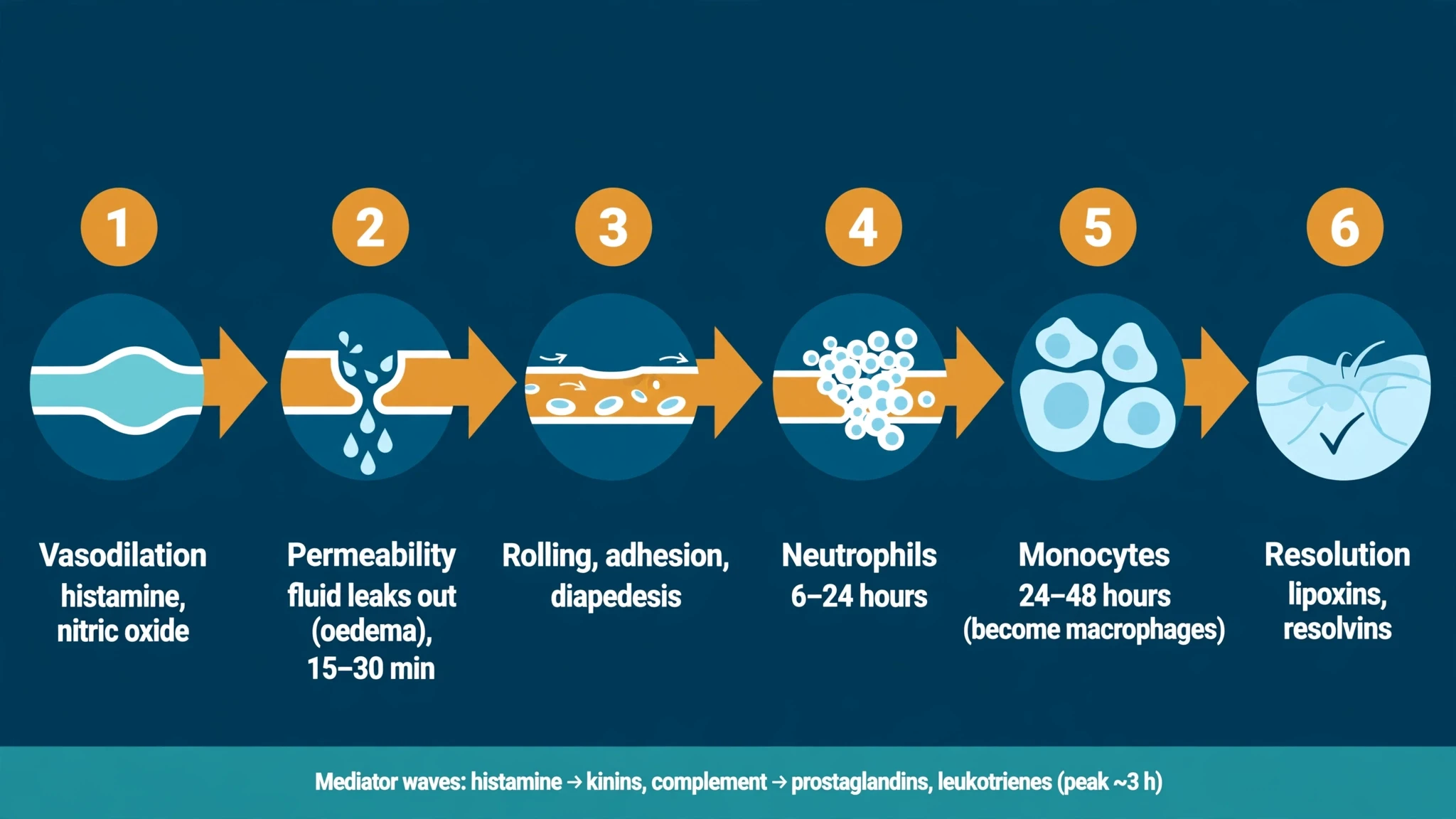
9.2 Vasodilation
The first step is vasodilation. Sometimes after a brief constriction lasting seconds, the arterioles feeding the injured area widen, blood flow increases, and the tissue becomes red and warm. The mediators are histamine and nitric oxide, acting on the smooth muscle of the vessel walls. This is the cause of the heat and redness of inflammation — the same widening of vessels, driven by the same molecules, that makes a fever patient's skin flush. It is also why an inflamed area feels hot to the touch: more warm blood is flowing through it than through the tissue around it.
9.3 Permeability and oedema
The second step is increased permeability. The endothelial cells lining the smallest veins contract, widening the gaps between them, mainly in the post-capillary venules, so that protein-rich fluid pours out of the blood and into the tissue. That fluid is the swelling — the oedema — and the protein in it is what makes the swelling firm rather than watery. The mediators are histamine, bradykinin and leukotrienes. The immediate response lasts 15 to 30 minutes; a later, cytokine-driven phase, driven by TNF and IL-1, retracts the endothelial junctions 4 to 6 hours after injury and lasts 24 hours or more. The timing matters, because it means the swelling of inflammation comes in waves: a fast wave driven by histamine, and a slower wave driven by cytokines, each with its own treatment implications.
9.4 Stasis and margination
As fluid leaves the blood, the blood left behind becomes thicker and slower. Red cells concentrate, viscosity rises, and flow stagnates — a state called stasis. White blood cells, mainly neutrophils, then accumulate along the vessel wall in a process called margination. They roll along the endothelium, slowed by selectins — P-selectin appears within minutes, E-selectin within hours, both upregulated by IL-1 and TNF — then adhere firmly through integrins such as LFA-1 and VLA-4 binding to ICAM-1 and VCAM-1 on the vessel wall, and finally migrate through the wall itself in a process called diapedesis. Once outside the vessel, they move toward the injury along a chemical gradient — chemotaxis — following signals that include bacterial products, the complement fragment C5a, leukotriene B4, and chemokines such as IL-8. The rolling, sticking and squeezing through the wall is not a metaphor for the process. It is the process, watched under a microscope: cells tumble along the vessel, catch, hold, and push through.
9.5 The changing of the guard
The cells that arrive first are not the cells that finish the job. Neutrophils predominate in the first 6 to 24 hours — fast, aggressive, short-lived. In 24 to 48 hours they are replaced by monocytes, which become macrophages, the larger cells that clean up debris, engulf dead neutrophils, and begin repair. Neutrophils are short-lived in tissue and disappear after about 48 hours unless the injury is repeated. The handover is the visible sign of a response that is working: the first wave kills, the second wave clears up, and the tissue returns to normal. When the handover fails, the response stalls, and acute inflammation becomes chronic.
9.6 The mediators in three waves
The chemical messengers of inflammation arrive in three waves, and knowing the waves explains why different medicines work at different times. The immediate wave, in the first 30 minutes, is histamine — released from mast cells, basophils and platelets — with largely vascular effects plus pain, but no ability to attract white blood cells. The middle wave brings kinins such as bradykinin, complement fragments C3a and C5a, and the coagulation and fibrinolytic systems. The delayed wave, peaking around three hours, brings prostaglandins and leukotrienes — the arachidonic-acid metabolites whose synthesis is blocked by NSAIDs such as aspirin — along with cytokines and chemokines including IL-1, TNF, IL-8, platelet-activating factor, PDGF and TGF-beta. This is why aspirin and ibuprofen work on inflammation: they block the delayed wave at its source, by shutting down the arachidonic-acid pathway that produces prostaglandins. They do not touch the histamine wave, which is why they do nothing for a histamine-driven reaction — and why the same medicine can be perfect for one kind of inflammation and useless for another.
9.7 What the exudate does for you
The protein-rich fluid that leaks into the tissue is not waste. It delivers immunoglobulins that tag microbes for destruction, dilutes toxins, delivers fibrinogen that walls off the area and prevents the infection spreading, and increases lymphatic drainage, which carries microbes to phagocytes and antigens to the immune system. Vasodilation increases the delivery of defenders, raises local temperature, and helps remove toxins. The swelling that makes an injury hurt is the same swelling that brings the reinforcements. Even the visible sequence has a name: Lewis's triple response describes the skin's reaction to injury as brief blanching, then reddening and a wheal — vasoconstriction, vasodilation and oedema, in order, written on the skin.
9.8 Resolution is active
The end of inflammation is not a passive fading. It is an active process, driven by specialised pro-resolving lipid mediators — lipoxins and resolvins — that switch the response off. The pro-inflammatory mediators have short half-lives and are inactivated by degradation, dilution in the exudate, or inhibition. Vascular changes reverse. Neutrophils stop marginating. Fluid drains through the lymphatics and fibrin is degraded by plasmin. If resolution fails, the outcome is fibrosis — scarring — or chronic inflammation, the state in which the defence never stands down. The discovery that resolution is active, not passive, changed how researchers think about inflammation: the body does not merely stop fighting. It sends a second set of signals to declare the fight over, and when those signals fail, the fire keeps burning.
10. When Inflammation Won't Switch Off: Chronic Inflammation and Inflammaging
10.1 Acute vs chronic in one line
In fever and inflammation, the acute form is rapid, lasting minutes to days, led by neutrophils, and ending in resolution or scarring. Chronic inflammation is persistent, lasting months to years, low-grade, led by macrophages and lymphocytes, and ending in tissue destruction and fibrosis. The difference is not intensity but duration: acute inflammation is a fire that burns hot and goes out, while chronic inflammation is a fire that never quite goes out, smouldering for years and damaging everything around it. The cells are different, the mediators are different, and the outcome is different — but the machinery is the same, which is why the same cytokines appear in both stories.
10.2 The diseases it drives
Systemic chronic inflammation is documented as a driver of the diseases that dominate modern medicine: cardiovascular disease, type 2 diabetes, neurodegenerative disorders including Alzheimer's and Parkinson's, non-alcoholic fatty liver disease, chronic kidney disease, hypertension, osteoporosis, sarcopenia and depression. The mechanisms are specific to each disease. In atherosclerosis, chronic inflammation damages the lining of the arteries, promotes the oxidation of LDL cholesterol — a key step in plaque formation — and destabilises existing plaques, raising the risk of heart attack and stroke. In type 2 diabetes, inflammatory cytokines interfere with insulin signalling, and inflamed fat tissue worsens insulin resistance. In Alzheimer's disease, chronically activated microglia — the brain's immune cells — release cytokines that damage neurons and contribute to amyloid plaques and tau tangles. Whether inflammation causes these diseases or merely marks the biological ageing that accompanies them remains actively debated, but the association is strong enough that no serious account of these diseases can ignore it.
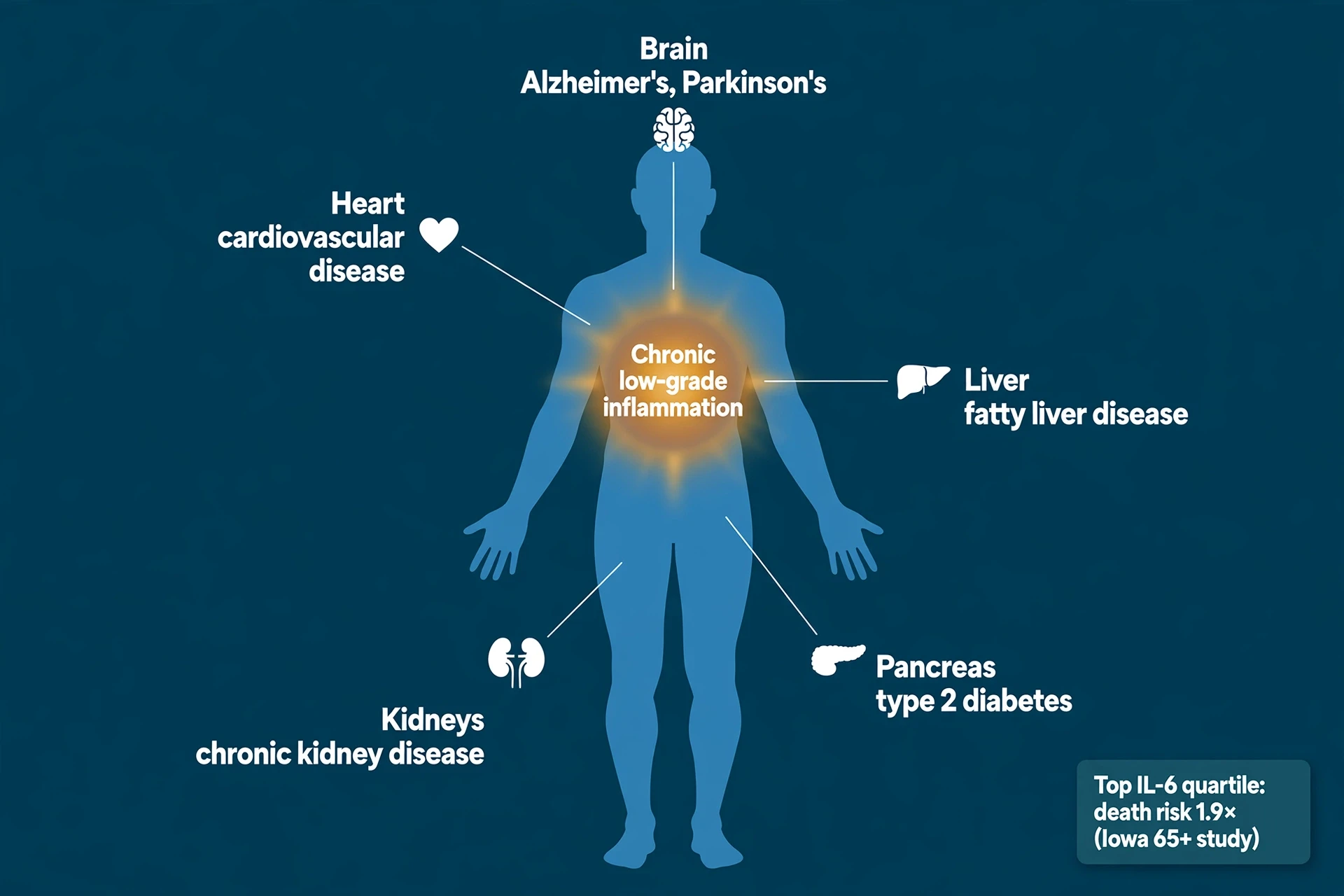
10.3 The mortality signal
The signal is not only about disease. It is about death. In the Iowa 65+ Rural Health Study, which followed 1,293 healthy, non-disabled older adults for about 4.6 years, people in the highest quartile of interleukin-6 had a relative risk of death of 1.9 compared with people in the lowest quartile. Those who were elevated on both IL-6 and CRP were 2.6 times more likely to die — and the association held independently of age, sex, smoking, diabetes, cardiovascular disease, body-mass index and white-cell count. A blood marker of inflammation, measured once, predicted who would die years later better than many of the risk factors doctors usually watch. That is the scale of what chronic inflammation means: not a minor background factor, but a signal as strong as the ones medicine has spent decades learning to measure.
10.4 Inflammaging — and the 2025 surprise
For years, the dominant idea was called inflammaging: the claim that inflammation rises with age in everyone, everywhere, and drives the chronic diseases of old age. In 2025, a study published in Nature Aging overturned the universal part of that claim. Franck and colleagues compared four populations — about 2,800 people aged 18 to 65 — using a panel of 19 cytokines. The inflammaging signature, in which cytokines rise with age and link to chronic disease, held in industrialised groups in Italy and Singapore. It did not hold in Indigenous groups: the Tsimane of the Bolivian Amazon and the Orang Asli of Peninsular Malaysia. In those groups, inflammation stayed high but stable with age, driven by infection — two-thirds of the Tsimane had at least one intestinal parasite, and more than 70 percent of the Orang Asli had an active infection — and chronic diseases such as type 2 diabetes, cardiovascular disease and Alzheimer's were rare or absent. The conclusion was blunt: inflammaging appears to be largely a by-product of industrialised conditions, not an inevitable feature of ageing. Fever and inflammation are not lit by age itself. They are lit by the conditions of modern life, and that changes what can be done about it.
10.5 No standard test exists
Here is the honest limit of what medicine can currently offer. Despite the strong observational evidence, there are no standard clinical biomarkers for indicating the presence of health-damaging chronic inflammation, and no randomised trial shows that lowering inflammation prevents frailty or extends human lifespan. High-sensitivity CRP is a marker of inflammatory burden, not a diagnosis, and a single elevated reading says little on its own. What this means for the reader is practical rather than medical: the factors that drive chronic inflammation — smoking, obesity, poor diet, inactivity, chronic stress, poor sleep — are the same factors that a healthy lifestyle addresses, and the evidence points toward lifestyle rather than fate. Diet is one of the levers, and Anti-Inflammatory Diet explains what the evidence actually says about food and inflammation. And the same machinery, when it turns against the body's own tissues instead of an invader, produces a different set of diseases entirely, covered in Autoimmune Diseases Explained.
Acute inflammation | Chronic inflammation | |
|---|---|---|
Duration | Minutes to days | Months to years |
Main cells | Neutrophils | Macrophages and lymphocytes |
Onset | Rapid, after injury or infection | Slow, often without a clear trigger |
Outcome | Resolution or scarring | Tissue destruction and fibrosis |
Examples | Sprained ankle, sore throat, infected cut | Atherosclerosis, type 2 diabetes, Alzheimer's disease |
Most people assume inflammation is either always bad or always good, and both versions of that assumption are wrong. The same process that saves your life when a cut becomes infected can destroy your arteries when it runs for twenty years without a clear target. The difference is not the inflammation itself. It is the context: short or long, local or systemic, with a resolution signal or without one. The body does not have a separate system for good inflammation and bad inflammation. It has one system, and the outcome depends on whether the system can switch itself off.
11. Inflammation and the Heart: CRP, CANTOS, and the 2026 ZEUS Surprise
11.1 CRP predicts heart risk
The link between inflammation and the heart was hiding in plain sight for decades before anyone proved it. In the Physicians' Health Study, which followed 1,086 healthy men, those with high-sensitivity CRP in the highest quartile had a 2.9-fold greater risk of heart attack and a 1.9-fold greater risk of stroke than men in the lowest quartile — independent of cholesterol and every other traditional risk factor. Each standard-deviation increase in log hs-CRP was associated with a 1.23-fold increased risk of coronary heart disease. A blood test for inflammation predicted heart attacks better than some of the measurements cardiologists had spent their careers perfecting, and the question it raised was obvious: if inflammation predicts heart disease, does fighting inflammation prevent it?
11.2 The IL-1 → IL-6 → CRP pathway
The pathway that connects fever and inflammation to the heart runs in a straight line: IL-1 beta switches on IL-6, and IL-6 tells the liver to pump out CRP, fibrinogen and other acute-phase proteins. It is the same cascade that produces fever, running at low intensity for years instead of days. Every modern anti-inflammatory heart trial targets this pathway, because it is the one place where the chain can be broken at a defined point — and the trials that followed tested whether breaking it actually helps.
11.3 JUPITER 2008
The first hint came from a statin trial. In JUPITER, published in 2008, 17,802 men and women free of cardiovascular disease, with low LDL cholesterol but elevated hs-CRP, were randomised to rosuvastatin or placebo. The statin cut hs-CRP by a median of 37 percent. The trial was not designed to test inflammation directly — statins lower cholesterol too — but it showed that a drug could move the inflammatory marker and the events together, and it gave researchers the confidence to test the inflammation hypothesis on its own, with a drug that had no effect on lipids at all.
11.4 CANTOS 2017
That test was CANTOS, published in 2017, and it is one of the most important trials in modern cardiology. It randomised 10,061 patients with a previous heart attack and hs-CRP of 2 milligrams per litre or higher to canakinumab — a monoclonal antibody against IL-1 beta, with no effect on cholesterol — or placebo. At 150 milligrams every three months over a median of 3.7 years, canakinumab reduced the primary endpoint of nonfatal heart attack, nonfatal stroke or cardiovascular death, with a hazard ratio of 0.85. It was the first hard proof that reducing inflammation without touching cholesterol lowers cardiovascular events. The caveats mattered: there were more fatal infections on canakinumab, and no significant reduction in deaths from all causes. But the principle was established. Inflammation was not merely a marker of heart disease. It was a driver, and it could be treated.
11.5 CIRT 2019: the contrast
Two years later, a contrasting trial sharpened the lesson. In CIRT, low-dose methotrexate — a broad anti-inflammatory drug — was given to 4,786 patients with previous heart attack or multivessel coronary disease. It did not reduce the IL-1 beta to IL-6 to CRP pathway, and it did not reduce cardiovascular events. The difference from CANTOS was the point: hitting the right pathway matters, not just "reducing inflammation" in general. A drug that lowers inflammation in the wrong place, or by the wrong mechanism, does nothing for the heart. The hypothesis survived CIRT, but it became narrower and more specific.
11.6 ZEUS, 31 July 2026
Then, on 31 July 2026, the hypothesis took its hardest hit. Novo Nordisk announced the results of ZEUS, a phase 3 trial of ziltivekimab, an antibody against IL-6, in 6,376 adults with atherosclerotic cardiovascular disease, chronic kidney disease and hs-CRP of 2 milligrams per litre or higher. The drug did exactly what it was supposed to do biochemically: free IL-6 and hs-CRP fell as expected. But it missed its primary endpoint. The hazard ratio for major adverse cardiovascular events was 0.99 — essentially no difference from placebo. Novo Nordisk said it would take a non-cash impairment charge in the third quarter of 2026, and two further trials, HERMES in heart failure and ARTEMIS after acute heart attack, were expected to read out in the first half of 2027. The full results had not been peer-reviewed at the time of the announcement.
11.7 Residual inflammatory risk
What ZEUS does and does not mean is the open question at the centre of this field. It shows that lowering IL-6 and hs-CRP does not automatically prevent heart attacks in this population — a setback for the broad inflammation hypothesis, and a reminder that CRP is a marker of inflammatory burden, not necessarily a driver of it. It does not erase CANTOS: blocking IL-1 beta did reduce events. The difference may be the target, or the population, or something else entirely, and HERMES and ARTEMIS may clarify it. What remains is the concept of residual inflammatory risk: even with intensive cholesterol lowering, many patients keep having cardiovascular events, and the inflammation-associated fraction of that remaining risk — commonly defined as persistently elevated hs-CRP despite lipid lowering — is real. In a pooled analysis of 31,245 statin-treated participants, baseline hs-CRP predicted future cardiovascular events and death from all causes more strongly than on-treatment LDL cholesterol. The marker is not the disease. But it is pointing at something the field has not yet fully understood, and the 2026 result is a reminder that understanding it will take more than one successful trial.
12. When Fever Is Dangerous: Thresholds, Seizures, and Red Flags
12.1 The number matters less than the child
The height of a fever correlates poorly with how serious the illness is. That is one of the most important sentences in this article, and it is the one that surprises parents most. A child at 104 degrees Fahrenheit who is drinking, playing and alert is usually less worrying than a lethargic child at 101 degrees who will not drink and cannot be woken properly. Behaviour and specific symptoms matter more than the thermometer. The number is a data point. The child is the patient.
12.2 The newborn rule
There is one exception to the rule that the number matters less than the child, and it is absolute. A fever of 100.4 degrees Fahrenheit (38.0 degrees Celsius) or higher in a baby under 28 days old requires urgent medical evaluation. It can be the only sign of a serious bacterial infection, because young infants often show no other symptoms at all. Paediatric guidance calls for urgent evaluation including blood and urine testing in this group. This is not a threshold to watch and wait on. It is a threshold to act on, the same day, without delay.
12.3 Age thresholds that change care
The thresholds shift with age, and they are worth knowing in advance rather than discovering at three in the morning. Under 28 days, any fever of 100.4 degrees or higher means urgent evaluation. From one to three months, the same threshold applies, though the workup may be streamlined. From three to six months, call the clinician; same-day evaluation is common. From six months to two years, manage comfort and call if there are red flags or the fever lasts beyond a day. Over two years, focus on behaviour and hydration, and call if the fever exceeds three days or red flags appear. The pattern is consistent: the younger the child, the lower the threshold for acting, because young children have fewer ways of showing they are seriously ill.
12.4 Red flags that override the number
Some signs override the thermometer entirely, at any age. Seek urgent care for a child who is difficult to wake, limp or unresponsive; for trouble breathing or bluish lips or face; for a rash that does not fade when pressed; for signs of dehydration — no tears, a dry mouth, no urine for eight hours or more; for a fever lasting more than five days, or one that resolves and then returns; and for any fever with a seizure. These are the signs that mean something is wrong beyond the fever itself, and they are the reason the advice in this article is always to watch the child, not the number. A fever is a defence. A child who cannot be woken is an emergency.
Age group | Threshold | What it means and what to do |
|---|---|---|
Under 28 days | 100.4°F (38.0°C) or higher | Urgent medical evaluation the same day, including blood and urine testing |
1–3 months | 100.4°F (38.0°C) or higher | Call the clinician urgently; workup may be streamlined |
3–6 months | 100.4°F (38.0°C) or higher | Call the clinician; same-day evaluation is common |
6 months–2 years | Any fever | Manage comfort; call if red flags appear or fever lasts beyond 24 hours |
Over 2 years | Any fever | Focus on behaviour and hydration; call if fever exceeds 3 days or red flags appear |
12.5 Febrile seizures
The complication parents fear most is also the one they understand least. Febrile seizures occur in roughly 2 to 5 percent of children between six months and five years old — the American Academy of Pediatrics puts it at 3 to 4 in every 100 — most often around 12 to 18 months, usually in the first few hours of a fever and most commonly with fevers of 102 degrees Fahrenheit or above, though they can happen with milder fevers. The rapid climb matters more than the absolute height. Most are brief, under 15 minutes, and they do not cause brain damage, nervous-system problems, paralysis, intellectual disability or death. That sentence is worth reading twice, because it contradicts what most parents believe.
If a seizure happens, place the child on the floor or bed away from hard or sharp objects, and turn the head to the side so saliva or vomit can drain. Do not put anything in the child's mouth — they will not swallow their tongue. A seizure longer than five minutes is a medical emergency — call emergency services. A first febrile seizure should still be evaluated by a doctor, to identify the cause of the fever; a spinal tap may be done to rule out meningitis, especially under age one. The UK's National Health Service lists a first-time febrile seizure as a reason to call 999 immediately. Simple febrile seizures do not indicate epilepsy, and they tend to run in families. The recurrence risk depends on age: children younger than one year at their first seizure have about a 50 percent chance of another febrile seizure, while children older than one year have about a 30 percent chance.
12.6 The only serious complications of fever itself are rare
Schmitt's 1980 review of the literature found that the only serious complications of fever itself were febrile status epilepticus — a prolonged seizure — and heat stroke. Two rare entities. Everything else that parents fear from fever — brain damage, lasting harm, a child somehow damaged by the heat — has no evidence behind it. The complications that do happen come from the illness causing the fever, not from the fever itself, and that distinction is the difference between treating a symptom and treating a disease.
12.7 When there is NO fever and it is still serious
The absence of fever is not reassurance either. Septicaemia caused by Gram-negative endotoxin does not always produce a fever: newborns, young infants, children with fulminant infection or malnutrition may present with normal temperature or even hypothermia, and mortality is significantly higher in septic patients whose capacity to release TNF and IL-1 beta is reduced. A child who is seriously ill without a fever is not a child who is fine. The immune system's failure to mount a fever can be as worrying as a fever itself — which is another reason the thermometer is a poor substitute for watching the child.
13. Fever Phobia: The Fear That Overtreats
13.1 Schmitt, 1980
In 1980, the paediatrician Barton Schmitt gave the fear a name: fever phobia. He had surveyed 81 parents bringing children to a hospital paediatric clinic and found that most were unduly worried about low-grade fever — temperatures of 38.9 degrees Celsius or below. Fifty-two percent believed that a moderate fever of 40 degrees or less could cause serious neurological side effects. Eighty-five percent gave antipyretic medicine before the temperature even reached 38.9 degrees, and 68 percent sponged the child before it reached 39.5 degrees. The parents were not careless. They were afraid, and their fear was driving them to treat a number rather than a child.
13.2 Forty years later, little has changed
Twenty years later, Crocetti and colleagues revisited parental misconceptions and found little had changed. And in 2024, Roland, writing in Pediatric Research, noted that there has been no formal replication of Schmitt's survey in the 2020s, but that there is no reason to believe the fear has faded, given that fever remains the most common reason children attend emergency departments. Forty-four years of medical progress, and the fear that Schmitt named in 1980 is still bringing the same parents into the same clinics for the same reason.
13.3 The 2013 literacy survey
The numbers from a 2013 survey of caregivers make the scale of the misunderstanding plain. Eighty-one percent defined the fever threshold as below 38.0 degrees Celsius — too low. Not one percent correctly defined fever as 38.0 to 38.3 degrees. Twenty percent of the children brought to clinic for "fever" were never truly febrile at all. Ninety-three percent believed high fever can cause brain damage. And for a child who looked comfortable, 89 percent said they would give antipyretics anyway, and 86 percent would schedule a clinic visit. The parents in that survey were not failing to care. They were caring on the basis of wrong information, and the wrong information was producing exactly the behaviour — overtreatment of comfortable children — that the guidelines warn against.
13.4 The 2024 FEVER study
The most recent data point comes from the FEVER study, published in 2024, which tested caregivers attending a children's emergency department and found that only 41 percent could correctly define a significant temperature — 38 degrees Celsius, or 100.4 degrees Fahrenheit — in a child. Fewer than half. The definition of fever is not a technical detail. It is the threshold on which every decision about a sick child rests, and most of the people making those decisions at three in the morning do not know it.
13.5 "Treat the child, not the fever"
The paediatric adage that answers all of this is five words long: treat the child, not the fever. The goal is the child's comfort and behaviour, not a normal number on the thermometer. A child who is drinking, playing and sleeping reasonably well does not need medicine because the thermometer reads 102. A child who is miserable, refusing fluids and unable to sleep may benefit from medicine even at a lower temperature. The medicine is for the discomfort, not for the number — and once that distinction is clear, most of the fear about fever and inflammation dissolves with it, because the decision becomes simpler: is the child comfortable, or not?
I have been on the receiving end of the midnight call that fever phobia produces, and I remember it because of what the parent actually said. It was not a question about medicine. It was a question about permission — permission to wait, permission to trust that a hot, sleeping child who was drinking normally did not need to be woken for a dose. The parent already knew the answer. What they needed was someone with the evidence behind them to say it out loud: the fever is doing its job, the child is comfortable, and waiting is a decision, not a failure to act. That is the moment this article is written for. Not the emergency, but the ordinary night, when the right answer is the calm one.
14. Treating Fever: What the Guidelines Actually Say
14.1 AAP 2011, reaffirmed 2022
The clearest guidance comes from the American Academy of Pediatrics, whose 2011 clinical report on fever and antipyretic use in children was reaffirmed in 2022 with updated references and data. Its position is the one this article has been building toward: comfort, not the number. The report states the position plainly: fever is a helpful physiological mechanism, not the illness itself; there is no evidence it causes long-term neurological harm; and the goal of treatment is the child's comfort, not a normal reading. That is the guideline in one sentence, and it answers the three-in-the-morning question directly: if the child is comfortable, the number does not need treating.
Fever, however, is not the primary illness but is a physiologic mechanism that has beneficial effects in fighting infection. There is no evidence that fever itself worsens the course of an illness or that it causes long-term neurologic complications. Thus, the primary goal of treating the febrile child should be to improve the child's overall comfort rather than focus on the normalization of body temperature. — Sullivan and Farrar, Pediatrics 2011, reaffirmed 2022
14.2 Acetaminophen vs ibuprofen
When medicine is used, the choice between the two common options matters less than most parents think. Current evidence suggests there is no substantial difference in the safety and effectiveness of acetaminophen and ibuprofen in the care of a generally healthy child with fever. Dosing is by weight, not by the height of the fever: acetaminophen at 10 to 15 milligrams per kilogram per dose every four to six hours, ibuprofen at 10 milligrams per kilogram per dose every six to eight hours, with a maximum of about 40 milligrams per kilogram per day. These are guideline ranges for a generally healthy child, not individual dosing advice — the weight on the scale, the child's age, and any other medicines all matter, and a clinician or pharmacist should confirm the dose. What the evidence does not support is the common practice of alternating or combining the two drugs: the AAP notes that questions remain about both the safety of that practice and its effectiveness in treating discomfort, which is the primary end point. As one of the report's authors put it, if the goal is treating discomfort, one agent should be adequate.
14.3 SCCM/IDSA 2023
The guidance for adults in intensive care is even more restrained. The 2023 guideline from the Society of Critical Care Medicine and the Infectious Diseases Society of America suggests avoiding the routine use of antipyretic medicines for the specific purpose of reducing temperature in critically ill patients with fever. The recommendation is weak and the evidence moderate, but the direction is clear: do not suppress fever by default. The guideline's meta-analysis found that fever management reduced temperature — by an average of 0.41 degrees Celsius across eight trials — but did not improve 28-day mortality: across 11 randomised trials with 1,745 patients, the relative risk was 1.03, meaning no benefit. For patients who value the comfort of a lower temperature, the guideline prefers antipyretic drugs over non-drug cooling. It also used 38.3 degrees Celsius as its working definition of fever in the intensive care unit, while urging doctors to follow temperature trends rather than fixed cutoffs — a working definition for one setting, distinct from the general clinical definition of 38.0 degrees.
14.4 Sepsis trials
The sepsis trials tell the same story with more detail. A 2015 trial sequential analysis of six randomised trials with 819 patients with established sepsis found no beneficial effect of antipyretic therapy on mortality, with an odds ratio of 1.02 — and the analysis was underpowered, needing more than 2,500 patients to answer the question properly. A second 2015 analysis of 15,268 sepsis patients found antipyretic therapy had no significant effect on mortality in lower temperature groups, but was associated with an increased risk of death in the group whose maximum temperature exceeded 39 degrees Celsius, with an odds ratio of 1.29. A 2013 meta-analysis of five trials with 399 critically ill adults found fever control did not significantly affect ICU mortality, with a pooled risk ratio of 0.98 — again underpowered, but pointing the same way. And the Schortgen trial of 2012, which tested external cooling in septic shock, is cited on both sides of the debate: it reduced the need for blood-pressure drugs but its mortality interpretation is contested, and this article presents it as exactly that — a trial whose results are cited on both sides, not as proof either way. The pattern across all of it is consistent: lowering fever does not reliably help, and in some groups it may harm.
14.5 Aspirin and Reye's syndrome
There is one medicine that should never be given for a child's fever, and the reason is a rare but devastating condition. Aspirin, and aspirin-containing products, should not be given to anyone under 19 during a fever-causing illness, because of the link to Reye's syndrome — a rare but life-threatening condition causing sudden brain swelling and severe liver damage, most often while recovering from influenza or chickenpox. In 1980, 555 cases of Reye's syndrome were reported in the United States. After warnings from the CDC, the American Academy of Pediatrics and the Surgeon General, cases collapsed. Since 1988 the FDA has required warning labels on all aspirin products. The National Reye's Syndrome Foundation, the Surgeon General, the FDA, the CDC and the AAP all recommend against aspirin under age 19 during fever-causing illnesses. The only exceptions are children prescribed aspirin for specific conditions such as Kawasaki disease or cardiac conditions, and only under a doctor's direction. For everyone else, the choice is acetaminophen or ibuprofen — never aspirin.
14.6 Physical cooling
Tepid sponging — wiping a feverish child with lukewarm water — can lower the number on the thermometer without improving comfort, and it may cause shivering, which generates heat and defeats the purpose. The body, told by a raised set point that it is too cold, responds to external cooling by shivering harder. Both the AAP and the SCCM/IDSA guidelines prefer medicines over physical methods when comfort is the goal. A lukewarm bath is not dangerous, but it is not a treatment either — and a cold bath or alcohol rub, both still suggested in folk advice, are worse than useless: they cause shivering and discomfort without helping.
Most people assume that a fever must be brought down to normal, that a febrile seizure means epilepsy, and that a high fever causes brain damage. The evidence on fever and inflammation says otherwise on all three counts. The AAP states plainly that there is no evidence fever itself causes long-term neurological complications. Simple febrile seizures are brief, do not cause brain damage, and do not indicate epilepsy. And the guidelines from both paediatrics and critical care say the same thing: the goal is comfort, not a normal thermometer reading, and pooled trials show no mortality benefit from lowering fever. The number on the thermometer is information. It is not an instruction.
15. History: When Doctors Prescribed Fever — the Nobel Prize for Malaria
15.1 Wagner-Jauregg's observation
The most extraordinary chapter in the history of fever begins in an asylum. Julius Wagner-Jauregg, an Austrian psychiatrist, noticed that patients with general paresis — the terminal stage of syphilis, then an incurable disease that destroyed the brain — occasionally became sane again after a febrile episode. A patient who had lost his mind to syphilis would catch a fever, and the fever would, sometimes, give his mind back. Wagner-Jauregg spent years trying to reproduce the effect, first with streptococci to cause erysipelas, then with tuberculin, and neither worked reliably. The observation was real but useless until he found a way to produce a fever on demand, at a predictable intensity, and then switch it off again.
15.2 June 1917: malaria as medicine
In June 1917 he found it. He inoculated neurosyphilis patients with blood from a malaria patient, deliberately infecting them with Plasmodium vivax — benign tertian malaria — which produced recurring fever spikes of 40 to 41 degrees Celsius every 48 hours. After a course of fevers, the malaria was cured with quinine. The treatment was exactly as alarming as it sounds: doctors were deliberately giving a fatal disease to patients who already had a fatal disease, on the strength of an observation that fever sometimes helped. It was, by any modern standard, an experiment that would never be approved. In 1917, with no other treatment for neurosyphilis in existence, it was the only idea anyone had.
15.3 The 1927 Nobel Prize
Ten years later, Wagner-Jauregg received the 1927 Nobel Prize in Physiology or Medicine for his discovery of the therapeutic value of malaria inoculation in the treatment of dementia paralytica. He remains the first, and still the only, psychiatrist to win the Nobel Prize in Medicine. His Nobel lecture, delivered on 13 December 1927, was titled "The Treatment of Dementia Paralytica by Malaria Inoculation" — a title that reads today like something from a different universe, which in a sense it is: a universe in which the best available treatment for a brain disease was to give the patient another disease.
15.4 It worked — at a price
It worked, more often than anyone had a right to expect. Malariotherapy produced long-term functional cures in a decisive majority of early-stage patients by some accounts — though the stricter measure of full remission was about 25 percent, against a near-zero remission rate without treatment. But it was dangerous. Treatment-related mortality was about 15 percent of patients by some accounts (other estimates range from 5 to 15 percent), mostly from splenic complications, and the technique was used into the 1950s despite that cost — because the alternative was certain, progressive dementia and death. A treatment that killed one patient in seven and cured one in four was, in that world, a good treatment. The arithmetic of it is almost impossible to hold in the mind at once: the same fever that saved one patient killed the next, and the doctors who administered it knew both numbers.
15.5 Why it worked
The mechanism, understood only later, was the one this article has been describing all along. Treponema pallidum, the bacterium that causes syphilis, is highly sensitive to elevated temperature; the amount surviving above 37 degrees Celsius drops sharply. Malaria fevers of up to 41 degrees made the patient too hot for the syphilis bacterium, while the malaria itself could be cured with quinine. The fever was not a side effect of the treatment. The fever was the treatment. The heat that the body produces to fight infection was, in this case, produced deliberately, at a scale the body would never produce on its own, to kill a bacterium that could not survive it.
15.6 The wider legacy
Wagner-Jauregg's work led to other "stress therapies" in psychiatry — including, indirectly, electroconvulsive therapy and insulin coma therapy — and to artificial-fever methods of every kind: foreign-protein injection, sulphur injections, diathermy, radiotherapy, hot baths and heat cabinets. The whole apparatus of fever therapy grew from one observation in an asylum and one deliberate infection in 1917. And the idea itself was older than all of it: Hippocrates is credited with the observation that fever could cure, and Egyptian scholars recognised that local inflammation was responsible for fever — an observation Billroth tried to confirm experimentally in 1868, when he injected pus into animals and produced a fever. The thread runs unbroken from Hippocrates to the Nobel Prize: fever heals, and people have known it, in one form or another, for as long as medicine has existed.
The first time I read the malariotherapy story, I did not believe it. I assumed I had misunderstood — that the malaria must have been accidental, or the fever a side effect of something else. Then I read the numbers: a quarter of patients in full remission, a Nobel Prize, a treatment used for thirty years. Disbelief gave way to something stranger, which was recognition. The doctors of 1917 had done, deliberately and dangerously, what the body does every time it runs a fever: they had turned up the heat to make the body uninhabitable for the invader. They had simply done it at a scale, and with a recklessness, that the body itself would never attempt.
16. Conclusion: The Fire That Heals — and the Fire to Respect
Fever is a decision. Inflammation is a local battle. Together, fever and inflammation are one defence system working at two scales, and both are defences with costs, governed by the same logic: a short, sharp response protects, and a response that never switches off destroys. The brain raises the set point on purpose, the immune system works better in the heat it creates, and the evidence — from 600 million years of evolution, from rabbits whose bacteria stopped growing at 41 degrees, from T cells that migrate faster when warm — says the heat is doing a job. The same machinery, running for years without a target, drives heart disease, diabetes and Alzheimer's. The same cytokines that save a child with pneumonia can, at extreme levels, drive septic shock. The fire heals, and the fire must be respected, and the difference between the two is usually a matter of time.
At three in the morning, the practical version of all of this is short. The threshold for fever is 38.0 degrees Celsius, 100.4 degrees Fahrenheit. Behaviour matters more than the number, except in a baby under 28 days old, where any fever means urgent evaluation the same day. Red flags — difficulty waking, trouble breathing, a rash that does not fade, dehydration, a seizure, a fever lasting more than five days — override the thermometer at any age. Comfort is the goal, not a normal reading, and the medicine is for the discomfort. And the open questions are genuinely open: the 2026 ZEUS result has unsettled the inflammation hypothesis of heart disease, the HERMES and ARTEMIS trials will report in 2027, and the 2025 discovery that inflammaging is a product of industrialised life rather than ageing itself has reframed the oldest question in this field — whether the fire can be banked without being extinguished.
Frequently Asked Questions
Why do we get a fever?
We get a fever because the brain deliberately raises the body's temperature set point in response to infection or immune activation. Immune cells release cytokines — mainly interleukin-1, interleukin-6 and tumour necrosis factor — which act at a gap in the blood-brain barrier called the OVLT, triggering production of prostaglandin E2 near the hypothalamus. PGE2 raises the set point, for example from 37 to 39 degrees Celsius, and the body shivers and constricts blood vessels to reach the new target. The heat slows bacterial growth, makes bacteria easier for the immune system to kill, and helps T cells reach the lymph nodes where infections are fought. Fever is a defence the body switches on, not a malfunction.
What causes inflammation?
Inflammation is caused by the immune system's response to infection, injury or irritants. When tissue is damaged or invaded, immune cells release chemical mediators — histamine, bradykinin, prostaglandins, cytokines — that widen blood vessels, make them leaky, and summon white blood cells to the scene. The result is the five cardinal signs: redness, heat, swelling, pain and loss of function. The same cytokines that drive inflammation also drive fever, which is why the two so often arrive together. Inflammation can also be triggered without infection, by autoimmune disease, allergic reactions, or chronic irritation — and when it persists for months or years without a clear target, it becomes chronic inflammation, which drives heart disease, diabetes and neurodegenerative disorders.
What are pyrogens?
Pyrogens are substances that cause fever. Exogenous pyrogens come from outside the body — the most potent is lipopolysaccharide (LPS), a component of Gram-negative bacterial membranes, along with peptidoglycan from Gram-positive bacteria, viral components and some toxins. Endogenous pyrogens are made by the body itself: mainly interleukin-1, interleukin-6 and tumour necrosis factor, released by macrophages and monocytes when they detect an invader. Exogenous pyrogens trigger the release of endogenous pyrogens, which then act on the brain to raise the temperature set point. Fever can also occur without any microbe, from transfusion reactions, autoimmune disease, drugs or brain lesions that release the same messengers.
Why does fever help fight infection?
Fever helps because heat makes bacteria easier to kill and makes immune cells work better. At 40 to 41 degrees Celsius, Gram-negative bacteria become more than 200 times more susceptible to destruction by serum. In a 1986 rabbit experiment, pneumococci doubled every 2.76 hours when fever was left alone, but every 1.10 hours when fever was blunted — and at 41 degrees they stopped growing entirely. Fever-range heat also activates T cells through the Hsp90-alpha-4 integrin pathway, helping them enter lymph nodes, and sharpens TH1 cells while reducing the suppression of regulatory T cells. The honest qualification is that some bacteria sense the heat and fight back, thickening their capsules — so fever improves the host's odds, but the outcome is never certain.
Is 98.6°F really normal body temperature?
No. The figure comes from an 1868 study by Carl Wunderlich, whose thermometers were calibrated about 1.5 degrees Celsius too high. A 1992 study of 148 healthy adults found a mean of 98.2 degrees Fahrenheit, with only 8 percent of readings actually at 98.6. A 2020 study found modern averages lower still, around 97.5 to 97.9 degrees Fahrenheit. Normal temperature also varies across the day — coolest in the early morning, warmest in the late afternoon — and by person, age, sex and measurement site. Normal body temperature is a range, not a single number — about 36.5 to 37.5 degrees Celsius.
When should I worry about a fever?
Worry about behaviour and red flags more than the number. In a baby under 28 days old, a temperature of 100.4°F (38.0°C) or higher needs urgent medical evaluation the same day. Seek urgent care at any age if a child is hard to wake, limp or unresponsive; struggles to breathe or has bluish lips; has a rash that stays visible when pressed; shows dehydration — no tears, a dry mouth, or no urine for eight hours; has a fever over five days or one that returns after resolving; or has a seizure with a fever. For older children and adults, the height of the fever correlates poorly with how serious the illness is — a 104-degree child who is drinking and alert is usually less concerning than a lethargic 101-degree child who refuses to drink.
Should I give medicine to bring a fever down?
Give medicine for comfort, not for the number. The American Academy of Pediatrics says the aim is the child's comfort, not a normal thermometer reading, and there is no evidence that fever itself worsens illness or causes long-term neurological complications. Acetaminophen and ibuprofen are similarly effective in a generally healthy child, dosed by weight; alternating or combining them is common but has unresolved questions about safety and effectiveness. Intensive-care guidelines suggest avoiding routine fever suppression in critically ill patients, since pooled trials show no mortality benefit. Never give aspirin to anyone under 19 who has a fever-causing illness — it is linked to Reye's syndrome. If the child is comfortable, medicine is not needed; if the child is miserable, it can help.
Can inflammation cause heart disease?
Inflammation is a driver of heart disease, not merely a marker of it. In the Physicians' Health Study, men with the highest levels of the inflammatory marker hs-CRP had 2.9 times the risk of heart attack of men with the lowest levels. The 2017 CANTOS trial proved the principle: blocking interleukin-1 beta with canakinumab reduced heart attacks, strokes and cardiovascular deaths by 15 percent without touching cholesterol. But the 2026 ZEUS trial complicated the picture — blocking interleukin-6 with ziltivekimab lowered IL-6 and CRP as expected yet did not reduce cardiovascular events at all. The current understanding is that the specific pathway matters, not inflammation in general, and that CRP marks inflammatory burden without necessarily driving it. Two further trials, HERMES and ARTEMIS, are expected to report in the first half of 2027.
Sources
El-Radhi, A. S., "Pathogenesis of Fever", Springer, 2018. https://pmc.ncbi.nlm.nih.gov/articles/PMC7122269/
Dinarello, C. A., "The history of fever, leukocytic pyrogen and interleukin-1", Temperature, 2015. https://doi.org/10.1080/23328940.2015.1017086
Evans, S. S., Repasky, E. A. and Fisher, D. T., "Fever and the thermal regulation of immunity: the immune system feels the heat", Nature Reviews Immunology, 2015. https://doi.org/10.1038/nri3843
Lin, C. et al., "Fever promotes T lymphocyte trafficking via a thermal sensory pathway", Immunity, 2019. https://doi.org/10.1016/j.immuni.2018.11.013
Heintzman, D. et al., "Fever supports CD4 T cell effector function", Science Immunology, 2024. https://doi.org/10.1126/sciimmunol.adp3475
Small, P. M. et al., "Fever as a host defense in experimental pneumococcal meningitis", Infection and Immunity, 1986. https://pubmed.ncbi.nlm.nih.gov/3699893/
Eichner, M. et al., "Bacterial RNA thermosensors and capsule regulation in Streptococcus pneumoniae and Haemophilus influenzae", PLoS Pathogens, 2021. https://doi.org/10.1371/journal.ppat.1009513
Mackowiak, P. A., Wasserman, S. S. and Levine, M. M., "A critical appraisal of 98.6°F, the upper limit of the normal body temperature, and other legacies of Carl Reinhold August Wunderlich", JAMA, 1992. https://doi.org/10.1001/jama.1992.03490120092034
Protsiv, M. et al., "Decreasing human body temperature in the United States since the Industrial Revolution", eLife, 2020. https://doi.org/10.7554/eLife.49555
Furman, D. et al., "Chronic inflammation in the etiology of disease across the life span", Nature Medicine, 2019. https://doi.org/10.1038/s41591-019-0675-0
Franck, T., Tanner, R., Tennyson, R. et al., "Nonuniversality of inflammaging across human populations", Nature Aging, 2025. https://doi.org/10.1038/s43587-025-00888-0
Ridker, P. M. et al., "Antiinflammatory therapy with canakinumab for atherosclerotic disease" (CANTOS), New England Journal of Medicine, 2017. https://doi.org/10.1056/NEJMoa1707914
Ridker, P. M. et al., "Rosuvastatin to prevent vascular events in men and women with elevated C-reactive protein" (JUPITER), New England Journal of Medicine, 2008. https://doi.org/10.1056/NEJMoa0807646
O'Grady, N. P. et al., "Guidelines for evaluating new fever in critically ill adult patients" (SCCM/IDSA), Critical Care Medicine, 2023. https://doi.org/10.1097/CCM.0000000000006022
Sullivan, J. E. and Farrar, H. C., "Fever and antipyretic use in children", Pediatrics, 2011 (reaffirmed 2022). https://doi.org/10.1542/peds.2010-3852
Schmitt, B. D., "Fever phobia: misconceptions of parents about fevers", American Journal of Diseases of Children, 1980. https://pubmed.ncbi.nlm.nih.gov/7352443/
Roland, D., "Fever phobia: a forty-year perspective", Pediatric Research, 2024. https://doi.org/10.1038/s41390-024-03134-2
Crocetti, M., Moghbeli, N. and Serwint, J., "Fever phobia revisited: have parental misconceptions about fever changed in 20 years?", Pediatrics, 2001. https://doi.org/10.1542/peds.107.6.1241
"Fever literacy and fever phobia" (2013 caregiver survey), Clinical Pediatrics, 2013. https://doi.org/10.1177/0009922812472252
Karamanou, M. et al., "Julius Wagner-Jauregg (1857–1940): the psychiatrist who treated syphilis with malaria", Psychiatriki, 2013. https://pubmed.ncbi.nlm.nih.gov/24185088/
Zhang, Y. et al., "Antipyretic therapy and mortality in sepsis" (trial sequential analysis and cohort analysis), PLoS ONE, 2015. https://doi.org/10.1371/journal.pone.0117279 and https://doi.org/10.1371/journal.pone.0121919
Schortgen, F. et al., "Fever control using external cooling in septic shock", American Journal of Respiratory and Critical Care Medicine, 2012. https://doi.org/10.1164/rccm.201110-1820oc
"Get the balance right" (inflammation focus), Nature Immunology, 2005. https://www.nature.com/articles/ni1205-1177
LibreTexts, "Fever", Anatomy and Physiology (Boundless). https://med.libretexts.org/Bookshelves/Anatomy_and_Physiology/Anatomy_and_Physiology_(Boundless)/20:_Immune_System/20.1:_Innate_Immunity/20.1F:_Fever
American Academy of Pediatrics, HealthyChildren, "Febrile Seizures in Children". https://www.healthychildren.org/English/health-issues/conditions/fever/Pages/Febrile-Seizures.aspx
American Academy of Pediatrics, HealthyChildren, "Fever: When to Call the Pediatrician". https://www.healthychildren.org/English/health-issues/conditions/fever/Pages/When-to-Call-the-Pediatrician.aspx
National Health Service (NHS), "High temperature (fever) in children". https://www.nhs.uk/conditions/fever-in-children/
Novo Nordisk, "Update on the ZEUS phase 3 trial in people with ASCVD, CKD and inflammation", press release, 31 July 2026. https://www.globenewswire.com/news-release/2026/07/31/3336733/0/en/novo-nordisk-provides-update-on-the-zeus-phase-3-trial-in-people-with-ascvd-ckd-and-inflammation.html
"Anti-inflammatory therapy in coronary artery disease: CANTOS and beyond", Frontiers in Cardiovascular Medicine, 2019. https://www.frontiersin.org/journals/cardiovascular-medicine/articles/10.3389/fcvm.2019.00016/full
"Pathogenesis of fever" (1967 editorial on Beeson's rejected report), New England Journal of Medicine, 1967. https://doi.org/10.1056/NEJM196705042761811
Dayer, J.-M., "The early history of interleukin-1", Arthritis Research and Therapy, 2018. https://doi.org/10.1186/s13075-018-1607-y
Eichenwald, H. F., "Fever and antipyresis", Bulletin of the World Health Organization, 2019. https://scielosp.org/scielo.php?script=sci_arttext&pid=S2237-96222019000100307&lng=en&tlng=en
Mayo Clinic, "Reye's syndrome", reviewed 2023. https://www.mayoclinic.org/diseases-conditions/reyes-syndrome/symptoms-causes/syc-20377255
"Inflammation tied to lifestyle, not just aging" (Franck et al. 2025 study coverage), EurekAlert, 30 June 2025. https://www.eurekalert.org/news-releases/1089421