

I woke up, walked to the kitchen, and made coffee before I had decided to do any of those things. My feet knew the route. My hands knew the order: kettle, mug, spoon, pour. I was thinking about an email I had to send, not about coffee at all, and yet the coffee appeared, hot and ready, as if someone else had made it. That is the strange power at the centre of this article. Learning how habits form means learning how the brain hands over work it once had to think hard about to a system that runs quietly in the background.
Most of us talk about habits as if they were a matter of character. Strong people have good habits, we say, and weak people have bad ones. The science tells a different story. A habit is a learned shortcut. It is the brain's way of saving effort by linking a familiar situation to a familiar action and a familiar payoff, then repeating that link until conscious thought is no longer needed. Once you see the machinery, the question changes. It is no longer "why can't I stick with this?" It becomes "what cue is triggering this, what reward is keeping it alive, and how can I redesign either one?"
This article follows that machinery from the first repetition to full automaticity. We will walk through the habit loop — cue, routine, reward — then into the brain, where the basal ganglia compresses long sequences of action into single chunks. We will look at dopamine, not as a pleasure chemical but as a prediction signal, and at the real timeline of change: a median of 66 days in the best-known real-world study, with a range from 18 to 254 days. We will also take apart the famous "21 days" claim, which came from a surgeon's observation about self-image, not from any study of habits at all.
1. What a Habit Actually Is
A habit is a behaviour that has become automatic in response to a stable context. Psychologists usually define it in three parts: the behaviour is repeated, it is triggered by a cue rather than by a fresh decision, and it runs with little conscious effort. Brushing your teeth after breakfast, checking your phone when you sit on the train, taking the same route to work — these are habits not because you do them often, but because the situation does the deciding for you.
That distinction matters. Doing something often is not the same as having a habit, and automaticity, not frequency, is the real marker of how habits form. You might go to the gym three times a week for a year and still have to argue with yourself every single time. That is a repeated behaviour, but it is not yet automatic. A habit has crossed a line: the cue fires, and the behaviour follows before the argument starts.
I learned this difference the hard way in my own lab years. I kept a notebook on my bench and told myself I would record every result the moment I saw it. For weeks I forgot, then remembered at the end of the day, then reconstructed numbers from memory — a terrible practice in science. The turning point was not a stronger resolution. It was a change of cue. I moved the notebook to sit directly on top of the instrument I used first each morning, so I literally could not start work without moving it. Within a fortnight, opening the notebook had become the first thing my hands did. The behaviour had not changed. The trigger had.
1.1 How much of your day is habit?
Behavioural scientist Wendy Wood, who has studied habits for decades at the University of Southern California, found in diary studies that roughly 43% of what people do each day is repeated in the same context, usually while they are thinking about something else. That figure is worth sitting with. Nearly half of your day is not chosen in the moment. It is replayed.
Wood's work is the clearest field evidence for how habits form in ordinary life, and it is described on the USC page about her book Good Habits, Bad Habits, makes a point that runs through this whole article: habits are driven by context, not by willpower. People who seem to have exceptional self-control often live in environments that demand very little of it. Their kitchens, their phones, their schedules and their social circles do the heavy lifting. The rest of us are fighting the same battles with worse terrain.
1.2 Habit, routine, and ritual
The words get mixed up, so here is a clean split:
Habit: automatic, cue-triggered, low effort. You do it without deciding.
Routine: a sequence you follow deliberately, even if it is familiar. A morning routine can contain several habits, plus steps you still have to think about.
Ritual: a routine with meaning attached — a birthday song, a pre-match superstition, a family dinner pattern. Rituals are often habits too, but their power comes from what they symbolise, not just from repetition.
A habit can grow out of a routine. Watching that transition is watching how habits form in real time. The first time you follow a new morning sequence, every step costs attention. After enough repetitions in the same context, the steps fuse. The routine becomes a habit, and attention is freed for something else. That freeing-up is the whole point, and also the whole danger: the same mechanism that lets you drive home while thinking about dinner also lets you eat a whole packet of biscuits while thinking about dinner.

2. The Habit Loop: Cue, Routine, Reward
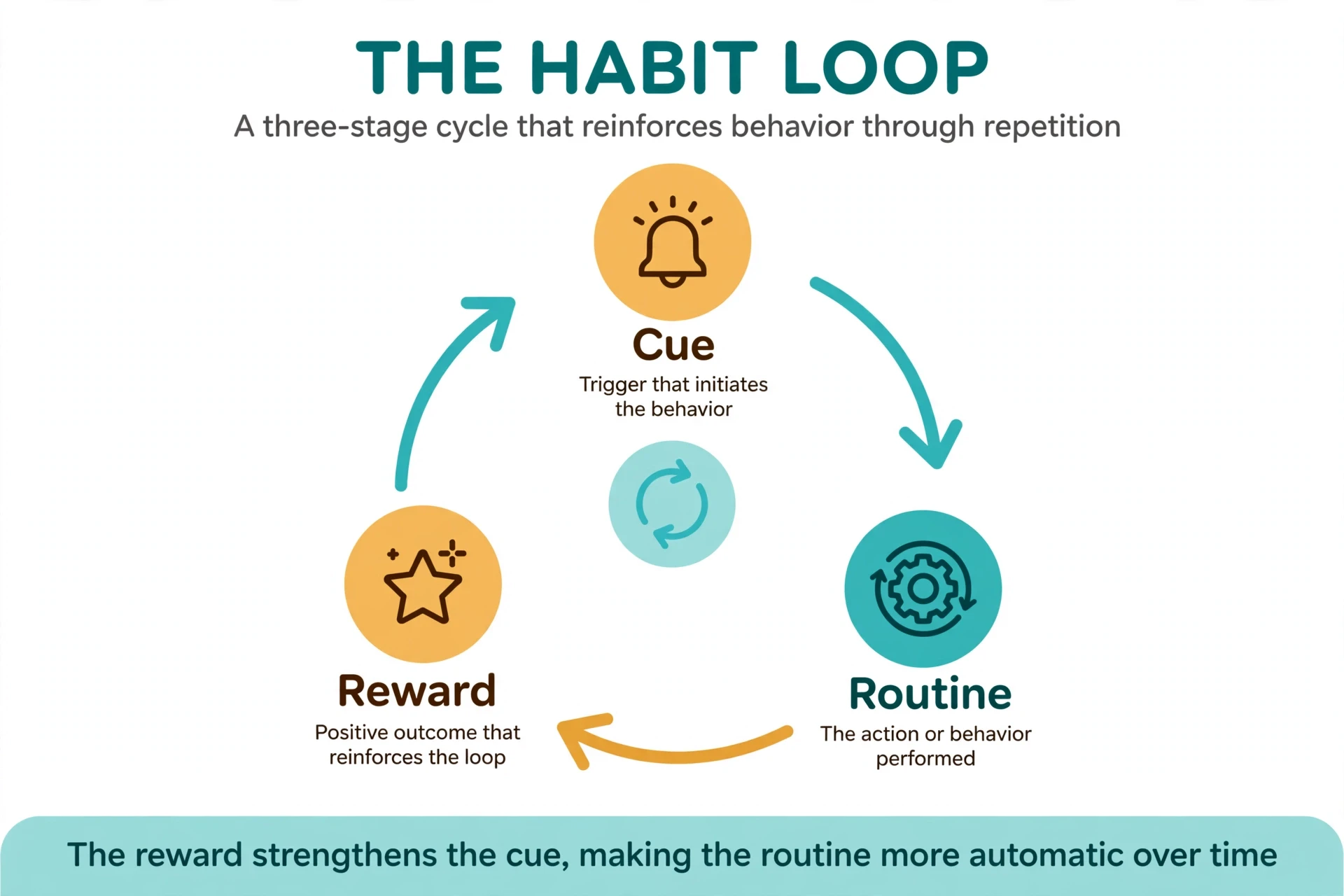
If there is one idea to carry away from this article, it is the habit loop. A cue triggers a routine, the routine delivers a reward, and the reward makes the loop more likely to fire next time the cue appears. Repeat that cycle in a stable context, and the loop tightens until it runs on its own. This is how habits form at the level of everyday life, and it is the framework the brain research in the next sections explains from the inside.
The loop was popularised by journalist Charles Duhigg in The Power of Habit (2012), drawing on the neuroscience of Ann Graybiel at MIT. Duhigg gave the public a clean three-part name for a pattern researchers had been mapping in animal experiments for years. The naming matters less than the structure, and the structure is the key to how habits form. Every habit you have, good or bad, can be read as a loop with those three parts.
2.1 The cue: the trigger you barely notice
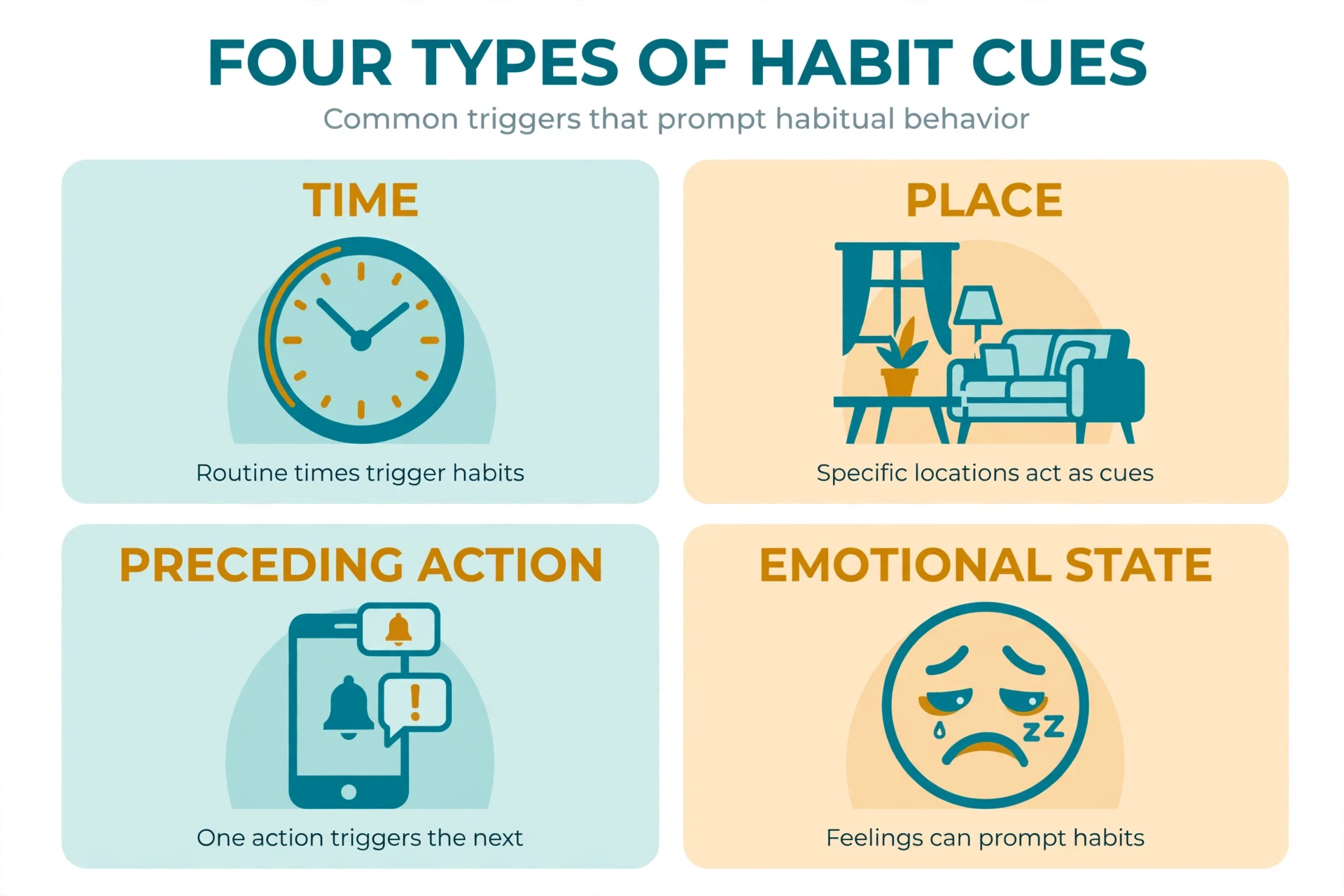
A cue is any stable feature of the situation that the brain has learned to associate with a behaviour. Cues come in several kinds, and recognising yours is the single most useful diagnostic skill in habit change.
Time: 7 a.m., lunchtime, the moment the working day ends.
Place: the kitchen, the car, the desk, the sofa.
A preceding action: finishing a meal, closing the laptop, putting the children to bed.
An emotional state: boredom, stress, loneliness, tiredness.
Other people: a colleague who always suggests a cigarette break, a friend who always orders dessert.
Most people, when they try to change a habit, aim at the routine. They try to resist the behaviour itself — yet the cue is where how habits form begins, and where change is easiest. The research suggests they are aiming at the wrong link. The cue is where the loop starts, and it is also where it is easiest to intervene, because cues are concrete and changeable. You cannot simply decide to stop wanting a biscuit at 3 p.m. You can move the biscuits out of the drawer, change where you sit at 3 p.m., or replace the 3 p.m. slot with a walk. The loop still fires — it just fires on a different routine.
I once watched a colleague try to quit checking email first thing in the morning by sheer resolve. He lasted four days. Then he changed one thing: he moved his phone charger out of the bedroom and into the hallway. The cue — the glowing phone on the bedside table at 6:30 a.m. — vanished. The habit collapsed within a week, not because his willpower improved, but because the trigger was gone. He had not beaten the loop. He had removed its starting gun.
2.2 The routine: the behaviour itself
The routine is the action — or the sequence of actions — at the centre of how habits form, and it follows the cue. It can be physical (going for a run), mental (worrying in a familiar pattern), or emotional (reaching for comfort food). Routines vary enormously in complexity, and that complexity turns out to be one of the main reasons some habits form in weeks and others take many months. Drinking a glass of water with lunch is a short, simple routine. Running for fifteen minutes before dinner involves shoes, weather, energy, time, and planning. The brain has more to chunk in the second case, and the loop takes longer to automate. We will come back to that in Section 5, when we look at the real timeline.
2.3 The reward: why the loop survives
A routine without a reward is a routine that dies, and that is why reward is the engine of how habits form. The reward is whatever the brain gets out of the behaviour: relief from stress, a pleasant taste, a sense of completion, social approval, the removal of an unpleasant feeling. Rewards do not have to be large or even conscious. The quiet satisfaction of ticking a box, the brief distraction from a boring task, the sugar hit that follows a stressful meeting — all of these count. The brain keeps a rough ledger: did this action, in this context, pay off? If the answer is yes often enough, the link strengthens.
One subtlety is worth naming early, because it explains so many failed attempts at change. The reward that maintains a habit is often not the reward you think it is. A person who smokes after dinner may believe the reward is nicotine. Often the reward is the five minutes of quiet outside, away from the table, away from demands. A person who scrolls their phone in bed may believe the reward is entertainment. Often the reward is the feeling of not being alone with their thoughts for a few minutes. Change the routine without replacing the real reward, and the loop will find its way back. The American Psychological Association's overview of habit science makes this point in plain terms: habits are learned associations between context and behaviour, and they persist because the context keeps delivering the payoff, not because the person keeps choosing it. See the APA topic page on habits.
2.4 Craving: the optional fourth step
Some writers add a fourth element — craving — between cue and routine. The cue sparks a desire, the desire drives the routine, the routine earns the reward. This is a useful addition for habits with a strong motivational pull, like snacking or phone-checking, where you can feel the urge build. For simpler habits, like locking the front door, there is no craving to speak of; the cue fires and the hands move. Whether you use three steps or four, the logic is the same: the loop is a circle, and every repetition makes the circle a little harder to break and a little easier to ride.
3. Inside the Brain: The Basal Ganglia and Chunking
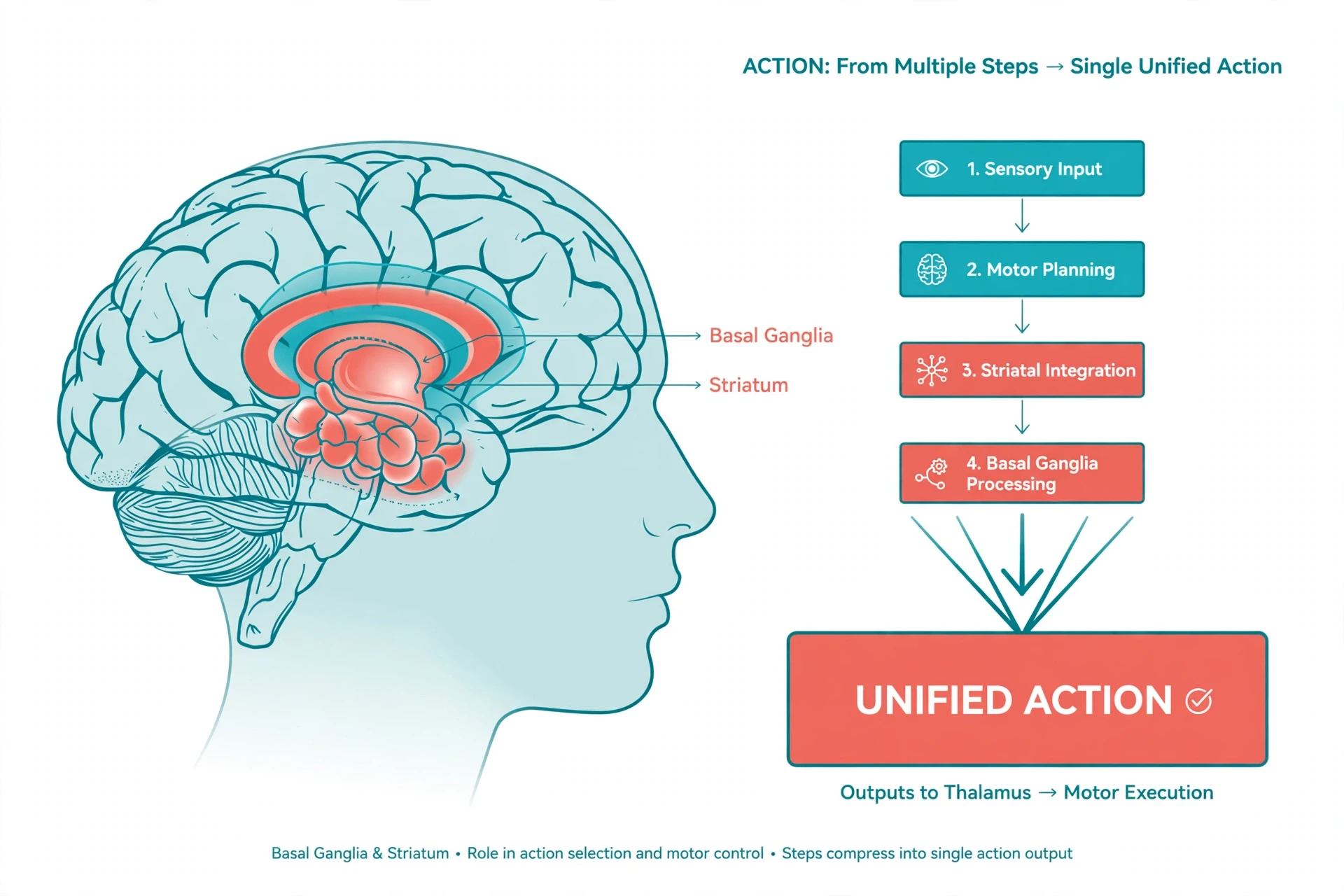
The habit loop describes what happens. The brain explains how. The key structure in how habits form is the basal ganglia, a cluster of nuclei buried deep beneath the cortex, in the forebrain. For a long time, the basal ganglia were known mainly for movement — they sit inside the wider nervous system, whose brain, spinal cord and nerves carry every signal in the loop — damage there causes the tremors and rigidity of Parkinson's disease. Then researchers began to notice something else: the same structures were busy whenever a behaviour became automatic.
The most elegant demonstration came from Ann Graybiel's laboratory at MIT. Her team trained rats to run a T-shaped maze. A tone told the rat which arm to turn toward, and a piece of chocolate waited at the end. Electrodes recorded neurons in the striatum, the largest input region of the basal ganglia, as the rats learned. At first, the neurons fired almost continuously throughout the maze run, as if every step might matter. As the rats learned the route, the firing pattern changed dramatically. Neurons fired hard at the very beginning, went quiet through the middle, then fired hard again at the end. The whole sequence — hear the tone, turn left, run, eat — had collapsed into a single unit. Graybiel called this chunking.
MIT's own account of the work puts it plainly: the patterns in the basal ganglia change when habits are formed, change again when habits are broken, and quickly re-emerge when something rekindles an extinguished habit. That last detail is the one that explains why old habits return so fast after a holiday, a stressful week, or a move back to a familiar place. The chunk was never deleted. It was only quiet. Read MIT's report, Brain researchers explain why old habits die hard.
3.1 The handover from cortex to basal ganglia
Learning a new behaviour starts in the prefrontal cortex, the part of the brain that handles planning, and the shift away from it is the neural signature of how habits form., attention, and deliberate choice. That is why the first week of a new habit feels so effortful. You are thinking about every step. You need reminders, lists, and encouragement. You are, quite literally, using the most expensive real estate in the brain to do the job.
With repetition in a stable context, control shifts. Activity in the prefrontal cortex falls. Activity in the basal ganglia rises. The behaviour becomes cheaper to run, and the cortex is freed for new problems. This handover is the neural version of what you feel when you learn to drive: at first you monitor the mirrors, the pedals, the gear stick, and the road all at once, and you are exhausted after twenty minutes. A year later you drive home and realise you cannot remember the journey. The basal ganglia drove. Your cortex was elsewhere.
A later MIT study sharpened the picture further. Researchers found specific neurons in the striatum — a region mapped in our guide to human brain anatomy and functions — that mark the beginning and end of chunked units of behaviour that mark the beginning and end of chunked units of behaviour — firing at the outset of a learned routine, going quiet while it is carried out, then firing again once it is complete. This "task-bracketing" pattern appears to be what initiates a routine and then notifies the brain once it is done. The full report is MIT's Distinctive brain pattern helps habits form.
3.2 Why chunking is a feature, not a flaw
It is tempting to see automaticity as laziness, or as the brain cutting corners. It is the opposite: chunking is the efficiency system at the heart of how habits form. Chunking is an efficiency system. The brain has limited conscious attention, and it cannot afford to spend it on the hundreds of small decisions that fill a day. By compressing repeated sequences into chunks, it reserves attention for the genuinely new: the unexpected email, the child who is upset, the problem nobody has solved yet. William James saw this in 1890, a century before the electrodes confirmed it, when he wrote that the more of daily life we can hand over to automatism, the more our higher powers of mind will be set free for their own proper work.
The cost is that chunks are hard to inspect. Because the middle of a chunk runs without conscious oversight, you cannot easily edit it from the inside. You cannot decide, mid-chunk, to do step three differently, because step three is not a separate decision anymore. It is part of the unit. That is why breaking a habit by willpower alone feels like trying to rewrite a sentence while someone else is speaking it. The practical answer, which we will develop in Section 7, is to intervene at the edges of the chunk — at the cue that starts it, or at the reward that closes it — rather than wrestling with the middle.
3.3 Habits versus memories: two systems, one brain
Habits and memories are close cousins, and comparing them clarifies how habits form as a separate kind of learning. The brain treats them differently. Declarative memory — the kind that lets you recall what you had for lunch or the name of your first teacher — depends heavily on the hippocampus. Habit memory depends on the basal ganglia. The two systems can operate independently, which is why a person with severe damage to the hippocampus can still learn a new motor habit, like mirror-tracing, while having no memory of ever practising it. They get better each day and are genuinely surprised by their own skill.
This split is worth keeping in mind when you read about memory elsewhere on this site. Our companion article on how the human brain forms memories explains the hippocampus, encoding, and consolidation during sleep. Habits are the other half of that story: the part of learning that does not need you to remember the lesson at all. Your body remembers it for you. And sleep, as the article on the science of sleep and dreams explains, plays a role in consolidating both kinds of learning — another reason a tired brain falls back on old habits first.
4. Dopamine: The Prediction Signal, Not the Pleasure Chemical
Ask most people what dopamine does, and they will say it is the pleasure chemical — an answer that misses the part that matters most for how habits form. — the brain's reward juice, released when you enjoy something. That description is so common that it has become a kind of folk neuroscience. It is also wrong in the way that matters most for understanding how habits form.
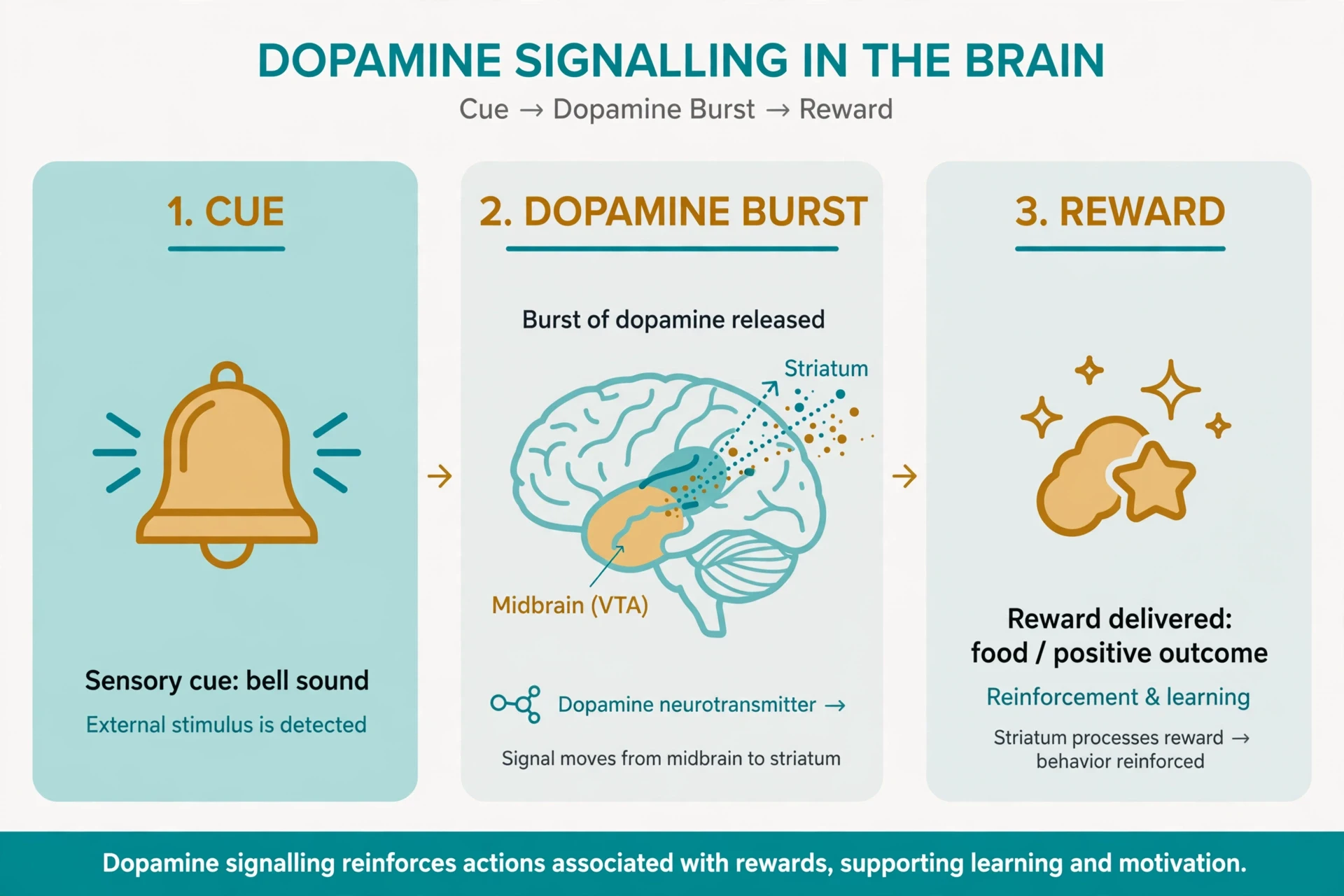
Dopamine is better understood as a prediction signal. It fires not when you get the reward, but when you learn that a reward is coming — and, crucially, when the reward is better or worse than expected. This is the reward-prediction-error idea, first mapped in detail by Wolfram Schultz and colleagues in the 1990s, and still being refined today. When a cue reliably predicts a reward, dopamine neurons fire at the cue. When the reward arrives exactly as expected, they stay quiet. When the reward is unexpectedly large, they fire more. When an expected reward fails to arrive, they dip below baseline. The brain is not recording pleasure. It is recording surprise, and using surprise to update its predictions.
Dopamine does not tell you that something felt good. It tells you that something turned out differently from what you expected — and that the prediction needs updating.
A 2025 study from the NIDA Intramural Research Program and Concordia University tested this distinction directly, separating dopamine's role as a reward-prediction-error signal from its role as a simple value signal, and found the evidence aligned with the prediction-error account. The paper is Disentangling prediction error and value in a formal test of dopamine's role in reinforcement learning. The technical details involve optogenetic stimulation in rats, but the headline is simple: dopamine is a teaching signal, and it teaches the brain which cues are worth acting on.
4.1 What this means for your habits
Three practical consequences follow from the prediction-error view, and each one changes how we should think about how habits form.
First, novelty and surprise strengthen learning. The first few times a new routine pays off, the prediction error is large, and the brain updates fast. That is why the early days of a new habit can feel exciting, and why the same habit later feels flat. The reward has not changed. The prediction has caught up with it. The loop no longer needs a big teaching signal to keep running, because the behaviour is already chunked.
Second, variable rewards are powerful teachers. When a reward is unpredictable — sometimes it comes, sometimes it does not, sometimes it is bigger than expected — the prediction error never settles to zero. The brain keeps paying attention. This is the mechanism behind slot machines, loot boxes, and the endless scroll of a social feed: each pull might be the good one, so the cue keeps firing the routine. It is also why a habit built on a variable reward can be so hard to break. The loop has been trained by surprise itself.
Third, the cue becomes rewarding in its own right. Once dopamine fires at the cue, the cue itself carries motivational pull. You do not need the biscuit to be in front of you. The sight of the kitchen at 3 p.m., the sound of the kettle, the feeling of boredom — any of these can trigger the anticipatory signal, and the anticipatory signal is what moves your feet. This is why people trying to break a habit often report that the hardest moment is not resisting the reward, but walking past the cue.
4.2 Dopamine, motivation, and the "I just don't feel like it" problem
A common complaint in habit-building is that motivation vanishes after the first week. The prediction-error view explains why that is normal, and how habits form even when motivation fades., not a personal failure. Early on, the new routine is unpredictable: will it work, will it feel good, will I manage it? Dopamine is active, and motivation is high. As the outcome becomes predictable, the teaching signal fades, and motivation fades with it. What replaces motivation is not more motivation. It is the chunk. If the loop has been repeated enough in a stable context, the behaviour runs without needing a motivational push. If it has not, the behaviour stalls the moment the excitement wears off. The fix is not to hunt for more excitement. It is to make the context so stable and the routine so small that the loop can survive the boring middle stretch, which is where most habits are actually built.
I felt this in my own attempt to build a daily writing habit. The first week was thrilling: new notebook, new routine, visible progress. The third week was dull, and I missed two days in a row. What saved the habit was not a motivational video. It was the fact that I had tied the writing to an unchanging cue — the same chair, the same hour, the same first cup of tea — and made the routine absurdly small: two sentences, no more required. Two sentences is too small to fail, and too small to need motivation. Most days I wrote more. The loop survived because the cue never changed and the entry cost stayed low.
5. How Long Does It Take? The 66-Day Finding
This is the question everyone asks, and the honest answer is less satisfying than the myth. There is no single number of days after which a habit is formed. There is a distribution — a wide one — and where you land in it depends on the habit, the context, and you.
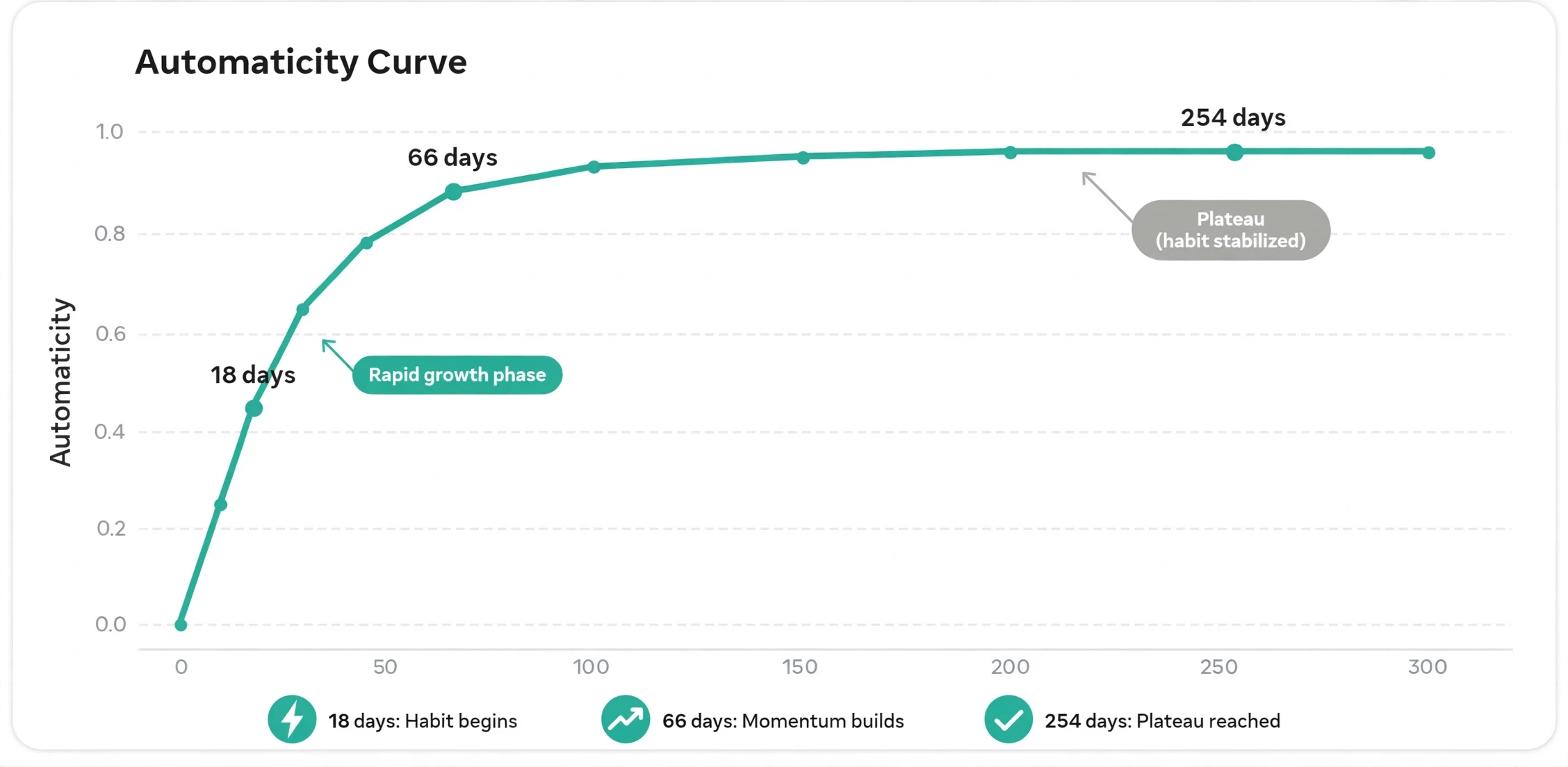
The best-known real-world study of how habits form is the one by Phillippa Lally and colleagues at University College London, published in the European Journal of Social Psychology in 2010. Ninety-six volunteers each chose one new behaviour — drinking a glass of water with lunch, eating a piece of fruit, doing a fifteen-minute run — and repeated it daily in response to a once-daily cue, for twelve weeks. Each day they rated how automatic the behaviour felt. The researchers fitted a curve to each person's data and asked when automaticity reached its plateau, the point where extra practice added almost nothing.
The headline result for how habits form: the median time to reach that plateau was 66 days. The range was enormous: 18 to 254 days. Simpler behaviours formed faster. Exercise habits took much longer. And missing a single day made no meaningful difference to the outcome — a finding that should be printed on the wall of every gym in January.
UCL's own blog post on the study, Busting the 21 days habit formation myth, states the conclusion plainly: 21 days is a myth; habit formation typically takes longer than that, and the best estimate is 66 days — but it is unwise to assign a single number to the process at all.
5.1 Why the range is so wide
Several factors stretch or shrink the timeline of how habits form:
Complexity. A one-step behaviour (a glass of water) chunks faster than a multi-step one (a run, which needs clothes, route, weather, and recovery).
Context stability. The same cue, same place, same time, every day, speeds chunking. A shifting context forces the brain to relearn the link each time.
Reward timing. An immediate, reliable reward strengthens the loop faster than a delayed or uncertain one. A habit whose payoff arrives weeks later — like exercise improving fitness — needs extra scaffolding, such as a small immediate reward after each session.
Prior habits. A new behaviour that fits an existing chunk forms faster than one that competes with an old chunk. Flossing after brushing slots into an existing sequence. Meditating at a random hour does not.
Individual differences. Some people in Lally's study plateaued in under three weeks. Others were still climbing after three months. Neither group was doing anything wrong. Their behaviours and contexts simply differed.
A 2024 systematic review and meta-analysis of health-behaviour habit formation, covering 20 studies and more than 2,600 participants, found a similar picture: a median of 59 to 66 days, with a range from 4 to 335 days. The exact numbers shift with the sample and the behaviour, but the shape is stable. Expect roughly two to three months for a typical daily habit, longer for complex ones, and treat any promise of a fixed number with suspicion.
5.2 The shape of the curve matters more than the number
Look at Figure 6 again. The curve rises steeply at first, then flattens, and its shape is the best visual summary of how habits form over time. That shape carries a practical message: the early repetitions buy you the most automaticity. The first two weeks of a new habit are not a warm-up. They are the period when the brain is updating fastest, when each repetition moves the needle most. The later weeks are consolidation — less dramatic, but necessary to lock the plateau in place. People who quit in week three often quit just as the curve is bending toward stability. They were closer than they felt.
The shape also explains why a missed day does not matter much. One missing repetition is a tiny dent in a curve built from dozens of repetitions. What matters is the pattern across weeks, not the perfection of any single day. The Lally data showed no significant harm from a single missed day. What derails habits is not a missed day. It is a missed week that becomes a missed month, during which the cue-behaviour link quietly weakens and the old chunk reasserts itself.
6. Why the "21 Days" Claim Is a Myth
The number 21 is everywhere in self-help: 21 days to form a habit, the most persistent misunderstanding about how habits form., 21 days to change your life, 21-day challenges, 21-day detoxes. It sounds scientific. It has the ring of a laboratory result. It is not one.
The trail leads to Maxwell Maltz, a plastic surgeon who published Psycho-Cybernetics in 1960. Maltz noticed that his patients seemed to take about three weeks to adjust to a new face after surgery, and that amputees experienced a phantom limb for about the same length of time. He wrote that it takes "a minimum of about 21 days for an old mental image to dissolve and a new one to jell." Read that sentence carefully. He said "a minimum of about" — a floor, not a promise. And he was talking about self-image after a physical change, not about learning to floss, run, or write in a journal. His book was based on clinical observation, not on a controlled study of behaviour.
What happened next is a small case study in how myths spread. Later writers dropped the hedge, "about," and dropped the qualifier, "minimum," and upgraded a single surgeon's impression into a universal rule for everything. The number survived because it is convenient: three weeks feels achievable, it fits neatly into a calendar, and it gives a programme a tidy length. It survived because nobody checked it against data — until Lally and her colleagues did, fifty years later, and found a median three times as long.
Most people assume the 21-day figure comes from research. What we actually see in the data is a clinical anecdote that was stretched, repeated, and eventually mistaken for a finding. The correction is not that habits take exactly 66 days instead. The correction is that habits take a variable amount of time, that the median is around two months, and that anyone selling you a fixed number is selling you a story, not a study.
7. How Habits Form in Real Life: Building Good Ones
Theory is only useful if it changes what you do on a Tuesday. This section turns how habits form — the loop, the chunking, and the timeline — into a working method. None of these steps requires willpower as a starting condition. Each one is a design choice about cues, routines, and rewards.
7.1 Start smaller than you think
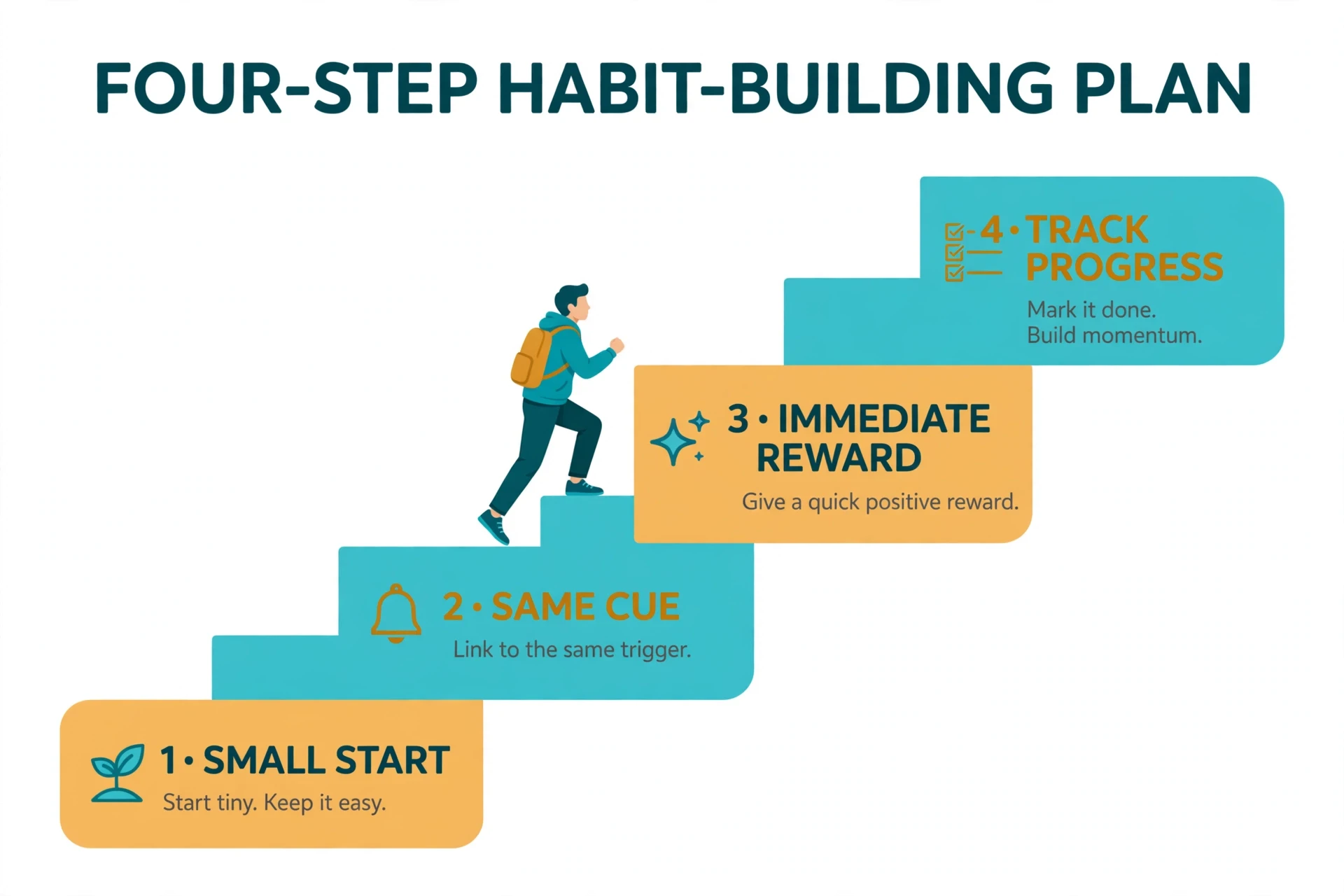
The most common mistake in habit-building is starting too big. It fails because it ignores how habits form — through small, repeated, chunkable steps. A person who has not exercised in a year decides to run five kilometres every morning. The routine is complex, the reward is delayed, and the cue is unstable. The loop never gets enough clean repetitions to chunk. A better start is absurdly small: put on running shoes and step outside. That is the whole routine for week one. It sounds trivial, and that is the point. A trivial routine gets repeated. A heroic routine gets skipped, and a skipped routine teaches the brain nothing except that the cue does not reliably lead to action.
Behavioural scientist BJ Fogg at Stanford calls these "tiny habits," and the logic matches the neuroscience exactly. A small routine is easy to chunk because there is little to chunk. Once the small version is automatic, you can grow it — add a minute, add a block, add a hill — while the cue and the context stay the same. The loop grows around a stable core instead of collapsing under a heavy one.
7.2 Anchor the new habit to a stable cue
Pick a cue that already happens every day, at the same time, in the same place, and attach the new routine to it, because a stable cue is the fastest route to how habits form reliably. "After I brush my teeth, I will floss one tooth." "After I pour my morning coffee, I will write two sentences." "When I sit down on the train, I will open the language app." This technique, often called habit stacking, works because it borrows the stability of an existing chunk. The old cue fires, the old routine runs, and the new routine rides along at the end of it, where the basal ganglia is already paying attention to beginnings and endings.
Stability is the key word. A cue that moves — sometimes morning, sometimes evening, sometimes at home, sometimes at work — forces the brain to rebuild the association each time. A cue that never moves lets the association deepen with every repetition. If you can only control one variable in your habit plan, control the cue.
7.3 Make the reward immediate
Long-term rewards are real, but they are weak teachers, and that delay is one reason how habits form slowly for habits like exercise. The brain updates fastest on rewards that arrive within seconds of the routine. If your habit's natural payoff is weeks away, add a small immediate one: a tick on a calendar, a favourite song after the run, a moment of quiet with a good coffee after the writing. The immediate reward does not need to be large. It needs to be reliable and close in time to the routine, so the prediction-error signal can do its work.
Be careful with rewards that contradict the habit. Rewarding a healthy lunch with a sugary treat teaches the loop that the treat is the payoff, and the loop will eventually skip the lunch and go straight to the treat. Choose a reward that points in the same direction as the habit, or at least one that does not fight it.
7.4 Design the environment, don't fight it
Wood's research points to the same conclusion again and again: context beats willpower, and environment design is the practical side of how habits form. People who appear disciplined usually live in environments that make the good habit easy and the bad habit hard. You can borrow that advantage without any special discipline. Put the fruit bowl on the counter and the biscuits in a high cupboard. Lay out the running shoes the night before. Delete the app from your phone's home screen so that opening it takes three taps instead of one. Each change is small. Together they change which loops fire and which ones starve.
The APA's 2023 guide to forming new habits makes the same point from the clinical side: lasting change comes from shaping the situation, not from white-knuckling through it. See the APA's How to form new habits.
7.5 Track the streak, forgive the miss
Tracking works because it makes the invisible visible, and visible progress is a small reward that keeps how habits form on track. A calendar with a cross for each day you performed the routine gives you an immediate reward — the cross itself — and a visible record of the pattern. It also makes a missed day legible: one blank square in a row of crosses is a blip, not a failure. The research supports this directly. A single missed day did not harm habit formation in Lally's study. What harms it is the story people tell themselves after a miss: "I've blown it, so I might as well stop." That story is the real enemy. The data says: miss a day, return the next day, and the curve barely notices.
I keep a paper calendar on my desk for exactly this reason. The crosses are satisfying in a way no app notification has ever matched, and the blank days are honest without being punishing. Some months the row is unbroken. Some months it looks like a mouth with missing teeth. The habit survives either way, because the cue is still there in the morning, and the routine is still small enough to do.
8. Breaking a Bad Habit: Why Deleting Does Not Work
Here is the hardest truth in how habits form: you cannot simply delete a habit once it is chunked. Once a sequence has been chunked in the basal ganglia, the pattern remains, even after long periods of disuse. MIT's Graybiel found that the neural patterns of an extinguished habit could re-emerge quickly when the old cue returned. The brain keeps the chunk on file. That is why a person who quit smoking years ago can feel the urge return in a single evening at a familiar bar, and why a dieter can fall back into old eating patterns within days of returning to a childhood home.
Duhigg's "golden rule" of habit change follows from this: you cannot eliminate a bad habit, you can only change it. Keep the cue. Keep the reward. Change the routine in the middle. The smoker who smoked for the five minutes of quiet outside can keep the cue (finishing dinner) and the reward (five quiet minutes outside) and replace the routine (a cigarette) with a walk around the block. The phone-scroller who scrolled for relief from boredom can keep the cue (the feeling of boredom) and the reward (a brief mental break) and replace the routine (the feed) with a chapter of a book or a short stretch.

8.1 Three ways to break a loop
Change the cue. Move, remove, or avoid the trigger. Different route home, different seat, different phone layout. This is the most reliable method, because a loop without its cue rarely fires.
Change the routine. Keep the cue and the reward, swap the middle. Same time, same place, different action. This is the golden rule in practice.
Change the reward. Make the old reward less satisfying or harder to get, and make the new reward more immediate. Add friction to the bad routine — log out of the app, keep the snacks in the car — and remove friction from the good one.
What does not work, reliably, is trying to break a loop by willpower alone while leaving the cue, the routine, and the reward all in place. Willpower is a prefrontal-cortex resource. It is strong in the morning, weak when you are tired, stressed, or distracted — which is exactly when the basal ganglia takes over. A plan that depends on willpower at the moment of temptation is a plan that fails at the moment of temptation. A plan that changes the cue works even when you are tired, because the loop never starts.
8.2 Stress and the return of old habits
Stress deserves a special note, because it explains so many relapses — and stress is when old chunks return first, which is the reverse side of how habits form. Under stress, the prefrontal cortex — the deliberate, planning part of the brain — works less well, and control shifts toward the basal ganglia. That is not a character flaw. It is how the brain is wired: when resources are scarce, it falls back on the cheapest available behaviour, which is the oldest chunk. This is why people under pressure reach for familiar comforts, familiar foods, and familiar routines, even ones they thought they had left behind.
The implication is practical, not moral. If you know a stressful week is coming, do not plan to rely on willpower. Plan the environment instead. Prepare the easy meal in advance. Put the phone in another room before the stressful meeting. Tell a friend what cue you are worried about. And if an old habit does return during a hard week, treat it as information — the cue is still active, the reward is still real — not as proof that you have failed. Our article on anxiety and depression explains how stress and mood interact with the brain's control systems, and why self-compassion during a relapse is not softness but sound strategy.
9. Habits, Goals, and Willpower: What Actually Runs Your Day?
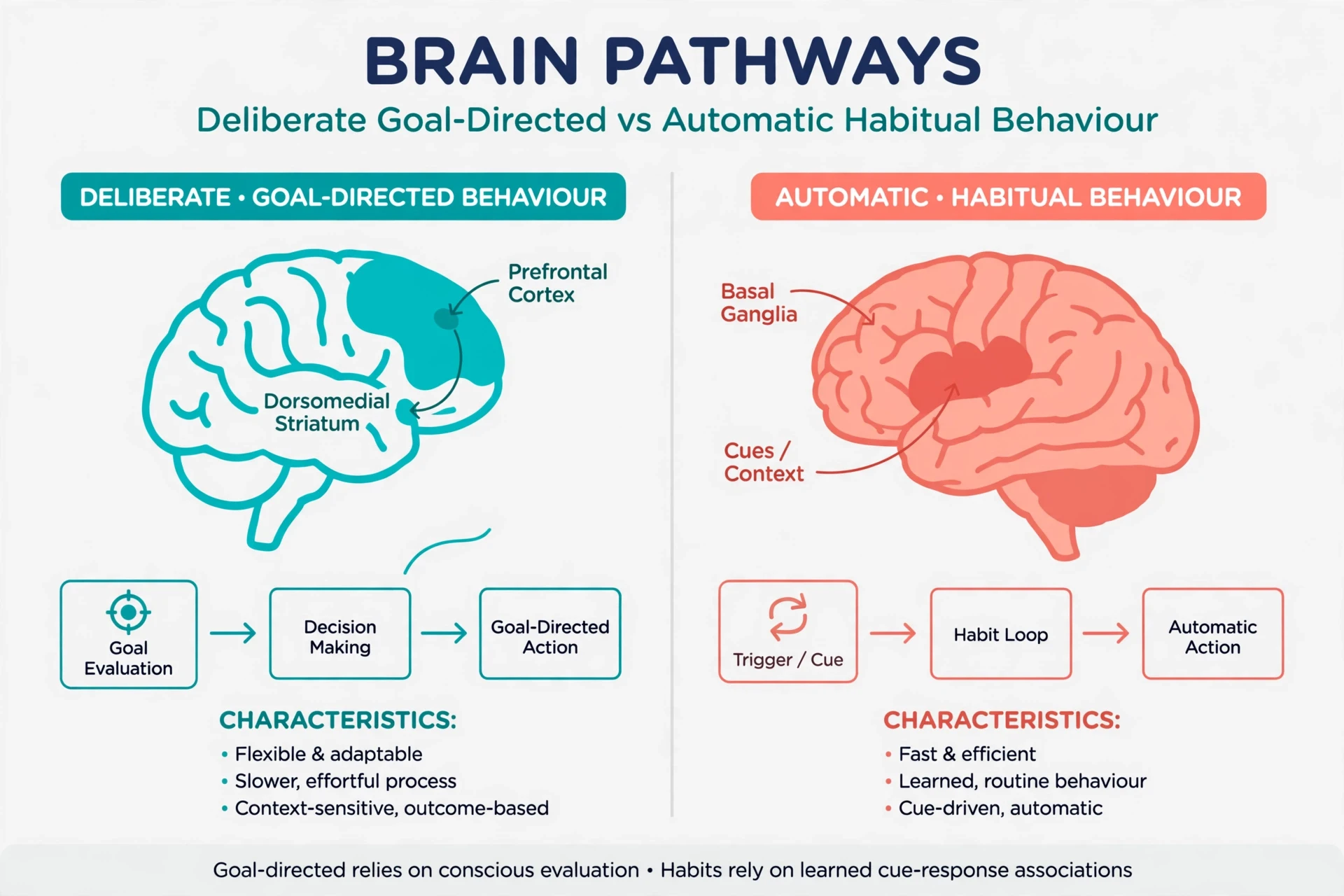
A useful way to understand how habits form is to contrast habits with goal-directed behaviour. Both live in the brain, but they use different systems, different triggers, and different kinds of effort. The table below summarises the contrast.
Feature | Goal-directed behaviour | Habitual behaviour |
|---|---|---|
Trigger | A goal or intention you hold in mind | A stable context cue |
Brain system | Prefrontal cortex and related networks | Basal ganglia, especially the striatum |
Effort | High; needs attention and willpower | Low; runs automatically once started |
Speed | Slow and flexible | Fast and rigid |
Sensitive to outcome? | Yes; stops if the goal changes | No; continues even if the reward fades |
Best for | New, complex, or changing situations | Stable, repeated, everyday situations |
Breaks down when | You are distracted or overloaded | The cue or context changes |
9.1 Willpower is real — and it is the wrong tool for habits
Willpower exists, and it matters. It is what lets you start a new behaviour before it is automatic, but it is the wrong tool for how habits form over months., and what lets you override a habit in a moment that matters. But willpower is a limited, fluctuating resource, and it is a poor long-term strategy for behaviour change, for a simple reason: a habit, by definition, is a behaviour that no longer needs willpower. If you are still relying on willpower after two months, the habit has not formed. The cue is unstable, the routine is too large, or the reward is too delayed. The answer is not more effort. It is a better design.
This is also why "just decide" advice fails so often. A decision is a prefrontal-cortex event. A habit is a basal-ganglia event. The decision can start the process, but only repetition in a stable context can finish it. The people who succeed at long-term change are rarely the people with the strongest resolve on day one. They are the people whose day-one plan made repetition easy: a small routine, a stable cue, an immediate reward, and an environment that helped instead of hindering.
9.2 When habits go wrong: the shadow side
The same chunking system that frees your attention can also trap it, which is the shadow side of how habits form. Compulsive behaviours, addiction, and rigid routines all use the same basal ganglia machinery as healthy habits, pushed to an extreme. The difference is not in the mechanism but in the outcome: a habit that once served a purpose continues even when it harms the person, because the loop no longer checks whether the reward is still worth it. That is why addiction researchers study the same striatal circuits as habit researchers, and why breaking a harmful habit often needs more than a redesigned cue — it can need social support, professional help, and time. If a habit is causing real harm to you or someone around you, that is a reason to seek help, not a reason to feel ashamed. The machinery is powerful, and sometimes it needs a team to rewire.
A habit is the brain's way of saying: this worked once, so let us not spend attention deciding it again. That is a gift most of the time — and a trap whenever the world, or your goals, have changed.
10. Latest Research: What Scientists Are Learning Now
Research into how habits form is not standing still. A few recent directions are worth knowing, because they refine the classic picture rather than replacing it.
First, the timeline of how habits form is getting more precise. The 2024 meta-analysis mentioned in Section 5, covering 20 studies and over 2,600 participants, confirmed the Lally median of roughly two months while showing an even wider range — from 4 days for the simplest behaviours to 335 days for the most complex. The message is not that the old number was wrong. It is that the number was always a summary of a distribution, and the distribution is wider than most summaries admit.
Second, researchers studying how habits form are paying closer attention to context. Recent studies show that habits tied to a routine-based cue ("after breakfast") form more reliably than habits tied to a time-based cue ("at 8 a.m."), probably because routines are more stable than clocks in real life. A routine cue also survives a late morning or a changed schedule better than a time cue does. If you are choosing between the two, choose the routine.
Third, the dopamine story is getting sharper. The 2025 work on reward-prediction error, cited in Section 4, shows that dopamine's teaching signal can be separated experimentally from a simple "value" signal — and that the prediction-error account wins. That matters because it tells habit-builders where to aim: not at making the reward bigger, but at making the cue-reward link more predictable and the surprise more informative early on.
Fourth, there is growing interest in how habits interact with sleep and memory consolidation. Sleep helps consolidate both declarative memories and procedural learning, which means a new habit practised during the day is partly consolidated overnight. A tired brain, conversely, leans harder on old chunks. If you are building a new habit, protecting your sleep is not a separate project. It is part of the same one. The science of sleep and dreams article explains the consolidation mechanisms, and our piece on brain fog describes what happens to attention and control when sleep and rest fall short — the exact conditions under which old habits take over.
Finally, researchers are studying how habits form in the real world with better tools: phone-based experience sampling, wearable sensors, and long-term tracking that follows people for months rather than weeks. The early results confirm the classic findings — context stability and repetition matter most — while adding detail about how habits survive disruption, travel, and illness. The field's direction is clear: less laboratory theory, more lived behaviour, measured where it actually happens.
11. Common Misconceptions About How Habits Form
Misconception 1: It takes 21 days to form a habit. No. The figure comes from a 1960 book about self-image after surgery, not from a habit study. The best real-world evidence points to a median of about 66 days, with a range of 18 to 254 days.
Misconception 2: Missing one day ruins the habit. No. In Lally's study, a single missed day made no meaningful difference. What matters is the pattern across weeks. Return the next day and the curve barely notices.
Misconception 3: Habits are about willpower and discipline. Mostly no. Willpower starts a habit; context and repetition finish it. People with strong habits usually have well-designed environments, not stronger character.
Misconception 4: Dopamine is the pleasure chemical, so more dopamine means more pleasure. No. Dopamine is a prediction and learning signal. It fires when an outcome differs from expectation, and it teaches the brain which cues predict reward. Pleasure and dopamine overlap, but they are not the same thing.
Misconception 5: You can erase a bad habit. No — not by deleting it. The chunk remains in the basal ganglia and can re-emerge when the old cue returns. What works is replacing the routine while keeping the cue and the reward, or removing the cue altogether.
Misconception 6: If a habit is automatic, it must be mindless and bad. No. Automaticity is neutral. It is what lets you drive, type, cook, and speak without thinking about every step. The question is never whether a behaviour is automatic. It is whether the automatic behaviour serves the life you want.
Misconception 7: Motivation must come first. Often the opposite is true. Action creates motivation more reliably than motivation creates action, especially once a small routine is chunked. Start tiny, let the loop run, and let the feeling follow the behaviour rather than waiting for the feeling to start it.
12. Putting It Together
How habits form is, at heart, a simple story with a deep mechanism. A cue triggers a routine. The routine earns a reward. The reward strengthens the link. Repeated in a stable context, the sequence is chunked in the basal ganglia, control shifts away from the prefrontal cortex, and dopamine's prediction signal quietly teaches the brain which cues are worth acting on. The process takes weeks to months — a median of about 66 days in the best study we have, longer for complex behaviours — and it does not run on a fixed calendar.
That story changes how you should approach change, because once you understand how habits form, willpower stops being the plan and design becomes the plan. Stop asking whether you have enough willpower, and start asking whether your cue is stable, your routine is small, and your reward is immediate. Stop trying to delete bad habits, and start redesigning them: keep the cue, keep the reward, change the middle. Stop counting days to a magic number, and start counting repetitions in the same context. The brain does not care about the date on the calendar. It cares about the pattern.
My coffee habit started as a deliberate choice and became a chunk. So did my notebook habit, and my writing habit, and — I will admit — my habit of checking my phone when I sit down on the train, which I am still redesigning, one cue at a time. The mechanism is the same in every case. Once you can see the loop, you can work with it instead of against it. And that, more than any number of days, is the skill worth building.
Frequently Asked Questions
How long does it take to form a habit?
It takes a median of about 66 days, according to the best-known real-world study by Lally and colleagues at University College London, with a range from 18 to 254 days depending on the person and the behaviour. Simpler habits form faster; complex ones, like daily exercise, take longer. A 2024 meta-analysis of more than 2,600 participants found a similar median of 59 to 66 days. There is no single fixed number, and the popular "21 days" figure is a myth — that range is the honest answer to how habits form on a calendar.
How do habits form in the brain?
How habits form in the brain is a matter of repetition in a stable context: habits form when a behaviour is repeated until the basal ganglia, especially the striatum, compresses the whole sequence into a single chunk. Control shifts from the prefrontal cortex, which handles deliberate thought, to the basal ganglia, which runs the chunk automatically. Dopamine acts as a prediction signal during this process, firing when a reward is better or worse than expected and teaching the brain which cues predict a payoff.
What is the habit loop?
The habit loop is a three-part cycle: a cue triggers a routine, the routine delivers a reward, and the reward strengthens the link back to the cue. The loop was popularised by Charles Duhigg in The Power of Habit, building on Ann Graybiel's neuroscience research at MIT. Some versions add craving between the cue and the routine. Every repetition tightens the loop until it runs with little conscious effort.
Why is 21 days to form a habit a myth?
The "21 days" figure comes from plastic surgeon Maxwell Maltz's 1960 book Psycho-Cybernetics. Maltz observed that patients took "a minimum of about 21 days" to adjust to a changed appearance after surgery. He was describing self-image, not habit formation, and his observation was clinical, not experimental. Later writers dropped the qualifiers and turned it into a universal rule. Real habit research finds a median of about 66 days, not 21.
Can you break a bad habit?
You cannot simply delete a bad habit, because the chunk remains stored in the basal ganglia and can re-emerge when the old cue returns. What works is changing the loop: keep the cue and the reward, but replace the routine in the middle — or remove the cue altogether. Adding friction to the bad routine and removing friction from the good one also helps. Under stress, old habits return more easily, so designing the environment matters more than relying on willpower.
Does missing one day ruin a habit?
No. In Lally's study, missing a single day made no meaningful difference to habit formation. What matters is the overall pattern of repetition across weeks, not perfection on any single day. The danger after a miss is the story people tell themselves — that they have failed and might as well stop. Returning the next day keeps the curve on track.
Is dopamine the pleasure chemical?
Not exactly. Dopamine is better described as a prediction and learning signal, and that distinction is central to how habits form. It fires when an outcome differs from what the brain expected — a reward-prediction error — and it teaches the brain which cues predict reward. It is involved in motivation and learning, but it is not a simple measure of pleasure. A fully expected reward triggers little extra dopamine, even if it is enjoyable.
Sources
Lally, P., van Jaarsveld, C. H. M., Potts, H. W. W., & Wardle, J. (2010). How are habits formed: Modelling habit formation in the real world. European Journal of Social Psychology, 40(6), 998–1009. Discussed at UCL: Busting the 21 days habit formation myth
Graybiel, A. M., and colleagues. Basal ganglia chunking and habit formation research, MIT. See MIT News: Brain researchers explain why old habits die hard and MIT News: Distinctive brain pattern helps habits form
Wood, W., Quinn, J. M., & Kashy, D. A. (2002). Habits in everyday life: Thought, emotion, and action. Journal of Personality and Social Psychology, 83(6), 1281–1297. See USC: Good Habits, Bad Habits by Wendy Wood
American Psychological Association. Habits topic page
American Psychological Association. How to form new habits (Monitor on Psychology, 2023)
Usypchuk, A. A., et al. (2025). Disentangling prediction error and value in a formal test of dopamine's role in reinforcement learning. Current Biology, 35(16), 4019–4027. PubMed: 40738112
Singh, B., et al. (2024). Time to Form a Habit: A Systematic Review and Meta-Analysis of Health Behaviour Habit Formation. Healthcare, 12(23), 2488.
Duhigg, C. (2012). The Power of Habit. Random House.
Maltz, M. (1960). Psycho-Cybernetics. Prentice-Hall.