

It was 11:47 p.m. on a Sunday, and I was doing something I had sworn I would never do again. The grant report I had promised my team was due at nine the next morning. I had three weeks to write it. I had the data, the outline, and a quiet office. What I did not have, at 11:47 p.m., was a single finished paragraph. Instead, I had a spotless kitchen, a reorganised bookshelf, and a sudden, passionate interest in the history of paperclips.
I am a research scientist. I run experiments for a living. I know how to plan, how to break a large job into small steps, and how to meet a deadline. And still, there I was, scrubbing a stovetop at midnight rather than writing the first sentence of a report I cared about. That night taught me something that years of reading about motivation had not: why do we procrastinate, even when we know exactly what to do, is rarely a failure of knowing. It is a failure — or rather, a shortcut — in how we handle what a task makes us feel.
If you have ever asked yourself why do we procrastinate when the cost of waiting is obvious, you are asking one of psychology's most human questions. Most of us do it. In one large meta-analysis, psychologist Piers Steel pulled together 691 studies and found that roughly one in five adults describes themselves as a chronic procrastinator, while the great majority of students say they delay regularly. This is not a rare flaw. It is a normal feature of how the human brain weighs feelings against plans.
This article follows the science where it leads. Procrastination is best understood as an emotion-regulation problem, not a character defect. Your brain is not broken when you put things off. It is doing exactly what it evolved to do: escape discomfort now and deal with the consequences later. The trouble starts when later arrives with interest.
1. The Night Before the Deadline
1.1 A familiar scene
Picture the scene, because you have lived some version of it. An essay is due on Friday. On Monday, you feel calm. There is plenty of time. On Tuesday, you open the document, stare at the blank page for four minutes, and decide to check your messages first. On Wednesday, the task feels heavier, so you clean your room. On Thursday night, panic arrives like a second wind, and you write the whole thing in a rush, fuelled by caffeine and regret.
I have watched this pattern in students, in colleagues, and in myself. The first time I supervised a group of undergraduates, I assumed the ones who submitted late simply did not care. Then I sat with them, one by one, and heard a different story. They cared a great deal. They were afraid the work would not be good enough. They were bored by the topic. They did not know where to start, and starting felt like admitting they were lost. Delay was not indifference. Delay was relief.
1.2 Why this question matters
Why do we procrastinate at work, at school, at the doctor's office, and in our private lives? The answer matters because the cost is real. Chronic delay is linked to higher stress, poorer sleep, worse grades and work performance, and even delayed medical care. People who procrastinate do not only lose time. They lose peace of mind, and they often blame themselves in ways that make the next delay more likely.
The good news is that the research of the last twenty years has replaced moral judgement with mechanism. Once you can see the machinery — the mood, the brain circuits, the way motivation fades with distance — you can work with it instead of fighting yourself. That is what the rest of this article does.
2. What Procrastination Really Is
2.1 A precise definition
Psychologists define procrastination as voluntarily delaying an intended course of action despite expecting to be worse off for the delay. Three parts of that definition matter.
First, the delay is voluntary. You choose it, even if the choice feels automatic. Second, you had an intention. You meant to start the essay, file the taxes, or call the doctor. Third, you know — or could reasonably expect — that waiting will make things worse. That last part separates procrastination from sensible waiting.
2.2 Delay is not always procrastination
Not every delay is procrastination, and the distinction is worth keeping. Waiting for test results before deciding is prudent. Postponing a hike because a storm is coming is wise. Putting off a task so you can gather information you genuinely need is planning. Procrastination is delay without a good reason, driven by avoidance, when you know the bill is coming due.
Tim Pychyl, a psychologist at Carleton University who has spent his career studying this behaviour, puts it neatly: all procrastination is delay, but not all delay is procrastination. The American Psychological Association's conversation with Fuschia Sirois, a leading procrastination researcher, makes the same point — the voluntary, needless quality of the delay is what defines it. (APA, Speaking of Psychology)
2.3 The scale of the problem
How common is it, really? Steel's 2007 meta-analysis, which pooled hundreds of studies, remains the landmark summary. Around 15–20% of adults report chronic procrastination — delay that is habitual and disruptive — and among university students, the figure is far higher, with 80–95% saying they procrastinate at least sometimes. Those numbers have held up across later reviews, including a large bibliometric analysis of procrastination research that traced the field's growth over three decades. (PMC)
Those figures should change how we talk about the problem. They also reframe the question of why do we procrastinate: if nearly everyone delays, the answer must lie in normal brain design, not in rare character flaws. If nearly everyone delays and one person in five does so chronically, this is not a story about a few lazy people. It is a story about a common human vulnerability.
3. It Is Not Laziness: Procrastination Is Emotion Regulation
3.1 The old story — and why it fails
For most of my school years, I believed the old story. Procrastinators were lazy, or disorganised, or short on willpower. The cure, in that story, was a better planner and a sterner lecture. I have since learned how wrong that story is, and how much harm it does.
If laziness were the cause, procrastinators would avoid effort in general. That is the first clue in answering why do we procrastinate: the energy is present, but the willingness to face a specific feeling is not. They do not. The same person who cannot start a report will spend four hours building a spreadsheet for a hobby, or reorganise an entire garage. The energy is there. What is missing is willingness to sit with a particular feeling.
3.2 Sirois and Pychyl: short-term mood repair
The turning point in the science came from Fuschia Sirois and Timothy Pychyl. In a widely cited 2013 review, they argued that procrastination is best understood as a failure of emotion regulation — a case of prioritising short-term mood repair over long-term goals. We do not avoid the task itself, they argued. We avoid the negative emotions the task triggers: boredom, anxiety, frustration, self-doubt, resentment, or a sense of being overwhelmed. Delay removes that feeling right now. That relief is the reward, and rewards teach the brain to repeat the behaviour.
Durham University, where Sirois works, summarises her position plainly: procrastination is rooted in emotion-regulation difficulties, not laziness or poor time management. (Durham University)
I remember the first time I read that review properly, and it answered why do we procrastinate in a way no planner ever had. I was supposed to be writing a paper, and — fittingly — I was reading about procrastination instead of writing. A sentence stopped me cold: we procrastinate to feel better now, and we hand the cost to our future self. I thought of the grant report, the midnight stovetop, and the relief I had felt when I closed the document. It had not felt like laziness. It had felt like escape. The science was describing my evening with unsettling accuracy.
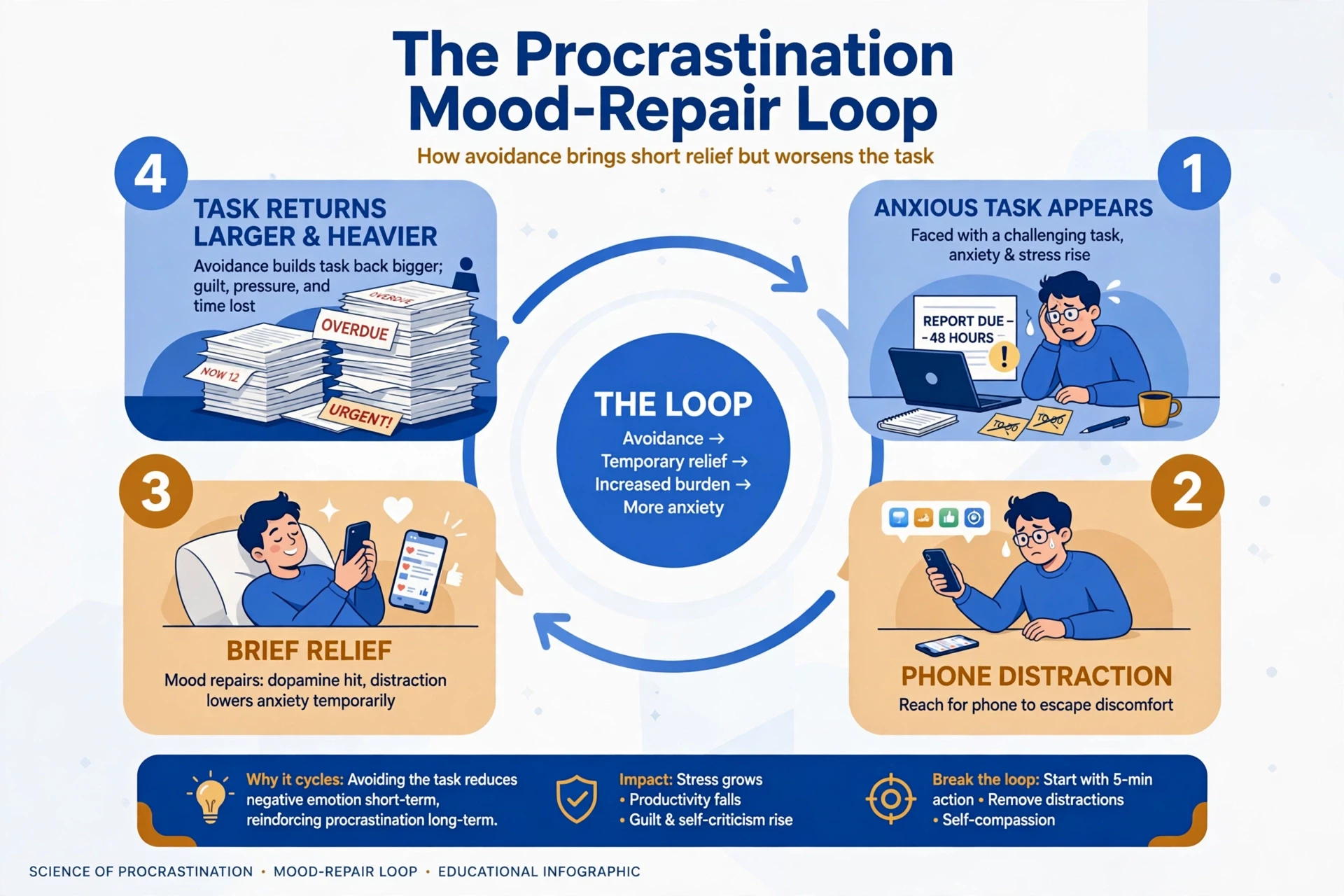
3.3 The mood-repair loop
Here is the loop, step by step:
A task triggers an unpleasant emotion — anxiety about failing, boredom, confusion, or dread.
You avoid the task, and the unpleasant emotion drops at once. Relief arrives within seconds.
Your brain records the lesson: avoidance works. It felt better.
The task waits, grows more urgent, and triggers stronger emotions next time.
The loop repeats, each round a little tighter.
This is classic reinforcement, the same learning process that shapes habits of every kind. The relief is immediate and certain. The cost is delayed and uncertain. For a brain built to favour the present, that is a badly stacked contest.
Recent research has strengthened the link. A 2025 study of university students found that emotion-regulation difficulties sat at the centre of the relationship between addictive phone use and procrastination — the same avoidance machinery, wearing different clothes. (PMC)
3.4 If it is about feelings, the fix changes too
This reframing changes everything about the solution, and it changes how we should ask why do we procrastinate in the first place — not as a question about schedules, but as a question about feelings. If procrastination were a time-management problem, the answer would be a better calendar. If it is an emotion problem, the answer has to start with the emotion. You do not need a new planner. You need a way to make the first five minutes of the task feel less awful — and a kinder way to talk to yourself when it feels awful anyway.
That is why "just do it" advice so often fails. It targets the schedule when the real obstacle is the feeling. Telling a procrastinator to manage time better is like telling a person with a fear of flying to manage their luggage better. The luggage was never the problem.
"We are not avoiding the task. We are avoiding the feeling the task brings — and avoidance works, briefly, which is exactly why it is so hard to stop."
4. Inside the Brain: The Planner Versus the Pleasure-Seeker
4.1 Two systems, one argument
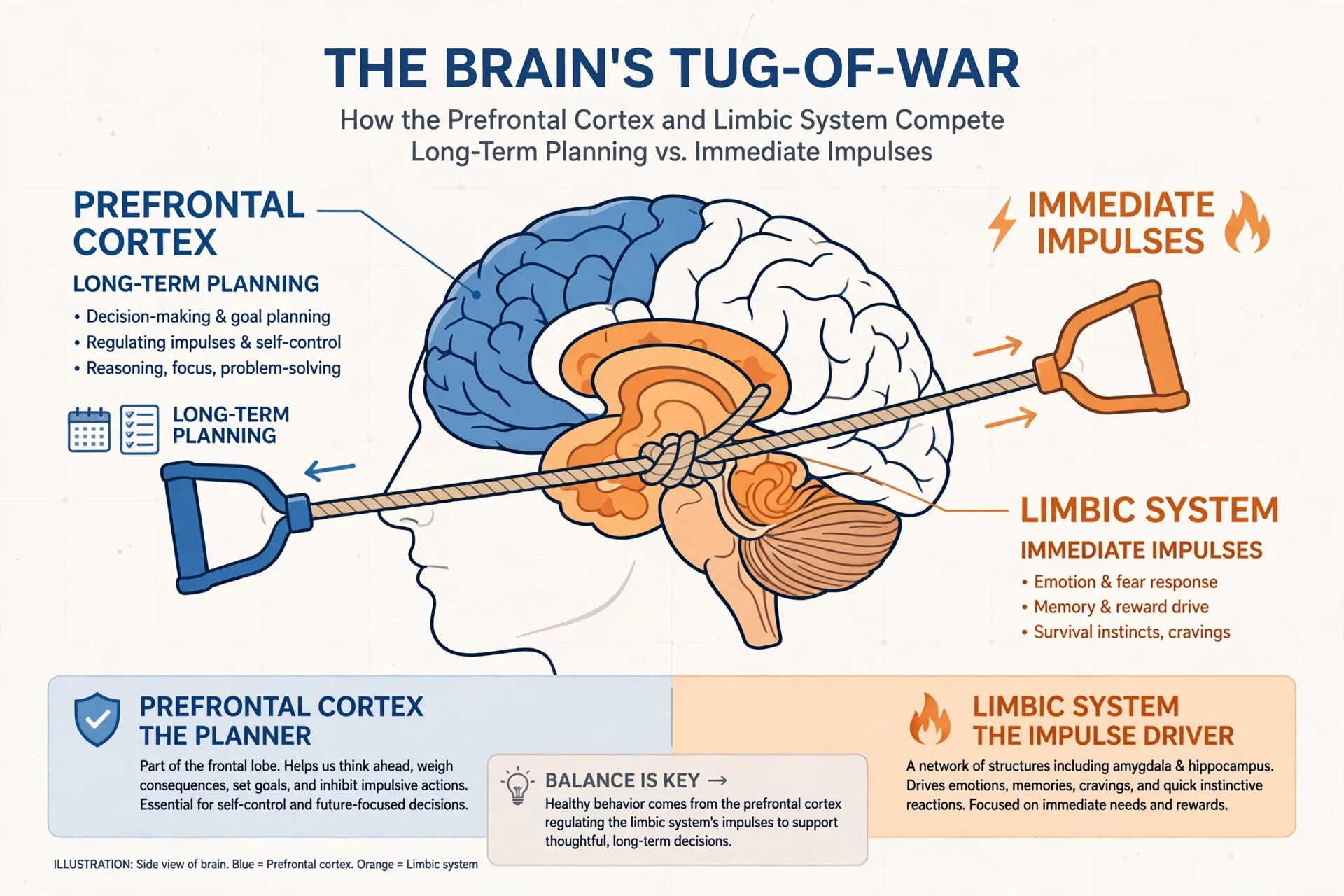
Your brain does not speak with one voice about the future, and that split is a large part of why do we procrastinate as often as we do. It speaks with at least two, and they want different things.
The prefrontal cortex, the area behind your forehead, handles planning, weighing consequences, and holding a long-term goal in mind while distractions compete for attention. It is the part of you that can picture next month's exam, next year's promotion, or the finished thesis. It is powerful, but it is also slow, effortful, and easily tired.
The limbic system, a set of older, deeper structures including the amygdala, handles emotion and reward. It reacts fast. It wants comfort now, threat gone now, pleasure now. When a task feels threatening or dull, the limbic system sounds the alarm — and the prefrontal cortex has to argue against a feeling, which is a hard argument to win. For a closer look at how these regions are organised, Sciory's guide to human brain anatomy maps the same territory in detail.
4.2 Why the limbic system usually wins the first round
The contest is unfair in a specific way. Limbic responses are automatic and immediate. Prefrontal control takes effort and energy, and it weakens when you are tired, stressed, hungry, or already drained by a long day. That is why procrastination gets worse in the evening, during exam season, or after a hard week. Your planner is exhausted, and the pleasure-seeker is wide awake.
I learned this in a laboratory, years ago, during a long week of data collection, and it taught me why do we procrastinate more when we are tired: the planner runs out of fuel first. By Thursday evening, I could not face writing up results I had collected that morning. I told myself I was lazy. What had actually happened was simpler: I had spent my planning energy on the day's experiments, and the part of my brain that could start a hard, boring write-up had nothing left. A night's sleep did more for my productivity than any motivational speech.
4.3 Stress hormones join the argument
When a task triggers anxiety, the body releases stress hormones, including cortisol. In the short term, cortisol sharpens attention. When it stays high, it clouds thinking, disrupts sleep, and makes avoidance feel even more attractive. Procrastination and stress feed each other: delay creates stress, stress makes starting harder, and harder starts invite more delay. The physiology of that spiral is covered in Sciory's article on high cortisol symptoms, which explains how chronic stress shows up in the body.
4.4 The brain treats your future self like a stranger
Brain-imaging studies have found something quietly startling, and it helps explain why do we procrastinate on tasks our future selves will inherit: when people think about themselves in the future, the brain activity looks more like thinking about another person than thinking about oneself. Your future self is, neurologically speaking, a distant acquaintance. That helps explain why handing a task to "future me" feels so easy. You would not dump a weekend of work on a stranger without a second thought — yet your brain does exactly that to the person you will be on Friday.
This is not a design flaw. It is a side effect of a brain that evolved to handle immediate threats and rewards, not quarterly reports. Knowing it, though, lets you design around it. If your future self feels like a stranger, you can make the task smaller, closer, and kinder for the person who has to do it — which, inconveniently, is you.
5. Temporal Motivation Theory: The Maths of "Later"
5.1 A formula for motivation
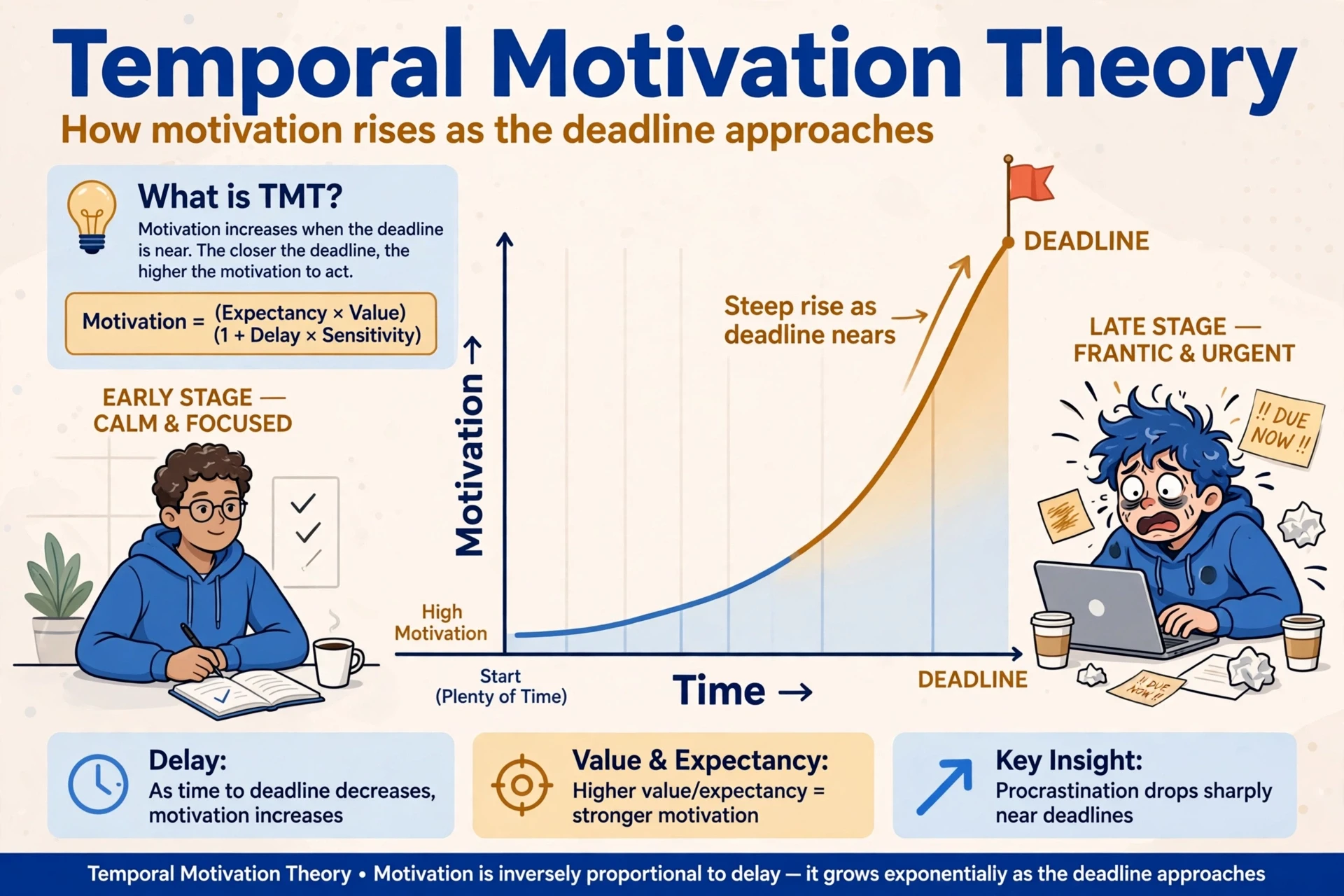
In 2007, Piers Steel proposed Temporal Motivation Theory, a framework built to answer why do we procrastinate in terms of measurable forces rather than moral judgement. an attempt to bring the scattered findings on procrastination into one equation. Stripped of its algebra, the theory says motivation depends on four things: how much you expect to succeed, how much you value the outcome, how long you must wait for the reward, and how impulsive you are.
Expectancy: do you believe you can do this? Low confidence sinks motivation.
Value: does the outcome matter to you, or is the task boring or unpleasant? Low value sinks motivation.
Delay: how far away is the deadline or reward? Long delays shrink motivation.
Impulsiveness: how easily are you pulled toward immediate rewards? High impulsiveness sinks motivation.
Motivation rises as the deadline approaches, because delay shrinks. That is why the essay that felt impossible on Monday becomes possible — even urgent — on Thursday night. Nothing about the task changed. The distance did.
5.2 Why deadlines work — and why they are a trap
Deadlines work because they collapse delay to zero. Panic is a powerful motivator, and it is also a terrible one. Work done in a panic is usually worse, the stress is real, and the memory of that miserable night makes the next task feel even more aversive. Deadlines rescue the project while punishing the person.
I have seen this in research teams. The group that finishes a paper the night before a conference deadline always swears it will start earlier next time. The group that sets its own earlier, smaller deadlines — a draft of the introduction by Tuesday, figures by Friday — rarely needs the panic at all. They changed the delay, not their character.
5.3 Steel's meta-analysis: what predicts procrastination best?
Steel's 2007 meta-analysis of 691 studies asked a blunt question that sits at the heart of why do we procrastinate: what actually predicts who delays? what actually predicts who procrastinates? The strongest predictors were not poor time management or laziness. They were task aversiveness (how unpleasant the task feels), impulsiveness, low self-efficacy for the task (doubting you can do it), and a tendency to be distracted. Conscientiousness — the personality trait of being organised and dutiful — was protective, but it was not the whole story. Even organised people procrastinate on tasks they dread.
That finding fits the emotion story perfectly. The best predictor of delay is how the task feels, not how the person manages a calendar.
6. Present You Versus Future You
6.1 The stranger you keep betraying
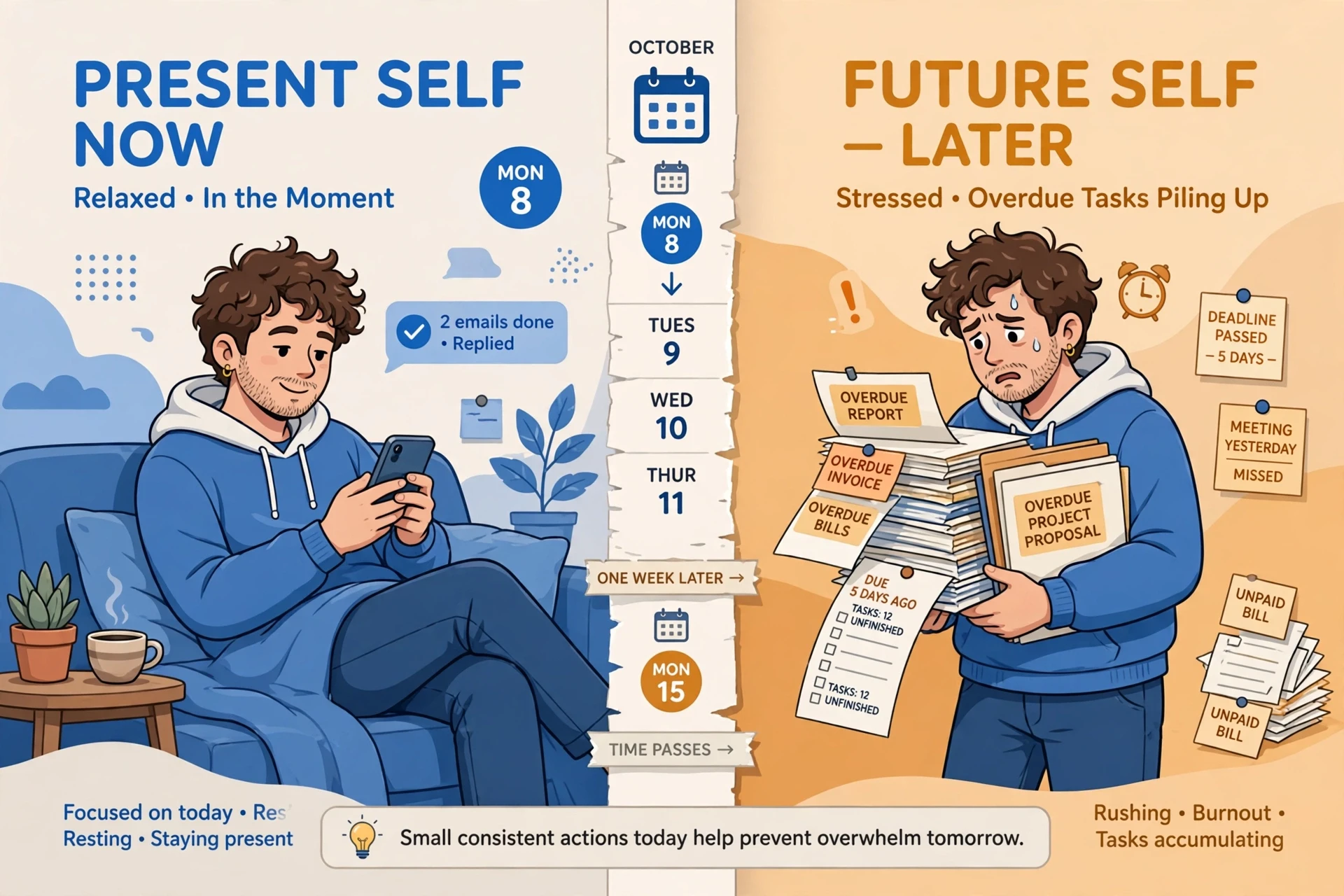
Why do we procrastinate on the very things we most want to finish? Part of the answer to why do we procrastinate is that the person who pays for the delay is not quite "you" in your brain's accounting. Present you gets the relief. Future you gets the 2 a.m. panic, the rushed work, and the apology email. Present you never has to meet future you — until the deadline arrives and the two of you are suddenly the same person.
This split explains the strange optimism of procrastinators. On Monday, you genuinely believe Friday-you will be energetic, focused, and happy to work. On Friday, you discover Friday-you is tired, distracted, and resentful. Monday-you made a promise that Friday-you never agreed to.
6.2 Time discounting
Economists call this pattern time discounting: a reward today is worth more to us than the same reward next month. The same logic applies to costs. A painful task today feels far worse than the same task next week, even though the task has not changed. Experiments on this effect are striking. In one well-known study, people offered a savings plan were far more likely to sign up when the plan started in the distant future than when it started immediately. We love our future selves in theory and abandon them in practice.
6.3 Making the future self real
The research points to a practical fix for why do we procrastinate: make your future self vivid. People who write a letter to their future self, or who simply imagine next week's version of themselves in concrete detail — where they will be sitting, how tired they will feel — are more likely to act now. The trick is not willpower. It is closing the psychological distance between the person deciding and the person paying.
I tried this during a long writing project. Instead of writing "finish chapter by Friday" in my planner, I wrote a note to Friday-me: "You will be tired, the kids will be home, and this chapter will feel twice as big. Do the first page tonight, while the house is quiet." It worked, not because I became more disciplined, but because I stopped lying to a stranger.
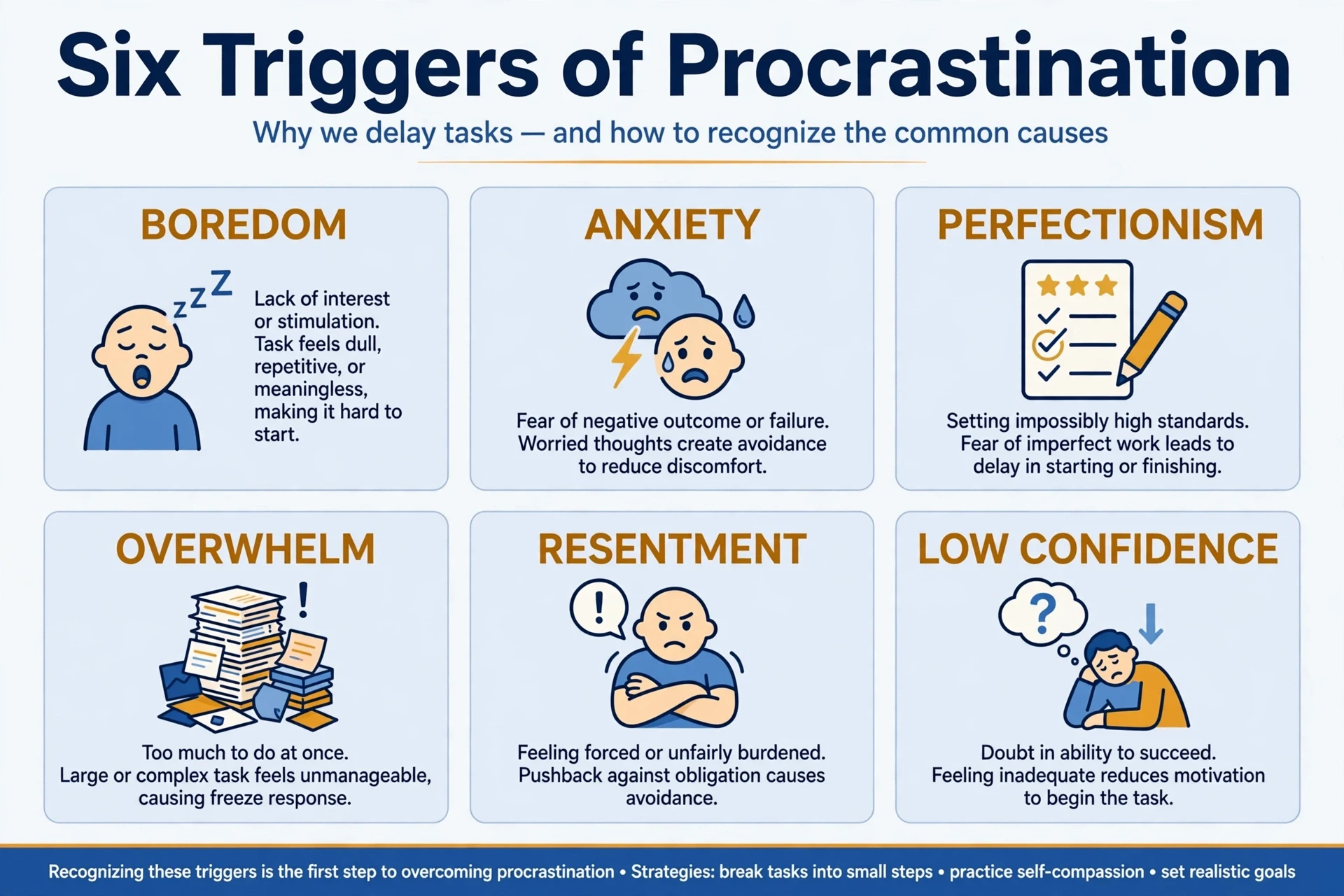
7. The Six Triggers: What Actually Makes You Put Things Off
7.1 It is rarely one reason
Ask a hundred procrastinators why they delayed, and you will hear six stories again and again. Each one is a different answer to why do we procrastinate, and each one needs a different fix. Most of us have a dominant trigger, and knowing yours matters — the fix for boredom is different from the fix for fear of failure.
1. Boredom. The task is dull, repetitive, or meaningless to you. Your brain hunts for stimulation, and the phone is always closer than the spreadsheet.
2. Anxiety and fear of failure. The task matters, and that is the problem. If you try and fail, the failure feels personal. Not starting protects the story that you could have done it.
3. Perfectionism. If it cannot be perfect, it cannot be started. Perfectionists often delay the beginning because the gap between the imagined perfect result and the messy first draft feels unbearable.
4. Overwhelm and confusion. The task is large, vague, or poorly defined. You do not know the first step, so you take no step. This is the most common trigger I see in students: "write a thesis" is not a task, it is a landscape.
5. Resentment and low value. The task feels imposed, pointless, or unfair. Delay becomes a quiet protest — the only control you have over a task you did not choose.
6. Low confidence. You doubt you have the skill, the knowledge, or the right to attempt it. Delay protects self-esteem in the short term and erodes it in the long term.
7.2 The anxiety link
Anxiety deserves a closer look, because it turns procrastination into a cycle — and it is one of the clearest answers to why do we procrastinate on the tasks that matter most. An anxious task triggers avoidance. Avoidance brings relief. Relief teaches the brain that the task is dangerous, so the next encounter triggers more anxiety. Over time, the person is not only avoiding a task — they are avoiding a feeling they have trained themselves to fear. Sciory's explainer on anxiety and depression describes how that loop works in the brain and what treatments target it, and the U.S. National Institute of Mental Health's anxiety pages explain the same mechanisms from a clinical perspective. (NIMH)
7.3 Procrastination versus strategic delay
Feature | Procrastination | Strategic delay |
|---|---|---|
Reason | Avoiding an unpleasant feeling | Waiting for information, rest, or a better moment |
Intention | You meant to start, then did not | You planned the pause in advance |
Feeling afterwards | Relief, then guilt and stress | Calm, because the plan is intact |
Effect on the outcome | Worse work, tighter deadline | Same or better work |
Example | Scrolling instead of starting the essay | Delaying a decision until test results arrive |
If your delay has a reason you could defend to a friend, it is probably strategic. If not, you are looking at the everyday puzzle of why do we procrastinate, and naming it honestly is the first step out of it. If the only reason is that starting feels bad, it is probably procrastination — and naming it honestly is the first step out of it.
8. What Delay Costs
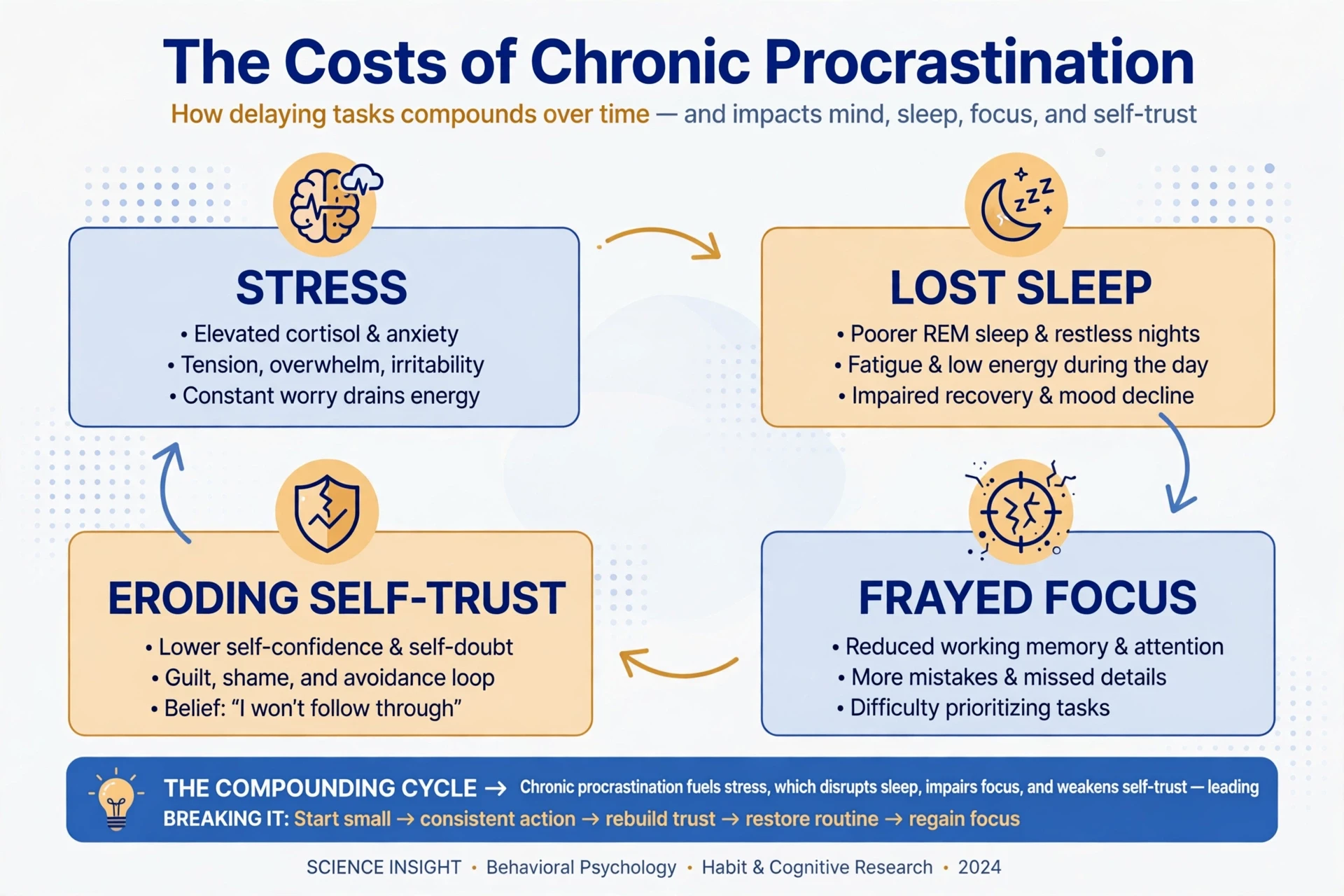
8.1 Stress that compounds
Why do we procrastinate if it makes us feel worse? Because the worse feeling arrives later, and later is easy to ignore. That delay in the cost is central to why do we procrastinate even when we can predict the regret. Sirois's research on procrastination and stress shows the pattern clearly: procrastinators report higher stress, and stress makes the next task harder to start. The American Psychological Association's stress pages describe the same compounding effect — chronic stress affects mood, sleep, immunity, and concentration. (APA)
8.2 Sleep, focus, and health
Late-night rushes steal sleep, and sleep loss degrades the very prefrontal control you need to start the next task. Focus frays, memory consolidation suffers — the process explained in Sciory's guide to how the human brain forms memories — and the next day's work feels harder than it should. That link is why procrastination so often travels with brain fog — the heavy, unfocused feeling that makes starting anything feel like wading through mud — and with the sleep problems described in Sciory's guide to the science of sleep and dreams and in its article on chronic insomnia. Chronic delay has also been linked to delayed medical appointments and poorer health habits, which is a steeper price than a late essay.
8.3 Performance and self-trust
The performance cost is real but often smaller than people fear. Many procrastinators do produce acceptable work under pressure. The deeper cost is self-trust. Each broken promise to yourself — "I will start tomorrow" — teaches you that your plans are unreliable. Over months, that erodes confidence more than any single late submission. I have met brilliant researchers who no longer believed their own schedules. Rebuilding that trust, one small kept promise at a time, mattered more than any productivity system.
8.4 The shame spiral
Shame is the fuel that keeps the loop running, which is another reason why do we procrastinate repeatedly: each round of self-attack makes the next start harder. After delaying, people often attack themselves: lazy, hopeless, undisciplined. Shame feels like accountability, but it functions as avoidance. A person drowning in self-criticism has less energy to start, not more. Research on self-compassion — treating yourself with the kindness you would offer a friend — finds the opposite pattern: people who forgive themselves for procrastinating are less likely to delay the next task, not more. Self-forgiveness is not letting yourself off the hook. It is putting the hook down so your hands are free to work.
9. Misconceptions About Procrastination
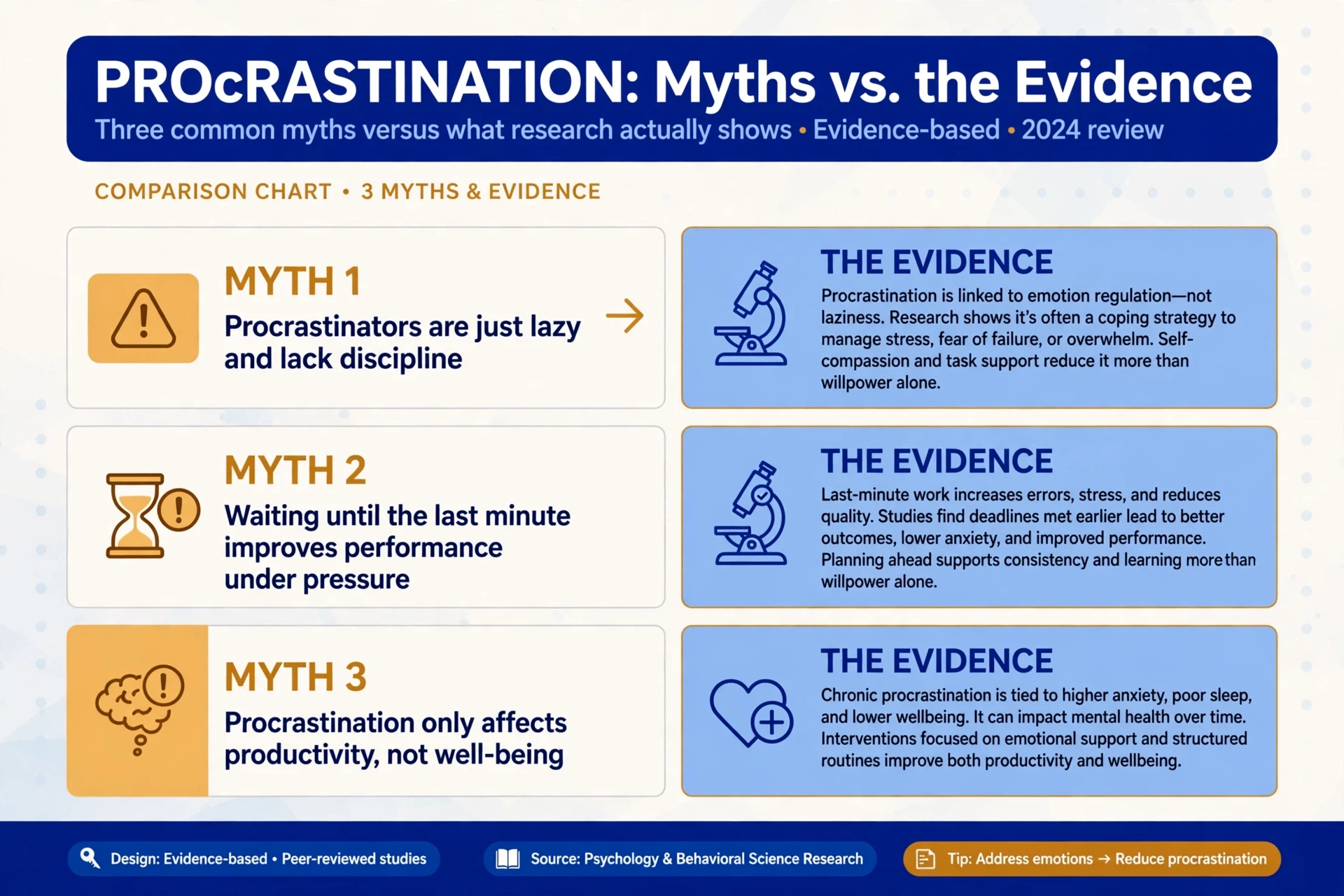
9.1 "Procrastinators are lazy"
This is the most common misconception, and the science contradicts it directly. It survives because it offers a simple answer to why do we procrastinate, and simple answers are comforting even when they are wrong. Lazy people do not care about the outcome. Procrastinators care — often too much — and avoid the task because the feelings around it are intense. The APA's reporting on procrastination research makes the point repeatedly: the problem is emotion regulation, not effort. (APA)
9.2 "You just need better time management"
Time management helps at the margins, but it misses the mechanism behind why do we procrastinate. A person who knows how to schedule a task and still cannot start it does not have a scheduling problem. Studies of chronic procrastinators find they often know exactly how long a task will take — they simply cannot bear to begin it. Planners treat the symptom. Emotion skills treat the cause.
9.3 "Pressure makes the work better"
Some people insist they do their best work at the last minute. The evidence is kinder to a narrower claim: pressure can force a start, and a start can produce decent work. But controlled comparisons generally find that last-minute work is more error-prone and less creative, and the stress cost is high. What feels like "working better under pressure" is often just relief that the waiting is finally over.
9.4 "Procrastination is the same as being relaxed"
True relaxation is chosen and restorative. You finish your work, close the laptop, and enjoy the evening. Procrastination is the opposite: the task hangs over the break, the break is not restful, and you return to work more tired than before. If your "break" is haunted by the thing you are avoiding, it was never a break.
9.5 "Some people are just born procrastinators"
Personality matters — impulsiveness and low conscientiousness raise the risk — but procrastination is a behaviour, not a destiny. That is hopeful news for anyone asking why do we procrastinate and whether the pattern can change: context shapes it, so changing context can change it. It varies by task, by mood, by sleep, and by situation. The same person can be decisive about one project and paralysed by another. That variability is good news: if context changes behaviour, changing the context can change the behaviour.
10. What Actually Works: Evidence-Based Ways to Start
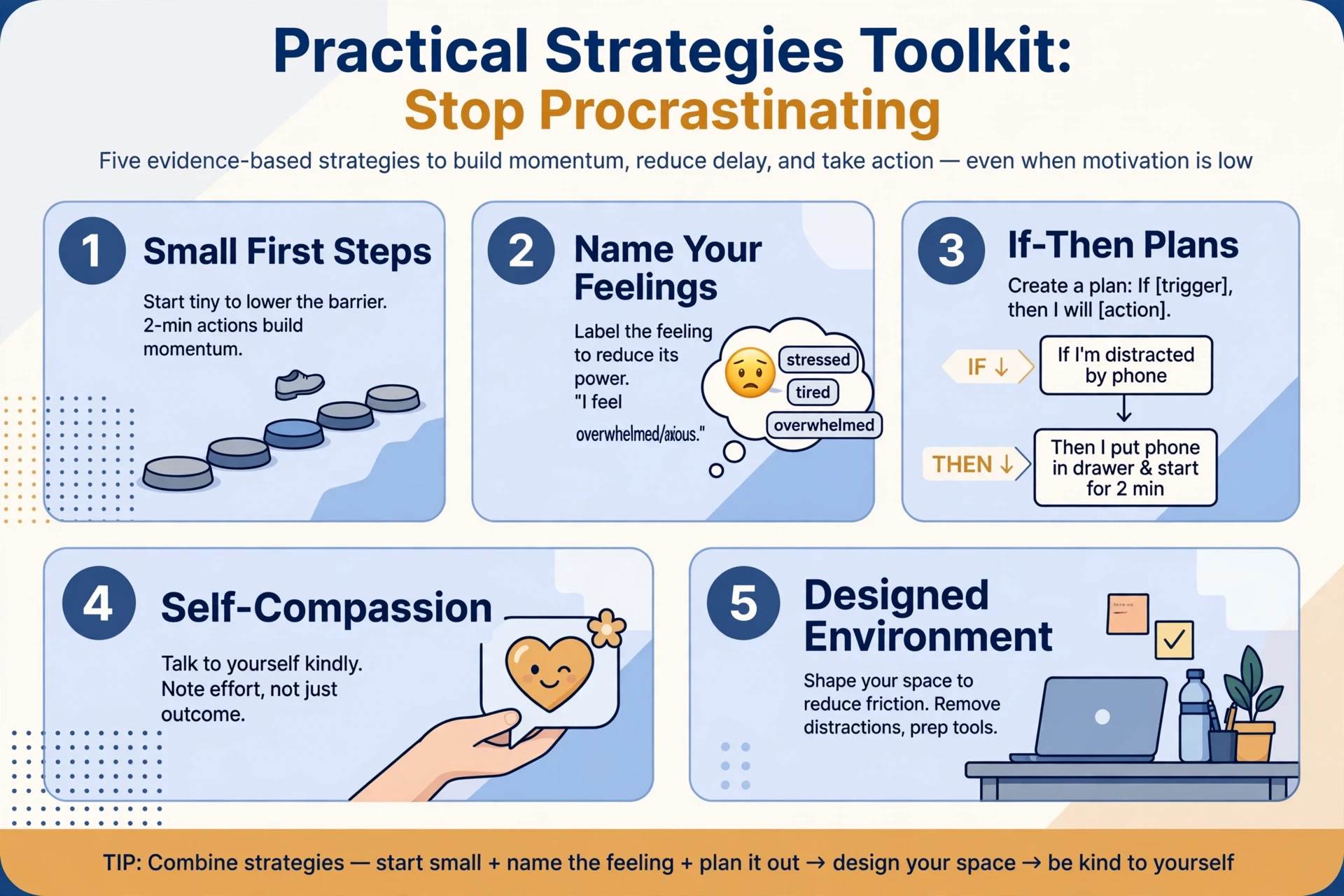
10.1 Start with the feeling, not the task
The single most useful question for anyone asking why do we procrastinate is not "how do I manage my time?" It is "what am I feeling about this task, and what would make that feeling smaller?" Name the emotion out loud — boredom, dread, confusion — and the task usually shrinks. Psychologists call this affect labelling, and brain studies suggest naming an emotion reduces its grip.
10.2 Make the first step absurdly small
The brain resists starting a large, vague task. It barely notices a tiny one. "Write the essay" is a wall. "Open the document and write one bad sentence" is a door. I use a version of this in my own work: I promise myself I will work for five minutes and then stop if I want to. It works because it sidesteps the very feeling that explains why do we procrastinate — the dread of beginning. I almost never stop after five minutes, because starting was the hard part. The technique is sometimes called the five-minute rule, and it works because it lowers the emotional cost of beginning to almost zero.
10.3 Temptation bundling and implementation intentions
Two strategies have solid support. Temptation bundling pairs an aversive task with something pleasant: the difficult report gets written in your favourite café, with your favourite drink, listening to music you love. Implementation intentions are specific if-then plans: "If it is 9 a.m. on Tuesday, then I will open the report and write the first paragraph at my desk." Vague plans fail. Specific plans, tied to a time and place, roughly double follow-through in experimental studies.
10.4 Self-compassion, not self-attack
When you have already delayed, the research-backed move is counterintuitive: forgive yourself, briefly and honestly. Acknowledge the delay, name what drove it, and choose the next small step. Self-compassion reduces the shame that fuels the next round of avoidance, and it keeps the focus on the task instead of on your character.
10.5 Design the environment
Willpower is a weak tool; environment is a strong one. Put the phone in another room. Block the distracting sites during work hours. Lay out the materials the night before so the first step is already taken. Each of these moves reduces the effort the prefrontal cortex must spend fighting the limbic system, which leaves more energy for the work itself.
10.6 When to seek more help
Occasional procrastination is normal. If delay is chronic, severe, and tangled up with persistent anxiety, low mood, or an inability to start almost anything, it is worth talking to a doctor or a mental-health professional — especially if you keep asking why do we procrastinate and the answer never seems to be within your control. Procrastination can be a feature of depression, anxiety disorders, and attention-deficit/hyperactivity disorder — conditions that respond to treatment. Seeking help in that case is not a failure of discipline. It is the same good sense as seeing a doctor for a persistent cough.
11. Latest Research: Where the Science Is Heading
11.1 From traits to moments
Newer research has shifted from asking who procrastinates to asking when — a finer-grained way of asking why do we procrastinate at some moments and not others. — tracking people through their days with phone prompts and finding that delay spikes at specific moments: when a task feels aversive, when energy is low, and when a tempting alternative is close at hand. That moment-by-moment view supports the emotion story and opens a practical door: interventions aimed at the moment of choice, not at personality, may help most.
11.2 The brain's control networks
Brain-imaging work is beginning to map the circuits involved. Studies link procrastination to weaker connectivity between the brain's control networks and its emotional centres — the planner and the alarm system are not talking to each other well. The findings are early and correlational, so they should be read as clues, not verdicts. Still, they fit the behavioural evidence: this is a coordination problem between systems, not a single broken part.
11.3 Self-compassion interventions
Intervention studies are testing structured self-compassion training for chronic procrastinators, with promising early results: participants report less delay and less stress, and the gains hold after the programme ends. The mechanism is the one this article has described all along — reduce the shame, and you reduce the need to escape the feeling.
11.4 What researchers still disagree about
Honest science includes its open questions, and the question of why do we procrastinate still has edges researchers are mapping. Researchers still debate how much of procrastination is a stable trait versus a situation-driven state, how far the findings from student samples generalise to workplaces, and whether "active procrastination" — deliberately delaying to work under pressure — is a real, distinct style or simply a story people tell themselves after the fact. The emotion-regulation core is well supported. The edges are still being mapped.
12. A Kinder Way to Begin
Why do we procrastinate? Because our brains are built to escape discomfort now and pay later, because our future selves feel like strangers, and because motivation fades with distance. None of that makes you lazy. It makes you human, operating with a brain that evolved for a world without deadlines, inboxes, and theses.
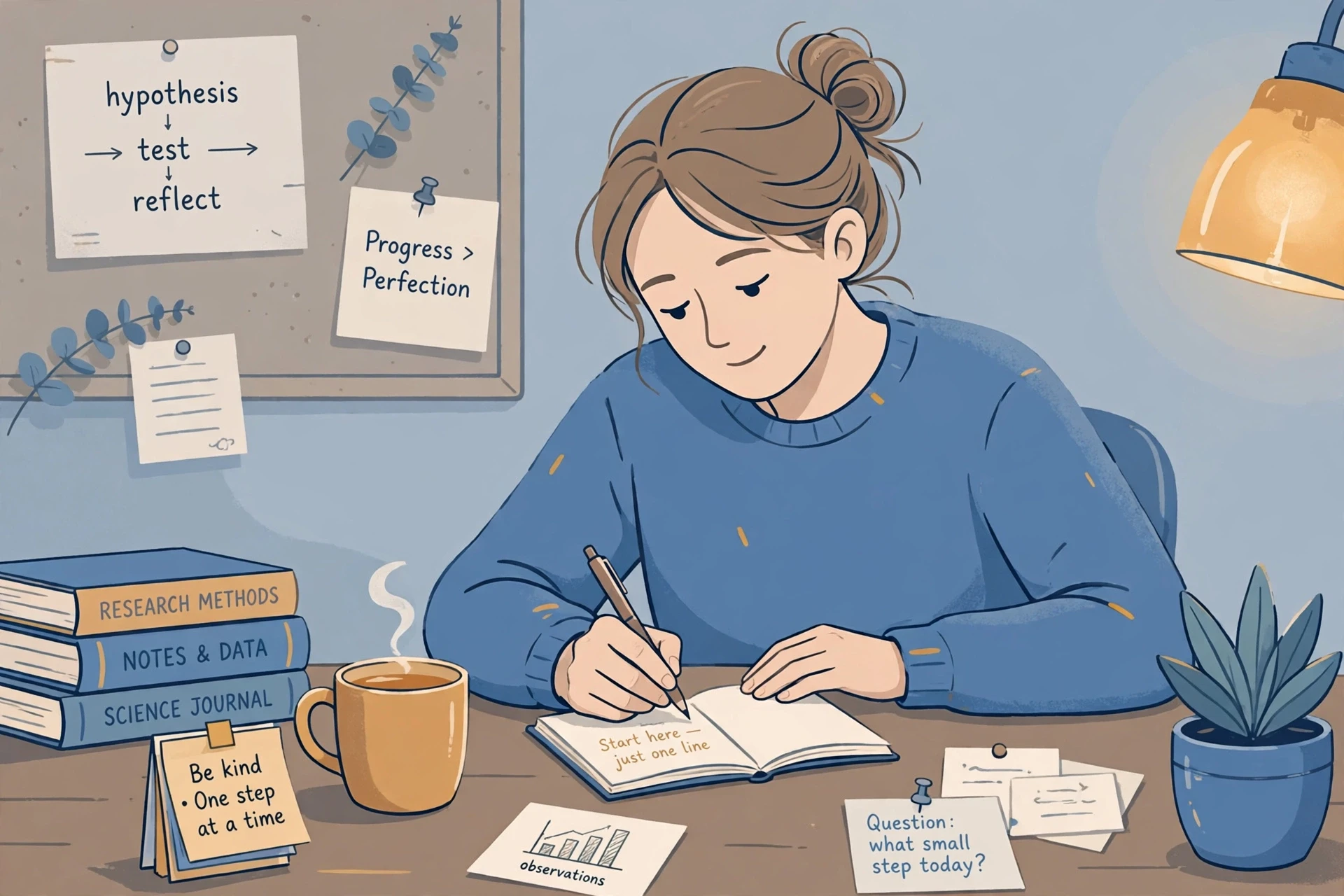
The way out is not a sterner lecture to yourself. It is a smaller first step, a named feeling, a specific plan, and a little forgiveness when you stumble. I still procrastinate sometimes — the grant report eventually got written, at 3 a.m., and it was not my finest work. What changed was not my discipline. It was my diagnosis. Once I stopped calling myself lazy and started asking what I was feeling, the task stopped being a wall and became a door I could open for five minutes. Most days, five minutes is enough.
Start there. Open the document. Write one bad sentence. Then see what happens next.
Frequently Asked Questions
Why do we procrastinate even when we know delay will hurt?
We procrastinate because delay brings immediate relief from an unpleasant feeling — anxiety, boredom, or dread — while the cost arrives later. The brain weighs the certain relief now more heavily than the uncertain cost later, so avoidance wins in the moment even when we know it will hurt.
Why do we procrastinate on important tasks more than easy ones?
Important tasks carry higher emotional stakes: fear of failure, perfectionism, and self-doubt all grow with importance. Easy, low-stakes tasks trigger little emotion, so there is nothing to escape from. The more a task matters to your identity, the more tempting it is to avoid it.
Is procrastination a sign of laziness?
No. Research consistently finds procrastination is an emotion-regulation problem, not laziness. Procrastinators often work hard on other things and care deeply about the delayed task. Laziness implies indifference; procrastination usually involves caring too much and avoiding the feelings that caring brings.
Why do we procrastinate at night more than in the morning?
Self-control draws on the prefrontal cortex, which tires through the day, while stress and fatigue accumulate. By evening, the planner is depleted and the limbic system — which wants comfort now — has the louder voice. Sleep restores planning capacity, which is one reason mornings often feel easier.
Can procrastination be a sign of anxiety or depression?
It can be. Chronic, severe procrastination is associated with anxiety, depression, and attention difficulties, and it can also be a feature of those conditions. Occasional delay is normal, but if procrastination is persistent and paired with low mood or constant worry, talking to a health professional is a sensible step.
What is the fastest evidence-based way to stop procrastinating?
Shrink the first step until it feels trivial — open the document and write one sentence, or work for five minutes — and name the feeling driving the delay. Pairing that tiny start with a specific if-then plan ("at 9 a.m. I will open the report at my desk") is the combination with the strongest support in the research.
Sources
American Psychological Association, Speaking of Psychology: "Why we procrastinate and what to do about it, with Fuschia Sirois, PhD" — https://www.apa.org/news/podcasts/speaking-of-psychology/procrastinate
American Psychological Association, Monitor on Psychology: "Procrastination" — https://www.apa.org/monitor/2010/04/procrastination
American Psychological Association: "Stress" — https://www.apa.org/topics/stress
National Institute of Mental Health: "Anxiety Disorders" — https://www.nimh.nih.gov/health/topics/anxiety-disorders
Sirois, F. M., & Pychyl, T. A. (2013). Procrastination and the priority of short-term mood regulation: Consequences for future self. Social and Personality Psychology Compass, 7(2), 115–127. https://doi.org/10.1111/spc3.12011
Steel, P. (2007). The nature of procrastination: A meta-analytic and theoretical review of quintessential self-regulatory failure. Psychological Bulletin, 133(1), 65–94. https://doi.org/10.1037/0033-2909.133.1.65
Social Media Addiction and Procrastination in University Students: Exploring the Role of Emotional Regulation (PMC) — https://pmc.ncbi.nlm.nih.gov/articles/PMC12072059/
What Research Has Been Conducted on Procrastination? Evidence From a Systematical Bibliometric Analysis (PMC) — https://pmc.ncbi.nlm.nih.gov/articles/PMC8847795/
Durham University: "Need help tackling your procrastination? This could be the book for you!" — https://www.dur.ac.uk/research/current/research-news/need-help-tackling-your-procrastination-this-could-be-the-book-for-you/