The kettle clicks off, and I pour hot water into a mug that is itself made of plastic, through a filter basket made of plastic, into a kitchen where the cutting board, the storage tubs, the bin liner and the handle of the knife are all plastic too. Before I have finished breakfast I will have touched a dozen different polymers without thinking about a single one of them. That is the strange thing about polymers: they are the most common materials in modern life, and also the most invisible. We notice them only when they fail — a cracked phone case, a stretched-out elastic band, a shopping bag that splits on the walk home.
Polymers are long molecules built by joining many small repeating units, called monomers, into chains. The word comes from the Greek for "many parts", and that is exactly what a polymer is: many parts, linked end to end, again and again, until a single molecule can contain thousands or even hundreds of thousands of atoms. Plastics are the best-known family of polymers, but they are only one branch of a much larger family tree. The cotton in your shirt, the silk in a scarf, the cellulose in a sheet of paper, the DNA in every cell of your body — all of these are polymers too. Some were made by nature over billions of years. Others were invented by chemists in the last hundred years, and they changed the world faster than almost any other material in history.
This article explains what polymers are, how they are made, why they behave the way they do, and what happens to them when we throw them away. It covers the chemistry of polymerization, the difference between thermoplastics and thermosets, the seven common plastics you meet every day, the natural polymers that life itself is built from, and the waste problem that now shadows the whole industry. By the end you should be able to pick up almost any plastic object, read the small triangle stamped on its base, and know what it is made of, how it was shaped, and whether it can be recycled.
1. What Are Polymers?
1.1 Many small parts, one long molecule
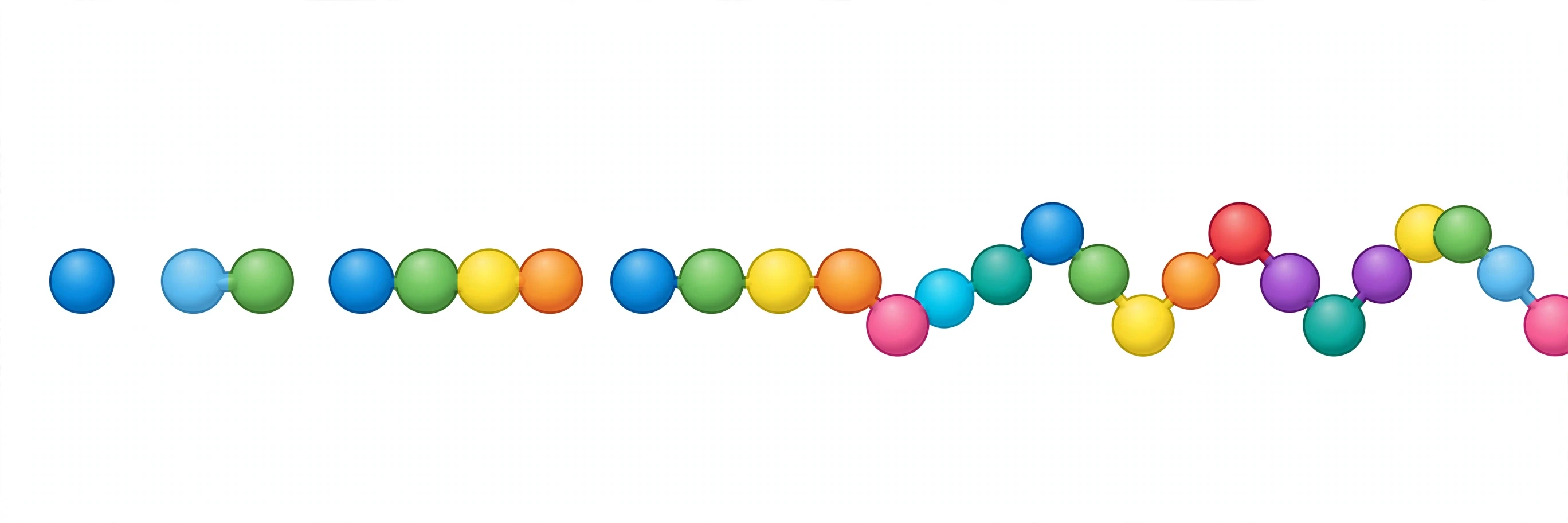
A monomer is a small molecule with a trick up its sleeve: it can bond to other copies of itself, or to other monomers, forming a long chain. Ethylene is a simple example. It is a gas made of two carbon atoms joined by a double bond, each carbon carrying two hydrogen atoms. Under the right conditions — heat, pressure, and a catalyst to start the reaction — the double bond opens up, and one ethylene molecule links to the next, and that one to the next. The result is polyethylene, a chain of thousands of ethylene units, each one now joined to its neighbours by single bonds. The chain is the polymer. The ethylene molecules are the monomers.
That one idea — small units joined into long chains — explains almost everything about polymers. A chain of a hundred units behaves differently from a chain of ten thousand units, even when the units are identical. Short chains slide past each other easily, so the material is soft, runny, or waxy. Long chains tangle together like cooked spaghetti, and the tangles resist being pulled apart, so the material is strong and tough. Chemists call the number of repeating units in a chain the degree of polymerization, and it is one of the most important numbers in polymer science. A plastic bag and a bulletproof vest can both be made from polyethylene; the difference is largely in how long the chains are and how they are arranged.
1.2 Chains, branches, and nets
Not all polymer chains are straight lines. Some are branched, with side chains sprouting off the main chain like twigs off a branch. Branches stop chains from packing neatly together, so branched polymers tend to be softer and more flexible. Low-density polyethylene, the soft plastic of squeeze bottles and cling film, is heavily branched. Its cousin, high-density polyethylene, has almost no branches, so its chains pack tightly and the material is rigid enough for milk bottles and water pipes.
Other polymers are cross-linked: their chains are joined to each other by chemical bonds, forming a three-dimensional net. A lightly cross-linked polymer is an elastomer — it stretches and springs back, like the rubber in a balloon or a car tyre. A heavily cross-linked polymer is hard and rigid and cannot be melted at all, like the Bakelite of old radio casings or the epoxy that holds a surfboard together. Once a cross-linked net has formed, heating it will not make it flow; the bonds between chains hold it in shape until the heat is high enough to break the material apart. This distinction between chains that can slide and nets that cannot is the key to understanding thermoplastics and thermosets, which we will meet properly in section 5.
1.3 Why chains change everything
A single monomer is a small, ordinary molecule. Join a thousand of them together and something new appears: properties that no single monomer has. The chain is too long to evaporate, so polymers are solids or thick liquids rather than gases. The chain is too tangled to dissolve easily, so most polymers resist water and many solvents. And because the bonds along the chain are strong covalent bonds, a polymer chain is hard to break by pulling on it. That is why a plastic bag can carry a heavy load of groceries on a film thinner than a sheet of paper.
I first saw this transformation for myself in a school chemistry demonstration that I still remember clearly. The teacher poured two colourless liquids into a beaker, stirred, and then slowly lifted a glass rod — and a thin white thread came up out of the liquid, and kept coming, metre after metre, as if the beaker were full of invisible string. It was nylon, forming at the boundary between the two liquids. The two liquids on their own were unremarkable. Joined together, they made something you could wind onto a spool. That is the whole story of polymers in one beaker: small parts, linked up, become a material.
2. A Short History of Polymers
2.1 Nature got there first
Long before any chemist made a polymer, nature was building with them. Cellulose is the polymer that gives wood its strength and cotton its softness: long chains of glucose units, bundled into fibres, hydrogen-bonded into structures strong enough to hold up a tree. Proteins are polymers of amino acids, folded into shapes that can carry oxygen, digest food, or contract a muscle. DNA is a polymer of nucleotides, carrying the instructions for building a whole organism in a molecule a few atoms wide. Starch, the polymer plants use to store energy, is a chain of the same glucose units as cellulose, joined in a different way — and that small difference in linking is the difference between a material you can eat and a material you cannot digest at all.
For most of human history, the only polymers people used were natural ones: wood, wool, silk, cotton, leather, and natural rubber from tree sap. These materials were worked, woven, and carved, but they were not made from scratch. Nobody could design a new polymer; they could only use what nature provided. That changed in the nineteenth century, when chemists began to modify natural polymers and, a little later, to build entirely new ones.
2.2 The first plastics
The first semi-synthetic plastic came from a practical problem: billiard balls. In the 1860s, ivory was becoming scarce and expensive, and a prize was offered for a substitute. Alexander Parkes, a British inventor, had been experimenting with cellulose treated with nitric acid — a material called celluloid — and it could be moulded into shape when warm and would hold that shape when cool. Celluloid went on to make photographic film and the first flexible movie stock. It had one serious flaw: it was highly flammable, and early film stock could catch fire in the projector.
The first fully synthetic plastic, made entirely from chemicals rather than from a modified natural polymer, was Bakelite. In 1907, the Belgian-American chemist Leo Baekeland mixed phenol and formaldehyde under heat and pressure and produced a hard, dark, heat-resistant resin that could be moulded into almost any shape. Bakelite did not melt, did not burn easily, and was an excellent electrical insulator, so it became the material of radio casings, telephone handsets, and electrical switches. It was the first plastic that was designed, not found — and it opened the door to everything that followed.
2.3 The polymer century
The real explosion came in the 1930s and after the Second World War. Nylon, the first fully synthetic fibre, was developed by Wallace Carothers and his team at DuPont, and it went from laboratory curiosity to parachutes, stockings, and ropes within a few years. Polyethylene was discovered almost by accident in Britain in 1933, when researchers compressing ethylene gas found a waxy white solid coating the inside of their reaction vessel. Polystyrene, PVC, and polypropylene followed, each one cheaper and more versatile than the last. By the middle of the twentieth century, chemists could design a polymer for almost any job: hard or soft, clear or opaque, rigid or stretchy, heat-proof or flexible at freezing temperatures.
The scale of that change is hard to overstate. Plastics replaced wood, metal, glass, and leather in thousands of products, not because they were better in every way, but because they were cheap, light, and could be moulded into shapes that no other material could take. A plastic bottle weighs a fraction of a glass one, so it costs far less to transport. A plastic pipe never rusts. Each of these small advantages added up, until polymers became the default material of modern life — and, as we will see in section 10, until the waste they leave behind became one of the biggest environmental problems of our time.
Figure 1: Monomers linking into a polymer chain. Each small monomer unit joins to the next through a covalent bond, building a long chain. The chain may contain hundreds or thousands of units, and its length, branches, and links to other chains decide how the finished material behaves.
3. How Polymers Are Made: Polymerization
3.1 Addition polymerization: opening the double bond
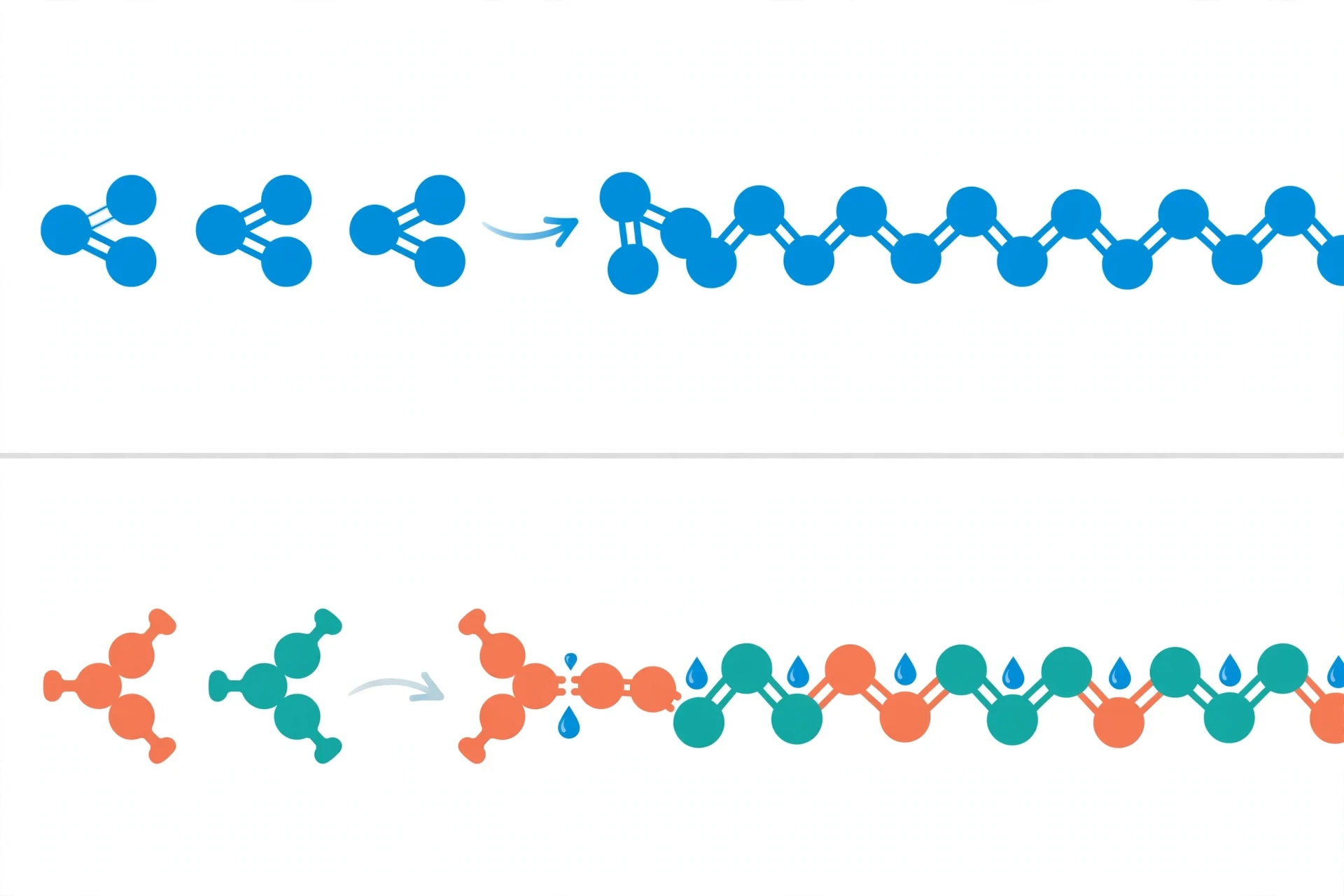
The simplest way to build a polymer is addition polymerization, also called chain-growth polymerization. It starts with a monomer that contains a carbon-carbon double bond, such as ethylene or styrene. A starter molecule, called an initiator, breaks the double bond and creates a reactive site — usually a free radical, a molecule with an unpaired electron that is hungry for a partner. That reactive site grabs another monomer, opens its double bond, and passes the reactive site along to the end of the growing chain. The chain grows one monomer at a time, quickly, until two growing chains meet and cancel each other out, or until the reactive site is deliberately stopped.
Polyethylene, polypropylene, polystyrene, and PVC are all made this way. Nothing is lost in the reaction: every atom of the monomers ends up in the polymer. That is why it is called addition polymerization — the monomers simply add together. The process is fast and can be run continuously in large reactors, which is one reason these plastics are so cheap. The trade-off is control: the chains grow at different rates, so a batch of polyethylene contains chains of many different lengths. Chemists describe this spread with a measure called the molecular weight distribution, and narrowing it is one of the jobs of the catalyst.
3.2 Condensation polymerization: joining and shedding
The second route is condensation polymerization, also called step-growth polymerization. Here two different monomers react together, and each time they join, a small molecule — usually water — is given off as a by-product. Nylon is the classic example. It is made from a diamine, a molecule with an amino group at each end, and a dicarboxylic acid, a molecule with an acid group at each end. The amino group of one monomer reacts with the acid group of the other, forming an amide bond and releasing a water molecule. The new molecule still has a reactive group at each end, so it can react again, and again, building a chain step by step.
Condensation polymerization is slower than addition polymerization, because every link has to form one at a time and each link releases a molecule that must be removed. But it makes polymers that addition polymerization cannot: polyesters such as PET, the plastic of drinks bottles; polyamides such as nylon; and polyurethanes, the foams in mattresses and car seats. It is also the way nature builds its polymers. Proteins are condensation polymers of amino acids, each link releasing a water molecule, and the same chemistry that makes nylon in a factory makes the proteins in your muscles.
3.3 Catalysts: the quiet directors
Most polymerization reactions need help. A catalyst is a substance that speeds up a reaction without being used up in it, and in polymer chemistry the catalyst often decides the structure of the final product. The Ziegler-Natta catalysts, developed in the 1950s, let chemists control how the monomers line up along the chain — whether the side groups all point the same way or alternate. That matters because a chain with all its side groups on the same side packs neatly into crystals and makes a strong, rigid plastic, while a chain with randomly arranged side groups stays messy and soft. The same monomer, polymerized with a different catalyst, can give a different material entirely.
I learned how much a catalyst matters during a university practical that went wrong in an instructive way. Our group forgot to add the initiator while making polystyrene, and nothing happened for an hour — the styrene sat there, clear and still, while neighbouring benches produced cloudy white solid. Then someone added a drop of initiator to our flask, and within minutes the liquid turned thick and syrupy as chains grew through it. The monomer had been ready all along; it just needed a push.
3.4 From chain structure to material behaviour
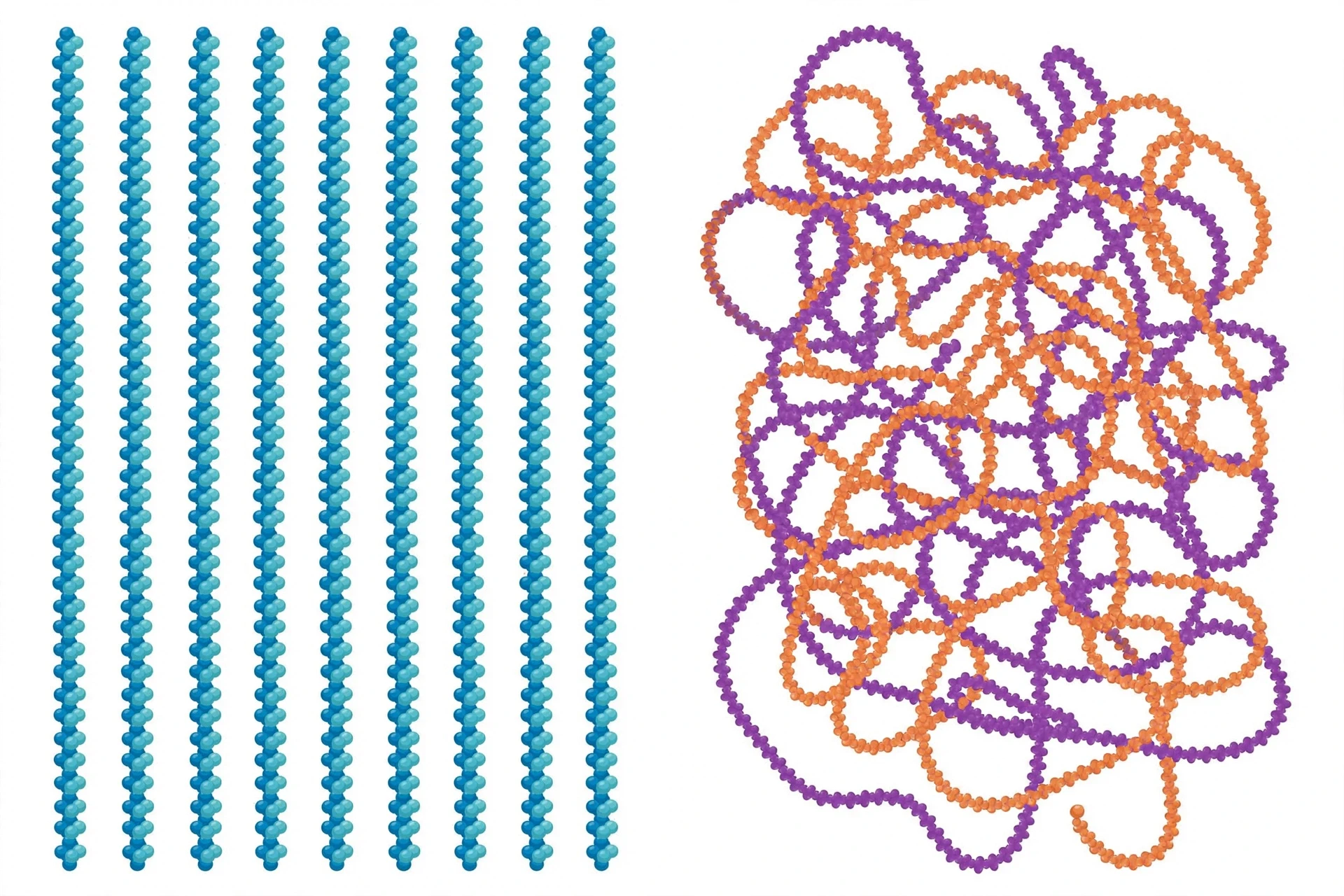
Once the chains exist, their arrangement decides the properties. Long, straight chains can line up side by side and form ordered regions called crystallites, where the chains are packed in neat rows. A polymer with many crystallites is strong and stiff but can be brittle. A polymer with few crystallites is amorphous — its chains are tangled at random, like a bowl of noodles — and it tends to be softer, clearer, and more flexible. Most real plastics sit somewhere between the two extremes, with crystalline regions scattered through an amorphous background, like ice crystals in slush.
Temperature matters too. Every polymer has a glass transition temperature, below which it is hard and glassy and above which it becomes soft and rubbery. A rubber band at room temperature is above its glass transition, so it stretches. The same rubber dipped in liquid nitrogen drops below it and shatters like glass when struck. This is not a chemical change — the chains are the same — it is a change in how much the chains can move. Understanding that one idea explains why a plastic dashboard cracks in a cold winter and why a plastic bottle softens in a hot car.
Figure 2: The two main routes to a polymer. In addition polymerization, monomers with double bonds open up and link together, and every atom ends up in the chain. In condensation polymerization, two different monomers join and release a small molecule, usually water, at each link.
4. How Plastics Are Made: From Oil to Object
4.1 Starting from crude oil and natural gas
Most synthetic plastics begin life as crude oil or natural gas. In a refinery, crude oil is heated and distilled into fractions, and one of those fractions — naphtha — is cracked at high temperature to break large hydrocarbon molecules into small ones, including ethylene and propylene. These small molecules are the feedstock for the plastics industry: the monomers from which the big chains are built. A smaller but growing share of plastics starts from other sources, including natural gas and, increasingly, plant-based feedstocks such as corn starch and sugar cane, but the oil and gas route still dominates.
This link to fossil fuels is one of the reasons plastics are tied to climate change. Making a plastic uses energy at every step, and most of that energy still comes from burning fossil fuels. The plastic itself also stores carbon: the carbon atoms in a polyethylene bottle came from oil, and if the bottle is burned, that carbon returns to the atmosphere as carbon dioxide. The connection between plastics and the greenhouse gases that warm the planet is direct, and it is one of the strongest arguments for using less plastic, reusing what we have, and recycling what we cannot reuse. For the science of the warming itself, see the Sciory article on the Greenhouse Effect, and for the wider picture, Climate Change.
4.2 Pellets: the raw material of the plastics world
Polymerization produces a polymer, but not yet a product. The polymer leaves the reactor as a powder or a sticky mass, and it is then mixed with additives — colourants, stabilisers that protect it from sunlight and heat, plasticisers that make it flexible, and fillers that make it cheaper or stronger — and melted and cut into small pellets, usually a few millimetres across. These pellets, sometimes called nurdles, are the raw material that factories buy by the tonne. They look unremarkable, like tiny lentils, but they are the starting point for almost every plastic object you own.
The pellet stage is also where a great deal of plastic escapes into the environment. Pellets spill from trucks and loading docks, and because they are small and light they are carried by wind and water into rivers and seas. They are one of the largest sources of primary microplastics — particles manufactured small, rather than broken down from larger items.
4.3 Shaping: extrusion, moulding, and blowing
Turning pellets into a product means melting them and forcing the molten plastic into shape. The most common methods are extrusion, injection moulding, and blow moulding, and each suits a different kind of object.
In extrusion, pellets are fed into a heated barrel, melted by a rotating screw, and pushed through a shaped opening called a die. The plastic comes out as a continuous length — a pipe, a sheet, a film, or a fibre — and is cooled as it leaves the die. Plastic bags, water pipes, and window frames are all extruded. In injection moulding, molten plastic is injected at high pressure into a closed mould, where it cools and hardens into the shape of the cavity. This is how bottle caps, toy bricks, phone cases, and car dashboards are made: the mould can be complex, the cycle takes seconds, and millions of identical parts can be produced from a single mould. In blow moulding, a tube of molten plastic is inflated inside a mould like a balloon, so the plastic presses against the mould walls and takes their shape. This is how hollow objects such as drinks bottles and fuel tanks are made.
Each method leaves its mark. An extruded pipe has a uniform cross-section. An injection-moulded part often has a faint seam where the mould halves met. A blow-moulded bottle has a slightly thicker base where the plastic stretched least. Once you know what to look for, you can read the manufacturing history of a plastic object from its shape.
4.4 Additives: the hidden ingredients
Pure polymer is rarely the finished product. Additives are mixed in at the pellet stage to tune the properties, and they are what make the same base polymer behave differently in different products. Plasticisers are small molecules that sit between polymer chains and let them slide past each other, making a stiff polymer flexible — they are what turn rigid PVC into the soft vinyl of a shower curtain. UV stabilisers absorb sunlight and stop it breaking the chains, which is why garden furniture does not crumble after a summer outdoors. Flame retardants slow the spread of fire in electronics and furniture foam. Colourants and fillers do the obvious jobs of colour and bulk.
Additives are also the source of some of the most argued-over health questions about plastics. Some plasticisers can leach out of soft plastics over time, and some flame retardants can migrate into dust, and researchers disagree about the size of the risk at the low levels people actually encounter. What is not disputed is that a plastic is not just its polymer — it is a mixture, and the mixture matters.
5. Thermoplastics and Thermosets: The Great Divide
5.1 What are thermoplastics and thermosets?
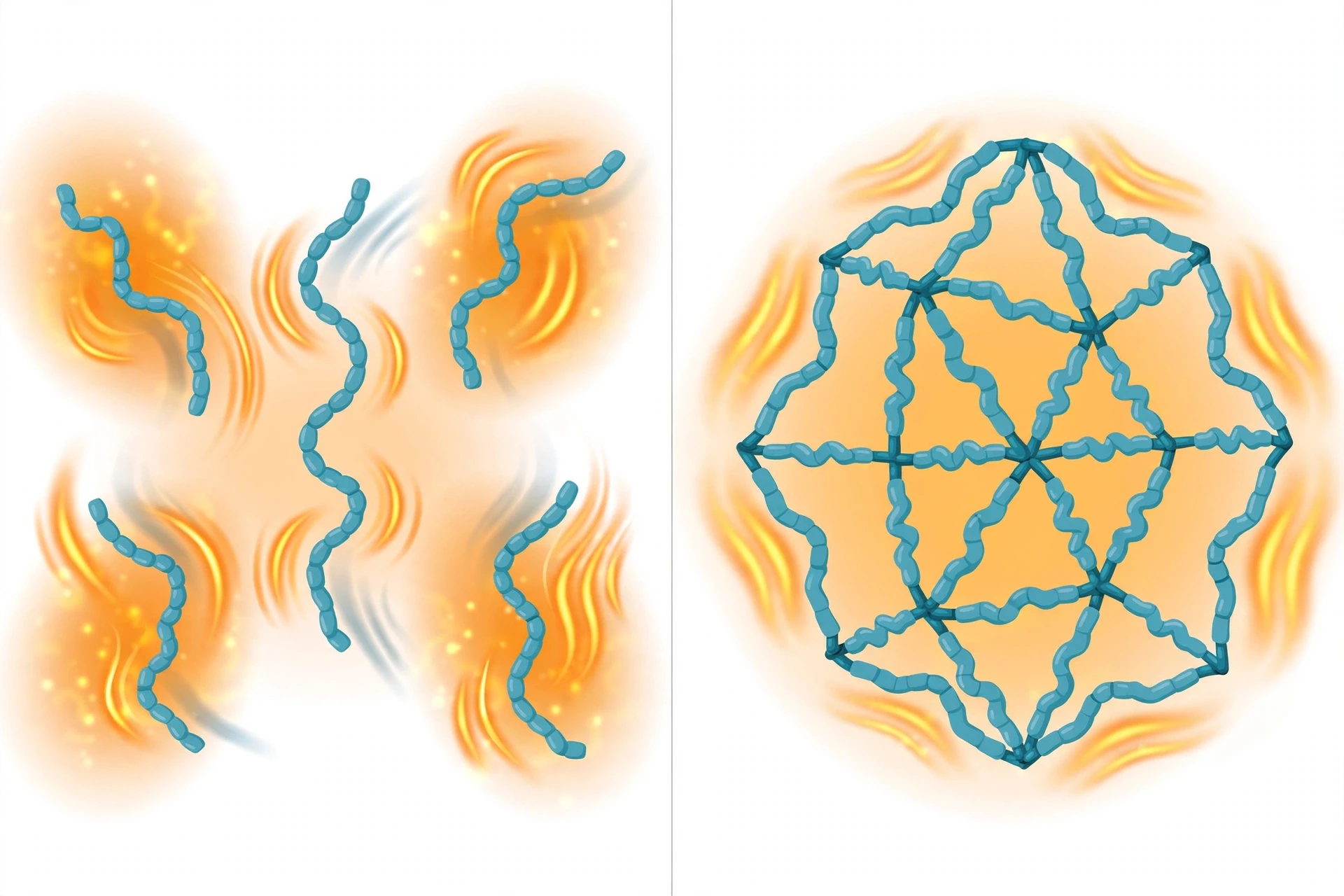
If you remember one distinction from this article, make it this one. Thermoplastics are polymers whose chains are not cross-linked. Heat them and the chains slide past each other, so the plastic softens and can be reshaped. Cool it and it hardens again, and the cycle can be repeated many times. Polyethylene, polypropylene, polystyrene, PVC, and PET are all thermoplastics. Thermosets are polymers whose chains are cross-linked into a three-dimensional net. Heat them and the net holds its shape; the plastic does not melt, and it cannot be reshaped. Heat it too much and it chars or burns rather than flowing. Epoxy resins, Bakelite, and the cured resin in a fibreglass boat hull are thermosets.
The difference comes down to the bonds between chains. In a thermoplastic, chains are held together only by weak attractions — van der Waals forces and, in some polymers, hydrogen bonds. Heat gives the chains enough energy to overcome those weak attractions and slide. In a thermoset, chains are joined by strong covalent bonds, and no amount of ordinary heating will break those bonds without breaking the material itself. That is why a thermoplastic bottle can be melted and remoulded, while a thermoset epoxy floor cannot.
5.2 Why the divide matters
The divide decides almost everything about how a plastic is used and what happens to it afterwards. Thermoplastics are the plastics of packaging, bottles, bags, and disposable goods, because they are easy to shape quickly and cheaply, and because they can, in principle, be melted and recycled. Thermosets are the plastics of things that must hold their shape under heat and stress: electrical fittings, engine parts, adhesives, and the composite materials of aircraft and wind turbine blades. A wind turbine blade is a thermoset composite — glass or carbon fibres set in a cured resin — and it must survive decades of flexing in all weathers without softening. No thermoplastic could do that job.
The divide also decides the recycling problem. Melting is the easiest way to recycle a plastic, and it only works for thermoplastics. A thermoset cannot be melted, so it must be ground up and used as filler, burned for energy, or buried. That is why wind turbine blades reaching the end of their working lives are such a headache for recyclers: they are superb materials that were designed never to come apart.
5.3 Elastomers: the stretchy middle ground
Elastomers sit in between. They are lightly cross-linked, so their chains can stretch out under tension and then spring back when the tension is released, because the cross-links pull them back into place. Natural rubber is an elastomer, and so is the synthetic rubber in car tyres and the silicone in a baking mould. The cross-linking process for rubber is called vulcanisation, and it was discovered by Charles Goodyear in the nineteenth century, when he found that heating natural rubber with sulfur made it far tougher and less sticky. Too few cross-links and the rubber flows like chewing gum; too many and it becomes hard and brittle. The right amount gives a material that can be stretched to several times its length and still return to its original shape, millions of times over.
Property
Thermoplastics
Thermosets
Elastomers
Chains
Separate, not cross-linked
Cross-linked into a 3D net
Lightly cross-linked
Effect of heat
Softens and melts; can be reshaped
Does not melt; chars if overheated
Softens slightly; keeps its shape
Can it be remoulded?
Yes, repeatedly
No
No, once cured
Typical examples
Polyethylene, PET, PVC, polystyrene
Epoxy, Bakelite, melamine
Natural rubber, silicone, neoprene
Typical uses
Bottles, bags, pipes, packaging
Electrical fittings, adhesives, composites
Tyres, seals, gloves, bands
Recycling
Can be melted and reprocessed
Hard to recycle; usually ground or burned
Hard to recycle; often ground for reuse
A thermoplastic is a promise that the material can be reshaped. A thermoset is a promise that it will never change shape. Both promises are kept by the same thing: the bonds between the chains.
Figure 3: Thermoplastics and thermosets under heat. In a thermoplastic the separate chains slide past each other when heated, so the plastic softens and can be reshaped. In a thermoset the chains are locked together by cross-links, so the net holds its shape and the plastic does not melt.
6. The Seven Plastics You Meet Every Day
6.1 Reading the triangle
Turn over almost any plastic container and you will find a small triangle of chasing arrows with a number inside it, from 1 to 7. This is the resin identification code, introduced to help sorters identify the type of plastic. It is not a guarantee that the item will be recycled — that depends on what your local recycling system accepts — but it is a useful map of the plastic world. The seven codes cover the plastics that dominate everyday life, and each one has a distinct chemistry, a distinct set of uses, and a distinct recycling story.
6.2 PET, HDPE, and PVC: codes 1 to 3
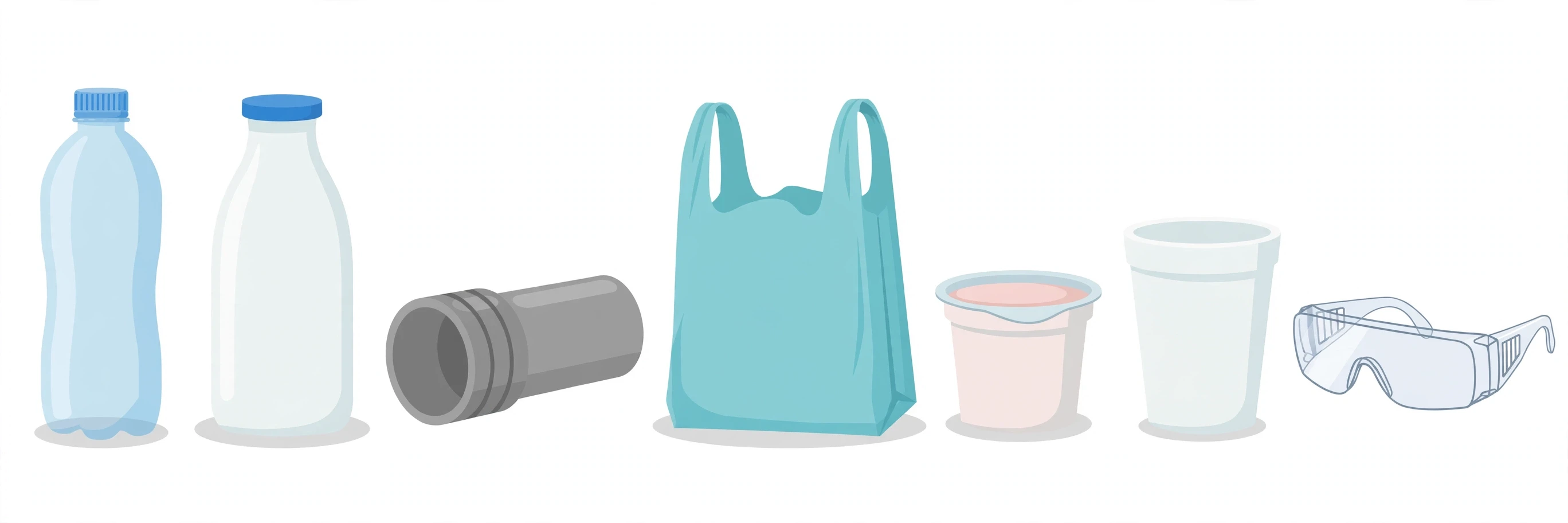
Code 1 is PET, poly(ethylene terephthalate), the polyester of drinks bottles and food trays. PET is clear, strong, and a good barrier to gases, which is why a fizzy drink stays fizzy in a PET bottle. It is also the most widely recycled plastic in the world: a used PET bottle can be washed, shredded, melted, and spun into new bottles, or into polyester fibre for clothing and carpets. That is the closest thing the plastics industry has to a working loop, and it works because PET melts cleanly and the collection system for bottles is well established.
Code 2 is HDPE, high-density polyethylene, the rigid plastic of milk bottles, detergent containers, and water pipes. Its chains are straight and pack tightly, so it is strong, stiff, and resistant to chemicals. HDPE is also widely recycled, and recycled HDPE is used for new bottles, crates, and pipes. Code 3 is PVC, polyvinyl chloride, the plastic of drainpipes, window frames, and vinyl flooring. PVC is unusual because it contains chlorine, and that chlorine makes it naturally flame-resistant and durable outdoors. It is also the hardest of the common plastics to recycle, because heating it can release hydrogen chloride gas, and because it is often mixed with plasticisers and other additives that complicate reprocessing.
6.3 LDPE, PP, and PS: codes 4 to 6
Code 4 is LDPE, low-density polyethylene, the soft, flexible plastic of carrier bags, cling film, and squeeze bottles. Its chains are heavily branched, so they cannot pack tightly, and the material is soft and stretchy. LDPE film is technically recyclable, but in practice it jams sorting machinery and is often not collected, which is why so much of it ends up in landfill or as litter. Code 5 is PP, polypropylene, the plastic of yoghurt pots, bottle caps, and reusable food containers. PP is tough, heat-resistant enough to survive a microwave, and light. It is increasingly recycled, though the small, mixed items it is made into — caps, tubs, straws — are harder to collect and sort than bottles.
Code 6 is PS, polystyrene, the plastic of disposable cups, takeaway boxes, and the foam packaging that protects electronics. Polystyrene is made from styrene, and its chains carry a bulky benzene ring on every other carbon, which stops them packing neatly and makes the material rigid and glassy. Expanded polystyrene foam is mostly air — up to 98 percent by volume — which makes it a superb insulator and a terrible waste problem, because it is bulky, breaks into small pieces easily, and is rarely recycled.
6.4 Code 7: everything else
Code 7 is the catch-all: "other". It covers polycarbonate, the tough clear plastic of safety glasses and water-cooler bottles; PLA, polylactic acid, a plastic made from fermented plant starch that can break down under industrial composting conditions; nylon, the polyamide of clothing and fishing nets; and the many layered plastics used in food pouches. Most code 7 plastics are difficult or impossible to recycle with current systems: when a pouch combines three polymers, a metal layer, and an adhesive, no single recycling process can separate them.
Code
Plastic
Common uses
Recycling
1
PET — poly(ethylene terephthalate)
Drinks bottles, food trays
Widely recycled
2
HDPE — high-density polyethylene
Milk bottles, detergent bottles, pipes
Widely recycled
3
PVC — polyvinyl chloride
Pipes, window frames, flooring
Rarely recycled
4
LDPE — low-density polyethylene
Carrier bags, cling film, squeeze bottles
Sometimes recycled; film often not collected
5
PP — polypropylene
Yoghurt pots, bottle caps, food containers
Increasingly recycled
6
PS — polystyrene
Disposable cups, takeaway boxes, foam packaging
Rarely recycled
7
Other (polycarbonate, PLA, nylon, mixed)
Safety glasses, compostable packaging, clothing
Usually not recycled
The table is a guide, not a promise. Whether a particular item is recycled depends on your local system, the size and shape of the item, and whether it is clean. A yoghurt pot rinsed out has a far better chance than the same pot caked in food. Sorting plants are machines with limits, and small, dirty, or mixed items are the ones that slip through.
Figure 4: The seven resin identification codes. The number inside the triangle of arrows tells you which polymer a container is made from. Codes 1 and 2 are the most widely recycled; codes 3, 6, and 7 are rarely recycled in most places.
7. Natural Polymers: The Ones Life Is Built From
7.1 Cellulose, starch, and the chemistry of plants
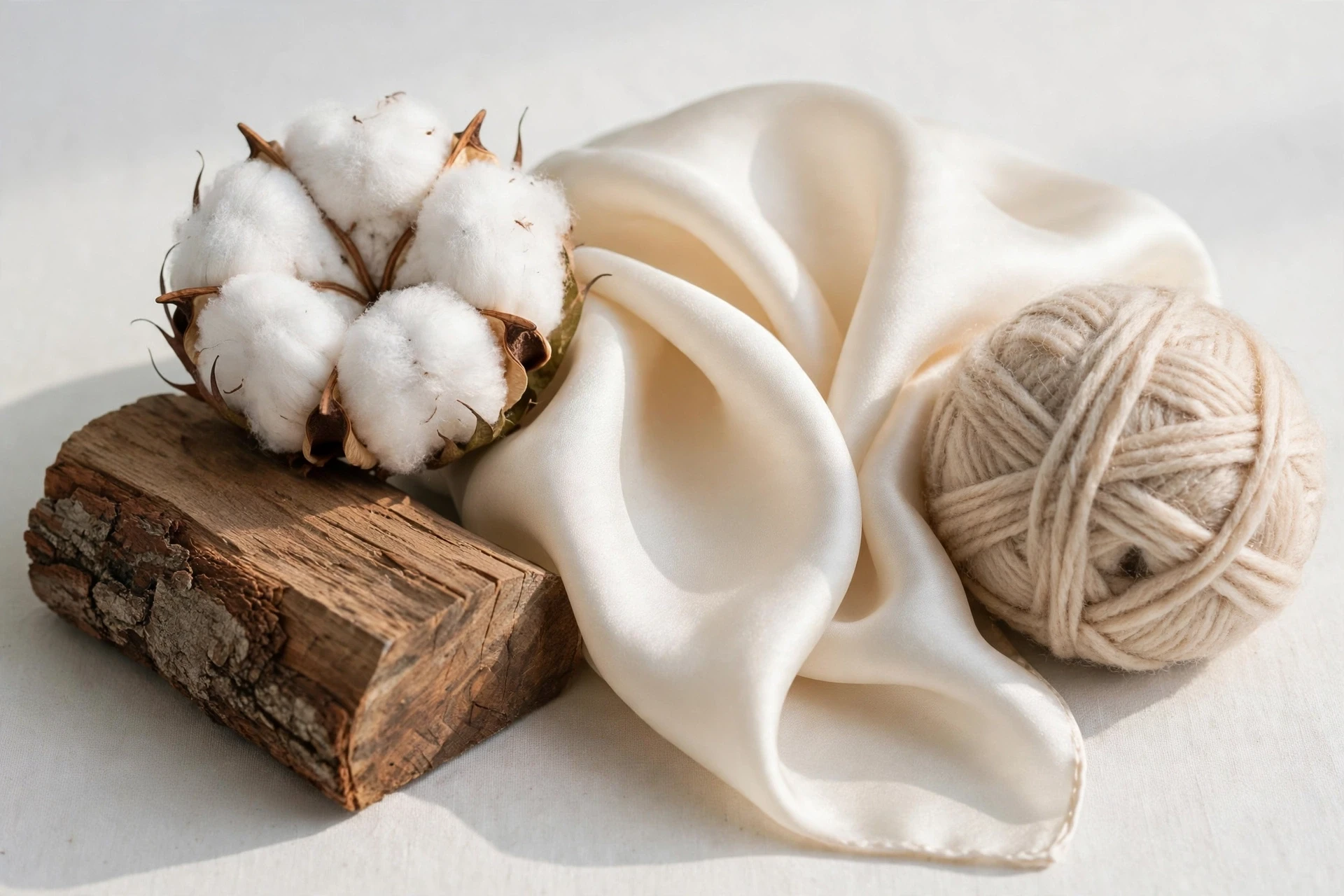
The most abundant polymer on Earth is not a plastic at all. It is cellulose, the structural polymer of plant cell walls, and plants make vast quantities of it every year. Cellulose is a chain of glucose units linked in a way that makes the chain straight and rigid, and the chains hydrogen-bond to each other in bundles that are stronger, weight for weight, than steel. Wood is mostly cellulose and lignin, another natural polymer that acts as the glue between cellulose fibres. Cotton is almost pure cellulose, which is why a cotton shirt is soft, breathable, and strong when wet — the cellulose fibres absorb water without losing their structure.
Starch is made from the same glucose units, but linked differently, in branched chains that coil up into granules. Plants use starch to store energy, and animals can digest it because their enzymes can break the particular link that joins its glucose units. Cellulose uses a different link, and most animals cannot break it — which is why wood is not food, even though it is made of sugar. Two polymers, same building block, different link, completely different fate. It is one of the neatest lessons in chemistry: structure decides function.
7.2 Proteins: polymers that do the work
Proteins are polymers of amino acids, joined by peptide bonds in chains that fold into precise three-dimensional shapes. The shape is the function. Haemoglobin, the protein that carries oxygen in your blood, folds into a shape that can hold an iron atom and bind oxygen reversibly. Collagen, the protein of skin, tendons, and bone, forms long triple helices that are enormously strong in tension. Enzymes are proteins folded into shapes that grip a particular molecule and speed up a particular reaction, sometimes by a factor of millions. The human body makes tens of thousands of different proteins from just twenty amino acids, by varying the order of the units along the chain — the same combinatorial trick that lets a small alphabet write a whole library.
Silk is a protein polymer too, spun by silkworms and spiders into fibres that are, weight for weight, stronger than steel and tougher than many synthetic materials. Spider silk in particular has fascinated materials scientists for decades: it is both strong and stretchy, a combination that is hard to achieve in a synthetic polymer, and researchers are still trying to copy it.
7.3 DNA and the polymers of information
DNA is a polymer of nucleotides, and it is the most information-dense polymer known. Each nucleotide carries one of four bases, and the sequence of bases along the chain spells out the instructions for building proteins. The chain is long — a single human chromosome contains tens of millions of nucleotides — and it is copied, read, and repaired by molecular machines that are themselves made of proteins. RNA, DNA's close cousin, is a similar polymer that carries messages from DNA to the protein-making machinery and does some of the work of building proteins itself.
What strikes me about natural polymers is how much they achieve with so few ingredients. Nature builds cellulose, starch, proteins, and DNA from a small set of monomers, and gets an enormous range of materials by varying the order, the linking, and the folding. Synthetic polymer chemistry works the same way, and the best synthetic polymers often borrow nature's tricks.
7.4 Rubber: nature's elastomer
Natural rubber is the polymer cis-polyisoprene, harvested as latex from rubber trees. Vulcanisation — heating it with sulfur — creates cross-links between the chains, turning it into the tough, elastic material of tyres, seals, and gloves. The story of rubber is a reminder that natural polymers are not automatically gentle or safe, and synthetic polymers are not automatically harmful. The question is never simply "natural or synthetic"; it is what the material is used for, how long it lasts, and what happens to it afterwards.
Figure 5: Natural polymers all around us. Cotton and wood are built from cellulose, wool and silk are protein polymers, and natural rubber is a polymer harvested from tree sap. Life has been making polymers for billions of years, long before chemists learned how.
8. Why Polymers Behave the Way They Do
8.1 Chain length, branching, and crystallinity
Four features of a polymer decide most of its behaviour: how long the chains are, how much they branch, how much they cross-link, and how neatly they pack. Long chains mean more tangles, and more tangles mean more strength and more resistance to being pulled apart. That is why ultra-high-molecular-weight polyethylene — polyethylene with extremely long chains — is used for bulletproof vests and artificial hip joints, while the same polymer with shorter chains makes a plastic bag. Branching stops chains packing together, so branched polymers are softer and more flexible. Cross-linking locks chains together, so cross-linked polymers are harder and cannot melt. And crystallinity — the share of the material that is packed in ordered regions — decides the balance between stiffness and clarity: crystalline regions make a plastic strong and opaque, while amorphous regions make it clear and flexible.
These four features are the dials a polymer chemist turns. Want a plastic that is clear and rigid, for a drinks bottle? Use a polymer that is mostly amorphous with just enough crystallinity for strength. Want a plastic that is tough and opaque, for a milk bottle? Use a polymer that crystallises readily. The same monomer can give a dozen different materials, depending on how the dials are set.
8.2 Strength, flexibility, and the trade-offs
Every polymer property comes with a trade-off. Strength and flexibility pull in opposite directions: the chains that make a plastic strong by packing tightly are the same chains that make it brittle, because they cannot slide to absorb an impact. Toughness — the ability to absorb energy without breaking — often comes from letting the chains move a little, or from adding a second, rubbery phase that stops cracks spreading. This is why many engineering plastics are blends: a rigid polymer mixed with small particles of rubber, so that a crack running through the rigid phase hits a rubber particle and is stopped. The material is stronger than either component alone, which is a neat reminder that a polymer is often not one substance but a designed mixture.
Temperature sets another trade-off. A polymer that is tough at room temperature may become brittle in a freezer, because its chains lose the freedom to move. Designing for the whole temperature range a product will see is one of the quiet challenges of polymer engineering, and it is the reason car parts use different polymers for the engine bay and the cabin.
8.3 Why some plastics are clear and others are not
A clear plastic is one whose chains are arranged randomly, so light passes through without being scattered. An opaque plastic is one whose crystalline regions scatter light in all directions, like frost on a window. Polystyrene and polycarbonate are clear because their bulky side groups stop the chains packing into crystals. Polyethylene is cloudy or opaque because its straight chains crystallise readily. The same physics explains why a plastic bottle can be transparent while a milk bottle made from a different polymer is white: the difference is not the colour, it is the order of the chains.
Additives can change this too. A pigment scatters light and makes a plastic coloured or opaque. A clarifying agent can be added to polypropylene to make it clearer, by controlling how its crystals form. And a plastic that starts out clear can turn cloudy with age, as its chains slowly rearrange and crystallise, or as sunlight breaks the chains and creates tiny cracks that scatter light. The yellowing of an old plastic window frame is chemistry in slow motion: the chains are breaking, and the light is showing you.
Figure 6: Crystalline and amorphous regions inside a polymer. In crystalline regions the chains line up in neat, ordered rows, making the material strong and stiff. In amorphous regions the chains are tangled at random, making the material softer and clearer. Most plastics contain both.
9. Polymers in Everyday Life, Medicine, and Technology
9.1 The house that polymers built
Walk through a house and count the polymers. The pipes are PVC or cross-linked polyethylene. The electrical cables are insulated with PVC or polyethylene. The window frames are uPVC. The carpet is nylon or polypropylene. The mattress is polyurethane foam. The list goes on, and it is not an exaggeration to say that a modern house is held together, insulated, wired, and furnished by polymers. They are there because they are light, cheap, durable, and easy to shape — and because for many of these jobs there is no better material.
9.2 Medicine: polymers inside the body
Medicine is one of the most demanding users of polymers, because the materials must work inside the human body without causing harm. Dissolvable stitches are made from polymers that the body can break down slowly, so the stitches vanish as the wound heals. Artificial hip joints use ultra-high-molecular-weight polyethylene as the bearing surface, because it is tough, slippery, and does not wear quickly. Contact lenses are soft hydrogels — polymers that hold water in a cross-linked net — shaped to sit comfortably on the eye. Drug delivery uses polymers too: a drug can be trapped inside tiny polymer capsules that release it slowly, or that release it only when they reach a particular part of the body.
I once watched a surgeon demonstrate a dissolvable stitch to a group of students, holding a thin thread that looked like fishing line and explaining that it would be gone in a few weeks, broken down by the body's own chemistry. It was a small moment, but it stayed with me: a material designed to disappear on schedule, doing its job and then leaving without a trace. That is the standard the rest of the plastics industry is now being asked to meet.
9.3 Technology: from screens to space
Electronics depend on polymers at every level. The flexible circuits in a phone are printed on polymer films. The touchscreen is protected by a polymer coating. The battery separator — the thin layer that keeps the two sides of a lithium-ion battery apart while letting ions through — is a microporous polymer film. Without polymers, a modern phone would be a box of loose metal and glass. Solar panels are encapsulated in a polymer called EVA, which protects the silicon cells from moisture and impact while letting sunlight through. Wind turbine blades, as we saw earlier, are polymer composites.
In space, polymers do jobs that no other material can. The insulation on a spacesuit is made from layers of polymer film, and the gold-coloured blankets on satellites are layers of polymer film coated with metal, reflecting sunlight and insulating the spacecraft. These are polymers at their best: light, strong, and designed for a specific, extreme environment.
The most impressive thing about polymers is not that they are cheap. It is that the same basic idea — long chains of small units — can be tuned to make a shopping bag, a bulletproof vest, a contact lens, and a spacecraft blanket.
9.4 Clothing, food, and the polymers we wear and eat
Most modern clothing is polymer. Polyester is the most widely used fibre in the world, and it is PET — the same polymer as a drinks bottle, spun into fine threads. Nylon is the fibre of stockings, ropes, and outdoor gear. Elastane, sold under trade names such as Lycra, is a stretchy polyurethane that gives sportswear its fit. Even cotton and wool are often blended with synthetic fibres to make them stronger, cheaper, or easier to care for. The result is that the average wardrobe is a polymer collection, and washing it releases tiny polymer fibres into the wastewater — one of the less visible sources of microplastic pollution.
Food packaging is the largest single use of plastics, and it is also the use where polymers do the most good and the most harm. A thin plastic film can keep food fresh for days, cutting food waste, which is itself a major source of greenhouse gas emissions. But the packaging is used for minutes and lasts for centuries, and the films that protect food best are often the hardest to recycle, because they are made from several layers bonded together.
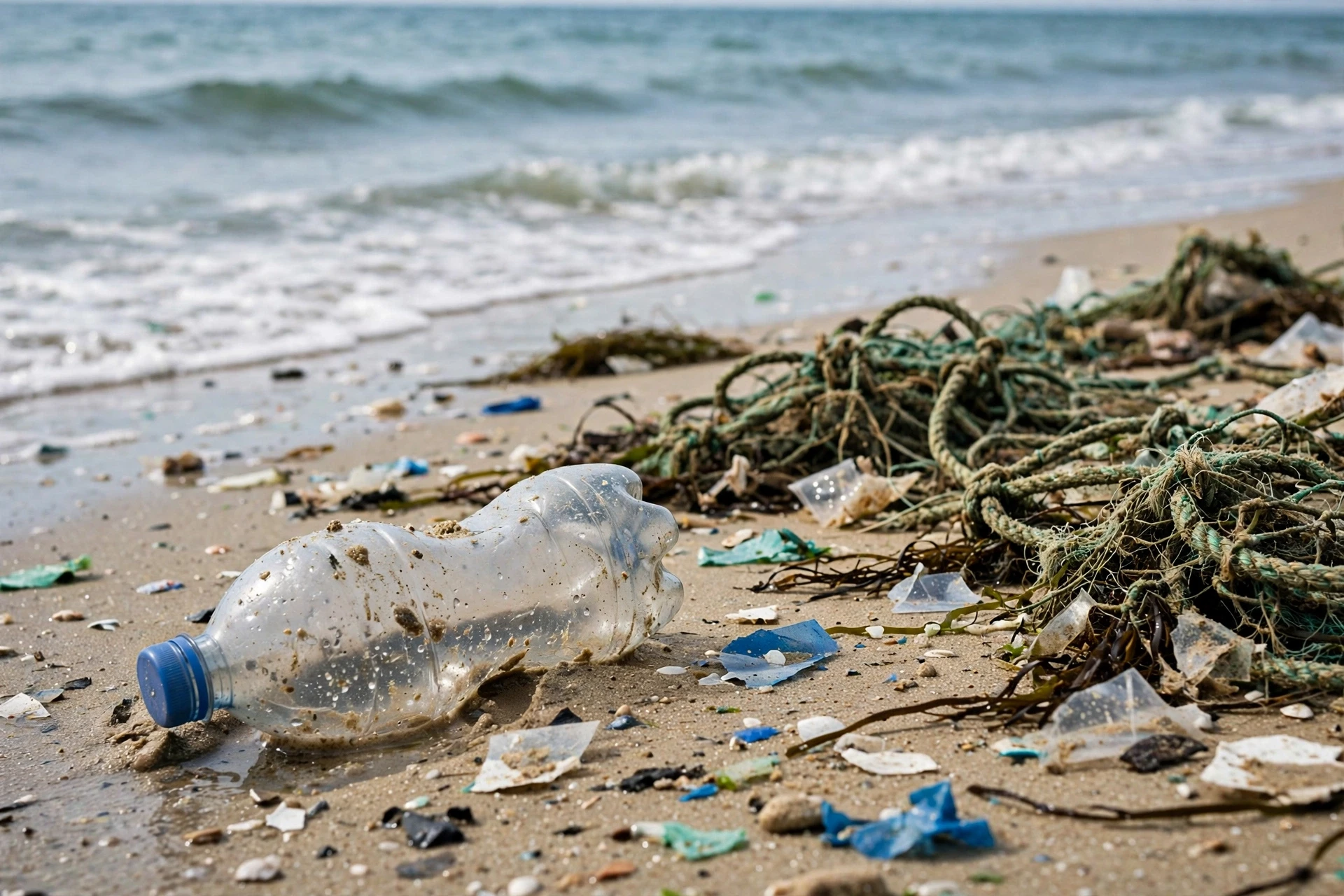
Figure 7: Plastic waste in the sea. Most of the plastic that reaches the ocean comes from land, carried by rivers, and once there it breaks into smaller and smaller pieces without ever truly disappearing.
10. The Plastic Problem
10.1 How much plastic, and where it goes
The world now makes hundreds of millions of tonnes of plastic every year, and the amount has grown almost every year since the 1950s. Most of it is used briefly — packaging, the largest use, is often discarded within days or weeks of being made — and a large share is not recycled. Some is burned, some is buried, and a significant amount escapes into the environment, carried by wind and water into rivers and the sea. Once there, plastic does not biodegrade the way food or paper does: sunlight and waves break it into smaller pieces, but the polymer chains themselves are very slow to break down.
That persistence is the heart of the problem. A plastic bottle thrown away today will still exist, in some form, for far longer than the person who threw it away. It may break into fragments, and the fragments into microplastics, and the microplastics into nanoplastics, but the material does not vanish. It accumulates, in soils, in rivers, in the ocean, and now, in small amounts, in the bodies of animals and people.
10.2 Microplastics: small pieces, big questions
Microplastics are plastic particles smaller than five millimetres, and they come from two sources. Primary microplastics are made small on purpose: the pellets that feed plastic factories, the microbeads once used in cosmetics, and the fibres shed from synthetic clothing. Secondary microplastics are the fragments of larger items — bags, bottles, fishing nets — broken down by sunlight, waves, and wear. Both kinds are now found almost everywhere scientists look: in ocean water, in river sediment, in soil, in the air of cities, and in the digestive systems of marine animals.
The health questions around microplastics are still open, and honest reporting means saying so. Laboratory studies show that high doses can harm small animals, but the doses people and wildlife actually encounter are much lower than those used in most laboratory studies, and researchers disagree about whether real-world doses cause measurable harm. What is clear is that microplastics are widespread, and that the sensible response is to reduce the flow of plastic into the environment while the research continues.
10.3 Wildlife and ecosystems
The effects on wildlife are easier to see than the effects on human health. Sea turtles mistake floating plastic bags for jellyfish. Seabirds feed plastic fragments to their chicks. Seals and dolphins become entangled in discarded fishing nets, which keep fishing long after they are lost — a problem known as ghost fishing. On land, animals ingest plastic, and the plastic can block their digestive systems or give a false sense of fullness that leads to starvation. These are not subtle effects; they are visible, documented, and widespread, and they are the reason plastic pollution has become a public concern in a way that few other chemical issues have.
The damage reaches beyond individual animals. Plastic waste smothers coral reefs, blocks sunlight, and carries invasive species across oceans on floating debris. The connection to the living world is direct: the same ecosystems that depend on the flow of energy and nutrients through food webs — the subject of the Sciory article on Ecosystems — are the ones that plastic waste disrupts.
10.4 The climate link
Plastics and climate change are linked in three ways. First, making plastics uses fossil fuels, both as the raw material and as the energy for the chemical plants, so producing more plastic means emitting more greenhouse gases. Second, when plastic waste is burned, the carbon in the polymer is released as carbon dioxide. Third, plastic in the environment can interfere with the natural systems that absorb carbon: plastic debris on the ocean surface can affect the plankton that draw carbon dioxide from the air, and microplastics in soil can change how soil stores carbon. None of these links is as large as the emissions from burning fossil fuels for energy and transport, but they all point the same way, and they are all growing as plastic production grows.
11. Recycling, Reuse, and What Comes Next
11.1 How recycling actually works
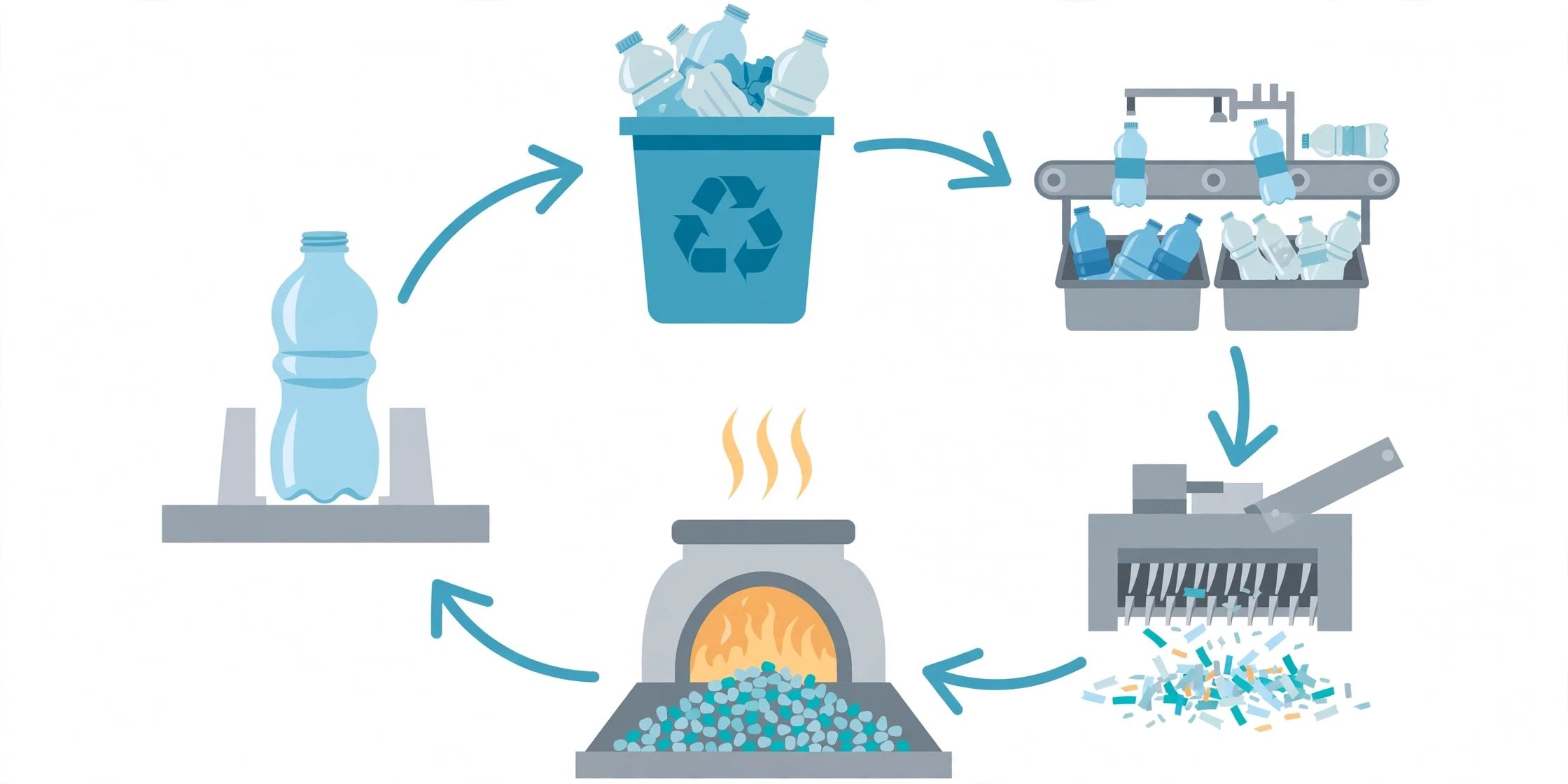
Mechanical recycling is the most common method, and it is straightforward in principle: collect the plastic, sort it by type, wash it, shred it, melt it, and shape it into new products. In practice it is harder, because the plastic stream is mixed, dirty, and made of many different polymers that do not mix well. Melt two different polymers together and you usually get a weak, blotchy material, because the chains do not blend. That is why sorting matters so much, and why a recycling plant is, at heart, a sorting machine with a melting machine attached.
Recycled plastic is also usually lower in quality than virgin plastic. Each time a polymer is melted and reprocessed, some of its chains break, and the average chain length falls. Shorter chains mean a weaker material, so recycled plastic is often used for lower-grade products — a bottle becomes a carpet fibre, a carpet fibre becomes a park bench. This is sometimes called downcycling, and it is the reason mechanical recycling alone cannot close the loop.
11.2 Chemical recycling and the limits of technology
Chemical recycling takes a different approach: instead of melting the polymer, it breaks the chains back down into monomers, which can then be rebuilt into new polymer. In principle this can produce plastic as good as new and handle mixed, dirty waste. In practice it is energy-intensive, expensive, and still small in scale. The technology is real and improving, but it is not yet a solution at the scale of the waste problem.
The honest picture is that recycling, in all its forms, can only handle part of the problem. The rest has to be handled upstream: making less single-use plastic, designing products that last longer, and choosing materials that can be reused or recycled easily. A plastic bottle that is used once and thrown away is a design failure, whatever happens to it afterwards.
11.3 Biodegradable and bio-based polymers
Two words are often confused here, and the difference matters. Bio-based means the polymer is made from plants rather than oil — PLA, made from fermented corn starch, is bio-based. Biodegradable means the polymer can be broken down by microorganisms into water, carbon dioxide, and biomass. Some bio-based polymers are biodegradable, and some are not; some biodegradable polymers are made from oil. PLA, for example, is bio-based and biodegradable, but only under the hot, damp conditions of an industrial composting plant. Throw a PLA cup into a home compost heap, or into the sea, and it will persist for a long time, because the conditions are not right for the microbes that can break it down.
This is why the labels on "compostable" packaging deserve a careful look. A cup that is compostable in an industrial facility is not compostable in your garden, and it is certainly not harmless if it is littered. The polymer chemistry is real, but the infrastructure to make use of it — collection, sorting, and industrial composting — is missing in most places. Until that infrastructure exists, the safest assumption is that a biodegradable plastic behaves like any other plastic if it escapes into the environment.
11.4 What actually helps
The most effective steps are also the least glamorous. Use a reusable bottle, bag, and cup, and use them many times — a reusable item only earns its keep if it replaces many single-use ones. Buy products with less packaging, and choose packaging made from a single polymer that your local system recycles, such as a PET bottle rather than a multi-layer pouch. Sort your recycling properly: rinse containers, and never put plastic film in the recycling bin unless your system accepts it. Support deposit and return schemes, which collect bottles far more effectively than kerbside bins.
Figure 8: The recycling loop. Used plastic is collected, sorted by polymer type, washed, shredded, and melted into pellets, which are then made into new products. The loop only works when the plastic is sorted correctly and the recycled material has a market.
12. Common Misconceptions About Polymers
12.1 "All plastics are the same"
This is the most common mistake, and it causes real problems. A PET bottle and a PVC pipe are both plastics, but they are different polymers with different chemistry, different properties, and different recycling routes. Mixing them in a recycling plant ruins both. The same goes for the idea that a plastic labelled "recyclable" will actually be recycled: the label means the material can, in principle, be recycled, not that your local system does recycle it. The triangle with the number is a material code, not a promise.
12.2 "Plastic is always bad, and natural is always good"
Natural materials have their own costs. Cotton farming uses large amounts of water and pesticides, and paper bags take more energy to make and transport than plastic bags, because they are heavier. The honest comparison is always between specific products used in specific ways, not between categories. A plastic bag used once and thrown away is a poor choice. A plastic bag used a hundred times is a good one. The material is not the whole story; the use is.
12.3 "Biodegradable plastic disappears"
As section 11 explained, most biodegradable plastics need industrial composting conditions to break down. A "biodegradable" bag dropped in a park will not vanish in a few weeks; it will behave much like an ordinary bag, breaking into fragments and persisting. The word on the label describes what the material can do under particular conditions, not what it will do in the real world.
12.4 "Recycling solves the plastic problem"
Recycling is necessary, but it is not sufficient. Only a minority of plastic is recycled, and much of what is collected is downcycled into lower-grade products. The flow of new plastic into the economy is far larger than the flow of recycled plastic out of the waste stream. Recycling works best as the last step in a hierarchy: reduce first, reuse second, recycle third. A system that recycles well but still produces ever more single-use plastic is a system that is losing.
Most people assume the triangle on the bottom of a bottle means it will be recycled. What the data actually shows is that the triangle is only a material code — whether the bottle is recycled depends on your local system, and in most places the answer for most plastics is still no.
13. The Future of Polymers
The future of polymers is being written in three directions at once. The first is better recycling: sorting machines that identify polymers by their infrared signature, chemical recycling plants that break polymers back into monomers, and designs that use a single polymer for a whole product. The second is new materials: polymers made from captured carbon dioxide and agricultural waste, self-healing polymers that repair small cracks on their own, and polymers that can be taken apart on demand and rebuilt. The third is less plastic: refill systems, reusable packaging, and products designed to last.
None of these directions alone will solve the problem, and none of them is a reason to stop paying attention. The chemists who invented the first plastics did not set out to fill the oceans with waste; they set out to make useful materials, and they succeeded beyond anything they imagined. The task now is to keep the usefulness and lose the waste — to design polymers that do their job, and then come back, and do it again.
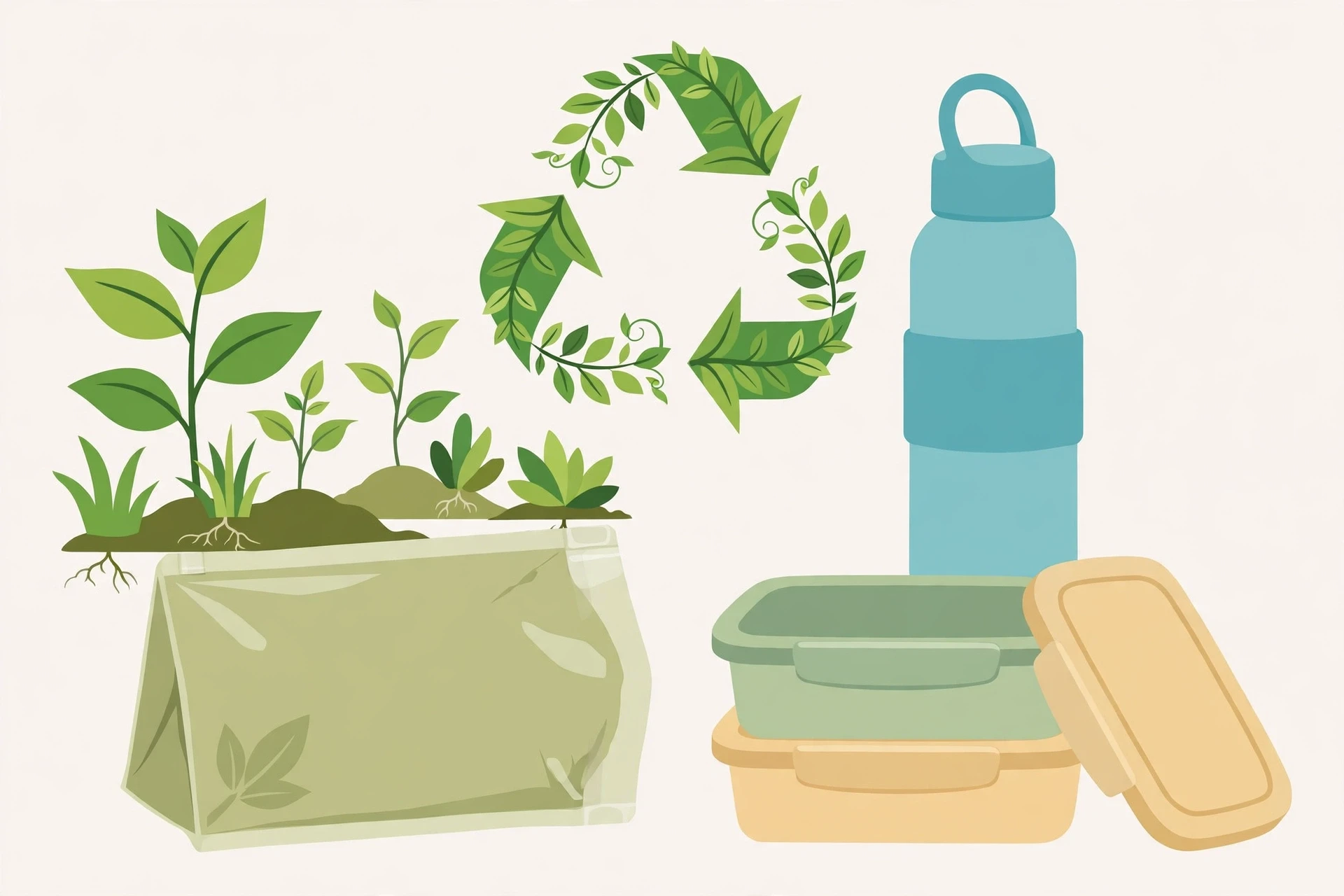
Figure 9: The future of polymers. Bio-based plastics grown from plants, refillable containers that replace single-use packaging, and better recycling systems are all part of the shift from a throwaway plastic economy to one where materials are used again and again.
I keep a small collection on my desk: a piece of Bakelite from an old radio, a nylon thread from that school demonstration, and a fragment of sea glass. The sea glass is not a polymer, but it is there for a reason. It is what happens when a material is tumbled by the sea for decades and comes out smooth and harmless. Polymers are not there yet. The challenge of the next fifty years is to make materials that can be as useful as plastic and as forgiving as sea glass.
Frequently Asked Questions
What are polymers?
Polymers are long molecules made by joining many small repeating units, called monomers, into chains. The chains can be straight, branched, or cross-linked into nets, and the way the chains are arranged decides the properties of the material. Polymers include both natural materials, such as cellulose, proteins, and DNA, and synthetic materials, such as polyethylene, nylon, and PVC. Plastics are one family of synthetic polymers, but not all polymers are plastics.
What is the difference between polymers and plastics?
A polymer is the general category: any long chain molecule built from repeating units. A plastic is a specific kind of synthetic polymer that can be shaped — usually by heat and pressure — into a solid object. All plastics are polymers, but not all polymers are plastics. Cotton, silk, wool, and DNA are polymers that nobody would call plastic, because they are natural materials and are not shaped by moulding. In everyday speech the two words are often used as if they meant the same thing, but in chemistry the polymer is the molecule and the plastic is the material made from it.
How are plastics made?
Most plastics start from crude oil or natural gas, which is refined and cracked into small molecules such as ethylene and propylene. These monomers are then joined into long polymer chains by a reaction called polymerization, usually with the help of a catalyst. The polymer is mixed with additives, melted, and cut into small pellets. The pellets are then melted again and shaped into products by extrusion, injection moulding, or blow moulding. A growing share of plastics is now made from plant-based feedstocks, but the oil and gas route still dominates.
What are thermoplastics and thermosets?
Thermoplastics are polymers whose chains are not cross-linked, so they soften and melt when heated and can be reshaped many times. Polyethylene, PET, PVC, and polystyrene are thermoplastics. Thermosets are polymers whose chains are cross-linked into a three-dimensional net, so they do not melt when heated and cannot be reshaped; heating them too much makes them char or burn. Epoxy resins and Bakelite are thermosets. The distinction matters for recycling, because only thermoplastics can be recycled by melting.
Are all plastics recyclable?
No. In principle most thermoplastics can be melted and reprocessed, but in practice only some are widely recycled — mainly PET bottles and HDPE containers. PVC, polystyrene, plastic film, and mixed or multi-layer packaging are rarely recycled, because they are hard to sort, hard to clean, or hard to reprocess. Thermosets cannot be melted at all, so they cannot be recycled by melting. Whether a particular item is recycled depends on its polymer type, its shape and size, how clean it is, and what your local recycling system accepts.
What are microplastics?
Microplastics are plastic particles smaller than five millimetres. They come from two sources: primary microplastics, which are made small on purpose, such as the pellets that feed plastic factories and the fibres shed from synthetic clothing; and secondary microplastics, which are fragments of larger plastic items broken down by sunlight, waves, and wear. Microplastics are now found in oceans, rivers, soil, and air. Researchers are still studying whether the levels people and wildlife actually encounter cause measurable harm, but the particles are widespread and persistent, and reducing the flow of plastic into the environment is the sensible response while the research continues.
What is the difference between biodegradable and bio-based plastic?
Bio-based means the plastic is made from plants or other renewable sources rather than oil. Biodegradable means microorganisms can break the plastic down into water, carbon dioxide, and biomass. The two words describe different things, and they do not always go together: some bio-based plastics are not biodegradable, and some biodegradable plastics are made from oil. Most biodegradable plastics only break down under the hot, damp conditions of an industrial composting plant, not in a home compost heap or in the sea.