

Introduction: The Café I Had Never Visited
I was sitting in a small café in a city I had never visited before, waiting for a friend who was running late. The waiter set down a cup of coffee. A tram rattled past the window. A woman at the next table laughed at something on her phone. And then it hit me — a wave of certainty so strong it stopped me mid-sip: I had lived this exact moment before. The cup, the tram, the laugh. All of it had happened already, in exactly this order.
I knew it had not. I had never been to this city, never sat in this café, never met that waiter. The feeling lasted perhaps five seconds, then faded, leaving behind a strange mix of wonder and unease. I spent the rest of the afternoon turning it over in my mind. How could my brain be so sure about something so plainly false?
That is déjà vu. The French phrase means "already seen," and the experience is one of the most common strange sensations in human life. Roughly two out of three people have felt it at least once, and most of us will feel it again. It arrives without warning, lasts only seconds, and leaves no trace except the question it plants: what just happened inside my head?
For a long time, the honest scientific answer was: nobody really knows. Déjà vu is hard to study precisely because it is brief, unpredictable, and impossible to summon on demand in a healthy person. You cannot schedule it in a laboratory the way you can schedule a memory test. But over the past two decades, researchers have found ways to trigger something very like it in the lab, to scan the brains of people as it happens, and to learn from patients whose brains produce it more often. The picture that has emerged is incomplete — and any honest account should say so — but it is far richer than the old folk explanations. Déjà vu is not a memory of a past life. It is not a glimpse of the future. It is, most likely, a small, revealing error in the machinery that tells you whether something is familiar — an error your brain then catches, in real time, and corrects.
This article follows that evidence as far as it goes, and marks clearly where it stops. We will look at the two separate systems that produce recognition, the brain region that acts as a fact-checker, the virtual-reality experiments that finally brought déjà vu into the laboratory, the theories that still compete with each other, and the question everyone eventually asks: when, if ever, should déjà vu worry you?

1. What Déjà Vu Actually Is
1.1 A definition with a twist
Déjà vu has a specific structure, and that structure is what separates it from ordinary familiarity. It is not simply the feeling that something rings a bell. It is two contradictory things at once: a powerful sense that the present moment is a repeat of something that happened before, and the clear knowledge that it cannot be. You feel you have lived this moment, and you know, with complete confidence, that you have not.
That contradiction is the defining feature. If you walk into a restaurant and think "I have been here before" and then realise you have — you visited it three years ago — that is not déjà vu. That is ordinary remembering. If you meet someone and feel sure you know them but cannot place them, that is recognition without recall, and it is close to the sensation but not quite it. It is the version where the resemblance has no traceable source, the feeling is strong, and you can tell, even while having it, that the feeling must be wrong.
The French philosopher Émile Boirac coined the term in the late nineteenth century, in a letter to a philosophy journal in 1876. People had presumably been experiencing it for as long as there have been people, but Boirac gave the sensation a name, and the name stuck. In French it simply means "already seen," which is an unusually accurate label for a psychological term: it describes exactly what the experience feels like from the inside.
1.2 How common is it, and how long does it last?
Surveys consistently find that déjà vu is remarkably common. Estimates vary depending on how the question is asked, but most large surveys put lifetime prevalence somewhere around 60 to 70 percent of people — roughly two in three of us. A pooled analysis of dozens of studies put the figure at about 67 percent. A more recent systematic review of healthy participants estimated it even higher, at roughly three quarters. The exact number matters less than the pattern: this is not a rare quirk. It is a normal feature of a normal brain.
For most people it is also infrequent. The typical healthy person experiences déjà vu a few times a year at most — often less. An episode lasts only seconds. Researchers who study it describe episodes of a few seconds' duration, rarely longer, and the feeling usually fades on its own without any effort. You do not need to do anything to make it stop. It stops because the brain's checking system does its job, which we will come to shortly.
I find that ordinariness reassuring, and a little humbling. A sensation that has inspired novels, films, and endless late-night theories about past lives turns out to be something most of us experience a handful of times a year and then forget about by dinner.
1.3 What it feels like from the inside
People describe the experience in strikingly similar words across cultures and decades. There is the sudden familiarity, often attached to a place — a street, a room, a view — more often than to a person or a conversation. There is a sense of strangeness or eeriness, sometimes a feeling of unreality, as if the world has briefly slipped out of focus. And there is often a companion sensation: the feeling that you know what is about to happen next. Someone is about to say a particular sentence. A door is about to open. You feel, for a second, that you could predict the next few moments.
That feeling of prediction is important, because it is where the folk explanations take root. If you feel you know what happens next, it is a short step to believing you have seen the future. But as we will see in Section 7, when researchers tested that feeling in the laboratory, the predictions turned out to be no better than chance. The feeling of knowing the future is real. The knowing itself is not.
There is one more feature worth noting. It is almost always described as a feeling, not a thought. People do not reason their way into it. It arrives as a sensation, immediate and involuntary, like a smell triggering a memory. That tells us something about where it comes from in the brain: it is generated by fast, automatic systems that operate below conscious thought, and conscious thought only gets involved afterwards, when it notices the mismatch and tries to make sense of it.
2. The Two Halves of Recognition: Familiarity and Recollection
2.1 Recognition is not one thing
The single most important idea for understanding déjà vu is that recognition — the sense of "I have encountered this before" — is not one process. It is two. Psychologists call this the dual-process model of recognition memory, and it has been studied for decades outside the context of déjà vu, in ordinary memory experiments.
The first process is familiarity. It is fast, automatic, and vague. It delivers a bare signal — "this rings a bell" — with no supporting detail. You see a face in a crowd and feel certain you know the person, but you cannot say from where. You hear a melody and feel you have heard it before, but you cannot name the song. That is familiarity working alone.
The second process is recollection. It is slower and more effortful. It reconstructs the context: where you were, when it happened, what else was going on. You see the same face and suddenly remember: she was the receptionist at the hotel in Lisbon, three summers ago. That is recollection filling in the story behind the signal.
In everyday life, the two usually work together so smoothly that you never notice them as separate systems. Familiarity fires, recollection follows a fraction of a second later with the details, and the result feels like a single seamless experience of remembering. On the leading account, this is what happens when the two come apart: the fast system fires strongly while the slow system comes up empty.
2.2 Where the two systems live
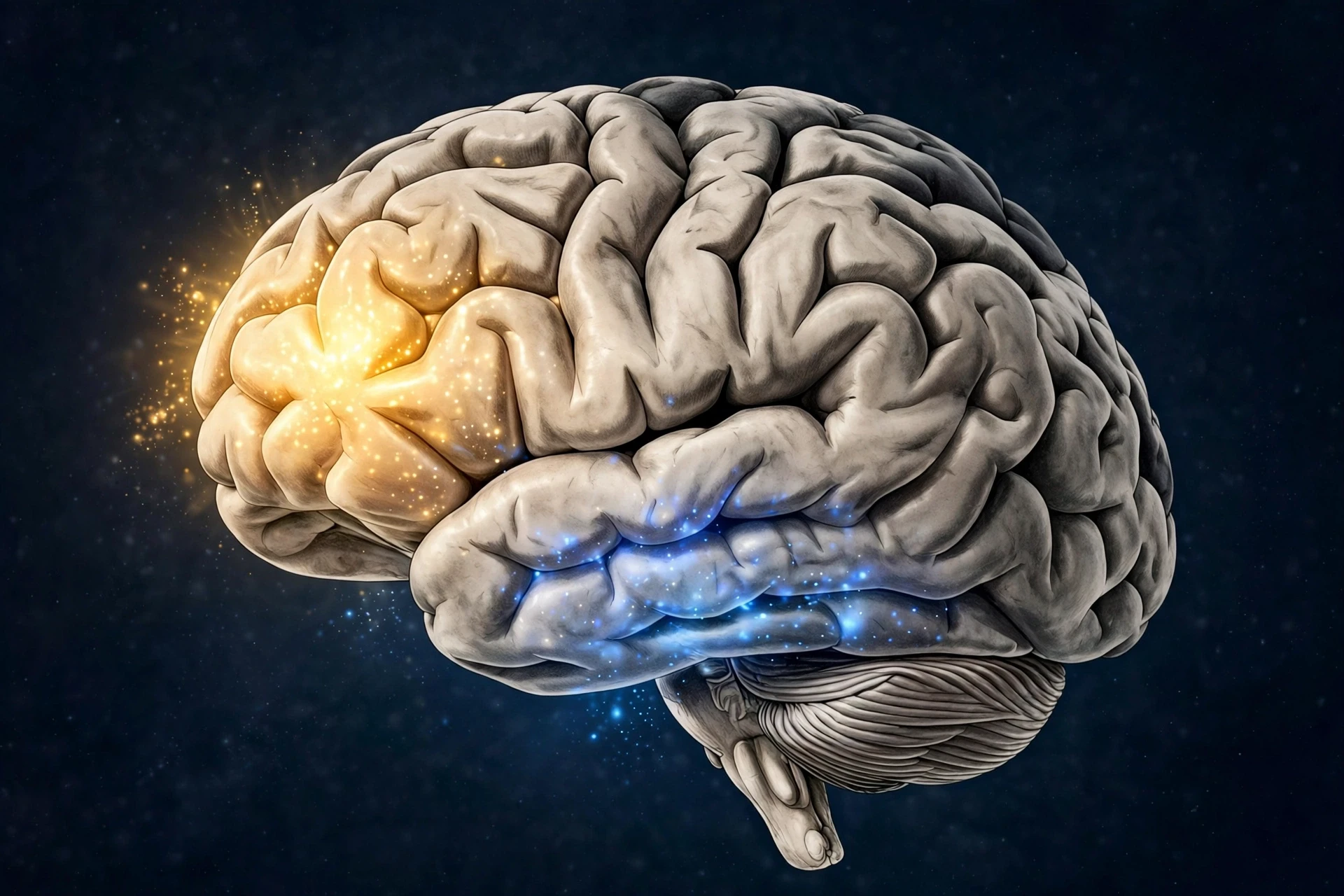
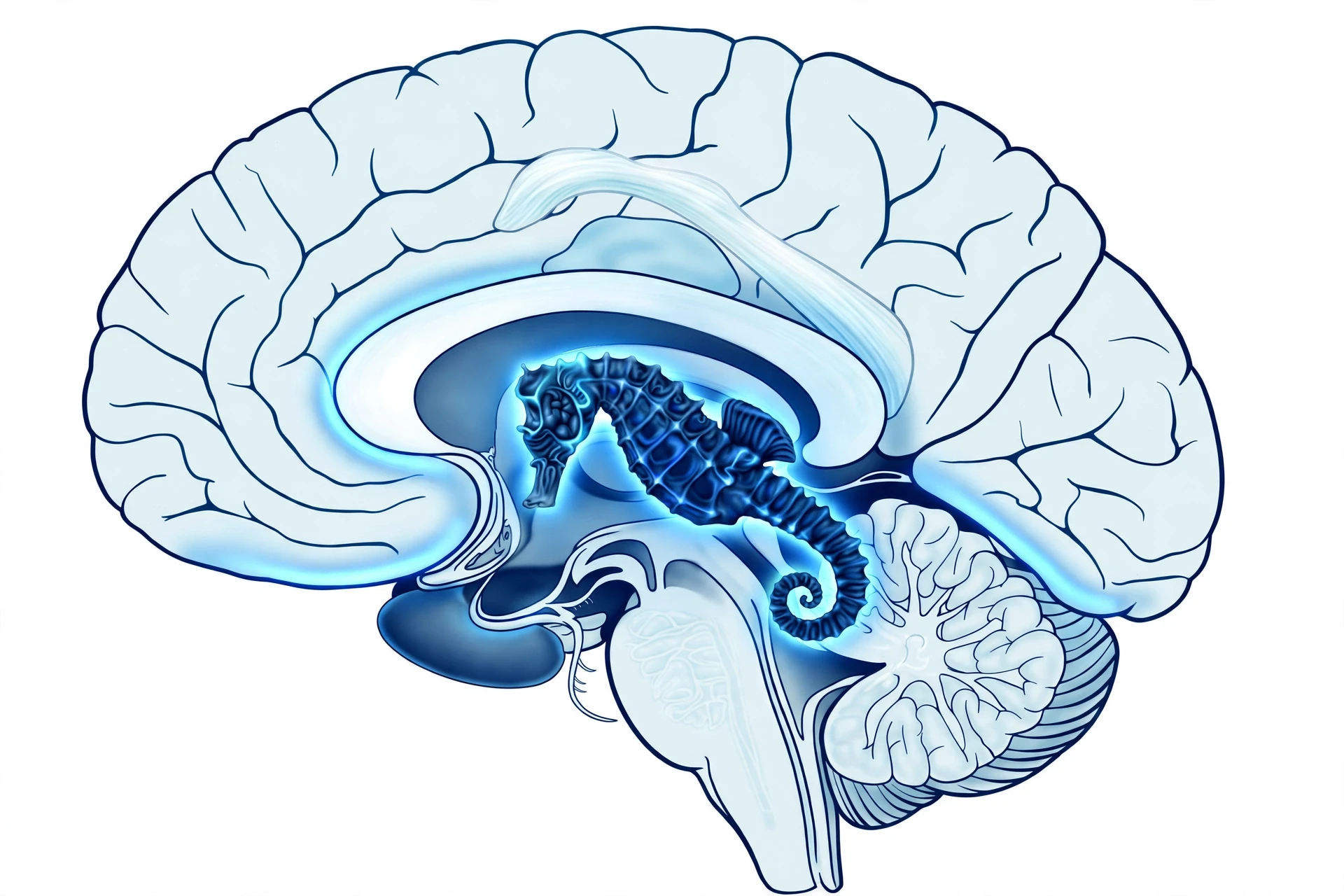
The two processes map, roughly, onto different parts of the medial temporal lobe — the region of the brain just behind your temples that handles memory. Familiarity is associated most closely with the rhinal cortices, the perirhinal and entorhinal cortex, which sit wrapped around the front of the temporal lobe and act as a kind of gatekeeper, judging whether incoming information matches something stored in memory. Recollection depends more heavily on the hippocampus, the seahorse-shaped structure that reconstructs the when and where of past experiences.
This anatomy matters because it explains how a false familiarity signal can arise at all. The rhinal cortex can fire on the basis of a partial match — a layout, a pattern, a configuration — without the hippocampus ever finding the original experience. When that happens, you get a powerful sense of pastness attached to a scene that has no past. The signal is real, in the sense that neurons really fired. The conclusion it points to is false.
Think of it like a smoke alarm. A smoke alarm is designed to go off when there is a fire, and most of the time it does. But it can also go off when you burn toast. The alarm is not broken; it is doing exactly what it was built to do, with a threshold set low enough to catch real fires. Familiarity works the same way. It is better, from the brain's point of view, to occasionally flag something new as familiar than to fail to recognise something genuinely familiar — a place you have been, a person you know, a danger you have met before. It may be the price of a smoke alarm set sensibly low.
2.3 A personal check: the supermarket test
I have a small test I use when I am explaining this to friends, because it makes the two systems visible in ordinary life. Picture yourself in a supermarket. A man walks past, and you are suddenly certain you know him. You cannot say how. That is familiarity without recollection — and it is, in miniature, the first half of déjà vu.
Now imagine a second version. The same man walks past, and a second later it comes to you: he was your neighbour five years ago, in a different city. The name arrives, then the street, then the dog he used to walk. That is recollection catching up and completing the picture. The feeling of familiarity is resolved, the mystery dissolves, and you move on.
Déjà vu is the first version, turned up to full volume, in a situation where the second version never arrives. The familiarity signal is strong — much stronger than the supermarket version — and recollection searches and finds nothing, because there is nothing to find. The scene really is new. What the brain does next, in those few seconds, is the most interesting part of the whole story, and it is where the newest research has the most to say.
3. The Brain's Fact-Checker: Catching Its Own Mistake
3.1 The conflict at the heart of déjà vu
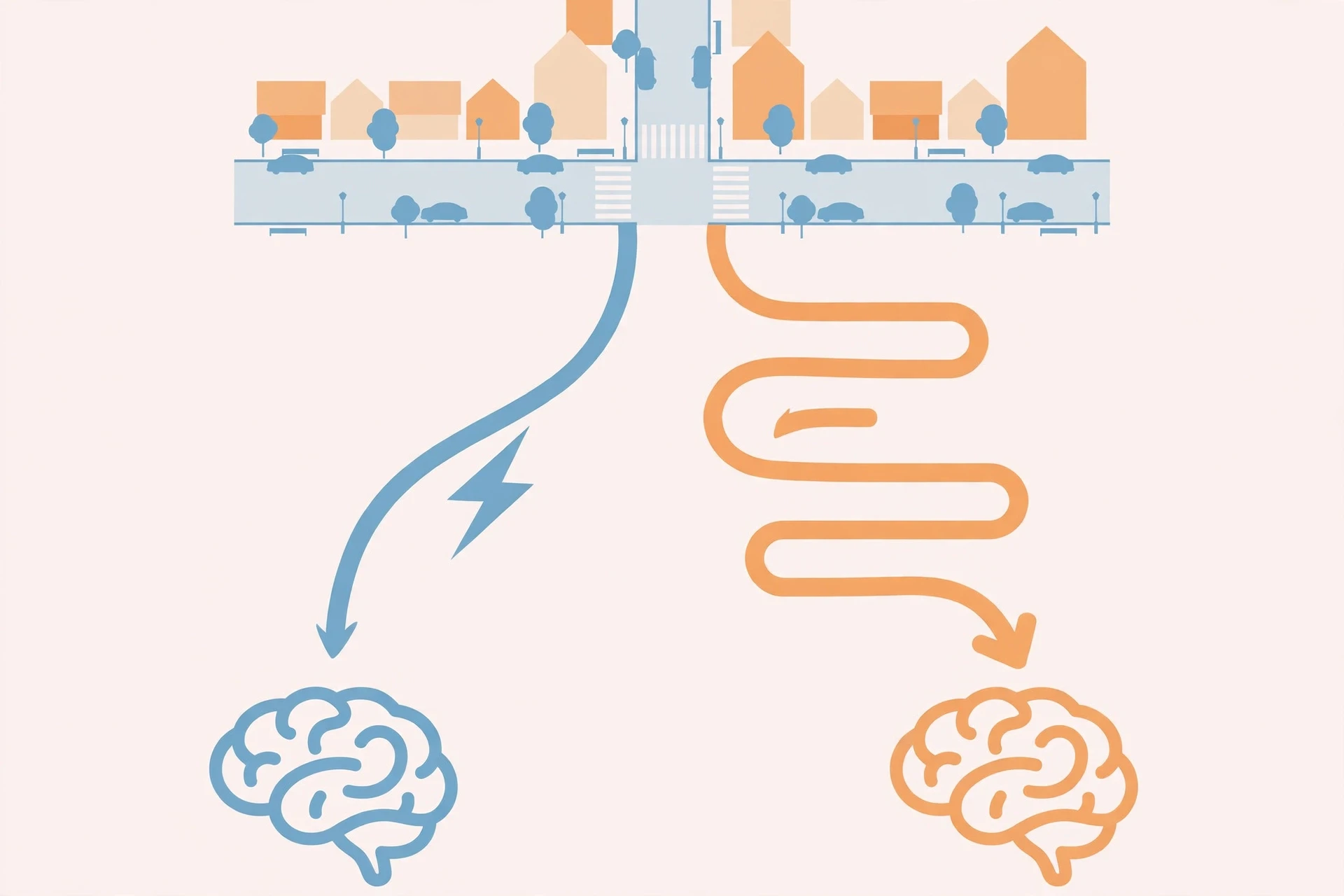
If the sensation were only a false familiarity signal, it would feel like an ordinary false memory — you would simply believe, wrongly, that you had been somewhere before. But déjà vu feels different from that, and the difference is the second half of the experience: the knowledge that the feeling must be wrong. You feel the familiarity and you know the scene is new. Both at once.
Researchers describe it as a conflict between a subjective evaluation of familiarity and a concurrent evaluation of novelty. That tension — "I know this" and "I couldn't possibly know this" — is the defining feature, and it points to a second brain system doing a different job: checking the familiarity signal against the facts.
The leading version of this idea comes from Akira O'Connor, a cognitive psychologist at the University of St Andrews in Scotland who has studied déjà vu for years. In his account, the feeling arises when the parts of the brain that recognise familiar situations are activated inappropriately. Then another region — in the frontal cortex, behind the forehead — checks that feeling against your actual recall of past experiences. When no match is found, the result is the discomfiting sense of having seen it all before, accompanied by the knowledge that you have not.
3.2 What the brain scans showed
O'Connor and his colleagues tested this idea directly, in one of the few studies to scan people's brains during experimentally triggered episodes. They used a word-association technique to induce the sensation in volunteers inside an MRI scanner, then watched which regions became active.
The result surprised them. They had expected the memory regions — the hippocampus and its neighbours — to light up. Instead, the activity appeared in the frontal regions of the brain, the areas involved in decision-making and conflict detection. The memory regions stayed comparatively quiet. The brain, it seemed, was not retrieving a memory. It was detecting a conflict and resolving it.
O'Connor has described the experience in a way I keep coming back to: you get a sense that all of these experiences do not quite match up, and at that stage you realise you have made an error. It feels like an error, he says, even though it is probably actually the avoidance of an error. That reframing matters. On this view, déjà vu is not your memory failing. It is your memory system working correctly — flagging a mismatch, checking it, and refusing to be fooled. The eerie feeling is the sound of the checking system doing its job.
"It feels like an error, even though it's probably actually the avoidance of an error." — Akira O'Connor, University of St Andrews, on what déjà vu reveals about the brain's checking system.
3.3 Why the fact-checker matters
This idea also helps explain a puzzle that has bothered researchers for years: why déjà vu becomes less common with age, even though memory generally gets worse as we get older. If déjà vu were simply a memory failure, older people should experience it more, not less. But they experience it less — one of the most consistent findings in the field, replicated across dozens of studies.
One explanation involves the fact-checker itself. Chris Moulin, a cognitive neuropsychologist at Grenoble Alpes University in France who also studies déjà vu, has suggested that older adults may be less adept at the frontal fact-checking that produces the recognition of the error. On that account, the false familiarity may still occur, but without the sharp sense of conflict that makes it feel like déjà vu. The feeling needs both halves: the false signal and the system that notices it is false. Take away the second half, and what is left is a vague sense of familiarity that passes unnoticed — or, in some people with dementia, a false familiarity that is accepted without question, because the checking system no longer flags it.
I find this one of the more poignant findings in the field. The same mechanism that makes a young person stop mid-sip in a café and think "this is impossible" is a sign of a healthy, vigilant brain.
4. The Laboratory Breakthrough: Virtual Rooms and Familiar Layouts
4.1 Why déjà vu was so hard to study
For most of the twentieth century, déjà vu research was mostly surveys. Researchers asked people whether they had experienced it, how often, and in what circumstances. The surveys produced real findings — the age pattern, the link to travel and new places, the association with tiredness and stress — but they could not answer the central question: what triggers it? To answer that, you need to produce the sensation in a laboratory, under controlled conditions, and watch what happens. And for decades, nobody could.
The problem is obvious once you state it. You cannot tell a volunteer "now have déjà vu" and expect it to happen. The sensation is involuntary and brief. The breakthrough came when researchers stopped trying to trigger déjà vu directly and instead tried to trigger its ingredients — in particular, familiarity without recall.
4.2 Anne Cleary and the gestalt familiarity hypothesis
The most rigorous experimental work on the phenomenon to date comes from Anne Cleary, a cognitive psychologist at Colorado State University. Cleary had spent years studying familiarity-based recognition: the feeling of knowing something without being able to recall why. When she read Alan Brown's landmark 2003 review — the first paper to bring déjà vu into mainstream cognitive science — she saw a testable idea inside it.
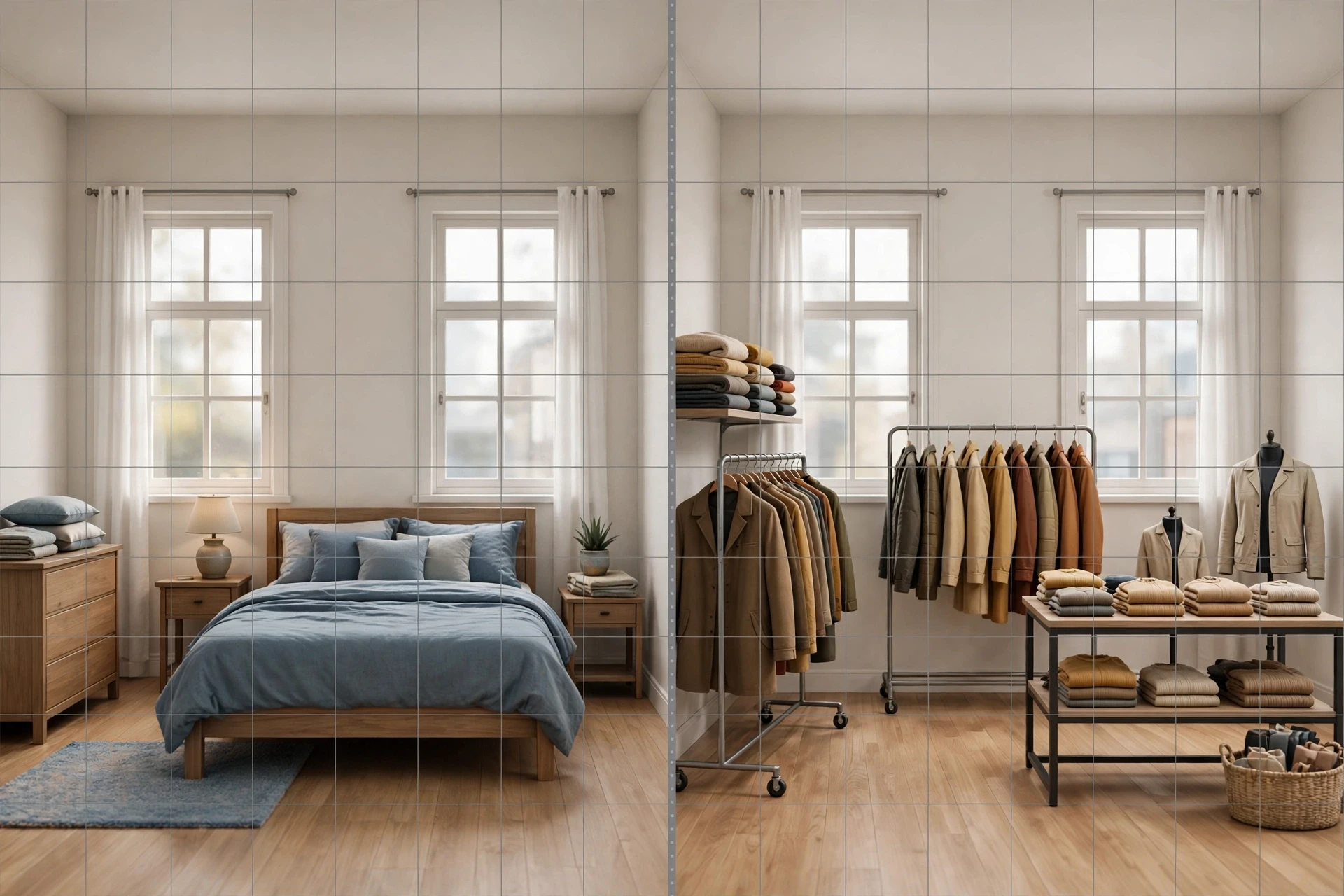
Brown had revived an old suggestion known as the gestalt familiarity hypothesis. The idea is simple. Suppose you enter a new place — a hotel lobby, a friend's kitchen, a street corner — that happens to share the same spatial layout as a place you have been before, even though everything in it looks different. The furniture is arranged the same way relative to the door. The windows sit in the same positions. The overall configuration matches. Your brain registers the match and produces a feeling of familiarity, but you fail to recall the earlier place that is the source of the feeling. The result: a brand-new scene that feels old.
Cleary's team tested this with virtual reality. They built scenes using video-game engines — a junkyard, a hedge garden, a hospital room, a bowling alley, a courtyard — and arranged them so that some new scenes shared the exact spatial layout of scenes participants had viewed earlier, while looking entirely different in content. A bedroom might have the same layout as a clothing store. A bowling alley might share the layout of a subway station.
The results were clear. When a new scene shared the layout of an earlier one, participants rated it as more familiar and reported the sensation more often — even while correctly recognising that the scene itself was new, and even when they could not consciously recall having seen the earlier layout at all. Familiarity ratings and reports of the sensation rose as the configural match grew stronger. This was a genuine laboratory analogue of déjà vu, produced on demand, and it showed that the brain does not need to remember the content of an earlier experience to register familiarity. Recognising the underlying pattern — the geometric skeleton of a room, the arrangement of objects — is enough.
4.3 What the lab can and cannot prove
Cleary's work is the strongest evidence we have for any single mechanism behind déjà vu, and it deserves its place at the centre of this article. But honesty requires saying what it does not prove. It does not prove that all spontaneous episodes works this way. In everyday life, déjà vu may sometimes be triggered by a matching layout, sometimes by a random misfire with no trigger at all, and sometimes by something researchers have not yet identified. The laboratory version is a model — a simplified, controlled version of the real thing — and models always leave something out.
That is not a weakness of the research. It is how science works on a phenomenon this elusive. Before Cleary's experiments, déjà vu was largely a matter of anecdote and speculation. After them, at least one pathway from a new scene to a false feeling of familiarity is established fact: configural resemblance can do it, in healthy volunteers, under controlled conditions. That is real progress, and it is more than the field had for the first hundred years after Boirac named the sensation.
I remember reading Brown's review as a student and feeling the same frustration Cleary must have felt: here was a phenomenon everyone had experienced, and the scientific literature on it could have fitted in a slim folder. Two decades later, the folder is thicker, the experiments exist, and the questions are sharper.
5. The Competing Theories: Four Ways to Explain the Same Five Seconds
5.1 No single agreed mechanism
There is no single, universally agreed-upon mechanism for the phenomenon. That is worth stating plainly, because popular accounts often present one theory as settled fact. The truth is that several explanations compete, and they are not all mutually exclusive — more than one may be right, for different episodes, in different people. Alan Brown's review sorted the scientific explanations into four families: memory-based, neurological, dual-processing, and attentional. The table below summarises the main contenders as they stand today.
Theory | Core idea | Key evidence | Main weakness |
|---|---|---|---|
Gestalt familiarity | A new scene matches the layout of a remembered scene; familiarity fires, recall fails | Cleary's virtual-reality experiments (2009, 2012): matching layouts raise familiarity and déjà vu reports | Cannot explain déjà vu with no matching scene, e.g. during conversation |
Temporal-lobe misfire | Brief, spontaneous activity in the medial temporal lobe generates a false familiarity signal | Electrical stimulation of the rhinal cortex reliably produces déjà vu; déjà vu as an aura before temporal lobe seizures | Everyday déjà vu shows no seizure activity; the misfire itself is rarely observed directly |
Dual-processing delay | One perceptual pathway registers a moment a fraction of a second before the other, so the second pass feels like a repeat | Intuitive; fits the "reliving" quality of the sensation | Never operationalised into a testable prediction; no direct evidence after more than a century |
Attentional / split perception | A scene is glimpsed while distracted, then seen properly a moment later; the second, full perception feels familiar | Fits episodes that follow distraction or divided attention | Requires a distracted first glance that people rarely remember; hard to test |
Table 1: The four main scientific explanations for déjà vu. Gestalt familiarity has the strongest laboratory support; the temporal-lobe account has the strongest neurological support; the other two remain plausible but unproven.
5.2 The temporal-lobe evidence: what epilepsy taught us
The oldest and most direct neurological evidence comes from an unexpected source: people with temporal lobe epilepsy. Some patients report déjà vu as an aura — a brief warning sensation just before a seizure — and neurosurgeons have long observed that direct electrical stimulation of certain temporal lobe structures can reliably produce a déjà vu-like feeling.
The history goes back to the 1950s, when the neurosurgeon Wilder Penfield reported that stimulating the temporal lobe during awake brain surgery for epilepsy produced sensations of familiarity, unfamiliarity, and vivid re-experiencing of past scenes. Later work narrowed the effect down: déjà vu is elicited far more reliably by stimulating the rhinal cortices — the perirhinal and entorhinal cortex, which sit next to the hippocampus — than by stimulating the amygdala or the hippocampus directly. The rhinal cortex, it seems, is the part of the brain most capable of generating a strong sense of familiarity on its own, disconnected from any real matching memory.
This does not mean that the everyday experience is a mini-seizure. That is a misunderstanding worth correcting directly. In healthy people, déjà vu occurs without any seizure activity, and the brains of people who experience it are, by every measure available, normal. What the epilepsy evidence shows is narrower and more useful: it shows where the feeling is generated. The same circuitry that can produce déjà vu as part of a seizure can also produce it, briefly and harmlessly, in a healthy brain — most likely through a small, spontaneous burst of activity that fades as quickly as it arrives. The machinery is the same. The context is different.
5.3 The theories that sound right but lack proof
The dual-processing delay idea deserves a special note, because it is the explanation most people have heard. It says that one hemisphere of the brain, or one perceptual pathway, registers a perception a split second before the other does, so the second registration feels like a repeat — as if the present is being filed as the past. It is intuitive, it is everywhere in popular writing, and after more than a century nobody has produced direct evidence for it.
The attentional theory — sometimes called split perception — is in a similar position, though with a little more going for it. It proposes that you glimpse a scene while distracted, then look at it properly a moment later, and the second, full perception feels familiar because the first, partial one already registered. This fits episodes that follow distraction, and tiredness and divided attention are among the reported triggers for déjà vu. But the distracted first glance is, by definition, something people rarely remember, which makes the theory hard to test. It remains plausible, unproven, and probably part of the story for some episodes.
The honest summary is this: gestalt familiarity is the best-tested mechanism, the temporal-lobe misfire is the best-supported neurological account, and the two fit together well — a matching layout or a spontaneous burst of activity produces the familiarity signal, the frontal cortex catches the mismatch, and the whole episode lasts a few seconds. The other theories may describe additional routes to the same feeling. Science does not yet know, and saying so is not a failure. It is the current state of knowledge, and it is more interesting than a false certainty.
6. Who Gets Déjà Vu, and When: Age, Travel, Tiredness, and Stress
6.1 The age curve: a peak in young adulthood
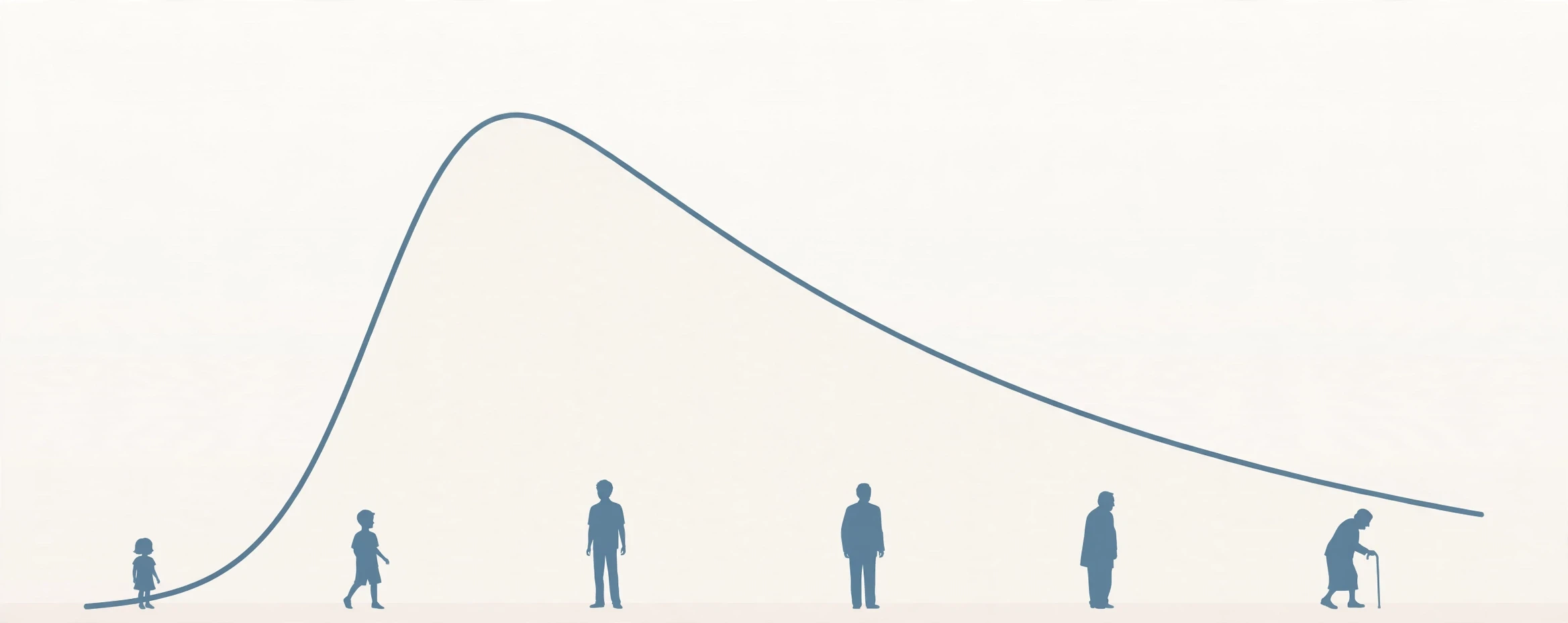
One of the most consistent findings in déjà vu research is the age pattern. The sensation is most common in teenagers and young adults, peaks roughly between the ages of 15 and 25, and then declines steadily with age. The decline has been replicated across dozens of studies, making it one of the most solid facts in the field.
Why? The honest answer is that researchers are not fully sure, but there are two plausible explanations, and they may both be true. The first is about the brain itself. Younger brains are more excitable — more prone to fire quickly rather than hold back — and the familiarity system may simply misfire more often in a young, fast, still-maturing brain. As neural pathways mature, the familiarity-detection system becomes more selective and less prone to false alarms.
The second explanation is about life, not the brain. Young adults encounter more genuinely novel scene layouts than older adults do. They travel more, move house more, start new jobs, walk into unfamiliar rooms. Every new layout is another opportunity for a configural match with a remembered one — another roll of the dice for gestalt familiarity. Older adults, with more settled routines and fewer new environments, simply get fewer chances. The two explanations are not rivals. A more excitable system meeting more novel scenes is exactly the combination that would produce a peak in the teens and twenties.
6.2 Triggers: travel, new places, tiredness, and stress
Surveys consistently point to the same set of triggers, and they make sense once you understand the mechanism. Travel and new places top the list — the most common elicitor of déjà vu across many survey studies is scenes or places, which is exactly what the gestalt familiarity hypothesis would predict. A new city is full of rooms, streets, and views whose layouts may echo places you have been before.
Tiredness and stress come next. Fatigue and sleep deprivation disrupt the brain's recognition processes, and stress changes how the brain perceives and processes information. Both make the familiarity system more likely to misfire and the checking system slower to catch it. This matches everyday experience: it seems to visit more often on long journeys, after poor sleep, or during intense, demanding periods — the times when the brain is running on low reserves and processing a lot of novelty at once.
There is also an association with education and with a tendency to travel, both of which may simply reflect exposure to more novel environments. And some studies have noted links with certain medications that affect dopamine activity in the temporal lobes, though that evidence is preliminary and should not be overstated. Dopamine is involved in signalling novelty and salience, so a link is plausible — but plausibility is not proof, and this is an area where the research is still thin.
6.3 What the triggers tell us
The trigger pattern is, in its own way, reassuring. Déjà vu visits most often when the brain is doing exactly what it is supposed to do: processing new environments, under load, with a system that is biased toward recognising things rather than missing them.
A friend of mine once told me she gets déjà vu almost every time she travels, and almost never at home. She had worried about it for years, quietly, assuming it meant something was wrong with her. When I explained the layout-matching idea — that a hotel lobby in a new city can share the bones of a lobby she walked through years ago — she laughed with relief. "So my brain is just recognising the furniture arrangement?" That is a simplification, but it is not a bad one. And it captures something important about this topic: understanding the mechanism takes the fear out of the experience without taking away the wonder.
7. What Déjà Vu Is Not: Past Lives, Precognition, and False Memories
7.1 Not a past life
This is the point where the science has to be blunt, because the folk explanations are persistent and the evidence against them is clear. Déjà vu is not a memory of a past life. There is no evidence that the feeling corresponds to any real previous experience, let alone a previous existence. The sensation is powerful, and the feeling of familiarity is genuine — neurons really fired — but the conclusion it suggests, that you have lived this moment before, is false. The brain's own checking system tells you so, in the same few seconds, by flagging the contradiction. Trust the checker, not the signal.
The same applies to the idea that déjà vu is a memory from a forgotten dream, or a memory from early childhood that has been buried. These are appealing stories, and they are unfalsifiable in the way that makes them hard to argue with — but there is no positive evidence for them, and the laboratory evidence points the other way. When researchers create déjà vu in the lab, they do it with new scenes and matching layouts, not with hidden memories. The feeling can be manufactured from novelty alone. It does not need a secret past.
7.2 Not precognition — the maze experiment
The most testable folk claim is precognition: the idea that during an episode you can predict what happens next. This was tested directly by Cleary and her colleague Alexander Claxton in a study published in 2018. They built a navigable virtual maze and let participants explore it, recording when déjà vu occurred. Participants who experienced it reported a strong subjective feeling of knowing which way to turn next — the classic "I know what happens now" sensation. But their actual prediction accuracy was no better than chance. The feeling of prediction was real. The prediction itself was not.
A newer study, published in 2025 by Andrew Huebert, Sarah Myers, and Anne Cleary, went further. Using virtual-reality tours across three experiments, the researchers showed experimentally — not just correlationally — that a spike in unconscious familiarity can directly cause a false feeling of being able to predict what happens next. Manipulating familiarity upward increased the feeling of prediction, even though nothing about the future had actually become more predictable. The feeling of knowing the future, in other words, is itself a product of the familiarity signal. It is the same misfire, wearing a different costume.
This matters beyond curiosity, because the precognition reading of déjà vu is the one that most often leads people astray. A person who feels they predicted a conversation may start to believe they have a gift, or a warning, and may act on it. The evidence says the gift is an illusion — a convincing one, generated by the same system that produces the familiarity itself. Knowing that does not make the experience less strange. It makes it less dangerous.
7.3 Cousin, not twin: false memories
Déjà vu is often confused with false memories, and the confusion is understandable — both involve feeling sure about something that is not true. But they are different phenomena, and the difference matters. A false memory is a detailed, confident recollection of an event that never happened, or happened differently: you remember a childhood holiday that never took place, or you remember saying something you never said. The memory feels complete, with people, places, and a story attached.
The sensation is thinner than that. It carries no story, no details, no remembered event — only a bare feeling of familiarity and the knowledge that it must be wrong. The checking system that fails in a false memory is the same system that succeeds in déjà vu: in déjà vu, the frontal fact-checker spots the mismatch and refuses to believe the signal. In a false memory, the check either does not happen or is satisfied by a plausible reconstruction. That is why déjà vu lasts seconds and fades, while a false memory can persist for years. The two phenomena share machinery — the same memory systems, the same familiarity signals — but they are not the same experience. How the brain builds and keeps the memories that these systems draw on is covered in Sciory's guide to how the human brain forms memories, and forgetting follows its own science, with memories fading and reshaping over time rather than simply vanishing.
"The feeling of knowing the future is real. The knowing itself is not." — What Cleary and Claxton's maze experiment showed about the predictive feeling that accompanies déjà vu.
8. When Déjà Vu Can Signal Something Medical
8.1 The exception that proves the rule
For most people, an occasional episode is nothing to worry about. It is a normal phenomenon in healthy individuals, usually occurring a couple of times a year, lasting a few seconds, and arriving on its own. The Cleveland Clinic's neurology guidance puts it plainly: occasional déjà vu is nothing to worry about, but if you experience it often, or if it lasts longer than a few seconds, or if it comes with other symptoms, it is worth getting checked out.
The main medical context is temporal lobe epilepsy. In some people with this condition, déjà vu occurs as an aura — the brief warning sensation before a seizure — and it occurs far more often than in the general population. In one study of familial mesial temporal lobe epilepsy, déjà vu was the most common focal seizure symptom, reported by 62 percent of cases. That is a striking figure, and it is the reason researchers take the temporal-lobe link seriously. But it needs to be read carefully: it describes people who already have epilepsy, not the general population. Among healthy people who experience déjà vu, the overwhelming majority do not have epilepsy and never will.
8.2 What is different about epilepsy-related déjà vu
Research comparing the epileptic and ordinary forms finds that the experience itself is remarkably similar — the feeling, in isolation, is much the same. What differs is the company it keeps. The epilepsy-related form tends to occur more frequently and last somewhat longer than the ordinary kind. It is more likely to arrive with other features: a rising sensation in the stomach, a strange smell or taste, a feeling of fear or unreality, confusion afterwards, or a brief loss of awareness. Ordinary déjà vu, by contrast, is brief, isolated, and leaves you fully yourself throughout.
Frequency is the most practical marker. Researchers who study the phenomenon note that most healthy people experience déjà vu a few times a year or less. When it occurs frequently — for example, every month or more often, and especially several times a month — that pattern is atypical for ordinary episodes and is worth mentioning to a doctor. Duration matters too: an episode lasting noticeably longer than a few seconds is unusual.
8.3 Information, not advice
This section is information only. It is not medical advice, and it is not a guide to diagnosing anything. Only a clinician who can take a history, examine you, and, if needed, order tests can determine whether frequent episodes has a medical cause. The point of including this section is narrower: to give readers a clear, calm picture of when a common, harmless experience shades into something worth mentioning to a healthcare professional — and to separate that picture from the fear that any déjà vu at all is a warning sign. It is not. Rare and brief is normal. Frequent, long, or accompanied by other symptoms is worth a conversation with a doctor. That is the whole of it, and it is a reassuringly small exception to a reassuringly ordinary phenomenon.
If you do mention it to a doctor, the most useful thing you can bring is a simple record: how often it happens, how long each episode lasts, and whether anything else happens at the same time. That is the information a clinician needs, and it is easy to note down after each episode. Beyond that, there is nothing to do — no exercise, supplement, or technique that prevents déjà vu, and no reason to try to prevent something that is, for most people, a harmless sign of a memory system doing its job.

9. Living With a Brain That Sometimes Over-Recognises
9.1 What to do in the moment
There is no technique for stopping it, and no need for one. The episode lasts seconds and resolves itself. But there are small things that make the experience more interesting and less unsettling, and they follow directly from the science.
First, notice the contradiction rather than fighting it. The feeling says "this happened before." Your knowledge says "it cannot have." Both are data. The contradiction itself is the experience, and recognising it as a conflict between two brain systems — rather than as a mystery or a message — takes the eeriness out of it without removing the wonder.
Second, look around. Déjà vu is most often triggered by places, and the trigger is often a layout. The arrangement of a room, the position of a window relative to a door, the shape of a street corner. I have started doing this almost automatically now: when the feeling arrives, I look at the geometry of the scene — where things sit relative to each other — and I often find a resemblance to somewhere I have been. Not always. Sometimes there is nothing to find, and the misfire seems to have no trigger at all. But often enough, the layout gives the game away, and the eerie feeling turns into a small piece of detective work.
Third, do not try to predict what happens next. The feeling that you know is an illusion, as the maze experiment showed, and testing it usually just produces a wrong guess and a mild embarrassment. Let the moment pass. It will, in a few seconds, on its own.
9.2 The bigger lesson: your brain is a prediction machine that checks its own work
It is a small phenomenon, but it opens a window onto something large: the way the brain balances speed against accuracy. Recognition has to be fast — in the real world, recognising a familiar place or person a second too late can matter. So the brain built a fast system that errs on the side of saying "familiar." And because that bias produces false alarms, it built a second system that checks the fast one's work. Déjà vu is the moment you notice the two systems disagreeing.
That architecture shows up everywhere in psychology. It is the same trade-off behind optical illusions, behind the way we jump to conclusions and then correct ourselves, behind the feeling of knowing a word that is on the tip of your tongue. The brain is not a perfect recorder. It is a prediction machine that guesses quickly, checks its guesses, and usually gets it right — and the moments when it visibly corrects itself are the moments when you can see the machinery working.
I have come to like déjà vu for that reason. It used to unsettle me, that afternoon in the café.
9.3 Common misconceptions, cleared up
A few misunderstandings come up so often that they are worth answering directly.
"Déjà vu means you have been here in a past life." No. There is no evidence for this, and the laboratory evidence shows the feeling can be produced from novelty alone, with no hidden past required.
"Déjà vu means you can see the future." No. The feeling of prediction is real, but tested predictions during déjà vu are no better than chance.
"Déjà vu means something is wrong with your brain." No, not on its own. Occasional, brief déjà vu is normal and common — about two in three people experience it. Only frequent, long-lasting, or accompanied-by-other-symptoms déjà vu is worth mentioning to a doctor.
"Déjà vu is a false memory." Not quite. A false memory is a detailed recollection of something that never happened. Déjà vu carries no details and no story — only a feeling, plus the knowledge that the feeling must be wrong.
"You can learn to trigger it at will." Not reliably. Researchers can trigger something like it in the lab with virtual scenes, but there is no known technique for summoning spontaneous episodes on demand, and no reason to want one.

10. Conclusion: Five Seconds That Explain Your Memory
I never did work out what triggered the déjà vu in that café. Perhaps the layout of the room matched a café I had sat in years before, in a different city, on a different trip — the position of the window, the counter, the door. Perhaps it was only tiredness and travel, a brain running on low reserves in a new place. Perhaps it was a random misfire with no trigger at all. The honest answer is that I do not know, and the science, as it stands, cannot tell me which it was.
What the science can tell me is what happened in those five seconds, in outline. A familiarity signal fired, strongly, from the medial temporal lobe — from the rhinal cortex, the brain's gatekeeper for "have I seen this before?" Recollection searched for the source and found nothing, because there was nothing to find. The frontal cortex, the brain's fact-checker, noticed the mismatch and refused to believe the signal. The feeling faded, the checker won, and I went back to my coffee, slightly shaken and slightly delighted.
That is déjà vu: not a mystery to be solved by the paranormal, and not a malfunction to be feared, but a brief, visible disagreement between two systems that usually agree — a disagreement your brain resolves in seconds, correctly, almost every time. It is most common when you are young, travelling, tired, or somewhere new, because those are the times when a fast familiarity system has the most to do and the most chances to overreach. It is not a memory of a past life, and it is not a glimpse of the future. It is a glimpse of something more interesting: your own memory system, caught in the act of checking its work.
The next time it happens to you — in a street you have never walked, a room you have never entered, a conversation you have never had — you will know what to do. Notice the feeling. Notice the contradiction. Look at the layout of the place around you. And then let it pass, as it always does, in a few seconds. Your brain has just shown you how it works. That is worth five seconds of wonder.
Frequently Asked Questions
What causes déjà vu?
Déjà vu is most likely caused by a mismatch between two recognition systems: the fast familiarity system fires a strong "this rings a bell" signal, while the slower recollection system finds no actual past experience to match it. The frontal cortex then spots the conflict, which is why you feel both the familiarity and the knowledge that the scene must be new. Laboratory work points to matching scene layouts as one trigger, and spontaneous bursts of activity in the medial temporal lobe as another.
Is déjà vu normal?
Yes. Roughly two out of three people experience it at least once in their lives, and for most people it happens a few times a year at most, lasts only seconds, and arrives on its own. It is considered a normal feature of a healthy memory system, not a sign of illness.
Why is déjà vu more common in young adults?
It peaks between the ages of 15 and 25 and declines steadily with age, one of the most consistent findings in the research. Younger brains are more excitable and more prone to false familiarity signals, and young adults also encounter more new places and layouts, giving the familiarity system more chances to misfire. Older adults may also be less likely to notice the conflict that makes the feeling feel like déjà vu.
Can déjà vu predict the future?
No. Although it often comes with a strong feeling of knowing what will happen next, laboratory tests show that predictions made during déjà vu are no better than chance. A 2025 experiment showed that raising familiarity alone can create the false feeling of being able to predict the future — the feeling is a product of the same misfire that causes déjà vu itself.
Is déjà vu a sign of epilepsy?
Occasional, brief episodes on their own are not a sign of epilepsy. However, déjà vu can occur as an aura before seizures in some people with temporal lobe epilepsy, and in those cases it tends to happen more frequently, last longer, and arrive with other symptoms such as a rising stomach sensation, strange smells or tastes, fear, or confusion. If déjà vu happens often, lasts longer than a few seconds, or comes with other symptoms, it is worth mentioning to a doctor. This article is information only, not medical advice.
What should I do when I have déjà vu?
Nothing is needed — an episode lasts only seconds and fades on its own. Noticing the contradiction between the feeling and your knowledge that the scene is new can make it less unsettling, and looking at the layout of the place around you sometimes reveals a resemblance to somewhere you have been before. Do not try to use the feeling to predict what happens next; the predictions are no better than chance.
Sources
Cleveland Clinic — Déjà Vu: What It Is and Why It Happens. https://health.clevelandclinic.org/deja-vu-what-it-is-and-when-it-may-be-cause-for-concern
Colorado State University SOURCE — What the heck is déjà vu? https://source.colostate.edu/deja-vu-a-paranormal-phenomenon-or-a-memory-tool-for-your-brain/
Association for Psychological Science — What Causes Déjà Vu? https://www.psychologicalscience.org/news/what-causes-deja-vu.html
PsyPost — New psychology research sheds light on the mystery of deja vu (Huebert, Myers & Cleary, 2025). https://www.psypost.org/new-psychology-research-sheds-light-on-the-mystery-of-deja-vu/
Cleary, Brown, Sawyer, Nomi & Ajoku — Familiarity from the configuration of objects in 3-dimensional space and its relation to déjà vu: A virtual reality investigation, Consciousness and Cognition, 2012. https://cdn2.psychologytoday.com/assets/2024-01/Cleary%20et%20al.%20%282012%29%20C%26C.pdf