

Introduction: The Joke That Died — and the Laugh That Would Not
I once watched a best man die on stage. Not literally — but if you have ever given a wedding speech, you will know the feeling. He had prepared for weeks. He had a story about the groom, a childhood friend, getting locked out of his own flat in his underwear. It was, on paper, a good story. He delivered the punchline, paused for the laugh, and got silence. A hundred guests stared at their plates. Then, from the back of the room, one person snorted — a short, helpless sound — and within three seconds the whole room was roaring. The joke had not changed. The audience had.
That night taught me something I have never forgotten: laughter is only partly about jokes. The same words can fall flat in one room and bring down the house in another. The difference is not the joke. It is the people, the moment, the shared feeling in the room, and what is happening inside the brain of every listener. So why do we laugh? The honest answer is stranger and more interesting than most people expect. We laugh far more at things that are not funny than at things that are. We laugh to show we belong, to soften bad news, to survive embarrassment, and sometimes for no reason we could explain if you asked us five minutes later.
Laughter is one of the most human things we do. Babies laugh before they can speak. People in every culture laugh, and they laugh at roughly the same kinds of things: surprise, mild embarrassment, taboo subjects, and the sudden collapse of an expectation. Yet for something so universal, laughter has puzzled thinkers for more than two thousand years. Philosophers, psychologists, and brain scientists have all tried to explain why do we laugh, and each of them caught a different piece of the truth. This article puts those pieces together: the classic theories of humour, what brain scans show when a joke lands, why laughter is far more social than funny, why it spreads like a yawn, the four styles of humour that shape our personalities, and — with the honesty this topic deserves — what laughter can and cannot do for your health.

1. Humour Is Not Laughter — and Laughter Is Not Always Funny
1.1 Two things we keep confusing
The first step in understanding why do we laugh is to separate two things we usually treat as one. Humour is the mental experience of finding something funny — the sudden sense that something is clever, absurd, or delightfully wrong. Laughter is the physical behaviour: the rhythmic bursts of sound, the shaking shoulders, the tears in the eyes. They overlap, but they are not the same system.
You can find something funny without laughing at all. I have read lines in books that made me sit back and admire the wit, smiling quietly, without a single sound escaping. And you can laugh without finding anything funny. Think of the last time you laughed at a funeral, or in a tense meeting, or when someone tripped and you were horrified at yourself for laughing. That laugh was not amusement. It was your nervous system doing something else entirely — releasing tension, signalling friendliness, or begging the room not to judge you.
Harvard Medical School's Carl Marci put the distinction cleanly: humour is an evoked response to storytelling and shifting expectations, while laughter is a social signal among humans — like a punctuation mark. That single sentence reframes the whole question. If laughter is punctuation, then asking why do we laugh is a bit like asking why we use commas. Sometimes it marks amusement. Often it marks something else: "I am with you," "I am not a threat," "that was awkward, let us move on."
1.2 What laughter actually is, physically
Laughter is a strange piece of machinery. It is a series of short, rhythmic bursts of sound — "ha-ha-ha" — each burst lasting around 75 milliseconds, separated by pauses of roughly 200 milliseconds. It is hard to fake well, and almost impossible to laugh and speak at the same time; laughter interrupts speech rather than flowing through it. That is why, in real conversation, laughs tend to land at the edges of sentences, like punctuation, rather than in the middle of them.
The body joins in too. The diaphragm spasms, breathing becomes irregular, the face flushes, the eyes water, and the muscles of the body briefly relax afterwards. A good belly laugh is, physically, a small workout followed by a small collapse. This is part of why a big laugh leaves you feeling oddly relaxed — the body has fired up and then cooled down in the space of a few seconds.
1.3 How much of our laughter is about jokes?
Here is the finding that surprises almost everyone. When psychologist Robert Provine and his students observed 1,200 instances of naturally occurring laughter in everyday settings — shopping malls, cafeterias, ordinary conversations — only about 10 to 20 per cent of them followed anything that resembled a joke. Most laughter followed ordinary remarks: "It was nice meeting you," "I'll see you tomorrow," "Are you sure?" The speakers laughed even more than the listeners — about 46 per cent more often. People were, in Provine's words, laughing as a social signal, not as a response to humour.
Keep that number in mind as we go through the theories. Any theory that explains only jokes will explain only a small slice of why do we laugh. The full answer has to cover the laugh after "nice to meet you" as well as the laugh after a punchline.
2. The Four Classic Theories of Humour
2.1 Incongruity: the expectation that breaks
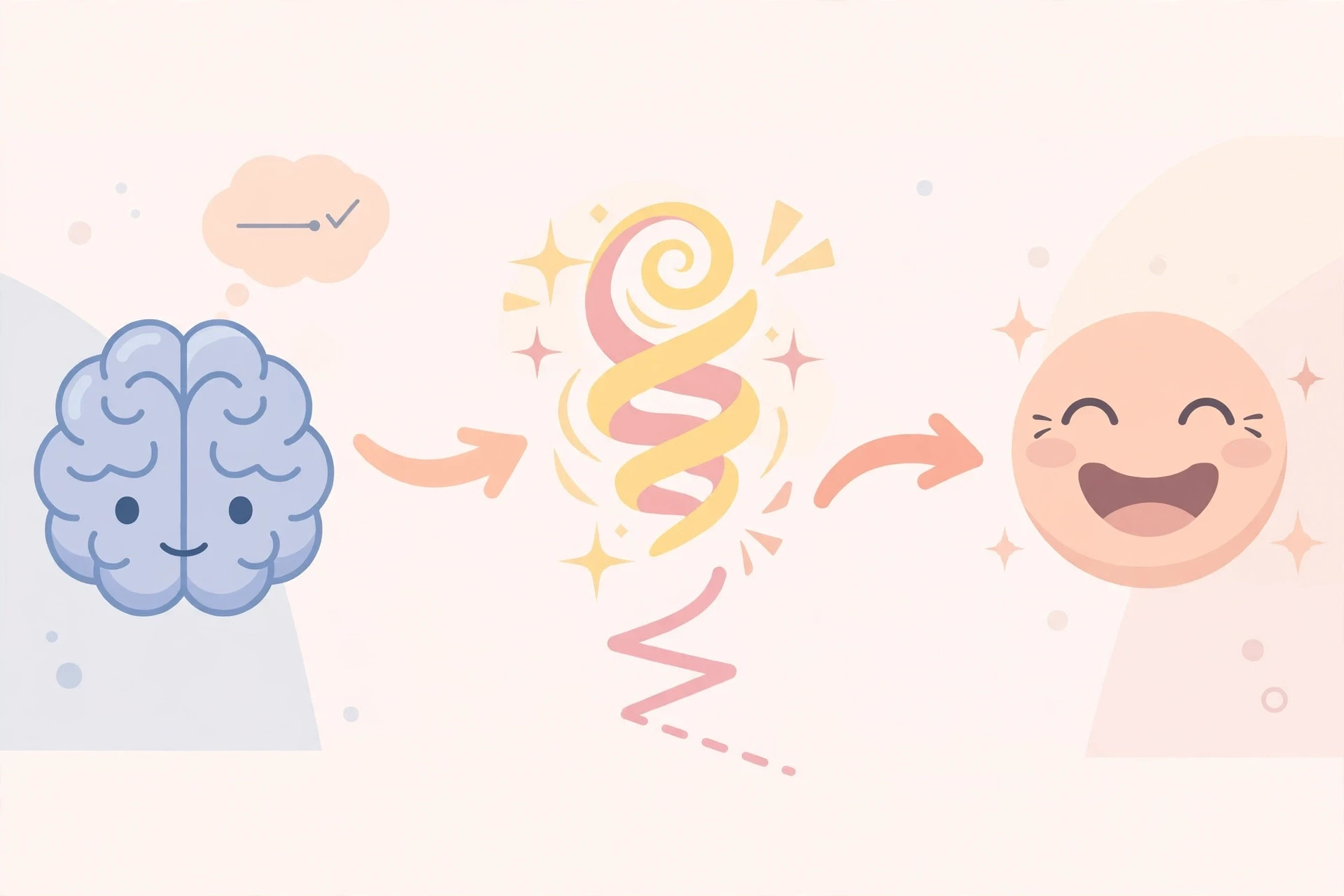
The most widely accepted theory today is incongruity theory. We laugh when something violates what we expected — and then, in a flash, the violation makes a new kind of sense. A joke sets up a pattern, your brain predicts where it is going, and the punchline goes somewhere else entirely. The surprise is the engine; the resolution is the reward.
Consider a simple pun — one of the clearest demonstrations of why do we laugh at wordplay. "I used to be a banker, but I lost interest." Your brain first reads "interest" as enthusiasm, then the banking context flips the meaning to money. Two incompatible meanings sit side by side for a split second, and the click of resolving them is what feels funny. Harvard's account of joke processing describes exactly this sequence: the frontal lobe searches for a pattern, the punchline breaks it, and the brain shifts from information processing toward an emotional response in the reward centres. That shift — from thinking to feeling — is the moment of the laugh.
Incongruity also explains why timing matters so much. A punchline delivered too slowly lets the brain solve the puzzle early, and the surprise evaporates. Delivered too fast, the brain cannot resolve the mismatch at all, and the joke reads as confusion rather than humour. The best comedians live in the narrow gap between those two failures.
2.2 Relief: laughter as a release valve
Sigmund Freud proposed the relief theory: laughter releases pent-up nervous energy. Jokes about sex, death, aggression, and other forbidden topics let us touch what is normally off-limits, and the laugh is the discharge of the tension that builds up around those subjects. This is why a joke in a tense room can feel like opening a window. The tension was already there; the joke gave it somewhere to go.
I felt this once in a meeting where a serious project had just failed and the whole team was sitting in miserable silence. Someone made a small, self-deprecating joke about the disaster — nothing brilliant — and the room dissolved. Nobody was amused by the failure. We were relieved to be allowed, for a second, not to carry it so heavily. Relief theory explains that laugh better than any other theory does.
Modern psychology has softened Freud's version of the idea. We no longer talk much about repressed psychic energy as Freud imagined it. But the core observation holds: laughter often follows the release of tension, and jokes about taboo subjects work partly because they let us approach what frightens us from a safe distance.
2.3 Superiority: laughing down, and laughing with
The oldest theory of all is superiority theory, traced back to Plato and Thomas Hobbes. We laugh, on this view, when we feel suddenly superior to someone else — at the fool, the pratfall, the person who slips on the ice. The laugh says, in effect, "glad that was not me."
There is an uncomfortable grain of truth here. Slapstick comedy is built on it. So is a great deal of schoolyard humour and, less happily, mockery. But superiority theory on its own is too narrow and too unkind. It cannot explain why we laugh at our own mistakes, or at absurd situations where nobody is inferior to anybody, or at a clever pun. It also misses something important: the laughter at a pratfall is often affectionate rather than cruel. We laugh at the person who trips partly because we recognise ourselves in them — we have all been that person. The superiority is real, but it is usually mixed with recognition and relief.
2.4 Benign violation: the theory that ties them together
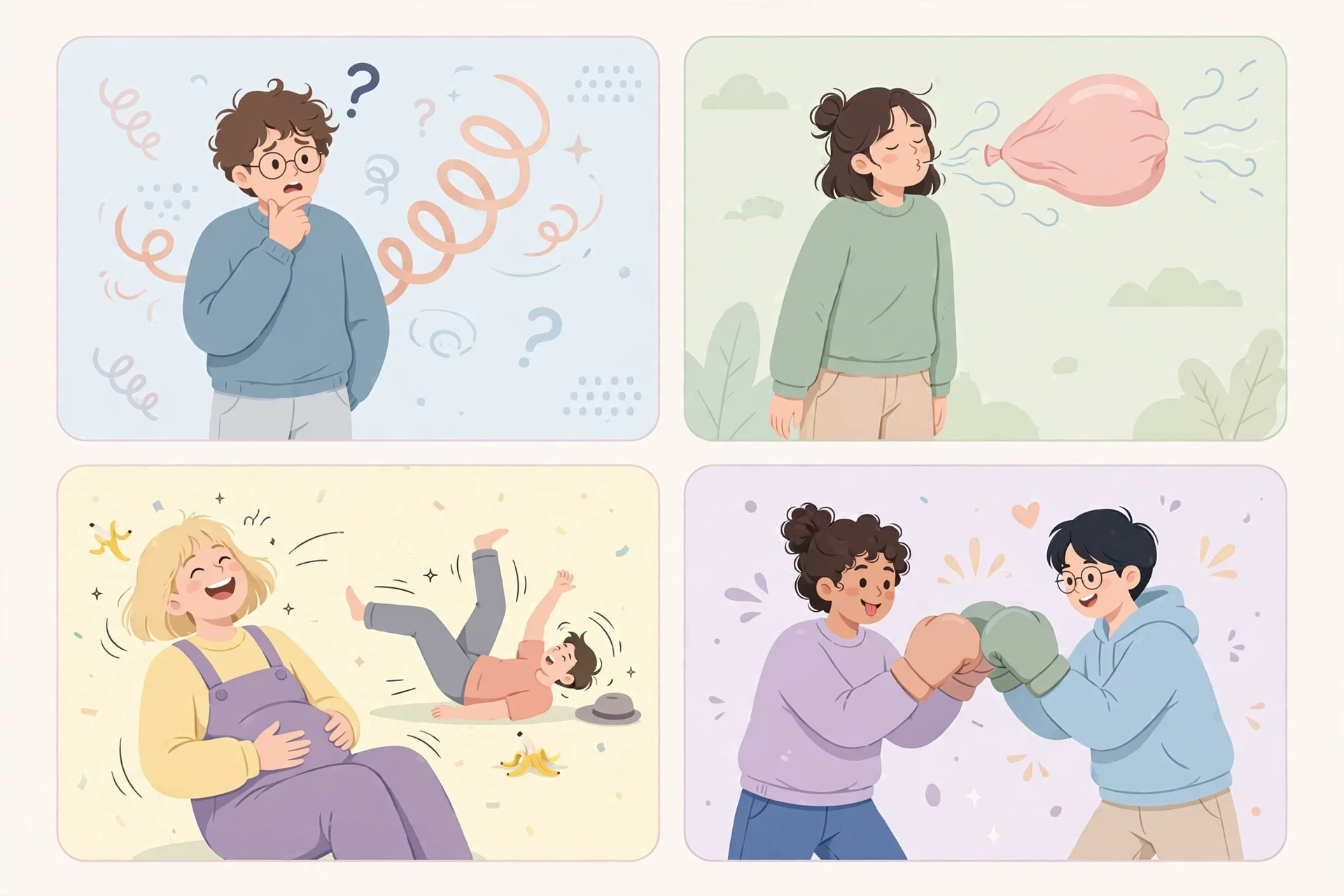
In 2010, researchers Peter McGraw and Caleb Warren proposed the benign violation theory, and it has become the most influential modern synthesis. Their claim is simple: something is funny when it is simultaneously a violation and benign. A violation is anything that threatens how we think the world should be — a broken expectation, a broken rule, a threat to the body or to dignity. Benign means it also seems safe, acceptable, or okay. Both appraisals have to happen at the same time.
Play-fighting is the textbook example. A child being tickled or mock-wrestled experiences something that looks like an attack — a violation — but in a context that is plainly safe. A joke about a tragedy can be funny years later, when time has made the violation feel distant and therefore benign, but the same joke told the day after the event feels cruel. That is the famous "too soon" rule, and benign violation theory explains it precisely: the violation has not yet become benign.
The theory also explains why distance matters. McGraw's experiments showed that severe violations, like tragedies, become funnier with psychological distance — time, geography, or social distance — while mild violations, like small mishaps, are funnier when they feel close. Distance makes the big things safe enough to laugh at; closeness keeps the small things threatening enough to matter.
Theory | Core idea | Explains best | What it misses |
|---|---|---|---|
Incongruity | An expectation is broken, then resolved in a surprising way | Puns, wordplay, plot twists, absurd comedy | Why some surprises are funny and others are just confusing |
Relief | Laughter releases built-up nervous tension | Taboo jokes, nervous laughter, laughter after stress | Jokes told when nobody is tense at all |
Superiority | We laugh at others' mistakes and misfortunes | Slapstick, mockery, laughing at fools | Laughing at ourselves, or at things where nobody loses |
Benign violation | Something is wrong and safe at the same time | "Too soon" jokes, play-fighting, dark humour | Pure silliness with no real violation at all |
Table 1: The four theories of humour compared. No single theory explains every laugh. Incongruity and benign violation do the most work in modern research, but relief and superiority each capture real cases the others miss.
2.5 Why there is no single answer
Most people assume one of these theories must be the right one and the others wrong. What the research actually shows is that they describe different routes to the same destination. A pun works through incongruity. A joke after bad news works through relief. A pratfall works through superiority softened by recognition. A dark joke told years after the event works through benign violation. Why do we laugh at such different things? Because laughter is not one mechanism. It is several mechanisms that happen to share the same sound.
3. What Happens in the Brain When a Joke Lands
3.1 The three-phase journey of a punchline
Brain-imaging studies give us a rough map of what happens when we get a joke. First, the frontal lobe works on the setup, searching for patterns and predicting what comes next. This is the same machinery we use to understand ordinary sentences. Second, when the punchline breaks the pattern, the brain has to do extra work — the prefrontal cortex, at the front of the frontal lobe, plays a central role in the flexible thinking needed to resolve the mismatch. Third, once the resolution clicks, the response shifts to the brain's reward circuitry, including the nucleus accumbens, and the body releases feel-good chemicals including dopamine, serotonin, and endorphins. Heart rate rises, the body jiggles, and the laugh comes out.
That sequence matters because it explains why "getting" a joke feels rewarding in itself — and it is a large part of why do we laugh at jokes rather than merely understanding them. The laugh is not only a reaction to the joke; it is the brain's way of marking a small cognitive victory. You solved a puzzle, and the reward system paid you for it. This is one reason humour and intelligence are linked in research: appreciating complex humour draws on the same flexible thinking that intelligence tests try to measure, though a good sense of humour is far broader than any test score.
3.2 Why some jokes leave you cold
The same brain map explains why jokes fail. If the prefrontal cortex cannot find a resolution — the punchline is too obscure, or it depends on knowledge you do not have — the reward system never fires, and the joke feels like a riddle with a missing answer. If the resolution comes too easily, there is no surprise to reward, and the joke feels flat. And if the violation feels threatening rather than benign, the brain's threat systems override the reward system entirely. That is the difference between a joke that lands and a joke that makes the room go quiet. The audience's brains all ran the same calculation, and most of them reached a different answer from the comedian's.
"Humor is an evoked response to storytelling and shifting expectations. Laughter is a social signal among humans. It's like a punctuation mark." — Carl Marci, Harvard Medical School
3.3 Laughter and the reward system
The involvement of the nucleus accumbens — a key part of the reward circuit — is worth pausing on. It is the same region that responds to food, music, and social approval. Laughter, in other words, is processed by the brain as a reward, not just as a reflex. This helps explain why we seek out comedy, why we rewatch funny films, and why a shared laugh with a friend can feel as satisfying as a good meal. It also explains why laughter is so hard to fake convincingly: the reward system is not easily fooled by a deliberate performance, and listeners can usually tell the difference between a genuine laugh and a polite one, even if they cannot say how.

4. Laughter Is Social: Why Do We Laugh 30 Times More With Others?
4.1 Provine's sidewalk science
If the brain section explains jokes, this section explains most of our actual laughter. Robert Provine, a psychologist at the University of Maryland, Baltimore County, took a radically different approach from the brain scanners. He went outside. He and his students observed 1,200 instances of naturally occurring laughter in shopping malls, cafeterias, and everyday conversations, recording who laughed, when, and at what. He called it "sidewalk neuroscience," and it overturned the assumption that laughter is mainly a response to humour.
His central finding is one of the most quoted numbers in all of psychology: in the absence of stimulating media such as television, radio, or books, people are about 30 times more likely to laugh when they are in a social situation than when they are alone. The speaker laughs more than the listener — about 46 per cent more often. And laughter punctuates speech the way punctuation marks a sentence, landing at the boundaries of phrases rather than interrupting them.
Think about your own life for a moment. When did you last laugh hard on your own? Probably while watching something or reading something — a social surrogate. Sitting alone in silence, people rarely burst out laughing. Put the same person in a room with a friend, and the laughs come easily, often at remarks that would not raise a smile on the page. The ingredient that matters most is not the joke. It is the other person.
4.2 What laughter is actually saying
If most laughter is not about humour, then why do we laugh so much in ordinary conversation? What is it for? The evidence points to bonding. Laughter signals safety, friendliness, and belonging. It tells the people around you: I am not a threat, I am with you, we are on the same side. That is why we laugh more with people we like and love, and why a shared laugh can make strangers feel like friends within minutes. It is also why laughter is so useful at the edges of awkward moments — after a small embarrassment, during an introduction, when a conversation stalls. The laugh smooths the moment and keeps the interaction going.
This social function also explains a pattern most of us have noticed but never named: we laugh more when we are the ones speaking. The speaker's laugh is often a signal to the listener — "this is friendly, stay with me" — rather than a response to anything funny. Once you notice this, you start hearing it everywhere: in meetings, in interviews, in first dates. The room is full of small laughs that have nothing to do with jokes and everything to do with keeping the social fabric intact.
4.3 Laughter as social glue — and social pressure
There is a gentler side to this, and a harder one. The gentle side is that shared laughter builds relationships. Couples who laugh together report stronger bonds, and researchers who study long-term marriages have found that shared humour is one of the things that helps couples weather hard times. A laugh in the middle of an argument can break the tension and remind both people that they are on the same team. It is hard to stay furious at someone you have just laughed with.
The harder side is that laughter is also a tool of social pressure. We laugh along with a group even when we do not find something funny, because not laughing would mark us as outsiders. We laugh at a boss's weak joke for the same reason. And laughter can exclude as easily as it includes — the group laughing at someone rather than with them is using the same signal as a weapon. Understanding why do we laugh means accepting both sides. The same sound that bonds a friendship can enforce a hierarchy.
5. Contagious Laughter: Why One Laugh Sets Off a Room
5.1 The laugh that spreads
Everyone has lived this: one person starts laughing in a quiet room, and suddenly nobody can stop. At the wedding I described at the start, a single snort from the back of the room was enough to release a hundred people. Contagious laughter is one of the most reliable phenomena in psychology, and Provine demonstrated it experimentally as early as 1992: hearing a recording of laughter alone, with no joke and no context, was enough to make listeners laugh or smile.
The mechanism seems to involve the brain's mirroring systems. Hearing someone laugh activates the premotor cortex — the region involved in producing movements — almost as if you were laughing yourself. Your brain prepares the laugh before you have decided to laugh. This is similar to how a yawn spreads, and it probably evolved for the same reason: to synchronise a group's emotional state quickly. When one member of a group signals safety and pleasure, the rest of the group catches it within seconds.
5.2 Why recorded laughter works — and why it sometimes does not
Television discovered this long before psychology did. The laugh track, invented in the 1950s, exists because recorded laughter makes a show feel funnier. It primes the audience's mirroring systems and signals that this is a moment for shared amusement. Modern comedies mostly dropped the laugh track, but the principle survives in a different form: watch a comedy alone, then watch the same episode with friends, and it will feel funnier the second time — which is one more clue to why do we laugh more in company than on our own. The jokes have not changed. The social context has.
There is a limit, though. A laugh track laid over a joke that is not funny feels manipulative, and audiences notice. Contagion amplifies amusement; it cannot create it from nothing. The same applies in real life. A room full of people laughing will pull you in — but only if the laughter feels genuine. A forced, performative laugh is contagious in a different way: it makes everyone else uncomfortable.
5.3 Tickling: the laugh you cannot control
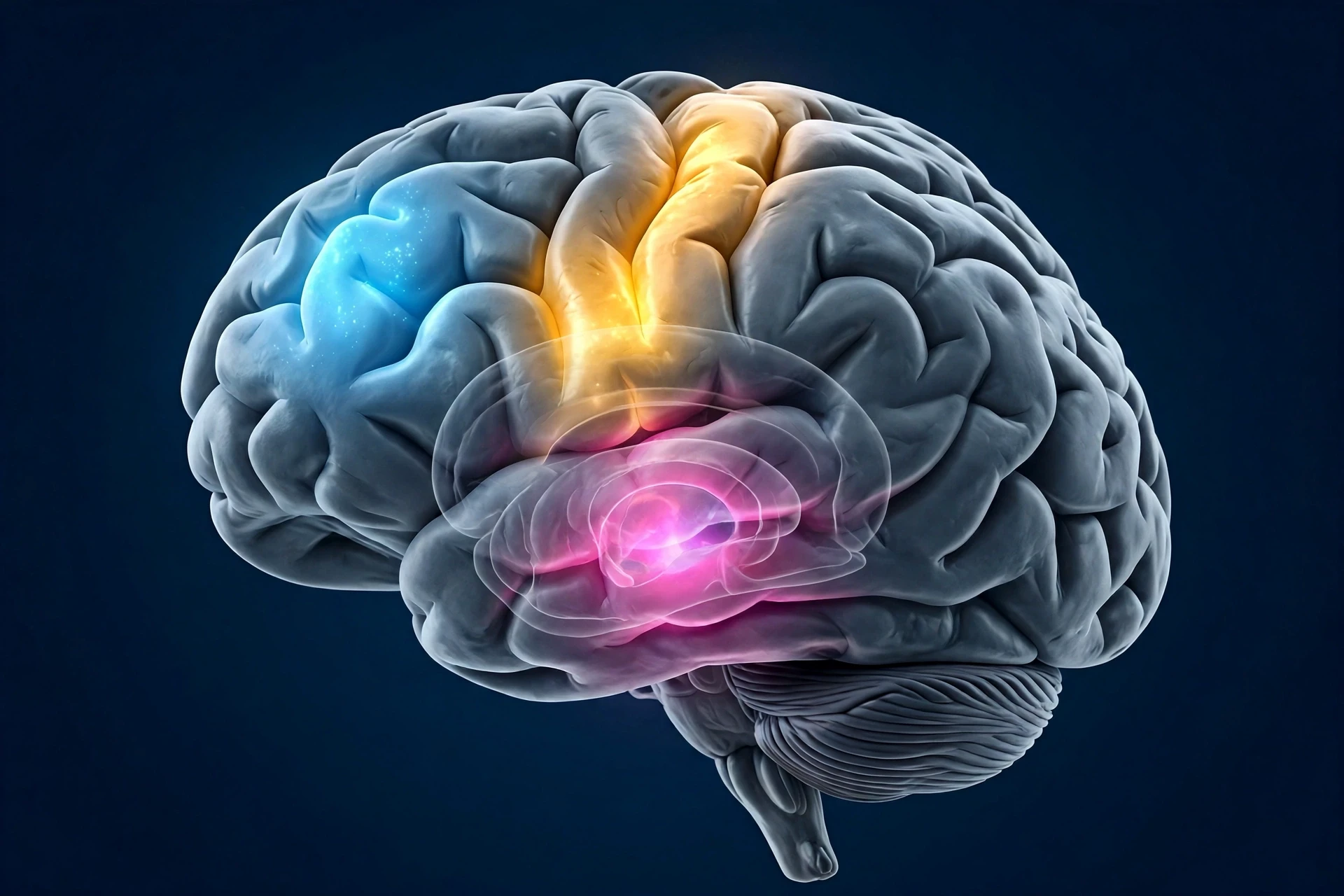
Tickling is the strangest corner of contagious laughter. You cannot tickle yourself into laughing — the brain predicts your own touch and cancels the response — but someone else's fingers on your ribs can produce helpless laughter even when nothing is funny. Scientists still do not fully understand why. The response involves the hypothalamus, which helps regulate mood and bodily states, the amygdala, where emotions are processed, and the cerebellum, which is involved in predicting sensory consequences. One leading idea is that tickling began as a form of play-fighting in young primates: a mock attack that teaches the young to defend vulnerable parts of the body while signalling that the attack is not real. The laughter is the signal that says "this is play."
I learned this the hard way with my nephew, who at three years old discovered that tickling his uncle was the funniest game in the world. He would chase me around the living room, and I would laugh until I could barely breathe — not because anything was funny, but because the game itself, the chase and the touch and his delighted shrieks, was pure social joy. That is tickling in miniature: a benign violation, a social bond, and a laugh that nobody chose.

6. The Four Humour Styles: What Your Jokes Say About You
6.1 More than a "sense of humour"
People talk about having a "good sense of humour" as if it were one thing. Psychologist Rod Martin and his colleagues showed that it is at least four. Their Humor Styles Questionnaire, developed in 2003, divides humour into four styles, two broadly helpful and two broadly harmful. The styles describe how a person habitually uses humour, not whether they are funny.
Affiliative humour — joking to connect with others, telling funny stories, easing tension in a group. This is the warm, inclusive style, and it is linked with stronger relationships and better social adjustment.
Self-enhancing humour — finding something to laugh at in your own difficulties, keeping perspective when things go wrong. This is the style most strongly linked with resilience and positive mental health.
Aggressive humour — put-downs, mockery, teasing that targets others. It can get laughs, but it is linked with poorer relationships and, over time, with loneliness.
Self-defeating humour — laughing at yourself in a way that puts you down, using yourself as the butt of the joke to win approval. It often masks low self-esteem, and it is linked with higher rates of anxiety and depression.
6.2 Why the style matters more than the joke
Two people can tell the same joke and mean opposite things. One uses it to include the room; the other uses it to wound someone in it. The difference is the style, and people are remarkably good at detecting it. We trust the affiliative joker and keep our distance from the aggressive one, even when the jokes themselves are equally clever. This is one reason humour is such a useful signal in dating and friendship: it reveals, quickly and cheaply, how a person treats other people when they have the floor.
It is also why the question of why do we laugh has a personality dimension. Our humour style is part of who we are, and it shapes the rooms we are welcome in. The self-enhancing style is particularly interesting, because it looks like a skill that can be practised. People who learn to find a lighter angle on their own setbacks — not denying the problem, just refusing to be crushed by it — tend to cope better with stress. That is not the same as "just laugh it off," which is usually unhelpful advice. It is closer to perspective-taking: the ability to see your own situation from a slight distance, where it looks smaller and more manageable.
7. Laughing When Nothing Is Funny
7.1 Nervous laughter
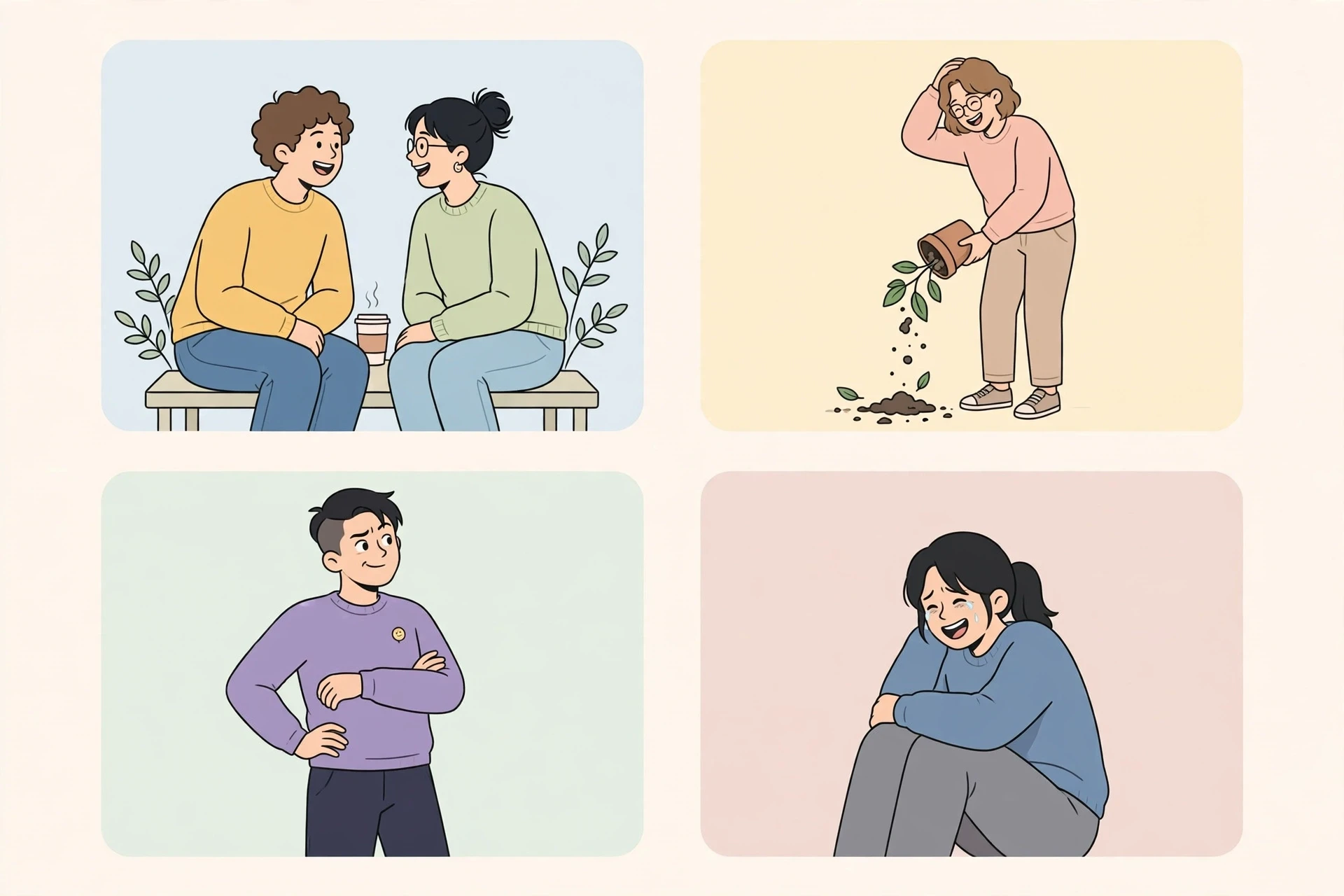
Some of the most revealing laughter happens in the worst moments. People laugh at funerals, in hospital waiting rooms, when they are told bad news, and when they are frightened. This is nervous laughter, and it is not a sign of callousness. It is the relief system firing under stress: the body is flooded with tension, and laughter is one of the few release valves it has. The person laughing is often horrified at themselves, which only adds to the tension, which produces more laughter. It is a miserable loop, and anyone who has been caught in it knows how little control you have over it.
Understanding this changes how we judge other people. The colleague who laughed when the project failed was not celebrating the failure. The friend who giggled while telling you about a frightening diagnosis was not taking it lightly. Their nervous system was doing what nervous systems do under overload. Compassion, in those moments, is worth far more than a raised eyebrow.
7.2 Polite laughter
Then there is the laughter we perform on purpose. The polite chuckle at a boss's joke, the social laugh when we have not understood what was said, the "ha ha" typed into a message when we are not laughing at all. These are social signals in their purest form — laughter as punctuation, exactly as Marci described it. They keep conversations smooth and relationships intact, and there is nothing dishonest about them. They are the social equivalent of saying "good morning" when you are tired. The signal matters more than the feeling behind it.
Typed laughter is an interesting modern case. "Haha," "lol," and the laughing emoji have become so detached from actual laughter that researchers now treat them as discourse markers — ways of softening a message, signalling friendliness, or marking irony — rather than reports of laughing. When someone writes "lol" they are usually not laughing out loud. They are telling you how to read the sentence.
7.3 Laughter, gender, and culture
Laughter is universal, but its rules vary — and culture is part of why do we laugh differently in different rooms. In some cultures, loud public laughter is encouraged; in others, it is considered rude, especially for women. Men and women laugh at slightly different things on average, and they use laughter differently in conversation — research has found, for example, that women tend to laugh more in mixed company, while men tend to be the ones trying to make others laugh. These are averages with wide overlap, not rules, and they shift with context. But they are a reminder that why do we laugh is not only a question about brains. It is also a question about the room, the culture, and who is allowed to be loud in it.
8. How Laughter Grows Up: Children, Play, and Evolution
8.1 Babies laugh before they speak
Babies typically begin laughing at around three to four months old, long before they can talk, walk, or understand a joke. Their first laughs come from peekaboo, from being tossed gently in the air, from a parent making a silly face. These are all benign violations in miniature: something disappears and returns, the world tilts and rights itself, an expectation breaks and resolves safely. The baby's laugh is both a delight response and a social signal — it tells the caregiver "do that again," and it strengthens the bond between them.
This early start is strong evidence that laughter is not learned from culture alone. It is built into us. Children who are deaf and blind from birth still laugh, and they laugh in the same way as other children, with the same sounds and the same timing. You cannot learn a behaviour you have never seen or heard. Laughter, like crying, arrives with the hardware.
8.2 Play, pretend, and the roots of humour
As children grow, their humour grows with them. Toddlers laugh at the absurd — a shoe on a head, a word said backwards. School-age children love riddles and knock-knock jokes, which are really incongruity puzzles with training wheels. Teenagers discover sarcasm, irony, and the social power of a well-timed joke. Each stage matches a stage of cognitive development, and each stage answers why do we laugh at different things as we grow: you cannot enjoy a joke that depends on a mental skill you have not built yet. This is why a five-year-old's favourite joke bores a fifteen-year-old, and why a fifteen-year-old's sarcasm flies over a five-year-old's head.
Play is the thread that runs through all of it. The rough-and-tumble play of young mammals, the peekaboo of babies, the pretend games of children — all of them involve mock threats in safe contexts, the exact structure of a benign violation. Some researchers think humour evolved from play: the laugh that once said "this attack is not real" became, over evolutionary time, the laugh that says "this idea is wrong, but safely wrong." If that is right, then every joke is a distant descendant of a game.
8.3 Why humans laugh and other animals mostly do not
Other animals have something like laughter. Rats make ultrasonic chirps when tickled. Chimpanzees pant-laugh during play. Dogs have a breathy pant that other dogs recognise as a play signal. But human laughter is louder, more varied, and far more woven into communication than any animal equivalent. We are the only species that laughs at ideas — at a pun, at an irony, at a story told well. That is because only humans have the kind of language and shared expectations that make incongruity possible. You cannot enjoy a broken expectation without expectations, and our expectations are built from language, culture, and a lifetime of shared social rules. Humour, in the end, is a side effect of having a mind that predicts the world — and delights in being wrong.
9. Is Laughter Good for Your Health? An Honest Answer
9.1 What the evidence actually supports
This is the section where most articles about laughter go wrong, so let us be careful. You will find claims online that laughter cures disease, boosts immunity dramatically, burns hundreds of calories, or adds years to your life. Almost none of that is proven. What the evidence does support is more modest — and still worth having.
Laughter genuinely helps with stress in the short term. When you laugh, you take in more oxygen-rich air, your heart rate rises and then falls, your muscles tense and then relax, and your body releases endorphins. The Mayo Clinic's summary of the research describes this as activating and then relieving the stress response — a rollicking laugh fires the stress system up and then cools it down, leaving you more relaxed than before. A 2023 systematic review and meta-analysis of interventional studies found that spontaneous laughter was associated with lower cortisol levels, the stress hormone, though the authors noted the studies were small and varied in quality. That is a real effect with honest limits attached.
Laughter also seems to help mood. People who laugh more report feeling happier, and laughter-based interventions have shown small positive effects on depression and anxiety symptoms in clinical studies. But the effects are modest, and laughter is one coping tool among many — not a substitute for treatment when someone is struggling. For readers dealing with anxiety and depression, that distinction matters: laughter can be part of a good day, but it is not a treatment plan.
9.2 What the evidence does not support
Here is where the honesty has to be blunt. Laughter has not been shown to cure cancer, prevent heart disease, or replace exercise. The famous claim that laughing for fifteen minutes burns as many calories as a workout is a wild exaggeration — a good laugh burns a few extra calories, roughly the equivalent of walking slowly for the same time, not running a marathon. Claims about laughter "boosting the immune system" rest mostly on small, short-term studies measuring immune markers in saliva or blood after a comedy video; those markers move, but nobody has shown that the movement translates into fewer colds or infections. The gap between a lab measurement and a real health outcome is exactly where most overclaims live.
"A good sense of humor isn't a cure for everything, but research is growing about the positive things laughter can do." — Mayo Clinic
9.3 Why the overclaims spread
The overclaims spread because we want them to be true — and because asking why do we laugh feels like it should have a medical answer, when the real answer is mostly social. Laughter feels healing, and it is tempting to turn a feeling into a fact. But the feeling is the benefit. A shared laugh with a friend lowers stress, lifts mood, and strengthens a bond — and those three things, repeated over a lifetime, are genuinely good for health. That is the real story, and it does not need exaggeration. The science of happiness reaches a similar conclusion: the things that make us lastingly happier are mostly social — close relationships, shared experiences, a sense of belonging — and laughter is one of the cheapest, most reliable ways to get more of them. You do not need laughter to be medicine. You need it to be what it already is: a signal that you are safe, connected, and, for a moment, delighted by a world that surprised you.

10. Common Misconceptions About Why We Laugh
10.1 "We only laugh at things that are funny"
The most common misunderstanding, and the one Provine's 1,200 laughs demolished. Only 10 to 20 per cent of everyday laughter follows a joke, which is the single most surprising fact about why do we laugh. Most of it is social — a signal of friendliness, agreement, or relief. If you only study jokes, you miss most of laughter.
10.2 "Laughter is the best medicine"
Laughter helps with stress and mood, and shared laughter strengthens relationships. It does not cure disease, and the research behind the bigger health claims is small, short-term, and often overstated. Treat laughter as a useful part of a healthy life, not as a treatment.
10.3 "People who laugh a lot are always happy"
Some of the funniest people are also the most troubled. Self-defeating humour — laughing at yourself to win approval — is linked with anxiety and low mood, and comedians have famously high rates of mental-health struggles. Laughter can mask distress as easily as it expresses joy. The laugh tells you someone is signalling, not necessarily how they feel.
10.4 "A good sense of humour is one thing"
It is at least four styles, and they point in different directions. Affiliative and self-enhancing humour help; aggressive and self-defeating humour harm. Asking whether someone "has a sense of humour" is the wrong question. Ask how they use it, and on whom.
10.5 "Contagious laughter means the joke was good"
Contagion amplifies amusement; it does not create it. A laugh track can make a weak joke feel funnier, and a room full of laughing friends can make an average evening feel wonderful — but the mechanism is social mirroring, not the quality of the material. Enjoy the amplification, and do not mistake it for evidence.
10.6 "You can tickle yourself"
You cannot, and the reason is revealing. Your brain predicts the sensory consequences of your own movements and cancels them out, so self-tickling produces no surprise and no laugh. Tickling needs another person — which is fitting, because so does most laughter.
11. Conclusion: The Sound of Being Wrong Together
The best man's joke did not become funny between the silence and the roar. The room changed. One person's laugh gave everyone else permission, the mirroring systems did their work, and the violation — a grown man telling a story about his friend locked out in his underwear — finally registered as benign. The punchline was the same. The social context was different. That is the story of laughter in miniature.
So why do we laugh? We laugh because our brains love resolving a broken expectation, and the reward system pays us for it. We laugh because tension needs somewhere to go, and a joke can open the valve. We laugh because we feel briefly superior, and because we recognise ourselves in the person who fell. We laugh because something was wrong and safe at the same time. Most of all, we laugh because we are with other people, and laughter is how we tell them we belong to each other.
That last reason is the one I keep coming back to. The brain science is real, the theories are useful, and the health benefits — modest as they are — are worth having. But the deepest answer to why do we laugh is not in a scanner or a theory. It is in a room full of people, laughing at something that would not be funny alone, and feeling, for a moment, less alone in the world. The joke is the excuse. The laughter is the point.
Frequently Asked Questions
Why do we laugh?
We laugh for several reasons, not one — and that is the short answer to why do we laugh. We laugh when an expectation is broken and then resolved in a surprising way, when tension is released, when we feel briefly superior, and when something is both a violation and safe at the same time. Most everyday laughter, though, is social rather than humorous — a signal of friendliness, belonging, and safety that we use to keep relationships smooth.
Why do we laugh more with other people than alone?
Research by Robert Provine found that people are about 30 times more likely to laugh in social situations than when alone, once you set aside laughing at television, radio, or books. Laughter is primarily a social signal, and hearing others laugh activates mirroring systems in the brain that prime us to laugh too. The speaker in a conversation laughs about 46 per cent more often than the listener.
Why is laughter contagious?
Hearing laughter activates the brain's premotor cortex almost as if you were laughing yourself, which primes the laugh response before you have consciously decided to laugh. Provine showed experimentally that hearing a recording of laughter alone, with no joke attached, is enough to make listeners laugh or smile. Contagion helps a group synchronise its emotional state quickly.
Why do we laugh when we are nervous?
Nervous laughter is the body's release valve under stress. When tension floods the system — at a funeral, in a tense meeting, after bad news — laughter discharges some of that tension, even though nothing is funny. The person laughing usually cannot control it and is often embarrassed by it. It is a sign of overload, not of callousness.
Is laughter really good for your health?
Laughter has real but modest benefits: it activates and then relieves the stress response, releases endorphins, relaxes muscles, and is associated with lower cortisol in a 2023 systematic review and meta-analysis. It can lift mood and strengthen relationships. It has not been shown to cure disease, prevent illness, or replace exercise, and claims that it does are overstatements of small, short-term studies.
Why can't you tickle yourself?
Your brain predicts the sensory consequences of your own movements and cancels them out, so self-tickling produces no surprise and no laugh. Tickling requires another person's unpredictable touch, which is why it involves brain regions for mood, emotion, and sensory prediction. It is one more reminder that laughter is built for social life.
Sources
Harvard Medical School — Humor, Laughter, and Those Aha Moments. https://hms.harvard.edu/news/humor-laughter-those-aha-moments
American Psychological Association — A laughing matter: Robert Provine on the science of laughter. https://www.apa.org/monitor/jun06/laughing.html
American Psychological Association — Humor and health: what the research says. https://www.apa.org/monitor/2017/02/humor
Provine, R. R. — Laughter. American Scientist, 1996 (via UCLA CogWeb). http://cogweb.ucla.edu/Abstracts/Provine_96.html
McGraw, A. P. & Warren, C. — Benign violations and humour (Frontiers in Psychology, 2019). https://www.frontiersin.org/journals/psychology/articles/10.3389/fpsyg.2019.01380/full
Mayo Clinic — Stress relief from laughter? It's no joke. https://www.mayoclinic.org/healthy-lifestyle/stress-management/in-depth/stress-relief/art-20044456
Kramer, C. K. et al. — Laughter as medicine: systematic review and meta-analysis of laughter and cortisol (PLOS ONE, 2023). https://journals.plos.org/plosone/article?id=10.1371/journal.pone.0286260