

I was seven years old the first time I swallowed a mouthful of seawater, and I have never forgotten the shock of it. One second I was diving under a wave, feeling brave; the next I was coughing on the sand, my mouth full of something bitter and stinging that made my eyes water. An adult laughed and said, "That's the sea for you." But the question stuck with me far longer than the taste did. Why is the ocean salty? The water in the river near my home was not salty. The rain was not salty. So where did all that salt come from, and why did it end up in the sea and nowhere else?
It turns out that this simple question — one of the first that children ask about the natural world — opens a door into almost the whole of Earth science. To answer it properly you need chemistry, geology, a little physics, and about four billion years of planetary history. The salt in the sea is not there by accident, and it is not there because someone put it there. It is the slow, patient result of rain falling on rock, rivers carrying the pieces away, volcanoes breathing minerals into the deep, and a planetary balancing act that keeps the whole system steady. The ocean is salty because the Earth is a machine for dissolving rock and delivering it to the sea — and because the sea, remarkably, knows how to get rid of almost exactly as much salt as it receives.
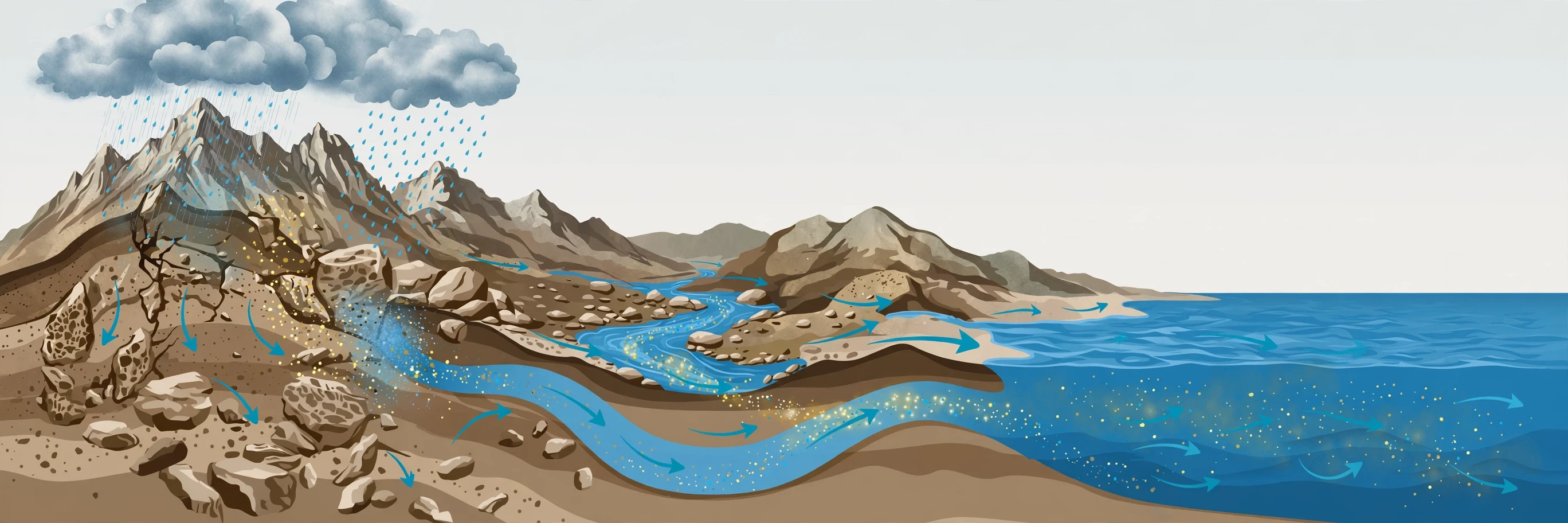
The short answer is this: rainwater is slightly acidic, and as it falls on land it dissolves tiny amounts of minerals from rocks and soil. Rivers collect those dissolved minerals and carry them to the sea. The water then evaporates back into the sky, but the minerals stay behind. Over billions of years, that one-way delivery built up the salt we taste today. Yet the ocean does not grow saltier every year, because salt also leaves the sea — buried in sediments, sprayed into the air, locked into rocks on the seafloor. The result is a balance, and that balance is the real story of why the ocean is salty.
1. What Salinity Actually Means
Before we chase the salt to its source, we need to be clear about what we are measuring — because any good answer to why is the ocean salty starts with a number. When scientists talk about how salty the sea is, they use the word salinity, and they measure it in parts per thousand, written with the symbol ‰. The average salinity of the open ocean is about 35 parts per thousand. That means that in every kilogram of seawater — roughly a litre — there are about 35 grams of dissolved salts. A litre of seawater holds about as much salt as two heaped tablespoons of table salt, dissolved so completely that you cannot see a single grain.
That number, 35, is one of the most stable figures in all of ocean science. Measure seawater off the coast of Hawaii, or in the middle of the Atlantic, or near the Antarctic ice, and you will get numbers that cluster close to it. But the word "close" matters. Salinity is not identical everywhere. It ranges from around 32 to 38 parts per thousand across most of the open ocean, and it goes far beyond those limits in special places. The Dead Sea, which is not a sea at all but a landlocked lake, reaches about 340 parts per thousand — nearly ten times saltier than the ocean. At the other extreme, the water of the Baltic Sea can fall below 10 parts per thousand near its river-fed northern end. Those exceptions are not noise. They are clues, and we will come back to them.
1.1 Salt Is Not Just Sodium Chloride
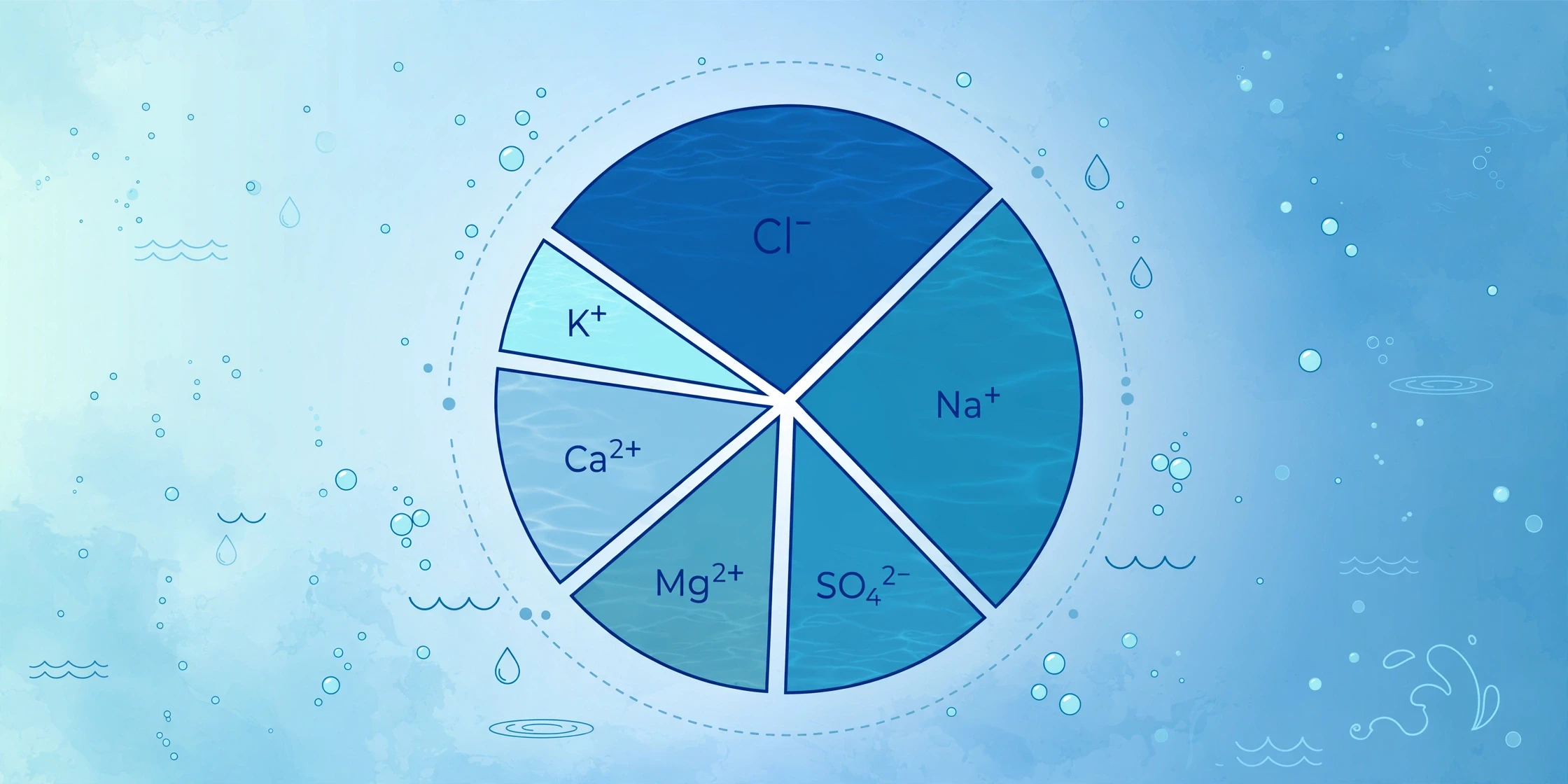
When most of us say "salt", we mean the white crystals in the shaker on the table — sodium chloride. Seawater contains plenty of sodium chloride, but it is not the whole story. The dissolved material in seawater is a cocktail of ions: atoms and molecules carrying an electrical charge, left over when minerals dissolve in water. Chloride ions make up about 55 percent of the dissolved solids, and sodium ions about 31 percent. Together they dominate, which is why seawater tastes like table salt. But the remaining 14 percent is a cast of supporting characters that matter enormously to marine life and to the chemistry of the planet: sulfate, magnesium, calcium, potassium, and bicarbonate, along with traces of almost every other element on the periodic table.
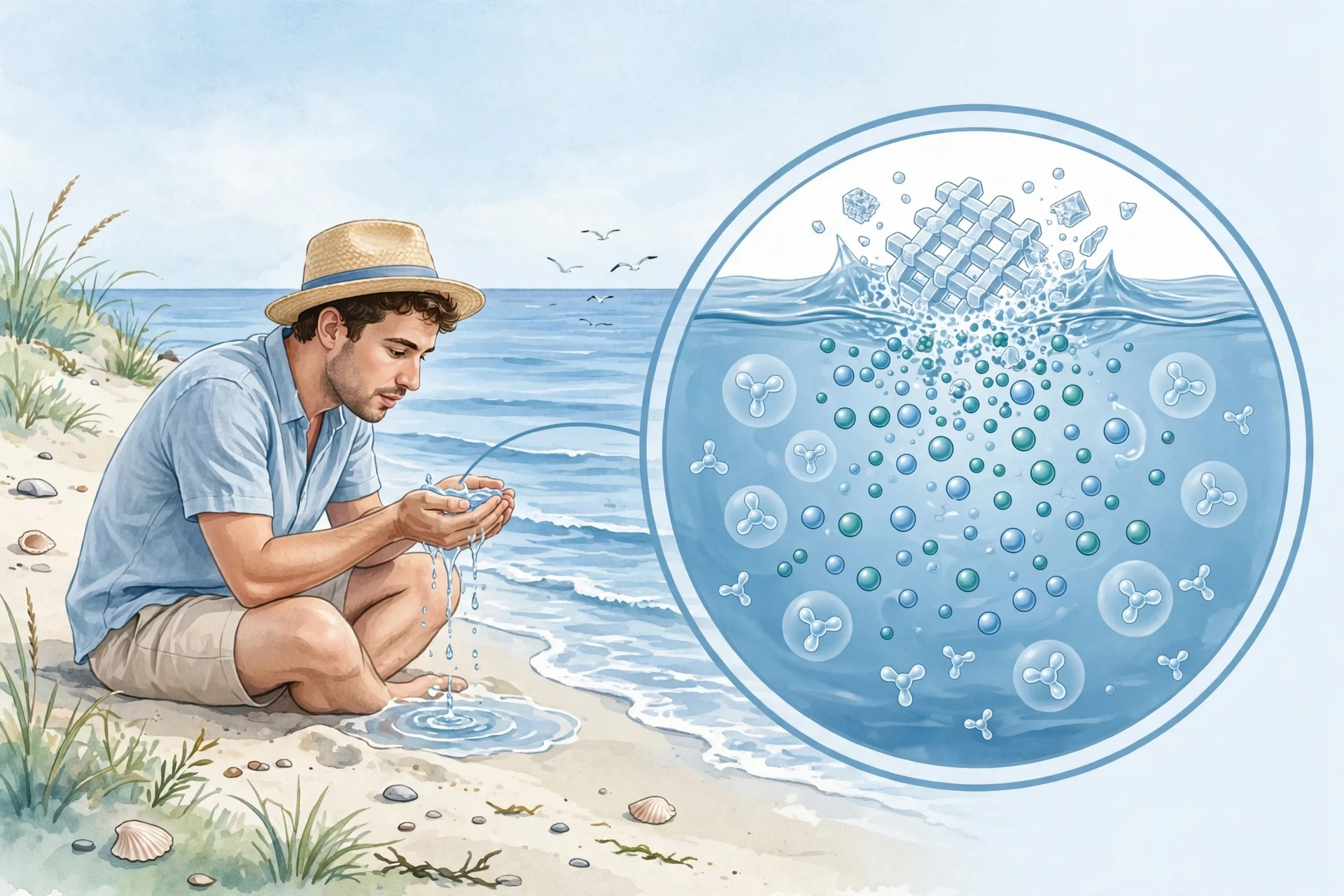
That mixture is not random. The proportions of the major ions in seawater are strikingly constant wherever you sample the open ocean — a principle oceanographers call the constancy of composition. The total amount of salt can vary, but the recipe barely changes. This tells us something important: the ocean is well mixed, and the processes that add and remove salt have been running long enough to smooth out local differences. A litre of water from the Pacific and a litre from the Indian Ocean are, chemically speaking, close cousins.
1.2 How Scientists Measure Saltiness
The earliest measurements were brutally simple: take a known weight of seawater, boil it dry, and weigh the salt left behind. That method works, but it is slow and clumsy, and some salts react with heat, so the results were never quite exact. Modern oceanographers rarely measure salt by drying it at all. Instead they measure how well the water conducts electricity, because dissolved ions carry current, and the more ions there are, the better the water conducts. A probe lowered from a ship can read conductivity — and therefore salinity — continuously as it sinks through the water column, building a profile of saltiness from surface to seafloor in minutes.
I once watched a technician on a research vessel lower such a probe over the side and call out numbers as it descended, and what struck me was how boring most of the readings were — 35.0, 35.1, 34.9 — until the probe passed through a layer of fresher water near a river mouth and the numbers dropped sharply. That sudden step was the whole story of the ocean in miniature: mostly uniform, with sharp exceptions wherever fresh water or heavy evaporation intervenes.
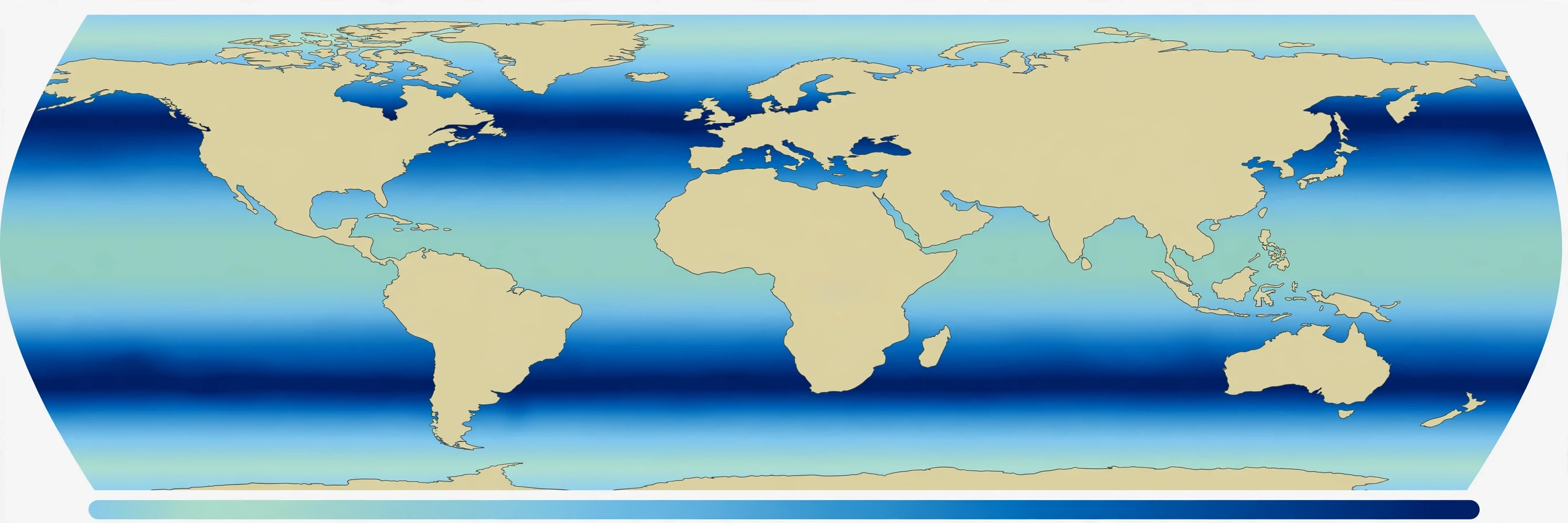
Today, satellites add a third way of measuring. NASA's Aquarius mission, launched to map ocean salinity from space, measured the faint microwave glow of the sea surface, which changes with salt content. From orbit, scientists could watch the great salty patches of the subtropics and the fresh lenses of the rainy equator shift with the seasons. The NASA Aquarius mission gave us the first truly global, continuous picture of where the ocean is salty and where it is not — and the patterns it found matched, beautifully, the physics of rain, evaporation, and wind.
1.3 Why 35 Parts per Thousand Matters
Thirty-five parts per thousand sounds like a small number until you multiply it by the size of the ocean. The oceans hold roughly 1.35 billion cubic kilometres of water. Dissolved in that water is an almost unimaginable quantity of salt — on the order of fifty thousand trillion tonnes. If you could somehow extract all of it and spread it evenly over the dry land of the Earth, it would bury the continents under a layer more than 150 metres thick. Every beach holiday, every ship, every whale swims in a solution that, in total, outweighs the rock of entire mountain ranges.
That figure also matters for life. The salt concentration of seawater sets the rules for every cell in the ocean. Seawater is saltier than the fluids inside most marine animals, so water constantly tends to leak out of their bodies by osmosis, and they must drink seawater and pump the excess salt out through gills or kidneys to survive. Freshwater fish face the opposite problem: their bodies are saltier than the river, so water floods in and they must constantly excrete it. The 35-parts-per-thousand figure is not just a chemical curiosity. It is the environment in which ocean life evolved, and it has shaped the physiology of everything from plankton to blue whales.
2. Why Is the Ocean Salty? The First Serious Answer
The first person to give a serious scientific answer to the question of why the ocean is salty was Edmond Halley — the same Halley of the comet — writing in 1715. Halley noticed what anyone who has watched a river can notice: rivers carry dissolved minerals to the sea, and the sea has no outlet. Water leaves by evaporation, but salt does not evaporate with it. So, he reasoned, the salt must accumulate, year after year, century after century, until the sea reached its present saltiness. The logic was clean, and it led Halley to a bold proposal: if you could measure how fast rivers deliver salt and how salty the sea already is, you could calculate the age of the Earth itself.
Halley was wrong about the age of the Earth — wildly wrong, as it happens, because the ocean does not simply accumulate salt without limit — but he was right about the mechanism. Rivers really are the main delivery service for salt. And his mistake is instructive, because it points directly at the deeper question. If rivers have been pouring salt into the sea for billions of years, why is the ocean not far saltier than it is? The answer to that question is the second half of the story, and it took another two centuries of ocean science to work out.
2.1 The Rain That Dissolves Mountains
The salt's journey begins not in the sea but on land, in the rain. Pure water is a poor solvent, but rainwater is not pure. As rain falls through the air, it picks up carbon dioxide and becomes a very weak solution of carbonic acid — about as acidic as a glass of sparkling water. That faint acidity is enough, given time, to attack rock. When slightly acidic rainwater runs over granite or limestone, it slowly dissolves the minerals locked inside: sodium and potassium from feldspar, calcium and magnesium from limestone and basalt, chloride from ancient salt deposits buried in the crust.
The process is called chemical weathering, and it is achingly slow on a human timescale. A single rainstorm dissolves an invisible amount of rock. But multiply that invisible amount by every rainstorm, over every continent, for four billion years, and you get the salt of the sea. I remember a school chemistry demonstration in which a teacher poured dilute acid over a lump of limestone and the rock fizzed gently, releasing tiny bubbles. The fizz was carbon dioxide escaping as the acid dissolved the stone. That fizzing lump was a speeded-up model of what rain does to whole mountain ranges — quietly, grain by grain, turning solid rock into dissolved ions.
Geologists sometimes describe rivers as the Earth's bloodstream, and the image fits. Every river is a conveyor belt carrying the dissolved remains of the land toward the sea. The Amazon alone discharges so much water that its plume of fresher, mineral-laden water can be detected hundreds of kilometres out into the Atlantic. The Ganges carries the ground-down Himalayas; the Mississippi carries the dissolved heartland of North America. None of that water tastes salty when you drink from the river, because the concentration is low — but the volume is so enormous that the total delivery is vast.
2.2 How Much Salt Do Rivers Deliver?
Every year, the world's rivers deliver roughly four billion tonnes of dissolved material to the oceans. That sounds enormous, and it is — four billion tonnes is about the weight of four hundred million elephants, or a train of rock stretching beyond imagining. But set against the fifty thousand trillion tonnes already in the sea, it is a trickle: at the present rate, rivers would need more than ten million years to deliver as much salt as the ocean already holds.
That slow rate is exactly why Halley's age calculation failed. If the ocean had simply accumulated river salt with no losses, and if rivers had always delivered at today's rate, the sea would have reached its present salinity in far less time than the Earth has existed — and then kept right on growing saltier. Since it did not, something must be removing salt at roughly the same rate that rivers add it. Hold that thought. We will meet the removal processes in Section 7, and they are every bit as interesting as the delivery.
There is another subtlety worth noting. Not all the salt rivers carry comes from weathering fresh rock. Some of it is recycled: salt that was deposited in ancient seas, buried, lifted back up by mountain building, and dissolved again by rain. Some comes from the atmosphere, as sea spray blown inland and washed back down. And a small share comes from human activity — fertilisers, road salt, mining — though on the scale of the global ocean, our contribution is still tiny. The river's load is a mixture of new salt from fresh rock and old salt making another round trip.
3. From Rock to River: Weathering in Detail
Weathering is not one process but a family of them, and each one contributes different ions to the river's load. Understanding the family helps explain why seawater contains the particular mixture it does — and why it does not simply mirror the composition of the rocks on land.
3.1 Chemical Weathering: Acid, Water, and Time
Chemical weathering is the quiet chemist of the group. Rainwater charged with carbon dioxide attacks silicate minerals — the feldspars and micas that make up most of the Earth's crust — and converts them into clay minerals, releasing sodium, potassium, calcium, and magnesium ions into solution along with bicarbonate. Limestone, which is calcium carbonate, dissolves even more readily: slightly acidic water can carve whole cave systems out of it, as anyone who has visited a limestone cavern has seen.
The rate of chemical weathering depends on climate. Warm, wet places weather fast; cold, dry places weather slowly. That is why tropical rivers like the Amazon and the Congo carry such large dissolved loads, and why the rivers of the high Arctic carry so little. It is also why the composition of the ocean has changed over geological time: when the Earth was warmer and wetter, weathering ran faster and rivers delivered more salt; when great ice sheets locked water away on land, weathering slowed. The ocean's saltiness is not a fixed property of the planet. It is a running average of the climate history of the Earth.
3.2 Physical Weathering: Breaking Rock Open
Physical weathering does not dissolve anything by itself, but it makes chemical weathering possible. When water seeps into cracks in rock and freezes, it expands and wedges the crack wider. When plant roots push into fissures, they prise the rock apart. When a cliff face is baked by day and chilled by night, the repeated expansion and contraction flakes the surface away. Each break exposes fresh mineral surfaces to rain and air, multiplying the area that chemistry can attack.
I once stood at the foot of a scree slope in the mountains and listened to the faint, irregular ticking of small rockfalls — pebbles loosening and rattling down the slope in the afternoon heat. It sounded like nothing much. But every one of those fresh surfaces was a new front in the slow war between water and rock, and the spoils of that war end up, eventually, in the sea.
3.3 The Role of Life
Life itself is a weathering agent, and a powerful one. Plant roots secrete organic acids that dissolve minerals far more aggressively than rainwater alone. Microbes in the soil produce acids and chelating compounds that pry metal ions out of rock. Lichens — those crusty orange and grey patches on boulders — are famously effective at etching their way into stone. Before land plants evolved, roughly 450 million years ago, weathering ran differently, and the chemistry of the rivers, and therefore of the sea, would have been different too. The salt in the ocean is, in a small but real sense, partly the work of living things.
4. Rivers: The Great Salt Delivery Service
If weathering is the factory, rivers are the delivery trucks. Every river on Earth is a salt pipeline, and the surprising thing is how little salt you can taste in any one of them. The average river carries only about 0.12 grams of dissolved solids per litre — roughly 300 times less salty than seawater. You could drink from most rivers all day and never notice the salt. Yet because rivers move such staggering volumes of water, the total adds up to billions of tonnes a year.
4.1 Why Rivers Taste Fresh
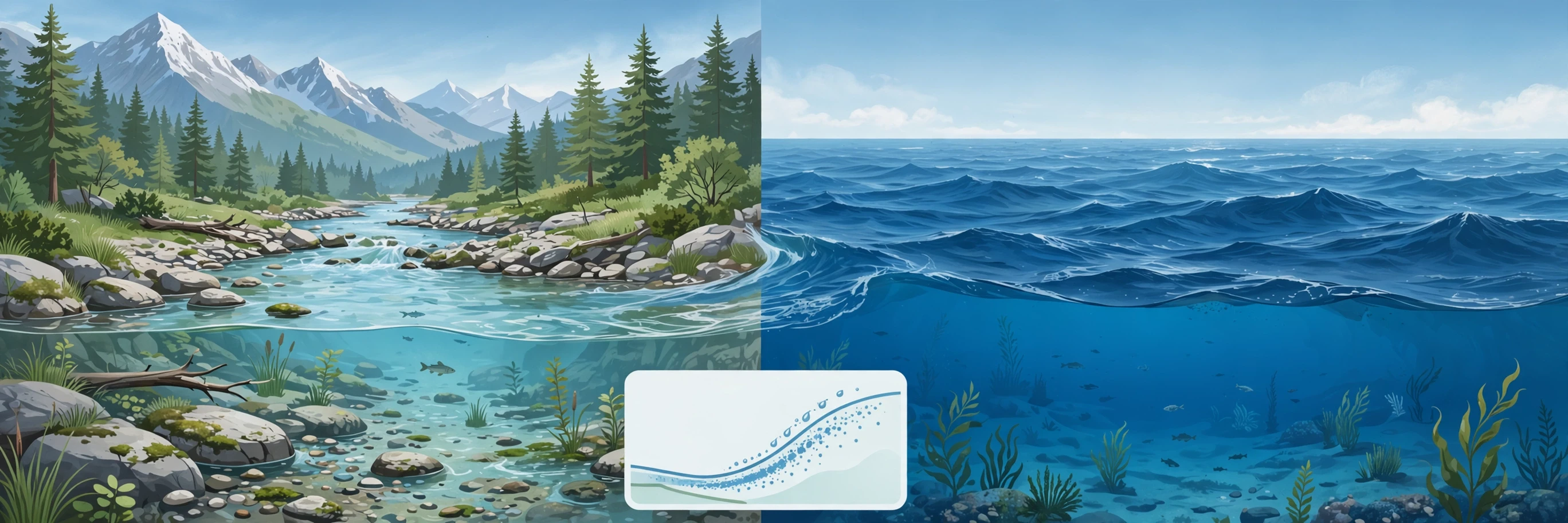
Here is the question that puzzles most people once they understand the delivery system: if rivers carry all this salt to the sea, why are the rivers themselves fresh? The answer is a matter of flow and residence time. A river is a moving stream, not a storage tank. The water in a river today will be in the sea within days or weeks, and it is constantly replaced by new rainwater. The salt passes through, but it never gets the chance to build up. The ocean, by contrast, is a trap with no drain. Water leaves only by evaporation, and evaporation leaves the salt behind. So the river stays fresh because it is a corridor, and the sea grows salty because it is a dead end — at least for water.
Think of it like a bathtub with the tap running and the plug out. The water in the tub stays shallow and clean because it flows straight through. Now put the plug in and let the tap run: the water rises, and anything dissolved in it accumulates. The river is the open drain; the ocean is the plugged tub. The water cycle, which constantly lifts fresh water out of the sea and drops it back on land as rain, is the tap. For a fuller picture of that cycle, see our article on the water cycle.
4.2 The Estuary: Where Fresh Meets Salt
The most dramatic place to see the fresh-salt boundary is an estuary, where a river meets the sea. I once stood on a small boat at the mouth of a wide river and watched the water change colour beneath us: brown, sediment-laden river water sliding out over the clear blue-green sea, the two layers refusing to mix at first, like oil on water. The boundary was visible because fresh water is less dense than salty water, so the river water floats on top of the seawater, spreading out in a thin lens before the tides and the wind stir them together.
Estuaries are among the most productive ecosystems on Earth precisely because of this mixing. The river brings nutrients from the land; the sea brings salt and marine life; the brackish water in between supports creatures adapted to neither extreme. Oysters, mangroves, salmon, and countless shorebirds all depend on the gradient that the salt creates. The estuary is a reminder that salinity is not just chemistry — it is habitat.
4.3 Rivers That Never Reach the Sea
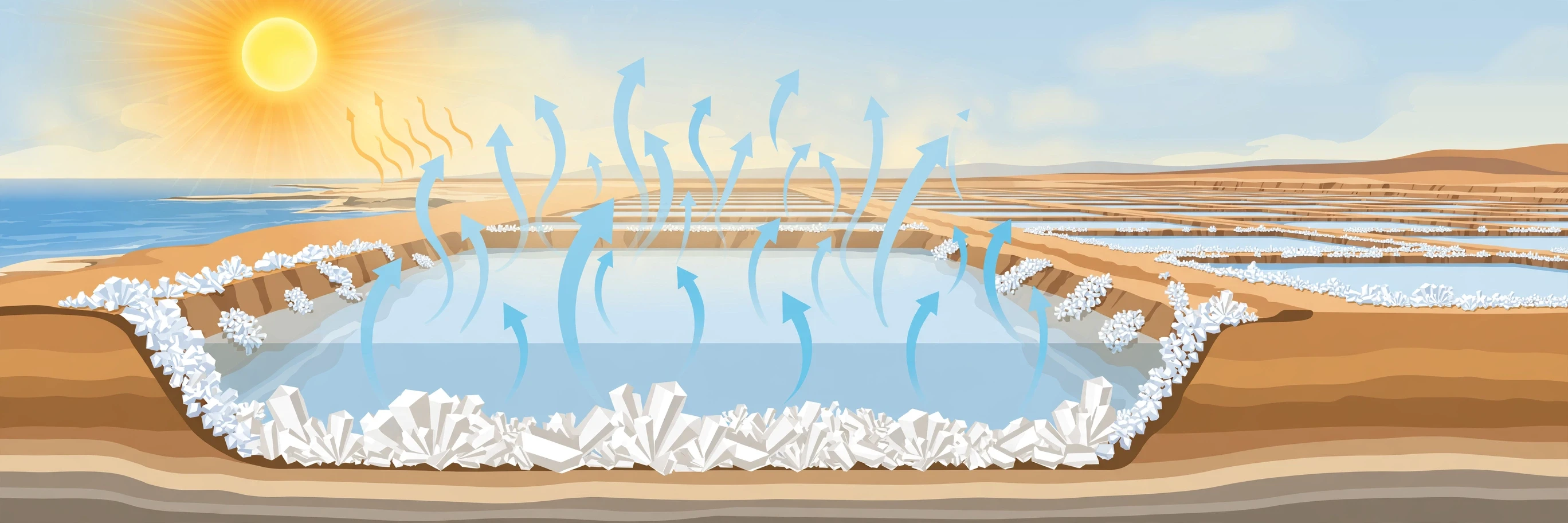
Not every river reaches the ocean. Some flow into landlocked basins — the Caspian Sea, the Aral Sea, the Great Salt Lake — where the water has nowhere to go but up, by evaporation. And in those closed basins, the same logic that makes the ocean salty operates at full force, but faster, because the basins are smaller. The water evaporates, the salt stays, and over time the lake grows saltier and saltier. The Great Salt Lake in Utah is the textbook example, and we will look at it closely in Section 9. For now, note the lesson: wherever water can leave only by evaporation, salt accumulates. The ocean is simply the largest such basin on the planet.
5. Volcanoes and Hydrothermal Vents: Salt from Below
Rivers are the main source of ocean salt, but they are not the only one. A second, stranger source operates in the dark, under crushing pressure, on the floor of the deep ocean. It involves volcanoes, cracks in the Earth's crust, and water heated to temperatures that would flash it to steam at the surface — kept liquid only by the weight of the sea above.
5.1 Volcanic Gases and Ash
When volcanoes erupt, they release gases — water vapour, carbon dioxide, sulfur dioxide, and hydrogen chloride — that dissolve in rain or fall directly into the sea. Over geological time, volcanic outgassing has added significant quantities of chloride and sulfate to the oceans. The early Earth, with its far more violent volcanism, probably received much of its first salt this way. Even today, a large eruption can dust the surrounding ocean with ash rich in soluble minerals, giving the local seawater a brief, measurable chemical nudge.
Volcanic islands add salt in a quieter way too. Fresh basalt is rich in magnesium and calcium, and as rain weathers a young volcanic island, those ions wash into the sea. Hawaii's rivers are small, but the islands are weathering fast, and their contribution, multiplied across every volcanic island and seamount on Earth, is far from negligible.
5.2 The Discovery of Black Smokers
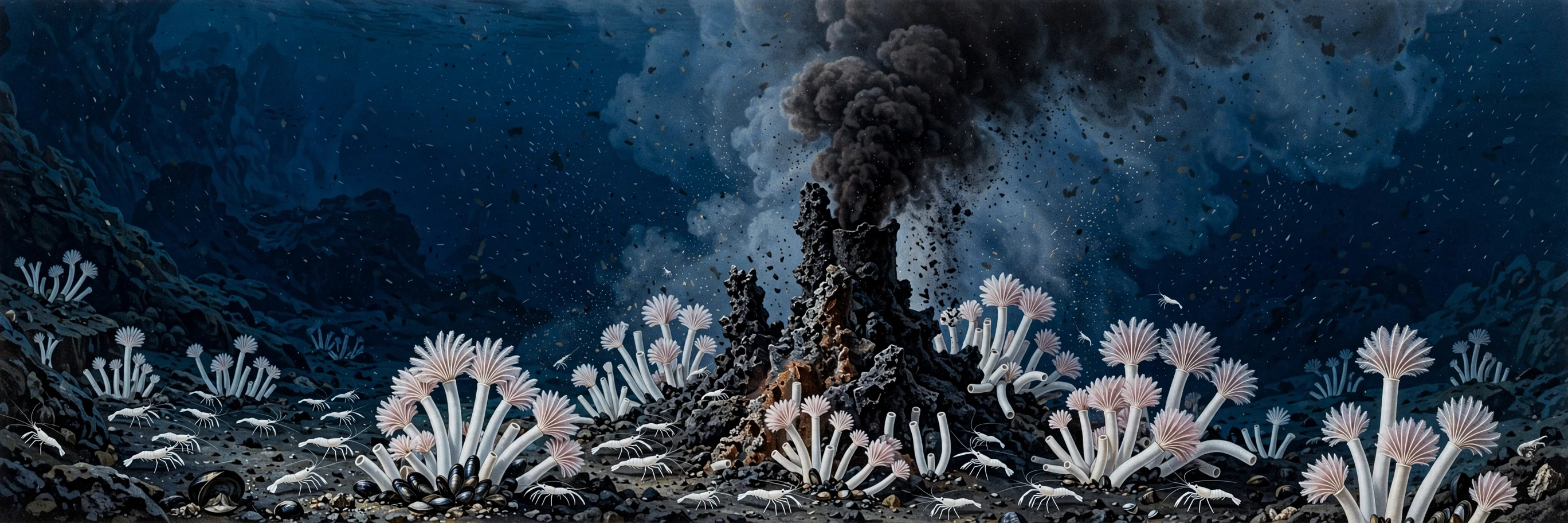
The most spectacular salt source from below was discovered only in 1977, when geologists exploring the Galápagos Rift in a small submersible found something no one had expected: chimneys of black rock on the seafloor, belching dark, mineral-laden water hot enough to melt lead, surrounded by dense communities of giant tube worms and white crabs in a place that should have been a lifeless desert. These were hydrothermal vents — "black smokers" — and they changed ocean chemistry overnight.
5.3 How Much Do Vents Contribute?
The total volume of water cycling through hydrothermal vents is enormous: over the course of a few million years, an amount equal to the entire ocean passes through the hot crust at mid-ocean ridges. That means vents are not a minor side channel. They are a major chemical processing plant, reshaping the composition of seawater on a planetary scale. They are also, crucially, a two-way street: they add some ions and remove others, which is part of the reason the ocean's composition stays as steady as it does. The vents take magnesium out and put calcium in, and that exchange helps explain why seawater is relatively poor in magnesium compared with what rivers deliver, and relatively rich in calcium. If you want to understand why the sea contains the exact mixture it does, you cannot ignore the vents.
The discovery of the vents also overturned a comfortable assumption about life itself. The animals clustered around black smokers live without sunlight, fed by bacteria that extract energy from the vent chemicals instead of from photosynthesis. It was the first proof that whole ecosystems could run on chemistry alone — a finding that reshaped ideas about where life might exist elsewhere in the universe. All of that, from a question about why the sea is salty.
6. What Is Actually Dissolved in Seawater?
We have talked about salt in general terms. Now it is time to look at the actual recipe, because the details carry the fingerprints of every source we have described.
6.1 The Six Major Ions
Six ions account for more than 99 percent of the dissolved solids in seawater. Chloride and sodium dominate, as we saw, but the supporting cast tells the story of the ocean's sources. Sulfate comes largely from the weathering of rocks and from volcanic gases. Magnesium and calcium come from the weathering of limestone and basalt, and their balance is constantly adjusted by hydrothermal vents and by the shells of marine organisms. Potassium comes from the weathering of feldspar. Bicarbonate comes from dissolved carbon dioxide and the weathering of carbonate rocks — and it is the ion that keeps seawater slightly alkaline and helps the ocean absorb carbon dioxide from the atmosphere.
Ion | Symbol | Share of dissolved solids | Main source |
|---|---|---|---|
Chloride | Cl⁻ | ~55% | Weathering of rocks; volcanic gases; ancient salt deposits |
Sodium | Na⁺ | ~31% | Weathering of feldspar and other silicate rocks |
Sulfate | SO₄²⁻ | ~8% | Weathering; volcanic sulfur gases |
Magnesium | Mg²⁺ | ~4% | Weathering of basalt and dolomite; adjusted by vents |
Calcium | Ca²⁺ | ~1% | Weathering of limestone; hydrothermal vents |
Potassium | K⁺ | ~1% | Weathering of feldspar and micas |
One of the most surprising facts about this table is what is not in it. Silicon, for example, is one of the most abundant elements in the Earth's crust, and rivers deliver enormous quantities of dissolved silica to the sea — yet seawater contains very little of it. The reason is biological: diatoms, the microscopic algae that build glassy shells of silica, strip it out of the water almost as fast as it arrives. When they die, their shells sink and are buried. The ocean's chemistry is not just geology. It is geology filtered through life.
6.2 The Constancy of Composition
The proportions in the table above are nearly the same in every ocean on Earth. That constancy was first demonstrated in the 19th century by the chemist William Dittmar, who analysed 77 seawater samples collected by the HMS Challenger expedition from all over the world and found that, while total salinity varied, the ratios of the major ions did not. Dittmar's result was one of the founding observations of chemical oceanography, and it has held up for 150 years.
Why should the recipe be so constant? Because the ocean mixes. The great currents carry water around the globe on timescales of about a thousand years, while the processes that add and remove salt operate over millions of years. Mixing is fast; chemistry is slow. So any local difference gets stirred away long before it can grow. The ocean is, in effect, one enormous well-stirred pot — and the constancy of its composition is the proof. To see how those currents move water and salt around the planet, see our article on oceanography: currents, ecosystems, and depth zones.
6.3 Trace Elements: A Little of Everything
Beyond the six major ions, seawater contains measurable traces of nearly every naturally occurring element — gold, uranium, lithium, iron, zinc, copper, and more. The concentrations are minuscule: gold, for example, is present at a few parts per trillion, far too dilute to mine profitably, despite the dreams of more than one inventor. But the traces matter. Iron, delivered by dust blown off deserts and by hydrothermal vents, is a limiting nutrient for plankton across vast stretches of the open ocean; add a little iron and plankton bloom, drawing carbon dioxide out of the atmosphere. The trace chemistry of seawater connects the salt in your mouthful at the beach to the dust storms of the Sahara and the chemistry of the deep Earth.
7. Why the Ocean Does Not Keep Getting Saltier
This is the question Halley could not answer, and it is the most interesting part of the whole story of why is the ocean salty. Rivers deliver about four billion tonnes of dissolved material to the sea every year. They have been doing so for billions of years. If nothing removed salt, the ocean would long ago have become a brine too salty for anything to live in. It did not. So where does the salt go?
7.1 The Balance Sheet
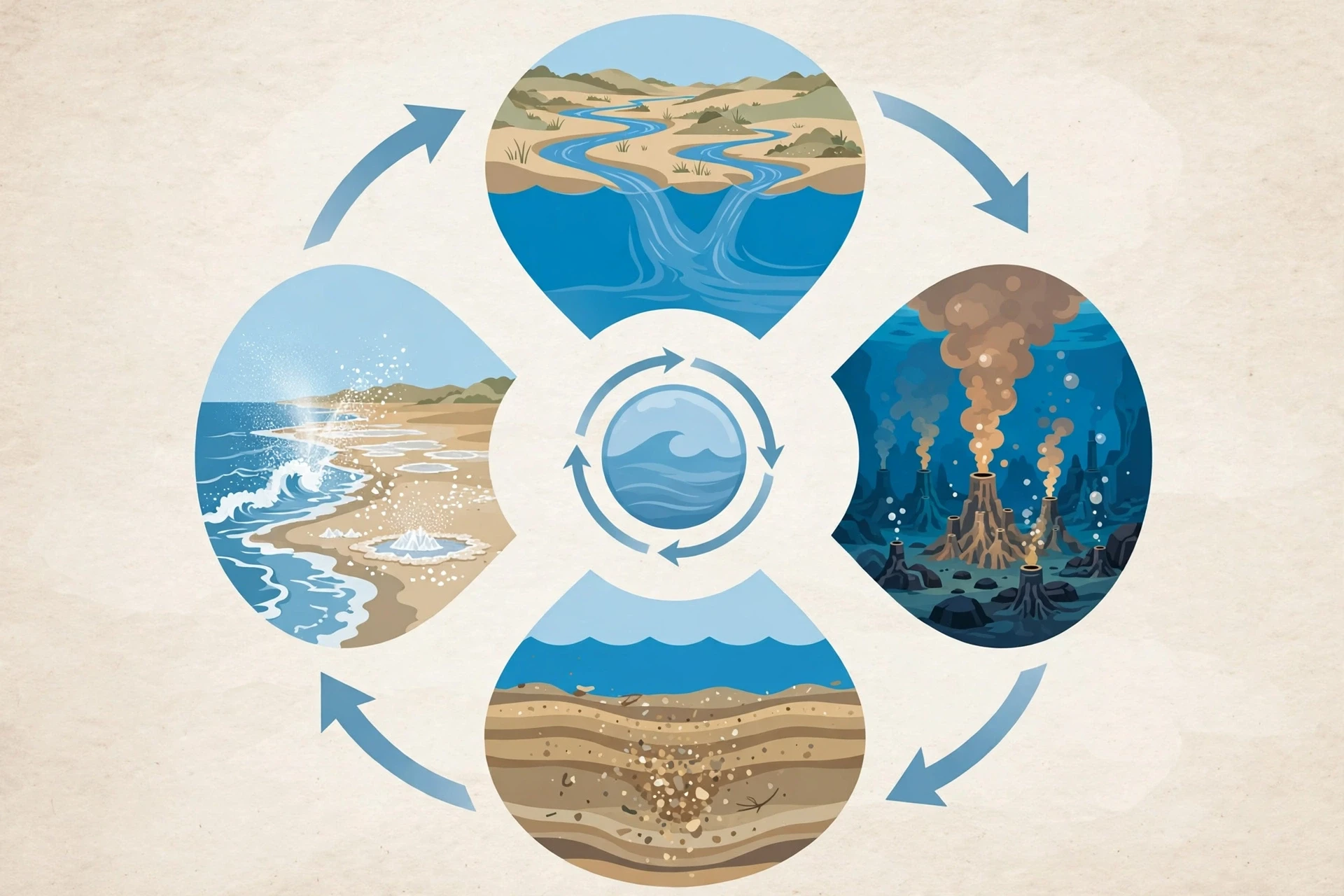
The ocean's saltiness is a balance — a dynamic equilibrium between inputs and outputs, like a bathtub with the tap running and the drain open at the same time. The water level stays constant not because nothing flows, but because inflow and outflow match. The same is true of salinity. Rivers, volcanoes, and vents add salt; a set of removal processes takes it away at roughly the same rate. The balance is not perfect on short timescales — salinity has drifted up and down over geological history — but over the last billion and a half years it has stayed within a range that life can tolerate. That long stability is one of the quiet miracles of Earth science.
The ocean is not a storage tank that fills with salt forever. It is a system in balance, adding and removing salt at nearly the same rate for over a billion years.
7.2 Sea Spray and Salt Flats
One removal route is wonderfully ordinary: sea spray. When waves break, they throw tiny droplets of seawater into the air. The water in the droplets evaporates, leaving microscopic salt crystals that drift on the wind. Some fall back into the sea, but some are carried inland and deposited on land, where rain eventually washes them into the soil — or, if the wind is strong, they can travel hundreds of kilometres before settling. The salt on your car after a drive along the coast, and the faint sting in the air at the seaside, are this process in action. It is a small leak in the ocean's salt budget, but over millions of years, small leaks add up.
A bigger leak operates where shallow seas evaporate. When a shallow arm of the sea is cut off from the open ocean — by a sandbar, a falling sea level, or the slow rise of the land — its water evaporates and leaves its salt behind as thick beds of halite and gypsum. The Mediterranean Sea nearly dried up entirely about six million years ago, when the Strait of Gibraltar closed, leaving salt deposits kilometres thick beneath what is now the seafloor. Those deposits are still there, buried under later sediments: a vast quantity of salt permanently removed from the ocean.
7.3 Burial in Sediments and the Deep Crust
Salt also leaves the sea by burial. The shells and skeletons of marine organisms — the calcium carbonate of corals and foraminifera, the silica of diatoms — sink to the seafloor and are buried in sediments, taking their ions with them. Clay minerals forming on the seafloor absorb potassium and other ions from seawater in a slow chemical exchange. And where one tectonic plate slides beneath another, sediments and the water trapped in them are carried down into the mantle, removing salt from the ocean for tens of millions of years at a time.
Hydrothermal vents, which we met as a source of salt, are also a sink. As cold seawater circulates through hot oceanic crust, it deposits magnesium and sulfate into the rock, removing them from the ocean even as it adds other elements. The vents are simultaneously a tap and a drain, and the net effect helps hold the ocean's composition steady.
7.4 How Stable Has Salinity Really Been?
The honest answer is: stable enough, but not perfectly constant. Evidence from fluid inclusions — tiny droplets of ancient seawater trapped inside salt crystals — suggests that the salinity of the ocean has varied over geological time, perhaps by a factor of two over the last 500 million years. The chemistry has shifted too: ancient seas were at times richer in calcium and poorer in sulfate than today's ocean, because the balance of weathering, volcanism, and vent activity was different.
That variation matters because it shows the balance is dynamic, not fixed. The ocean's saltiness is a negotiation between the continents, the climate, and the deep Earth, and the terms of that negotiation change as the planet evolves. What has stayed constant is the existence of the balance — the fact that removal has always roughly kept pace with input. Without that, the ocean would have become uninhabitable long ago, and the story of life on Earth would have been very different.
8. How Salinity Varies Around the World
If the ocean is well mixed, why does salinity vary at all — and what does that variation tell us about why is the ocean salty in the first place? Because the surface of the ocean is constantly being pushed in opposite directions by two processes: evaporation, which removes fresh water and leaves salt behind, and precipitation, which adds fresh water and dilutes the salt. Where evaporation wins, the surface grows saltier. Where rain wins, it grows fresher. The result is a global map of salinity that mirrors the planet's climate.
8.1 The Salty Subtropics and the Fresh Equator
The saltiest open-ocean waters are found in the subtropics — roughly 20 to 30 degrees north and south of the equator — in the great ocean gyres of the Atlantic, Pacific, and Indian Oceans. These are the regions beneath the descending arms of the atmosphere's circulation, where dry air sinks, skies are clear, and evaporation far outpaces rainfall. The surface water there reaches 36 to 37 parts per thousand, and the salt accumulates in vast, slowly rotating pools.
By contrast, the equator itself is fresher. Warm air rises at the equator, cools, and dumps its moisture as rain — the same rising air that feeds the tropical rainforests. That rain dilutes the surface ocean to around 34 parts per thousand. The poles are fresher still: cold air holds little moisture, so there is little evaporation, and melting sea ice and glacial runoff add fresh water each summer. The surface waters of the Arctic Ocean can fall below 30 parts per thousand in summer, when the ice melts.
NASA's Aquarius satellite mapped these patterns from orbit, and the map it produced is one of the most beautiful in ocean science: a planet painted in salt, with bright salty bands in the subtropics and fresh blue patches at the equator and the poles, all tracking the winds and the rain. The NASA Earth Observatory water cycle pages explain how evaporation and precipitation drive these patterns, and the connection is direct: salinity is, in large part, a map of the water cycle written on the sea.
8.2 The Atlantic Is Saltier Than the Pacific
One of the most striking facts on the salinity map is the difference between the two great oceans. The Atlantic is distinctly saltier than the Pacific — by about one part per thousand on average. The reason is atmospheric: the trade winds carry water vapour from the Atlantic across Central America and dump it as rain over the Pacific. The Atlantic loses fresh water to the sky and keeps its salt; the Pacific gains the rain and is diluted. The difference is small in absolute terms, but it has enormous consequences, because saltier water is denser, and the dense, salty water of the North Atlantic is what sinks and drives the great overturning circulation that carries heat around the planet.
8.3 Enclosed and Semi-Enclosed Seas
Where a sea is partly cut off from the open ocean, local conditions take over, and salinity can swing far from the ocean average. The Mediterranean Sea, with its hot, dry summers and narrow connection to the Atlantic through the Strait of Gibraltar, runs at about 38 parts per thousand — saltier than the open ocean. The Red Sea, hotter and drier still, reaches about 40. The Baltic Sea, fed by many rivers and connected to the North Sea only through narrow Danish straits, runs in the opposite direction: as low as 7 parts per thousand in its northern reaches, barely saltier than some rivers. The Caspian Sea, entirely landlocked, sits at about 12 parts per thousand.
Body of water | Typical salinity (parts per thousand) | Why it differs |
|---|---|---|
Open ocean (average) | ~35 | Global balance of evaporation and rain |
Red Sea | ~40 | Intense evaporation, almost no rivers |
Mediterranean Sea | ~38 | Hot dry climate, narrow Atlantic connection |
Baltic Sea | ~7–10 | Many rivers, narrow connection to the North Sea |
Caspian Sea | ~12 | Landlocked, fed by rivers, evaporates |
Dead Sea | ~340 | Landlocked desert lake, extreme evaporation |
Great Salt Lake | ~50–270 | Landlocked desert lake, varies with water level |
8.4 Salinity Changes with Depth
So far we have talked about the surface. Below it, salinity changes with depth, and the pattern is a record of the ocean's history. In the tropics, salinity often rises slightly just below the surface, then falls again in the deep, because the deep water formed long ago in cold, fresh polar regions and has carried that signature with it ever since. In the Atlantic, a tongue of salty Mediterranean water can be traced thousands of kilometres out into the ocean at mid-depth, a chemical fingerprint of the strait it came through. Oceanographers read these layers the way a forester reads tree rings — each one a record of where the water came from and what the climate was doing when it sank.
9. The Dead Sea and the Great Salt Lake
If you want to see what happens when the ocean's salt-accumulating logic runs without any check, you do not need to look far. You need only visit a landlocked lake in a desert. The Dead Sea and the Great Salt Lake are the ocean's story told at fast-forward speed, and they are the places where the physics of salinity becomes something you can feel with your own body.
9.1 The Dead Sea: Ten Times Saltier Than the Ocean
The Dead Sea sits in the lowest place on the Earth's land surface, more than 400 metres below sea level, in the hot desert rift valley between Israel and Jordan. It is fed by the River Jordan and a few small streams, but it has no outlet. The desert sun evaporates the water, and the salt stays. Over thousands of years, the lake has become a brine of about 340 parts per thousand — nearly ten times saltier than the ocean. At that concentration, the water is denser than the human body, and a swimmer floats effortlessly, bobbing on the surface like a cork. Fish cannot live in it. Almost nothing can, except a few specialised microbes and algae, which is how the lake got its name.
I have never floated in the Dead Sea, but I have stood on its shore and picked up chunks of salt the size of fists, crystallised on the rocks like frost. The water leaves a white crust on your skin as it dries, and the air smells faintly of minerals. It is the ocean's logic taken to its extreme: give water nowhere to go but up, and salt will accumulate until the water can barely hold any more. The Dead Sea is also shrinking, because the River Jordan's water is increasingly diverted for farming and drinking before it reaches the lake. As the level falls, the remaining water grows saltier still, and the shoreline retreats across widening flats of salt and mud.
9.2 The Great Salt Lake: A Lake That Changes Its Mind
The Great Salt Lake in Utah is the remnant of a much larger Ice Age lake, Lake Bonneville, which once covered a vast area of the American West. As the climate warmed and dried, the lake shrank, and the water that remained grew saltier. Today the lake's salinity swings wildly — from about 50 parts per thousand in wet years, when rivers dilute it, to more than 270 in dry years, when evaporation concentrates it. A causeway built across the lake divides it into two arms that barely mix, and the northern arm, cut off from most river inflow, is far saltier than the southern arm. From the air, the two arms are visibly different colours: the saltier water blooms pink with salt-loving microbes.

The Great Salt Lake is a warning as well as a curiosity. In recent years its level has fallen sharply as water is diverted for agriculture and cities and as the climate warms. If it shrinks much further, the exposed lake bed — loaded with salt and with metals accumulated over millennia — could become a source of toxic dust storms for the millions of people who live nearby. The lake's salinity is not just a scientific curiosity; it is a measure of a whole region's water balance, and it is moving in the wrong direction.
9.3 What These Lakes Teach Us About the Ocean
The Dead Sea and the Great Salt Lake are the exceptions that prove the rule. They show, in miniature and at high speed, exactly what would happen to the ocean if the salt-removal processes of Section 7 stopped working. The ocean avoids their fate not because it is different in kind, but because it is bigger, better mixed, and equipped with removal processes — burial, spray, vents, subduction — that landlocked lakes lack. The ocean is a Dead Sea that learned how to take out the rubbish.
10. Why Rivers Stay Fresh
We touched on this in Section 4, but the question deserves its own answer, because it is the mirror image of the question of why is the ocean salty — and because the usual explanations get it subtly wrong.
10.1 The Short Answer, and the Longer One
The short answer is that rivers are conduits, not reservoirs. Their water is replaced constantly by rain, and it reaches the sea within days or weeks, before the dissolved load can build up. The longer answer is that "fresh" is relative. River water is not pure water. It carries dissolved minerals — typically about 0.12 grams per litre — and that load is precisely the salt that will eventually season the sea. The river is fresh only in comparison with the ocean, because the ocean has had billions of years to accumulate what the river delivers in a week.
There is a useful way to picture the difference. Imagine a bucket under a dripping tap, and a hose running through a pipe. The pipe water tastes fresh because it never sits still; the bucket water grows stale and concentrated because it stays. A river is the pipe. The ocean is the bucket — except that the ocean's bucket has a small leak in the bottom, the removal processes of Section 7, which keeps it from overflowing with salt.
10.2 The Exception That Tests the Rule
Some rivers do taste salty, and they are worth a look, because they confirm the logic. Rivers that flow through regions rich in ancient salt deposits — parts of the American Southwest, the salt ranges of Pakistan, the basins of Central Asia — can carry far more dissolved salt than average. The Rio Grande, in places, runs noticeably brackish. Rivers in arid regions, where evaporation concentrates the water before it even reaches the sea, can be saltier still. These are not violations of the rule. They are the rule operating with different starting conditions: more salt in the rocks, more evaporation, and the same short residence time. Even the saltiest river is still far fresher than the sea, because it still flows.
10.3 Groundwater: The Hidden River
Beneath our feet, a slower version of the same story is running. Groundwater seeps through rock for years, decades, or centuries before it reaches a river or the sea, and because it spends so long in contact with minerals, it is often far saltier than surface water. Some deep groundwaters are saltier than seawater itself, carrying the dissolved remains of ancient seas trapped underground millions of years ago. When that groundwater finally discharges into the ocean — as submarine springs along the coast — it delivers its load directly to the sea, bypassing the rivers entirely. It is a small contribution compared with the rivers, but it is a reminder that the salt delivery system has more than one route.
11. What Salinity Does: Density, Currents, and Climate
Saltiness is not just a taste. It is a physical force. Dissolved salt makes water denser and heavier, and that density difference drives some of the largest movements of water on the planet. Without salt, the ocean's circulation — and the climate we live in — would look very different.
11.1 Salt Makes Water Sink
Cold water is denser than warm water, and salty water is denser than fresh water. In the North Atlantic, cold, salty surface water — made saltier by evaporation and by the formation of sea ice, which ejects salt into the water below as it freezes — becomes so dense that it sinks, plunging thousands of metres to the seafloor. That sinking water then flows southward along the bottom of the Atlantic, around the Southern Ocean, and into the Pacific and Indian Oceans, in a slow, planet-spanning loop that oceanographers call the thermohaline circulation — "thermo" for temperature, "haline" for salt.
The loop takes about a thousand years to complete, and it carries heat, oxygen, and nutrients around the globe. It is the reason Western Europe is far warmer than other places at the same latitude: the Gulf Stream and the North Atlantic Drift carry warm water northward, and the sinking of cold, salty water in the far north is the engine that keeps that current flowing. If the North Atlantic grew fresher — as it would if Greenland's ice melted rapidly, pouring fresh water into the sea — the sinking could slow, and the climate of an entire continent could shift. The NOAA Ocean Service explains how temperature and salinity together set seawater density, and the physics is simple enough to state in one sentence: add salt, or remove heat, and water sinks.
That sentence is also a warning. Climate change is adding fresh water to the North Atlantic from melting ice and increased rainfall, and scientists are watching the overturning circulation closely for signs of weakening. The salt in the sea is not only a record of the past. It is a lever on the future.
11.2 Salt, Sea Ice, and the Freezing Point
Salt also changes the temperature at which seawater freezes. Pure water freezes at 0 degrees Celsius; seawater, at 35 parts per thousand, freezes at about minus 1.9 degrees. That nearly two-degree difference shapes the polar oceans. When sea ice forms, the salt is mostly excluded from the ice crystals, so the water beneath the ice grows saltier and denser — the same process that helps drive the sinking in the North Atlantic. In winter, the polar oceans become factories for cold, salty, dense water that feeds the deep circulation.
The freezing-point effect also explains something you may have noticed on a winter road: spreading salt on ice melts it. The salt lowers the freezing point of the water on the road surface, so ice that would be solid at minus 2 degrees becomes liquid. It is the same physics, scaled down from an ocean to a pavement, and it is the reason coastal cities in cold climates can have harbours that stay open in winter while nearby freshwater lakes freeze solid.
11.3 Salt and Sound
Here is a stranger consequence of salinity, and one I did not believe until I saw the data: salt changes how sound travels through water. Seawater absorbs sound differently from fresh water, and the speed of sound in the ocean depends on temperature, pressure, and salinity together. Whales and submarines both exploit this. Sound waves bend as they pass through layers of different salinity, and under the right conditions they can be trapped in a "sound channel" — a layer of water that carries sound for thousands of kilometres. During the Cold War, navies mapped these channels carefully, because a submarine hiding in one could hear, and be heard, across an ocean basin. The salt in the sea shapes not only currents and climate but the acoustic world of the deep.
Salty water is heavy water. That single fact drives the great overturning circulation, steadies the climate of Europe, and sets the freezing point of the polar seas.
12. Common Misconceptions About Ocean Salt
Some questions attract confident wrong answers, and the question of why is the ocean salty attracts more than most. Here are the misconceptions I hear most often, and what the evidence actually says.
12.1 "The Ocean Is Salty Because of Dead Sea Creatures"
This is the most common explanation I encounter, and it sounds plausible: countless animals live and die in the sea, and their bodies must leave salt behind. But it gets the chemistry backwards. The salt in a fish's body came from the seawater in the first place. When the fish dies and decays, it returns salt that was already there; it does not add new salt. The net contribution of dead organisms to ocean salinity is essentially zero. The real sources are the rocks, the rivers, and the vents — the Earth's crust, not its creatures.
12.2 "The Sea Was Salty from the Very Beginning"
Most people assume the ocean was born salty, and in a sense the first oceans were salty — volcanic outgassing delivered chloride and other ions to the early seas. But the modern ocean's saltiness is not a leftover from creation. It is the product of billions of years of river delivery, balanced by removal. The early ocean was probably less salty than today's, and its chemistry was different. The salt we taste is not original equipment. It is accumulated history.
12.3 "The Ocean Gets Saltier Every Year"
This follows naturally from Halley's reasoning, and it is wrong for the same reason his age calculation was wrong. If the ocean accumulated salt without loss, it would indeed grow saltier every year. But removal processes — burial in sediments, sea spray, salt deposits, uptake by clays, subduction — take salt away at roughly the same rate that rivers add it. On human timescales, the salinity of the open ocean is effectively constant. The changes that matter happen over millions of years, not over a human lifetime, and they are driven by changes in climate and tectonics, not by the calendar.
12.4 "All Salt Comes from the Sea"
Table salt does often come from the sea — evaporated in shallow ponds, as it has been for thousands of years — but much of the salt we eat is mined from ancient deposits laid down by seas that dried up hundreds of millions of years ago. The great salt mines under Cheshire in England, under Detroit in the United States, and in the Punjab were all once shallow seas. When you shake salt onto your food, you may be tasting a sea that vanished before the dinosaurs. The ocean is the source of salt, yes — but often by way of a sea that no longer exists.
12.5 "You Can Make Seawater Fresh Just by Boiling It"
Boiling seawater does not remove the salt; it removes the water, leaving the salt behind, more concentrated than before. To get fresh water from seawater you must capture the steam and condense it — distillation — or force the water through a membrane that blocks the salt, as in reverse-osmosis desalination. The distinction matters, because it is the same distinction that governs the whole planet: evaporation separates water from salt only when the vapour is carried away and condensed elsewhere, which is exactly what the water cycle does when it lifts vapour off the ocean and drops it as rain on land. For the chemistry that makes water behave so strangely as a solvent, see our article on why water is the weirdest molecule.
13. The Short Answer, Revisited
We began with a mouthful of seawater on a beach, and we can now give the question of why is the ocean salty the answer it deserves. The ocean is salty because rain dissolves minerals from rock, rivers carry those minerals to the sea, and evaporation leaves them behind. It stays at about 35 parts per thousand — rather than growing saltier without limit — because salt also leaves the sea, buried in sediments, sprayed into the air, locked into the crust, and carried down into the mantle. The balance between those two flows has held for more than a billion years.
That balance is fragile in the way that all planetary balances are fragile: it depends on the climate, on the arrangement of the continents, and on the slow churning of the Earth's interior. Change any of those, and the saltiness of the sea will change with them, over millions of years. But for now, the system holds, and the sea we swim in is, chemically speaking, the same sea that the first fish swam in — seasoned by the same rocks, delivered by the same rivers, and kept in check by the same quiet removal processes.
The next time you taste seawater — deliberately, this time, and in a small quantity — remember what you are tasting. It is not just salt. It is the dissolved memory of mountains, the exhalation of volcanoes, the chemistry of deep-sea vents, and the slow, patient accounting of a planet that has been balancing its books for four billion years.
Frequently Asked Questions
Why is the ocean salty but rivers are not?
Rivers carry dissolved minerals from weathered rock, but their water is constantly replaced by rain and reaches the sea within days or weeks, so salt never builds up. The ocean has no outlet: water leaves only by evaporation, which leaves the salt behind. Over billions of years, that one-way delivery made the sea salty while the rivers stayed fresh.
How salty is the ocean exactly?
The average salinity of the open ocean is about 35 parts per thousand — roughly 35 grams of dissolved salts per kilogram of seawater. Most open-ocean water falls between 32 and 38 parts per thousand. Enclosed seas differ widely: the Mediterranean is about 38, the Red Sea about 40, the Baltic as low as 7, and the Dead Sea about 340.
Why is the ocean salty — where does the salt come from?
Most of it comes from the chemical weathering of rocks on land. Slightly acidic rainwater dissolves minerals from rock, rivers carry the dissolved ions to the sea, and evaporation leaves them behind. Smaller contributions come from volcanic gases, hydrothermal vents on the seafloor, and the recycling of ancient salt deposits lifted back onto land by mountain building.
Why doesn't the ocean keep getting saltier?
Salt leaves the ocean at roughly the same rate that rivers add it. It is buried in sediments, deposited in salt beds when shallow seas evaporate, carried inland as sea spray, absorbed by clay minerals on the seafloor, and dragged down into the mantle at subduction zones. Hydrothermal vents also remove magnesium and sulfate even as they add other ions. The result is a dynamic balance that has held for over a billion years.
Is the Dead Sea really ten times saltier than the ocean?
Yes, roughly. The Dead Sea's salinity is about 340 parts per thousand, compared with the ocean's 35 — nearly ten times saltier. It is a landlocked lake in a hot desert with no outlet, so evaporation concentrates the salt without limit. The water is so dense that swimmers float effortlessly, and almost no fish or plants can live in it.
Can you drink seawater?
No — not safely, and not for long. Seawater is saltier than human body fluids, so drinking it draws water out of your cells by osmosis, making dehydration worse rather than better. Your kidneys would also have to excrete the excess salt, which requires more water than the seawater provides. A small accidental mouthful is harmless, but seawater is not a source of drinking water. Desalination — distillation or reverse osmosis — is needed to make it safe.
Will climate change make the ocean saltier or fresher?
Both, in different places. Warming increases evaporation in the subtropics, making those waters saltier, while melting ice and heavier rainfall freshen the polar regions and the rainy equator. The pattern is already visible in satellite measurements: salty regions are getting saltier and fresh regions fresher, which is one more way the water cycle is intensifying as the planet warms. The global average, however, changes very slowly, because the total salt in the ocean is so large.