

Introduction: The Man on the Platform
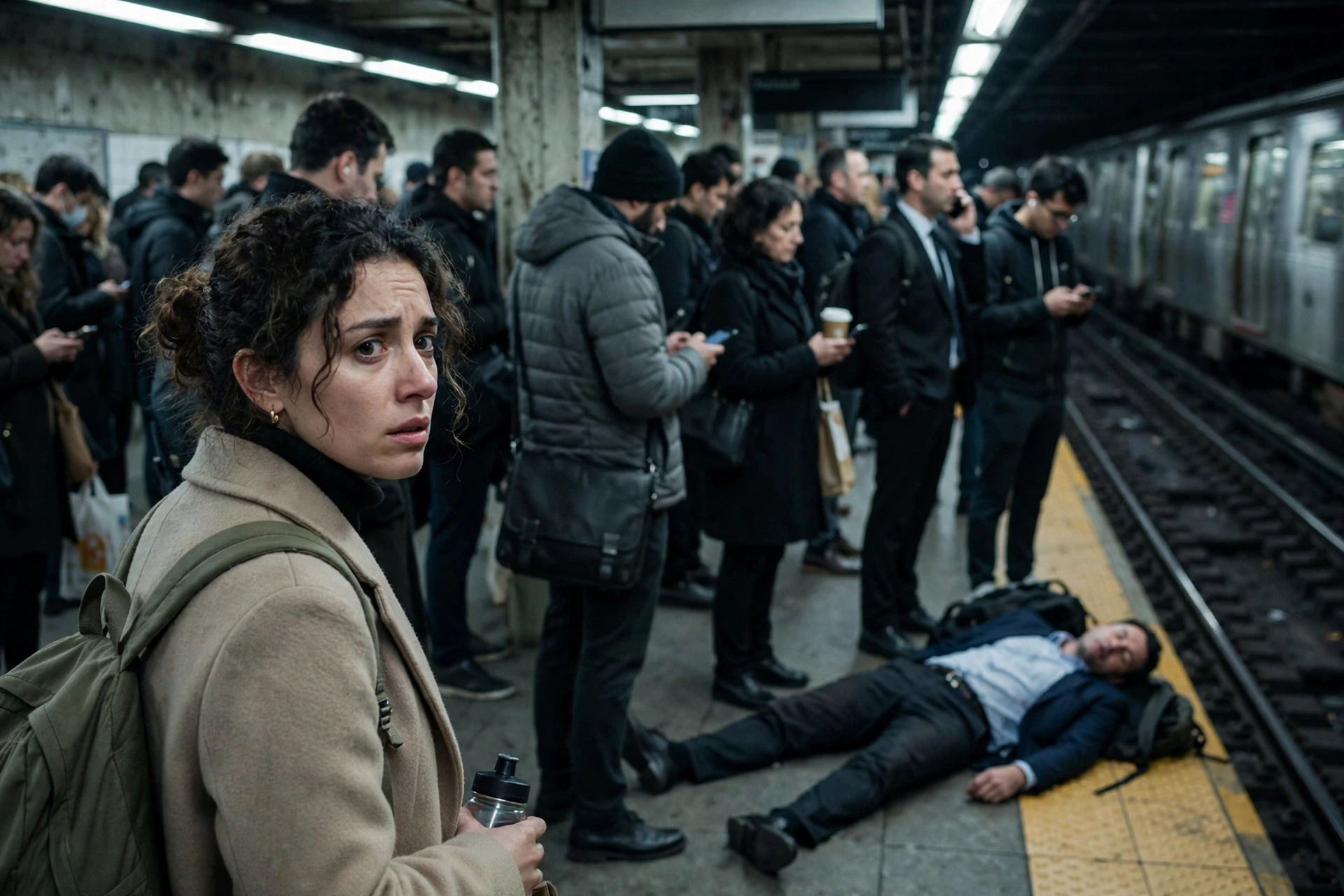
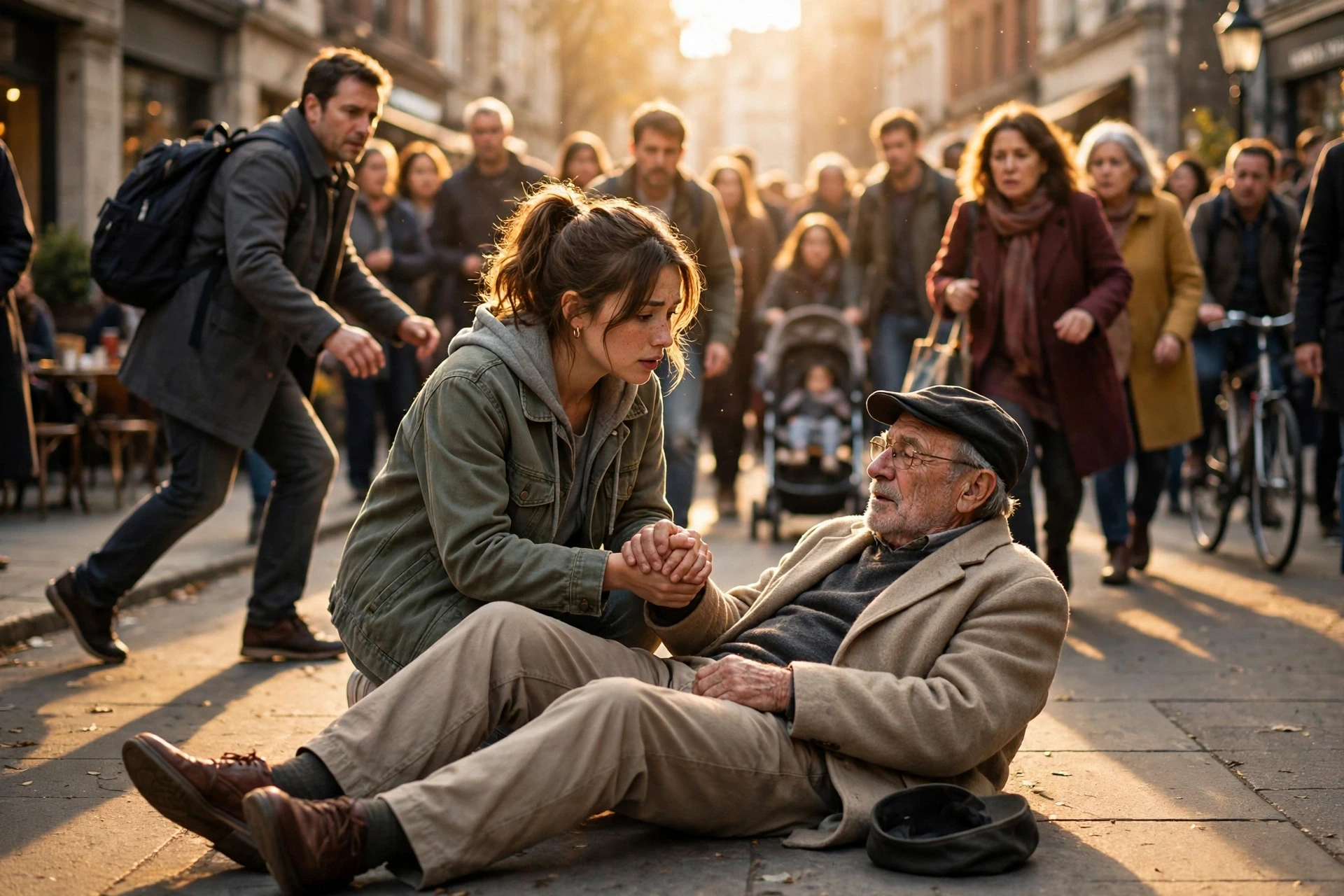
It was a Tuesday morning, the platform was packed, and a man in his sixties went down hard. One moment he was standing with his coffee and his newspaper, the next he was on the concrete, the coffee spreading in a dark pool around the cup, the newspaper sliding under a bench. I saw it happen. I was perhaps four metres away. And for three or four seconds — seconds that felt much longer — I did nothing.
I did not walk away. I did not decide he was fine. I stood there, coffee in my own hand, watching him, while a small crowd formed around us and also watched. Then a woman in a red coat pushed through, knelt beside him, and asked if he could hear her. Only then did the rest of us move. Someone called for help. Someone else fetched a member of staff. The man, it turned out, had fainted; he came round, embarrassed, insisting he was fine. But I have thought about those three or four seconds ever since. I am not a callous person. Nobody on that platform looked callous. So why did a dozen decent people, myself included, stand still while a man lay on the ground?
That question is the heart of the bystander effect: the well-documented finding that a person in trouble is less likely to receive help from any one witness when other people are present than when they are alone. The more people watching, the less likely it is that any single one of them steps forward. It sounds backwards. Common sense says that a crowd should mean more help, more hands, more eyes. The research says the opposite — at least for any individual in that crowd. And the reasons have almost nothing to do with cruelty.
This article follows the science from the beginning: the murder in Queens in 1964 that gave the field its founding story, the laboratory experiments that proved the effect was real, the three mental traps that freeze good people in place, and the modern camera footage that complicates the whole picture — because in real life, people help far more often than the textbooks suggest. It also answers the question that matters most: what can you actually do, in the moment, to make sure you are the person who moves?
1. What Is the Bystander Effect?
1.1 A definition that actually helps
The bystander effect is the tendency for an individual to be less likely to help a person in need when other people are present. The key words are "any individual" and "less likely." The effect does not say that crowds never help. It says that each person in a crowd feels less personal pressure to act than they would if they were alone — and that, as a result, help is often slower to arrive, or arrives from nobody at all.
Picture the arithmetic. You are alone on a quiet street and you see someone collapse. One hundred per cent of the responsibility sits on you. There is nobody else to call, nobody else to check, nobody else to blame if you walk on. Now put ten people on that street. Each of them carries, in their head, roughly a tenth of the responsibility. Each of them can reasonably think: someone else will call, someone else knows first aid, someone else has already phoned. The total responsibility has not changed. It has been sliced so thin that nobody feels its weight.
That slicing has a name: diffusion of responsibility. It is the single most powerful explanation for the bystander effect, and it will come up again and again in this article. But it is not the only one. People also look to each other to decide whether something is an emergency at all, and they worry about looking foolish in front of strangers. Three traps, working together, in a matter of seconds.
1.2 The paradox at the centre of the science
The bystander effect is a paradox, and paradoxes are worth sitting with. A crowd is a resource — more hands, more phones, more knowledge. Yet in the laboratory, adding witnesses reliably reduces the chance that any one witness helps. In one classic experiment, which we will look at closely in Section 3, 85 per cent of people who believed they alone heard a stranger having a seizure reported it. When they believed four other people could hear it too, only 31 per cent did. The emergency was identical. The person in trouble was identical. The only thing that changed was the number of people who might help — and help became less likely.
Most people, hearing this, assume the explanation must be that city life makes people cold, or that modern life has eroded kindness. That is the wrong conclusion, and it matters that it is wrong, because it leads to the wrong fix. If the problem were cold hearts, the answer would be moral lectures. If the problem is a predictable glitch in how the brain handles groups, ambiguity, and social pressure, the answer is something far more useful: a set of learnable habits that let you override the glitch. The rest of this article is about understanding the glitch — and then overriding it.
1.3 This is not about bad people
Let me say this plainly, because it is the point that gets lost whenever this topic comes up in the news. The bystander effect is not evidence that people are selfish. Laboratory volunteers who failed to help were not monsters; in interviews afterwards, many were distressed, confused, and genuinely surprised at their own inaction. They had wanted to help. They had simply been caught in a situation where wanting to help never turned into moving.
I have seen this in myself, on that platform, and I have seen it since in smaller ways: the colleague who looks upset in a meeting and nobody asks why; the person struggling with a pram on the stairs while a dozen commuters flow past. The bystander effect is not a story about strangers being cruel. It is a story about ordinary, decent people whose brains are running a set of shortcuts that made sense for most of human history — and that misfire in a crowd.
2. The Night That Started It All: Kitty Genovese — and the Myth
2.1 What the newspapers said
On 13 March 1964, a 28-year-old bar manager named Catherine "Kitty" Genovese was attacked outside her apartment building in Kew Gardens, Queens, New York, in the early hours of the morning. She was stabbed by a man named Winston Moseley. She died. That much is true, and it is a tragedy that deserves to be remembered as a murder, not as a psychology lesson.
Two weeks later, The New York Times published a front-page story with the headline "37 Who Saw Murder Didn't Call the Police." The article itself opened with a different number — 38 respectable, law-abiding citizens, it said, had watched a killer stalk and stab a woman for more than half an hour, in three separate attacks, and none of them had called the police or come to her aid. The story spread everywhere. It became the founding parable of a whole field of psychology: 38 witnesses, all watching, all doing nothing.
For decades, that version was taught in almost every introductory psychology course in the English-speaking world. It was the first thing students learned about helping behaviour. There was only one problem with it. Most of it was not true.
2.2 What the records actually show
In 2007, psychologists Rachel Manning, Mark Levine and Alan Collins went back to the archive: the trial records, the police files, and the contemporary reporting. Their paper, published in the journal American Psychologist, took the famous story apart claim by claim. The number 38 appears nowhere in the police records. There is no evidence that 38 people watched the murder, no evidence that those who were aware of it actually saw the attack itself, and no evidence that witnesses stayed inactive. The attack happened in two parts, about ten minutes apart, not three — and the fatal second attack took place in a vestibule, a small entrance hall, that almost nobody could have seen into. At least two neighbours telephoned the police. One man shouted from a window and drove the attacker off, which is why there was a pause between the two attacks at all. A neighbour named Sophia Farrar came down and held Genovese as she died.
In 2016, The New York Times itself acknowledged the problem. In its obituary of Moseley, the paper wrote that its 1964 account had "grossly exaggerated the number of witnesses and what they had perceived." The parable had been wrong for fifty years — and it had been wrong in the newspaper that created it.

2.3 Why the myth matters — and why it does not sink the science
Here is the twist that makes this story worth telling carefully. The Genovese myth is false, but the science it inspired is real. Manning, Levine and Collins were careful to make exactly this distinction: the story was wrong; the experiments that followed it still had to be judged on their own evidence. And on their own evidence, the experiments held up.
That distinction matters for two reasons. First, it is a lesson in how science should work: a dramatic story can launch a research programme, and the research programme can survive the story turning out to be wrong, because the research stands on its own data. Second, it changes the moral of the story. The old version taught that crowds make people callous — that ordinary citizens will watch a murder and do nothing. The corrected version teaches something more honest and more useful: that real emergencies are usually confusing, dark, and ambiguous, that people often do help, and that when they do not, the reasons are usually about confusion and divided responsibility rather than indifference. That is a harder lesson to tell at a dinner party. It is also the true one.
I remember the first time I read the Manning paper, years after I had first been taught the 38-witnesses version as a student. I felt a small jolt of embarrassment — I had repeated the parable myself, confidently, to friends — followed by a larger feeling, something like relief. The world was not quite as bleak as the story had made it seem. And the science was more interesting than the story, because the science had to explain a subtler pattern than "people are heartless."
2.4 The two psychologists who asked the right question
The two people who turned the Genovese story into science were John Darley, then at New York University, and Bibb Latané, then at Columbia. They were not convinced by the explanations doing the rounds in 1964 — that city life had made people alienated, or that modern society had destroyed community. Those explanations were too vague to test, and they blamed character when the situation might have been doing the work.
Darley and Latané suspected something more specific: that the number of witnesses was itself the problem. They set out to test that idea in the laboratory, with controlled experiments where everything except the number of bystanders could be held constant. What they found, starting in 1968, became one of the most replicated findings in social psychology — and it is where the bystander effect stops being a newspaper story and starts being science.
3. The Experiments That Proved the Bystander Effect
3.1 The seizure over the intercom: 85 per cent versus 31 per cent
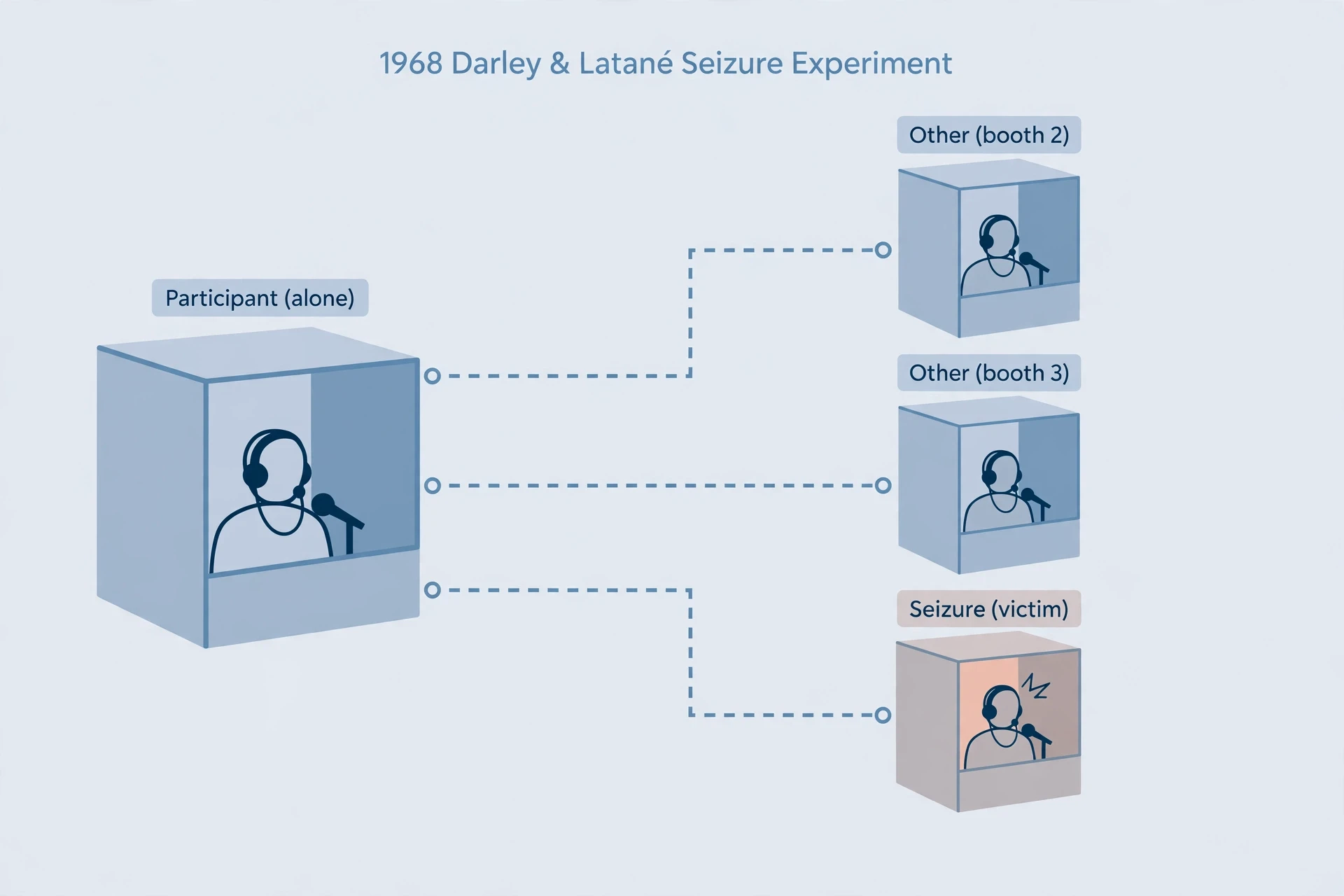
The most famous experiment is also the simplest. Darley and Latané invited university students to take part in what they were told was a discussion about the problems of student life, conducted over an intercom so that the participants could not see each other. Each student sat alone in a small room with a microphone and headphones. In reality, there was no group discussion at all. There was one real participant — and a tape recording.
During the "discussion," one of the voices on the tape — supposedly another student — began to have a seizure. He stammered, gasped, called for help, and said he was having a fit and needed someone to get him assistance. Then the voice fell silent. The real participant, sitting alone in their room, had to decide what to do. They could leave the room to find the experimenter. That was the only way to help.
The trick was that the experimenters varied what the participant believed about the size of the group. Some participants believed they were the only other person listening. Others believed one other person was listening too. Others believed four other people were listening. Everything else was identical: the same voice, the same seizure, the same silence afterwards.
The results were stark. When participants believed they were the only witness, 85 per cent left the room to get help, and they did so quickly — most within a minute. When they believed four other people were also listening, only 31 per cent reported the emergency at all. The rest sat in their rooms, listening to the silence, waiting for someone else to act. Afterwards, many of them said they had assumed someone else had already gone for help. The emergency had not changed. The person in trouble had not changed. Only the imagined crowd had changed — and help had collapsed.
3.2 The smoke-filled room: when nobody moves, everyone waits
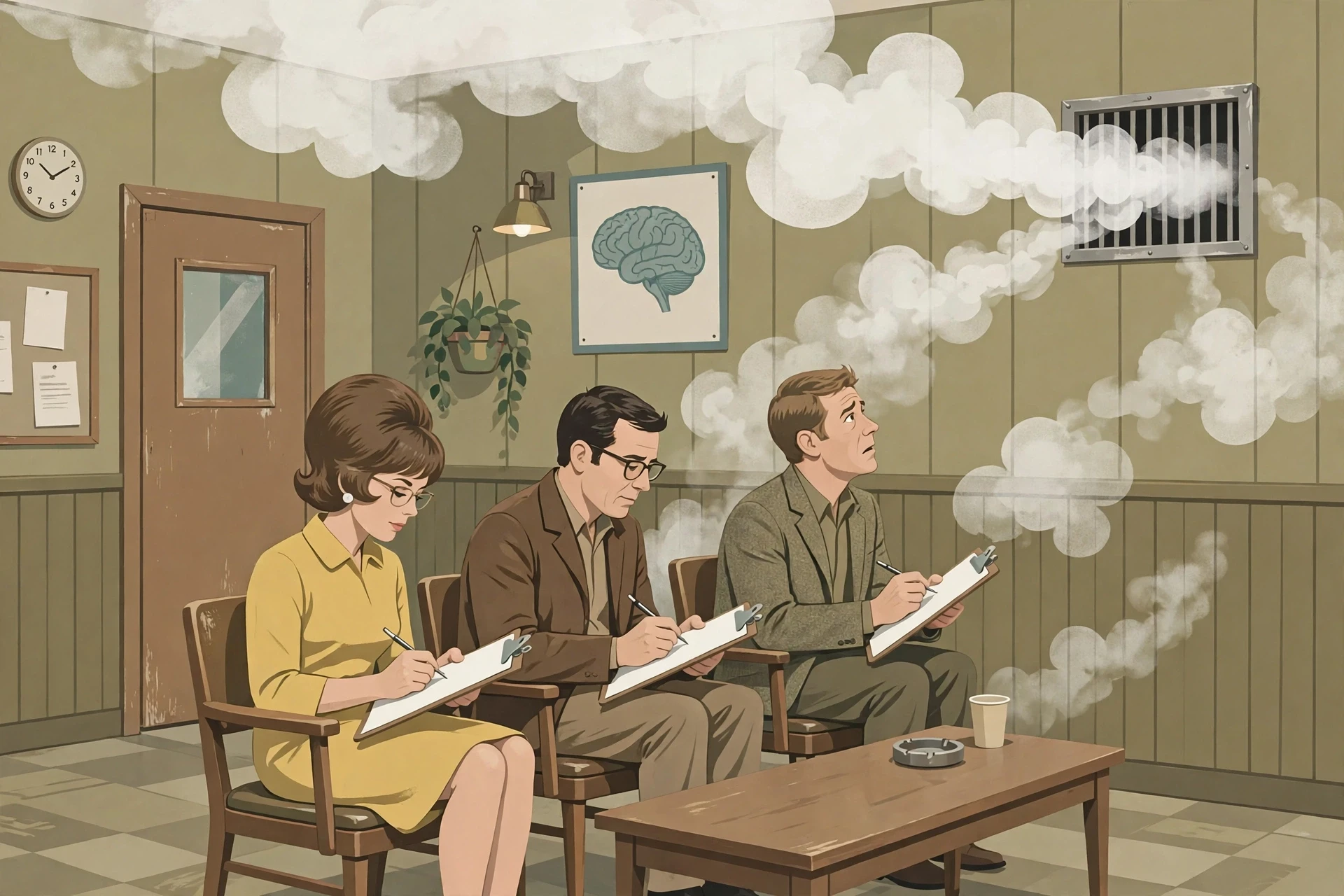
Darley and Latané ran a second experiment that exposed a different trap. This time, participants sat in a waiting room filling in a questionnaire. Some sat alone. Others sat with two other people — who were, without the real participant knowing, actors working for the experimenters. After a few minutes, smoke began pouring into the room from a vent in the wall. It was not dangerous smoke, but it looked alarming, and it kept coming.
Participants sitting alone reacted fast: three-quarters of them left the room to report the smoke within a few minutes. Participants sitting with the two actors, who had been instructed to stay calm, glance at the smoke, shrug, and carry on with their questionnaires, mostly did nothing. Only about one in ten reported the smoke while the actors stayed passive. The participants later said they had decided the smoke was probably not dangerous — because the other people in the room were not reacting. Each person was reading the others' calm as evidence that nothing was wrong, while the others were doing exactly the same thing. Everyone was copying everyone else's inaction, and the copy of a copy looked like certainty.
I have thought about the smoke-filled room more than any other experiment in psychology, because it captures something I recognise in myself. I once sat in a train carriage while a smell of burning grew stronger, and I watched the other passengers. Nobody moved. I told myself it was probably the brakes, or a smell from outside, and I stayed in my seat. It was, in the end, nothing. But the logic I used was exactly the logic of the smoke-filled room: if nobody else is worried, I should not be either. The experiment shows how reasonable that logic feels — and how wrong it can be.
3.3 What fifty years of replications found
Darley and Latané's experiments were not one-off curiosities. In 1981, Latané and Steve Nida reviewed about fifty studies on the bystander effect, and in the great majority of them, people alone helped more than people in groups. Later reviews reached the same conclusion. A meta-analysis by Peter Fischer and colleagues in 2011, which pooled research from the 1960s through 2010, confirmed that the bystander effect is real and reliable in laboratory studies — and it added an important qualification, which we will come to in Section 6: the effect is strongest in ambiguous, non-dangerous emergencies, and it shrinks or even reverses when the emergency is clearly dangerous.
That qualification is worth holding in mind. The bystander effect is not a law that says crowds always fail. It is a pattern with conditions, and understanding the conditions is what lets us predict when it will appear — and when it will not.
4. The Five Steps to Helping — and Where They Break
4.1 A chain with five links
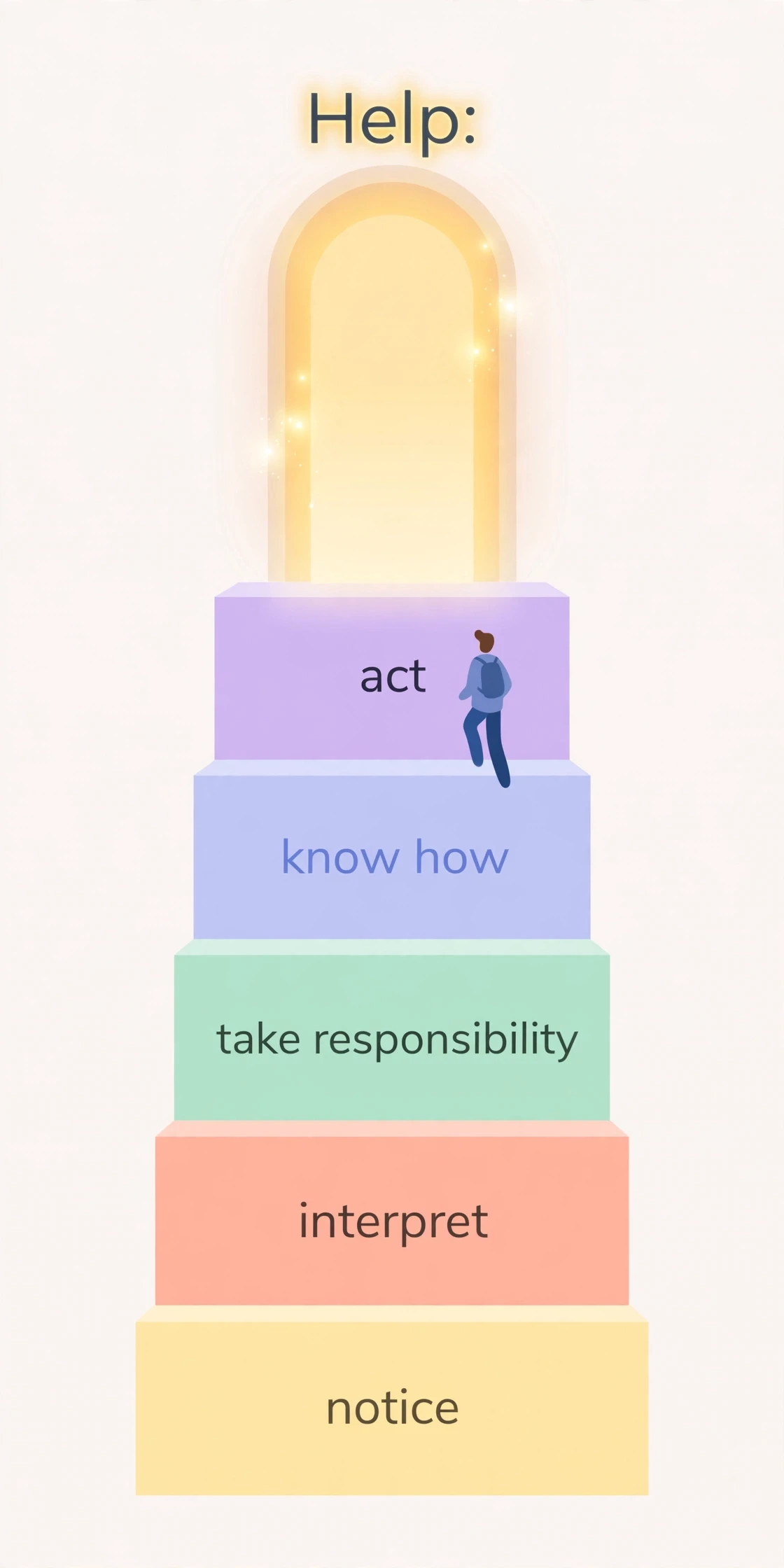
Darley and Latané did not just show that crowds inhibit helping. They built a model of how helping happens at all. According to their model, a bystander must pass through five steps before they act:
Notice the event. You have to see or hear that something is happening. In a busy street, with headphones in and a phone in your hand, step one alone can fail.
Interpret it as an emergency. You have to decide that what you are seeing is a real emergency, not a joke, a performance, or someone's ordinary business.
Feel personally responsible. You have to decide that helping is your job, not someone else's.
Know what to do. You have to have some idea of an appropriate action — call for help, fetch a first-aider, perform CPR, step in safely.
Decide to act. You have to overcome the final hesitation and actually move.
Each step is a point of failure. If any one of them fails, help does not happen. And other people can block almost every step. A crowd makes step one harder, because attention is divided. It makes step two harder, because everyone looks to everyone else for a verdict on what is happening. It makes step three hardest of all, because responsibility is shared. It even makes step five harder, because acting in front of an audience raises the fear of looking foolish.
4.2 Why step two is the quiet killer
Of the five steps, the second — interpreting the event as an emergency — deserves special attention, because it is where most bystander failures actually happen. Real emergencies rarely announce themselves clearly. A person slumped on a bench might be having a stroke, or might be asleep. A couple shouting on the street might be in a dangerous fight, or might be rehearsing a play. A person clutching their chest might be having a heart attack, or might have heartburn. Ambiguity is the norm, not the exception, and ambiguity is exactly what the bystander effect feeds on.
This is why training matters so much. People who have done a first-aid course are not braver than the rest of us. They are better at step two and step four: they recognise the signs of a stroke or a seizure faster, and they know what to do next. Knowledge does not just add skill. It removes ambiguity, and removing ambiguity removes the freeze.
4.3 The freeze response: your body is not betraying you
There is another reason people freeze in emergencies, and it has nothing to do with other people at all. The human stress response is not only fight or flight. There is a third option: freeze. When the brain's threat-detection system — centred on a small almond-shaped structure called the amygdala — detects danger it cannot immediately categorise, it can hit pause on the whole body. Heart rate changes, muscles tense, attention narrows, and for a few seconds you cannot decide what to do. This is not cowardice. It is an ancient survival reflex, and it is the same reflex that makes a deer stand motionless in headlights.
The freeze response explains a lot of what bystanders report afterwards: "I just stood there." "My mind went blank." "I wanted to move but I couldn't." Those are not excuses. They are descriptions of a nervous system doing what it evolved to do — stopping, assessing, waiting for more information — in a situation where stopping is the worst possible move. The good news is that the freeze response can be shortened by preparation. People who have rehearsed what to do — even mentally, even once — tend to move faster, because their brains do not have to build a plan from scratch under stress. The stress hormones involved are the same ones covered in Sciory's guide to high cortisol symptoms, and the brain regions behind the response are covered in our human brain anatomy guide. The same threat system is involved in anxiety more generally, as explained in Sciory's guide to anxiety and depression.
"The freeze response is not cowardice. It is an ancient survival reflex — and like any reflex, it can be shortened by preparation."
5. Why We Freeze: The Three Mechanisms
The five-step model describes the journey from seeing to acting. Underneath it sit three psychological mechanisms that do the actual blocking. They usually operate together, in the same few seconds, and they reinforce each other. Understanding them by name is the first step to recognising them in yourself.
5.1 Diffusion of responsibility: the thinner the slice, the lighter it feels
Diffusion of responsibility is the mechanism we met in Section 1: when other people are present, each person feels less personally responsible for acting. The classic formulation is simple — responsibility is divided by the number of bystanders — and the seizure experiment showed it in action. With one witness, the whole weight fell on one person. With five, each person carried a fifth, and most carried it lightly enough to wait.
Diffusion is strongest when the bystanders are strangers, when nobody has an obvious role, and when nobody is singled out. It is weakest when someone is named — "You in the blue jacket, call an ambulance" — because naming collapses the division back onto one person. That single fact is the most practical insight in this whole article, and we will return to it in Section 8.
5.2 Pluralistic ignorance: everyone is copying everyone else's calm
Pluralistic ignorance is the smoke-filled-room trap. Each person in a group privately feels uncertain or concerned, but because nobody visibly expresses that concern, each person assumes that the others see no cause for alarm. The group's public calm is an illusion built out of private worry. Nobody is lying. Everyone is reading the same misleading evidence: each other's faces.
This mechanism has a close cousin in everyday life. Think of a meeting where the boss proposes something that makes no sense, and nobody objects — not because everyone agrees, but because each person assumes everyone else agrees. Or a classroom where nobody asks a question, because each student assumes the others understood. The bystander effect is the emergency version of a pattern that runs through ordinary social life: we use other people's behaviour as information, and when everyone is doing that at once, the information is empty.
The link to conformity is close — both involve reading the group — but the two are not the same thing. Conformity is about going along with what the group does. Pluralistic ignorance is about misreading what the group thinks. In a bystander emergency, you are not copying the crowd's action. You are copying its inaction, and mistaking that inaction for knowledge.
5.3 Evaluation apprehension: the fear of looking foolish
The third mechanism is the most human and the most embarrassing to admit: the fear of being judged. Evaluation apprehension is the worry that if you act and you are wrong — if the man on the ground is just asleep, if the couple are just rehearsing, if the smoke is just steam — you will look foolish in front of strangers. In an emergency, that fear competes with the fear that someone is dying, and surprisingly often, the fear of embarrassment wins.
This is not vanity. It is a deep social instinct. Human beings are exquisitely sensitive to how they appear to others, because for most of our evolutionary history, being cast out of the group was dangerous. The audience in a bystander emergency is usually made of strangers you will never see again — but your brain does not know that. It treats any audience as a jury. The result is that people hesitate not because they do not care, but because they care too much about the wrong thing, at the wrong moment.
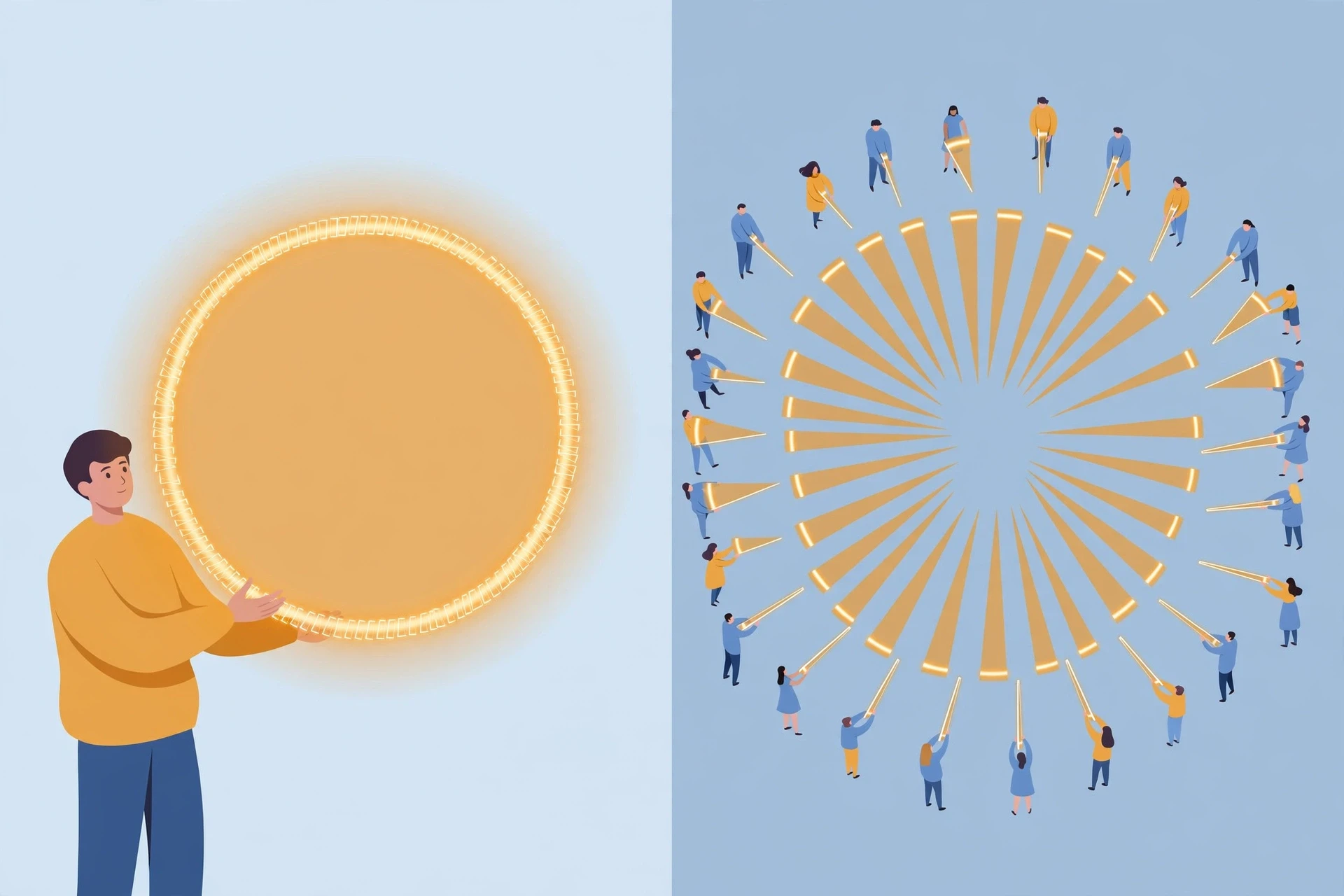
5.4 How the three mechanisms work together
In a real emergency, the three mechanisms rarely act alone. Imagine you see someone collapse on a crowded street. Diffusion tells you someone else will handle it. Pluralistic ignorance tells you it must not be serious, because nobody else is reacting. Evaluation apprehension tells you not to make a scene. Three quiet voices, each reasonable on its own, add up to standing still. That is why the bystander effect is so stubborn: it is not one bias. It is a system of biases that agree with each other.
There is one more factor worth naming, because it shapes who helps and who does not: the relationship between the bystander and the victim. Research consistently finds that people are more likely to help someone they see as similar to themselves, or as part of their own group — and less likely to help someone they see as an outsider. This is uncomfortable to admit, and it is one of the reasons the bystander effect is not only a psychological curiosity but a social problem. It means that the people who most need help — strangers, outsiders, people who look different from the crowd — are the ones least likely to get it quickly. Naming that pattern is the first step to resisting it.
6. When the Crowd Helps: What the Cameras Showed
6.1 The study that changed the story
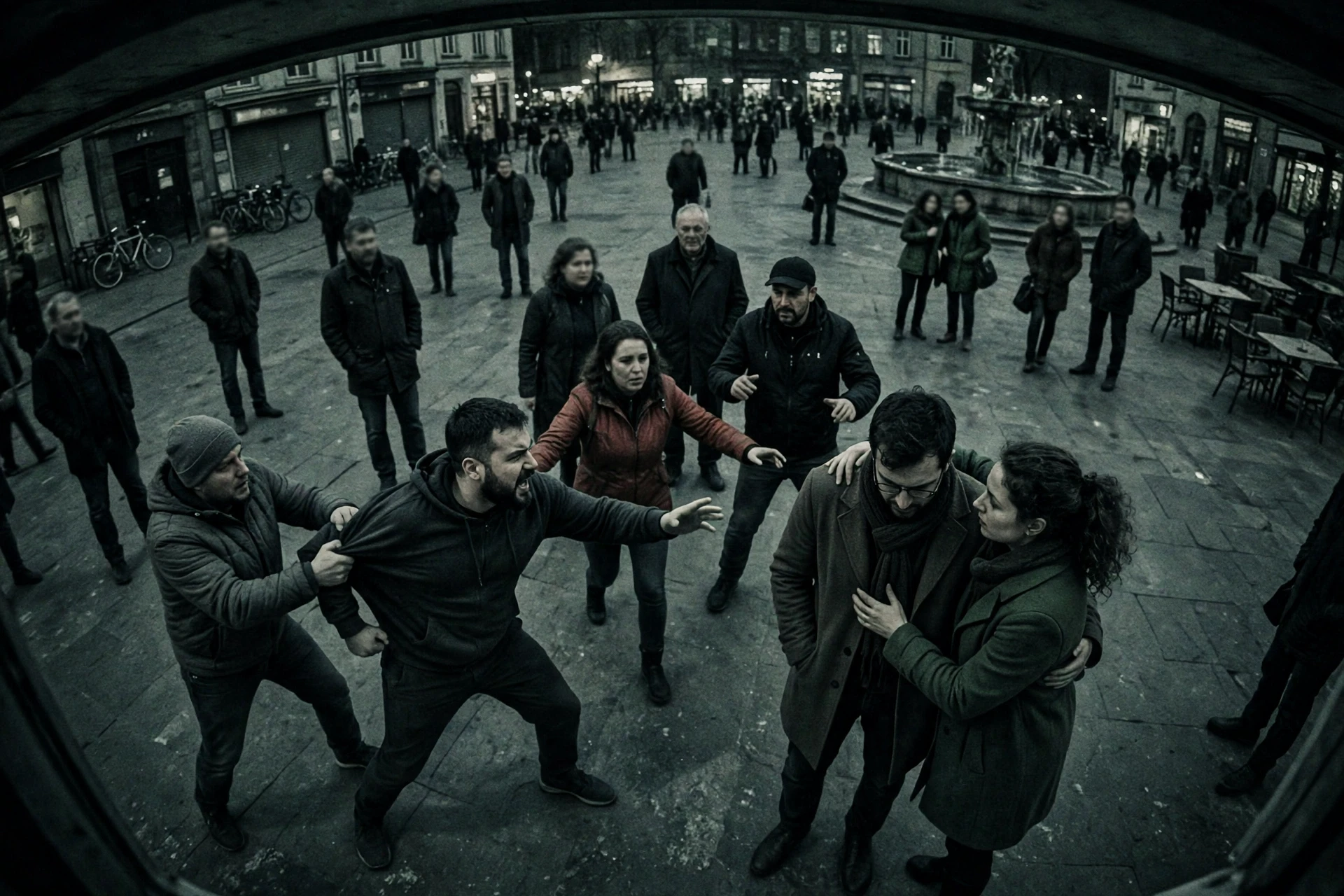
For fifty years, the bystander effect was taught as a simple story: crowds make people less helpful. Then, in 2020, a team led by Richard Philpot at Lancaster University did something the field had rarely done — they looked at what actually happens on real streets, instead of in laboratories. They obtained police and city CCTV recordings of 219 real public conflicts in the entertainment and business districts of Amsterdam, Cape Town, and Lancaster: three cities that differ sharply in how safe their public spaces feel. Trained coders watched every recording and noted every time a bystander did something to help — stepping between the parties, pulling an aggressor away, calming someone with a gesture or a touch, or comforting the victim.
The results, published in American Psychologist, contradicted the popular picture. In 90.9 per cent of the conflicts, at least one bystander intervened — usually several people. The average was 3.76 interveners per incident. The rate held across all three countries. And, most strikingly, a greater number of bystanders present was associated with a greater likelihood that someone stepped in — the reverse of the laboratory pattern. Each additional person present raised the odds that someone would help by about 10 per cent.
6.2 Reconciling the laboratory and the street
How can both findings be true? The laboratory says crowds reduce helping. The cameras say crowds increase it. The answer is that the two kinds of research are asking different questions. The laboratory measures the probability that a given individual acts — and that probability does fall as the group grows. The CCTV study measures the probability that at least one person in the whole group acts — and that probability rises, because a larger group is more likely to contain someone who will move. Both can be true at once. A crowd can make each person less likely to help, while still making it more likely that somebody helps.
The two kinds of research also study different emergencies. Laboratory experiments usually involve ambiguous situations — a seizure heard through a wall, smoke seeping under a door — where the bystander effect is strongest. The CCTV study looked at public conflicts: loud, visible, clearly dangerous situations, where the bystander effect is weakest. Fischer's 2011 meta-analysis found exactly this pattern: when an emergency is clearly dangerous, the bystander effect shrinks and can even reverse, because danger makes the situation unambiguous. Nobody has to wonder whether a fight is an emergency. They can see that it is.
Laboratory experiments (Darley & Latané onwards) | Real-world CCTV (Philpot et al., 2020) | |
|---|---|---|
What was studied | Ambiguous emergencies: seizures heard through a wall, smoke under a door | Visible public conflicts in Amsterdam, Cape Town and Lancaster |
Question asked | Will this particular person help? | Will at least one person in the crowd help? |
Key finding | Each individual is less likely to help as the group grows (85% alone vs 31% with four others) | Someone intervened in 90.9% of incidents; more bystanders meant a greater chance someone did |
Why it differs | Ambiguity lets pluralistic ignorance and diffusion take hold | Clear danger removes ambiguity; a bigger crowd is more likely to contain a helper |
What it teaches us | The effect is real — and it lives in ambiguity | People are far more helpful than the textbook story suggests |
Table 1: The laboratory versus the street — two true findings that answer different questions. The bystander effect is real, and it is also not the whole story about human nature.
6.3 The limits of the good news
The CCTV findings are genuinely encouraging, but they should not be stretched into a claim that crowds always help. The study had limits its authors listed openly: the cameras had no sound, so verbal help was missed; most incidents were in night-time entertainment districts, where drinking is common and where staff such as bouncers may be present; and the definition of helping was broad. Other real-world studies have found lower rates in different settings — in one study of filmed shop robberies, bystanders helped in only about a third of cases. A robbery is a different kind of emergency from a street argument: the danger to the helper is higher, and the ambiguity about what to do is greater.
The honest summary is this: people help far more often than the old story suggested, and the bystander effect is strongest exactly where help is hardest to recognise — in quiet, ambiguous, private emergencies, where nobody is sure anything is wrong. That is where the effect does its damage, and that is where the fixes in the next sections matter most.
6.4 Why this matters for how we see each other
There is a quiet cost to believing the old, exaggerated version of the bystander effect. If you believe that crowds never help, you are less likely to expect help yourself — and less likely to ask for it. You may also be less likely to help, because you assume nobody else will either, so why should you be the fool who tries? A false belief about human nature can become a self-fulfilling prophecy. The corrected picture — people often do help, and the effect is real but conditional — gives you a better reason to act. You are not fighting human nature when you step forward. You are joining the majority of people who, when the situation is clear, do exactly that.
7. How to Overcome the Bystander Effect
Knowing about the bystander effect is not enough. The people in Darley and Latané's experiments did not know they were in an experiment, and most of us will never be warned before a real emergency either. What helps is having a plan before you need one — a set of simple, concrete moves that short-circuit each of the three mechanisms. None of these requires bravery in the heroic sense. They require preparation.
7.1 Name one person
The single most effective trick in the research is also the simplest: point at one specific person and give them one specific job. "You in the blue jacket — call an ambulance." "You — go to the front desk and bring the first-aider." Naming a person collapses diffusion of responsibility in an instant. The named person is no longer one of ten. They are the one. And the act of naming also breaks pluralistic ignorance for everyone else, because it publicly declares that this is an emergency.
I learned this not from a textbook but from a first-aid course I took years ago, where the instructor made us practise it until it felt natural. "Never shout 'somebody call an ambulance' into a crowd," she said. "The crowd will assume somebody else heard you. Point. Name a colour. Give one job." The first time I practised CPR on a dummy in that course, my hands shook. The second time, they shook less. That is the whole point of practice: it moves the plan from something you have to invent under stress to something you have already done.
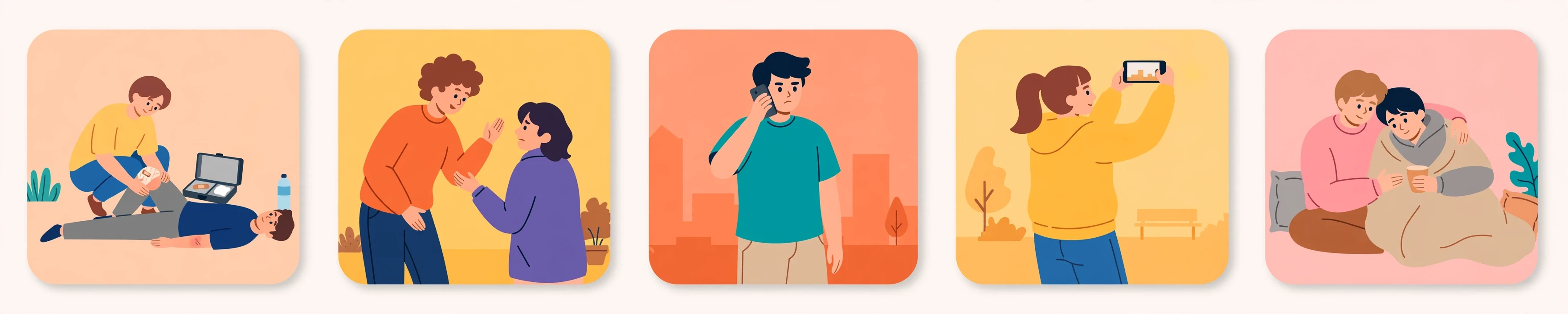
7.2 The 5 Ds: five ways to help, not one
For situations involving harassment or conflict, where direct intervention may be unsafe, the framework developed by the organisation Right to Be (formerly Hollaback!) and the Green Dot programme offers five options — the 5 Ds. The point of having five is that "help" does not have to mean "step into the middle of a fight." It can mean any of these:
Direct: Intervene yourself, calmly and clearly, if it is safe to do so — for example, naming the behaviour: "That is not okay. Leave them alone."
Distract: Interrupt the situation indirectly — ask for directions, start a different conversation, spill your coffee. A distraction gives the person being targeted a moment to get away.
Delegate: Find someone with more authority or better skills — a member of staff, a security guard, a police officer — and tell them what is happening.
Delay: If you cannot act in the moment, check in afterwards. "I saw what happened. Are you okay?" That single sentence can matter enormously to the person who was targeted.
Document: If someone is already intervening, record what is happening — safely, and only with the consent of the person harmed before sharing anything. A record can help if they later decide to report it.
The 5 Ds work because they match the reality of emergencies: sometimes direct action is right, sometimes it is dangerous, and sometimes the best help is the quiet kind that arrives after the danger has passed. Knowing all five in advance means you are never stuck choosing between "do something heroic" and "do nothing."
7.3 Make the emergency visible
Pluralistic ignorance thrives on silence. The antidote is to say out loud what you see. "That man has collapsed — I think he needs help." "That smoke is getting worse." Speaking turns a private worry into public information, and public information changes what everyone else can do. One voice saying "this is an emergency" is often enough to break the spell for the whole group. Research on real emergencies finds that once one person acts, others usually follow quickly — helping, it turns out, is contagious too.
7.4 Decide in advance who you want to be
This is the least technical piece of advice and, in my experience, the most powerful. Before you ever face an emergency, decide — in a quiet moment, with no pressure — that you are the kind of person who moves. Psychologists call this an implementation intention: a simple if-then plan. "If I see someone in trouble, then I will go to them and ask if they need help." "If I see harassment, then I will distract or delegate." People who have made such a plan in advance act faster and more reliably than people who have only a vague intention to "help if I can." The plan does the deciding, so the freeze response has less room to operate.
A friend of mine, a nurse, told me she uses a version of this every time she walks into a crowded place. "I just remind myself: if something happens, I am the one who goes." She has never had to use it in a crowd. But the reminder costs her nothing, and it means she will not have to decide who she is in the three seconds that matter.
7.5 Learn the skills that remove ambiguity
First-aid training, bystander-intervention training, and even a short online course on recognising a stroke or a seizure all do the same thing: they make step two and step four of the five-step model automatic. When you know what a seizure looks like, you do not have to wonder whether the person is having one. When you know how to call for help and what to say, you do not have to improvise under stress. Training does not make you a different person. It makes the emergency a different situation — one you have already met, in a classroom, where the stakes were low.
If you take one practical step from this article, let it be this: book a first-aid course. It takes a day. It is the single most useful thing you can do to make sure that the next time you are the bystander, you are also the helper.
8. Common Misconceptions About the Bystander Effect
8.1 "People in crowds are selfish"
This is the most common misunderstanding, and the research contradicts it. The people who fail to help in laboratory studies are usually distressed about their own inaction afterwards. They are not selfish. They are caught in a situation that divides responsibility, hides information, and raises the social cost of acting. And in real life, as the CCTV footage showed, people intervene in nine out of ten public conflicts. A theory that says "people are selfish" cannot explain that.
8.2 "The 38 witnesses watched Kitty Genovese die"
No. As Section 2 showed, there is no evidence for 38 witnesses, no evidence that witnesses watched the murder, and no evidence that they all stayed inactive. At least two neighbours called the police, one man shouted the attacker off, and a neighbour held Genovese as she died. The murder was real. The parable was not.
8.3 "If I were there, I would definitely help"
Most of us believe this about ourselves, and most of us are wrong — not because we are bad people, but because we are predicting our behaviour in a calm moment, and emergencies do not happen in calm moments. In the seizure experiment, the participants who failed to help had the same confidence beforehand. The honest version of the belief is: "I would want to help, and I should prepare so that I do." Preparation, not confidence, is what predicts action.
8.4 "The bystander effect means nobody ever helps in a crowd"
The effect is about the probability that any one individual helps, not about whether anyone helps. A large crowd can reduce each person's chance of acting while still increasing the chance that at least one person acts — because a large crowd is more likely to contain someone who moves. Both statements are true. Confusing them is how the old, bleak version of the story got told.
8.5 "Only strangers are affected"
The bystander effect is strongest among strangers, but it is not limited to them. Colleagues in a meeting, students in a classroom, family members at a gathering — any group where responsibility is unclear and nobody has a defined role can show the same pattern. That is why the fixes work in offices and schools as well as on streets: name a person, name a job, say what you see out loud.
8.6 "Freezing means you are a coward"
Freezing is a reflex, not a character verdict. The freeze response is the nervous system's way of pausing to gather information, and it happens to trained professionals as well as to bystanders — the difference is that trained people have practised what to do next, so the pause is shorter. If you have frozen in the past, that does not make you a coward. It makes you a person whose nervous system did what nervous systems do. The question is what you do with that knowledge now.
9. Conclusion: Be the Person Who Moves
Let me go back to the platform, to the man who fell and the seconds when nobody moved. What finally broke the stillness was not a hero. It was a woman in a red coat who knelt down and asked a simple question: "Can you hear me?" One person, one action, one sentence — and then the whole crowd came alive. Someone called for help. Someone fetched staff. The man sat up, embarrassed, and thanked us. The rest of the morning, I thought about how little it had taken, and how long it had felt before someone did it.
That is the real lesson of the bystander effect. It is not that people are heartless. It is that help often waits for one person to go first — and that any of us can be that person. The science is clear about what stops us: responsibility divided until it disappears, a crowd's calm mistaken for knowledge, and the fear of looking foolish. And the science is equally clear about what starts us moving again: naming one person, saying what you see out loud, knowing five ways to help instead of one, and deciding in advance who you want to be.
The next time you see someone in trouble, you will feel the three traps closing in. You will feel the thought that someone else will handle it, the glance at the calm faces around you, the small fear of making a scene. Feel them, notice them — and then move anyway. Point at someone. Give them a job. Kneel down and ask if the person can hear you. That is all it takes to change a crowd from a collection of watchers into a group of helpers. And once one person moves, the rest usually follow.
Frequently Asked Questions
What is the bystander effect?
The bystander effect is the finding that an individual is less likely to help a person in need when other people are present. The more witnesses there are, the less personal responsibility each one feels, because responsibility is divided across the group. It was first demonstrated experimentally by John Darley and Bibb Latané in 1968. The effect is strongest in ambiguous emergencies and weakest when the danger is obvious.
Did 38 people really watch Kitty Genovese die and do nothing?
No. That version of the story is largely a myth. A 2007 analysis by Manning, Levine and Collins, working from trial records and police files, found no evidence for 38 witnesses, no evidence that witnesses watched the murder, and no evidence that they all stayed inactive. At least two neighbours called the police, one man shouted the attacker off, and a neighbour held Genovese as she died. In 2016, The New York Times acknowledged that its original report had grossly exaggerated the number of witnesses and what they had perceived.
Why don't people help in emergencies?
People usually fail to help for three reasons, not one: diffusion of responsibility (each person assumes someone else will act), pluralistic ignorance (each person reads the others' calm as proof nothing is wrong), and evaluation apprehension (fear of looking foolish if the situation turns out not to be an emergency). The freeze response — the body's ancient pause under threat — can also stop people in the first few seconds. These are situational traps, not signs of selfishness.
Do people usually help, or usually stand by?
In real life, people help far more often than the textbook story suggests. A 2020 study of CCTV footage of 219 real public conflicts in three countries found that at least one bystander intervened in 90.9 per cent of incidents, usually several people. The laboratory effect is real, but it is strongest in ambiguous emergencies; when danger is clear, the effect shrinks and can reverse. Both findings are true, because they answer different questions.
What is the difference between the bystander effect and conformity?
Conformity is about going along with what a group does — adopting its opinions or behaviour. The bystander effect is about not acting in an emergency because responsibility feels shared and the situation looks ambiguous. They are related — both involve reading the group — but they describe different things. In a bystander emergency you are not copying the crowd's action; you are copying its inaction, and mistaking that inaction for knowledge.
How can I overcome the bystander effect?
Decide in advance that you will act, and give yourself a simple plan: if you see someone in trouble, go to them and ask if they need help. In the moment, name one specific person and give them one specific job ("You in the blue jacket, call an ambulance"), and say out loud what you see ("That man has collapsed"). Learn the 5 Ds — direct, distract, delegate, delay, document — so you have options beyond stepping into danger. And take a first-aid course: training removes the ambiguity that makes people freeze.
Is the bystander effect real, or has it been debunked?
The bystander effect is real. Dozens of laboratory experiments, and meta-analyses pooling them, confirm that individuals are less likely to help when others are present, especially in ambiguous emergencies. What has been debunked is the founding story — the "38 witnesses" version of the Kitty Genovese murder — and the exaggerated claim that crowds never help. The modern picture is more nuanced: the effect is real, it is conditional, and in clear, dangerous emergencies, people usually do step in.
Sources
American Psychological Association — Bystander effect (APA Dictionary of Psychology). https://dictionary.apa.org/bystander-effect
Darley, J. M., & Latané, B. (1968). Bystander intervention in emergencies: Diffusion of responsibility. Journal of Personality and Social Psychology, 8(4), 377–383. https://doi.org/10.1037/h0025589
Manning, R., Levine, M., & Collins, A. (2007). The Kitty Genovese murder and the social psychology of helping: The parable of the 38 witnesses. American Psychologist, 62(6), 555–562. https://doi.org/10.1037/0003-066X.62.6.555
Philpot, R., Liebst, L. S., Levine, M., Bernasco, W., & Lindegaard, M. R. (2020). Would I be helped? Cross-national CCTV footage shows that intervention is the norm in public conflicts. American Psychologist, 75(1), 66–75. https://doi.org/10.1037/amp0000469
Fischer, P., Krueger, J. I., Greitemeyer, T., Vogrincic, C., Kastenmüller, A., Frey, D., Heene, M., Wicher, M., & Kainbacher, M. (2011). The bystander-effect: A meta-analytic review on bystander intervention in dangerous and non-dangerous emergencies. Psychological Bulletin, 137(4), 517–537. https://doi.org/10.1037/a0023304
Simply Psychology — Bystander Effect. https://www.simplypsychology.org/bystander-effect.html
Right to Be — The 5Ds of Bystander Intervention. https://righttobe.org/guides/bystander-intervention-training/
University of Colorado Denver — Ethical Bystander Intervention. https://www.ucdenver.edu/offices/equity/education-training/resource-guides/ethical-bystander-intervention